Ford Escape Brake Caliper Sticking: Causes, Signs & Fixes
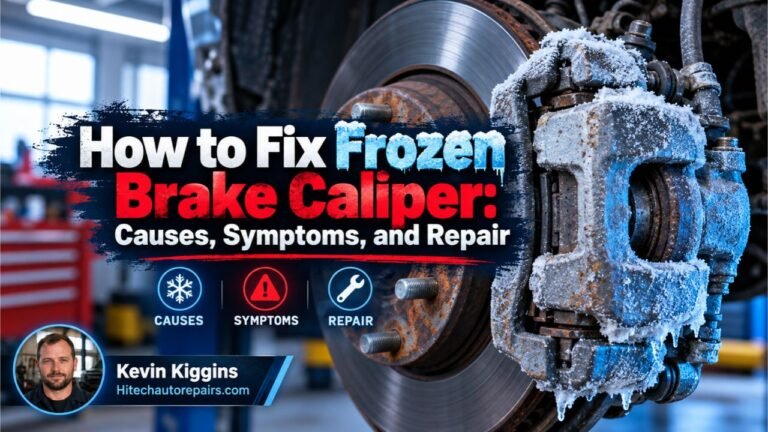
A Ford Escape brake caliper that keeps sticking is commonly caused by seized slide pins, a corroded caliper piston, restricted brake hose, binding brake pads, or a parking-brake problem.
A sticking brake caliper can make a Ford Escape feel unusually sluggish, pull toward one side, wear out a brake pad much faster than normal, or produce a hot-wheel or burning smell after driving. Because a dragging brake continually presses a pad against the rotor, the problem can generate substantial heat and eventually damage the pads, rotor, caliper, and nearby components.
Diagnosing Ford Escape brake caliper sticking correctly matters because the caliper itself is not always the actual cause. A flexible brake hose can deteriorate internally and hold hydraulic pressure at the wheel even after you release the brake pedal. The caliper slide pins can also seize from corrosion or dried lubricant, preventing a floating caliper from moving freely.
Rear-brake diagnosis can be different from front-brake diagnosis as well. Depending on the Ford Escape model year and brake configuration, the rear brakes may incorporate a mechanical or electronic parking brake, which introduces additional components that can cause brake drag.
The following guide explains the common causes, symptoms, diagnostic clues, repair options, and safety considerations so you can determine why an Escape brake is sticking instead of immediately replacing parts.
What Causes Ford Escape Brake Caliper Sticking?
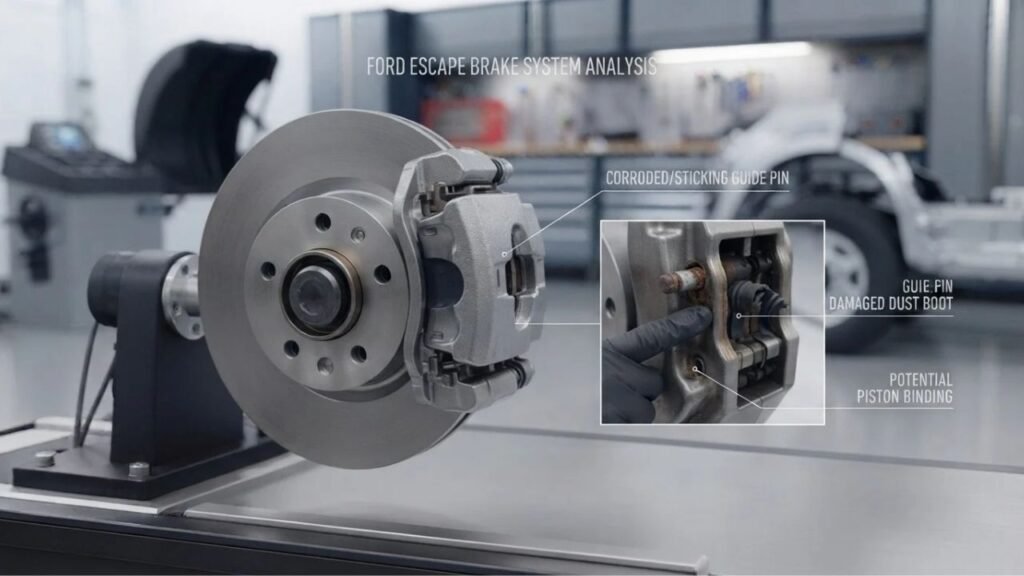
A Ford Escape brake caliper sticking usually means one brake remains partially applied after the driver releases the brake pedal.
The most common causes include:
- Seized or corroded caliper slide pins
- Sticking caliper piston
- Internally restricted flexible brake hose
- Brake pads binding in the caliper bracket
- Rust beneath pad hardware
- Damaged piston dust boot
- Parking-brake mechanism that does not release completely
- Electronic parking-brake fault on equipped models
- Less commonly, retained hydraulic pressure elsewhere in the brake system
The correct repair depends on identifying which component is preventing the brake from releasing.
Symptoms of a Sticking Brake Caliper on a Ford Escape
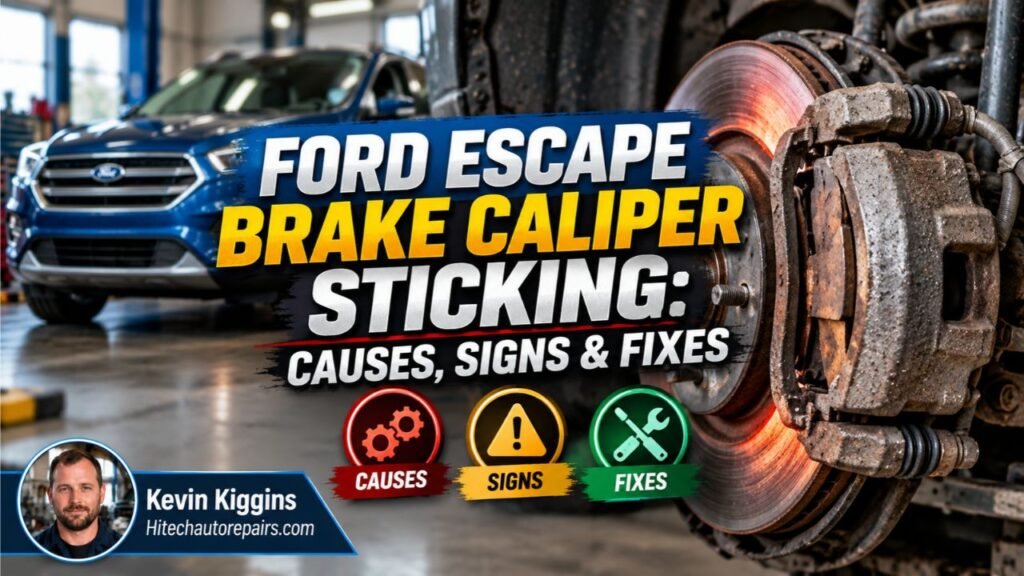
A sticking caliper often produces several symptoms at the same time.
The Escape Pulls to One Side
A brake that remains partially applied creates additional resistance at one wheel.
The vehicle may pull toward the affected side while driving.
However, pulling during braking can have several possible causes, so this symptom alone does not prove the caliper is sticking.
One Wheel Gets Much Hotter Than the Others
Excessive wheel temperature is one of the strongest clues.
A dragging brake converts energy into heat continuously.
After driving, the affected wheel may be noticeably hotter than the wheel on the opposite side.
Do not immediately touch a suspected hot rotor or caliper. Brake components can become hot enough to cause burns.
Burning Smell From One Wheel
A severely dragging brake can produce a strong hot or burning odor.
The smell may come from overheated:
- Brake pads
- Rotor
- Caliper
- Grease
- Nearby components
If a wheel becomes extremely hot or you see smoke, stop driving and have the brake inspected.
Uneven Brake Pad Wear
A sticking caliper can cause one pad to wear significantly faster than another.
For example:
- Inner pad much thinner than outer pad
- Outer pad much thinner than inner pad
- One wheel’s pads much more worn than the opposite wheel
The wear pattern can provide clues about whether the problem involves the piston, slide pins, or pad movement.
Reduced Fuel Economy
Even mild brake drag creates additional rolling resistance.
The engine must work harder to move the vehicle, which can reduce fuel economy.
Vehicle Feels Slow or Heavy
Some drivers describe the Escape as feeling as though it is:
- Towing extra weight
- Struggling to accelerate
- Slowing unusually quickly after releasing the accelerator
Severe brake drag can create this feeling.
Brake Dust on One Wheel
A continuously rubbing pad can produce more brake dust.
One wheel may become noticeably dirtier than the wheel on the opposite side.
Squealing or Grinding
A sticking caliper can keep the pad in contact with the rotor and accelerate wear.
Eventually you may hear:
- Squealing
- Scraping
- Grinding
Grinding can indicate that the friction material has worn away enough for metal components to contact the rotor.
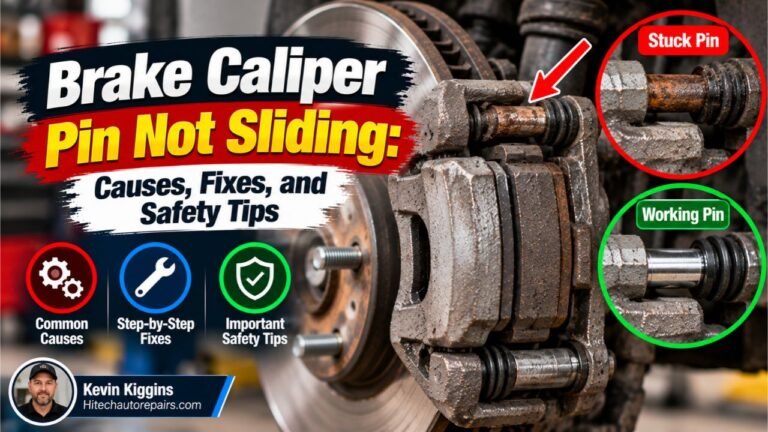
Stuck Caliper Slide Pins on a Ford Escape
Many Ford Escape brake configurations use floating calipers.
A floating caliper must move smoothly on its guide or slide pins.
When you press the brake pedal, the piston pushes one brake pad against the rotor while movement of the caliper body brings the opposite pad into contact.
If a slide pin seizes, the caliper cannot center or release correctly.
Why Slide Pins Stick
Common causes include:
- Corrosion
- Torn slide-pin boots
- Water intrusion
- Old or dried lubricant
- Incorrect lubricant
- Dirt contamination
A pin may appear acceptable externally but be heavily corroded inside its bore.
Signs of a Stuck Slide Pin
Possible signs include:
- Uneven inner and outer pad wear
- One pad remaining against the rotor
- Difficulty moving the caliper by hand during service
- Rusted or dry guide pins
- Damaged rubber boots
If the pins are only dirty and lightly corroded, proper cleaning and lubrication may restore movement.
Badly pitted or seized pins, damaged brackets, or deteriorated boots may require replacement components.
Sticking Ford Escape Caliper Piston
The caliper piston pushes the pad toward the rotor when hydraulic pressure enters the caliper.
When brake pressure is released, the piston should relax enough to allow the pads to stop applying significant braking force.
A corroded or damaged piston can remain extended.
Why a Caliper Piston Sticks
Possible causes include:
- Moisture contamination in brake fluid
- Internal corrosion
- Torn piston dust boot
- Damaged piston surface
- Damaged internal seal
- Long-term exposure to road salt and moisture
A torn dust boot can allow water and dirt to reach the piston surface, eventually causing corrosion.
How a Sticking Piston Affects Pad Wear
A sticking piston often keeps the inboard brake pad pressed against the rotor.
That pad may wear faster than the outer pad.
However, wear patterns are not absolute proof. The complete caliper, bracket, pad fit, and slide system should be inspected.
Can a Bad Brake Hose Make the Caliper Seem Stuck?
Yes.
This is an important possibility because replacing the caliper alone may not solve the problem.
A flexible brake hose can deteriorate internally while still looking relatively normal from the outside.
The damaged inner lining can sometimes act like a one-way restriction.
Brake-pedal pressure forces fluid toward the caliper, but the fluid cannot return freely when the pedal is released.
Hydraulic pressure remains trapped, keeping the brake applied.
Clues That the Brake Hose May Be the Problem
A restricted hose should be considered when:
- The caliper remains clamped after releasing the pedal
- A replacement caliper develops the same problem
- Slide pins move freely
- The piston can be compressed after hydraulic pressure is released
- One wheel repeatedly overheats
A brake hose can also develop external cracking, bulging, leaks, or other visible deterioration and should be inspected carefully.
How Mechanics Separate a Bad Caliper From a Bad Brake Hose
A common diagnostic principle is determining whether the brake is mechanically stuck or being held by hydraulic pressure.
If a wheel is dragging, a technician may check whether releasing pressure at the caliper allows the brake to release.
If opening the hydraulic system immediately releases the brake, trapped pressure becomes a strong suspect.
Possible causes then include:
- Restricted flexible hose
- Hydraulic-control issue
- Master-cylinder-related problem
- Less commonly, ABS/HCU pressure retention
If releasing hydraulic pressure does not free the brake, the problem is more likely mechanical, such as:
- Seized piston
- Seized slide pin
- Binding brake pads
- Parking-brake mechanism
Because opening the hydraulic system requires correct bleeding afterward, this diagnosis is best left to someone familiar with brake repair.
Brake Pads Can Stick in the Caliper Bracket
The caliper piston and slide pins may work correctly while the brake pads themselves bind in the bracket.
Rust can form beneath the stainless pad clips or on the bracket surfaces.
As corrosion builds, it reduces the space available for the brake pad ears.
The pads then become difficult to move.
Signs of Binding Brake Pads
You may notice:
- Pads difficult to remove from the bracket
- Uneven pad wear
- Pads that cannot slide freely
- Heavy rust beneath hardware
- Heat despite apparently functional slide pins
During a brake service, the bracket surfaces should be properly cleaned and compatible hardware installed according to the brake manufacturer’s requirements.
Do not grind excessive material from brake pads or brackets just to force parts to fit.
Rear Ford Escape Brake Caliper Sticking
Rear brake problems require special attention because the parking brake operates through the rear braking system.
Depending on model year and configuration, the Ford Escape may use different parking-brake designs.
Possible rear-brake causes include:
- Sticking rear piston
- Seized slide pins
- Pad binding
- Parking-brake mechanism not fully releasing
- Parking-brake cable problem on applicable designs
- Electronic parking-brake actuator problem on equipped models
If both rear brakes behave abnormally, the parking-brake system deserves particular attention.
Electronic Parking Brake and Rear Caliper Problems
Newer Escape models may use an electronic parking brake (EPB).
An electric actuator controls the parking-brake function instead of a conventional hand lever or foot-operated cable arrangement.
Symptoms of an EPB-related problem can include:
- Rear brake remaining applied
- Parking-brake warning
- Difficulty retracting the rear piston
- Parking brake failing to release
- Rear brake overheating
Rear brake service procedures can differ significantly between model years.
Some Ford systems require the brake or electronic parking-brake system to be placed into a specific service or maintenance mode before rear brake components are serviced.
Do not force an electronically controlled rear piston back into the caliper without first checking the correct procedure for that exact model year.
How to Check for a Sticking Ford Escape Brake
Some basic observations can help narrow the problem.
Compare Wheel Temperature
After a short normal drive, one wheel that is dramatically hotter than the others can indicate brake drag.
For greater safety and accuracy, a non-contact infrared thermometer can be useful.
Compare wheels on the same axle under similar conditions.
Small differences can be normal. A very large temperature difference deserves inspection.
Lift and Rotate the Wheel
When the vehicle is safely raised and supported according to Ford’s lifting instructions, rotate the suspected wheel by hand.
Some light pad contact can be normal.
A wheel that is extremely difficult to rotate may have significant brake drag.
Remember that drivetrain resistance can affect how easily driven wheels turn, so compare similar wheels whenever possible.
Inspect Pad Thickness
Compare:
- Inner vs. outer pad on the same caliper
- Left vs. right side of the axle
Large differences can identify abnormal caliper operation.
Inspect the Slide Pins
If brake disassembly is being performed, confirm that each guide pin moves smoothly and is free from severe corrosion.
Check the rubber boots for damage.
Inspect the Flexible Hose
Look for:
- Cracks
- Bulges
- Twisting
- Fluid leakage
- Abrasion
A hose can still be internally restricted even when the outside looks acceptable.
Ford Escape Brake Caliper Sticking After Replacement
If a new or remanufactured caliper begins sticking soon after installation, do not automatically assume the replacement caliper has failed.
Check other causes, especially:
Brake Hose Restriction
A restricted hose can make even a new caliper stay applied.
Slide Pin or Bracket Problems
Some replacement calipers include different combinations of parts.
If the original bracket or slide pins remain in service, the sticking component may never have been replaced.
Binding Pads
New pads can bind if bracket corrosion was not properly removed.
Incorrect Installation
Possible issues include:
- Twisted brake hose
- Incorrect hardware
- Improperly installed pads
- Wrong caliper
- Incorrect lubrication
Remaining Hydraulic Pressure
If the mechanical components move correctly, hydraulic pressure may be preventing release.
Further diagnosis may be necessary.
Ford Escape Caliper Sticking After Driving
A brake that behaves normally when cold but begins dragging after several miles can point toward a heat- or pressure-related problem.
Possible causes include:
- Brake hose restriction
- Piston binding as components heat
- Insufficient brake pad clearance
- Parking-brake problem
- Hydraulic pressure not releasing
As the brake drags, heat increases. Increased heat can make the problem progressively worse.
This is why a vehicle that drives normally at first can begin feeling sluggish later in the trip.
Can You Lubricate a Sticking Brake Caliper?
It depends on what is sticking.
Lubrication may help caliper slide pins if they are otherwise serviceable.
Use only a lubricant designed for the specific brake components and compatible with rubber boots.
Do not apply lubricant to:
- Rotor friction surfaces
- Brake pad friction material
- Caliper piston friction surfaces
- Any surface where grease could contaminate the braking area
A seized hydraulic piston is not normally repaired by spraying lubricant around the exterior.
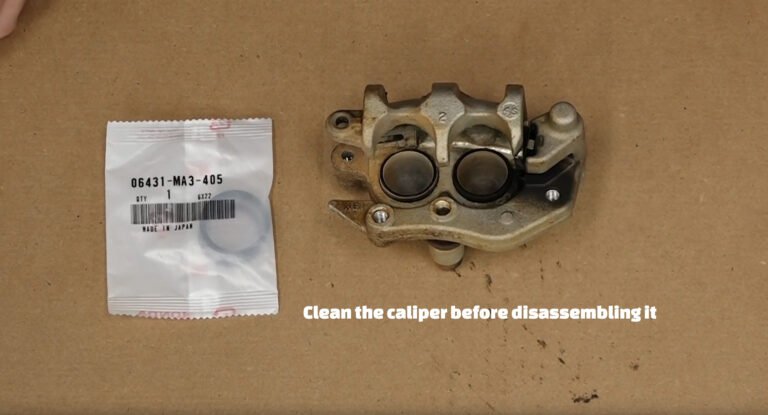
If the piston is corroded or internally damaged, the caliper may require rebuilding or replacement.
Should You Rebuild or Replace a Sticking Caliper?
Replacement is often the more straightforward option on a daily-driven vehicle.
A rebuild may be reasonable if:
- The caliper body is in good condition
- Correct seals and piston are available
- The bore is serviceable
- The person performing the work understands hydraulic brake rebuilding
Replacement may be preferable when:
- Piston is badly corroded
- Bleeder screw is seized
- Caliper body is heavily corroded
- Dust boot is badly damaged
- Caliper repeatedly sticks
- Rebuilding is not economical
A new caliper still will not fix a restricted hose or binding bracket, so complete diagnosis should come first.
Do You Need to Replace Both Calipers?
Not automatically.
If only one caliper is defective, replacing that caliper can be sufficient when the caliper on the opposite side is in good condition.
However, inspect both sides because they have experienced similar age and operating conditions.
Brake pads and rotors are normally serviced as axle pairs to maintain consistent braking characteristics.
If one overheated brake has damaged its pad or rotor, the corresponding brake components on both sides of that axle may need servicing to maintain balanced braking.
Can a Sticking Caliper Damage the Rotor?
Yes.
Continuous friction creates excessive heat.
A dragging caliper can cause:
- Rapid pad wear
- Rotor discoloration
- Heat checking
- Surface damage
- Uneven deposits
- Reduced brake performance
Severe overheating can affect more than the rotor.
Nearby wheel-bearing components, seals, and brake fluid can also be exposed to unnecessary heat.
After repairing the sticking problem, inspect the rest of the brake assembly rather than simply replacing the caliper.
Is It Safe to Drive a Ford Escape With a Sticking Caliper?
Driving with a confirmed sticking caliper is not recommended.
A lightly dragging brake may quickly become much hotter during highway driving or repeated braking.
Possible consequences include:
- Reduced braking consistency
- Vehicle pulling
- Accelerated pad and rotor wear
- Brake fade from excessive heat
- Tire or wheel-area overheating
- Increased fuel consumption
If the wheel is extremely hot, the vehicle pulls strongly, braking feels abnormal, you smell burning material, or smoke appears, stop driving and arrange professional inspection or towing.
How Much Does It Cost to Fix a Sticking Ford Escape Caliper?
The total repair cost depends on what is actually wrong.
A sticking brake does not always require a complete caliper replacement.
Possible repairs include:
- Cleaning and servicing slide pins
- Replacing slide-pin hardware or boots
- Replacing brake pads
- Replacing a brake hose
- Replacing a caliper
- Replacing pads and rotors damaged by overheating
- Repairing a parking-brake system
- Diagnosing an electronic or hydraulic control problem
Labor rates and parts prices vary significantly across the United States, so obtaining a vehicle-specific estimate is more useful than relying on a single nationwide price.
How to Prevent Caliper Sticking
You cannot prevent every caliper failure, but routine brake inspection can reduce the chance of severe problems.
Helpful practices include:
- Inspect brakes when tires are rotated
- Check pad wear on both sides
- Inspect caliper boots for tears
- Service guide pins correctly during brake work
- Use the proper brake lubricant
- Replace damaged slide-pin boots
- Inspect flexible hoses
- Address brake-fluid leaks promptly
- Follow Ford’s recommended brake-fluid maintenance guidance
- Repair parking-brake problems when they appear
Vehicles driven where road salt is heavily used may require extra attention to caliper brackets and sliding components because corrosion develops more quickly.
Common Diagnostic Mistakes
Replacing the Caliper Without Checking the Hose
If the hose is trapping pressure, the replacement caliper can begin dragging immediately.
Lubricating the Pins Without Removing Corrosion
Adding fresh grease over heavily corroded parts does not restore proper fit or movement.
Ignoring the Brake Pad Bracket
Rust under the pad clips can create enough pressure to make otherwise good pads bind.
Assuming Every Hot Wheel Means a Bad Caliper
Wheel-bearing problems, parking-brake issues, and other faults can also create heat.
The brake assembly should be diagnosed rather than replacing parts based on temperature alone.
Ignoring Rear Parking-Brake Electronics
On EPB-equipped Escapes, rear brake behavior can involve both mechanical and electronic components.
FAQs About Ford Escape Brake Caliper Sticking
Why Does My Ford Escape Caliper Keep Sticking?
Repeated sticking can be caused by a problem outside the caliper, particularly a restricted flexible brake hose, corroded slide pins, binding brake pads, or a parking-brake mechanism that does not fully release.
If a replacement caliper develops the same problem, investigate these components before replacing another caliper.
How Can I Tell if My Ford Escape Caliper or Brake Hose Is Bad?
If the brake is dragging because hydraulic pressure remains trapped, releasing that pressure can allow the wheel to free up. That can indicate a hose or upstream hydraulic issue.
If the brake remains mechanically stuck even without retained hydraulic pressure, the caliper piston, slide pins, pads, or parking-brake mechanism becomes more likely.
Opening a hydraulic brake system requires proper service and bleeding afterward.
Why Is One Ford Escape Wheel Much Hotter Than the Others?
A dragging brake is a common reason.
The pad may remain against the rotor because of a sticking piston, slide pin, brake hose, pad, or parking-brake mechanism.
A wheel that becomes extremely hot should be inspected promptly.
Can Sticking Caliper Pins Cause Uneven Pad Wear?
Yes.
If a floating caliper cannot slide properly, one brake pad may remain more heavily loaded against the rotor.
This often creates a noticeable difference between inner and outer pad thickness.
Can a Bad Ford Escape Brake Hose Lock the Caliper?
Yes.
An internally damaged flexible hose can restrict brake-fluid return and retain hydraulic pressure at the caliper.
The brake can then remain partially or fully applied after the pedal is released.
Why Is My Ford Escape Rear Brake Sticking?
Possible causes include a seized rear caliper piston, sticking guide pins, binding pads, restricted brake hose, or a parking-brake problem.
On models equipped with an electronic parking brake, the EPB actuator and required service procedures should also be considered.
Can I Drive a Few Miles With a Sticking Brake Caliper?
It is safer not to drive a vehicle with a confirmed dragging brake.
The amount of heat can increase quickly and damage the pads, rotor, and surrounding components.
If the brake is severely dragging, the safest choice is professional inspection or towing.
Should I Replace the Rotor After a Caliper Has Been Sticking?
Not always, but the rotor must be inspected.
Replacement may be necessary if overheating has caused excessive wear, cracking, severe discoloration, dimensional problems, or other damage.
Pads exposed to significant overheating should also be evaluated.
Conclusion
A Ford Escape brake caliper sticking problem should be diagnosed before parts are replaced because the caliper itself is only one possible cause. Seized slide pins, a corroded piston, binding pads, a restricted flexible brake hose, and parking-brake faults can all keep a brake from releasing properly.
A hot wheel, burning smell, pulling, rapid pad wear, and excessive brake dust are common warning signs. Comparing pad wear, inspecting the slide pins and hose, and determining whether the brake is mechanically stuck or being held by hydraulic pressure can narrow down the cause.
Because a dragging brake can generate extreme heat and reduce braking reliability, do not continue driving an Escape that has a severely sticking caliper. Correct diagnosis and repair of the underlying problem are much safer—and usually less expensive—than repeatedly replacing overheated brake parts.