Do Rear Brakes Have Calipers: Key Facts and Helpful Explanations
When a vehicle is raised for a brake inspection, the rear wheels may reveal either a caliper gripping a rotor or a round brake drum with no visible caliper. Do rear brakes have calipers? Sometimes they do, but the answer depends on the vehicle’s rear brake design.
Most modern cars use rear disc brakes with calipers, while some cars, trucks, and older vehicles use rear drum brakes instead. Identifying which system is installed explains how the rear brakes work, what parts may need service, and why the rear setup may look different from the front.
Do rear brakes have calipers?
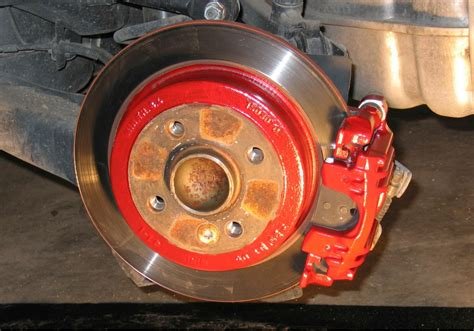
Rear brakes have calipers when the vehicle uses a rear disc brake system. In this design, a flat brake rotor rotates with the wheel, and the caliper sits over the rotor’s edge. Brake pads inside the caliper press against both sides of the rotor when the driver applies the brake pedal.
Rear brakes do not have calipers when the vehicle uses drum brakes. A brake drum is a round, enclosed component that rotates with the wheel. Inside it, curved brake shoes press outward against the drum’s inner surface to create friction.
Therefore, the most accurate short answer is: rear disc brakes have calipers; rear drum brakes generally do not. The vehicle’s make, model, year, trim level, and rear braking package determine which arrangement it has.
How a rear brake caliper works
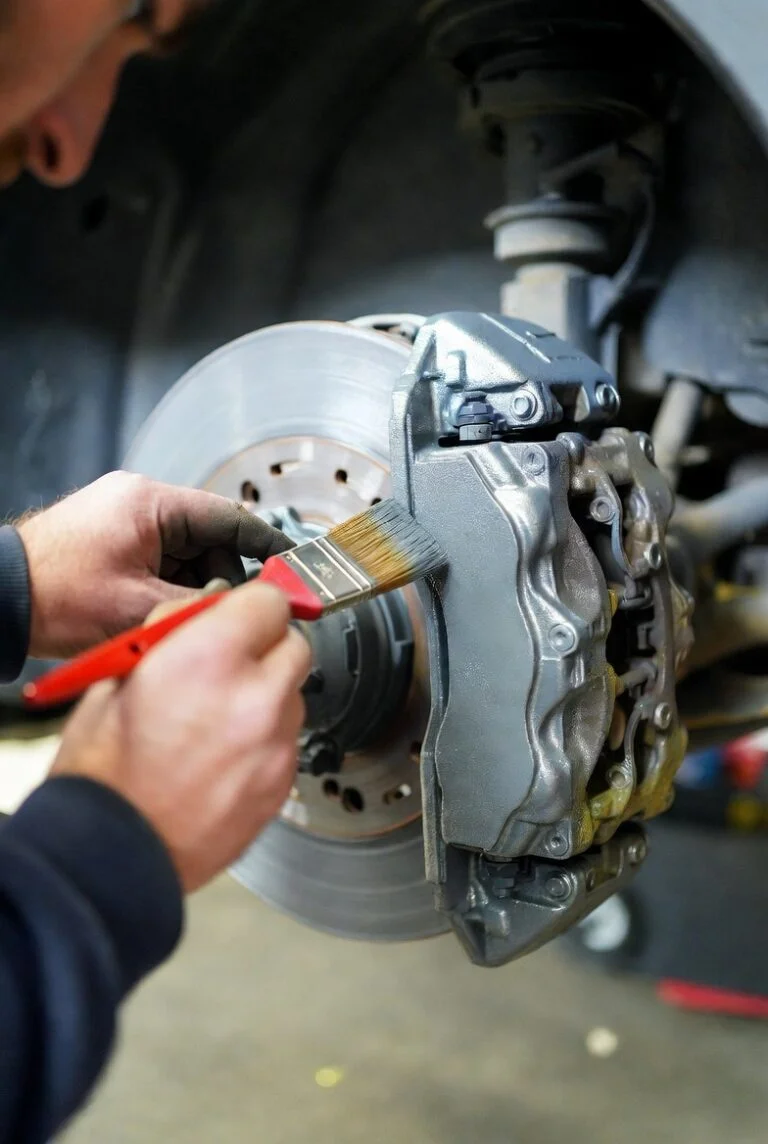
A rear brake caliper is a housing that applies pressure to the brake pads. When the driver presses the brake pedal, hydraulic pressure travels through the brake lines to a piston inside the caliper. The piston pushes one pad toward the rotor, while the caliper’s design brings the opposite pad against the other side.
The resulting friction slows the rotor and the wheel attached to it. Because the rotor turns with the wheel, reducing rotor speed reduces vehicle speed.
Rear calipers are usually smaller than front calipers because the front brakes typically perform more of the vehicle’s stopping work. During braking, the vehicle’s weight shifts forward, increasing the front tires’ grip and allowing the front brakes to handle a larger share of the force. Rear brakes still remain essential for controlled stopping, stability, and the operation of the parking brake.
A rear caliper may include a mechanical or electronic parking-brake mechanism. On some vehicles, the parking-brake cable operates a lever on the caliper. On others, an electronic parking brake uses a motor mounted on or built into the caliper. This additional mechanism can make rear caliper service different from front brake service.
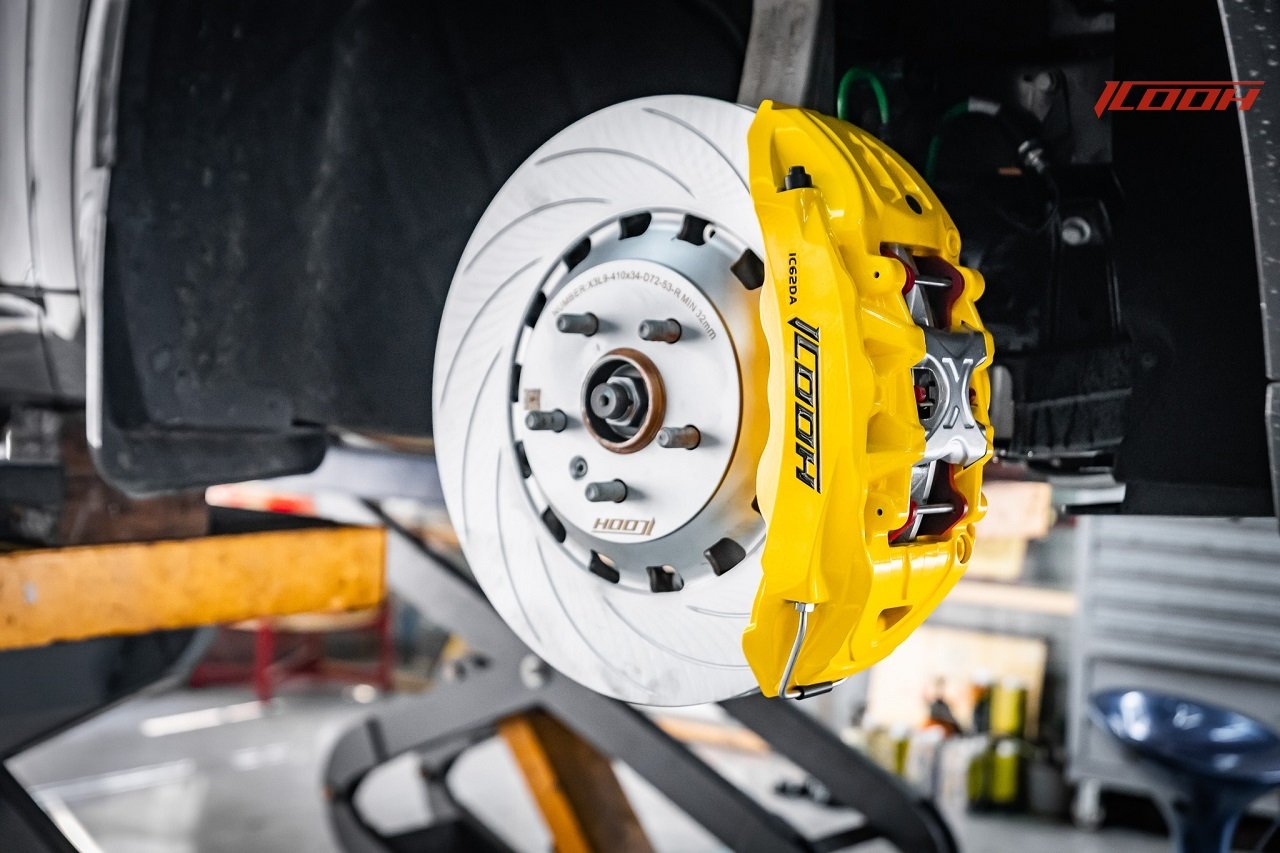
Rear disc brakes versus rear drum brakes
Rear disc brakes
A rear disc system normally includes:
- A brake rotor attached to or positioned with the wheel hub
- A caliper mounted near the rotor
- Inner and outer brake pads
- A caliper piston and seals
- A parking-brake mechanism, depending on the vehicle
Disc brakes expose more of the friction area to air, which can help heat escape. Their pad and rotor condition is also generally easy to view through the wheel, although a complete inspection still requires checking thickness, wear patterns, hardware, and caliper movement.
Rear drum brakes
A rear drum system normally includes:
- A brake drum rotating with the wheel
- Brake shoes inside the drum
- Wheel cylinders that push the shoes outward
- Return springs and hold-down hardware
- A parking-brake lever or cable mechanism
The wheel cylinder performs the pressure-applying function in a drum system, but it is not a caliper. It uses pistons to push the brake shoes against the inside of the drum rather than squeezing pads around a rotor.
Drum brakes are enclosed, so their friction material and hardware are not as visible from outside the wheel. The drum normally must be removed for a detailed inspection. Some vehicles combine rear disc brakes with a small drum-style parking brake located inside a “drum-in-hat” section of the rear rotor. In that arrangement, the service brake uses a caliper and pads, while the parking brake uses separate shoes inside the rotor hat.
Why some vehicles use rear calipers
Automakers select rear disc or drum brakes according to braking requirements, vehicle size, cost, packaging, maintenance goals, and parking-brake design. Rear disc brakes provide a familiar pad-and-rotor arrangement and can offer consistent performance under repeated braking.
Rear drum brakes remain practical for some vehicles because the drum can provide a strong mechanical parking-brake function and may be economical to manufacture. Their enclosed design also protects internal components from some outside exposure. Neither the presence nor absence of a rear caliper alone determines whether a vehicle is safe or properly equipped.
Some vehicles use different rear brake designs within the same model line. A base trim may have rear drums, while a higher trim, performance package, or larger towing package may use rear discs. Looking up a vehicle by its exact year, trim, and braking package is more reliable than assuming every version uses the same parts.
How to tell whether a vehicle has rear calipers
The simplest visual check is to look through the opening in a rear wheel. A rear disc brake usually shows a flat, shiny rotor and a caliper mounted around part of its outer edge. The caliper often looks like a thick metal housing covering the rotor from one side.
A rear drum brake usually shows a large, solid, rounded drum behind the wheel. There is no caliper wrapped around a visible rotor. The outside may appear smooth and enclosed, although the exact appearance varies with the wheel and drum design.
Wheel openings can make identification difficult. A dust shield, spoke design, road dirt, or limited visibility may hide the brake components. Do not identify the system by the wheel alone if the view is unclear. A vehicle parts catalog, owner’s manual, repair manual, or reliable application listing can confirm whether the rear axle has discs or drums.
Never place a hand near a brake assembly simply to identify it, and never work under a vehicle supported only by a jack. If the wheel must be removed, the vehicle should be parked securely and supported with properly rated jack stands on a suitable surface.
Rear caliper problems and symptoms
A rear caliper can develop problems even when the brake pads still have usable material. Common issues include a seized piston, restricted movement in the caliper bracket, damaged guide pins, torn rubber boots, leaking seals, or a parking-brake mechanism that does not release correctly.
Possible signs of a rear caliper problem include:
- Uneven wear between the inner and outer rear brake pads
- The vehicle pulling to one side during braking
- A rear wheel becoming unusually hot after driving
- A burning odor near one wheel
- Grinding, scraping, or persistent brake noise
- Reduced fuel economy caused by brake drag
- A parking-brake warning or brake-system warning light
- A vehicle that moves reluctantly after the parking brake is released
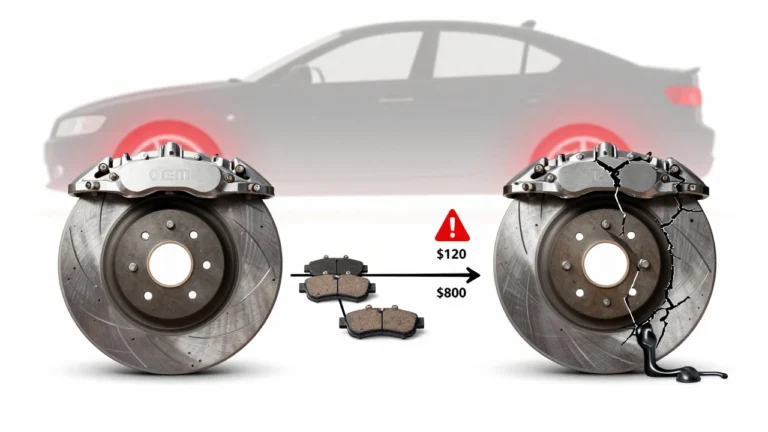
These symptoms do not prove that the caliper is defective. A bent dust shield, worn pad hardware, damaged rotor, wheel bearing issue, brake-hose restriction, or parking-brake fault can create similar signs. A qualified inspection should compare both sides and check the complete rear brake assembly.
Light surface rust on a rotor after rain or parking is often temporary and may clear during normal braking. Heavy grooves, cracks, blue heat marks, severe corrosion, or a rotor that is below its specified minimum thickness requires professional evaluation.
Rear brake service considerations
Replacing rear brake pads is not always the same as replacing front pads. If the rear caliper has a screw-in piston or an integrated mechanical parking brake, the piston may need to be retracted by turning it with the correct tool. Forcing it straight back can damage the caliper or parking-brake mechanism.
Vehicles with electronic parking brakes may require a service mode or scan-tool procedure before the caliper is serviced. The correct process varies by manufacturer. Following the vehicle-specific procedure helps prevent actuator damage and allows the parking brake to recalibrate correctly.
Brake components should generally be serviced according to the condition of the entire axle. Pads are commonly replaced in pairs on the same axle so braking remains balanced. Rotors may need replacement or resurfacing when they are damaged, excessively worn, severely corroded, or below the manufacturer’s minimum thickness.
A caliper does not automatically need replacement whenever rear pads are replaced. If the piston, seals, bracket, guide pins, and parking-brake mechanism operate correctly, the existing caliper may remain in service. Replacement becomes more likely when there is a fluid leak, seized piston, damaged bore, broken mounting hardware, or an electronic actuator fault.
Brake fluid should not contact friction surfaces. Pads and rotors contaminated with brake fluid, grease, or oil may not produce dependable braking and usually require replacement or careful evaluation. After brake work, the pedal should be firm, the parking brake should release fully, and the vehicle should be tested cautiously in a safe area.
What the answer means for your vehicle
If a vehicle has rear disc brakes, expect to find a caliper, brake pads, and a rotor at each rear wheel. If it has rear drum brakes, expect brake shoes, a drum, and wheel-cylinder hardware instead. A vehicle can also use a mixed arrangement in which the normal rear service brake is a disc caliper but the parking brake operates through separate drum-style shoes inside the rotor.
The most dependable identification method is to combine a visual inspection with vehicle-specific parts information. Do not order rear brake parts based only on the model name, because different trims and production configurations may use different systems.
Conclusion
So, do rear brakes have calipers? They do when the vehicle uses rear disc brakes, but rear drum brakes use shoes and wheel cylinders instead. Check the rotor-and-caliper arrangement, confirm the exact vehicle configuration, and use the manufacturer’s service procedure when inspecting or repairing the rear brakes.