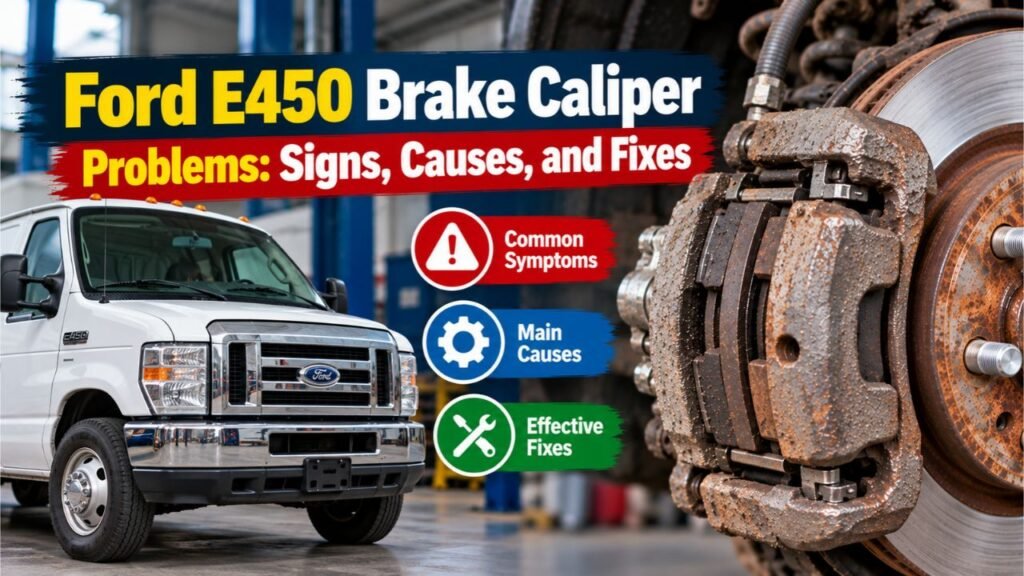
Ford E450 Brake Caliper Problems: Signs, Causes, and Fixes
The Ford E-450 is a heavy-duty chassis commonly used for motorhomes, shuttle buses, ambulances, box trucks, and other commercial applications.
Because these vehicles can carry substantial weight and sometimes spend long periods parked, their braking systems can experience conditions that are harder on components than typical passenger-car use.
If something begins going wrong at a wheel, the brake caliper is often one of the first components owners suspect.
Common Ford E450 brake caliper problems include a sticking or seized piston, binding caliper slide pins, brake-fluid leaks, uneven pad wear, overheating, and a brake that does not fully release. A deteriorated flexible brake hose can also mimic a seized caliper by trapping hydraulic pressure.
Symptoms may include the E-450 pulling to one side, a burning smell from a wheel, noticeably excessive brake dust, one rotor becoming much hotter than the others, poor acceleration caused by brake drag, or brake pads wearing much faster on one side.
However, these symptoms do not prove that the caliper itself is defective. Brake hoses, wheel bearings, rotors, pads, and related hardware should also be checked before parts are replaced.
Model year matters as well. The E-450 has been produced in different brake configurations over the years, and many E-450 chassis are completed by motorhome, bus, or commercial-body manufacturers.
Part numbers and service procedures should therefore be verified using the VIN, model year, axle configuration, and existing brake hardware rather than assuming every E-450 uses the same caliper.
This guide explains the most likely Ford E450 brake caliper problems, how to recognize them, what causes them, how a technician can tell a bad caliper from another brake problem, and when replacement is the safest solution.
Ford E450 Brake Caliper Problems and Their Symptoms
A brake caliper should apply the pads when hydraulic pressure reaches it and then release enough to allow the rotor to turn normally after the brake pedal is released.
Problems develop when the caliper piston, slide mechanism, seals, or related hydraulic components no longer operate freely.
Ford service guidance for disc brakes calls for inspecting the caliper and anchor bracket for corrosion, wear, or damage and explains that the caliper moves on guide pins as brake wear is automatically compensated.
Sticking Brake Caliper
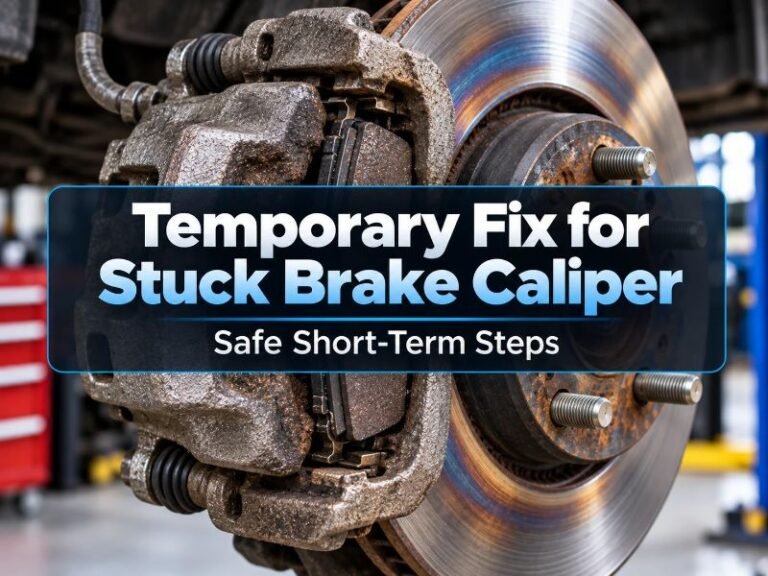
A sticking caliper is one of the most noticeable problems because the brake may remain partially applied after you release the pedal.
You might notice:
- Vehicle pulling to one side
- A hot wheel after driving
- Burning odor
- Excessive brake dust
- Poor coasting
- Reduced fuel economy
- Accelerated pad wear
- Rotor discoloration from excessive heat
A mildly sticking caliper can be difficult to notice initially. The vehicle may simply feel slightly sluggish.
As the problem becomes worse, the heat generated by constant friction can damage the pads, rotor, seals, and potentially nearby components.
Seized Caliper Piston
The caliper piston uses hydraulic pressure to press the brake pad against the rotor.
Corrosion, contamination, damaged seals, or deterioration inside the bore can prevent the piston from moving properly.
A piston can fail in two general ways.
It may become stuck in the applied position, causing constant brake drag.
Or it may resist moving outward, reducing braking force at that wheel.
During a brake job, a piston that cannot be retracted using the correct service procedure may indicate caliper trouble. However, the technician should first confirm that the particular caliper is supposed to be compressed in that manner.
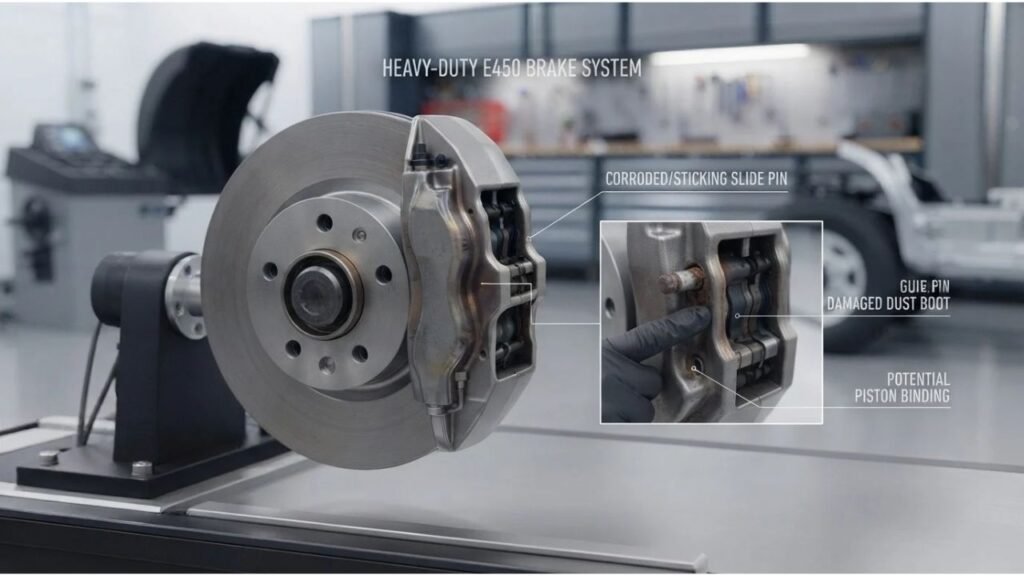
Seized or Binding Slide Pins
Not every sticking brake is caused by a piston.
Many floating calipers rely on guide pins or slide pins that allow the caliper body to move as the brake is applied.
If these pins become:
- Rusted
- Dry
- Contaminated
- Bent
- Damaged
the caliper may stop moving freely.
This can result in one brake pad wearing considerably faster than the other.
A seized slide pin can sometimes be serviced without replacing the entire caliper, provided the caliper bracket and other components remain in good condition.
Uneven Brake Pad Wear
Uneven pad wear is an important clue when diagnosing an E-450 brake problem.
Possible patterns include:
- Inner pad much thinner than outer pad
- Outer pad much thinner than inner pad
- One wheel’s pads worn much more than the opposite wheel
- Tapered pad wear
Different wear patterns can point toward different causes.
A sticking piston may keep pressure on an inner pad, while seized slides can prevent the caliper from distributing clamping force correctly.
Pads should therefore be inspected on both sides of the rotor, not just through the wheel where only one pad may be visible.
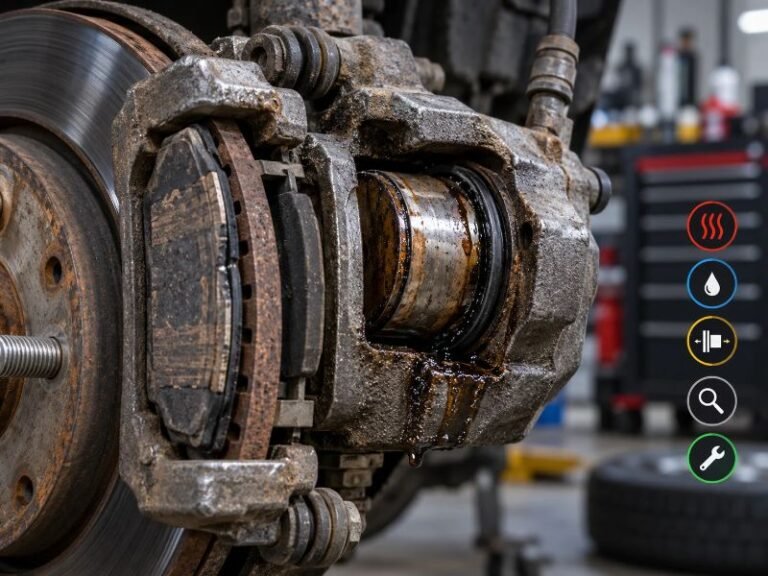
Brake Fluid Leaking From the Caliper
A brake-fluid leak is more serious than normal pad wear.
Fluid can potentially leak around:
- Piston seal
- Bleeder screw
- Brake hose connection
- Caliper housing
Look for wetness around the caliper rather than assuming every dark area is brake dust or road grime.
Brake fluid loss can lower the reservoir level and eventually reduce hydraulic braking performance.
A caliper that leaks from the piston seal generally requires rebuilding or replacement.
If the leak is at a hose connection or bleeder screw, the precise source should be identified before replacing the caliper.
Caliper Will Not Release
Sometimes the caliper applies normally but stays clamped after the brake pedal is released.
This can certainly indicate a seized caliper, but there is another important possibility: the flexible brake hose.
An internally damaged hose can sometimes allow pressure to reach the caliper while restricting its return.
The result feels almost exactly like a stuck caliper.
Replacing the caliper without checking the hose may therefore leave the original problem unresolved.
Why Ford E450 Brake Calipers Can Stick
Several factors can contribute to caliper problems.
Corrosion
Moisture is one of the major enemies of brake components.
Corrosion can develop on:
- Pistons
- Slide pins
- Brackets
- Piston bores
- Bleeder screws
- Pad contact points
Vehicles operated in parts of the United States where road salt is heavily used can be particularly vulnerable to exterior brake corrosion.
Corrosion can also become significant on vehicles that sit unused for extended periods.
Long Periods of Storage
Many E-450 chassis are used as RVs or specialty vehicles rather than daily transportation.
A motorhome may sit for weeks or months between trips.
During long storage periods, moisture and corrosion can affect exposed brake surfaces and moving components.
Regular use does not guarantee that caliper problems will never happen, but long periods of inactivity can make sticking components more likely.
Heavy Vehicle Weight
An E-450 application may be considerably heavier than a typical passenger vehicle.
Stopping a heavy vehicle converts a large amount of motion into heat at the brakes.
Repeated braking on steep grades, city driving, towing, or operating near the vehicle’s rated weight can produce significant brake temperatures.
Heat does not automatically cause caliper failure, but excessive or repeated overheating can accelerate deterioration of:
- Seals
- Boots
- Brake fluid
- Pads
- Rotors
- Lubricants
Damaged Piston Dust Boots
The rubber boot around the piston helps prevent dirt, water, and debris from reaching sensitive areas.
A torn or deteriorated boot can allow contamination to reach the piston.
Over time, corrosion may develop and cause the piston to stick.
A damaged boot discovered during routine brake service should therefore not be ignored.
Old or Moisture-Contaminated Brake Fluid
Brake fluid is hygroscopic, meaning it can absorb moisture over time.
Excess moisture reduces the fluid’s resistance to boiling and can contribute to corrosion within hydraulic components.
The correct fluid type and replacement recommendations should be confirmed for the specific E-450 model year.
Symptoms of a Bad Ford E450 Brake Caliper
Several symptoms deserve prompt inspection.
E-450 Pulls While Braking
If the vehicle consistently pulls left or right when braking, the braking force may not be balanced across the front or rear axle.
A caliper can cause this, but other possibilities include:
- Contaminated brake pads
- Brake hose problem
- Tire issue
- Suspension problem
- Alignment problem
- Rotor or pad condition
Do not replace a caliper based on pulling alone.
Burning Smell Near One Wheel
A brake that does not release generates continuous heat.
You may smell something similar to burning friction material after driving.
A wheel or rotor may also become considerably hotter than the corresponding wheel on the opposite side.
Do not touch the rotor or caliper immediately after driving. Brake components can become hot enough to cause severe burns.
Smoke From the Wheel Area
Smoke is a more serious sign.
A severely dragging brake can overheat pads, rotor surfaces, grease, and nearby components.
If smoke is coming from a wheel, stop driving as soon as it is safe.
Continuing to drive can greatly increase brake damage and potentially create a fire hazard.
E-450 Feels Like It Is Being Held Back
A dragging caliper can make a heavy E-450 feel even more sluggish.
The vehicle may:
- Accelerate poorly
- Coast only a short distance
- Require more throttle than usual
- Feel as though the brakes are lightly applied
Because E-450 vehicles are already heavy, mild brake drag may not immediately be obvious to the driver.
Excessive Brake Dust on One Wheel
Some brake dust is completely normal.
Ford also notes that brake dust can accumulate under normal brake wear.
However, if one wheel develops substantially more brake dust than the matching wheel on the same axle, accelerated pad wear or brake drag may be occurring.
One Wheel Is Much Hotter Than the Other
Comparing brake temperatures can help identify a dragging brake.
After similar braking conditions, one rotor being dramatically hotter than the corresponding rotor can indicate abnormal friction.
Temperature alone does not identify the failed part, though.
Possible causes can include:
- Stuck piston
- Seized slides
- Restricted hose
- Pad binding in bracket
- Mechanical damage
The brake needs further inspection.
Bad Caliper or Bad Brake Hose?
This distinction matters because the symptoms can be nearly identical.
A flexible brake hose can deteriorate internally even when the outside looks acceptable.
If hydraulic pressure becomes trapped, the caliper may stay applied.
A technician can use hydraulic diagnostic procedures to determine whether pressure is being retained upstream of the caliper.
Replacing the caliper without diagnosing hydraulic pressure can result in unnecessary parts replacement.
For an older E-450 with a dragging brake, inspecting both the caliper and flexible hose is sensible.
Bad Caliper or Stuck Slide Pins?
Slide pins should move freely within their normal range.
If the piston operates normally but the caliper cannot move on the slides, the problem may be primarily in the bracket and pins.
Depending on component condition, servicing may involve:
- Cleaning the bracket
- Replacing guide pins
- Replacing damaged boots
- Using the correct brake lubricant
- Replacing the bracket
If the caliper body, piston, or seals are also deteriorated, replacing the complete assembly may make more sense.
What Uneven Pad Wear Can Tell You
Brake-pad wear patterns can provide useful diagnostic clues.
| Pad Condition | Possible Cause |
| Inner pad wears much faster | Piston sticking, pad binding, or hydraulic issue |
| Outer pad wears much faster | Slide or bracket problem |
| Both pads on one wheel wear quickly | Brake not fully releasing |
| One wheel wears faster than opposite side | Caliper, hose, or hardware problem |
| Pads wear at an angle | Binding hardware or improper caliper movement |
These are diagnostic clues rather than absolute rules.
The entire brake assembly should be inspected before deciding what failed.
Can a Stuck E450 Caliper Damage the Rotor?
Yes.
If a caliper keeps the pads against the rotor, friction creates excessive heat.
The rotor can develop:
- Severe scoring
- Heat discoloration
- Surface cracking
- Uneven wear
- Thickness below specification
The brake pads can also become overheated or glazed.
Replacing only the caliper may therefore be insufficient after severe brake drag.
Pads and rotors should be inspected carefully.
Can a Bad Caliper Damage a Wheel Bearing?
Severe brake overheating can expose nearby components to temperatures they normally would not experience.
That does not mean every sticking caliper destroys the wheel bearing.
However, after an extreme overheating event, technicians may inspect surrounding components for heat-related damage rather than assuming only the pads and caliper were affected.
Should You Replace Both E450 Brake Calipers?
It is not universally necessary to replace both calipers just because one fails.
If one caliper has a specific isolated failure and the opposite caliper is in excellent condition, replacing only the defective unit can be appropriate.
Replacing both sides may make more sense when:
- Both calipers are heavily corroded.
- Both are similarly old.
- The vehicle has experienced repeated sticking.
- Both dust boots are deteriorated.
- Both assemblies show poor slide movement.
Brake pads, however, should normally be serviced as an axle set to maintain balanced friction characteristics. Ford’s brake inspection guidance also specifies axle-set pad replacement.
Should You Replace the Brake Hose With the Caliper?
Not automatically.
The flexible brake hose should be inspected and replaced if it is:
- Cracked
- Leaking
- Swollen
- Damaged
- Twisted
- Internally restricted
On an older E-450 with a dragging brake, verifying hose condition is especially important because a restricted hose can imitate caliper failure.
If the hose caused the caliper to remain applied for a long time, both components may ultimately require replacement.
Should Brake Pads and Rotors Be Replaced Too?
That depends on their condition.
Brake pads should generally be replaced if they have become:
- Excessively worn
- Unevenly worn
- Overheated
- Cracked
- Contaminated with brake fluid
Rotors should be measured and inspected for minimum thickness and damage.
A severely overheated rotor should not automatically be reused simply because it still looks reasonably smooth.
Can You Rebuild an E450 Brake Caliper?
Some brake calipers can be rebuilt using replacement pistons, seals, and dust boots.
Rebuilding only makes sense if the reusable caliper components remain in good condition.
Replacement is usually preferable when you find:
- Severe piston corrosion
- Deep pitting
- Damaged bore
- Cracked housing
- Damaged threads
- Severe heat damage
For many owners, a quality new or remanufactured replacement caliper is simpler than rebuilding a heavily worn unit.
How to Diagnose Ford E450 Brake Caliper Problems
Accurate diagnosis should include more than simply looking at the caliper.
A thorough inspection may include:
- Check brake-fluid level.
- Inspect for visible leaks.
- Compare inner and outer pad wear.
- Inspect rotor condition.
- Check slide-pin movement.
- Verify piston movement.
- Inspect the flexible hose.
- Examine the pad contact points in the bracket.
- Compare braking temperatures when appropriate.
- Check the opposite wheel on the axle.
This systematic approach helps separate caliper failure from problems elsewhere in the brake system.
When Is It Unsafe to Drive?
Do not continue normal driving if you notice serious brake symptoms such as:
- Visible brake-fluid leakage
- Smoke from a wheel
- Severe brake drag
- Vehicle pulling aggressively
- Brake pedal sinking unusually low
- Major loss of braking force
- Red brake warning indicator accompanied by braking problems
Ford advises inspection when there is continuous grinding, squealing, vibration, or shudder during braking.
An E-450 can be a large and heavy vehicle, so small braking defects deserve prompt attention rather than waiting until performance deteriorates further.
Check for Recalls by VIN
An E-450 has been produced across many model years, and the completed vehicle may also include equipment installed by another manufacturer.
For that reason, recall status should be checked using the 17-character VIN, not assumptions based only on the E-450 name.
NHTSA’s VIN lookup identifies unrepaired safety recalls associated with a specific vehicle and recommends completing applicable recall repairs through the manufacturer.
A recall involving another E-450 year or body configuration does not necessarily apply to your vehicle.
Preventing Future Caliper Problems
You cannot prevent every brake failure, but regular inspection can catch developing problems sooner.
During brake service, pay attention to:
- Slide-pin movement
- Dust boots
- Piston condition
- Uneven pad wear
- Flexible hoses
- Rotor condition
- Brake-fluid condition
- Caliper and bracket corrosion
For an RV or seasonal E-450 that spends long periods in storage, inspecting the brakes before major trips is particularly sensible.
Do not assume low annual mileage means the braking system does not need attention. Age, moisture, corrosion, and storage conditions can matter as much as mileage.
Common Mistakes When Diagnosing an E450 Caliper
One of the biggest mistakes is replacing the caliper immediately whenever a brake drags.
A similar symptom can come from:
- Restricted brake hose
- Seized guide pins
- Pads rusted into the bracket
- Incorrectly installed hardware
- Hydraulic system problem
Another mistake is replacing damaged parts on only one side without checking the corresponding brake.
The opposite-side components may reveal whether the failure is isolated or part of broader age-related deterioration.
Finally, never ignore severe heat.
If a dragging brake became extremely hot, inspect the entire wheel-end assembly rather than replacing one component and assuming everything else survived undamaged.
FAQs About Ford E450 Brake Caliper Problems
What is the most common sign of a stuck Ford E450 brake caliper?
A wheel that becomes unusually hot, combined with brake drag or uneven pad wear, is a strong indication that something in that brake assembly is not releasing properly.
The problem may be the piston, slides, pad hardware, or brake hose, so further diagnosis is needed.
Why does my Ford E450 pull to one side when braking?
A sticking or weak caliper can create unequal braking force and cause pulling.
Other causes include a brake hose restriction, contaminated pads, tire problems, suspension problems, or alignment issues.
Why does my Ford E450 smell like burning brakes?
A burning brake smell can occur when a caliper remains partially applied and continuously rubs the pads against the rotor.
Stop and investigate the cause rather than continuing to drive, especially if one wheel is extremely hot or smoking.
Can a collapsed brake hose cause E450 caliper problems?
Yes.
An internally damaged flexible hose can restrict the return of brake fluid and keep hydraulic pressure at the caliper.
This can make a healthy caliper behave as though it is seized.
Why does one brake pad wear faster than the other on my E450?
Uneven pad wear can result from a sticking piston, seized slide pins, binding pads, corrosion, or other problems that prevent normal caliper movement.
The wear pattern can help with diagnosis, but the brake should be inspected before parts are replaced.
Should I replace E450 calipers in pairs?
Not necessarily.
One defective caliper can be replaced individually if the opposite unit is in good condition.
Replacing both may be worthwhile if both are heavily corroded or showing similar deterioration.
Can a stuck caliper make an E450 feel underpowered?
Yes.
If one brake remains applied, the engine must work against continuous brake friction.
The vehicle may feel sluggish, coast poorly, and use more fuel.
How do I know whether my E450 caliper needs replacement?
Replacement is generally appropriate if the piston is seized, the caliper leaks, the bore or piston is badly corroded, the housing is damaged, or the caliper cannot operate reliably after the surrounding hardware has been serviced.
Conclusion
The most important Ford E450 brake caliper problems to watch for are sticking pistons, seized slide pins, hydraulic leaks, brake drag, uneven pad wear, and excessive heat at one wheel. These problems may become especially noticeable on heavily loaded vehicles or E-450 motorhomes and commercial vehicles that spend significant time parked.
However, a dragging E-450 brake does not automatically mean the caliper is bad. Flexible brake hoses, guide pins, brackets, pads, and other hydraulic components can create very similar symptoms.
If an E-450 pulls while braking, develops a burning smell, produces smoke, leaks brake fluid, or has one wheel becoming dramatically hotter than the others, have the brake system inspected before continuing normal driving. Correct diagnosis can prevent unnecessary parts replacement while ensuring that a genuinely defective caliper is repaired before it creates additional brake damage.