Are DOT 3 and DOT 4 Brake Fluid Compatible? Mixing and Safety
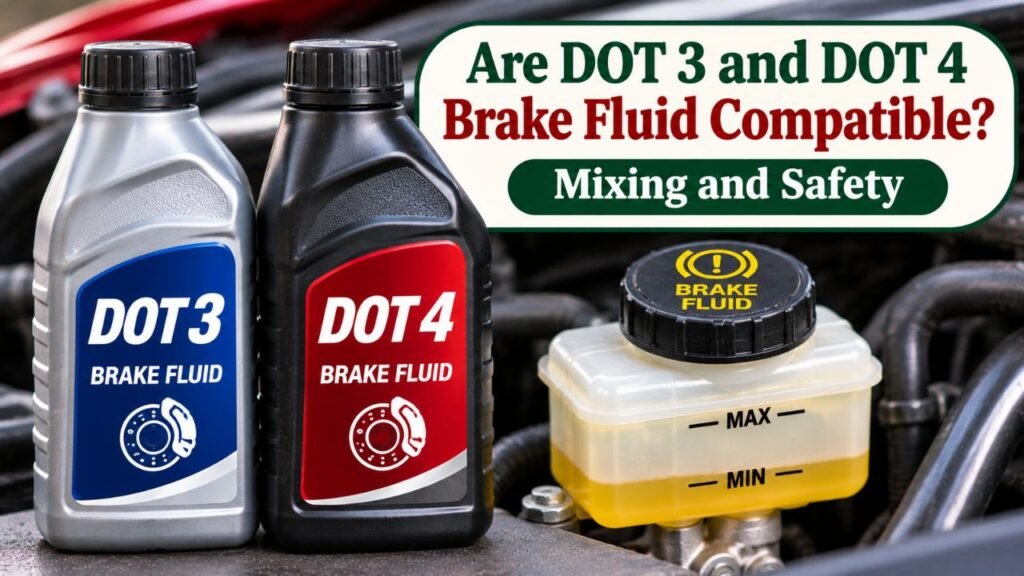
Yes, DOT 3 and DOT 4 brake fluids are generally chemically compatible because both are glycol-based hydraulic fluids. They can normally mix without separating or causing an immediate chemical reaction. However, chemical compatibility does not mean that mixing them is recommended or approved for every vehicle. The safest choice is always the brake fluid specified by the vehicle manufacturer.
DOT 4 has higher minimum dry and wet boiling-point requirements than DOT 3. Adding DOT 3 to a braking system designed for DOT 4 can reduce its heat resistance and potentially compromise the required performance. Some modern vehicles also need specialized low-viscosity brake fluid for their anti-lock braking and stability-control systems.
On the other hand, certain DOT 4 products are suitable for vehicles originally requiring DOT 3, provided the fluid meets the manufacturer’s specifications. This does not mean every brake fluid can be used interchangeably.
The confusion often comes from the difference between whether two fluids can mix and whether they should be mixed.
In this article, I explain DOT 3 and DOT 4 brake fluid compatibility, the differences in boiling point and viscosity, and when one can replace the other. I also cover accidental mixing, ABS requirements, brake-fluid flushing, and how to choose the correct fluid without risking braking performance.
Are DOT 3 and DOT 4 Brake Fluid Compatible? Quick Answer
Standard DOT 3 and DOT 4 brake fluids are generally miscible, meaning they can blend together. However, the resulting mixture may not meet the vehicle’s required brake-fluid specification.
The direction of the substitution matters.
DOT 3 and DOT 4 Compatibility Chart
| Situation | Chemical Compatibility | Recommendation |
| DOT 4 added to a DOT 3 system | Generally compatible | Use only if the product meets vehicle requirements |
| DOT 3 added to a DOT 4 system | Generally compatible | Avoid unless expressly permitted |
| DOT 3 mixed with DOT 4 | Generally miscible | Not preferred for routine maintenance |
| Two brands of DOT 3 mixed | Usually compatible if specifications match | Prefer the specified fluid |
| Two brands of DOT 4 mixed | Usually compatible if specifications match | Check required performance and viscosity |
| DOT 4 mixed with DOT 5.1 | Generally chemically compatible | Follow manufacturer specifications |
| DOT 3 mixed with DOT 5 silicone | Incompatible | Never mix |
| DOT 4 mixed with DOT 5 silicone | Incompatible | Never mix |
| DOT 3 or DOT 4 mixed with mineral oil | Incompatible | Never mix |
The NAPA Brake Fluid FAQs confirm that conventional DOT 3, DOT 4, and DOT 5.1 fluids can generally mix, while warning that mixing can reduce the performance of higher-grade fluid.
What Does Compatible Actually Mean?
Compatibility can describe several different properties:
- Whether the liquids physically mix
- Whether they remain chemically stable
- Whether they work with the system’s rubber seals
- Whether they satisfy the required boiling-point specification
- Whether their viscosity meets the vehicle’s requirements
Two fluids may be chemically miscible without being approved for the same application.
For example, DOT 3 may mix with DOT 4 without creating sludge, but the mixture may not provide the high-temperature performance required by a DOT 4 braking system.
Is Mixing Automatically Dangerous?
Not necessarily.
A small amount of compatible glycol-based fluid does not automatically cause immediate brake failure.
However, the effect on performance cannot be determined reliably from appearance alone.
When the wrong grade has been used, the vehicle’s requirements should be checked before continuing normal operation.
Key Takeaway: DOT 3 and DOT 4 can generally mix chemically, but the correct fluid depends on the vehicle’s specified braking-system requirements.
What Is DOT 3 Brake Fluid?
DOT 3 is a glycol-based hydraulic brake fluid commonly used in passenger vehicles, light trucks, and certain motorcycles.
Its purpose is to transfer hydraulic pressure from the master cylinder to the wheel brakes.
Main Characteristics of DOT 3
DOT 3 brake fluid:
- Is generally glycol-ether-based
- Meets defined minimum boiling-point requirements
- Absorbs moisture over time
- Provides corrosion protection
- Is used in compatible hydraulic brake and clutch systems
- Must be replaced according to the vehicle’s service schedule
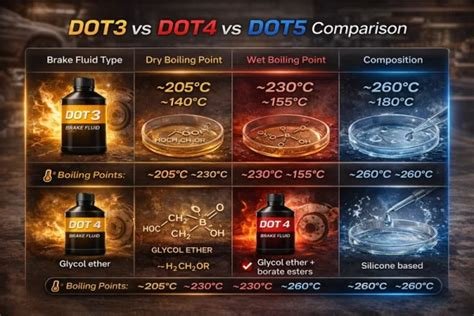
DOT 3 Minimum Boiling Points
Under U.S. Federal Motor Vehicle Safety Standard No. 116, DOT 3 must meet:
- Dry boiling point: At least 401°F (205°C)
- Wet boiling point: At least 284°F (140°C)
These are minimum requirements.
Individual DOT 3 products may exceed them.
Where Is DOT 3 Commonly Used?
DOT 3 is found in various vehicles, particularly older designs and models whose manufacturers specify it.
However, some newer vehicles also use DOT 3.
Vehicle age alone does not determine the required fluid.
Does DOT 3 Work With ABS?
Yes, DOT 3 can be suitable for ABS-equipped vehicles designed for DOT 3.
The presence of ABS does not automatically require DOT 4.
However, certain advanced braking systems specify a particular viscosity class or manufacturer-approved formulation.
Key Takeaway: DOT 3 is a conventional glycol-based brake fluid with defined performance requirements. It remains appropriate when the manufacturer specifies DOT 3.
What Is DOT 4 Brake Fluid?
DOT 4 is another glycol-based hydraulic brake fluid, commonly formulated using glycol ethers and borate esters.
It has higher minimum boiling-point requirements than DOT 3.
Main Characteristics of DOT 4
DOT 4 brake fluid:
- Is generally glycol-based
- Has higher minimum boiling points than DOT 3
- Absorbs moisture over time
- Is suitable for braking systems designed for its performance
- Is available in conventional and specialized low-viscosity formulations
- Requires periodic replacement
DOT 4 Minimum Boiling Points
Under FMVSS No. 116, DOT 4 must meet:
- Dry boiling point: At least 446°F (230°C)
- Wet boiling point: At least 311°F (155°C)
This gives DOT 4 a higher minimum heat-resistance specification than DOT 3.
Why Does the Higher Boiling Point Matter?
Braking converts vehicle motion into heat.
Some of that heat transfers to the hydraulic brake fluid.
If the fluid boils, vapor bubbles can form.
Unlike liquid brake fluid, vapor is compressible.
This may cause a soft brake pedal and reduced braking performance.
A higher boiling point provides an additional margin against this problem.
Does DOT 4 Always Perform Better?
Not necessarily in every application.
Although DOT 4 has higher minimum boiling-point requirements, the vehicle may also require a particular viscosity, additive formulation, or manufacturer approval.
A general-purpose DOT 4 product is not automatically the best choice for every braking system.
Key Takeaway: DOT 4 provides higher minimum boiling-point performance, but vehicle-specific compatibility remains essential.
DOT 3 vs DOT 4 Brake Fluid: Main Differences
The most significant differences involve boiling-point performance and formulation.
Comparison Table
| Feature | DOT 3 | DOT 4 |
| General chemistry | Glycol-based | Glycol-based |
| Common formulation | Glycol ethers | Glycol ethers and often borate esters |
| Minimum dry boiling point | 401°F (205°C) | 446°F (230°C) |
| Minimum wet boiling point | 284°F (140°C) | 311°F (155°C) |
| Moisture absorption | Yes | Yes |
| Chemical miscibility with the other grade | Generally yes | Generally yes |
| ABS compatibility | When specified | When specified |
| Specialized low-viscosity versions | Vehicle/product dependent | Commonly available |
| Heat-resistance requirement | Lower minimum | Higher minimum |
| Replacement interval | Manufacturer-specific | Manufacturer-specific |
What Is Dry Boiling Point?
Dry boiling point represents brake-fluid performance in a fresh, standardized test condition.
It helps measure the fluid’s resistance to boiling before significant moisture exposure.
What Is Wet Boiling Point?
Wet boiling point measures performance after standardized moisture conditioning.
Glycol-based brake fluids absorb moisture over time, which can lower their boiling points.
The wet boiling-point requirement is therefore important for understanding aged-fluid performance.
Is DOT 4 Thinner Than DOT 3?
Not necessarily.
The standard DOT number alone does not tell you which individual product is thinner under all conditions.
Conventional DOT 4 may have different low-temperature viscosity from DOT 3.
Specialized DOT 4 LV fluids are formulated for improved fluidity at low temperatures.
Which Fluid Is More Heat-Resistant?
DOT 4 has higher minimum dry and wet boiling-point requirements.
However, a premium DOT 3 product may exceed the minimum standards, and actual product performance varies.
Always compare specifications rather than relying only on the DOT number.
Key Takeaway: DOT 4 has higher minimum heat-resistance requirements, but both fluid grade and vehicle-specific formulation matter.
Can You Mix DOT 3 and DOT 4 Brake Fluid?
Yes, standard DOT 3 and DOT 4 fluids are generally chemically miscible. However, mixing is not the preferred approach when servicing a braking system that requires a specific grade.
Why Can They Mix?
Both conventional fluids use related glycol-based chemistry.
They generally blend into a uniform liquid rather than separating into distinct layers.
This differs from silicone-based DOT 5 fluid.
Does Mixing Create Sludge?
Normal, clean DOT 3 and DOT 4 fluids that meet applicable specifications should not automatically produce sludge simply because they are mixed.
However, sludge may develop from other problems, including:
- Contaminated fluid
- Deteriorated brake components
- Incompatible chemical additives
- Incorrect fluid type
- Moisture-related corrosion
If sludge is already present, do not assume the issue can be solved by adding another grade.
Does Mixing Affect Performance?
It can.
The mixture’s properties depend on:
- The specific products
- The amount of each fluid
- The condition of the existing fluid
- Moisture content
- Additive formulations
Mixing DOT 3 into DOT 4 may reduce the higher-grade fluid’s boiling-point performance.
It may also alter viscosity and other properties.
Is It Better to Avoid Mixing?
Yes, for routine maintenance.
The Castrol DOT 3 and DOT 4 brake fluid product guidance explicitly confirms that Castrol DOT 4 is compatible with fluids meeting DOT 3 and DOT 4 standards, while recommending against unnecessary mixing to preserve the product’s performance characteristics.
What If the Existing Fluid Is Old?
Mixing fresh brake fluid with aged fluid does not eliminate accumulated moisture.
For example, adding new DOT 4 to old DOT 3 does not automatically create a braking system containing fresh DOT 4.
The remaining old fluid may still have reduced boiling-point performance.
Key Takeaway: Chemical compatibility makes mixing possible, but using one manufacturer-approved specification consistently is the better maintenance practice.
Can You Use DOT 4 Instead of DOT 3?
DOT 4 can often replace DOT 3 when the particular DOT 4 product meets the vehicle manufacturer’s requirements. However, it should not be treated as an automatic upgrade for every vehicle.
Why Might DOT 4 Be Suitable?
Many commercial DOT 4 products also satisfy DOT 3 performance requirements.
Certain products are explicitly approved for systems requiring either grade.
However, the owner’s manual and product specifications should determine suitability.
Will DOT 4 Damage DOT 3 Brake Seals?
A suitable glycol-based DOT 4 fluid should generally be compatible with brake systems designed for conventional glycol-based fluids.
However, additive formulations vary, and the manufacturer may specify a particular fluid.
Do not assume all products have identical material compatibility.
Does DOT 4 Improve Braking Performance?
Not necessarily during ordinary driving.
DOT 4 provides higher minimum boiling-point capability.
This may offer improved resistance to vapor formation during severe braking.
However, simply changing from DOT 3 to DOT 4 does not automatically increase braking force or shorten stopping distances.
Brake performance also depends on:
- Tire traction
- Brake pads
- Rotors
- Calipers
- Hydraulic condition
- ABS operation
- Vehicle weight
- Road conditions
Should You Completely Flush DOT 3 Before Switching to DOT 4?
If a manufacturer-approved switch is being performed as part of scheduled maintenance, a complete fluid exchange according to the service manual is generally preferable to repeatedly topping off old fluid.
This helps ensure the system contains the intended fresh fluid.
Some vehicles require specialized bleeding procedures.
What If the Reservoir Cap Says DOT 3?
Check the owner’s manual.
Some caps identify a minimum specification, while others identify the required product.
Do not interpret the wording without checking the vehicle’s actual fluid requirements.
Key Takeaway: DOT 4 may be a suitable replacement for DOT 3, but the vehicle manufacturer’s instructions and the particular fluid’s specifications must agree.
Can You Use DOT 3 Instead of DOT 4?
DOT 3 should not ordinarily be used in a braking system that specifies DOT 4 unless the manufacturer explicitly permits it.
This is a more important limitation than simple chemical miscibility.
Why Is DOT 3 a Poor Substitute?
DOT 3 has lower minimum boiling-point requirements.
A braking system requiring DOT 4 may be designed around greater thermal performance.
Replacing the specified fluid with DOT 3 may reduce the margin against fluid boiling.
Can DOT 3 Cause Immediate Brake Failure?
Not automatically.
Standard glycol-based DOT 3 does not necessarily react destructively with DOT 4.
However, its presence may mean the combined fluid no longer meets the required specification.
The absence of immediate symptoms does not prove the mixture is acceptable.
What Happens During Heavy Braking?
Extended downhill driving, towing, and repeated heavy braking can raise brake-fluid temperatures.
If the fluid’s boiling point is insufficient, vapor bubbles may form.
This can cause:
- Increased pedal travel
- Spongy brake feel
- Reduced hydraulic response
- Brake fade
- Potentially severe loss of braking performance
What If DOT 3 Was Added by Mistake?
Do not assume the amount is harmless or that the system must automatically be replaced.
Confirm the vehicle’s required specification and the product used.
If DOT 3 was not approved, arrange qualified inspection and a manufacturer-approved fluid exchange as necessary.
If the brake warning light is illuminated, the pedal feels abnormal, or fluid is leaking, do not drive.
Key Takeaway: DOT 3 may mix chemically with DOT 4, but it is not an acceptable routine replacement for a system requiring higher-performance DOT 4 fluid.
What Happens If You Accidentally Mix DOT 3 and DOT 4?
The correct response depends on the vehicle’s specification, the fluid used, and the amount added.
Common Accidental Mixing Situations
| Situation | Main Concern | Recommended Response |
| Small amount of DOT 4 added to DOT 3 system | Whether DOT 4 is approved | Check manual and product specifications |
| Large amount of DOT 4 added to DOT 3 system | Final fluid specifications | Confirm suitability and service needs |
| Small amount of DOT 3 added to DOT 4 system | Reduced required performance | Consult qualified technician |
| Significant DOT 3 added to DOT 4 system | System may not meet DOT 4 requirements | Arrange appropriate fluid service |
| DOT 3 and DOT 4 mixed during a flush | Uncertain final fluid properties | Complete service with specified fluid |
| DOT 5 accidentally mixed with either | Chemical incompatibility | Stop using vehicle and obtain professional repair |
Step 1: Identify the Vehicle’s Required Fluid
Check:
- Owner’s manual
- Brake-fluid reservoir cap
- Manufacturer service information
The owner’s manual takes priority when there is uncertainty.
Step 2: Identify What Was Added
Read the bottle label.
Check whether the product is:
- DOT 3
- DOT 4
- DOT 4 LV
- DOT 5
- DOT 5.1
- Another specialized hydraulic fluid
Do not rely only on fluid color.
Step 3: Determine Approximately How Much Was Added
Was it a few drops, a small top-up, or a substantial quantity?
This information helps a technician evaluate the situation.
However, there is no universal percentage that guarantees a mixture meets a particular vehicle specification.
Step 4: Check for Immediate Safety Problems
Do not operate the vehicle if you notice:
- Brake pedal sinking unusually far
- Spongy or abnormal pedal feel
- Brake warning light
- Brake fluid leaks
- Reduced braking performance
These symptoms require immediate attention regardless of which fluid was added.
Step 5: Arrange the Appropriate Service
If the wrong grade was used, consult the vehicle manufacturer or a qualified brake technician.
A manufacturer-approved brake fluid exchange may be required.
If an incompatible petroleum-based or silicone fluid entered the system, the repair may be more extensive.
What Should You Avoid?
Do not:
- Add another type of fluid to balance the mixture.
- Assume the mixture has DOT 4 performance.
- Attempt to separate the fluids.
- Add chemicals to improve compatibility.
- Ignore brake-system warning signs.
Key Takeaway: Accidental DOT 3/DOT 4 mixing does not automatically cause an immediate chemical failure, but the fluid must still meet the vehicle’s requirements.
Will Mixing DOT 3 and DOT 4 Lower the Boiling Point?
Adding DOT 3 to DOT 4 can reduce the mixture’s boiling-point performance.
However, the actual boiling point cannot be determined reliably from the mixing ratio alone.
Example: Mixing Equal Amounts
Suppose you combine:
- 50% fresh DOT 3
- 50% fresh DOT 4
You should not assume the mixture has a boiling point exactly halfway between the two published minimums.
Actual performance depends on the chemical formulations.
Does a 50/50 Mixture Still Meet DOT 4?
Not necessarily.
The fact that both products individually meet their DOT specifications does not guarantee that the blend meets DOT 4 requirements.
What If Both Products Exceed Their Minimum Standards?
The mixture may still have relatively high boiling resistance.
However, without appropriate testing, the final performance cannot be confirmed.
Is Mixing Better Than Using Old Brake Fluid?
Fresh compatible fluid may be preferable to seriously deteriorated or contaminated fluid in certain circumstances, but this is not a substitute for correct brake maintenance.
If the fluid is overdue for replacement, perform the appropriate service using the manufacturer’s specified product.
Why Is Boiling Point So Important?
Under heavy braking, brake fluid can become hot enough to form vapor if its boiling point is inadequate.
Vapor bubbles compress under pedal pressure.
This can create a longer or softer pedal and reduce braking effectiveness.
Key Takeaway: Mixing can dilute DOT 4 performance. Do not calculate or assume a new certified boiling-point rating from the amount of DOT 3 added.
Are DOT 3 and DOT 4 Compatible With ABS Brakes?
Both DOT 3 and DOT 4 can be used in ABS-equipped vehicles when the vehicle manufacturer specifies them.
However, some modern braking systems require a specialized low-viscosity formulation.
Why Does Brake Fluid Viscosity Matter?
Viscosity describes how easily a fluid flows.
In an anti-lock braking system, electronically controlled valves and pumps may regulate hydraulic pressure rapidly.
Fluid behavior at low temperatures can influence the response of these components.
Is Regular DOT 4 Suitable for Every ABS System?
No.
Some vehicles specify conventional DOT 4.
Others require DOT 4 LV, DOT 4 ESP, ISO 4925 Class 6, or a manufacturer-specific formulation.
A general DOT 4 label does not guarantee compliance with these additional requirements.
What Is DOT 4 LV?
DOT 4 LV means low-viscosity DOT 4.
It is designed to provide suitable fluid flow characteristics, particularly at low temperatures.
It still needs to meet the relevant braking-system specifications.
Can DOT 3 Replace DOT 4 LV?
Do not assume so.
Even though standard DOT 3 and DOT 4 are chemically miscible, they may not meet the same viscosity or manufacturer-specific performance requirements.
Does Every Vehicle With ABS Need DOT 4 LV?
No.
ABS-equipped vehicles have different brake-fluid requirements depending on their design.
The Brembo brake fluid compatibility guide explains that newer vehicles with advanced electronic braking and stability systems may require low-viscosity formulations. Brembo also recommends following the vehicle manufacturer’s specified fluid rather than treating DOT grades as universally interchangeable.
What If You Added Regular DOT 4 to a DOT 4 LV System?
The fluid may be chemically compatible but unsuitable for the specified low-temperature viscosity requirement.
Check the manufacturer’s requirements and arrange service if the product does not meet them.
Key Takeaway: ABS compatibility depends on more than whether DOT 3 and DOT 4 mix. The required viscosity specification can be equally important.
DOT 3 vs DOT 4 vs DOT 5 vs DOT 5.1 Compatibility
The similar names can cause confusion, especially between DOT 5 and DOT 5.1.
Brake Fluid Compatibility Overview
| Brake Fluid | General Chemistry | Compatible With DOT 3? | Compatible With DOT 4? |
| DOT 3 | Glycol-based | Yes | Generally chemically compatible |
| DOT 4 | Glycol-based | Generally chemically compatible | Yes |
| DOT 4 LV | Specialized glycol-based | Generally miscible, but approval varies | Generally miscible, but viscosity matters |
| DOT 5 | Silicone-based | No | No |
| DOT 5.1 | Glycol-based | Generally chemically compatible | Generally chemically compatible |
| Mineral hydraulic fluid | Mineral-oil-based | No | No |
The table describes general chemical compatibility, not permission to substitute fluids.
Why Is DOT 5 Different?
DOT 5 is silicone-based.
It is not interchangeable with conventional glycol-based DOT 3, DOT 4, or DOT 5.1 fluids.
Mixing incompatible types can create serious hydraulic-system problems.
Is DOT 5.1 the Same as DOT 5?
No.
DOT 5.1 is a glycol-based fluid.
DOT 5 is silicone-based.
The numerical similarity does not mean the products share the same chemistry.
Can You Mix DOT 5.1 With DOT 3 or DOT 4?
They are generally chemically miscible.
However, use DOT 5.1 only when it meets the vehicle’s requirements.
A higher DOT number does not guarantee that all manufacturer-specific specifications are satisfied.
What About Mineral-Oil Brake Systems?
Certain specialized vehicles use mineral hydraulic fluids.
These must not be mixed with ordinary DOT 3 or DOT 4 products.
Using incompatible fluid can damage seals and seriously compromise braking performance.
Key Takeaway: DOT 3, DOT 4, and DOT 5.1 are generally chemically compatible. Silicone DOT 5 and mineral-based brake fluids are different and must not be mixed with them.
Can You Mix Different Brands of DOT 3 or DOT 4?
Brake fluids from different manufacturers may be chemically compatible when they meet appropriate standards.
However, mixing brands is not always preferable.
Do All Brands Use the Same Formula?
No.
Brake-fluid manufacturers may use different:
- Glycol-based components
- Borate esters
- Corrosion inhibitors
- Lubricity additives
- Stabilizers
- Viscosity modifiers
Different products can meet the same DOT grade without having identical formulas.
Is Mixing Two DOT 4 Brands Safe?
It is generally possible when both products comply with the required specifications.
However, manufacturer-specific approvals still matter.
For example, two products labeled DOT 4 may have different low-temperature viscosity values.
Can You Mix Synthetic and Non-Synthetic DOT 3?
Most conventional DOT 3 and DOT 4 brake fluids are synthetic formulations.
Marketing terms such as synthetic do not replace the need to verify the correct DOT specification.
Is It Better to Use the Same Brand?
Using the same approved product makes maintenance more consistent.
However, the required specification is more important than brand loyalty.
A different brand that meets all vehicle requirements may be suitable.
Does Mixing Brands Require a Flush?
Not automatically.
If both products meet the vehicle’s requirements, a complete flush may not be needed solely because the brands differ.
However, periodic fluid replacement is still necessary, and a professional should assess any uncertain mixture.
Key Takeaway: Different brands may be compatible, but the vehicle’s required DOT grade and specific approvals matter more than the brand name.
Can You Top Off DOT 3 Brake Fluid With DOT 4?
Sometimes, if the vehicle and DOT 4 product permit it.
However, topping off brake fluid should not become routine maintenance without understanding why the reservoir level is low.
Why Does Brake Fluid Level Decrease?
The reservoir level may decline because of:
- Normal brake pad wear
- Brake shoe wear and adjustment
- Hydraulic leakage
- Improper servicing
- Component damage
As disc brake pads wear, the caliper pistons extend farther.
This causes more brake fluid to occupy the calipers and may lower the amount visible in the reservoir.
Should You Always Fill to MAX?
Not necessarily.
If the level has decreased because of brake pad wear, topping off without considering pad condition can lead to overfilling when the pads are replaced.
Follow the owner’s manual.
When Is a Low Level Dangerous?
A sudden drop, repeated fluid loss, or a level below the permitted range can indicate a hydraulic problem.
If the brake warning light is active or the pedal feels abnormal, do not drive.
How to Check the Correct Fluid
- Identify the required brake fluid in the owner’s manual.
- Check the reservoir cap.
- Confirm any additional specification or approval.
- Use fresh fluid from a properly sealed container only when appropriate.
- Keep dirt and moisture out of the reservoir.
Do not open the cap unnecessarily.
Can You Top Off DOT 4 With DOT 3?
Do not do so unless the vehicle manufacturer explicitly permits it.
The lower grade may reduce the performance needed by the braking system.
Key Takeaway: DOT 4 may be suitable for some DOT 3 top-ups, but first check the vehicle’s requirements and investigate the reason for a low reservoir level.
Do You Need to Flush the Brakes Before Switching From DOT 3 to DOT 4?
If a switch is approved, a proper fluid exchange is generally preferable during scheduled brake maintenance.
What Is a Brake Fluid Flush?
A brake fluid flush replaces old fluid throughout the hydraulic circuits according to the vehicle’s service procedure.
It may involve the:
- Reservoir
- Master cylinder
- Brake lines
- Calipers or wheel cylinders
- ABS hydraulic unit
The exact method depends on the vehicle.
Is Changing Only the Reservoir Fluid Enough?
No.
Removing old fluid from the reservoir and adding new fluid does not replace all the fluid in the brake lines and wheel brakes.
Can You Switch Without a Complete Flush?
Because conventional DOT 3 and DOT 4 are generally chemically miscible, a full flush is not automatically required merely to prevent a chemical reaction.
However, a complete exchange may be needed to establish the desired fluid specification and remove aged fluid.
Follow the vehicle manufacturer’s instructions.
What About ABS Brake Bleeding?
Some ABS and electronically controlled braking systems have specific bleeding requirements.
Certain procedures require diagnostic equipment to operate hydraulic valves or pumps.
Improper bleeding can leave air inside the system.
Can You Do the Flush Yourself?
Only if you have the correct service information, suitable equipment, and the ability to perform and verify the procedure safely.
Braking systems are safety-critical.
If uncertain, use a qualified technician.
What Happens if Air Enters the Brake Lines?
Air can compress when the brake pedal is pressed.
Possible symptoms include:
- Soft pedal
- Excessive pedal travel
- Reduced hydraulic response
If braking performance is abnormal after service, do not drive until the problem is corrected.
Key Takeaway: DOT 3 and DOT 4 do not necessarily require flushing solely because they are miscible, but a proper fluid exchange is often appropriate when changing specifications or replacing old fluid.
Does Mixing DOT 3 and DOT 4 Damage Brake Seals?
Mixing clean, compatible glycol-based DOT 3 and DOT 4 fluids does not ordinarily cause the immediate seal damage associated with petroleum-based contamination.
However, correct fluid selection remains important.
What Are Brake Seals Made Of?
Many conventional hydraulic brake systems use elastomers designed for glycol-based brake fluids.
The materials and their compatibility requirements depend on the system.
Can Different Additives Matter?
Yes.
Brake-fluid formulations contain additives intended to support lubrication, corrosion protection, and material compatibility.
Vehicle manufacturers evaluate fluids according to the needs of their systems.
What Fluids Are Especially Dangerous?
Never introduce:
- Engine oil
- Power steering fluid
- Automatic transmission fluid
- Mineral oil
- Gasoline
- Unapproved solvents
- Silicone DOT 5 into a glycol-based system
These substances may damage braking-system components or compromise hydraulic operation.
Can You Correct Petroleum Contamination With a Flush?
Not necessarily.
Petroleum contamination can damage rubber components.
The affected parts may require replacement.
If an incompatible substance has entered the brake reservoir, stop using the vehicle and obtain professional service.
What About Mixing DOT 3 and DOT 4?
The usual concern is maintaining correct fluid performance and manufacturer approval rather than an immediate chemical reaction.
Key Takeaway: Compatible DOT 3/DOT 4 mixtures differ from serious petroleum or silicone contamination. Nevertheless, the brake fluid must meet the system’s actual specifications.
How Often Should DOT 3 and DOT 4 Brake Fluid Be Replaced?
Both DOT 3 and DOT 4 glycol-based brake fluids absorb moisture over time.
Moisture can lower the fluid’s boiling point and contribute to internal corrosion.
Does DOT 4 Last Longer Than DOT 3?
Not universally.
Different formulations behave differently during service.
A higher minimum boiling-point specification does not automatically establish a longer replacement interval.
Typical Service Intervals
Some manufacturers specify brake fluid replacement approximately every two years.
Others specify three years or another interval.
Follow the exact maintenance schedule for your vehicle.
Does Low Mileage Make Brake Fluid Last Longer?
Not necessarily.
Moisture absorption can occur while a vehicle is parked.
A rarely driven car may still require time-based brake fluid replacement.
Can You Judge Fluid Condition by Color?
Not reliably.
Color can provide clues about deterioration or contamination.
However, it does not establish the fluid’s actual boiling point or moisture content.
Does Adding Fresh DOT 4 Restore Old DOT 3?
No.
Topping off old fluid does not remove moisture or contamination from the existing hydraulic system.
A proper fluid exchange is needed when replacement is due.
Key Takeaway: Both grades require maintenance. Follow vehicle-specific service intervals rather than assuming DOT 4 lasts longer simply because it has a higher boiling point.
Common Mistakes When Mixing DOT 3 and DOT 4 Brake Fluid
1. Assuming Chemical Compatibility Means Universal Approval
DOT 3 and DOT 4 can generally mix chemically, but that does not make every substitution suitable.
2. Adding DOT 3 to a DOT 4-Only System
This can reduce the required boiling-point performance.
Use DOT 3 only if expressly permitted.
3. Assuming Every DOT 4 Works With Advanced ABS
Some braking systems require DOT 4 LV or another specialized specification.
4. Confusing DOT 5 With DOT 5.1
DOT 5 is silicone-based, while DOT 5.1 is glycol-based.
They are not interchangeable.
5. Mixing With Mineral Oil
Conventional DOT brake fluids must not be mixed with mineral hydraulic oils.
6. Choosing Based Only on the DOT Number
Manufacturer-specific approvals, viscosity, and other requirements also matter.
7. Assuming a Mixed Fluid Meets DOT 4 Standards
A mixture of DOT 3 and DOT 4 is not automatically certified as DOT 4.
8. Adding New Fluid to Old Fluid Instead of Servicing It
Topping off does not remove accumulated moisture.
9. Ignoring a Low Reservoir Level
Low fluid may reflect brake wear or a hydraulic leak.
Investigate the cause.
10. Using Brake Fluid From an Open Container
Glycol-based fluids absorb moisture from the surrounding air.
Use fresh fluid stored according to the manufacturer’s directions.
11. Letting Dirt Enter the Reservoir
Contamination can affect hydraulic components.
Keep the cap and surrounding area clean.
12. Allowing the Reservoir to Run Dry During Service
Air may enter the system and require additional bleeding.
13. Assuming a Soft Pedal Is Normal After a Fluid Change
A soft pedal may indicate air or another hydraulic fault.
Do not drive until braking performance is verified.
14. Using Brake Fluid to Fix a Mechanical Brake Problem
New fluid does not automatically repair leaking calipers, worn pads, damaged lines, or faulty master cylinders.
Key Takeaway: Most serious mistakes come from ignoring the specified fluid, misunderstanding compatibility, or overlooking a separate brake-system problem.
Which Brake Fluid Should You Choose?
The best choice is the fluid that meets the vehicle manufacturer’s requirements.
Recommended Choice by Situation
| Your Situation | Recommended Approach |
| Vehicle specifies DOT 3 | Use approved DOT 3 or an expressly permitted alternative |
| Vehicle specifies DOT 4 | Use the required DOT 4 fluid |
| Vehicle specifies DOT 4 LV | Use fluid meeting the required low-viscosity specification |
| Vehicle permits DOT 3 or DOT 4 | Use a suitable product meeting the stated approvals |
| Vehicle specifies DOT 5.1 | Use approved DOT 5.1 or expressly permitted alternative |
| Vehicle specifies silicone DOT 5 | Use the approved silicone fluid |
| Vehicle specifies mineral hydraulic fluid | Use the manufacturer-required mineral fluid |
| Small amount of DOT 3 accidentally added to DOT 4 system | Verify specifications and arrange appropriate service |
| Wrong fluid added and pedal feels abnormal | Do not drive; obtain professional inspection |
| Brake fluid is overdue for replacement | Perform manufacturer-approved fluid service |
When I Would Choose DOT 3
I would use DOT 3 when the manufacturer specifies it and there is no clear reason or approval to use another product.
When I Would Choose DOT 4
I would choose DOT 4 when the vehicle requires it, or when the manufacturer approves a particular DOT 4 product as a replacement for DOT 3.
When I Would Choose DOT 4 LV
I would choose a qualifying low-viscosity formulation when the braking system specifically requires it.
I would not substitute a conventional product simply because its DOT number is the same.
What If the Manual Lists Multiple Fluids?
Some vehicles permit more than one brake-fluid specification.
In that case, use a product meeting the stated requirements.
If the wording is unclear, confirm the specification with the manufacturer or a qualified service technician.
Key Takeaway: Vehicle approval is the deciding factor. Chemical compatibility alone is not enough to select a brake fluid safely.
Conclusion
DOT 3 and DOT 4 brake fluids are generally chemically compatible because both use glycol-based formulations. They can normally mix without separating or causing an immediate chemical reaction. However, mixing is not automatically recommended or approved for every vehicle.
The main difference is their performance specification.
DOT 3 has minimum dry and wet boiling points of 401°F and 284°F, while DOT 4 has higher minimum requirements of 446°F and 311°F.
Adding DOT 3 to a system designed for DOT 4 may reduce the braking system’s required heat resistance.
Some modern vehicles also need special low-viscosity fluids, making the choice more complicated than simply selecting a higher DOT number.
DOT 4 can often replace DOT 3 when the specific product is approved, but the reverse should not be assumed.
It is also essential to distinguish DOT 5 silicone fluid from glycol-based DOT 5.1. DOT 5 must not be mixed with conventional DOT 3 or DOT 4 fluids.
If you accidentally mix DOT 3 and DOT 4, the correct response depends on the vehicle’s requirements and the amount introduced.
I recommend checking the owner’s manual, using fresh brake fluid that meets every required specification, and performing fluid replacement according to the manufacturer’s maintenance schedule.
When fluid compatibility is uncertain, have a qualified brake technician verify the correct service before relying on the vehicle’s braking system.
FAQs About Are DOT 3 and DOT 4 Brake Fluid Compatible
Can you mix DOT 3 and DOT 4 brake fluid?
Yes, conventional DOT 3 and DOT 4 brake fluids are generally chemically miscible because they are glycol-based. However, mixing can change boiling-point and viscosity performance. The mixture may not meet the vehicle’s required specification, so follow the manufacturer’s instructions rather than mixing them unnecessarily.
Can I use DOT 4 brake fluid instead of DOT 3?
Often, yes, when the DOT 4 product meets the vehicle manufacturer’s requirements. Many DOT 4 products also satisfy DOT 3 performance standards. However, not every substitution is automatically approved. Check the owner’s manual and product specifications before switching.
Can I use DOT 3 brake fluid instead of DOT 4?
Not unless the vehicle manufacturer explicitly permits it. DOT 3 has lower minimum boiling-point requirements than DOT 4. Using it in a DOT 4-specified system may reduce the required heat resistance and compromise braking performance under demanding conditions.
What happens if you accidentally mix DOT 3 and DOT 4?
The fluids generally blend without an immediate chemical reaction. However, the mixture may not meet the required boiling-point or viscosity specification. Check the vehicle requirements and have a technician assess whether a fluid exchange is necessary. Do not drive if braking performance is abnormal.
Will mixing DOT 3 and DOT 4 damage brake seals?
Clean, compatible glycol-based DOT 3 and DOT 4 fluids do not ordinarily cause immediate seal damage simply because they are mixed. However, formulations vary, and the vehicle’s specifications must still be followed. Petroleum-based oils and silicone DOT 5 are much more serious compatibility concerns in glycol-based systems.
Can you mix DOT 3 and DOT 4 in an ABS system?
They are generally chemically miscible, but an ABS system may require a specific brake-fluid grade or low-viscosity formulation. Some vehicles need DOT 4 LV or another approved product. Mixing standard DOT 3 and DOT 4 does not guarantee the required viscosity or braking-system performance.
Is DOT 4 better than DOT 3 brake fluid?
DOT 4 has higher minimum dry and wet boiling-point requirements, making it more resistant to boiling under demanding braking conditions. However, it is not automatically the correct choice for every vehicle. The best brake fluid is the one that meets the manufacturer’s specified requirements.