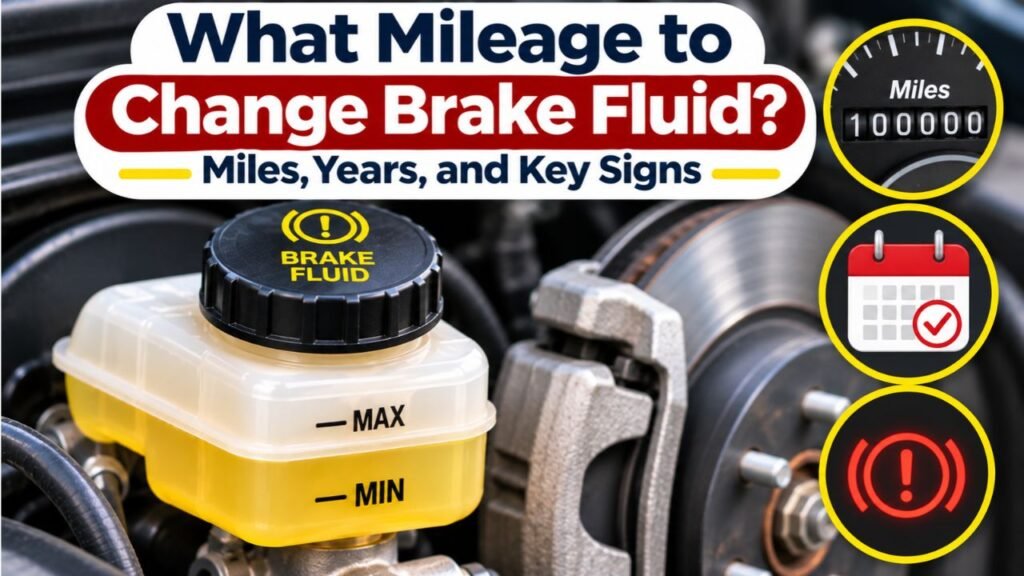
What Mileage to Change Brake Fluid? Miles, Years, and Key Signs
Many automotive maintenance guides recommend changing brake fluid around every 30,000 miles or two years, but there is no universal mileage interval that applies to every vehicle. Some manufacturers specify replacement every three years regardless of mileage, while others use longer intervals, such as 48,000 miles or four years, whichever comes first.
Brake fluid is different from engine oil because mileage alone doesn’t accurately describe its condition. Most passenger vehicles use glycol-based brake fluid, which gradually absorbs moisture. That means a car driven only 5,000 miles in three years may still need a brake fluid change, even though it has accumulated very little mileage.
The correct replacement schedule depends on the manufacturer’s requirements, brake fluid specification, operating conditions, and maintenance history.
Following that schedule helps preserve the fluid’s boiling-point performance and protect internal hydraulic brake components.
In this article, I explain what mileage to change brake fluid, how mileage and time-based intervals work, and why different manufacturers recommend different schedules. You’ll also learn when to inspect or test brake fluid, how to identify overdue maintenance, and when a complete brake fluid flush is necessary.
What Mileage to Change Brake Fluid? Quick Answer
Around 30,000 miles is a common general maintenance guideline, but the correct brake fluid replacement mileage is the interval specified by your vehicle manufacturer.
For some vehicles, the interval is determined entirely by time rather than mileage.
Brake Fluid Replacement Interval Chart
| Maintenance recommendation | Mileage interval | Time interval | Important note |
| AAA general maintenance guidance | Around 30,000 miles | Around 2 years | General advice, not a universal manufacturer requirement |
| 2026 Honda CR-V | Maintenance Minder code 7 | No later than 3 years without the reminder | Follow the vehicle’s Maintenance Minder and time limit |
| Example 2026 Hyundai U.S. schedule | 48,000 miles | 4 years | Whichever comes first |
| Vehicle with a different manufacturer schedule | Model-specific | Model-specific | Consult the owner’s manual |
| Fluid contaminated or hydraulic system unsafe | No minimum mileage | Immediate inspection | Do not wait for a scheduled interval |
These examples demonstrate why different cars may require replacement at different mileage readings.
A vehicle with a 48,000-mile interval doesn’t automatically need a flush at 30,000 miles.
Similarly, a vehicle requiring replacement every three years shouldn’t wait until reaching a mileage target if the time limit has already passed.
Is 30,000 Miles a Good Time to Change Brake Fluid?
For vehicles whose manufacturers recommend that interval, yes.
AAA’s time-based car maintenance checklist includes replacing transmission and brake fluids at approximately 30,000 miles or two years as general maintenance guidance.
However, this recommendation shouldn’t override the vehicle’s specific service schedule.
What if the Owner’s Manual Doesn’t Give a Mileage?
Check whether the manufacturer specifies a time interval or an electronic maintenance reminder.
Some vehicles rely on calendar time or a maintenance monitoring system rather than a fixed odometer reading.
Key Takeaway: Don’t use 30,000 miles as a universal rule. Check the manufacturer-specified interval and follow whichever mileage, time, or maintenance reminder requirement applies.
Why Brake Fluid Replacement Depends on Time and Mileage
Brake fluid doesn’t deteriorate in exactly the same way as engine oil.
Engine oil experiences combustion-related contamination, engine heat, and mechanical operation.
Brake fluid operates in a sealed hydraulic system, but that system isn’t completely immune to moisture entering over time.
Why Does Brake Fluid Absorb Moisture?
Most modern passenger vehicles use DOT 3, DOT 4, or DOT 5.1 glycol-based brake fluids.
These fluids are hygroscopic, meaning they can absorb moisture.
Water can gradually enter the system through certain hoses, seals, reservoir components, and service openings.
The process can occur even when the vehicle isn’t driven regularly.
What Happens When Moisture Builds Up?
As moisture accumulates, the brake fluid’s boiling point generally decreases.
During heavy braking, temperatures within the braking system may rise substantially.
If the fluid becomes hot enough to produce vapor, the brake pedal may become soft or lose effective hydraulic pressure transmission.
Moisture can also contribute to internal corrosion.
Why Mileage Doesn’t Tell the Whole Story
Consider two vehicles.
Vehicle A
- Has traveled 60,000 miles.
- Had its brake fluid replaced one year ago.
- Has a manufacturer-recommended three-year interval.
Vehicle B
- Has traveled only 8,000 miles.
- Has not had brake fluid replacement for four years.
- Has a three-year interval.
Vehicle A may not need another routine brake fluid replacement yet.
Vehicle B is overdue despite having much lower mileage.
The age of the fluid matters more than the total mileage displayed on the odometer in this example.
Does Brake Fluid Wear Out From Driving?
Brake fluid doesn’t get consumed during normal braking like gasoline.
However, high temperatures, contamination, moisture, and hydraulic system conditions can affect its performance.
Frequent demanding braking may justify additional inspections or more frequent service where recommended by the manufacturer.
Brake Fluid Replacement Intervals by Manufacturer
Manufacturers use different maintenance schedules.
Even vehicles from the same brand may have different requirements based on model, model year, market, and braking-system design.
Honda Brake Fluid Replacement Interval
Honda frequently uses a three-year time-based replacement requirement.
For example, the official 2026 Honda CR-V owner’s manual maintenance schedule identifies Maintenance Minder sub-item 7 as brake fluid replacement.
If the reminder doesn’t appear within 36 months after the brake fluid service reminder was reset, Honda instructs owners to change the fluid every three years.
This means mileage alone doesn’t determine when the service is due.
A Honda driven only a few thousand miles annually may still require replacement after three years.
Hyundai Brake Fluid Replacement Interval
Hyundai schedules vary by vehicle and model year.
For example, one official 2026 Hyundai U.S. maintenance schedule specifies:
- Inspect brake fluid every 8,000 miles or 12 months.
- Replace brake fluid every 48,000 miles or 48 months.
The replacement requirement applies when either limit is reached.
Not every Hyundai model uses this exact schedule, so confirm the instructions for your vehicle.
Ford Brake Fluid Replacement Interval
Some Ford vehicles specify brake fluid replacement primarily by calendar time.
For example, certain Mustang Mach-E maintenance schedules require brake fluid changes every three years.
However, Ford maintenance requirements vary by model and year.
Use the vehicle’s official owner documentation rather than applying another Ford model’s interval automatically.
Toyota Brake Fluid Replacement Interval
Toyota maintenance schedules can vary by model, market, and year.
Some schedules emphasize periodic brake inspections, while others may specify fluid replacement requirements.
Do not assume every Toyota requires a brake fluid flush at exactly 30,000 miles.
Check the maintenance guide for the specific vehicle.
BMW Brake Fluid Replacement Interval
BMW vehicles commonly use time-based service reminders for brake fluid.
The actual interval should be checked through the vehicle’s service information and the schedule for its model year.
If the vehicle displays a brake fluid service warning, don’t ignore it simply because the odometer reading is low.
Chevrolet, Nissan, Subaru, and Other Vehicles
These manufacturers also use model-specific maintenance requirements.
Certain vehicles use mileage-based intervals, others use calendar-based intervals, and some include operating-condition considerations.
Rather than relying on a brand-wide generalization, confirm the exact model and year.
Key Takeaway: Manufacturer instructions take priority over general mileage recommendations. A service interval from one vehicle should not automatically be applied to another.
Should You Change Brake Fluid Every 2 or 3 Years?
For many vehicles, yes, but not universally.
Two- and three-year schedules are commonly discussed because glycol-based fluid can absorb moisture over time.
However, some manufacturers specify longer intervals, and some vehicles use condition-based maintenance.
Every Two Years
A two-year interval can be appropriate when specified by the manufacturer or supported by a vehicle-specific service program.
It may also be adopted as a conservative maintenance approach for certain vehicles, but that doesn’t establish it as a universal requirement.
Every Three Years
A three-year interval is used by a number of manufacturers.
For example, Honda specifies a maximum three-year interval in the CR-V maintenance instructions described above if the Maintenance Minder doesn’t call for service sooner.
Every Four Years
Some manufacturer schedules extend to four years.
The Hyundai example above calls for replacement at 48,000 miles or 48 months, whichever comes first.
Is It Better to Change Brake Fluid Early?
Replacing brake fluid earlier than the manufacturer’s schedule can be reasonable in certain conditions.
However, unnecessary service also involves cost, fluid handling, and the risk of mistakes during the procedure.
Follow the manufacturer’s requirements and consider earlier service when testing or operating conditions justify it.
Should You Change Brake Fluid at 20,000 Miles?
Not automatically.
At 20,000 miles, the need for brake fluid replacement depends on the age of the fluid and the vehicle’s schedule.
For example, a car driven 20,000 miles over four years may already be overdue under a three-year requirement.
Another car driven 20,000 miles in a single year may not yet be due.
When Replacement May Be Necessary
A fluid change may be appropriate if:
- The manufacturer specifies an interval already reached.
- The time-based limit has passed.
- Testing indicates unacceptable fluid condition.
- The braking system requires related maintenance.
- The fluid is contaminated.
When It May Be Unnecessary
If the fluid was replaced recently and the car is still within its required maintenance interval, another complete exchange may not be necessary.
Should You Change Brake Fluid at 30,000 Miles?
Thirty thousand miles is a useful checkpoint for reviewing brake fluid maintenance.
However, it is not a universal replacement requirement.
Example 1: The Car Is Two Years Old
If the manufacturer specifies 30,000 miles or two years, the service is due when either threshold is reached.
Example 2: The Car Is Only One Year Old
If the car has traveled 30,000 miles in one year, a mileage-based 30,000-mile replacement requirement would be reached.
However, a manufacturer with a time-only three-year requirement may have different instructions.
Example 3: The Fluid Was Recently Changed
If the brake fluid was replaced at 20,000 miles and the odometer now reads 30,000 miles, only 10,000 miles have passed since the last service.
Whether another flush is necessary depends on the specified maintenance interval and the time since replacement.
Key Takeaway: At 30,000 miles, check the brake fluid service history and manufacturer schedule rather than ordering a flush solely because the odometer has reached that number.
Should You Change Brake Fluid at 40,000 or 50,000 Miles?
It depends on the maintenance history.
A car reaching 40,000 or 50,000 miles for the first time without any brake fluid replacement deserves a review of its maintenance schedule.
However, a recently serviced car with the same mileage may not be due.
Example: A 48,000-Mile Interval
Suppose a vehicle requires replacement every 48,000 miles or four years.
If the car reaches 48,000 miles after three years, the service is due because the mileage requirement has been met.
If it reaches only 25,000 miles after four years, the time requirement has been met.
What if You’re at 45,000 Miles?
Check the exact manufacturer’s requirement.
You may be approaching a scheduled service, already overdue due to time, or still within the interval.
Mileage without the fluid’s age doesn’t provide the complete answer.
Do You Need to Change Brake Fluid at 60,000 Miles?
Many vehicles will have required at least one brake fluid replacement by 60,000 miles, depending on how long they took to reach that mileage.
However, the odometer alone doesn’t reveal the fluid’s age.
Example: Regular Maintenance
Suppose your vehicle follows a three-year brake fluid interval.
The fluid was last changed at 45,000 miles, two years ago.
Now the odometer shows 60,000 miles.
The fluid may still be within the scheduled service period.
Example: No Previous Fluid Change
Suppose your vehicle has 60,000 miles and no documented brake fluid replacement.
If it has already exceeded its manufacturer-specified service interval, the service is overdue.
Arrange an inspection and review the records.
What About 100,000 Miles?
A car with 100,000 miles shouldn’t automatically need a fluid change just because of that milestone.
What matters is the maintenance completed along the way.
If the brake fluid has never been replaced, determine the manufacturer’s requirements and arrange appropriate service promptly.
What Does “Whichever Comes First” Mean?
Some manufacturers specify both mileage and calendar time.
When a schedule says 30,000 miles or two years, whichever comes first, the service becomes due as soon as either limit is reached.
Example: High-Mileage Driver
Suppose you drive 25,000 miles annually.
Under a 30,000-mile or two-year schedule, you’ll reach 30,000 miles in approximately 14.4 months.
The mileage limit comes first.
Example: Low-Mileage Driver
Suppose you drive only 5,000 miles annually.
After two years, you’ll have traveled approximately 10,000 miles.
The calendar limit comes first.
Example: Average Driving
Suppose your vehicle has a 48,000-mile or four-year requirement and you drive 12,000 miles annually.
Both limits would be reached at approximately the same time.
However, actual driving varies, so record both the service date and odometer reading.
Mileage and Time Calculation
When a manufacturer gives both limits:
Next mileage due = Mileage at last service + Mileage interval
Next date due = Date of last service + Time interval
The service is due at whichever threshold occurs first.
For example:
- Last replacement: 42,000 miles.
- Mileage interval: 30,000 miles.
- Time interval: 2 years.
The next mileage threshold is:
42,000 + 30,000 = 72,000 miles
But if two years pass before the car reaches 72,000 miles, the service is due based on time.
Why You May Need Brake Fluid Replacement Before the Mileage Interval
The normal replacement schedule assumes the hydraulic system is in appropriate condition.
Certain problems require inspection regardless of mileage.
Brake Fluid Contamination
If the fluid has been contaminated with an incompatible substance, a routine maintenance interval no longer applies.
Petroleum-based fluids, for example, can damage seals in braking systems designed for glycol-based brake fluid.
Contamination requires prompt professional evaluation.
Moisture-Related Deterioration
Excessive moisture can reduce the fluid’s boiling point and contribute to corrosion.
Appropriate testing may identify a problem before the scheduled replacement.
Brake Hydraulic Repairs
A hydraulic repair may require bleeding or exchanging fluid.
Examples include replacing:
- Brake hoses.
- Calipers.
- Master cylinders.
- Certain brake lines.
- Hydraulic ABS components.
The correct procedure depends on the component and vehicle.
Heavy Braking Conditions
Frequent mountain descents, towing, or other demanding use can increase brake temperatures.
If the manufacturer provides severe-service guidance, follow it.
However, these driving conditions don’t automatically mean every vehicle requires an arbitrary shorter mileage interval.
Unknown Maintenance History
If you recently purchased a used car and don’t know when the fluid was last changed, review the records and have its condition evaluated.
A professional inspection can help determine whether replacement is appropriate.
How to Tell if Brake Fluid Needs Changing
Brake fluid can deteriorate without producing obvious symptoms.
Therefore, normal pedal feel doesn’t prove the fluid is still within its recommended service interval.
Signs That Deserve Attention
| Observation | Possible meaning | Recommended response |
| Replacement interval has passed | Scheduled maintenance overdue | Arrange fluid replacement |
| High moisture reading | Possible fluid deterioration | Confirm with suitable testing |
| Fluid appears heavily contaminated | Possible aging or contamination | Inspect and diagnose |
| Brake warning light | Hydraulic or other brake-system problem | Investigate promptly |
| Spongy brake pedal | Air, vapor, leaks, or other faults | Stop using vehicle if braking is unsafe |
| Pedal sinks abnormally | Possible serious hydraulic fault | Do not drive |
| Fluid level drops unexpectedly | Pad wear or hydraulic leak | Inspect brake system |
| Recent hydraulic repair | Bleeding may be required | Follow repair procedure |
Does Dark Brake Fluid Need Replacing?
Dark or cloudy brake fluid may warrant inspection.
However, color isn’t a reliable measurement of moisture content or boiling point.
Some fluid formulations darken differently over time.
Use the maintenance schedule and appropriate testing rather than relying on appearance alone.
Can Brake Fluid Be Bad Without Symptoms?
Yes.
Moisture contamination can occur before the driver notices a difference in normal braking.
The problem may become more apparent during demanding braking, when the hydraulic system becomes hotter.
Does a Soft Brake Pedal Mean It’s Time for a Flush?
Not necessarily.
A soft pedal may be caused by trapped air, fluid vapor, or mechanical and hydraulic faults.
A simple fluid exchange won’t necessarily solve those problems.
If braking performance is reduced, the pedal sinks, or a hydraulic leak is suspected, don’t drive the vehicle. Arrange professional inspection or towing.
Can You Test Brake Fluid Instead of Replacing It?
Testing can help assess brake fluid condition, but it doesn’t automatically replace manufacturer-specified maintenance.
Different tests evaluate different characteristics.
Moisture Content Testing
Some electronic brake fluid testers estimate moisture contamination.
These can provide an indication of fluid condition.
However, inexpensive conductivity-based testers can be influenced by fluid formulation and other factors.
Results should be interpreted carefully.
Boiling-Point Testing
Professional equipment can estimate or measure brake fluid boiling-point performance.
This may provide useful evidence about whether fluid has deteriorated.
However, a test result from the reservoir may not fully describe conditions in every hydraulic component.
Test Strips
Some brake fluid test strips assess particular chemical indicators or contamination-related conditions.
They don’t necessarily measure the same properties as an electronic moisture tester.
Is a 3% Moisture Reading Too High?
A reading around 3% moisture is commonly treated as a reason for concern in brake fluid service discussions.
However, not every tester measures moisture directly or accurately enough to make a definitive decision.
Use a test method appropriate for the fluid and follow the vehicle manufacturer’s service requirements.
Should You Skip a Scheduled Change if the Fluid Tests Good?
Not automatically.
If the manufacturer requires replacement after a specified time or mileage, a favorable test result doesn’t necessarily override that requirement.
Testing is particularly helpful when the service history is unknown or contamination is suspected.
Brake Fluid Flush vs. Top-Off vs. Brake Bleeding
Understanding these services can help you avoid unnecessary or incomplete maintenance.
Brake Fluid Top-Off
A top-off adds fluid to the reservoir.
It doesn’t replace old fluid within the hydraulic lines, calipers, or ABS components.
It also doesn’t repair leaks.
Brake Fluid Flush
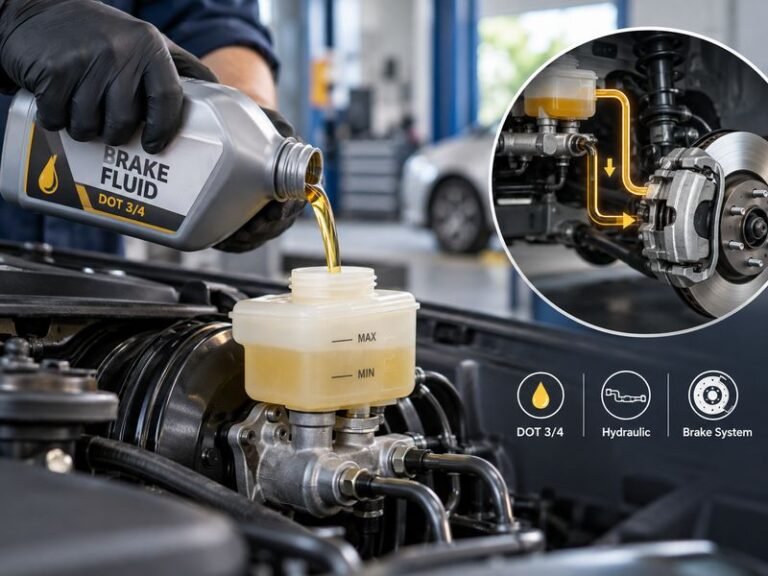
A full brake fluid replacement exchanges old fluid for fresh, manufacturer-approved fluid throughout the specified hydraulic circuits.
For scheduled maintenance, this is generally the intended service.
Brake Bleeding
Brake bleeding removes trapped air from the hydraulic system.
It may be performed after certain repairs or as part of a full fluid exchange.
A limited bleed doesn’t necessarily replace all the old brake fluid.
Does Changing Brake Pads Require a Fluid Flush?
Not automatically.
Ordinary brake pad replacement often doesn’t require opening the hydraulic system.
However, the fluid may independently be due for replacement under the vehicle’s maintenance schedule.
If a hydraulic component is opened or repaired, bleeding may be required.
Does Replacing Brake Fluid Fix a Spongy Pedal?
It may help if degraded fluid or trapped air is the cause.
However, a soft pedal can also indicate leaks or component failures.
The underlying problem must be diagnosed.
What Brake Fluid Should You Use at the Scheduled Mileage?
Use the specification stated in the owner’s manual and any applicable manufacturer service information.
Common brake fluid classifications include:
- DOT 3.
- DOT 4.
- DOT 4 LV.
- DOT 5.
- DOT 5.1.
DOT 3
DOT 3 is a common glycol-based brake fluid used in vehicles requiring that specification.
DOT 4
DOT 4 is also glycol-based and has higher minimum dry and wet boiling-point requirements than DOT 3.
However, this doesn’t mean it is approved for every vehicle that specifies DOT 3.
DOT 4 LV
DOT 4 low-viscosity formulations are designed to meet particular fluid-flow requirements.
Some modern ABS and electronic stability systems require this type of fluid.
Ordinary DOT 4 isn’t automatically equivalent to DOT 4 LV.
DOT 5
DOT 5 is silicone-based.
It must not be mixed with conventional glycol-based DOT 3, DOT 4, or DOT 5.1 fluids.
DOT 5.1
DOT 5.1 is generally glycol-based despite the similar name to DOT 5.
Use it only when compatible with the vehicle’s requirements.
Can You Mix DOT 3 and DOT 4 at the Service Interval?
Standard DOT 3 and DOT 4 fluids are generally chemically compatible, but mixing doesn’t guarantee that the resulting fluid meets the vehicle’s required specification.
For a scheduled replacement, use the manufacturer’s approved fluid instead of creating an unverified blend.
Do Electric and Hybrid Cars Need Brake Fluid Changes?
Yes, vehicles with hydraulic braking systems may still require brake fluid maintenance, including electric and hybrid vehicles.
Regenerative braking doesn’t eliminate the need for hydraulic brake components.
How Regenerative Braking Changes Brake Use
Electric and hybrid vehicles can recover some energy through regenerative braking.
This may reduce the use of conventional friction brakes in certain driving situations.
However, it doesn’t prevent moisture from entering glycol-based hydraulic brake fluid over time.
Do EVs Need Less Frequent Brake Fluid Changes?
Not automatically.
The service interval depends on the manufacturer.
For example, a time-based three-year requirement remains relevant even when regenerative braking reduces friction brake use.
Are Hybrid Vehicles Different?
Hybrid vehicles also use hydraulic braking components, sometimes combined with more complex electronic braking systems.
Their maintenance may require specialized procedures and equipment.
Follow the model-specific service instructions.
Key Takeaway: Reduced brake pad wear doesn’t necessarily mean brake fluid can remain in service longer. Brake fluid maintenance and friction-material wear are separate considerations.
How to Check When Your Brake Fluid Was Last Changed
A simple maintenance history can prevent both overdue service and unnecessary early replacement.
Step 1: Check the Owner’s Manual
Identify the required mileage, time, or service reminder interval.
Make sure the manual matches the vehicle’s model year and market.
Step 2: Review Service Records
Look for terms such as:
- Brake fluid replacement.
- Brake fluid exchange.
- Brake hydraulic fluid flush.
- Brake bleeding.
- Brake system service.
Remember that a simple brake bleed isn’t always equivalent to a complete fluid exchange.
Step 3: Check the Service Date
Determine how many months or years have passed since the last replacement.
Step 4: Check the Odometer Reading at the Last Service
If the schedule is mileage-based, calculate the distance traveled since the fluid change.
Step 5: Check the Maintenance Reminder
Some vehicles have a brake fluid service code or reminder.
Follow the manufacturer’s instructions for interpreting and resetting it.
Step 6: Record the Next Due Interval
Keep a maintenance entry containing:
- Service date.
- Odometer reading.
- Brake fluid specification.
- Shop or technician.
- Work performed.
- Next due date or mileage.
This makes future maintenance decisions easier.
How Much Does Brake Fluid Replacement Cost?
A routine brake fluid replacement is usually less expensive than repairing major hydraulic braking components.
However, prices vary by vehicle, location, service provider, and the procedures required.
What Affects the Price?
Common factors include:
- Local labor rates.
- Brake fluid specification.
- Amount of fluid required.
- Specialized ABS bleeding requirements.
- Access to brake bleeder screws.
- Corrosion or damaged components.
- Additional repairs.
A straightforward brake fluid exchange is different from repairing a leaking caliper or replacing a master cylinder.
Can You Change Brake Fluid Yourself?
An experienced DIY mechanic may be able to perform certain brake fluid exchanges with the correct tools and service information.
However, improper bleeding can leave air in the hydraulic system and compromise braking performance.
Some vehicles require specialized electronic bleeding procedures.
If you’re not familiar with hydraulic brake servicing, professional replacement is the safer choice.
Is It Worth Changing Brake Fluid Early?
If the fluid is contaminated or requires replacement under the manufacturer’s schedule, yes.
However, changing it much earlier without a specific reason may add unnecessary expense.
Base your decision on the vehicle’s requirements, service history, and verified condition.
Common Mistakes When Choosing Brake Fluid Replacement Mileage
Assuming Every Car Needs a Flush at 30,000 Miles
Thirty thousand miles is a general guideline, not a universal manufacturer requirement.
Some vehicles have longer schedules or time-only requirements.
Ignoring Calendar Time
A low-mileage car may still be overdue.
Brake fluid moisture absorption doesn’t stop when the vehicle is parked.
Counting Total Mileage Instead of Mileage Since the Last Change
If the fluid was changed at 40,000 miles, a 30,000-mile service interval would generally be measured from that service, not from the vehicle’s original zero-mile reading.
Confusing Brake Pad Replacement With Fluid Replacement
Brake pads and brake fluid have different maintenance requirements.
One service doesn’t automatically replace the other.
Assuming Dark Fluid Proves Failure
Color alone doesn’t establish moisture content or boiling-point performance.
Use appropriate inspections and testing.
Adding Fluid Instead of Investigating a Leak
An unexpectedly low brake fluid level may indicate a hydraulic leak or worn pads.
A top-off doesn’t repair the cause.
Using the Wrong Brake Fluid Specification
Using an incompatible or unsuitable fluid can compromise the braking system.
Verify the exact requirement before adding or replacing fluid.
Relying on a Cheap Tester Instead of the Maintenance Schedule
A basic electronic tester may provide useful information, but it doesn’t automatically override the manufacturer’s replacement interval.
Ignoring Abnormal Brake Pedal Feel
A sinking or unusually soft brake pedal may indicate a serious hydraulic problem.
Don’t postpone an inspection until the next scheduled mileage.
Brake Fluid Maintenance Checklist
Before your next service, review the following:
- Identify the vehicle’s make, model, and year.
- Check the official brake fluid replacement schedule.
- Determine whether the interval is mileage-based, time-based, or reminder-based.
- Find the last brake fluid replacement date.
- Record the odometer reading at the last replacement.
- Calculate the next due date and mileage.
- Verify the required DOT brake fluid specification.
- Check for warning lights or abnormal brake pedal feel.
- Have unexplained low fluid or suspected leaks inspected.
- Request a complete manufacturer-specified fluid exchange when due.
- Keep a record of the completed service.
Conclusion
Around 30,000 miles or two years is a common general brake fluid replacement guideline, but the correct interval depends on your vehicle’s manufacturer.
Some vehicles use a three-year time-based requirement, while others specify a longer mileage and time interval. For example, a 2026 Hyundai maintenance schedule specifies 48,000 miles or 48 months, whichever comes first.
Unlike engine oil, glycol-based brake fluid can absorb moisture even when a vehicle isn’t driven regularly. This makes calendar time an important part of brake fluid maintenance.
I recommend checking your vehicle’s official maintenance schedule, recording when the fluid was last changed, and following the applicable mileage or time limit. If contamination, leaks, or abnormal braking symptoms appear, arrange an inspection without waiting for the next scheduled service.
The best answer to what mileage to change brake fluid is the manufacturer-specified interval—not a mileage number applied to every car.
FAQs About What Mileage to Change Brake Fluid
At What Mileage Should Brake Fluid Be Changed?
Around 30,000 miles is a commonly cited general maintenance guideline.
However, some manufacturers specify different intervals, such as 48,000 miles or four years, while others use time-based requirements without a fixed mileage.
Follow your vehicle’s maintenance schedule.
Should I Change Brake Fluid Every 30,000 Miles?
Only if that interval is appropriate for your vehicle.
Thirty thousand miles is a useful point to review service history, but it isn’t a universal replacement requirement.
Should Brake Fluid Be Changed Every 2 Years?
Some general maintenance guidance recommends replacement every two years.
However, certain manufacturers specify three-year or four-year intervals.
The vehicle’s own schedule should determine the service.
Is Brake Fluid Replacement Necessary Every 3 Years?
For vehicles with a three-year requirement, yes.
Honda, for example, uses a three-year maximum interval in certain Maintenance Minder schedules when a brake fluid service reminder doesn’t appear sooner.
Other manufacturers may specify different intervals.
Can Brake Fluid Last 50,000 Miles?
Possibly, depending on the vehicle’s maintenance schedule and the time elapsed.
However, fluid that has accumulated only 20,000 miles over several years may still be overdue.
Mileage alone isn’t enough to determine whether the fluid remains serviceable.
Should I Change Brake Fluid at 60,000 Miles?
Check when the fluid was last replaced.
If the vehicle has reached or exceeded its specified interval, arrange service.
If the fluid was changed recently and remains within the manufacturer-required interval, another full replacement may not be necessary.
Can Brake Fluid Last 5 Years?
Some vehicles have longer intervals than others, but five years should not be assumed acceptable for every car.
Follow the manufacturer-specified time requirement and consider appropriate testing when the service history is uncertain.
What if I Drive Only 5,000 Miles per Year?
Brake fluid can still absorb moisture over time.
If the manufacturer specifies replacement every three years, for example, the service may be due after approximately 15,000 miles of driving.
What Happens if You Never Change Brake Fluid?
Moisture contamination can reduce boiling-point performance and contribute to corrosion within the hydraulic system.
Over time, this may increase the risk of braking problems and expensive component repairs.
Does Brake Fluid Need Changing if the Brakes Feel Fine?
Yes, when required by the maintenance schedule.
Brake fluid can deteriorate without producing an obvious change in everyday pedal feel.
Normal braking doesn’t prove that the fluid meets its required specifications.
Can You Check Brake Fluid Instead of Replacing It?
Testing can help assess fluid condition.
However, a favorable test doesn’t necessarily replace a manufacturer-specified time or mileage requirement.
Use testing alongside the maintenance schedule.
Does a Brake Fluid Flush Include Bleeding?
A proper fluid exchange generally involves moving new fluid through the hydraulic system and ensuring that air isn’t trapped.
However, a separate limited bleeding procedure isn’t necessarily the same as a complete fluid flush.
Do Hybrid and Electric Cars Need Brake Fluid Changes?
Yes, if they use a hydraulic brake system that requires brake fluid maintenance.
Regenerative braking can reduce friction brake use, but it doesn’t eliminate fluid aging.
Follow the vehicle manufacturer’s instructions.
Does Low Brake Fluid Mean It Needs Changing?
Not necessarily.
Low fluid may be caused by brake pad wear or hydraulic leakage.
An unexplained decrease should be investigated rather than treated as a routine fluid replacement issue.
How Do I Know When My Last Brake Fluid Change Was?
Check service invoices, dealership records, maintenance logs, or the vehicle’s service reminder history.
If no reliable record exists, have a qualified mechanic inspect the braking system and review the manufacturer’s replacement schedule.
Can Old Brake Fluid Cause a Spongy Brake Pedal?
Severely moisture-contaminated fluid can produce vapor under high temperatures, potentially affecting pedal feel.
However, a spongy pedal can also indicate trapped air, hydraulic leaks, or component problems.
If braking is compromised, do not drive the vehicle until it has been inspected.