Which Brake Fluid Does Not Absorb Moisture From the Air? Guide
DOT 5 silicone-based brake fluid is the main automotive DOT brake fluid that does not absorb moisture from the air. It is non-hygroscopic, unlike the glycol-based DOT 3, DOT 4, and DOT 5.1 fluids commonly used in passenger vehicles. However, DOT 5 is not a safer substitute for every car simply because it resists water absorption.
Water can still enter a brake system filled with DOT 5. Because silicone fluid does not dissolve that water, it may collect in low points, potentially causing corrosion, freezing problems, or vapor formation during heavy braking. Silicone fluid can also create pedal-feel and compatibility concerns, particularly in brake systems not designed for it.
The distinction between DOT 5 and DOT 5.1 is especially important. Despite their similar names, DOT 5.1 absorbs moisture and is chemically different from DOT 5 silicone fluid. Mixing incompatible brake fluids can compromise braking performance and damage components.
In this guide, I explain which brake fluids absorb moisture, why DOT 5 behaves differently, and the benefits and limitations of silicone fluid. You’ll also learn about boiling points, ABS compatibility, maintenance, and how to choose the correct fluid for your vehicle.
Which Brake Fluid Does Not Absorb Moisture From the Air?
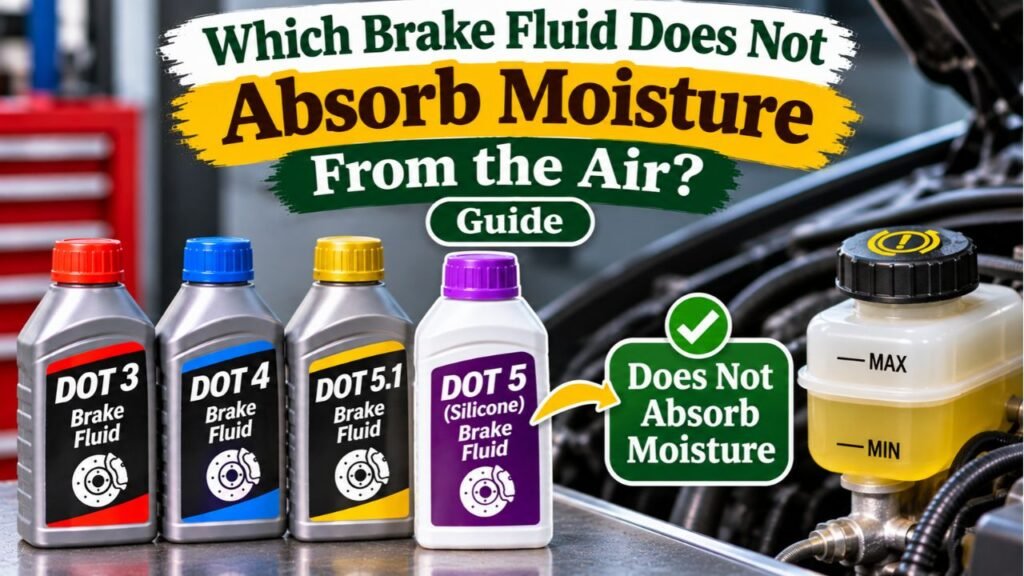
DOT 5 silicone brake fluid is non-hygroscopic, meaning it does not readily absorb or dissolve moisture from the surrounding air.
This property distinguishes it from most conventional automotive brake fluids.
DOT 3, DOT 4, and DOT 5.1 are generally glycol-based and hygroscopic. They gradually absorb moisture during normal service.
DOT 5 uses a silicone-based formulation that behaves differently when exposed to water.
Brake Fluid Moisture Absorption Comparison
| Brake Fluid | Base Chemistry | Absorbs Moisture? | Common Applications |
| DOT 3 | Glycol ether | Yes | Cars and light trucks |
| DOT 4 | Glycol ether/borate ester | Yes | Modern passenger vehicles |
| DOT 5 | Silicone | No, essentially non-hygroscopic | Selected classic, military, and specialty vehicles |
| DOT 5.1 | Glycol-based | Yes | Vehicles requiring higher-performance glycol fluid |
| Mineral hydraulic fluid | Mineral oil | Generally non-hygroscopic | Specialized hydraulic brake systems |
The most important point is that DOT 5 and DOT 5.1 are fundamentally different fluids.
DOT 5 is silicone-based, while DOT 5.1 is glycol-based.
According to TotalEnergies’ technical explanation of brake fluid types, DOT 5 was developed partly for applications requiring long-term storage without the moisture absorption associated with conventional glycol-based fluids.
However, this benefit comes with important limitations.
What Does Non-Hygroscopic Mean?
A non-hygroscopic fluid does not readily absorb moisture from the surrounding atmosphere.
In brake systems, silicone-based DOT 5 does not dissolve water the way glycol-based fluids do.
That is beneficial for retaining certain fluid properties during storage.
However, it does not make the entire braking system waterproof.
Does DOT 5 Repel Water?
DOT 5 is hydrophobic, meaning water does not readily mix with it.
If water enters the hydraulic system, it can remain separate from the silicone fluid.
That can create localized problems rather than allowing water to become distributed throughout the fluid.
Key Takeaway: DOT 5 silicone brake fluid does not absorb atmospheric moisture, but it does not prevent water from entering or damaging a braking system.
What Is DOT 5 Silicone Brake Fluid?
DOT 5 is a silicone-based hydraulic brake fluid formulated for applications designed or specifically approved to use it.
Its chemistry differs from conventional glycol-based brake fluid.
Main Characteristics of DOT 5
DOT 5 generally provides:
- Very low moisture absorption
- High standardized boiling-point performance
- Good stability during appropriate storage
- Less aggressive effects on many painted finishes
- A distinctive silicone-based formulation
However, it also has limitations related to air handling, water separation, and compatibility with certain braking systems.
What Color Is DOT 5 Brake Fluid?
Under U.S. federal brake-fluid specifications, silicone-based DOT 5 fluid is identified by a purple color.
Conventional DOT 3, DOT 4, and DOT 5.1 fluids are generally colorless to amber.
However, fluid color should not be the only way to identify what is inside a vehicle.
Aged fluid may change appearance, and contamination can alter its color.
Use the vehicle manufacturer’s specification and reliable service records.
Where Is DOT 5 Commonly Used?
DOT 5 silicone brake fluid has historically been associated with:
- Certain military vehicles
- Some classic vehicles
- Selected collector vehicles
- Certain specialty hydraulic systems
However, not every classic car or specialty vehicle can safely use it.
The brake system must be designed or specifically approved for silicone fluid.
Is DOT 5 Used in Modern Passenger Cars?
It is uncommon in mainstream passenger vehicles.
Most modern cars specify glycol-based DOT 3, DOT 4, or DOT 5.1 fluid.
One reason is that silicone fluid has different air-handling and hydraulic characteristics.
Vehicle manufacturers select brake fluids based on the entire braking system, including seals, valves, hydraulic controls, and temperature requirements.
Key Takeaway: DOT 5 is a specialized silicone brake fluid, not a universal upgrade for ordinary passenger cars.
Why Does DOT 5 Brake Fluid Not Absorb Moisture?
The answer comes from its chemical composition.
Most conventional automotive brake fluids use glycol-based compounds that interact with water.
Silicone-based DOT 5 has a different molecular structure and does not readily dissolve moisture.
How Glycol Brake Fluid Behaves
DOT 3, DOT 4, and DOT 5.1 fluids are hygroscopic.
When water enters these fluids, it can become distributed throughout the liquid.
This helps prevent small amounts of water from immediately collecting as a separate layer.
However, increasing moisture generally reduces the fluid’s boiling point.
Over time, the braking system may lose some of its resistance to vapor formation during high-temperature operation.
How Silicone Brake Fluid Behaves
DOT 5 silicone fluid does not readily absorb water.
As a result, its bulk boiling-point properties are not reduced through uniform water absorption in the same way as glycol-based fluids.
However, any water that enters may remain separate.
That water can collect in parts of the hydraulic system.
Why Is That Important?
The behavior of water matters because brake components experience heat, pressure, and temperature changes.
Separate water in the system can potentially:
- Promote internal corrosion
- Freeze in extremely cold conditions
- Form vapor when sufficiently heated
- Interfere with consistent hydraulic performance
Therefore, non-hygroscopic fluid has benefits, but water separation also creates risks.
Key Takeaway: DOT 5 resists moisture absorption because of its silicone chemistry. That does not eliminate the hazards of free water inside the hydraulic system.
DOT 5 vs. DOT 5.1: Which One Absorbs Moisture?
DOT 5 does not readily absorb water, while DOT 5.1 does.
This is one of the most important distinctions in automotive brake-fluid specifications.
The names are similar, but their chemistry is different.
DOT 5 vs. DOT 5.1 Comparison
| Feature | DOT 5 | DOT 5.1 |
| Fluid base | Silicone | Glycol-based |
| Hygroscopic | No | Yes |
| Water behavior | Water remains separate | Water is absorbed into the fluid |
| Common color specification | Purple | Colorless to amber |
| Typical use | Selected specialty systems | Compatible conventional hydraulic brake systems |
| Compatibility with DOT 3 or DOT 4 | Not for routine mixing | Generally chemically compatible, subject to vehicle approval |
| ABS suitability | Often not recommended unless specifically approved | Commonly formulated for ABS-compatible applications |
| Maintenance | Follow system-specific instructions | Requires scheduled fluid replacement |
Why Is DOT 5.1 Glycol-Based?
DOT 5.1 was developed to provide certain higher-performance characteristics while retaining the chemistry used in conventional glycol-based braking systems.
This allows suitable DOT 5.1 formulations to be used in vehicles designed for compatible glycol-based fluids.
However, the manufacturer may specify additional requirements, including viscosity or product approvals.
Can DOT 5.1 Replace DOT 5?
No.
DOT 5.1 should not be treated as a direct substitute for silicone-based DOT 5.
They use different base chemistries and are not intended for routine mixing.
Can DOT 5 Replace DOT 5.1?
No.
If a vehicle specifies DOT 5.1, adding DOT 5 silicone fluid can compromise the braking system.
Never choose a brake fluid solely because its DOT number appears similar or higher.
Key Takeaway: DOT 5 is silicone and non-hygroscopic. DOT 5.1 is glycol-based and hygroscopic, despite the similar name.
DOT 3 vs. DOT 4 vs. DOT 5 vs. DOT 5.1 Boiling Points
Brake fluid must remain effective under the high temperatures that can develop during braking.
Different DOT classifications establish minimum boiling-point performance requirements.
Brake Fluid Boiling Point Chart
| Fluid Type | Minimum Dry Boiling Point | Minimum Wet Boiling Point |
| DOT 3 | 401°F (205°C) | 284°F (140°C) |
| DOT 4 | 446°F (230°C) | 311°F (155°C) |
| DOT 5 silicone | 500°F (260°C) | 356°F (180°C) |
| DOT 5.1 non-silicone | 500°F (260°C) | 356°F (180°C) |
These are minimum standardized requirements rather than the exact boiling points of every commercial product.
The values and labeling requirements are described in the U.S. Federal Motor Vehicle Safety Standard No. 116.
What Is Dry Boiling Point?
Dry boiling point measures the fluid’s boiling resistance under specified conditions before standardized moisture conditioning.
A higher dry boiling point generally provides greater resistance to boiling when the fluid is fresh.
However, real-world performance depends on the product and operating conditions.
What Is Wet Boiling Point?
Wet boiling point is a standardized measure of boiling performance after a prescribed moisture-conditioning test.
It does not mean every fluid naturally absorbs the same amount of moisture.
For silicone DOT 5, the standardized wet-boiling-point requirement should not be interpreted as evidence that the fluid is hygroscopic.
Does DOT 5 Always Have a Higher Boiling Point Than DOT 4?
Not necessarily.
DOT 5 has higher minimum standardized boiling-point requirements than ordinary DOT 4.
However, some specialized high-performance DOT 4 products exceed the minimum DOT 5 dry boiling-point requirement.
Compare actual manufacturer specifications rather than assuming the DOT label alone determines every product’s thermal performance.
Key Takeaway: DOT 5 has high standardized boiling-point requirements, but fluid chemistry, compatibility, and system condition are more important than selecting the highest advertised temperature.
What Happens if Water Gets Into DOT 5 Brake Fluid?
Water that enters a DOT 5-filled system can remain separate from the silicone fluid instead of dissolving throughout it.
This is the major drawback of non-hygroscopic brake fluid.
Water Can Accumulate in Low Points
Free water may settle in lower areas of a hydraulic braking system.
Depending on its design, this may include portions of the brake lines, wheel cylinders, or calipers.
Accumulated water can contact metal surfaces and contribute to corrosion.
Water Can Boil During Heavy Braking
Brake calipers and nearby components can become very hot.
If free water reaches a sufficiently high temperature, it may produce vapor.
Vapor is compressible.
When vapor forms in hydraulic lines, pressure transfer can become less effective.
The brake pedal may feel soft or travel farther than normal.
In severe cases, braking effectiveness may be reduced.
Water Can Freeze in Cold Weather
Free water can also freeze under sufficiently cold conditions.
Ice formation inside a hydraulic system can interfere with normal operation.
The risk depends on where water is present and the operating environment.
Is DOT 5 Completely Immune to Moisture Damage?
No.
DOT 5 may resist moisture absorption, but it cannot stop water entering through damaged or aging components.
It also cannot prevent corrosion caused by separate water contamination.
This is why silicone brake fluid still requires proper maintenance.
Key Takeaway: DOT 5 resists water absorption, but any water entering the hydraulic system may create concentrated corrosion or vapor problems.
Is DOT 5 Better Than DOT 3 or DOT 4?
Not universally.
DOT 5 has advantages in certain applications, but it also has characteristics that make it unsuitable for many vehicles.
Advantages of DOT 5 Silicone Brake Fluid
Potential benefits include:
- Resistance to atmospheric moisture absorption
- Stable bulk-fluid boiling characteristics under appropriate conditions
- Good long-term storage characteristics
- Less aggressive effects on painted surfaces than typical glycol fluids
- Suitability for certain specialty brake systems
These advantages may be useful where silicone fluid is specifically approved.
Disadvantages of DOT 5 Silicone Brake Fluid
Important limitations include:
- Water may remain separate and collect in the system.
- Air entrainment or fluid compressibility can affect pedal feel.
- It is not intended for routine mixing with glycol-based fluids.
- It is often unsuitable for ABS systems unless specifically approved.
- Converting a vehicle can require extensive brake-system evaluation.
- It may be difficult to find at ordinary automotive service locations.
Why Do Most Cars Use Glycol-Based Brake Fluid?
Glycol-based fluids offer suitable hydraulic performance, predictable service characteristics, and compatibility with braking systems designed around them.
Their ability to absorb moisture has a disadvantage: boiling resistance declines as water accumulates.
However, absorbing moisture also helps keep small amounts of water dispersed rather than allowing them to collect in one area.
Manufacturers account for these properties when designing brake systems and establishing replacement intervals.
Is Non-Hygroscopic Always Better?
No.
For a braking system, safe fluid performance depends on much more than moisture absorption.
Important characteristics include:
- Boiling resistance
- Viscosity
- Lubrication
- Seal compatibility
- Air-release characteristics
- Corrosion protection
- ABS and stability-control performance
A fluid that resists moisture but does not meet the vehicle’s other requirements is not a suitable choice.
Key Takeaway: DOT 5 is useful in approved applications, but DOT 3, DOT 4, and DOT 5.1 remain the correct choices for vehicles designed to use them.
Can You Use DOT 5 Brake Fluid in an ABS System?
DOT 5 silicone brake fluid is generally not recommended for most ABS-equipped vehicles unless the manufacturer specifically approves it.
Anti-lock braking systems use hydraulic valves and pumps to control braking pressure.
These components require fluid with suitable viscosity, lubrication, and air-handling characteristics.
Why Can Silicone Fluid Be a Problem?
Silicone brake fluid can be more susceptible to certain air-handling and compressibility problems.
Entrained air or unsuitable fluid characteristics can interfere with hydraulic response.
ABS systems operate through rapid, precise hydraulic pressure changes.
Using an unapproved fluid may compromise that performance.
Are All ABS Systems Identical?
No.
Brake-system designs vary considerably.
The correct fluid specification depends on the particular vehicle.
Some modern vehicles specify low-viscosity glycol-based brake fluid for cold-temperature hydraulic response.
A general statement that all DOT 5 fluids are compatible with all ABS systems would be incorrect.
Should You Replace DOT 4 With DOT 5 to Avoid Moisture?
No.
If the manufacturer specifies DOT 4, use the approved DOT 4 fluid.
Switching to silicone fluid without vehicle-specific approval is not a safe maintenance shortcut.
Key Takeaway: For an ABS-equipped vehicle, follow the exact brake-fluid specification. Do not switch to DOT 5 simply to avoid moisture absorption.
Can You Mix DOT 5 With Other Brake Fluids?
DOT 5 silicone fluid should not be mixed with conventional DOT 3, DOT 4, or DOT 5.1 brake fluid during routine vehicle service.
The fluids have different chemical bases.
They are not interchangeable simply because they all carry DOT classifications.
Brake Fluid Mixing Compatibility
| Combination | Recommendation |
| DOT 3 with specified compatible glycol fluid | Only as permitted by vehicle requirements |
| DOT 4 with DOT 5.1 | Chemically compatible in many cases; verify required specifications |
| DOT 3 with DOT 5 silicone | Do not mix |
| DOT 4 with DOT 5 silicone | Do not mix |
| DOT 5.1 with DOT 5 silicone | Do not mix |
| DOT 5 with mineral hydraulic oil | Do not mix |
What Happens if You Mix Incompatible Fluids?
Potential problems include:
- Unpredictable fluid behavior
- Hydraulic performance issues
- Incompatibility with system components
- Contamination
- Reduced braking reliability
The consequences depend on the fluids, contamination level, and braking-system design.
What Should You Do if DOT 5 Was Added by Mistake?
Do not assume the problem can be corrected by adding more glycol-based brake fluid.
Stop using the vehicle and arrange professional assessment.
A technician may need to inspect the system and determine whether fluid replacement or component repairs are necessary.
Do not continue driving if braking performance is uncertain.
Key Takeaway: Use the exact specified brake fluid. Mixing DOT 5 with a conventional glycol-based system is not an acceptable way to improve moisture resistance.
Can You Convert a DOT 3 or DOT 4 Brake System to DOT 5?
A conversion may be possible for certain specialty vehicles, but it should not be treated as a routine brake-fluid flush.
The entire hydraulic system must be evaluated for suitability.
Why Is Conversion Complicated?
A system designed for glycol-based fluid may contain components or operational characteristics that are not suitable for silicone fluid.
Converting the system may require:
- Confirming manufacturer approval
- Evaluating hydraulic seals
- Inspecting brake hoses
- Checking master and wheel cylinders
- Assessing ABS compatibility
- Removing incompatible fluid and contamination
- Using approved parts and procedures
- Performing proper bleeding and testing
For ordinary passenger vehicles, conversion is generally unnecessary and may create additional risks.
Can You Simply Drain DOT 4 and Add DOT 5?
No.
Draining the reservoir alone does not remove all fluid from the brake lines, calipers, ABS components, and other hydraulic passages.
Even a routine fluid exchange does not establish that the system is suitable for a different fluid chemistry.
A conversion should only be considered with proper technical authorization and professional expertise.
What About Classic Cars?
Some classic-car owners prefer silicone brake fluid for long-term storage or paintwork considerations.
However, many classic cars were originally designed for glycol-based fluid.
Age alone does not make a vehicle suitable for DOT 5.
The condition and specifications of the entire hydraulic system must be considered.
Key Takeaway: Switching from glycol-based fluid to DOT 5 is a brake-system compatibility decision, not a simple fluid upgrade.
Does DOT 5 Brake Fluid Last Longer?
DOT 5 can retain some properties longer because it does not absorb atmospheric moisture in the same way as glycol-based fluids.
However, non-hygroscopic does not mean maintenance-free.
Brake-fluid service requirements depend on the vehicle and system.
Does DOT 5 Need to Be Changed Every Two Years?
Not necessarily.
The replacement interval should come from the vehicle or brake-system manufacturer’s instructions.
Some specialty systems may have different service requirements from ordinary passenger vehicles.
However, do not assume silicone brake fluid can remain in service indefinitely.
Why Does DOT 5 Still Need Maintenance?
Several problems can occur over time:
- Free-water contamination
- Corrosion
- Dirt or debris entering the system
- Fluid contamination during servicing
- Aging hydraulic components
- Seal deterioration
- Brake-system leaks
These issues can exist even when the silicone fluid itself has absorbed very little moisture.
How Should DOT 5 Fluid Be Stored?
Keep it in its original container with the cap securely closed.
Store it in a clean, dry location according to the manufacturer’s instructions.
Although DOT 5 does not readily absorb moisture, keeping the container sealed helps prevent dirt, free water, and other contamination.
Key Takeaway: DOT 5 may offer storage advantages, but the braking system still requires inspection and appropriate fluid maintenance.
Are Mineral-Oil Brake Fluids Non-Hygroscopic?
Yes.
Some specialized hydraulic brake systems use mineral-oil-based fluids that do not readily absorb moisture.
However, mineral hydraulic oil is completely different from standard DOT brake fluids.
Where Is Mineral Hydraulic Fluid Used?
Mineral-oil hydraulic fluids are used in certain specialized vehicle systems and some bicycle braking systems.
The exact product depends on the equipment.
Examples include particular hydraulic systems designed specifically for mineral oil rather than glycol-based fluid.
Can You Use Mineral Oil Instead of DOT Brake Fluid?
No. Never substitute ordinary mineral oil for DOT 3, DOT 4, DOT 5, or DOT 5.1 brake fluid.
Mineral oil can damage seals and other components in hydraulic braking systems designed for conventional DOT fluid.
This can lead to leakage and braking failure.
Is Mineral Oil Better Because It Does Not Absorb Water?
Not automatically.
Like silicone fluid, mineral oil may allow free water to remain separate.
That water can still contribute to corrosion, freezing, or vapor-related problems.
The correct fluid is the one specified for the particular hydraulic system.
Key Takeaway: Mineral hydraulic fluids can also be non-hygroscopic, but they are not interchangeable with automotive DOT brake fluids.
How to Choose Brake Fluid for Your Car
The correct brake fluid is determined by the vehicle manufacturer, not by moisture resistance alone.
Step 1: Check the Owner’s Manual
Find the required brake-fluid specification.
It may identify DOT 3, DOT 4, DOT 5.1, or another approved performance requirement.
Some vehicles specify additional low-viscosity or manufacturer-specific standards.
Step 2: Check the Reservoir Cap
Many vehicles print the required DOT specification on or near the brake-fluid reservoir.
Use this information together with the owner’s manual.
Step 3: Select Approved Fluid
Purchase a product that explicitly meets the required specification.
Do not assume DOT 5 is an upgrade over DOT 4 or that DOT 5.1 is a silicone fluid.
Step 4: Use Fresh Fluid
Use brake fluid from a clean, sealed container.
For glycol-based products, minimize exposure to air because they absorb moisture.
Step 5: Follow the Maintenance Schedule
Replace the fluid at the manufacturer’s recommended interval.
A fluid’s moisture-absorption properties do not eliminate the need for proper maintenance.
Step 6: Check for Braking Problems
If the fluid level drops unexpectedly, the pedal becomes soft, or braking performance changes, arrange professional inspection.
Do not assume changing fluid type will repair a hydraulic problem.
Ford’s official brake-fluid guidance specifically cautions that DOT 5 silicone fluid should not be added to vehicles requiring DOT 3 or DOT 4 because brake-system damage can occur.
Key Takeaway: Always prioritize the manufacturer’s required specification over a fluid’s claimed moisture resistance.
Common Misconceptions About Non-Hygroscopic Brake Fluid
DOT 5 Never Contains Water
Incorrect.
DOT 5 does not readily absorb water, but free water can still enter and collect within the braking system.
DOT 5.1 Is Silicone-Based
Incorrect.
DOT 5.1 is generally glycol-based and hygroscopic.
Its name does not make it chemically similar to DOT 5.
DOT 5 Is Suitable for Every Vehicle
Incorrect.
Many modern braking systems require glycol-based fluid.
DOT 5 should only be used where specifically approved.
A Higher DOT Number Always Means Better Fluid
Incorrect.
DOT classifications describe performance requirements, not a universal ranking of suitability.
The correct fluid depends on the braking system.
Non-Hygroscopic Fluid Prevents Corrosion
Not completely.
Free water can still cause corrosion inside a system filled with silicone fluid.
DOT 5 Never Needs Replacing
Incorrect.
Fluid contamination and hydraulic-component deterioration can still occur.
Follow the appropriate maintenance requirements.
Silicone Brake Fluid Makes Brakes Stronger
Not automatically.
Braking performance depends on hydraulic design, friction components, tires, and other factors.
DOT 5 does not inherently increase braking force.
Purple Fluid Is Always Safe to Identify as DOT 5
Not reliably.
Color can help identify a product, but it should not replace the manufacturer’s specification and confirmed service history.
Key Takeaway: Non-hygroscopic describes one fluid characteristic. It does not guarantee safety, compatibility, or longer component life.
Conclusion
The answer to which brake fluid does not absorb moisture from the air is DOT 5 silicone-based brake fluid.
Unlike glycol-based DOT 3, DOT 4, and DOT 5.1 fluids, DOT 5 is non-hygroscopic and does not readily absorb water.
This can help it retain certain properties during appropriate storage and use.
However, water can still enter a braking system filled with silicone fluid.
Because the water remains separate, it may accumulate in low areas, causing corrosion, freezing, or vapor-related braking problems.
DOT 5 also has compatibility limitations and is generally not recommended for most conventional ABS-equipped vehicles unless specifically approved.
It should never be treated as a direct substitute for DOT 3, DOT 4, or DOT 5.1.
Mineral hydraulic fluids can also resist moisture absorption, but they are intended for different systems and must not replace standard DOT brake fluid.
For most modern passenger vehicles, the best brake fluid is the glycol-based product specified by the manufacturer.
Follow the correct maintenance schedule, use fresh approved fluid, and keep the braking system in proper condition.
Moisture resistance is useful, but brake-system compatibility and safety always come first.
FAQs About Brake Fluid That Does Not Absorb Moisture
Which DOT Brake Fluid Does Not Absorb Water?
DOT 5 silicone-based brake fluid is non-hygroscopic, meaning it does not readily absorb water from the air. However, water can still enter the braking system and remain separate from the silicone fluid. DOT 5 should only be used in systems specifically designed or approved for it.
Does DOT 5.1 Brake Fluid Absorb Moisture?
Yes. DOT 5.1 is glycol-based and hygroscopic, like DOT 3 and DOT 4. Despite its similar name, it is chemically different from silicone-based DOT 5. It requires periodic maintenance according to the vehicle manufacturer’s instructions.
Is DOT 5 Better Than DOT 4 for Moisture Protection?
DOT 5 does not absorb moisture like DOT 4, but that does not make it universally better. Water entering a DOT 5-filled system can remain separate and contribute to corrosion or vapor formation. DOT 4 is the correct choice when required by the manufacturer.
Can You Put DOT 5 Brake Fluid in a DOT 3 System?
No, not as a routine replacement or top-up. DOT 5 is silicone-based and should not be mixed with conventional DOT 3 glycol-based fluid. Use the manufacturer’s specified brake fluid. Any proposed conversion requires professional evaluation of the entire hydraulic system.
Is Silicone Brake Fluid Safe for ABS?
DOT 5 silicone fluid is generally not recommended for most ABS systems unless the vehicle manufacturer specifically approves it. Its air-handling and hydraulic characteristics may be unsuitable for systems designed around glycol-based brake fluid.
Does DOT 5 Brake Fluid Last Forever?
No. Although DOT 5 does not readily absorb moisture, water contamination, corrosion, component deterioration, and other hydraulic-system problems can still occur. Follow the applicable maintenance and inspection requirements.
Can DOT 5 Brake Fluid Prevent Brake Line Rust?
It may reduce some moisture-related concerns because it does not absorb atmospheric water, but it cannot completely prevent corrosion. Free water entering the system may collect in low points and corrode metal components. Proper maintenance remains important.
Is There Any Brake Fluid Besides DOT 5 That Does Not Absorb Moisture?
Certain mineral-oil-based hydraulic brake fluids are also non-hygroscopic. However, they are intended for specialized systems and are not compatible with ordinary DOT brake-fluid systems. For automotive DOT classifications, silicone-based DOT 5 is the primary non-hygroscopic option.