Can I Spray WD-40 on Brake Pads? Risks, Squeaks & Safe Fixes
No, you should not spray WD-40 on brake pads, brake rotors, or any other braking friction surface. Brake pads need friction to slow your vehicle, while WD-40 Multi-Use Product leaves a lubricating film that can reduce the grip between the pad and rotor.
This is especially important if you are thinking about using WD-40 on squeaky brakes. The noise may temporarily change after spraying a lubricant, but that does not mean the brake has been repaired. You may simply have reduced the friction that allows the brakes to work properly.
If WD-40 has already reached the pad’s friction material, the safest solution is generally to replace the contaminated pads and clean the rotor with a suitable brake parts cleaner. Automotive brake manufacturers recommend replacement when pad friction material becomes contaminated with oil or grease.
The correct solution for squeaking depends on what is causing the noise. Sometimes the problem is brake dust or contamination. Other times it may involve worn pads, improper bedding, dry caliper contact points, sticking slide pins, glazed surfaces, or worn hardware.
The key is to fix the cause rather than lubricate the braking surface.
Can You Spray WD-40 on Brake Pads?
No. Do not spray WD-40 Multi-Use Product directly onto brake pads.
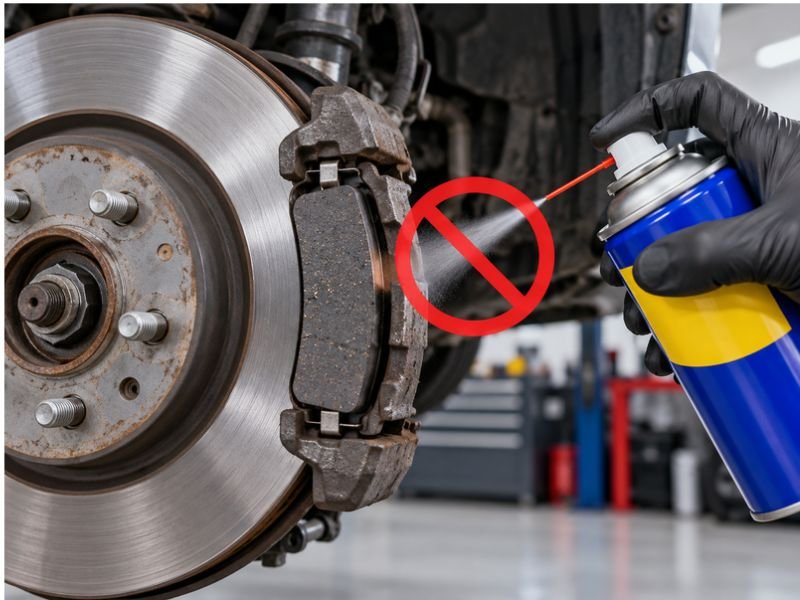
The friction material on a brake pad is specifically designed to grip the brake rotor when the caliper applies pressure.
WD-40 Multi-Use Product is designed to perform jobs such as:
- Lubricating moving components
- Loosening stuck parts
- Displacing moisture
- Protecting metal against corrosion
Those properties are useful for many mechanical jobs, but they are the opposite of what you want between a brake pad and rotor.
Brake manufacturers specifically warn against getting lubricants on the friction side of brake pads or on the rotor.
If you need lubrication during a brake job, it belongs only on approved non-friction contact points, using a lubricant designed for brake systems.
Why Is WD-40 Bad for Brake Pads?
A braking system works by creating controlled friction.
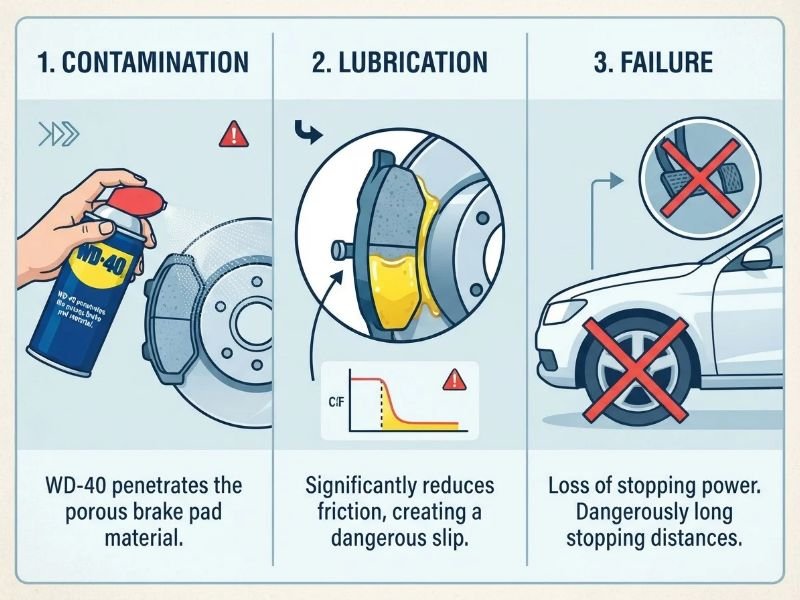
When you press the brake pedal, the caliper presses the pads against the rotor. Friction converts the vehicle’s motion into heat and slows the wheel.
Putting WD-40 between those surfaces can interfere with that process.
Reduced Friction
The most immediate concern is a reduction in the pad’s ability to grip the rotor.
That can lead to:
- Reduced braking effectiveness
- Longer stopping distances
- Uneven braking
- Brake pull
- Unpredictable pedal response
How severe the problem becomes depends on how much contamination occurred and whether one or multiple brakes were affected.
Contaminated Friction Material
Brake pads are not supposed to contain oil or grease on their braking surface.
Once the friction material becomes contaminated, simply wiping the outside of the pad may not restore predictable braking performance.
Wagner’s brake troubleshooting guidance lists oil-, grease-, or brake-fluid-contaminated pads as requiring replacement.
That is why replacing contaminated pads is generally safer than trying to save them with repeated cleaning, heating, or sanding.
The Rotor Can Become Contaminated Too
WD-40 sprayed onto a pad can also transfer onto the rotor.
Even if you spray only the rotor, the pad will contact that surface as soon as the brakes are applied and can pick up the contamination.
For this reason, both sides of the pad-and-rotor interface need attention after an accidental spray.
Can I Spray WD-40 on My Brake Pads to Stop Squeaking?
No. WD-40 should not be used to stop squeaky brake pads.
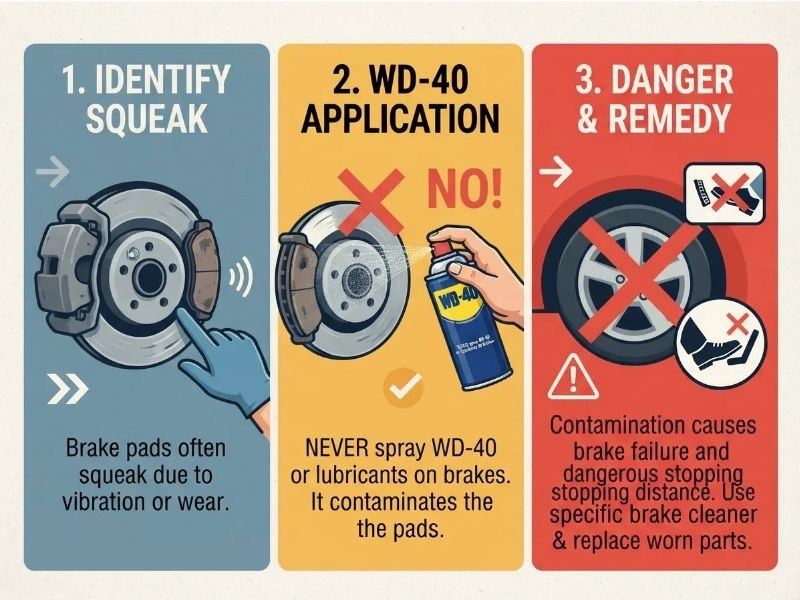
This is one of the most common reasons people consider spraying WD-40 on brakes.
It sounds logical: if a hinge squeaks, lubrication stops the noise, so why not lubricate squeaky brakes?
Because a brake is fundamentally different from a hinge.
A hinge is supposed to move with minimal friction. A brake needs high, controlled friction to stop a vehicle.
Spraying WD-40 on squeaky brakes may alter the noise temporarily, but it can also compromise braking performance.
Instead, identify why the brakes are squeaking.
What Can I Spray on Brake Pads to Stop Squeaking?
There is no general-purpose lubricant that should be sprayed onto the friction face of a brake pad to stop squeaking.
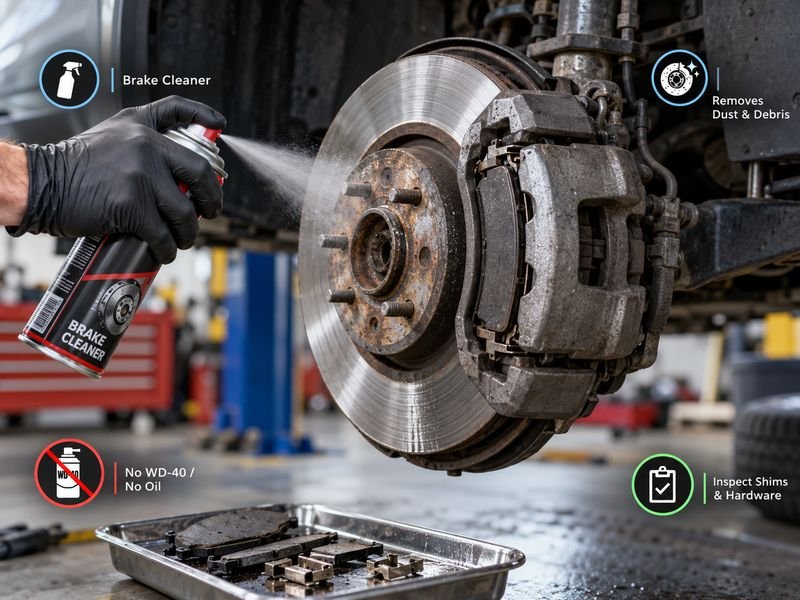
If the brake pads or rotor are dirty, a dedicated brake parts cleaner may be appropriate. Brake cleaners are designed to remove contaminants and dry without leaving an oily lubricating film. Some brake-parts cleaners are specifically labeled for use on brake pads, discs, calipers, and related components.
However, brake cleaner is not a cure for every squeak.
If squeaking comes from:
- Worn brake pads
- Damaged shims
- Sticking slide pins
- Improper pad installation
- Glazed pads
- Rotor problems
- Incorrect bedding
- Severe friction-material contamination
the underlying problem needs to be corrected.
There are also disc brake quiet products designed to reduce vibration, but these are typically applied to the metal backing side of compatible brake pads, not the friction surface. Always follow the product and brake-pad manufacturer’s directions.
What’s the Best Lubricant for Brake Pads?
If by “brake pad lubricant” you mean lubricant used during brake service, use a high-temperature brake lubricant specifically designed for brake components.
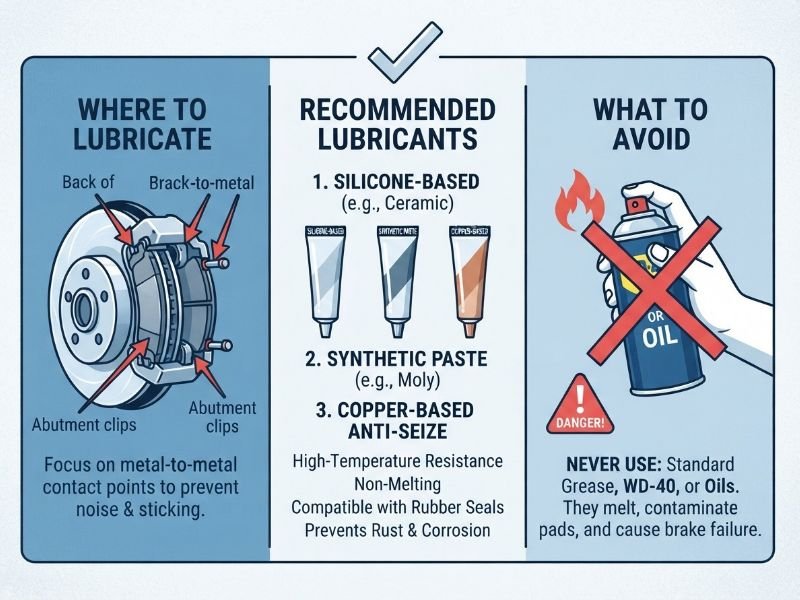
It may be applied in small amounts to approved contact points such as:
- Pad ears or tabs where they contact the bracket
- Certain caliper contact surfaces
- Caliper slide pins when the lubricant is compatible with the boots and seals
- The back of some brake-pad shims when specified by the pad manufacturer
It should never go on the brake pad friction material or rotor face.
There is another important detail: not every brake pad design uses lubricant in exactly the same locations.
Some modern pads have integrated shims or noise-control materials that should not receive certain chemical compounds. Wagner, for example, gives different lubrication instructions depending on the pad and shim design.
So the best rule is:
Use brake-specific lubricant only where the brake or pad manufacturer tells you to use it.
Why Do Brake Pads Squeak?
Squeaking does not automatically mean your brakes need more lubricant.
Brake noise commonly comes from high-frequency vibration somewhere in the pad, caliper, rotor, or hardware.
Possible causes include:
Brake Dust or Surface Contamination
Dirt and debris can sometimes create temporary noise.
A proper brake inspection and cleaning may solve the problem.
Worn Brake Pads
Some pads use mechanical wear indicators that intentionally produce a high-pitched squeal when the friction material becomes thin.
Spraying anything on the brakes will not repair worn pads.
Dry or Corroded Contact Points
The pad ears and caliper hardware need to move correctly.
Rust or dry contact points can contribute to noise and poor pad movement.
These areas may need cleaning and appropriate brake lubricant.
Sticking Caliper Slide Pins
A caliper that cannot move freely may apply uneven pressure to the pads.
That can cause noise and uneven wear.
Glazed Pads or Rotors
Excessive heat can alter the friction surfaces and contribute to noise.
The appropriate repair depends on the condition of the components.
Improper Bedding
New brake pads and rotors often require a proper bed-in or burnishing procedure to establish an even transfer layer.
Poor bedding can contribute to noise, vibration, or inconsistent braking. Wagner notes that proper burnishing helps the pad mate correctly to the rotor.
What Should I Do If I Already Sprayed WD-40 on My Brakes?
What you should do depends on where the WD-40 landed.
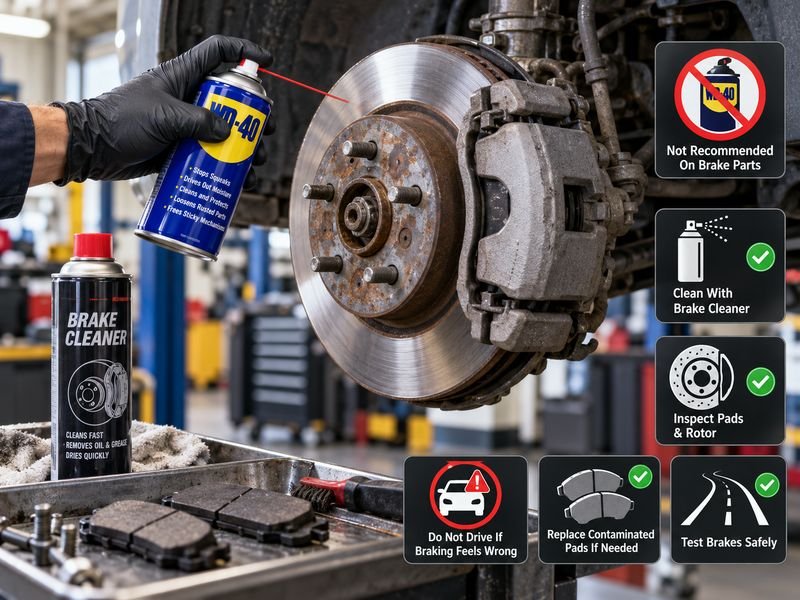
If WD-40 Got Directly on the Brake Pads
Do not rely on normal braking to “burn it off.”
Oil or grease contamination of automotive friction material is generally a reason to replace the affected pads.
The basic repair is:
- Stop using the contaminated brake until it has been inspected.
- Remove the affected pads.
- Replace contaminated brake pads.
- Thoroughly clean the rotor with a suitable brake-parts cleaner.
- Inspect the rotor, caliper, shims, and hardware.
- Correct any original problem that caused you to spray the brakes.
- Reassemble according to vehicle specifications.
- Follow the new pad manufacturer’s bedding instructions.
If you are not experienced with brake repairs, have the vehicle inspected by a qualified technician.
If WD-40 Got Only on the Rotor
If you catch the problem before the pads contact the contaminated rotor, clean the rotor thoroughly with brake parts cleaner and a clean, lint-free cloth according to the cleaner manufacturer’s directions.
The rotor must be completely free from oily residue before it contacts the brake pads.
If the pads have already been driven against the contaminated rotor, inspect them for contamination rather than assuming cleaning the rotor alone has solved the problem.
If It Was Only a Tiny Amount of Overspray
Do not ignore it simply because the amount looked small.
A brake’s friction surface should remain free from oil and grease.
Clean any affected rotor surface before driving and inspect the pad if there is a reasonable chance the lubricant reached it.
What Is the Best Way to Clean Brake Pads?
For automotive brakes, a brake-parts cleaner specifically labeled for brake components is the appropriate cleaning product for removing ordinary brake dust, dirt, grease, and surface contaminants.
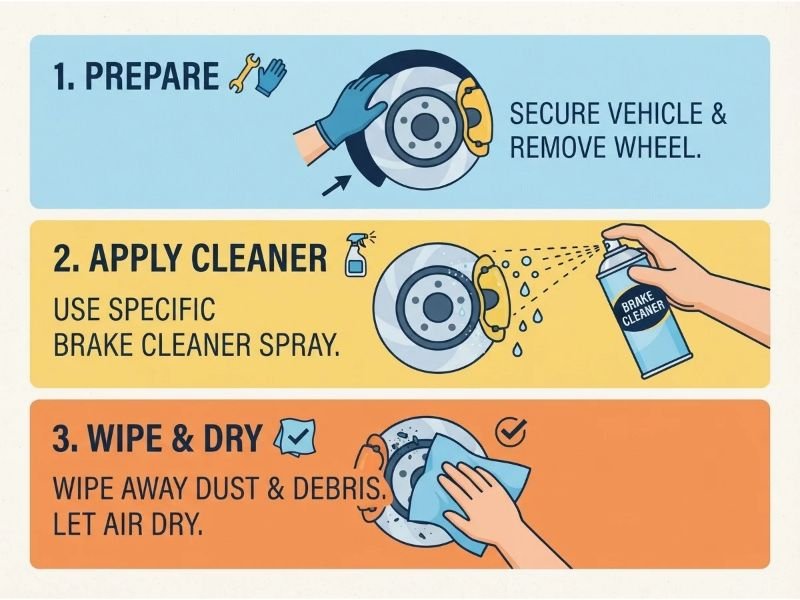
Do not substitute:
- WD-40 Multi-Use Product
- Engine degreaser not approved for brakes
- Chain lubricant
- Penetrating oil
- Household oil
- Silicone spray
- General-purpose grease
A dedicated brake cleaner is formulated to clean and evaporate without leaving the lubricating film you would get from WD-40 Multi-Use Product.
However, cleaning and repairing contamination are not always the same thing.
Light Dirt and Brake Dust
A brake-specific cleaner can generally be used according to its label.
Oil- or Grease-Contaminated Pads
Replacement is generally the better approach.
Trying to rescue oil-soaked friction material with repeated applications of cleaner is not as reliable as installing uncontaminated pads.
Severely Worn, Cracked, or Damaged Pads
Cleaning will not restore damaged friction material.
Replace them.
Can You Sand WD-40 Off Brake Pads?
Sanding should not be considered a reliable repair for brake pads that have been significantly contaminated with WD-40.
Sanding removes material only from the outer surface. It does not guarantee that oil or other contamination has been removed sufficiently to restore predictable friction.
For a safety-critical component, replacing contaminated pads is the safer solution.
This is especially true when you do not know how much product reached the pads or how deeply the contamination has spread.
Will WD-40 Help Squeaky Brakes?
It may change the sound temporarily, but WD-40 is not a proper squeaky-brake repair.
If the squeak disappears because the braking surfaces have become slippery, you have not solved the brake problem—you have reduced friction.
A proper squeak repair might involve:
- Cleaning the brakes
- Replacing worn or contaminated pads
- Servicing caliper hardware
- Lubricating approved contact points
- Replacing damaged shims
- Correcting rotor issues
- Properly bedding new components
The exact solution depends on the cause.
WD-40 on Bike Brakes: Is It Safe?
The same basic rule applies to bicycles:
Do not put WD-40 Multi-Use Product on bicycle brake pads, disc rotors, or rim-brake braking surfaces.
Oil contamination can significantly reduce bicycle braking performance.
For SRAM disc brakes, the manufacturer specifically instructs users not to let brake fluid or oil contact brake pads. If the pads become contaminated, SRAM says they should be replaced. Oil on the rotor should be cleaned with isopropyl alcohol.
What Happens If You Put WD-40 on Bike Brakes?
Possible results include:
- Weak braking
- Increased stopping distance
- Persistent squealing
- Reduced initial bite
- Inconsistent brake feel
- Contamination transferring between rotor and pads
For disc brakes, clean the rotor according to the brake manufacturer’s instructions and replace contaminated pads when required.
For rim brakes, keep oils and lubricants away from the rim’s braking track and pads as well.
If you use WD-40 products elsewhere on a bicycle—for example, around drivetrain or mechanical components—protect the brake surfaces from overspray.
Can WD-40 Damage Plastic or Rubber?
This requires a little more nuance.
According to WD-40, WD-40 Multi-Use Product is compatible with rubber and many common plastics when used as directed. The company specifically says to avoid polycarbonate and clear polystyrene, and recommends testing an inconspicuous area when material compatibility is uncertain.
So it is not accurate to say WD-40 automatically destroys all rubber or plastic.
However, brake systems contain specialized seals, boots, coatings, adhesives, and friction materials. A product being generally compatible with “rubber” or “plastic” does not mean it is the correct product for every brake component.
Wagner also warns that inappropriate petroleum-based grease can cause some caliper dust boots to swell, which is one reason brake-specific lubricants should be used during brake service.
For brake components, follow the vehicle, brake component, and lubricant manufacturer’s compatibility instructions.
What Should You Not Spray WD-40 On?
In the context of a vehicle, avoid spraying WD-40 Multi-Use Product onto any surface that depends on friction for safe operation.
That includes:
- Brake pad friction material
- Brake rotor friction surfaces
- Brake shoes and drum friction surfaces
- Clutch friction surfaces
- Tire tread
- Any braking surface on a bicycle
You should also be cautious around materials that the manufacturer identifies as incompatible, including polycarbonate and clear polystyrene.
Overspray matters too.
If you are using WD-40 to loosen a rusty fastener near a brake assembly, shield the rotor and pads so the spray cannot reach them.
WD-40 vs Brake Cleaner: They Are Not the Same Thing
Although both products may come in aerosol cans, their purposes are very different.
| Product | Main Purpose | Use on Rotor Friction Surface? | Use on Brake Pad Friction Surface? |
|---|---|---|---|
| WD-40 Multi-Use Product | Lubrication, moisture displacement, corrosion protection | No | No |
| Brake Parts Cleaner | Remove oil, grease, dust, and contaminants | Yes, when label allows | Follow product directions |
| Brake Lubricant | Lubricate approved caliper/pad contact points | No | No |
| Disc Brake Quiet | Reduce pad/caliper vibration on compatible applications | No | Only backing side when specified |
The product label and brake manufacturer’s instructions always take priority.
A Better Way to Fix Squeaky Brakes
Instead of spraying WD-40, diagnose the noise in a logical order.
First, inspect the brake pad thickness. If the pads are worn out, replace them.
Next, check for obvious contamination, glazing, rotor damage, or uneven wear.
Then inspect the caliper hardware and slide pins to make sure the pads and caliper can move freely.
Clean approved surfaces and lubricate only the locations specified for that brake system.
If the pads or rotors were recently replaced, verify that the correct bedding procedure was performed.
Persistent brake squeal may require a more complete inspection because the sound can come from several different parts of the braking system.
FAQs About Can I Spray WD-40 on My Brake Pads?
Can I Spray WD-40 on My Brake Pads?
No. WD-40 Multi-Use Product should not be sprayed on brake-pad friction material because the lubricant can reduce the friction needed for effective braking.
Can You Spray WD-40 on Brakes?
Not on brake pads, rotors, shoes, drums, or other friction surfaces. If WD-40 is used on a nearby fastener, protect the braking surfaces from overspray.
Can I Use WD-40 to Stop Squeaky Brakes?
No. Squealing should be diagnosed and repaired properly. WD-40 may change the sound by reducing friction, which is exactly what you do not want on a braking surface.
What Can I Spray on Brake Pads to Stop Squeaking?
Do not spray lubricant on the pad’s friction surface. A suitable brake-parts cleaner may help when noise comes from removable contamination, while other squeaks require pad replacement, hardware service, proper lubrication of non-friction contact points, or rotor repair.
What’s the Best Lubricant for Brake Pads?
Use a high-temperature, brake-specific lubricant only on manufacturer-approved contact points such as certain pad ears, brackets, slide pins, or backing surfaces. Never put it on the friction side of the pad or rotor.
What Is the Best Way to Clean Brake Pads?
For ordinary automotive brake cleaning, use a dedicated brake parts cleaner according to its instructions. If the friction material is significantly contaminated with WD-40, oil, grease, or brake fluid, replacement is generally safer.
What Happens If You Put WD-40 on Bike Brakes?
It can contaminate the pads and braking surface, leading to weak braking and noise. For disc brakes, manufacturer guidance may require contaminated pads to be replaced and the rotor cleaned with isopropyl alcohol.
Can WD-40 Damage Rubber?
WD-40 says its Multi-Use Product is generally safe on rubber when used as directed. However, specialized brake seals and boots should only be exposed to products approved for that application.
Can WD-40 Damage Plastic?
It is compatible with many plastics, but WD-40 advises against using its Multi-Use Product on polycarbonate and clear polystyrene. Spot-test unfamiliar materials and follow manufacturer recommendations.
What Should I Do If I Accidentally Sprayed WD-40 on My Rotor?
Do not simply drive and hope it burns away. Clean the rotor thoroughly with an appropriate brake-parts cleaner before use. If the contaminated rotor has already contacted the pads, inspect the pads and replace them if they became oil-contaminated.
Can Brake Cleaner Fix WD-40-Contaminated Pads?
Brake cleaner can remove surface oils and is useful for cleaning brake components, but heavily oil-contaminated friction material should not be assumed safe simply because it has been sprayed with cleaner. Replacement is the more reliable approach.
Is WD-40 the Same as Brake Cleaner?
No. WD-40 Multi-Use Product and brake cleaner serve very different purposes. WD-40 lubricates and protects, while brake cleaner is designed to remove contaminants from brake components without leaving an oily lubricating film.
Conclusion: Can I Spray WD-40 on My Brake Pads?
So, can I spray WD-40 on my brake pads? No.
Keep WD-40 Multi-Use Product away from the brake pad friction surface and brake rotor. Brakes depend on friction, and applying a lubricant where the pad contacts the rotor can reduce braking performance rather than repair the problem.
If your goal is to stop squeaking, identify the actual cause. You may need to clean the brake components, replace worn or contaminated pads, service the caliper hardware, correctly lubricate non-friction contact points, or bed the brakes properly.
If WD-40 has already contaminated the pads, replacing the affected pads and cleaning the rotor is generally the safest approach.
Use brake-specific products for brake-specific jobs—and never try to silence brake noise by lubricating the surfaces responsible for stopping the vehicle.