What Is a Sintered Brake Pad? Materials, Pros, Cons, and Uses
A sintered brake pad is a metal-rich friction pad made by compressing powdered metals with other friction ingredients, then heating the mixture until the particles bond into a hard, heat-resistant material. Compared with organic pads, sintered pads usually handle heat, rain, mud, and repeated hard braking better, though they may create more noise and rotor wear.
That material difference matters because every braking event converts vehicle motion into heat at the rotor and pad. A pad compound that does not suit the brake system or operating conditions may wear rapidly, make excess noise, change brake feel, or put unnecessary wear on the rotor.
A properly matched compound gives more predictable braking under the conditions the machine actually faces. Sintered material is commonly chosen for motorcycles, mountain bikes, ATVs, scooters, and other applications that see high temperatures, wet conditions, dirt, or repeated braking.
The Federal Highway Administration reported 9,516,910 registered motorcycles in the United States in 2023. That makes motorcycle brake-pad construction highly relevant in the U.S. market, and sintered compounds are common across many modern street, touring, sport, and off-road motorcycle applications.
During my research on what is a sintered brake pad, one point stood out: “sintered” describes a manufacturing method and material family, not one fixed friction formula. Manufacturers change metal content, abrasives, lubricating ingredients, and other materials to produce different braking characteristics.
Another practical detail is that fully sintered pads are much more familiar in motorcycles, powersports equipment, bicycles, and racing than in ordinary passenger-car replacement catalogs. Car owners are more likely to see ceramic, semi-metallic, low-metallic, or organic/NAO classifications.
The sections below explain how sintered pads are made, how they work, how they compare with organic and semi-metallic pads, their advantages and drawbacks, where they are commonly used, rotor compatibility, and what to check before switching compounds.
What Is a Sintered Brake Pad and How Is It Made?
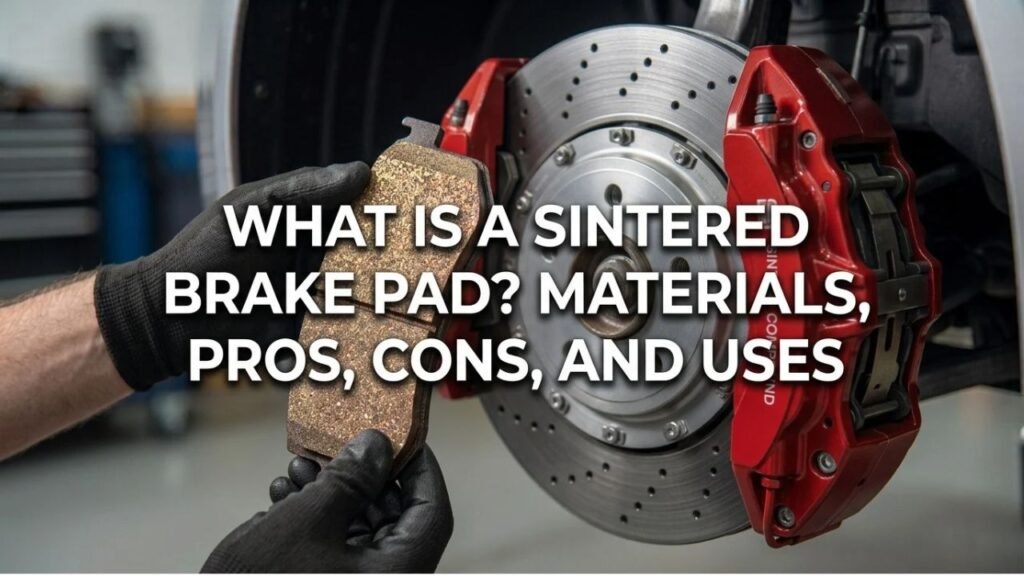
A sintered brake pad uses a friction material formed from a high proportion of metallic particles mixed with other ingredients that control friction, wear, heat behavior, and brake feel.
The mixture is pressed into shape and exposed to high temperature so the particles bond into a dense friction matrix. The finished friction block is then secured to a backing plate designed for a specific brake caliper.
What Happens During the Sintering Process?
Production starts with powdered ingredients rather than a solid slab of metal.
The manufacturer blends the friction recipe, compacts it under pressure, and heats it under controlled conditions. SBS Friction describes motorcycle sintering temperatures around 800°C, or about 1,472°F, and above for bonding the metal-rich friction matrix.
The process differs from conventional resin-based pad production because the finished friction material relies heavily on bonded metallic particles.
Pressure, temperature, ingredient ratios, and manufacturing methods vary among pad makers.
What Materials Are Used in Sintered Brake Pads?
There is no universal recipe.
A sintered compound may contain copper or other metallic powders along with abrasives and solid lubricating materials. Manufacturers select ingredients according to the intended brake system and use.
A street motorcycle pad may use a different formulation from a downhill mountain-bike pad. Race compounds may be tuned for temperatures that a normal street brake rarely reaches.
This is why the word sintered alone cannot tell you the exact friction level, noise output, cold response, or rotor-wear rate.
How Is the Friction Material Attached to the Backing Plate?
The friction block must remain firmly attached to its metal backing plate despite heat, pressure, vibration, and repeated braking cycles.
Pad makers may use brazing, mechanical retention, specialized bonding processes, or combinations of these methods.
The attachment system varies by manufacturer and product line, so it should not be assumed that all sintered pads are built exactly the same way.
Key Takeaway: Sintered pads are formed from a compressed metal-rich mixture that is heated into a dense friction matrix, but the exact recipe and manufacturing details differ among products.
How Do Sintered Brake Pads Work?
Sintered brake pads work through friction between the pad surface and brake rotor.
When the brake is applied, the caliper pushes the pads against the rotating disc. Friction slows the rotor and converts the vehicle’s kinetic energy mainly into heat.
The main difference from softer pad materials is how the sintered friction matrix behaves as temperature, moisture, and braking load increase.
How Sintered Pads Handle Heat
Repeated braking can put large amounts of heat into the pad and rotor.
Metal-rich compounds are commonly selected for applications that experience high brake temperatures because they can retain useful friction characteristics under repeated braking.
This trait is one reason sintered compounds are common on motorcycles and downhill mountain bikes.
Long descents, track riding, carrying a passenger, and repeated hard stops can generate more brake heat than light urban riding.
How They Perform in Wet and Dirty Conditions
Sintered pads are also widely used where brakes are exposed to rain, mud, water, and trail debris.
SRAM recommends metallic bicycle pads for heavy braking, long descents, and wet or muddy conditions. The harder friction material tends to tolerate abrasive contamination better than many softer resin compounds.
That does not mean a contaminated pad will always recover. Oil, grease, brake fluid, and some cleaning products can ruin braking behavior regardless of pad type.
Do Sintered Pads Need Heat Before They Work?
Not every sintered compound behaves the same way when cold.
Some street-oriented products are developed to produce strong braking from low temperatures. Other compounds, especially those aimed at racing, may perform best after more heat builds in the system.
The pad maker’s stated use is more useful than assuming every sintered pad needs to be hot.
Key Takeaway: Sintered pads create braking force in the same basic way as other disc pads, but their metal-rich structure is well suited to heat, repeated braking, rain, mud, and other demanding conditions.
Sintered vs. Organic vs. Semi-Metallic Brake Pads
Sintered, organic, and semi-metallic pads differ mainly in how their friction material is formulated and manufactured.
Each type has strengths and tradeoffs.
| Feature | Sintered | Organic / Resin | Semi-Metallic |
| Friction material | High metal content | Fibers and fillers in resin | Metal mixed with other friction materials |
| Heat tolerance | Usually high | Usually lower | Moderate to high |
| Wet-condition use | Often strong | May wear faster in wet grit | Compound-dependent |
| Pad life | Often long under hard use | Often shorter under hard use | Usually moderate to long |
| Noise | Can be higher | Often quieter | Varies |
| Rotor wear | Can be higher | Usually lower | Varies |
| Common applications | Motorcycles, MTB, powersports, racing | Bicycles, light-duty applications | Cars, trucks, motorcycles |
These are broad patterns rather than guarantees. Actual behavior depends on the specific compound, rotor, brake design, vehicle weight, temperature, and use.
Sintered vs. Organic Brake Pads
Organic pads, sometimes called resin pads in bicycle applications, use fibers, fillers, and other materials held together by a resin-based matrix.
They are often associated with quieter braking and softer brake feel.
Sintered pads tend to tolerate heat and abrasive wet conditions better. For downhill mountain biking or muddy trail use, that can mean longer service life than a softer resin pad.
For a commuter bicycle used mainly in dry conditions, the quieter operation of an organic pad may be more appealing.
Sintered vs. Semi-Metallic Brake Pads
Semi-metallic pads contain substantial metallic material, but they are not identical to fully sintered pads.
Their friction material normally combines metal with nonmetallic fibers, fillers, resins, and friction modifiers.
Semi-metallic pads are common in passenger-car and light-truck braking systems because manufacturers can tune them for a mixture of heat tolerance, wear, noise, and everyday road use.
Some motorcycle manufacturers also offer semi-sintered compounds that sit between traditional organic and fully sintered designs.
Which Type Lasts Longer?
Under high heat, wet grit, mud, or hard repeated braking, a sintered compound often lasts longer than a softer organic pad.
That does not mean it will always have the longest life.
Vehicle weight, rotor condition, braking habits, compound hardness, contamination, temperature, and caliper condition all affect wear.
Key Takeaway: Sintered pads usually favor heat resistance and hard-use durability, organic pads often favor quieter operation, and semi-metallic compounds combine metallic and nonmetallic ingredients for a different balance.
Advantages and Disadvantages of Sintered Brake Pads
Sintered pads have real strengths, but those strengths do not make them the best material for every brake system.
Advantages of Sintered Brake Pads
High heat tolerance: Their metal-rich friction material is well suited to repeated braking and elevated brake temperatures.
Good wet-condition durability: Rain, mud, and gritty trail conditions often favor sintered pads over softer resin compounds.
Long wear under hard use: A quality sintered pad can resist rapid friction-material loss during demanding riding.
Consistent braking during repeated stops: Street and performance compounds can be formulated to maintain stable friction as the brake gets hotter.
Suitable for demanding machines: Motorcycles, ATVs, downhill bikes, scooters, and some race vehicles commonly use sintered materials.
Disadvantages of Sintered Brake Pads
More noise may occur: Metallic compounds can produce more squeal or scraping noise than softer organic pads.
Rotor wear can increase: Some sintered compounds are harder on brake discs, especially if the rotor is not intended for metallic pads.
Brake feel may change: A sintered pad can have a different initial bite and lever or pedal feel compared with an organic compound.
Bed-in may take longer: Certain metallic bicycle pads need a more involved bedding procedure before braking settles into its normal behavior.
Compatibility restrictions exist: Some brake rotors are marked for resin or organic pads only.
Are the Drawbacks Serious?
They become a problem mainly when the compound does not match the brake system or intended use.
A properly approved sintered pad on a compatible rotor is very different from installing a metallic pad on a rotor designed only for resin material.
My preference is to check compatibility before comparing noise or pad life because the approved pad-and-rotor pairing sets the limits for everything else.
Key Takeaway: Sintered pads handle heat, moisture, and hard use well, but possible drawbacks include extra noise, different brake feel, longer bed-in, and increased rotor wear on some systems.
Where Are Sintered Brake Pads Commonly Used?
Sintered friction material appears in several brake markets, but motorcycles and powersports machines are among the most familiar applications.
Motorcycles and Scooters
Modern motorcycles commonly use sintered brake pads because their braking systems may experience high temperatures and repeated high-energy stops.
SBS states that most newer motorcycles use sintered pads, while Brembo offers multiple sintered compounds for street motorcycles, scooters, racing, front calipers, and rear calipers.
The front and rear brakes may use different pad formulas even on the same motorcycle.
A front pad designed for strong deceleration is not automatically the correct rear pad.
Mountain Bikes
Metallic sintered pads are common in mountain biking, especially for:
- Long downhill runs
- Wet trails
- Muddy conditions
- Gravity riding
- Heavier riders or bikes
- Repeated hard braking
Their durability and heat resistance are major reasons for their use.
Some bicycle rotors are marked “resin pads only.” A sintered pad should not be fitted to such a rotor simply because the pad fits the caliper.
ATVs and Off-Road Machines
ATVs, dirt bikes, enduro motorcycles, and other off-road machines expose their brakes to dirt, water, grit, and frequent speed changes.
Those conditions can wear softer friction materials quickly.
Sintered formulations are commonly offered for these machines because the dense metallic matrix stands up well to abrasive environments.
Cars and Racing Applications
Fully sintered pads do exist in automotive racing.
They are far less common as an everyday replacement category for normal passenger vehicles.
A typical street-car owner is more likely to compare:
- Ceramic pads
- Semi-metallic pads
- Low-metallic pads
- Organic or NAO pads
For normal car service, I would follow the pad specification approved for the exact vehicle rather than selecting a sintered product simply because it sounds more durable.
Key Takeaway: Sintered pads are widely associated with motorcycles, mountain bikes, scooters, ATVs, off-road machines, and some racing applications rather than ordinary passenger-car replacement service.
Are Sintered Brake Pads Better?
Sintered brake pads are better in situations that make use of their strengths.
They are a strong match for brakes exposed to repeated high temperatures, rain, mud, long descents, heavy loads, or hard riding.
They are not automatically better for quiet street use or a brake system built around softer pad compounds.
Sintered Pads May Make Sense For
A sintered compound may suit:
- Motorcycle touring with repeated braking
- Sport riding
- Wet-weather motorcycle use
- Downhill mountain biking
- Muddy trail riding
- ATV use
- Heavy braking
- Some track applications
The exact product still has to be approved for the brake system.
Organic Pads May Make More Sense For
An organic or resin compound may suit a brake system where quiet operation, softer feel, lower rotor wear, or low-temperature urban braking receives more priority.
A bicycle used mainly for flat, dry commuting may have very different braking demands from a downhill bike ridden through mud.
Why the Exact Compound Matters
Two sintered pads from different product lines can behave differently.
One may focus on street use and cold bite. Another may target racing temperatures. A third may be built for muddy off-road conditions.
The word “sintered” describes the broad material type, not every detail of its behavior.
Key Takeaway: Sintered pads are not universally better; they make the most sense when their heat resistance, wet-condition durability, and hard-use characteristics match the brake system and operating conditions.
How to Choose the Correct Sintered Brake Pad
Start with fitment, then check rotor compatibility and intended use.
A high-grade friction compound is useless if its backing plate, thickness, retaining tabs, sensor arrangement, or pad shape does not match the caliper.
Check Exact Fitment
Use the motorcycle, bicycle, ATV, or vehicle manufacturer’s fitment information.
Match:
- Make
- Model
- Year
- Brake model
- Front or rear position
- Caliper type
- Rotor requirement
Some vehicles within the same model line use different calipers or brake packages.
Check Rotor Compatibility
This check is especially important on bicycles.
If the rotor says resin pads only, do not switch to a metallic sintered compound unless the brake manufacturer specifically approves the combination.
Motorcycle and racing systems may also pair certain pad formulas with specific disc materials.
Check Front and Rear Pad Requirements
Do not assume the same compound should be used at both ends.
Brake temperature, braking load, and desired response can differ between front and rear calipers.
Manufacturers such as Brembo offer separate sintered formulas for different brake positions and riding uses.
Match the Pad to the Conditions
Think about how the brake is actually used.
Frequent rain, mountain descents, a heavy motorcycle, track riding, off-road mud, or repeated hard stops place different demands on the pad than short urban trips.
Product descriptions should state if a compound is intended for street, touring, scooter, off-road, downhill, racing, or another use.
Key Takeaway: Choose a sintered pad using exact fitment, rotor compatibility, brake position, and intended operating conditions rather than relying on the material name alone.
Do Sintered Brake Pads Need to Be Bedded In?
Yes. New pads need a proper bedding procedure before normal hard use.
Bedding gradually mates the new pad and rotor surfaces and establishes the friction layer required by the brake system.
SRAM specifies a more involved bed-in procedure for its metallic bicycle pads than for its organic pads.
Motorcycle and automotive brake-pad manufacturers may use different procedures.
Do not copy a bedding sequence from an unrelated pad brand. Follow the instructions supplied with the pad or brake system.
A poorly bedded brake may develop:
- Uneven friction
- Noise
- Inconsistent brake feel
- Patchy rotor deposits
- Reduced initial braking response
Bedding cannot correct a damaged or incompatible rotor.
Check the rotor for contamination, severe scoring, heat damage, minimum-thickness limits, and compound compatibility before installing new pads.
Conclusion
What is a sintered brake pad in practical terms? It is a brake pad made from a metal-rich friction mixture that is compressed and heated until the particles form a dense bonded material.
Its main strengths are heat tolerance, long wear under demanding conditions, and strong resistance to wet or muddy use. Possible tradeoffs include more noise, different brake feel, longer bedding requirements, and greater rotor wear with some pad-and-disc combinations.
I would choose a sintered compound only after checking the exact brake model and rotor specification. A softer organic or semi-metallic pad may be the better match for systems designed around low noise, gentle rotor wear, or everyday low-temperature braking.
The material category gives useful information about the pad’s construction, but the manufacturer’s intended use and compatibility requirements should control the final selection.
FAQs About Sintered Brake Pads
Are Sintered Brake Pads Metallic?
Yes. Sintered pads are commonly described as metallic because their friction material contains a high proportion of metal particles bonded into a dense matrix.
They can also contain abrasives, lubricating ingredients, and other friction modifiers. The exact formula varies by manufacturer and product.
Are Sintered Brake Pads Better Than Organic Pads?
They are often better for high heat, long descents, wet conditions, mud, and repeated hard braking.
Organic pads may run quieter and can offer a softer brake feel in some systems. The better option is the one approved for the rotor and suited to the actual riding or driving conditions.
Do Sintered Brake Pads Last Longer?
They often last longer than organic pads during hard, wet, or gritty use.
Actual life varies with brake temperature, vehicle weight, terrain, rotor condition, pad formulation, contamination, caliper condition, and braking habits. A sintered label by itself cannot predict mileage or riding hours.
Do Sintered Brake Pads Wear Rotors Faster?
Some sintered compounds can wear rotors faster than softer organic pads because the metallic friction material can be harder and more abrasive.
Rotor compatibility matters. A disc approved for metallic pads is intended to work with that type of friction material, while a resin-only bicycle rotor should not be paired with a sintered pad.
Are Sintered Brake Pads Noisy?
They can produce more noise than organic pads, especially on bicycle brakes or in wet conditions.
Noise can also come from glazing, contamination, poor bedding, rotor damage, loose brake hardware, or incorrect caliper alignment. Pad material is only one possible cause.
Can I Replace Organic Brake Pads With Sintered Pads?
Only if the caliper and rotor manufacturer approve metallic pads.
Check rotor markings and brake-system instructions before switching. Some systems also require rotor replacement or preparation when changing friction compounds because the old pad leaves material on the rotor surface.
Are Sintered Brake Pads Good for Cars?
Sintered friction materials are used in some automotive racing applications, but fully sintered pads are not the usual replacement category for normal passenger cars.
Most street-car owners will see ceramic, semi-metallic, low-metallic, or organic/NAO pads. Use the friction type and specification approved for the exact vehicle and intended driving conditions.