What Is a Brake Pad? How Brake Pads Work and What They Do
A brake pad is a replaceable friction component in a vehicle’s disc brake system that presses against the brake rotor to slow or stop the wheel. When you press the brake pedal, hydraulic pressure causes the brake caliper to squeeze the brake pads against the rotating rotor, converting the vehicle’s motion into heat through friction.
So, what is a brake pad, and why is such a relatively small component so important? Brake pads are among the main wear items in a vehicle’s braking system. Every time you slow for traffic, stop at an intersection, or control speed on a downhill road, the pads create friction against the rotors. Because this process gradually wears away their friction material, brake pads eventually require replacement.
Although the basic idea is simple, brake pads are carefully engineered parts. Their friction material must work across a wide range of temperatures, provide predictable stopping performance, control noise and vibration, and withstand thousands of heating and cooling cycles. Different vehicles may use different pad materials, shapes, hardware, and wear-sensing systems.
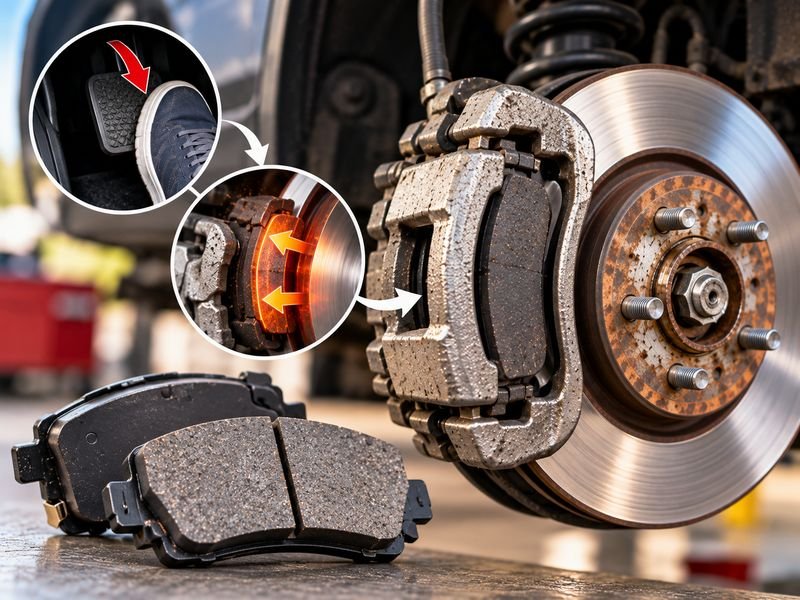
This guide explains what are brake pads, what brake pads do, how they work, where brake pads are located on a car, what a brake pad looks like, and how brake pads are made. It also covers pad materials, major components, wear, replacement, and other important details every vehicle owner should understand.
What Is a Brake Pad?
A brake pad is a flat or slightly curved friction component installed inside a disc brake caliper. Its main job is to create friction against the brake rotor when the driver applies the brakes.
Most brake pads consist of two major sections:
- A rigid metal backing plate
- A layer of friction material bonded or mechanically attached to the plate
Depending on the design, the pad may also include:
- Noise-reducing shims
- Slots
- Chamfers
- Wear indicators
- Insulation layers
- Retaining clips or attachment points
Brake pads operate as a pair on each disc brake rotor. One pad normally sits on the inboard side of the rotor and another on the outboard side.
When braking occurs, these pads squeeze the rotor from both sides.
The friction generated between the pads and rotor resists wheel rotation, helping reduce vehicle speed.
Because brake pads are designed to wear gradually, they are considered normal maintenance components rather than permanent parts of the braking system.
What Are Brake Pads?
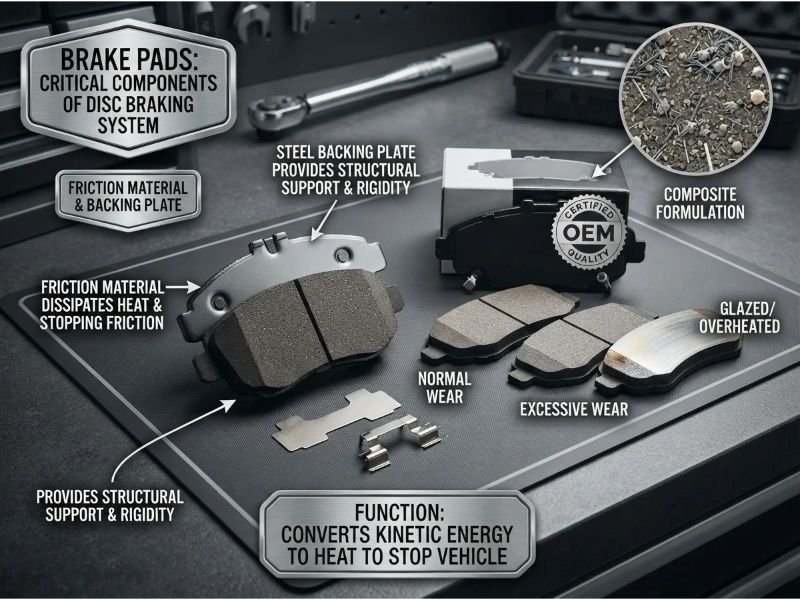
If you are wondering what are brake pads, they are the replaceable friction elements used in disc brakes.
A typical disc brake assembly includes:
- Brake rotor
- Brake caliper
- Brake pads
- Caliper bracket
- Slide pins on many designs
- Brake hose
- Mounting hardware
The rotor rotates with the wheel. The brake pads remain positioned inside the caliper around the rotor.
During braking, the caliper applies force to the pads, and the pads clamp the spinning rotor.
A vehicle may have disc brakes on:
- All four wheels
- Only the front wheels
- Front wheels with drum brakes at the rear
Many modern passenger vehicles use four-wheel disc brakes, but brake configurations vary by make, model, year, trim, and market.
This is why not every vehicle has the same number or style of brake pads.
What Do Brake Pads Do?
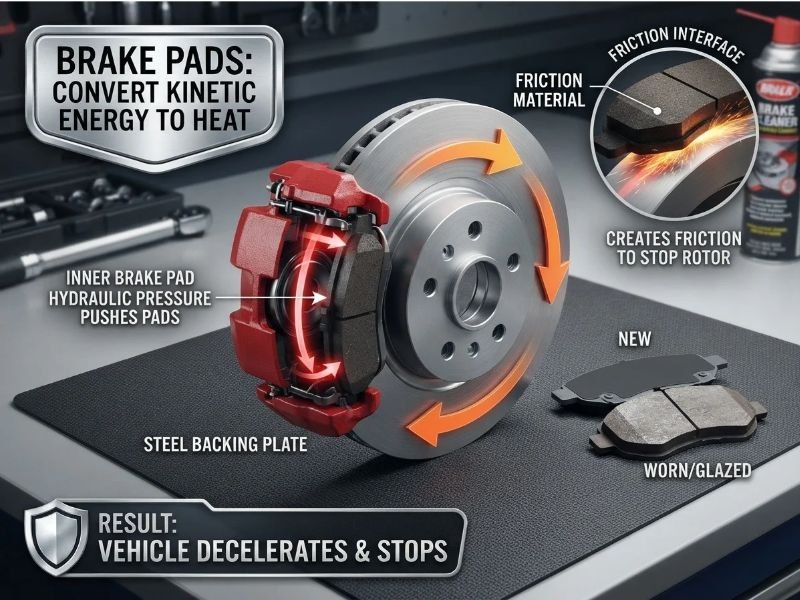
Brake pads create the friction needed to slow or stop a vehicle equipped with disc brakes.
Their job sounds simple, but several things happen simultaneously when the pads contact the rotor.
They Convert Motion Into Heat
A moving vehicle contains kinetic energy.
When the brake pads press against the rotors, friction converts much of this motion-related energy into thermal energy, or heat.
The brake pads and rotors must absorb and dissipate this heat repeatedly without losing predictable braking performance.
They Control Wheel Rotation
Brake pads do not directly stop the vehicle body.
They apply friction to the brake rotors, which are connected to the wheel hubs.
Slowing the rotors slows the wheels.
Tire grip against the road then allows the vehicle itself to decelerate.
They Help Provide Controlled Braking
Brake pads should create friction progressively.
When you gently press the brake pedal, braking force should increase smoothly rather than suddenly locking the wheels.
Modern systems combine the mechanical braking components with systems such as:
- Anti-lock braking system (ABS)
- Electronic stability control
- Traction control
- Electronic brake-force distribution
These systems may regulate braking pressure, but the brake pads still provide the physical friction at disc-brake-equipped wheels.
They Influence Pedal Feel, Noise, and Comfort
Brake pad friction characteristics can affect:
- Initial braking response
- Pedal feel
- Brake noise
- Brake dust
- Rotor wear
- High-temperature performance
This is one reason brake pad material matters.
How Do Brake Pads Work?
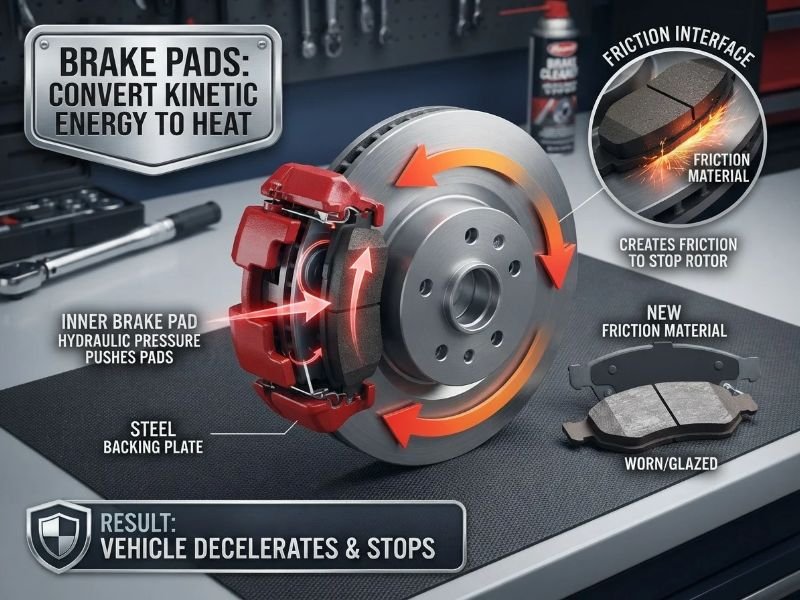
To understand how do brake pads work, it helps to follow the braking process from the driver’s foot to the wheel.
1. The Driver Presses the Brake Pedal
Pressing the pedal activates the brake system.
On conventional hydraulic braking systems, pedal force is transferred into hydraulic pressure through the master cylinder, usually with assistance from a brake booster.
The exact system design varies, particularly on hybrids, electric vehicles, and vehicles using brake-by-wire or regenerative braking functions.
2. Hydraulic Pressure Travels Through the Brake System
Brake fluid transfers pressure through brake lines and flexible brake hoses toward the wheel brakes.
At each disc brake, this pressure acts on one or more caliper pistons.
3. The Caliper Piston Moves
Hydraulic pressure pushes the caliper piston outward.
The piston applies force to the brake pad.
In a typical floating-caliper design, piston movement also causes the caliper body to slide so that pads on both sides squeeze the rotor.
Fixed calipers work differently because they typically have pistons positioned on both sides of the rotor.
4. The Brake Pads Clamp the Rotor
The brake pads contact the rotor’s friction surfaces.
As clamping force increases, friction increases.
This resistance makes the rotor harder to rotate.
5. The Wheel Slows Down
Because the rotor is connected to the wheel hub, slowing the rotor slows the wheel.
The tires transfer this braking force to the road surface.
6. Heat Is Generated
The friction between the pad and rotor generates substantial heat.
The rotor’s large exposed surface helps dissipate much of this heat into the surrounding air.
The brake pad material must continue functioning as temperature changes.
7. The Pads Release When the Pedal Is Released
When the driver releases the brake pedal, hydraulic pressure drops.
The caliper piston retracts slightly, allowing the pads to stop applying significant clamping force.
The pads remain very close to the rotor so they can engage quickly the next time the brakes are applied.
How Brake Pads Work With the Brake Rotor
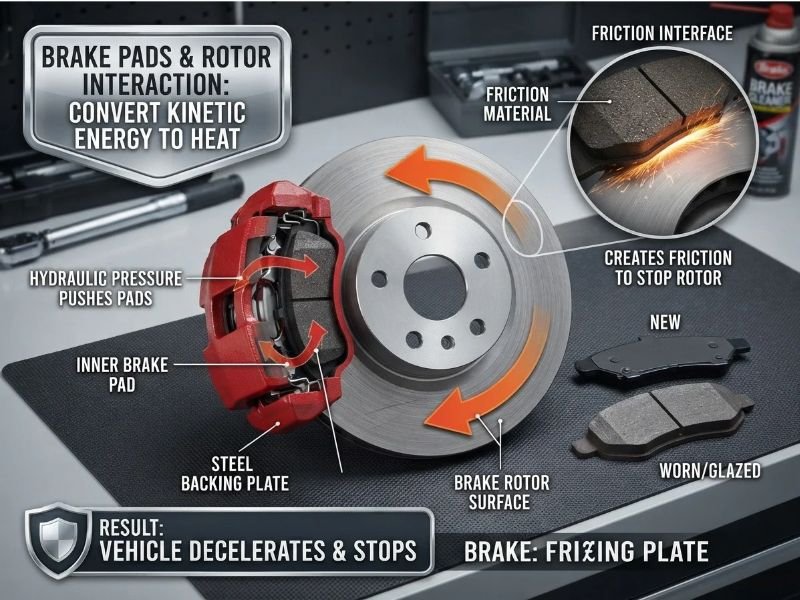
A brake pad cannot perform its job without the rotor.
The brake rotor, sometimes called a brake disc, is a circular metal component attached to the wheel hub or hub assembly.
The rotor spins whenever the wheel spins.
The brake pads sit on opposite sides of its friction surface.
During braking:
Brake caliper applies pressure → brake pads clamp rotor → friction resists rotor rotation → wheel slows → vehicle decelerates.
The surfaces of both the pad and rotor affect braking performance.
Problems such as:
- Severely worn pads
- Contaminated friction material
- Damaged rotor surfaces
- Improper pad bedding
- Caliper problems
can interfere with normal pad-to-rotor contact.
Where Are Brake Pads Located on a Car?
If you want to know where are brake pads located on a car, they are located inside the brake calipers at wheels equipped with disc brakes.
You usually cannot see the entire brake pad without looking through the wheel or removing it.
At a typical disc brake wheel, the components are arranged roughly like this:
Wheel → brake caliper and pads → brake rotor → wheel hub.
The rotor sits behind the wheel.
The caliper fits around part of the rotor.
The brake pads are positioned inside the caliper or caliper bracket on both sides of the rotor.
Where Are the Front Brake Pads?
Front brake pads are located behind the front wheels, inside the front brake calipers.
The front brakes often handle substantial braking force because vehicle weight shifts forward during deceleration.
For this reason, front brake pads frequently wear differently from rear pads.
However, actual wear rates vary according to vehicle design, driving conditions, braking systems, and driving habits.
Where Are the Rear Brake Pads?
If the vehicle has rear disc brakes, rear brake pads are located inside the rear brake calipers behind the rear wheels.
Some vehicles use rear drum brakes instead.
A drum brake uses brake shoes rather than conventional disc brake pads.
Some vehicles also combine rear disc brakes with a separate drum-style parking brake mechanism inside the center section of the rear rotor.
Does Every Wheel Have Brake Pads?
No.
Brake pads are used only at wheels equipped with disc brakes.
A vehicle with four-wheel disc brakes generally has brake pads at all four wheels.
A vehicle with front disc brakes and rear drum brakes has brake pads at the front and brake shoes at the rear.
Always identify the actual brake configuration before ordering replacement components.
What Does a Brake Pad Look Like?
A typical brake pad looks like a relatively small, thick, flat metal plate with a block or layer of dark friction material attached to one side.
So, what does a brake pad look like in more detail?
Although designs vary, most pads include a recognizable combination of:
- Steel backing plate
- Friction material
- Curved or rectangular profile
- Tabs or ears on each side
- Slots or grooves in the friction surface
- Chamfered edges on some designs
- A rear shim on some pads
Backing Plate
The backing plate forms the structural foundation of the brake pad.
It is usually made from steel and must be rigid enough to transfer caliper force evenly to the friction material.
Friction Material
The friction material is the part that contacts the rotor.
New friction material is several times thicker than it will be near the end of its usable service life.
Its exact color and appearance depend on its formulation.
Slots
Some pads have a groove or slot running through part of the friction material.
Slots can help manage:
- Heat
- Dust
- Debris
- Friction behavior
- Noise characteristics
Not all brake pads use the same slot design.
Chamfers
Chamfers are angled sections along the edges of the friction material.
Manufacturers may use them to influence the way the pad contacts the rotor and help control vibration or noise.
Shims
A pad may have a shim attached to the rear of the backing plate.
The shim can help isolate vibration between the pad, piston, and caliper.
Wear Indicator
Some pads include a small metal wear indicator.
When friction material becomes sufficiently thin, the indicator may contact the rotor and create a high-pitched warning sound.
Other vehicles use electronic brake pad wear sensors.
Main Parts of a Brake Pad
Although the term “brake pad” sounds like a single piece, several layers or design elements may be involved.
Friction Block
This is the material that physically contacts the rotor.
Its composition largely determines the pad’s friction, noise, temperature, dust, and wear characteristics.
Backing Plate
The steel backing plate supports the friction block and transfers force from the caliper.
Adhesive or Mechanical Retention
The friction material must remain securely attached to the backing plate.
Manufacturing methods vary.
Depending on the pad design, bonding may involve specialized adhesives, molding processes, mechanical retention features, or combinations of these techniques.
Underlayer
Some pads use an intermediate layer between the friction material and backing plate.
This can help manage heat, noise, bonding, or mechanical stresses.
Noise-Control Components
These may include:
- Shims
- Coatings
- Slots
- Chamfers
Different brake pad manufacturers may use different combinations.
What Are Brake Pads Made Of?
Brake pad friction material is generally made from a carefully formulated mixture of materials rather than one single substance.
A typical formulation may combine different categories of ingredients, such as:
- Fibers
- Fillers
- Binders
- Lubricants
- Abrasives
- Metallic or mineral components
- Friction modifiers
The exact formula varies widely among pad types and manufacturers.
Historically, asbestos was widely used in friction materials because of its heat resistance, but modern automotive brake pads in many markets use non-asbestos formulations because of the serious health hazards associated with asbestos.
Modern pad formulations are engineered around performance requirements such as:
- Friction stability
- Temperature tolerance
- Noise control
- Rotor compatibility
- Wear rate
- Dust characteristics
Types of Brake Pad Material
Brake pads are often grouped into broad material categories.
The exact formulation within each category can still vary considerably.
Ceramic Brake Pads
Ceramic-style brake pads generally use ceramic fibers or related materials blended with other ingredients.
They are often designed to provide:
- Smooth operation
- Controlled noise
- Relatively low visible dust
- Stable everyday braking characteristics
However, suitability depends on the vehicle and brake system.
A “ceramic” label alone does not automatically make a pad better for every application.
Semi-Metallic Brake Pads
Semi-metallic pads contain a meaningful proportion of metallic material blended with other friction components.
Depending on the formulation, metals may help with:
- Heat transfer
- Friction
- Durability
These pads are used in many passenger and performance-oriented applications.
Possible tradeoffs can include greater noise or rotor wear in certain formulations compared with some alternatives.
Non-Asbestos Organic Pads
Non-asbestos organic, often abbreviated NAO, pads use combinations of fibers, fillers, binders, and other non-asbestos materials.
They may provide smooth and relatively quiet braking, depending on their formulation.
Their exact durability and temperature performance vary.
Low-Metallic Formulations
Some pads combine organic-style friction material with a smaller amount of metallic content.
This type may be designed to balance friction response, heat management, noise, and wear.
Classification terminology can vary among manufacturers and markets.
How Are Brake Pads Made?
Understanding how are brake pads made helps explain why friction material is far more sophisticated than it appears.
Exact manufacturing processes are proprietary and differ among companies, but a typical brake pad production process involves several general stages.
1. Friction Ingredients Are Selected
Engineers develop a friction formula based on the desired characteristics of the pad.
The mixture may contain:
- Binder material
- Reinforcing fibers
- Friction modifiers
- Fillers
- Abrasive particles
- Lubricating materials
- Metallic or mineral ingredients
The proportions of these ingredients affect braking behavior.
2. Ingredients Are Mixed
The ingredients must be blended thoroughly.
Consistent distribution helps ensure predictable friction and wear characteristics throughout the pad.
Manufacturing controls are important because inconsistent material could affect performance.
3. The Backing Plate Is Prepared
Steel backing plates are stamped or formed into the required shape.
Features may be added for:
- Mounting
- Pad retention
- Wear sensors
- Caliper fitment
The plate surface may also receive treatments or coatings designed to resist corrosion or improve bonding.
4. Friction Material Is Formed
The friction mixture is placed into a mold with the backing plate.
Pressure, and often heat, are used to form the friction material and attach it securely to the plate.
The exact molding technique depends on the manufacturer and pad design.
5. The Pad Is Cured
After molding, the pad may undergo controlled heating or curing.
This helps stabilize the friction material and its binder system.
Temperature and time are controlled according to the formulation.
6. The Friction Surface Is Finished
The pad may be ground to its final thickness and shape.
This provides the proper surface geometry for installation and rotor contact.
7. Slots and Chamfers May Be Added
Depending on the pad design, manufacturers may machine or mold:
- Center slots
- Multiple grooves
- Edge chamfers
These features can influence noise, wear, heat behavior, and contact characteristics.
8. Shims and Hardware Are Added
Noise-control shims, clips, sensors, or other components may then be attached.
9. Pads Are Inspected
Quality-control processes can include checks for:
- Dimensions
- Material consistency
- Bond quality
- Surface finish
- Hardware fit
- Other manufacturer-specific requirements
Brake pads must fit the intended caliper and rotor system correctly.
Why Brake Pads Wear Out
Brake pads are designed to create friction, and friction gradually removes material from the pad surface.
Every braking event causes microscopic wear.
Over time, friction material becomes thinner.
Wear rate depends on many factors.
Driving Style
Frequent hard braking generally creates more heat and wear than smooth, progressive braking.
Traffic Conditions
Stop-and-go driving may require far more braking events than steady highway driving.
Vehicle Weight
Heavier vehicles require more energy to slow down, although brake systems are designed around expected vehicle loads.
Pad Material
Different friction compounds can have different wear characteristics.
Brake System Condition
A sticking caliper, seized slide pin, or hydraulic problem can cause one pad to remain in contact with the rotor and wear rapidly.
Rotor Condition
Damaged, heavily corroded, or irregular rotor surfaces can affect pad wear.
Regenerative Braking
Many hybrid and electric vehicles use regenerative braking to slow the vehicle using the electric motor.
This can reduce use of conventional friction brakes under some driving conditions.
However, actual brake wear depends on the vehicle’s system and operating conditions.
How Thick Are Brake Pads?
There is no single universal brake pad thickness for all vehicles.
New pad thickness varies according to the braking system and pad design.
Manufacturers also specify different wear limits.
For this reason, brake pad condition should be evaluated against the manufacturer’s service specification rather than relying on one universal replacement number.
A technician may measure friction material thickness using an appropriate gauge or measuring tool.
The important measurement is the remaining friction material, not simply the total thickness of the pad and backing plate.
How Can You Tell When Brake Pads Are Worn?
Worn brake pads can produce several warning signs.
Squealing or High-Pitched Noise
Some pads use mechanical wear indicators designed to produce noise when the friction material becomes low.
However, brake squeal can have many causes and does not automatically mean the pads are worn out.
Grinding
Grinding may indicate that friction material has worn extremely low or that another brake component is contacting the rotor.
Grinding during braking should be inspected promptly.
Continuing to drive with severely worn pads can damage rotors and reduce braking effectiveness.
Brake Warning Message
Vehicles with electronic pad wear sensors may display a dashboard warning when the pads reach a certain condition.
Not every vehicle has this feature.
Reduced Friction Material
Visual inspection may reveal thin pad material.
Both inner and outer pads should be checked because they do not always wear evenly.
Uneven Pad Wear
One pad may wear faster because of:
- Sticking slide pins
- Caliper piston problems
- Hardware issues
- Installation problems
Uneven wear often requires more investigation than simply installing new pads.
How Long Do Brake Pads Last?
There is no reliable universal mileage that applies to every brake pad.
Brake pad life depends heavily on:
- Driving conditions
- Driving habits
- Vehicle weight
- Brake design
- Pad material
- Road conditions
- Terrain
- Caliper condition
- Front-to-rear brake balance
- Regenerative braking use
A vehicle driven mostly on open highways may experience very different pad wear from the same model driven in dense urban traffic.
Regular inspection is more useful than assuming pads will last a fixed number of miles.
Front vs. Rear Brake Pads
Front and rear brake pads may look similar, but they usually are not interchangeable.
They can differ in:
- Size
- Shape
- Friction formulation
- Thickness
- Hardware
- Wear sensor design
Why Front Pads Often Work Harder
During braking, vehicle weight transfers toward the front axle.
This increases the load that the front tires and front brake system may need to handle.
Brake system design accounts for this weight transfer.
However, modern brake distribution and stability-control strategies can affect actual wear patterns, so front pads do not always wear at the same rate on every vehicle.
Brake Pads vs. Brake Shoes
Brake pads and brake shoes perform similar basic functions but operate in different brake systems.
| Feature | Brake Pads | Brake Shoes |
| Brake type | Disc brake | Drum brake |
| Friction surface | Brake rotor | Brake drum |
| Position | Inside caliper | Inside drum |
| Action | Clamp rotor | Press outward against drum |
| Common location | Front and/or rear | Often rear on some vehicles |
A disc brake pad squeezes a rotor.
A drum brake shoe pushes outward against the inside surface of a rotating drum.
The terms should not be used interchangeably.
Brake Pads vs. Brake Rotors
Brake pads and rotors work together but are very different components.
The brake pad is the replaceable friction material.
The brake rotor is the circular disc that rotates with the wheel.
During braking:
Pads remain in the caliper → rotor spins with wheel → caliper squeezes pads against rotor → friction slows rotor.
Both components can wear, but their replacement intervals do not necessarily match.
Do Brake Pads Touch the Rotor All the Time?
Brake pads normally remain extremely close to the rotor when the brakes are released.
Depending on brake design, there may be very slight contact or very small clearance.
They should not remain clamped tightly enough to create significant continuous braking force.
If a caliper piston, slide pin, brake hose, or other component prevents proper release, the brake may drag.
Possible signs of brake drag include:
- Excessive heat
- Rapid pad wear
- Burning odor
- Reduced fuel efficiency
- Vehicle pulling
- Wheel resistance
Brake drag should be investigated because excessive heat can damage braking components.
Why Do Brake Pads Create Dust?
Some material is gradually worn away whenever friction occurs between the brake pad and rotor.
The resulting particles contribute to what drivers commonly call brake dust.
Brake dust may contain material from both:
- Brake pads
- Brake rotors
The amount and appearance vary depending on the pad formulation and braking conditions.
Dark material accumulating on the wheels is common, especially with some friction formulations.
Why Brake Pads Sometimes Make Noise
Brake systems naturally generate vibration.
Under certain conditions, those vibrations can become audible.
Brake pad noise can be influenced by:
- Pad compound
- Rotor surface condition
- Pad hardware
- Shims
- Caliper condition
- Contamination
- Temperature
- Moisture
- Improper installation
- Uneven wear
A brief noise does not always indicate brake failure, but persistent, new, or severe noise should be investigated.
Grinding, heavy knocking, or a noticeable change in braking performance deserves particular attention.
What Happens If Brake Pads Wear Out Completely?
Allowing brake pads to wear beyond their usable friction material can cause serious problems.
Once the friction layer is exhausted, the metal backing plate may contact the rotor.
This can result in:
- Grinding noise
- Rotor damage
- Reduced braking performance
- Excessive heat
- Longer repair requirements
Severely worn brakes can become a safety issue.
Brake inspections should be performed before pads reach this condition.
When Should Brake Pads Be Replaced?
Brake pads should be replaced when they reach the applicable wear limit, are damaged, become contaminated, or develop another condition that makes them unsuitable for continued use.
Replacement may also be necessary because of:
- Cracked friction material
- Severe uneven wear
- Oil or grease contamination
- Abnormal overheating
- Friction material separation
- Manufacturer-specific service requirements
The correct replacement point varies by vehicle and pad design.
Consult the vehicle manufacturer’s service information for exact specifications.
Should Brake Pads Be Replaced in Pairs?
Brake pads are normally serviced as an axle set.
That means both left and right brakes on the same axle receive matching pads.
Replacing pads on only one wheel can produce inconsistent friction characteristics across that axle.
A typical front brake pad replacement therefore includes the pads for both front wheels.
The same applies to rear disc brake pad replacement.
What Else Should Be Checked When Replacing Brake Pads?
Installing new pads without inspecting the rest of the brake system can allow underlying problems to remain.
A brake service inspection may include:
- Rotor condition
- Rotor thickness
- Caliper operation
- Caliper piston condition
- Slide pin movement
- Brake hoses
- Pad hardware
- Brake fluid leaks
- Wheel bearing condition
- Parking brake components where applicable
Manufacturer procedures determine which measurements and inspections are required.
Do New Brake Pads Need to Be Bedded In?
Some brake pad and rotor combinations require or benefit from a specific bedding or burnishing procedure.
Bedding helps establish the intended interaction between the new friction surfaces.
However, procedures differ by:
- Vehicle
- Brake system
- Pad manufacturer
- Rotor condition
Do not assume one aggressive braking procedure is correct for every vehicle.
Follow the brake pad or vehicle manufacturer’s instructions.
Can You Replace Brake Pads Yourself?
Brake pad replacement is possible for an experienced DIYer with the correct tools and vehicle-specific information, but the braking system is safety-critical.
The job can involve:
- Lifting the vehicle
- Removing wheels
- Retracting caliper pistons
- Removing calipers
- Inspecting rotors
- Installing brake hardware
- Tightening fasteners to specifications
- Restoring correct brake pedal operation
Some vehicles have electronic parking brakes that require a specific service mode or scan-tool procedure before rear brake work.
If you are unfamiliar with the brake system or do not have access to proper specifications, professional service may be the safer choice.
Important Brake Pad Safety Considerations
Brake components directly affect the vehicle’s ability to stop.
When inspecting or servicing them:
- Park on a stable, level surface.
- Secure the vehicle against movement.
- Use the manufacturer’s designated lifting points.
- Support the vehicle with properly rated jack stands.
- Never work under a vehicle supported only by a jack.
- Avoid touching brakes immediately after driving because they may be extremely hot.
- Use correct torque specifications for brake and wheel fasteners.
- Keep grease, oil, and other contaminants away from pad and rotor friction surfaces.
- Do not inhale or blow brake dust with compressed air.
Older braking components may contain hazardous dust. Appropriate cleaning methods and personal protection should be used.
Common Brake Pad Misconceptions
All Brake Pads Are Basically the Same
They are not.
Brake pads differ in:
- Dimensions
- Friction materials
- Hardware
- Temperature characteristics
- Noise behavior
- Vehicle compatibility
Using the correct pad for the specific vehicle and brake system is important.
The Most Expensive Pad Is Always the Best
Price alone does not establish compatibility or suitability.
The right pad should meet the requirements of the specific braking system and intended use.
Squeaking Always Means Brake Pads Are Worn Out
Not necessarily.
Brake squeal can occur because of moisture, vibration, rotor condition, hardware, pad material, contamination, or wear indicators.
Inspection is necessary to determine the actual cause.
New Pads Automatically Fix Every Brake Problem
New pads cannot correct problems such as:
- Sticking calipers
- Damaged rotors
- Hydraulic faults
- Worn wheel bearings
- Loose hardware
The brake system should be inspected as a whole.
You Can Judge Pad Condition From the Outer Pad Alone
Not always.
Inner and outer pads can wear differently.
A sticking caliper or slide pin may cause severe wear on one pad while another still appears relatively thick.
Frequently Asked Questions About What Is a Brake Pad
What is a brake pad in simple terms?
A brake pad is a friction component that presses against a brake rotor to slow or stop a vehicle. It sits inside a disc brake caliper and gradually wears down through normal braking.
The pad works with the rotor and caliper to convert vehicle motion into heat.
What are brake pads used for?
Brake pads are used to create braking friction in a disc brake system. When squeezed against the rotor, they resist wheel rotation and help reduce vehicle speed.
They are used at any wheel equipped with disc brakes.
What do brake pads do when you press the brake pedal?
Brake pads clamp against the rotating brake rotor when the brake pedal is pressed. The resulting friction converts motion into heat and slows the wheel.
Hydraulic brake pressure and the caliper provide the force needed to press the pads against the rotor.
How do brake pads work?
Brake pads work by creating friction against a spinning brake rotor. The brake caliper squeezes pads against both sides of the rotor, causing the wheel to slow.
The pads release most of their braking pressure when the driver releases the brake pedal.
Where are brake pads located on a car?
Brake pads are located inside the brake calipers at wheels equipped with disc brakes. They sit on opposite sides of each brake rotor.
Front pads are behind the front wheels, while rear pads are behind the rear wheels on vehicles with rear disc brakes.
What does a brake pad look like?
A brake pad usually looks like a thick, flat piece of friction material attached to a metal backing plate. It may also include slots, chamfers, shims, clips, or a wear indicator.
Its exact shape depends on the brake caliper and vehicle application.
How are brake pads made?
Brake pads are generally made by mixing friction ingredients, molding the material onto a metal backing plate, curing it, and finishing it to the required dimensions. Manufacturers may then add slots, chamfers, shims, coatings, or wear indicators.
Exact materials and manufacturing processes differ between manufacturers.
Are brake pads on all four wheels?
Only vehicles with disc brakes on all four wheels have conventional brake pads at every wheel. Vehicles with rear drum brakes use brake shoes at the rear instead.
Brake configuration varies by vehicle.
How do I know if my brake pads need replacing?
Brake pads may need replacement when the friction material reaches its specified wear limit or when they become damaged or contaminated. Warning signs can include wear-indicator noise, grinding, warning messages, or visibly thin friction material.
The correct wear limit should be checked using the manufacturer’s specifications.
Are front and rear brake pads the same?
Usually not. Front and rear brake pads commonly differ in size, shape, friction characteristics, or hardware. They are designed for their specific calipers and braking requirements.
Always use pads listed for the exact vehicle and brake position.
Conclusion
Understanding what is a brake pad makes the entire disc brake system much easier to understand. A brake pad is a replaceable friction component positioned inside the brake caliper. When the driver presses the brake pedal, the caliper squeezes the pads against the brake rotor, creating friction that slows the wheel and converts vehicle motion into heat.
That basic process explains what brake pads do and how brake pads work, but the components themselves are carefully engineered. Their backing plates, friction materials, shims, slots, chamfers, and wear indicators are designed to provide predictable braking while managing heat, noise, vibration, and gradual wear.
If you are trying to identify where brake pads are located on a car, look behind the wheels at the brake calipers surrounding the rotors. A typical pad looks like friction material attached to a steel plate, while the exact shape and construction vary by vehicle.
Because brake pads naturally wear every time the brakes are used, regular inspection is important. Replacing worn pads before the friction material is exhausted helps protect the rotors and, more importantly, keeps the braking system working as intended.
