What Type of Brake Pads Do I Need? How to Choose the Right Set
Start with pads that are listed for your exact vehicle and brake package, then choose the friction material around how the vehicle is used. Ceramic pads often suit daily-driven cars that prioritize low noise and low dust. Semi-metallic pads are often a better match for towing, heavier vehicles, repeated hard braking, and high-heat use.
Buying the wrong pad is not just a matter of getting a noisy set. A pad may have the wrong shape, sensor provision, hardware, friction behavior, or heat capacity for the brake system. Even two vehicles with the same model name can use different front or rear pads because of engine, trim, axle, rotor, or brake-package differences.
A good match gives the brake system the friction behavior it was designed around while also fitting the driver’s real use. That means checking compatibility first and treating material type as the second decision, not the first.
A NHTSA hydraulic-braking safety assessment that reviewed 2012 U.S. crash data identified 32,477 crashes, or 0.58% of the reviewed GES crashes, as at least partly attributable to braking issues. That figure covers braking problems broadly rather than brake-pad material alone, but it is a useful reminder that pad selection belongs inside a safety system, not a cosmetic upgrade decision.
The practical answer to what type of brake pads do i need is usually this: use an OE-compatible pad for the exact application, choose ceramic for quiet and low-dust daily driving when the application supports it, and choose a semi-metallic or severe-duty formulation when repeated heat, load, or hard braking is a major part of the vehicle’s use.
What stood out to me while reviewing current product information is that reputable brake makers often use vehicle-specific friction formulations, even within a single product family. Bosch, for example, lists both ceramic and semi-metallic formulas and describes them as platform-specific rather than treating one compound as the best fit for every vehicle.
The sections below show how to confirm fitment, compare ceramic, semi-metallic, and organic pads, match pad type to commuting, towing, performance, hybrids, and EVs, and avoid the most common buying mistakes.
What Type of Brake Pads Do I Need for My Car?
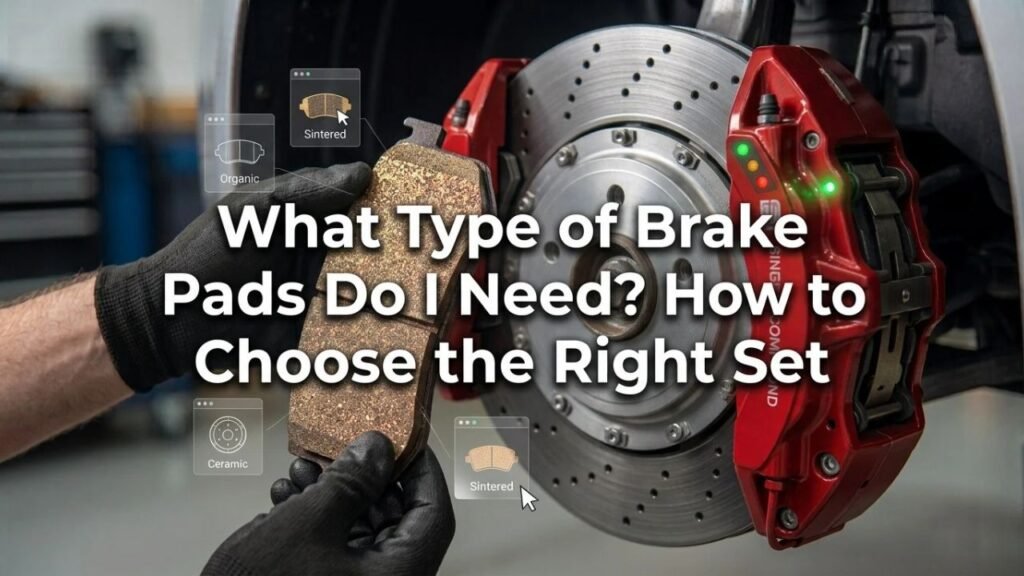
For most drivers, the answer starts with the vehicle’s original brake setup. Find a pad set listed for the exact year, make, model, trim, axle position, and brake package. After that, choose a friction formulation suited to the way the vehicle is driven.
Daily Commuting and Normal Street Driving
For a passenger car or crossover used mainly for commuting, errands, and highway driving, a quality ceramic pad is often a strong option if the vehicle catalog lists it as compatible.
Ceramic formulations are commonly chosen for low dust, low noise, smooth pedal feel, and steady street behavior. Akebono, for example, markets its ceramic ProACT line around low dust, low noise, consistent pedal feel, and vehicle-specific formulas.
Do not treat “ceramic” as proof that a pad is automatically superior. A cheap or poorly matched ceramic pad can be a worse fit than a well-engineered semi-metallic pad made for the vehicle.
Towing, Hauling, and Heavy Vehicles
A truck, SUV, van, or crossover that regularly tows or carries heavy loads needs pads that tolerate repeated heat.
Semi-metallic or severe-duty pads are common choices for this use because metal-containing formulations can manage heat well and provide firm braking response under repeated load. PowerStop’s towing guidance also separates light-duty organic materials from semi-metallic and heavy-duty formulas for higher-heat work.
Check the vehicle maker’s towing information and the pad manufacturer’s application notes. Do not install a “performance” pad based only on the label on the box.
Mountain Driving and Repeated Hard Braking
Long descents and repeated hard stops can raise brake temperatures far beyond a normal commute.
A pad with better high-temperature behavior may make more sense than a low-dust comfort pad. Semi-metallic street pads, severe-duty formulations, or application-specific performance pads may be listed for this role.
Brake fluid condition, rotor condition, vehicle load, and braking technique matter too. A higher-heat pad does not correct thin rotors, sticking calipers, old fluid, or an overloaded vehicle.
Performance Street Driving
A performance street car needs a pad designed for the temperatures it actually reaches.
Track-oriented pads may require heat before they provide their intended friction level, and some can be noisy or dusty in street use. A street-performance pad is often a more sensible match for a road car that sees spirited driving but not sustained track sessions.
I would choose the pad around the real duty cycle rather than buying the most aggressive compound available.
Key Takeaway: Confirm exact vehicle fitment first. Ceramic commonly suits quiet daily use, while semi-metallic, severe-duty, or street-performance formulations make more sense as heat and load increase.
Confirm Brake Pad Fitment Before Choosing a Material
Pad material means nothing if the part does not physically and functionally match the brake system.
Check Year, Make, Model, Trim, and Axle
Start with a trusted parts catalog or the brake manufacturer’s application lookup.
Enter the exact:
- Model year
- Make
- Model
- Trim or submodel
- Engine when requested
- Front or rear axle
Front and rear pads are often different, so a front set cannot be assumed to fit the rear.
Watch for Multiple Brake Packages
Some vehicles use more than one brake setup in the same model year.
Differences may involve:
- Rotor diameter
- Caliper design
- Wheel size
- Performance package
- Towing package
- Engine option
- Production date
- Axle or trim level
If a catalog shows two possible pad sets for the same vehicle, do not guess. Use the VIN, brake code, rotor measurement, caliper casting information, or the catalog’s identification method.
Check Sensors, Shims, and Hardware
The correct pad set may need a mechanical wear tab, an electronic wear sensor, specific abutment clips, or OE-style shims.
Bosch listings show that pad applications can differ in wear-sensor provisions and included hardware even within the same product line.
A pad can have the correct overall shape yet still be the wrong purchase if the vehicle requires a sensor arrangement that the set does not support.
Key Takeaway: Match the exact brake package, axle, sensor setup, and hardware before comparing pad compounds. Fitment errors cannot be fixed by choosing a better material.
Ceramic vs. Semi-Metallic vs. Organic Brake Pads
The three names most drivers see are ceramic, semi-metallic, and non-asbestos organic (NAO). Each category contains many formulas, so the comparison describes common tendencies rather than a promise for every pad.
| Pad type | Common strengths | Common tradeoffs | Often suited to |
| Ceramic | Low dust, low noise, smooth street feel | Higher price, not always the best choice for repeated heavy heat | Commuting, family cars, normal street use |
| Semi-metallic | Strong bite, good heat handling, broad heavy-use capability | More noise and darker dust in many formulas | Trucks, towing, mountain use, spirited driving |
| Organic/NAO | Quiet, softer friction behavior, often lower cost | Faster wear and less heat tolerance in many formulas | Light-duty use when specified for the application |
Ceramic Brake Pads
Ceramic pads use ceramic-based friction materials blended with other ingredients. They became popular in street applications because many formulas create light-colored dust and run quietly.
For a normal daily driver, this can be a very practical combination. Cleaner wheels and lower noise matter to many drivers who rarely tow or push the brakes through repeated high-temperature stops.
The limitation is that the word “ceramic” covers many formulations. One ceramic pad may be designed for a compact sedan while another is engineered for a larger SUV. The vehicle-specific formula matters more than the category name by itself.
Semi-Metallic Brake Pads
Semi-metallic pads contain a meaningful share of metallic material blended with friction modifiers and binders.
They are widely used where heat transfer, firm bite, and repeated braking matter. They can be a strong fit for trucks, SUVs, towing, hilly routes, and performance-oriented street use.
The tradeoff is that many semi-metallic formulas produce more visible dust and more noise than a quiet ceramic street pad. Some may also be harder on rotors.
Organic or NAO Brake Pads
Non-asbestos organic pads use fibers, resins, fillers, and other non-asbestos materials.
They can provide quiet operation and a softer feel, and they may be gentle on rotors. They also tend to be less suited to repeated heavy heat than stronger metallic or specialized formulas.
Use an organic pad only when it is a listed fit for the vehicle and the driving duty is appropriate. Choosing it only because it costs less can lead to faster wear if the vehicle is heavy or used hard.
Key Takeaway: Material labels describe broad behavior, not exact performance. Compare pads that already fit the vehicle, then use ceramic for comfort-focused street use, semi-metallic for higher heat and load, and organic for suitable light-duty applications.
Why OE-Compatible Friction Matters More Than the Label
A brake pad is part of a matched system involving the rotor, caliper, hydraulic system, ABS, tires, vehicle weight, and chassis calibration.
That is why a pad should not be chosen from material name alone.
Bosch states that its brake pads use platform-specific friction formulations, and its catalog includes both ceramic and semi-metallic compounds for different applications. That approach supports a useful rule: the best pad is the one engineered for the vehicle and duty, not the one with the most fashionable material name.
Original equipment does not mean you must buy a dealership-branded box. Quality aftermarket pads can be built as direct replacements. The key is using a reputable application catalog and a pad line intended to match or improve the required street behavior for that vehicle.
NHTSA has also stated that there is no Federal Motor Vehicle Safety Standard aimed specifically at replacement brake pads by themselves; federal standards regulate brake systems, and brake pads remain motor-vehicle equipment subject to safety-defect recall rules.
Can I Switch From Semi-Metallic to Ceramic Brake Pads?
Sometimes, yes, but the replacement needs to be listed for the vehicle and suitable for its use.
When a Ceramic Switch Can Make Sense
A compatible ceramic pad may be appealing if the vehicle is a daily driver and the goals are:
- Less visible brake dust
- Quieter operation
- Smooth street braking
- Lower cleaning effort on wheels
Akebono states that some of its vehicle-optimized ceramic applications can replace original semi-metallic pads, which shows that a compound change can be engineered properly for specific vehicles.
The key phrase is vehicle-optimized. Do not assume any ceramic pad is a sound substitute for any semi-metallic pad.
When I Would Stay With Semi-Metallic or Heavy-Duty Pads
I would be cautious about changing to a comfort-focused ceramic pad on a vehicle that regularly:
- Tows near its rated limits
- Carries heavy loads
- Descends long grades
- Sees repeated hard stops
- Uses brakes in severe-duty fleet work
- Has an OE setup that calls for a high-heat friction formula
In those cases, heat behavior matters more than keeping the wheels clean.
Do Both Axles Need the Same Material?
Not always. Vehicle engineers may specify different friction formulations front and rear.
Do not assume that installing ceramic pads on the front means the rear should also be ceramic. Use pads listed for each axle and avoid mixing unmatched pads left-to-right on the same axle.
Key Takeaway: A material change can be reasonable when the pad maker lists the application and the new formula suits the vehicle’s real use. Do not swap compounds by material name alone.
Which Brake Pads Make Sense for Common Driving Situations?
A short scenario check can narrow the choice.
| Driving situation | Sensible starting point |
| Commuter sedan or crossover | OE-compatible ceramic or OE-style pad |
| Family SUV with normal street use | OE-compatible ceramic or specified OE-style formula |
| Pickup used for regular towing | Semi-metallic, severe-duty, or towing-rated application |
| Frequent mountain descents | High-heat street or heavy-duty application listed for the vehicle |
| Performance street car | Street-performance pad matched to the brake package |
| Track use | Track-rated pad chosen for the brake system and temperature range |
| Light older vehicle originally using NAO | Quality NAO or approved upgrade listed for the application |
| Hybrid or EV | OE-compatible pad that matches the vehicle’s brake system and corrosion/noise requirements |
For hybrids and EVs, regenerative braking often reduces how often the friction brakes are used during normal driving. That can change wear and corrosion patterns, but it does not mean any low-dust pad is suitable. Use an application specifically listed for the vehicle.
For towing, do not treat a truck badge as enough information. A half-ton pickup used empty on city streets has a different duty cycle from the same truck pulling a trailer down long grades.
Features That Matter Beyond Brake Pad Material
Two pads made from the same general compound can still behave differently because of their construction.
Shims sit on the backing-plate side and are used to control vibration and noise.
Chamfers are angled edges on the friction material. They can influence contact behavior and noise.
Slots divide the friction block and can help manage gases, dust, heat, and vibration depending on the design.
Wear indicators may be mechanical tabs or electronic sensors. The replacement pad needs the correct arrangement for the application.
Hardware kits may include abutment clips or related pieces. Replacing worn or corroded hardware can matter as much as buying a premium pad.
Bosch product listings show OE-style slots and chamfers, multi-layer shims, sensor variations, and application-specific hardware across its pad range.
Do not compare two pad boxes only by ceramic versus semi-metallic. Look at the whole set and what the vehicle requires.
How to Choose Brake Pads in 7 Steps
- Identify the exact vehicle.
Use year, make, model, trim, engine, and VIN details when the catalog asks for them. - Select the correct axle.
Confirm front or rear. Do not assume the same pad is used at both ends. - Resolve brake-package differences.
If multiple sets appear, identify rotor size, caliper type, package code, or production split before buying. - Start with an OE-compatible application.
Choose pads from a reputable manufacturer that specifically lists the vehicle. - Match the compound to real use.
Daily commuting often points toward ceramic. Repeated heavy heat, towing, and demanding use often point toward semi-metallic or severe-duty formulas. - Check sensors, shims, and hardware.
Make sure the set includes or supports the pieces required by the vehicle. - Inspect the rest of the brake system.
New pads should not be used to hide deeply scored rotors, sticking calipers, seized slides, fluid leaks, or other brake faults.
Safety Tip: If the vehicle already has grinding brakes, a soft or sinking pedal, fluid loss, severe pulling, or sharply reduced braking force, diagnose the brake system before treating the job as a simple pad upgrade.
Common Brake Pad Buying Mistakes
Buying by price alone is one of the easiest mistakes. A cheap pad that wears quickly, makes noise, or does not match the vehicle’s heat demands may cost more after another repair.
Another mistake is assuming ceramic is always the premium answer. Ceramic is a material family, not a universal performance ranking.
Buying from only the model name can also cause trouble. A vehicle may have several rotor diameters or caliper packages in the same year.
Do not buy front pads for the rear axle, ignore wear-sensor requirements, or assume hardware from the old set should always be reused.
I would also avoid changing friction type to solve a braking fault. Noise, pulling, vibration, overheating, or rapid wear can come from rotors, calipers, slides, installation errors, contamination, or suspension and tire problems. A different compound will not repair those faults.
Conclusion
The best answer to what type of brake pads do i need is not simply “ceramic” or “semi-metallic.” Start with a pad that fits the exact vehicle, axle, brake package, and sensor setup, then choose a friction formula suited to the vehicle’s normal workload.
Ceramic pads are often a strong fit for daily street driving where quiet operation and low dust matter. Semi-metallic or severe-duty pads often make more sense for towing, heavier loads, repeated hard braking, and high-temperature use. Organic or NAO pads still have a place in compatible light-duty applications.
My recommendation is to treat OE compatibility as the filter that comes first. After the fit is confirmed, compare friction material, heat demands, dust, noise, hardware, and driving conditions. That approach is far safer than buying a pad because one material name sounds more premium.
FAQs About Choosing the Right Brake Pads
How Do I Know Exactly Which Brake Pads Fit My Car?
Use a reputable parts catalog and enter the exact year, make, model, trim, engine, and axle position. If the catalog lists more than one set, identify the brake package using the VIN, rotor diameter, caliper information, option code, or the catalog’s fitment notes.
Do not order from the vehicle model name alone when several brake packages exist.
Are Ceramic Brake Pads Best for Most Cars?
Ceramic pads are a strong option for many daily-driven passenger vehicles because compatible formulas can run quietly and create little visible dust.
They are not automatically the best pad for every car. Trucks used for towing, vehicles exposed to repeated high heat, and some performance applications may be better served by semi-metallic or specialized formulas.
Do I Need Ceramic or Semi-Metallic Brake Pads?
Choose from pads listed for the vehicle first. For normal commuting, ceramic is often attractive for low dust and quiet operation. For towing, mountain driving, heavier vehicles, or repeated hard stops, semi-metallic or severe-duty pads are often the better starting point.
The exact formulation and application rating matter more than the category name.
Can I Use Any Brake Pads That Physically Fit?
No. Physical shape is only one part of compatibility.
The pad must also suit the brake package, axle, sensor arrangement, hardware, rotor design, and intended friction behavior. Use a verified vehicle application instead of matching pads by shape.
Should Front and Rear Brake Pads Be the Same Type?
Not necessarily. Front and rear brakes do different shares of the braking work, and a manufacturer may use different friction materials or pad designs on each axle.
Use the correct listed pads for the front and rear rather than forcing both axles to use the same compound.
Are Expensive Brake Pads Always Better?
No. Price does not prove that a pad matches the vehicle or driving conditions.
A premium track-oriented pad can be a poor street choice if it is noisy, dusty, or designed around a different temperature range. A quality OE-style pad may suit a commuter car far better.
What Brake Pads Should I Use for Towing?
Start with a pad set listed for the exact truck or SUV and rated for higher heat or severe-duty use. Semi-metallic and towing-focused formulations are common choices because repeated braking with extra load creates more heat.
Inspect rotors, calipers, brake fluid, and trailer brakes too. Pad material cannot compensate for problems elsewhere in the braking system.