What Is the Minimum Thickness of Brake Pads? When to Replace
For most passenger cars, brake-pad replacement should be planned at about 3 mm (0.118 inch) of remaining friction material. That is a practical replacement point, not a universal service limit. Some vehicles specify 2 mm or another value, so the manufacturer’s specification for the exact model should decide the final cutoff.
Waiting until almost no friction material remains creates two problems. The pad has less material between the caliper and rotor, and a small amount of extra wear can bring the metal backing plate into contact with the rotor. That can turn a routine pad replacement into a pad-and-rotor repair.
Replacing worn pads before they reach that stage gives you more margin between inspections and reduces the chance of rotor scoring. It also gives you time to address uneven wear, a sticking caliper, or worn slide hardware before one pad reaches its limit much earlier than the others.
Manufacturer specifications show why one number should not be treated as universal. One Ford U.S. brake-system specification lists 3 mm (0.1181 inch) as the minimum front and rear pad thickness, while Mazda has published a 2 mm minimum for brake pads in its U.S. brake-replacement information.
That variation is the main reason the answer to what is the minimum thickness of brake pads should be split into two numbers: the common replacement point and the vehicle’s actual service limit. In my research, 3 mm repeatedly appeared as the point where replacement deserves immediate attention, while manufacturer limits can sit below or at that figure.
The sections below explain what 2 mm, 3 mm, 4 mm, and thicker readings mean, how pad thickness should be measured, why inner and outer pads need separate checks, how legal inspection limits differ from service recommendations, and which warning signs mean you should not wait for the next routine inspection.
What Is the Minimum Thickness of Brake Pads in Millimeters?
For a typical passenger vehicle, 3 mm is a sensible replacement point, but it is not a universal mechanical limit for every brake system.
Some manufacturers specify 3 mm as the minimum. Others permit the friction material to wear closer to 2 mm. Published specifications for some vehicles go slightly above or below 2 mm, which is why the repair information for the exact year, make, model, and brake package takes priority.
A useful way to think about the numbers is:
- 3 mm: Replace soon or now unless the manufacturer specifies otherwise.
- 2 mm: Very thin and at the service limit for some vehicles.
- Below the stated manufacturer limit: Replace the pads.
- Metal backing plate touching the rotor: The pads have been worn too far and rotor damage may already be present.
The measurement refers to the friction material, not the total thickness of the friction material, steel backing plate, shim, and other pad components.
Three millimeters equals about 0.118 inch, which is slightly less than 1/8 inch. Two millimeters equals about 0.079 inch.
Mazda, for example, has published a 2 mm minimum in U.S. brake information. Ford documentation for another application specifies 3 mm. A separate manufacturer document filed with NHTSA lists pad service limits around 2.0–2.15 mm for its front and rear brakes.
That spread is strong evidence against treating 2 mm or 3 mm as a universal number for every car.
Brake Pad Thickness Chart
The following chart works as a general passenger-car planning reference. It does not replace the service specification for your vehicle.
| Remaining friction material | General condition | Suggested action |
| 8 mm or more | Plenty of material on many pads | Continue normal inspections |
| 6–7 mm | Moderate wear | Monitor during routine service |
| 4–5 mm | Getting lower | Plan another inspection and prepare for replacement |
| 3 mm | Near common replacement point | Replacement is usually sensible |
| 2 mm | Very thin | Replace promptly unless a confirmed specification says otherwise |
| Below specified service limit | Worn out | Replace |
| Metal-to-metal contact | Pad friction material exhausted | Stop delaying repair and inspect rotors |
New pad thickness is not identical across vehicles. Published factory specifications show examples ranging from roughly 9 mm to 10 mm on some passenger vehicles, while other applications use thicker friction material.
For that reason, a 5 mm reading does not always mean a pad is exactly “50% worn.” Pad life should not be calculated by dividing the current thickness by an assumed new thickness.
Why 3 mm Is a Common Brake Pad Replacement Point
It Leaves Margin Before the Service Limit
Replacing at 3 mm gives the driver some distance from service limits that may fall near 2 mm.
That extra material is useful because pads do not always wear at identical rates. One inner pad may be thinner than the outer pad you can see through the wheel. A reading taken from only one easy-to-see location can miss the thinnest pad.
Subaru’s U.S. parts information classifies 0–3 mm as needing immediate attention, 4–6 mm as requiring future attention, and 7–12 mm as having good pad life.
Thin Pads Leave Less Room for Continued Wear
Brake pads lose friction material every time the rotor and pad rub during braking. Once a pad reaches only a few millimeters, waiting through several more months of driving can carry it closer to its limit.
Mileage predictions become unreliable because wear changes with traffic, terrain, vehicle mass, towing, braking habits, brake design, and mechanical condition.
A driver covering mostly open highway miles may use the brakes far less than a driver making repeated stops in city traffic.
It Reduces the Chance of Rotor Damage
The friction material is bonded or otherwise attached to a steel backing plate. Once the friction layer wears away, the backing plate can contact the rotor.
A rotor that has been deeply scored or overheated may need replacement along with the pads. Changing the pads before metal contact is far less disruptive than waiting for grinding noises.
Key Takeaway: Treat 3 mm as a strong replacement signal, then confirm the exact vehicle specification rather than trying to use one universal cutoff.
Is 4 mm of Brake Pad Thickness Still Good?
A 4 mm brake pad is worn but usually still above the common 3 mm replacement point. It deserves closer monitoring rather than the same treatment as a thick, nearly new pad.
The practical decision changes with driving plans. A car that will soon cover a long road trip, tow a trailer, spend time in mountain traffic, or go many months before its next inspection may justify replacement at 4 mm.
If another pad on the same axle is already at 3 mm or lower, replacing the axle set is generally more sensible than focusing only on the 4 mm pad.
Brake pads on the same axle are normally replaced as a set so braking characteristics remain matched from side to side.
Is 3 mm Brake Pad Thickness Safe?
A pad measuring 3 mm has not necessarily reached metal-to-metal condition, but it has reached a point where replacement should no longer be treated as a distant maintenance item.
Some manufacturers use 3 mm as their minimum. Others place their service limit lower. That means 3 mm may represent the actual limit on one vehicle and a small remaining margin on another.
I would not use a 3 mm reading as a reason to calculate how many thousands of miles can still be extracted from the pads. The more useful question is how soon the pads can be replaced and if all four pad positions on that axle have been measured.
Is 2 mm Too Thin for Brake Pads?
For routine passenger-car use, 2 mm should be treated as replacement territory.
Some manufacturer specifications identify 2 mm as the minimum friction-material thickness. Mazda’s published U.S. information is one example. Other vehicles have limits near the same figure.
A vehicle with 2 mm remaining should not be assumed to have a predictable number of miles left. A measured service limit is a maintenance boundary, not a target that owners need to squeeze every pad down to.
If the specified minimum is 3 mm, a 2 mm pad is already below specification.
How to Measure Brake Pad Thickness Correctly
Measure the Friction Material Only
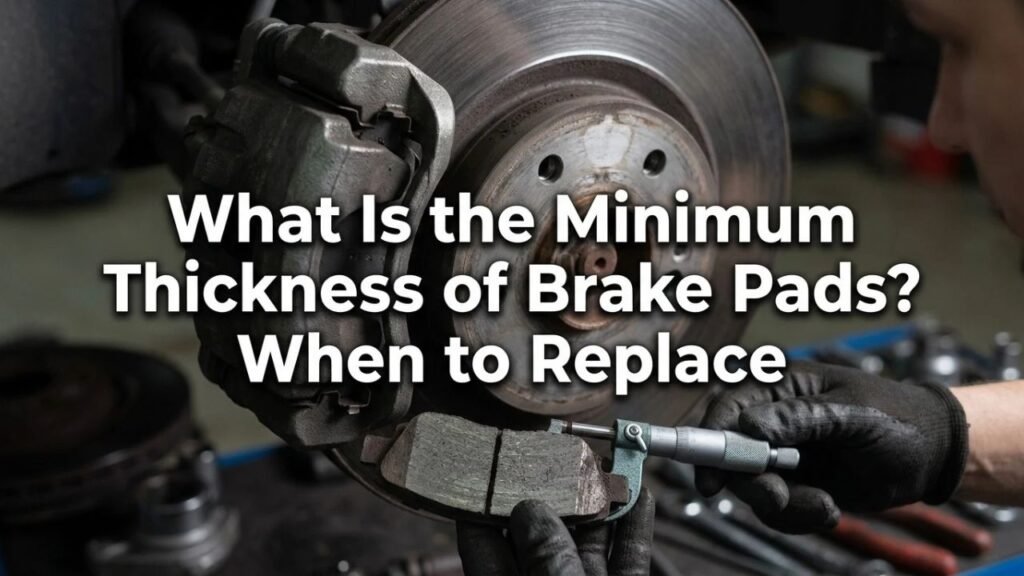
Find the friction layer that actually contacts the rotor. Do not include the steel backing plate or noise-control shim in the measurement.
A brake-pad gauge is convenient because its stepped blades correspond to common pad thicknesses. A suitable caliper or other measuring tool can give a more exact reading when the pad is accessible.
The measurement should represent the thinnest usable friction material, not a manufactured groove or slot that is intentionally cut into the pad.
Check Through the Wheel Only as a First Look
Many wheels provide enough space to see the outer brake pad with a flashlight. This can reveal a badly worn pad without disassembly.
The limitation is visibility. The inner pad may be difficult or impossible to judge accurately while the wheel is installed.
If the reading matters for a replacement decision, removing the wheel gives a much better view of both sides of the rotor.
Safety Tip: Support a raised vehicle with properly rated jack stands at approved lifting points. Do not work around a wheel or brake assembly while the vehicle is supported only by a jack.
Measure Inner and Outer Pads
A disc-brake caliper normally has friction material on both sides of the rotor. Measure both pads.
If one pad is much thinner than its partner, do not treat that only as normal wear. Uneven thickness can point to restricted caliper movement, a sticking piston, seized or dry slide hardware, pad binding, or another brake-system fault.
Checking just the visible outer pad can create a false impression that plenty of lining remains.
Compare the Reading With the Vehicle Specification
After measuring the pads, check the service information for the exact vehicle.
Do not rely on an internet chart alone if the manufacturer supplies a specific wear limit. Brake packages can differ even within the same model line due to engine, trim, wheel size, performance package, or axle configuration.
Key Takeaway: Measure the friction layer at the thinnest real wear point, inspect inner and outer pads, and compare the lowest reading with the specification for the exact brake system.
Why Brake Pads Can Wear Unevenly
Inner and Outer Pad Wear Can Differ
A floating caliper relies on free movement of the caliper body and slide hardware. If movement becomes restricted, one pad can stay in stronger contact with the rotor or receive more clamping force than intended.
That may create a clear difference between the inner and outer pad thicknesses.
One pad at 6 mm does not cancel out another at 2 mm. The thinnest pad is the one that needs attention.
Left and Right Sides Can Also Differ
Pads on opposite sides of the same axle should be inspected together.
A large left-to-right difference may come from caliper trouble, restricted hardware, contamination, or another braking fault. Repairing the wear cause matters because new pads can develop the same pattern if the underlying problem remains.
Tapered Wear Is Another Warning
A brake pad should not be judged from one thick edge when the opposite edge is much thinner.
Tapered wear can appear when the pad does not sit or move correctly in the bracket, hardware is damaged, or caliper movement is uneven. Measure more than one point when the pad surface does not appear parallel to the backing plate.
Key Takeaway: The lowest pad measurement matters most. A major thickness difference between pads or across one pad deserves inspection of the caliper and related hardware.
Warning Signs That Brake Pads May Be Near Their Limit
Thickness measurement is more dependable than waiting for symptoms, but worn pads can produce several clues.
Common signs include:
- High-pitched squealing from a mechanical wear indicator
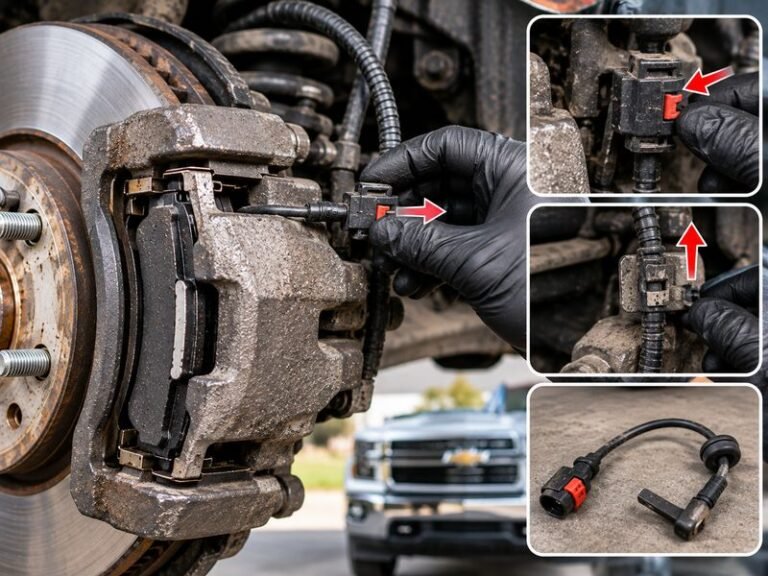
- A brake-pad warning message on vehicles with electronic sensors
- Grinding or scraping noises
- Visible friction material that looks very thin
- Uneven pad wear
- Rotor scoring
- Changes in braking feel that require inspection
A squeal does not always mean the pads are worn out, since brake noise has several possible causes. A wear indicator touching the rotor is one common cause.
Grinding deserves faster attention because it can indicate that friction material has worn away far enough for metal components to contact the rotor.
Do not assume the dashboard brake warning lamp measures pad thickness. Some vehicles have dedicated electronic pad-wear sensors; many do not.
How Long Will 3 mm Brake Pads Last?
There is no dependable mileage figure for a pad that has 3 mm remaining.
A driver might travel through thousands of low-braking highway miles with relatively little wear, while repeated city stops, mountain descents, towing, heavy loads, or a dragging caliper can consume material much faster.
Past wear history gives a better estimate than a generic mileage claim. If a technician recorded 6 mm at one service and 4 mm at a later service, those dated measurements show the vehicle’s recent wear rate.
Even that rate can change if driving conditions change or a brake begins dragging.
My preference is to treat 3 mm as a replacement decision rather than a mileage-prediction exercise. The cost of inspecting or replacing pads is easier to manage than discovering that an unseen inner pad has reached its backing plate.
Brake Pad Service Limits and Legal Minimums Are Not the Same
A manufacturer service limit tells you when a component has reached the specified wear boundary for that brake design. A state vehicle-inspection rule is a legal inspection standard. Those two numbers do not always match.
For example, current Virginia safety-inspection rules reject bonded, molded, or riveted disc pads worn below 2/32 inch, about 1.6 mm, at the measured point. New Hampshire law also specifies 2/32 inch minimum friction material for covered motor vehicles.
That does not mean a vehicle with a manufacturer minimum of 3 mm should be driven down to 1.6 mm. The higher vehicle-specific requirement still matters for maintenance.
Commercial vehicles can also operate under separate brake rules and very different lining dimensions. Passenger-car owners should not use heavy-truck brake limits as their maintenance target.
Should You Replace Brake Pads at 5 mm?
Five millimeters generally means the pads still have measurable friction material above the common replacement range.
Replacement at 5 mm may still make sense if the pads are wearing unevenly, contaminated, cracked, making a long trip before the next inspection, or being serviced alongside other brake work.
If all pads on the axle show even 5 mm readings and the vehicle manufacturer specifies a much lower service limit, immediate replacement may not be required.
The key is to base the decision on actual measurements and condition rather than pad thickness alone.
When Brake Pad Thickness Is Not the Only Reason to Replace Them
A pad can need replacement before reaching its numerical wear limit.
Replacement or repair may be needed if the friction material is:
- Cracked or separating from the backing plate
- Contaminated with brake fluid, grease, or oil
- Worn at a severe angle
- Damaged by excessive heat
- Unevenly worn due to a brake-system fault
The rotor, caliper, slides, boots, hoses, and related components should also be examined when unusual pad wear is found.
Thickness tells you how much friction material remains. It does not tell you that every other part of the brake assembly is healthy.
Conclusion
For most passenger vehicles, the practical answer to what is the minimum thickness of brake pads is around 3 mm for replacement planning, with some manufacturer service limits closer to 2 mm. The specification for the exact vehicle should settle the decision.
Measure only the friction material, inspect both the inner and outer pads, and use the thinnest genuine wear point. A 4–5 mm pad may still have usable material, while 3 mm deserves replacement planning and 2 mm should be treated as very thin.
I recommend avoiding the temptation to drive pads all the way to the smallest legal or mechanical number. If the pads are near their limit, unevenly worn, or showing damage, replacing them before the backing plate reaches the rotor is the more sensible path.
FAQs About Minimum Brake Pad Thickness
What Is the Lowest Safe Brake Pad Thickness?
There is no single lowest thickness that applies to every passenger vehicle. About 3 mm is a common replacement point, while some manufacturers specify service limits around 2 mm. Use the specification for the exact vehicle and treat any pad below that limit as worn out.
Is 4 mm Low for Brake Pads?
Yes, 4 mm means the pads have reached a lower stage of their service life, but it is often still above the replacement limit. Check them more frequently and plan for replacement, especially if another pad on the axle is thinner or upcoming driving will delay the next inspection.
Should Brake Pads Be Replaced at 3 mm?
In many cases, yes. Three millimeters is a common replacement threshold, and some manufacturers specify 3 mm as the actual minimum. Even if the vehicle has a slightly lower service limit, replacing around 3 mm leaves more margin before the friction material is exhausted.
Are 2 mm Brake Pads Safe to Drive On?
Two millimeters is very thin and is the specified minimum for some brake systems. It is below the minimum for others. A 2 mm reading should trigger prompt replacement rather than an attempt to estimate months of remaining use.
Do You Measure the Backing Plate With Brake Pad Thickness?
No. Measure the friction material only unless the vehicle service procedure states a different method. The steel backing plate, shims, and other attached components are not part of the remaining friction-material measurement.
Do Inner Brake Pads Wear Faster Than Outer Pads?
They can, but a major difference should not automatically be treated as normal. Restricted caliper slides, piston problems, pad binding, contamination, and other faults can create uneven wear. Both inner and outer pads need inspection before deciding how much pad life remains.
Can Brake Pads Be Bad Even If They Are Still Thick?
Yes. Pads may require replacement due to cracking, contamination, separation, severe taper, heat damage, or other physical problems even when their thickness remains above the wear limit. Pad condition and brake-system operation matter along with the numerical measurement.