Is DOT 3 Brake Fluid Flammable? Flash Point, Risks, and Safety
DOT 3 brake fluid is not easily ignited at normal room temperature, but it can burn when exposed to sufficient heat and an ignition source. Most conventional DOT 3 brake fluids have relatively high flash points and are not classified as flammable liquids under U.S. OSHA criteria. However, they should still be treated as potentially combustible materials.
DOT 3 brake fluid is generally made from glycol ethers and related compounds designed to transmit hydraulic pressure and withstand high braking temperatures. These ingredients behave differently from highly volatile fuels such as gasoline.
For example, Prestone reports a flash point above 203°F (118.3°C) for its DOT 3 brake fluid, while Ford Motorcraft lists 289.4°F (143°C) for its High Performance DOT 3 product. The difference shows that there is no single flash point for every DOT 3 formulation.
The fire risk increases when brake fluid leaks onto hot engine components, contacts flames, or is exposed to extreme heat.
In this article, I explain whether DOT 3 brake fluid is flammable or combustible, its flash point, and how ignition differs from boiling. I also cover what happens near hot brake components, whether spilled fluid can catch fire, safe storage and cleanup procedures, and precautions for handling brake fluid around vehicles.
Is DOT 3 Brake Fluid Flammable or Combustible?
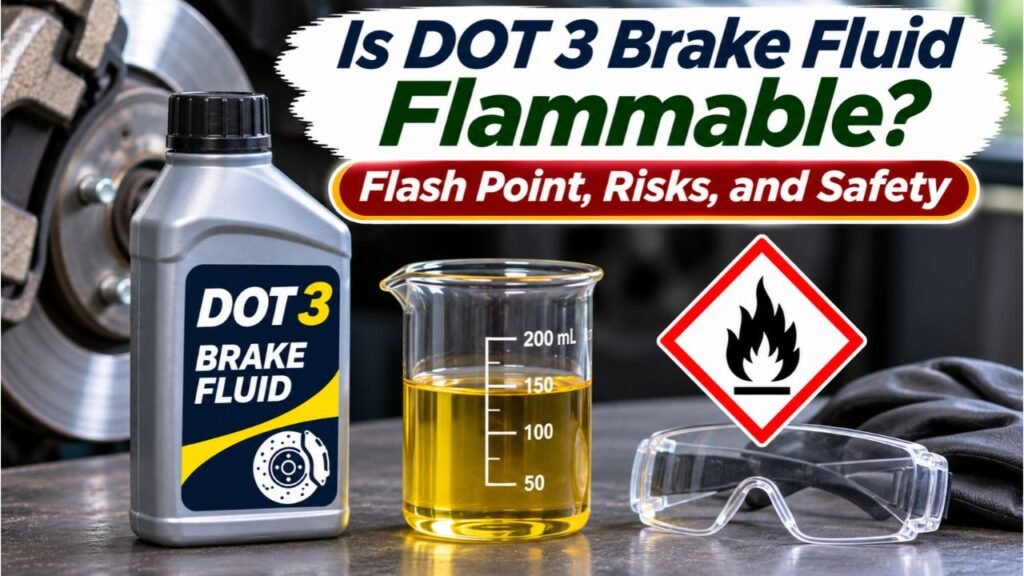
DOT 3 brake fluid can burn, but most formulations are not readily flammable under ordinary atmospheric conditions.
The distinction between flammable and combustible is important.
In everyday conversation, people often describe any material that can catch fire as flammable.
However, technical safety classifications use specific criteria.
What Does Flammable Mean?
A flammable liquid releases enough vapor to form an ignitable mixture with air at a relatively low temperature.
The lower its flash point, the easier it generally is for the liquid to produce ignitable vapor under ordinary conditions.
For example, gasoline is highly flammable because it readily produces ignitable vapor at normal temperatures.
DOT 3 brake fluid generally has a much higher flash point.
That makes it less likely to ignite from an ordinary room-temperature spill.
What Does Combustible Mean?
A combustible material can burn when exposed to suitable ignition conditions.
However, it may require more heating before it produces enough vapor to ignite.
DOT 3 brake fluid is often described as combustible in this practical sense.
It does not need to be classified as a flammable liquid to present a fire hazard.
How Does OSHA Classify Flammable Liquids?
Under the current OSHA Hazard Communication Standard, Appendix B.6, a flammable liquid has a flash point of 93°C (199.4°F) or lower.
Its categories are:
| OSHA flammable-liquid category | Flash-point criteria |
| Category 1 | Below 73.4°F, with an initial boiling point at or below 95°F |
| Category 2 | Below 73.4°F, with an initial boiling point above 95°F |
| Category 3 | 73.4–140°F |
| Category 4 | Above 140°F through 199.4°F |
The precise boundaries use Celsius values defined in the regulation.
A liquid with a flash point above 199.4°F falls outside these OSHA flammable-liquid categories.
However, that classification does not establish that the substance cannot burn.
Is DOT 3 Brake Fluid Classified as Flammable?
The answer depends on the particular product and applicable classification system.
Many DOT 3 brake fluids have flash points above OSHA’s 199.4°F limit.
These products are not classified as flammable liquids under that definition.
However, a manufacturer may still identify fire-related precautions in its safety data sheet.
Key Takeaway: DOT 3 brake fluid is generally combustible rather than readily flammable. A high flash point reduces ordinary ignition risk but does not eliminate the possibility of fire.
What Is the Flash Point of DOT 3 Brake Fluid?
The flash point of DOT 3 brake fluid varies with the chemical formulation.
There is no universal value that applies to every brand.
Verified DOT 3 Brake Fluid Flash Points
| DOT 3 brake fluid | Published flash point | Test method |
| Prestone DOT 3 Brake Fluid | Above 203°F (118.3°C) | Pensky-Martens closed cup |
| Ford Motorcraft High Performance DOT 3 | 289.4°F (143°C) | Cleveland open cup |
Prestone’s value comes from its DOT 3 Brake Fluid Safety Data Sheet, revised May 27, 2023.
Ford Motorcraft provides its value in the High Performance DOT 3 Brake Fluid Safety Data Sheet.
These are product-specific figures.
The two manufacturers also used different flash-point testing methods, which limits direct comparison.
What Does a 203°F Flash Point Mean?
A flash point identifies the temperature at which a liquid can release enough vapor to form an ignitable mixture near its surface under a specified test method.
It does not mean the liquid automatically catches fire at that temperature.
An ignition source is normally required for a flash-point test.
It also does not mean the liquid is guaranteed to be safe below that temperature in every circumstance.
For example, spraying or misting a combustible liquid can create different ignition conditions from a stationary pool of fluid.
Does All DOT 3 Brake Fluid Have the Same Flash Point?
No.
Different manufacturers use different blends of glycol ethers, additives, and other ingredients.
These differences influence fire-related properties.
A particular product’s safety data sheet provides the most appropriate reference.
Where Can You Find the Flash Point?
Look at Section 9: Physical and Chemical Properties of the product’s Safety Data Sheet (SDS).
This section may list:
- Flash point.
- Boiling point.
- Autoignition temperature.
- Vapor pressure.
- Flammability limits.
- Other physical properties.
Section 5 generally contains firefighting information.
For the most accurate assessment, use the SDS for the exact product and formulation.
DOT 3 Brake Fluid Flash Point vs Boiling Point
Flash point and boiling point are different physical properties.
They should never be treated as interchangeable measurements.
What Is Flash Point?
Flash point describes the lowest temperature at which a liquid produces enough vapor to form an ignitable mixture with air under a specified test.
The presence of an ignition source is an important part of this concept.
What Is Boiling Point?
Boiling point describes the temperature at which a liquid boils under specified pressure conditions.
For brake fluid, boiling resistance is especially important because boiling can produce vapor bubbles inside the hydraulic braking system.
These bubbles can reduce the system’s ability to transmit pressure effectively.
What Is Autoignition Temperature?
Autoignition temperature describes the temperature at which a substance can ignite under specified test conditions without a separate spark or flame.
It is not the same as flash point.
A liquid can have a relatively high flash point and still ignite if exposed to sufficient heat.
Not every DOT 3 manufacturer provides an autoignition temperature in its SDS.
Comparison Table
| Property | Meaning | Main safety concern |
| Flash point | Temperature at which sufficient vapor can form an ignitable mixture | Fire risk when an ignition source is present |
| Boiling point | Temperature at which the fluid boils under specified conditions | Vapor formation and loss of hydraulic performance |
| Autoignition temperature | Temperature at which ignition can occur without a separate ignition source under specified conditions | Ignition from extreme heat |
| Decomposition temperature | Temperature range where chemical breakdown may occur | Harmful decomposition products |
What Is the DOT 3 Boiling Point?
Federal brake-fluid performance requirements specify minimum boiling-point values.
For DOT 3 brake fluid:
- Minimum dry boiling point: 401°F (205°C).
- Minimum wet boiling point: 284°F (140°C).
These represent standardized brake-fluid performance tests.
They do not describe flash point.
Why Is the Wet Boiling Point Lower?
DOT 3 brake fluid is hygroscopic, meaning it absorbs moisture.
Water contamination reduces its boiling resistance.
As the fluid ages and absorbs moisture, it may boil at a lower temperature during severe braking.
That can create hydraulic problems even when the fluid is not burning.
Can DOT 3 Brake Fluid Ignite Before It Boils?
Potentially, yes, when exposed to suitable ignition conditions.
A product’s flash point can be lower than its boiling point.
However, this doesn’t mean brake fluid routinely catches fire inside an operating brake system.
The hydraulic circuit is designed to contain liquid fluid, and ignition requires suitable conditions.
Key Takeaway: DOT 3 brake fluid can present a fire hazard at temperatures below its boiling point. Boiling and ignition are separate hazards.
Why Can DOT 3 Brake Fluid Catch Fire?
DOT 3 brake fluid commonly contains organic chemical compounds, including glycol ethers.
These compounds can release combustible vapors when sufficiently heated.
What Is DOT 3 Brake Fluid Made Of?
A typical formulation may contain:
- Glycol ethers.
- Related glycol compounds.
- Corrosion inhibitors.
- Stabilizing additives.
- Other proprietary ingredients.
The precise proportions depend on the manufacturer.
DOT 3 is a performance classification, not a single chemical formula.
Are Glycol Ethers Combustible?
Many glycol ethers can burn under appropriate conditions.
However, their individual flash points and other fire properties vary substantially.
The properties of the finished brake fluid depend on its overall formulation.
Therefore, the fire behavior of one individual ingredient cannot automatically be used to predict the exact behavior of the entire product.
Does DOT 3 Produce Flammable Vapor?
It can produce ignitable vapor when heated sufficiently.
However, at ordinary room temperature, DOT 3 generally has much less tendency to release readily ignitable vapor than gasoline.
This helps explain why a small DOT 3 spill doesn’t normally behave like a gasoline spill.
Nevertheless, heat, ignition sources, and mist formation can increase the hazard.
Can Brake Fluid Burn Without a Spark?
Certain materials can ignite without a separate spark or flame under sufficiently extreme conditions.
However, the specific autoignition temperature of a DOT 3 brake fluid depends on its formulation and may not be available in its SDS.
Prestone’s safety guidance also identifies a specific hazard involving spills on hot, fibrous insulation.
This is one reason brake fluid leaks near very hot engine components should not be ignored.
Can DOT 3 Brake Fluid Catch Fire on a Hot Exhaust?
Yes, leaked DOT 3 brake fluid can present a fire risk if it contacts sufficiently hot exhaust components or other ignition sources.
However, contact with a warm surface doesn’t automatically cause ignition.
The outcome depends on several factors.
Factors Affecting Ignition
These include:
- Temperature of the surface.
- Amount of fluid.
- Fluid formulation.
- Availability of oxygen.
- Presence of flames or sparks.
- Whether the fluid forms droplets, a pool, or mist.
- Contact with insulation or other materials.
A hot exhaust manifold or other exhaust component may reach much higher temperatures than surrounding engine-compartment surfaces.
Leaking brake fluid should therefore be kept away from these areas.
What About Brake Fluid on the Engine?
A fluid spill on a relatively cool engine surface may not create an immediate fire.
However, the risk may increase when the engine warms up.
Brake fluid can also damage painted surfaces and contaminate surrounding components.
Clean spills promptly using safe procedures.
What About Brake Fluid on Exhaust Insulation?
Some insulation materials can retain absorbed fluids while being exposed to heat.
This can create a more serious hazard than a small spill on a cool, nonporous surface.
Prestone’s SDS specifically warns about possible combustion involving brake fluid on hot, fibrous insulation.
Don’t attempt to test whether a contaminated surface will ignite.
If brake fluid has leaked onto hot exhaust components or insulation, avoid operating the vehicle until the contamination and leak have been properly addressed.
Can a Brake Fluid Leak Start an Engine Fire?
It is possible under suitable ignition conditions.
However, many other vehicle fluids and materials can also contribute to engine-compartment fires.
A fire investigation would be necessary to determine the actual cause of a particular incident.
Key Takeaway: DOT 3 brake fluid is not highly volatile like gasoline, but leaks onto hot components can still create a fire hazard.
Can DOT 3 Brake Fluid Catch Fire Inside the Brake System?
Under normal operation, brake fluid is contained within a hydraulic circuit.
Its main function is transferring pressure.
The system is not designed to expose the fluid directly to open flames.
Does Brake Fluid Get Hot While Driving?
Yes.
Brake pads and rotors generate heat when the vehicle slows down.
Some of that heat travels through the calipers and into the hydraulic fluid.
This is normal.
Can Hot Brake Fluid Ignite Inside the Lines?
Ordinary heating inside a properly functioning hydraulic system does not mean the brake fluid will catch fire.
Ignition requires suitable combustion conditions.
A sealed hydraulic line does not present the same conditions as a pool of brake fluid exposed to air and an ignition source.
What Happens if DOT 3 Gets Too Hot?
The more immediate concern is fluid boiling.
If moisture-contaminated brake fluid reaches its boiling point, vapor bubbles may form.
Unlike liquid brake fluid, vapor compresses relatively easily.
This can lead to:
- A soft brake pedal.
- Increased pedal travel.
- Reduced hydraulic response.
- Longer stopping distances.
- Severe brake fade.
Can a Dragging Brake Create a Fire?
A sticking caliper or another mechanical defect can generate excessive friction and heat.
Under severe conditions, overheated brakes can damage components or contribute to a wheel-area fire.
However, the fire may involve friction materials, tires, grease, or other nearby combustibles rather than the hydraulic fluid itself.
A dragging brake requires prompt inspection.
Does Brake Fluid Boiling Mean It Is Burning?
No.
Boiling is a physical change from liquid to vapor.
Burning is a chemical reaction involving combustion.
Brake fluid can boil without igniting.
Likewise, exposed brake fluid can present a combustion hazard without first reaching its normal boiling point.
Is DOT 3 More Flammable Than DOT 4 Brake Fluid?
There is no universal rule that DOT 3 is always more flammable or less flammable than DOT 4.
The products have different performance requirements, but their flash points depend on their chemical formulations.
DOT 3 Brake Fluid
DOT 3 is commonly glycol-based.
It must meet specified brake-fluid performance requirements, including minimum boiling points.
Actual flash points vary by manufacturer.
DOT 4 Brake Fluid
DOT 4 generally has higher minimum boiling-point requirements than DOT 3.
However, this doesn’t automatically establish that it has a higher flash point.
Boiling point and flash point are different measurements.
DOT 5 Brake Fluid
DOT 5 is silicone-based.
It differs chemically from the glycol-based DOT 3, DOT 4, and DOT 5.1 fluids commonly used in automotive brake systems.
Its fire characteristics must be evaluated using the particular product’s SDS.
Don’t assume DOT 5 is universally noncombustible.
DOT 5.1 Brake Fluid
DOT 5.1 is generally glycol-based despite its name.
It has higher minimum boiling-point requirements than DOT 3.
However, those requirements do not determine its exact flash point.
Brake Fluid Comparison
| Brake fluid type | Common chemical base | Can present a fire hazard? | Important note |
| DOT 3 | Glycol-based | Yes, at sufficient heat | Flash point varies |
| DOT 4 | Glycol-based | Yes, depending on formulation and conditions | Higher boiling requirement doesn’t prove higher flash point |
| DOT 5 | Silicone-based | Fire properties depend on formulation | Not interchangeable with glycol-based fluids |
| DOT 5.1 | Glycol-based | Yes, depending on formulation and conditions | Different from silicone DOT 5 |
For fire-safety questions, consult the exact product’s safety data sheet.
For brake-system compatibility, always use the fluid specified by the vehicle manufacturer.
Is DOT 3 Brake Fluid as Flammable as Gasoline?
No.
DOT 3 brake fluid is generally far less easily ignited under ordinary conditions than gasoline.
Why Gasoline Ignites More Easily
Gasoline contains volatile hydrocarbons that readily evaporate and form ignitable vapor-air mixtures.
This makes gasoline a serious fire hazard even at relatively low temperatures.
DOT 3 brake fluid generally has a much higher flash point and lower volatility.
It is therefore less likely to create an ignitable vapor mixture at room temperature.
Does That Make DOT 3 Safe Around Flames?
No.
A material doesn’t need to be as volatile as gasoline to burn.
DOT 3 can still ignite under sufficiently severe heating conditions.
Avoid exposing it to:
- Open flames.
- Welding or cutting sparks.
- Smoking materials.
- Very hot equipment.
- Other ignition sources.
Is Brake Fluid More Like Engine Oil?
In terms of ordinary fire risk, both brake fluid and many lubricating oils generally have higher flash points than gasoline.
However, they have different chemical compositions and different product-specific flash points.
It would be inaccurate to assume they burn at the same temperature.
Does Brake Cleaner Have the Same Fire Risk?
No.
Brake cleaner is a different product from brake fluid.
Many brake cleaners use volatile solvents and may be highly flammable, although some formulations are marketed as nonflammable.
Always read the brake cleaner’s own warning label and SDS.
Don’t use brake-fluid fire information to judge the hazards of brake-cleaning sprays.
Can Spilled DOT 3 Brake Fluid Catch Fire?
Yes, if it encounters suitable ignition conditions.
However, a small spill at ordinary room temperature isn’t normally expected to ignite as easily as gasoline.
What Happens When DOT 3 Spills?
The fluid can spread across a surface and contaminate nearby materials.
Potential problems include:
- Slip hazards.
- Skin and eye exposure.
- Damage to painted surfaces.
- Environmental contamination.
- Fire risk near sufficiently hot equipment.
The severity depends on the spill’s size, location, and surrounding conditions.
Is a Brake Fluid Spill Dangerous on Concrete?
A small spill on cool concrete generally presents a lower immediate ignition risk than a spill onto hot exhaust components.
However, it should still be cleaned promptly.
Brake fluid can create a slippery surface and should not enter drains or waterways.
Can Brake Fluid on a Rag Catch Fire?
A rag contaminated with DOT 3 brake fluid is not automatically going to ignite.
However, contaminated absorbent materials should be kept away from heat and ignition sources.
Avoid storing fluid-soaked rags near hot engines, heaters, or welding areas.
Use appropriate waste containers and disposal procedures.
Can DOT 3 Damage Car Paint?
Yes.
Glycol-based brake fluid can damage certain automotive paint finishes.
A spill should be addressed promptly.
Avoid spreading the fluid across painted panels.
Follow suitable surface-cleaning guidance and prevent contaminated runoff from entering drains.
How to Clean Up a DOT 3 Brake Fluid Spill Safely
For a small, cool spill that can be handled safely, follow the product SDS and appropriate workshop procedures.
Step 1: Check for Fire and Heat Hazards
Before approaching the spill, identify nearby ignition sources.
If the fluid is on a hot exhaust system or the area is unsafe, do not attempt cleanup.
Allow qualified personnel to handle the situation.
Step 2: Wear Protective Equipment
Use suitable chemical-resistant gloves and eye protection.
DOT 3 brake fluid can irritate skin and cause serious eye injury.
Avoid prolonged contact.
Step 3: Ventilate the Area
Provide adequate ventilation when safe.
Avoid breathing vapor or mist.
Do not use compressed air to blow the spilled fluid around.
Step 4: Contain the Spill
For a small spill, use suitable absorbent material.
Examples include appropriate shop absorbent pads or compatible inert absorbents.
Prevent the fluid from reaching drains, soil, or waterways.
Step 5: Collect Contaminated Material
Place the used absorbent in an appropriate container for disposal.
Follow the product SDS and local waste requirements.
Do not leave contaminated material near heat sources.
Step 6: Clean the Surface Appropriately
After removing the bulk fluid, clean the affected surface using a method suitable for that material.
Painted and electrical surfaces may require special care.
Don’t use unapproved solvents simply because they evaporate quickly.
Step 7: Dispose of Waste Properly
Follow local automotive-fluid disposal requirements.
Do not pour brake fluid:
- Into storm drains.
- Onto soil.
- Into waterways.
- Into ordinary drinking-water drainage systems.
Do not mix used brake fluid with other automotive wastes unless the receiving waste facility explicitly permits it.
Important: Large spills, hot spills, and spills involving fire require a different response. Keep people away and contact appropriate emergency or hazardous-material professionals.
What Happens if DOT 3 Brake Fluid Catches Fire?
Burning brake fluid can produce heat, smoke, and hazardous combustion products.
The exact products depend on the fluid formulation and fire conditions.
What Gases Can Burning Brake Fluid Produce?
Manufacturer safety data sheets identify possible hazardous decomposition products, including:
- Carbon monoxide.
- Carbon dioxide.
- Other irritating or hazardous compounds.
Inhaling smoke from burning automotive chemicals is dangerous.
Do not approach a chemical fire without appropriate training and protective equipment.
Can DOT 3 Brake Fluid Explode?
DOT 3 brake fluid is not ordinarily classified as an explosive product.
However, heating a sealed container can create pressure and a risk of rupture.
Combustible vapors may also present hazards under particular confined or heated conditions.
Never heat a brake fluid container or attempt to test its ignition properties.
What Extinguishers Are Suitable?
Manufacturer SDS guidance commonly lists extinguishing agents such as:
- Dry chemical.
- Carbon dioxide.
- Suitable foam.
Prestone also identifies water spray or fog for certain firefighting situations.
However, a forceful water jet may spread burning liquid or create other hazards.
The appropriate firefighting method depends on the fire and surrounding materials.
What Should You Do During a Fire?
If brake fluid or another automotive chemical catches fire:
- Move people away from the danger.
- Avoid inhaling smoke.
- Call emergency services when necessary.
- Do not open the hood of a burning vehicle to investigate.
- Do not attempt to fight a spreading or dangerous fire.
A trained person may use a suitable extinguisher on a small, contained fire only when they have a clear escape route and can do so safely.
Your safety takes priority over protecting the vehicle or equipment.
How to Store DOT 3 Brake Fluid Safely
Proper storage helps reduce fire, contamination, and exposure risks.
Keep the Original Container
Store DOT 3 brake fluid in its original, clearly labeled container.
Avoid transferring it into drink bottles or unmarked containers.
Close the Cap Tightly
DOT 3 brake fluid absorbs moisture from the environment.
Keeping the container closed helps reduce contamination.
It also prevents spills.
Store Away From Excessive Heat
Choose a cool, dry location away from:
- Open flames.
- Welding equipment.
- Space heaters.
- Hot engine parts.
- Other sources of excessive heat.
Do not leave a bottle on a running engine or near hot exhaust components.
Avoid Direct Contamination
Use clean tools when handling brake fluid.
Do not allow engine oil, power steering fluid, water, or other materials into the container.
Contaminated fluid may become unsuitable for the braking system.
Keep Away From Children and Pets
Brake fluid can be harmful if swallowed and may cause serious eye injury.
Store it securely.
Never place brake fluid in containers associated with food or beverages.
Check the Safety Data Sheet
Different DOT 3 products can have different handling instructions.
Read the product’s Sections 5, 7, and 9 for firefighting, storage, and physical-property information.
Is DOT 3 Brake Fluid Toxic if It Is Not Highly Flammable?
Yes, it can be harmful even when its fire risk is relatively low under ordinary conditions.
Flammability and toxicity are separate safety properties.
A substance doesn’t have to ignite easily to cause serious health effects.
Skin Exposure
DOT 3 brake fluid can irritate the skin.
Remove contaminated clothing and wash the affected skin thoroughly with soap and water.
Seek medical advice if symptoms develop or persist.
Eye Exposure
Brake fluid can cause significant eye irritation or injury.
If it enters the eyes, begin rinsing immediately with clean water and seek urgent medical attention.
Follow the product SDS for the recommended irrigation duration.
Inhalation
Avoid breathing heated vapors, smoke, or mist.
Move to fresh air if exposure occurs.
Seek medical attention if symptoms develop.
Swallowing Brake Fluid
Ingestion can be dangerous because some brake fluid ingredients are toxic.
If brake fluid is swallowed, contact poison control or emergency medical services immediately.
Do not induce vomiting.
Take the product container or label information to medical professionals when possible.
Key Takeaway: DOT 3 brake fluid requires careful handling even when there is no immediate fire hazard.
Common Mistakes About DOT 3 Brake Fluid Flammability
Assuming DOT 3 Cannot Burn
A high flash point doesn’t make brake fluid fireproof.
It can burn under suitable conditions.
Assuming Every DOT 3 Product Has the Same Flash Point
Manufacturers use different formulations.
Always check the specific product’s SDS.
Confusing Flash Point With Boiling Point
Flash point concerns ignitable vapor.
Boiling point concerns the transition from liquid to vapor.
They measure different properties.
Assuming the Fluid Ignites Automatically at Its Flash Point
Flash-point testing involves an ignition source.
Reaching the flash point doesn’t guarantee spontaneous ignition.
Ignoring Fluid Leaks Near the Exhaust
Leaked brake fluid near hot components can present a fire risk.
Have hydraulic leaks repaired promptly.
Assuming Brake Fluid Cannot Be Harmful Because It Isn’t Highly Flammable
Brake fluid can cause health problems through ingestion, eye exposure, or other inappropriate contact.
Storing Brake Fluid Near Flames
Keep containers away from excessive heat and ignition sources.
Follow the manufacturer SDS.
Mixing Brake Cleaner With Brake Fluid
Brake cleaner is a different chemical product.
Its flammability and compatibility properties cannot be assumed from brake fluid information.
Pouring Spilled Fluid Into a Drain
Brake fluid should be collected and disposed of according to applicable waste requirements.
Trying to Test Brake Fluid With a Flame
Never test its flash point by applying a flame, heating a container, or spraying it near an ignition source.
Such experiments are dangerous and do not provide a reliable safety classification.
How to Reduce Fire Risks When Working With DOT 3 Brake Fluid
The following practices are useful during brake fluid changes, inspections, and other vehicle maintenance.
Use the Correct Brake Fluid
Follow the vehicle manufacturer’s fluid specification.
Do not substitute unrelated hydraulic fluids.
Allow Hot Components to Cool
Before opening or servicing the brake system, allow nearby hot parts to cool appropriately.
Avoid working around hot exhaust components.
Clean Leaks and Spills Promptly
Brake fluid should not remain on engine parts, painted surfaces, or workshop floors.
Use appropriate protective equipment and cleanup materials.
Keep Ignition Sources Away
Avoid flames, smoking, welding, or spark-producing activities near exposed fluid.
Use Clean Filling Equipment
A clean, suitable funnel or dispensing tool helps prevent spills and contamination.
Keep the Container Closed
Open the container only when needed.
Close it promptly after use.
Inspect Brake Hoses and Lines
Damaged hydraulic components may leak.
A brake fluid leak is a braking safety concern even when no fire risk is present.
Have leaks repaired immediately.
Dispose of Old Fluid Correctly
Collect used brake fluid in a properly labeled container.
Follow local disposal requirements.
Do not reuse drained brake fluid.
Conclusion
DOT 3 brake fluid is not readily flammable at normal room temperature, but it is combustible and can catch fire when exposed to sufficient heat and ignition conditions.
Its relatively high flash point distinguishes it from highly volatile automotive fuels such as gasoline.
Manufacturer data shows that the flash point varies by formulation. Prestone reports a value above 203°F, while Ford Motorcraft lists 289.4°F for its High Performance DOT 3 brake fluid.
These figures are not the same as the fluid’s boiling point.
Boiling can produce vapor bubbles and compromise braking performance, while combustion requires suitable ignition conditions.
I recommend keeping DOT 3 brake fluid away from excessive heat, flames, hot exhaust components, and contaminated absorbent materials. Store it in its original sealed container and clean spills according to the manufacturer’s safety instructions.
Always check the exact product’s SDS before making assumptions about its fire hazards.
The safest conclusion is that DOT 3 brake fluid is difficult to ignite under ordinary conditions, but it is not fireproof and must be handled as a potentially combustible automotive chemical.
FAQs About Is DOT 3 Brake Fluid Flammable
Can DOT 3 Brake Fluid Catch Fire?
Yes. DOT 3 brake fluid can burn when exposed to sufficient heat and suitable ignition conditions.
However, it generally has a much higher flash point than gasoline and isn’t easily ignited at ordinary room temperature.
What Is the Flash Point of DOT 3 Brake Fluid?
The flash point varies by brand and formulation.
Prestone reports a value above 203°F (118.3°C), while Ford Motorcraft lists 289.4°F (143°C) for its High Performance DOT 3 brake fluid.
Check the exact product’s safety data sheet.
Is DOT 3 Brake Fluid Combustible?
Yes, DOT 3 can be considered combustible in the practical sense that it can burn under suitable conditions.
Many formulations have flash points above OSHA’s threshold for classification as a flammable liquid.
Can Brake Fluid Catch Fire on a Hot Exhaust?
Yes, if the surface and surrounding conditions permit ignition.
However, contact with a warm surface doesn’t automatically cause fire.
A brake fluid leak near hot exhaust components should be treated as a safety hazard and repaired promptly.
Is DOT 3 Brake Fluid More Flammable Than DOT 4?
Not necessarily.
The exact flash point depends on each product’s chemical formulation.
DOT 4 has higher minimum boiling-point requirements, but that doesn’t automatically establish a higher flash point.
Compare manufacturer safety data sheets.
Can DOT 3 Brake Fluid Explode?
DOT 3 is not normally classified as an explosive product.
However, heating sealed containers can create pressure and other hazards.
Never heat brake fluid containers or intentionally expose the liquid to ignition sources.
Does DOT 3 Brake Fluid Burn at 212°F?
Not automatically.
Some DOT 3 products have flash points near or above that temperature, but a flash point is not an autoignition temperature.
A fluid must encounter suitable ignition conditions to burn.
The exact fire behavior depends on the formulation and exposure conditions.