Does Brake Fluid Freeze in Cold Weather? Temperatures and Risks
Brake fluid normally does not freeze in ordinary winter weather. Properly specified automotive brake fluid is formulated to remain fluid at temperatures far below 32°F (0°C), and U.S. safety standards test its low-temperature performance at −40°F and even −58°F. However, freezing should not be confused with thickening: brake fluid becomes more viscous as temperatures fall, and severely contaminated or unsuitable fluid may create problems.
Most cars use glycol-based DOT 3, DOT 4, or DOT 5.1 brake fluid. These fluids absorb moisture over time, which mainly reduces their boiling-point protection and can promote corrosion. Silicone-based DOT 5 behaves differently because water can remain separate. In either case, a hard brake pedal or wheels that refuse to turn on a freezing morning do not automatically mean the brake fluid has frozen. Ice around the parking brake, mechanical binding, and other brake faults are possible.
In this article, I explain how cold brake fluid can get, what the DOT specifications actually guarantee, and how contamination changes the risks. I also cover cold-weather symptoms, safe diagnosis, and maintenance steps that protect the braking system.
Does Brake Fluid Freeze in Cold Weather? Quick Answer
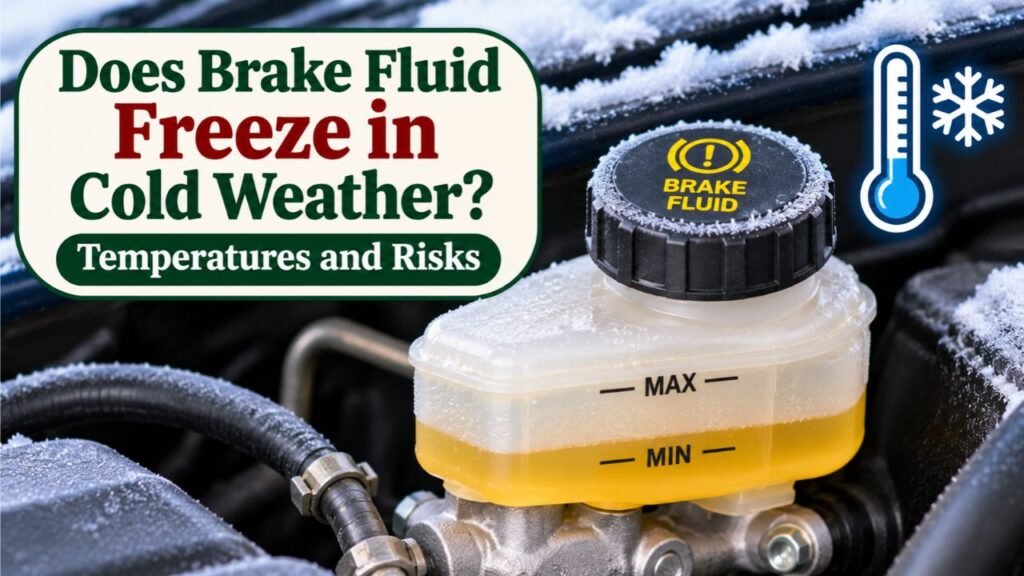
No, properly specified brake fluid should not freeze during normal winter temperatures.
Automotive brake fluid is designed to operate across a wide temperature range, from extreme winter cold to the high temperatures generated during braking.
Ordinary water freezes at 32°F (0°C), but brake fluid has a very different chemical composition.
Most conventional brake fluids contain glycol ethers and other ingredients that provide low-temperature fluidity.
However, the exact freezing behavior depends on the formulation.
Brake Fluid Behavior at Different Temperatures
| Outside temperature | Expected behavior of suitable brake fluid |
| 32°F (0°C) | Remains liquid under normal conditions |
| 20°F (−7°C) | Normally operates without freezing |
| 0°F (−18°C) | Remains liquid; viscosity increases |
| −20°F (−29°C) | Designed for cold-weather operation |
| −40°F (−40°C) | Subject to specified federal viscosity and fluidity tests |
| −58°F (−50°C) | Subject to a separate short-duration federal fluidity test |
These are performance expectations for compliant automotive brake fluids, not exact freezing points for every product.
According to the U.S. Federal Motor Vehicle Safety Standard No. 116 for brake fluids, brake fluids must meet low-temperature fluidity requirements at −40°C and −50°C.
The standard checks for problems such as crystallization, excessive viscosity, and separation.
Does Brake Fluid Freeze at 32°F?
No.
The freezing point of pure water is not the freezing point of automotive brake fluid.
Properly formulated DOT brake fluid remains liquid at temperatures well below freezing.
If your brakes behave abnormally at 32°F, do not immediately assume the brake fluid has frozen.
Can Brake Fluid Freeze at Extremely Low Temperatures?
At sufficiently extreme temperatures, any particular fluid formulation can eventually lose its ability to flow normally.
However, there is no single universal freezing temperature for all brake fluids.
DOT specifications establish low-temperature performance requirements rather than one exact freezing point.
Product chemistry, contamination, and fluid condition affect behavior.
Can Old Brake Fluid Freeze?
Old or contaminated brake fluid may have reduced performance.
However, age alone does not mean the fluid will freeze at ordinary winter temperatures.
Moisture contamination is more commonly associated with reduced boiling-point protection and internal corrosion.
Key Takeaway: Proper brake fluid is designed for severe cold. A winter brake problem is more likely to involve contamination, mechanical freezing, or another brake-system fault than ordinary fluid freezing solid.
What Temperature Does Brake Fluid Freeze At?
There is no single freezing-point specification that applies to all DOT brake fluid products.
Brake fluid is a formulated mixture rather than a single pure chemical.
Different products may contain different glycol compounds, additives, and other ingredients.
These ingredients affect how the fluid responds to temperature changes.
Why Is There No Universal Brake Fluid Freezing Point?
A product’s freezing behavior depends on its chemical composition.
Two products classified as DOT 4 may meet the same general performance requirements while using different formulations.
Some are designed specifically for low-viscosity operation.
Others emphasize high-temperature performance.
Therefore, it is misleading to assign one exact freezing point to every DOT 3 or DOT 4 fluid.
What Does the −40°F Requirement Mean?
U.S. safety standards require brake fluid to meet viscosity limits at −40°F (−40°C).
Viscosity describes resistance to flow.
A fluid with high viscosity is thicker and flows less easily.
A fluid with low viscosity flows more easily.
Brake fluid must remain sufficiently fluid to transmit hydraulic pressure and support proper braking-system operation.
What About −58°F?
Federal testing also includes a short-duration low-temperature fluidity test at −50°C, equivalent to −58°F.
Under the specified test conditions, compliant fluid must not exhibit prohibited crystallization, sludge, or separation.
It must also meet a defined fluidity requirement.
However, passing this test does not mean every brake fluid has an exact freezing point of −58°F.
It also does not guarantee normal vehicle operation at every temperature below that point.
Low-Temperature Test Summary
| Test | Temperature | What it evaluates |
| Cold viscosity | −40°F (−40°C) | Resistance to fluid flow |
| Extended cold exposure | −40°F (−40°C) | Fluidity and physical stability |
| Short-duration extreme-cold exposure | −58°F (−50°C) | Fluidity and resistance to crystallization or separation |
| Cold water-tolerance test | −40°F (−40°C) | Stability of fluid containing specified moisture |
The last test is especially important because brake fluid can absorb moisture during service.
Why Doesn’t Brake Fluid Freeze Like Water?
The answer comes from brake fluid chemistry.
Most passenger vehicles use glycol-based hydraulic brake fluid.
Glycol ethers have physical properties different from those of water.
Glycol-Based Brake Fluid
Common glycol-based brake fluids include:
- DOT 3.
- DOT 4.
- DOT 5.1.
Their formulations are designed to provide:
- Suitable low-temperature fluidity.
- High boiling-point performance.
- Hydraulic pressure transmission.
- Lubrication of compatible components.
- Corrosion protection.
- Compatibility with specified seals and hoses.
These requirements make brake fluid suitable for a wide range of automotive operating conditions.
Brake Fluid Is Not Pure Water
Water changes from liquid to solid at approximately 32°F under ordinary atmospheric pressure.
Glycol-based brake fluid is a mixture of different chemicals.
Its behavior cannot be predicted from the freezing point of water alone.
Even when glycol-based fluid absorbs a small amount of moisture, the resulting mixture does not necessarily form ice at 32°F.
Is Brake Fluid the Same as Antifreeze?
No.
Brake fluid and engine coolant serve different purposes.
Engine coolant typically uses glycol and water in a mixture designed for cooling-system heat transfer and freeze protection.
Brake fluid is specially formulated for hydraulic braking systems.
Never add engine antifreeze or coolant to a brake fluid reservoir.
The wrong fluid can damage seals and cause serious braking-system problems.
Does DOT 3 Brake Fluid Freeze in Cold Weather?
DOT 3 is a common glycol-based brake fluid used in many passenger vehicles.
It is designed to remain usable at temperatures far below the freezing point of water.
DOT 3 Cold-Weather Performance
Under the U.S. brake fluid standard, DOT 3 must meet a maximum kinematic viscosity of 1,500 mm²/s at −40°C.
This requirement helps ensure that the fluid remains sufficiently mobile in very cold conditions.
DOT 3 also must meet other applicable low-temperature fluidity and stability requirements.
Can DOT 3 Get Too Thick?
Yes.
Like many liquids, DOT 3 brake fluid becomes more viscous as its temperature decreases.
This is expected behavior.
However, properly specified fluid must remain within its required performance limits.
At temperatures beyond the validated range, performance is not guaranteed.
Should You Replace DOT 3 Before Winter?
Replace it when required by the vehicle manufacturer’s maintenance schedule or when testing and inspection establish that replacement is necessary.
Do not automatically change it every winter solely because freezing temperatures are expected.
Does DOT 4 Brake Fluid Freeze in Cold Weather?
DOT 4 is another widely used glycol-based brake fluid.
It is common in many vehicles with modern braking systems.
Like DOT 3, it is designed to remain fluid in severe winter conditions.
DOT 4 Cold-Weather Requirements
The general DOT 4 specification allows a maximum viscosity of 1,800 mm²/s at −40°C.
However, some DOT 4 products are specifically formulated for lower viscosity.
These products may be labeled:
- DOT 4 LV.
- DOT 4 Low Viscosity.
- DOT 4 ESP.
- Other manufacturer-specific designations.
Their specifications are not necessarily identical.
Why Does Low-Viscosity DOT 4 Matter?
Modern vehicles often use electronically controlled braking systems.
These include:
- Anti-lock braking systems (ABS).
- Electronic stability control (ESC).
- Traction control.
- Other advanced brake-control systems.
These systems may rapidly adjust hydraulic pressure through small valves and passages.
Low-viscosity brake fluid can support the designed response of these systems in cold conditions.
According to HELLA’s technical guide to brake fluid testing and maintenance, DOT 4 low-viscosity formulations and DOT 5.1 products are designed to maintain suitable flow properties at low temperatures, particularly for electronically controlled brake systems.
Can You Replace Regular DOT 4 With DOT 4 LV?
Only when the product meets the vehicle manufacturer’s required specifications.
Do not assume that every product with a higher performance claim is automatically suitable.
Brake-fluid compatibility includes more than boiling point or viscosity.
Use the required specification listed in the owner’s manual or service documentation.
Does DOT 5 Brake Fluid Freeze?
DOT 5 is different from DOT 3, DOT 4, and DOT 5.1.
Conventional DOT 5 brake fluid is silicone-based.
It is designed to remain fluid at low temperatures.
However, it handles moisture differently.
DOT 5 Does Not Absorb Water Like Glycol-Based Fluid
Silicone-based DOT 5 brake fluid is not hygroscopic in the same way as conventional glycol-based fluid.
This means water can remain separate rather than dissolving uniformly.
If water enters a DOT 5 hydraulic system, it may collect in certain locations.
That can create corrosion and freezing concerns.
Can Water Freeze in a DOT 5 System?
Yes.
Separate water within a hydraulic braking system may freeze when the temperature becomes low enough.
The exact behavior depends on the amount and location of the water.
Frozen moisture may obstruct hydraulic passages or interfere with component operation.
This does not mean that the DOT 5 silicone fluid itself freezes at 32°F.
It means that unwanted water contamination can create a separate problem.
Is DOT 5 Better for Winter?
Not automatically.
DOT 5 is not a universal upgrade for cold-weather driving.
A vehicle designed for glycol-based fluid may not be compatible with silicone-based DOT 5.
Do not mix DOT 5 silicone fluid with DOT 3, DOT 4, or DOT 5.1 glycol-based fluid.
Use DOT 5 only when it is specified and approved for the vehicle.
Does DOT 5.1 Brake Fluid Freeze?
DOT 5.1 is generally glycol-based despite its name.
It is chemically different from silicone-based DOT 5.
DOT 5.1 fluid must meet demanding boiling-point and low-temperature viscosity requirements.
DOT 5.1 Cold Performance
DOT 5.1 has a low-temperature viscosity requirement of no more than 900 mm²/s at −40°C under the relevant classification.
This supports use in braking systems designed for low-viscosity fluid.
Is DOT 5.1 Better Than DOT 4 in Winter?
It can offer lower viscosity than standard DOT 4 fluid.
However, certain DOT 4 LV products also provide very low viscosity.
The correct choice depends on the manufacturer’s required specification.
Do not select a brake fluid based solely on its DOT number.
Brake Fluid Cold-Weather Comparison
| Brake fluid | General base | Cold-weather characteristic | Main consideration |
| DOT 3 | Glycol-based | Designed for severe cold | Use only where specified |
| DOT 4 | Glycol-based | Meets cold viscosity requirements | Standard products vary |
| DOT 4 LV | Glycol-based | Lower viscosity for compatible systems | Check manufacturer approval |
| DOT 5 | Silicone-based | Designed for cold operation | Separate water contamination is a concern |
| DOT 5.1 | Glycol-based | Low-viscosity performance | Not interchangeable with DOT 5 |
All these fluids must be selected according to the vehicle’s braking-system requirements.
Can Water in Brake Fluid Freeze During Winter?
Moisture contamination is one of the main reasons brake fluid requires maintenance.
However, water contamination must be understood correctly.
How Does Water Enter Brake Fluid?
Most glycol-based brake fluids are hygroscopic.
They gradually absorb moisture from their surroundings.
Moisture may enter through:
- Certain brake hoses.
- Reservoir ventilation arrangements.
- Seals and other system interfaces.
- Improper servicing.
- Contaminated equipment or fluid.
The rate of moisture absorption depends on the fluid and hydraulic-system design.
Does Moisture Make Brake Fluid Freeze at 32°F?
Not automatically.
When water dissolves in glycol-based brake fluid, the resulting mixture behaves differently from pure water.
Therefore, a small amount of absorbed moisture does not necessarily turn to ice when the temperature reaches 32°F.
However, severe contamination, incompatible fluid, or free water may create abnormal low-temperature behavior.
What Happens When Free Water Collects?
Water that remains separate from the brake fluid can create additional risks.
At sufficiently low temperatures, free water may freeze.
Ice can interfere with hydraulic passages or the operation of certain components.
This is a concern particularly when the fluid and water do not mix uniformly.
Why Is Moisture More Dangerous During Hot Braking?
For glycol-based brake fluid, the most widely recognized moisture-related problem is reduced boiling-point protection.
As moisture accumulates, the fluid’s boiling point decreases.
Under high braking temperatures, vapor may form.
Vapor compresses more readily than liquid.
This can produce a soft brake pedal and reduced braking effectiveness.
Can Moisture Cause Corrosion?
Yes.
Water contamination can contribute to corrosion inside brake lines, cylinders, calipers, and hydraulic control components.
Corrosion can create problems in both winter and summer.
A brake fluid change removes aging or contaminated fluid but cannot repair a corroded component.
Can Brake Fluid Become Too Thick in Cold Weather?
Yes.
Brake fluid normally becomes thicker as the temperature falls.
This is called an increase in viscosity.
What Is Brake Fluid Viscosity?
Viscosity measures a liquid’s resistance to flow.
A higher-viscosity liquid flows less easily.
A lower-viscosity liquid flows more easily.
Brake fluid must remain within suitable viscosity limits to support hydraulic operation.
Does Thick Brake Fluid Mean It Has Frozen?
No.
Thickening and freezing are different physical processes.
A liquid may become considerably more viscous while remaining completely liquid.
Brake-fluid specifications account for this behavior.
Why Does Cold Viscosity Matter for ABS?
ABS and electronic stability systems rapidly control hydraulic pressure.
They rely on the fluid moving through valves and hydraulic passages as designed.
The wrong viscosity specification can affect the system’s intended behavior.
This is one reason some vehicles require specific low-viscosity brake fluid.
Can You Thin Brake Fluid for Winter?
No.
Never add alcohol, antifreeze, water, solvents, or another fluid to reduce brake-fluid viscosity.
These substances can damage the braking system or make the fluid unsuitable for safe operation.
If you suspect the wrong brake fluid was installed, have a qualified technician identify and correct the problem.
Why Do Car Brakes Feel Frozen in Cold Weather?
Cold-weather braking problems do not necessarily indicate frozen brake fluid.
Several other conditions can make a vehicle difficult to move or cause unusual pedal behavior.
1. Frozen Parking Brake
Moisture can collect around parking-brake components.
When temperatures drop below freezing, ice may prevent the mechanism from releasing properly.
This is particularly possible after driving through rain, slush, or snow.
Common Symptoms
- The vehicle will not move normally.
- One or more wheels appear locked.
- The parking brake does not release as expected.
- A dragging sensation occurs.
- The vehicle resists movement after overnight parking.
Do not force the vehicle to move with the brakes locked.
This can damage brake components.
2. Brake Pads Frozen to Rotors
Moisture may collect between a brake pad and rotor.
If the car is parked in freezing conditions, ice can temporarily bond the surfaces.
This is different from brake fluid freezing.
The problem occurs at the wheel-end friction components.
3. Frozen or Binding Parking-Brake Cable
Some vehicles use mechanical parking-brake cables.
Moisture and corrosion can interfere with cable movement.
In freezing weather, the mechanism may become stuck.
A cable that repeatedly freezes or binds requires inspection and repair.
4. Seized Brake Caliper
A caliper can develop mechanical problems from corrosion, damaged components, or other causes.
Cold weather may make an existing problem more noticeable.
However, a seized caliper is not necessarily caused by frozen fluid.
5. Brake Booster or Vacuum Problem
A hard brake pedal can result from insufficient power-brake assistance.
Some vehicles use vacuum-operated brake boosters.
Others have electric or electronically controlled brake-assist systems.
A fault in these systems may create a hard pedal.
This is not the same as frozen brake fluid.
6. Hydraulic-System Problem
A soft pedal, sinking pedal, or reduced braking response can indicate:
- Air in the hydraulic lines.
- A brake-fluid leak.
- A master-cylinder fault.
- A problem with the hydraulic control system.
- Other serious braking defects.
Do not assume that cold weather is the only cause.
Cold-Weather Brake Symptoms Chart
| Symptom | Possible cause | Recommended action |
| Wheel will not rotate | Frozen parking brake, ice, or mechanical binding | Do not force movement; arrange inspection |
| Parking brake will not release | Frozen cable or brake mechanism | Stop and seek appropriate assistance |
| Brake pedal feels unusually hard | Brake-assist or mechanical problem | Do not drive with abnormal braking |
| Brake pedal feels soft | Air, leak, or other hydraulic fault | Stop driving and seek professional diagnosis |
| Brakes drag after release | Caliper or parking-brake problem | Arrange inspection |
| ABS warning light appears | Electronic or hydraulic fault | Diagnose the warning before relying on normal operation |
| Brakes make a brief scraping noise | Surface rust, ice, or another issue | Inspect if persistent or accompanied by abnormal braking |
A symptom chart cannot replace a professional brake-system diagnosis.
Important: If braking performance is unreliable, do not drive the vehicle until the problem has been assessed.
What Should You Do if Your Brakes Seem Frozen?
If the brakes do not release properly or the pedal behaves abnormally, treat the situation as a potential safety problem.
Step 1: Stop Trying to Force the Vehicle
Do not repeatedly accelerate against a locked wheel.
This can damage the brake system, tires, or drivetrain.
Step 2: Check for an Obvious Parking-Brake Issue
Confirm that the parking brake is being released according to the owner’s manual.
Some vehicles use electronic parking brakes.
Others have a hand lever or foot pedal.
Do not bypass or dismantle the mechanism without understanding the system.
Step 3: Look for Ice and Snow
If it is safe to do so, inspect visible areas around the wheels.
Ice or compacted snow may be present.
However, do not crawl underneath an inadequately supported vehicle.
Do not place your hands near moving or potentially moving brake components.
Step 4: Avoid Improvised Heating Methods
Do not apply an open flame or torch to brake components.
Avoid pouring boiling water over parts in an attempt to free them.
Rapid temperature changes, new ice formation, and damage to surrounding components are possible.
Use a professional service method appropriate for the vehicle.
Step 5: Check Brake-Pedal Behavior
If the pedal is abnormally soft, hard, sinking, or inconsistent, do not continue driving.
Arrange professional inspection or towing.
Step 6: Have the Braking System Inspected
A technician can determine whether the problem involves:
- Parking-brake components.
- Frozen moisture.
- Corroded cables.
- Brake calipers.
- Hydraulic fluid contamination.
- Brake-assist equipment.
- Other mechanical or electronic faults.
Correcting the underlying cause is more important than assuming a fluid flush will solve everything.
How to Prevent Brake Fluid Problems in Winter
Winter brake maintenance should focus on correct fluid specifications, regular replacement, and the condition of the entire braking system.
Follow the Recommended Brake Fluid Change Interval
For many passenger vehicles, brake fluid replacement is recommended approximately every 2–3 years.
However, manufacturer requirements vary.
For example, Volkswagen’s official brake fluid guide explains that its brake fluid is designed to operate at temperatures as low as −40°C.
Volkswagen also recommends a first brake fluid change after three years on certain new vehicles, followed by two-year intervals.
Other manufacturers may specify different schedules.
Always follow the requirements for your exact vehicle.
Use the Correct Brake Fluid
Check the owner’s manual or brake fluid reservoir cap.
Use the required specification.
Do not switch between DOT types without confirming compatibility.
Avoid Unnecessary Reservoir Opening
The reservoir is designed to limit contamination.
Opening it repeatedly can introduce moisture or dirt.
Check the fluid level through the reservoir wall when possible.
Use Fresh Fluid During Service
Brake fluid can absorb moisture after a container is opened.
Use properly stored fluid from an appropriate sealed container.
Do not assume an old, partially used bottle is suitable for a brake-system service.
Inspect Brake Hoses and Lines
A mechanic should inspect the hydraulic system for:
- Leaks.
- Corrosion.
- Damaged hoses.
- Deteriorated fittings.
- Other visible defects.
Replacing fluid cannot compensate for a damaged hydraulic component.
Maintain Parking-Brake Components
Parking-brake cables and mechanisms should operate freely.
If a parking brake repeatedly sticks in winter, have it inspected.
Do not wait until a wheel locks completely.
Remove Road Salt and Debris
Road salt and winter debris can contribute to corrosion.
Washing the vehicle’s underbody according to manufacturer recommendations may help reduce buildup.
However, avoid directing damaging high-pressure water at sensitive components.
Inspect the Brakes Before Severe Winter Conditions
A pre-winter brake inspection is especially useful when:
- The last brake fluid change is unknown.
- Brake components are heavily corroded.
- The parking brake occasionally sticks.
- The brake pedal feels unusual.
- A warning light is present.
The purpose is to identify problems before they become more serious.
Should You Change Brake Fluid Before Winter?
Not automatically.
Brake fluid does not need to be replaced every winter solely because the temperature drops below freezing.
The correct service interval depends on the vehicle manufacturer’s requirements and fluid condition.
When a Pre-Winter Change Makes Sense
Consider arranging service before winter if:
- The brake fluid is already overdue.
- The service history is unknown.
- Testing indicates deterioration.
- The wrong fluid was previously installed.
- The hydraulic system has been opened for repairs.
- A mechanic identifies contamination or another service-related concern.
When Replacement May Be Unnecessary
If the correct fluid was replaced recently, the braking system is in good condition, and the vehicle is not due for service, an extra winter flush may offer little benefit.
However, ordinary brake inspections should still be performed as required.
Is Brake Fluid Replacement Based on Mileage?
Many brake-fluid schedules are time-based because moisture absorption can occur even with little driving.
A car driven only a few thousand miles per year may still require a fluid change based on age.
Can a Brake Fluid Test Tell if It Is Safe for Winter?
A professional can assess aspects of fluid condition, such as moisture-related properties or boiling-point performance.
However, a simple moisture tester does not measure every aspect of cold-weather performance.
The correct fluid specification, hydraulic-system condition, and maintenance history also matter.
Can You Mix Brake Fluids to Prevent Freezing?
No.
Brake fluids should never be mixed merely to change their cold-weather performance.
Can You Mix DOT 3 and DOT 4?
Certain glycol-based fluids have chemical compatibility under defined conditions.
However, the vehicle may require a specific boiling point, viscosity, or other performance characteristic.
Use only fluid that meets the manufacturer-approved specification.
Can You Mix DOT 4 and DOT 5?
No.
Conventional DOT 4 is glycol-based, while DOT 5 is silicone-based.
They must not be mixed.
Using incompatible fluids can damage seals or create unsafe hydraulic-system behavior.
Is DOT 5.1 the Same as DOT 5?
No.
DOT 5.1 is generally glycol-based.
DOT 5 is silicone-based.
The similar names do not mean the products are interchangeable.
Can You Add Antifreeze to Brake Fluid?
Absolutely not.
Engine coolant and brake fluid are designed for completely different systems.
Adding antifreeze to brake fluid can cause serious hydraulic-system damage.
If an incorrect fluid has entered the reservoir, do not drive the vehicle until a qualified technician has evaluated it.
Does Brake Fluid Freeze While the Car Is Parked?
Properly specified brake fluid normally remains fluid during ordinary winter parking conditions.
The engine does not need to be running to prevent the brake fluid from freezing.
What Happens When the Engine Is Off?
The brake fluid gradually approaches the temperature of its surroundings.
As it cools, viscosity increases.
However, the fluid remains suitable for low-temperature operation within its required specifications.
Why Do Brakes Stick After Overnight Parking?
Moisture around the parking-brake system or friction components may freeze.
This can create sticking or binding even though the hydraulic fluid remains liquid.
Corrosion and mechanical faults can also cause similar symptoms.
Can Parking in a Heated Garage Help?
Keeping a vehicle in a suitable warmer environment can reduce external ice formation around certain components.
However, a heated garage does not repair corroded cables, seized calipers, leaks, or unsuitable brake fluid.
Repeated sticking requires diagnosis.
Common Myths About Brake Fluid Freezing
Several misconceptions can make winter brake problems harder to diagnose.
Myth 1: Brake Fluid Freezes at 32°F
False.
Proper automotive brake fluid is designed to remain fluid far below the freezing point of water.
Myth 2: DOT 4 Always Has a Lower Freezing Point Than DOT 3
Not necessarily.
DOT specifications include different performance requirements, but there is no single universal freezing temperature for every product within each category.
Myth 3: DOT 5 Is Automatically Better for Cold Weather
False.
Silicone-based DOT 5 is not suitable for every vehicle.
It also handles water contamination differently from glycol-based fluids.
Myth 4: Brake Fluid Cannot Become Thicker in Winter
False.
Brake fluid viscosity increases as temperatures fall.
It is specifically formulated and tested to maintain acceptable low-temperature flow.
Myth 5: A Frozen Parking Brake Means the Brake Fluid Has Frozen
False.
Ice around parking-brake mechanisms, cables, or friction surfaces can prevent the brakes from releasing.
The hydraulic fluid may still be functioning normally.
Myth 6: Adding Antifreeze Protects Brake Fluid
False and dangerous.
Engine antifreeze must never be added to the hydraulic braking system.
Myth 7: Brake Fluid Only Needs Replacement When It Looks Dirty
False.
Glycol-based brake fluid can absorb moisture without showing obvious visual changes.
Follow the manufacturer’s maintenance schedule.
Myth 8: A Brake Fluid Flush Fixes Every Winter Brake Problem
False.
Frozen parking-brake mechanisms, seized calipers, brake-assist faults, and hydraulic leaks may require specific repairs.
A fluid change alone may not correct them.
Conclusion
So, does brake fluid freeze in cold weather? Under normal winter conditions, properly specified automotive brake fluid should remain liquid and functional.
U.S. brake fluid standards include low-temperature performance testing at −40°F and −58°F, demonstrating that automotive brake fluid is designed for conditions much colder than the freezing point of water.
However, these temperatures are standardized test conditions, not universal freezing points for every formulation.
Brake fluid also becomes thicker as temperatures fall.
This makes the correct viscosity specification important, particularly for vehicles with electronically controlled braking systems.
Moisture contamination presents additional concerns, including reduced boiling-point protection, corrosion, and potential freezing problems when free water is present.
A vehicle with brakes that appear frozen may actually have a stuck parking brake, icy friction components, or another mechanical problem.
My recommendation is to use only the manufacturer-approved brake fluid, follow the recommended replacement interval, and have abnormal brake performance inspected rather than assuming the hydraulic fluid has frozen.
A correctly maintained braking system is essential for safe driving in every season.
FAQs About Does Brake Fluid Freeze in Cold Weather
At What Temperature Does Brake Fluid Freeze?
There is no single freezing temperature for all brake fluids. U.S. specifications require brake fluid to meet defined low-temperature performance tests at −40°F (−40°C) and −58°F (−50°C). These are test conditions rather than exact freezing points for every product.
Does DOT 3 Brake Fluid Freeze in Winter?
Properly specified DOT 3 brake fluid should remain liquid during normal winter conditions. It is formulated to meet cold-temperature viscosity and fluidity requirements. However, severe contamination or conditions beyond its tested performance range can create problems.
Does DOT 4 Brake Fluid Freeze at 32 Degrees?
No. Proper DOT 4 brake fluid does not freeze at 32°F like pure water. It is designed for much colder temperatures. Its viscosity increases as temperature decreases, but compliant fluid must satisfy specified cold-weather performance requirements.
Can Water in Brake Fluid Freeze?
Yes, separate water contamination can freeze under suitable conditions. However, water absorbed into glycol-based fluid does not automatically freeze at 32°F. Moisture also reduces boiling-point protection and can contribute to corrosion.
Can Frozen Brake Fluid Cause a Hard Brake Pedal?
A serious hydraulic restriction could interfere with brake operation, but a hard brake pedal does not prove that the fluid is frozen. Brake-assist problems, mechanical binding, and other faults may cause unusual pedal behavior. If braking is abnormal, do not drive until the system has been inspected.
Can You Drive With Frozen Brakes?
No. If the brakes are stuck, the wheels will not rotate properly, or the brake pedal behaves abnormally, do not force the vehicle to move. Arrange professional diagnosis and repair before returning it to service.
Should You Change Brake Fluid Before Every Winter?
No. Brake fluid does not normally require annual replacement simply because winter is approaching. Follow your vehicle manufacturer’s maintenance schedule, commonly around every 2–3 years for many cars, and replace it sooner when a qualified inspection identifies a reason.