What Brake Fluid Is Silicone Based? DOT 5 Compatibility Guide
DOT 5 is the silicone-based brake fluid used in certain hydraulic brake systems. Unlike DOT 3, DOT 4, and DOT 5.1, which are glycol-based, DOT 5 is formulated with silicone oil and does not readily absorb moisture. That difference makes it useful in some classic cars, specialty vehicles, and older motorcycles—but it does not make it a universal upgrade.
The confusing part is the numbering. DOT 5.1 sounds like a newer version of DOT 5, yet it is a non-silicone, glycol-based fluid. DOT 5 must not be mixed with DOT 3, DOT 4, or DOT 5.1. Using the wrong fluid can create serious brake-system problems, and many ABS-equipped vehicles are not approved for silicone DOT 5.
DOT 5 is typically dyed purple and meets specific boiling-point requirements, but color and boiling point alone cannot establish whether it belongs in your vehicle. The owner’s manual and reservoir labeling take priority.
In this article, I explain what silicone brake fluid contains, how DOT 5 compares with other grades, and why its moisture behavior matters. I also cover compatible vehicles, ABS concerns, fluid mixing, replacement procedures, and how to identify the correct brake fluid safely.
What Brake Fluid Is Silicone Based? The Correct DOT Grade
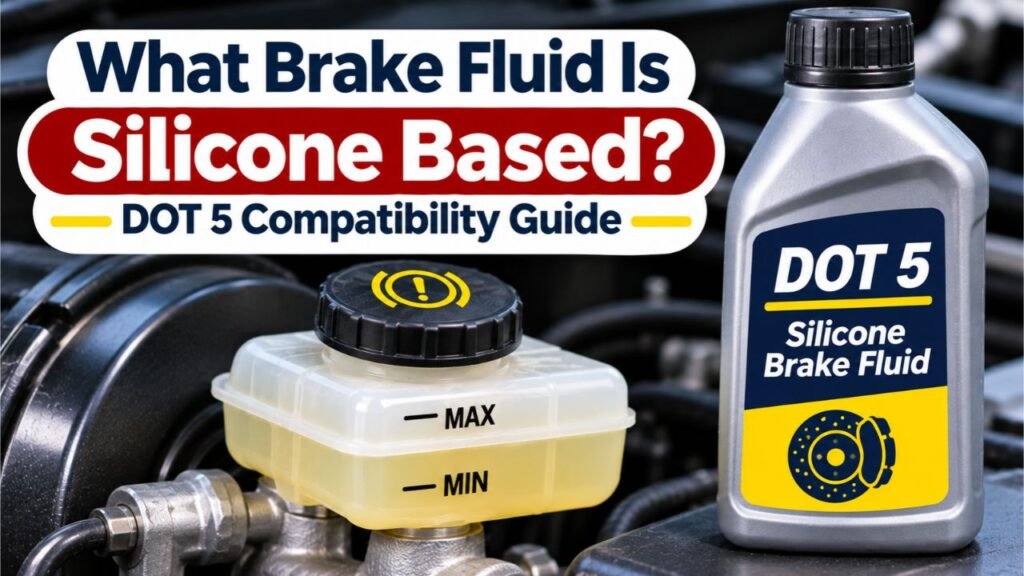
DOT 5 is the silicone-based brake fluid classification. DOT 3, DOT 4, and DOT 5.1 are non-silicone, glycol-based classifications.
The distinction matters because brake fluid must be chemically compatible with the hydraulic system.
DOT 5 silicone fluid is generally formulated using polysiloxane compounds, commonly described as silicone oils.
It differs from conventional glycol-based fluids in its moisture behavior, chemistry, and compatibility characteristics.
Silicone vs Glycol Brake Fluid Comparison
| Brake fluid | Main chemical base | Absorbs moisture? | Typical color | Silicone-based? |
| DOT 3 | Glycol ethers | Yes | Clear to amber | No |
| DOT 4 | Glycol ethers and borate esters | Yes | Clear to amber | No |
| DOT 5 | Silicone | Does not readily absorb water | Purple | Yes |
| DOT 5.1 | Glycol-based formulation | Yes | Clear to amber | No |
The colors shown are the specified colors for these brake-fluid categories under U.S. federal requirements.
They should not be used as the sole method of identifying an unknown fluid.
How Do You Identify DOT 5 Silicone Brake Fluid?
Check the bottle for the designation:
DOT 5 SILICONE BASE
This is more reliable than looking for purple fluid alone.
Under Federal Motor Vehicle Safety Standard No. 116, silicone-based DOT 5 fluid must be identified by its classification and silicone-base designation.
The same standard distinguishes DOT 5.1 as non-silicone-based.
Is DOT 5 the Only Silicone Brake Fluid?
Within the common U.S. DOT classifications, DOT 5 is the silicone-based type.
Various manufacturers produce DOT 5 products, but the important identification is the specification rather than the brand name.
Do not confuse silicone-based brake fluid with silicone grease or other silicone lubricants.
Those products are not interchangeable.
Key Takeaway: If you are looking for silicone-based automotive brake fluid, the relevant designation is DOT 5 Silicone Base—not DOT 5.1.
What Is Silicone Brake Fluid Made Of?
Silicone-based DOT 5 brake fluid uses silicone compounds rather than the glycol-ether chemistry found in most conventional automotive brake fluids.
Its primary fluid component is generally a type of polysiloxane.
What Is Polysiloxane?
Polysiloxanes are silicone polymers containing silicon-oxygen structures.
Their properties can be adjusted through chemical formulation.
For brake-fluid applications, silicone compounds are selected to provide suitable hydraulic performance across a wide temperature range.
A finished DOT 5 brake fluid also contains additives designed to meet applicable performance requirements.
Does DOT 5 Contain Petroleum Oil?
DOT 5 silicone brake fluid is not ordinary petroleum-based engine oil.
Its formulation is chemically different from conventional mineral oil.
This distinction matters because some hydraulic brake and suspension systems use specially formulated mineral-oil fluids.
Those systems must not be filled with DOT 5 simply because both products differ from glycol-based brake fluid.
Is Silicone Brake Fluid the Same as Silicone Oil?
No.
Although silicone brake fluid contains silicone-based compounds, ordinary silicone oil may not meet the requirements of a hydraulic braking system.
Automotive DOT 5 must satisfy performance specifications involving:
- Boiling point
- Viscosity
- Corrosion resistance
- Low-temperature behavior
- Compatibility with specified brake-system materials
- Chemical and physical stability
Never substitute generic silicone oil for DOT 5 brake fluid.
DOT 5 vs DOT 5.1: Which One Is Silicone Based?
DOT 5 is silicone-based. DOT 5.1 is glycol-based.
Despite their similar names, these fluids have fundamentally different formulations.
This is one of the most important distinctions in brake-fluid selection.
DOT 5 Silicone Brake Fluid
DOT 5 has characteristics that include:
- Silicone-based chemistry
- Very low moisture absorption
- High minimum dry boiling point
- Purple coloring under U.S. requirements
- Incompatibility with glycol-based brake fluids
- Use in certain specifically approved brake systems
DOT 5.1 Brake Fluid
DOT 5.1 has different characteristics:
- Glycol-based chemistry
- Hygroscopic moisture behavior
- High minimum boiling-point requirements
- Clear-to-amber coloring
- Chemical compatibility with many DOT 3 and DOT 4 formulations
- Use in vehicles specifying suitable glycol-based brake fluid
DOT 5.1 is not a silicone version of DOT 5.
DOT 5 vs DOT 5.1 Comparison
| Feature | DOT 5 | DOT 5.1 |
| Base fluid | Silicone | Glycol-based |
| Hygroscopic | No | Yes |
| Mixes with DOT 3 or DOT 4 | No | Generally chemically compatible |
| Minimum dry boiling point | 500°F | 500°F |
| Minimum wet boiling point | 356°F | 356°F |
| U.S. specified color | Purple | Clear to amber |
| Typical application | Systems specifically requiring silicone DOT 5 | Systems requiring compatible glycol-based fluid |
| Suitable for all ABS systems | No | Depends on vehicle specification |
The minimum boiling-point values are regulatory requirements, not the measured boiling points of every individual product.
Why Does DOT 5.1 Have a Similar Number?
The DOT classification describes fluid performance requirements.
The numbering should not be interpreted as a simple sequence in which every higher number can replace the previous fluid.
DOT 5.1 is a non-silicone formulation that meets the relevant high-temperature requirements.
Therefore, a car specifying DOT 5.1 should not be filled with silicone DOT 5.
What Is the Boiling Point of Silicone Brake Fluid?
DOT 5 silicone brake fluid must meet minimum boiling-point requirements under applicable U.S. regulations.
These requirements are important because hydraulic brake systems can generate substantial heat.
DOT Brake Fluid Boiling Point Chart
| Brake fluid | Minimum dry boiling point | Minimum wet boiling point |
| DOT 3 | 401°F (205°C) | 284°F (140°C) |
| DOT 4 | 446°F (230°C) | 311°F (155°C) |
| DOT 5 silicone | 500°F (260°C) | 356°F (180°C) |
| DOT 5.1 non-silicone | 500°F (260°C) | 356°F (180°C) |
These figures are minimum standardized values.
Individual products may exceed them.
What Is Dry Boiling Point?
Dry boiling point is the boiling-point result measured using fluid before the specified humidification procedure.
For silicone DOT 5, the minimum is 500°F.
This provides high-temperature performance potential, but it does not make the fluid immune to braking problems.
What Is Wet Boiling Point?
Wet boiling point is measured after a standardized laboratory humidification process.
For DOT 5, the minimum is 356°F.
This does not mean silicone DOT 5 absorbs water in the same way as glycol-based fluid.
The specification is a standardized test requirement.
In real service, water introduced into a silicone-filled braking system may remain separated rather than dissolving uniformly.
That creates a different moisture-management concern.
Does a Higher Boiling Point Mean DOT 5 Is Better?
Not necessarily.
Brake-system performance depends on more than boiling point.
Other important factors include:
- Viscosity
- Air entrainment
- Hydraulic-system design
- Seal compatibility
- ABS requirements
- Manufacturer specifications
A properly formulated DOT 4 or DOT 5.1 may be the correct fluid for a vehicle even though silicone DOT 5 has a high minimum boiling point.
Does Silicone Brake Fluid Absorb Moisture?
DOT 5 silicone brake fluid is hydrophobic, meaning it does not readily absorb water.
This is one of its defining characteristics.
DOT 3, DOT 4, and DOT 5.1 are hygroscopic, meaning they absorb moisture.
Why Moisture Matters in a Brake System
Hydraulic brake fluid transfers force from the brake pedal or lever to the braking components.
The fluid can become hot during repeated braking.
If water contamination causes vapor formation, braking performance can deteriorate.
Moisture can also contribute to corrosion inside metal hydraulic components.
What Happens to Water in DOT 5?
Since silicone DOT 5 does not absorb water readily, introduced moisture can remain as separate droplets or pockets.
Depending on the system, this may create risks involving:
- Corrosion
- Water accumulation
- Localized vapor formation under high temperatures
- Freezing at low temperatures
- Irregular hydraulic behavior
Therefore, non-hygroscopic does not mean moisture contamination is harmless.
Does Silicone Brake Fluid Prevent Rust?
It may reduce some moisture-related corrosion concerns because the fluid itself does not readily absorb atmospheric water.
However, it does not guarantee a rust-free braking system.
Water contamination can still enter and remain separate from the silicone fluid.
If moisture collects near metal components, corrosion may develop.
The condition of the entire hydraulic system remains important.
Does Silicone Brake Fluid Last Forever?
No.
Low moisture absorption does not eliminate the need for maintenance.
Brake systems can still experience contamination, seal deterioration, mechanical wear, and other service issues.
Follow the manufacturer’s brake-fluid replacement and inspection requirements.
Advantages of DOT 5 Silicone Brake Fluid
Silicone DOT 5 has several properties that make it useful for certain applications.
However, these benefits matter only when the fluid is approved for the braking system.
1. Very Low Moisture Absorption
DOT 5 does not readily absorb water from the surrounding environment.
This can be useful in some systems where the manufacturer specifically selects silicone fluid for its moisture behavior.
However, any introduced water can remain separate.
2. High Minimum Boiling Point
DOT 5 must meet a minimum dry boiling point of 500°F.
This provides substantial thermal performance capability when the fluid is in good condition.
However, high boiling point alone does not establish suitability for racing or modern ABS applications.
3. Reduced Risk to Painted Surfaces
Silicone DOT 5 is generally less aggressive toward automotive paint than conventional glycol-based brake fluids.
This can be attractive for classic and show vehicles with carefully maintained finishes.
However, silicone fluid can leave residue, and its effects on specific finishes and materials may vary.
Clean spills promptly according to the product instructions.
4. Useful for Certain Specialty Vehicles
Some vehicles were specifically designed or approved for silicone brake fluid.
Examples may include:
- Certain older motorcycles
- Some classic vehicles with compatible systems
- Specialty vehicles
- Certain military applications
- Custom vehicles with correctly specified hydraulic components
Use in these applications should follow the appropriate equipment specifications.
5. Distinct Chemical Formulation
Silicone DOT 5 is chemically different from glycol-based fluids.
This can provide benefits in specifically designed systems.
However, it also creates strict limitations on fluid mixing and substitution.
Disadvantages of Silicone DOT 5 Brake Fluid
DOT 5 also has important limitations.
These are among the reasons it is not the default choice for most modern passenger cars.
1. Incompatibility With Glycol-Based Fluid
DOT 5 should not be mixed with DOT 3, DOT 4, or DOT 5.1.
The different chemistries are not intended to be used together.
Combining them may cause fluid separation, deposits, or other hydraulic-system problems.
2. Potential Air Entrapment
Silicone brake fluids can be more prone to retaining entrained air during handling or bleeding.
Trapped air is compressible.
This can produce a soft or spongy brake pedal.
According to Wilwood Engineering’s technical explanation of silicone DOT 5 brake fluid, silicone fluid can be prone to aeration and foaming. Wilwood does not recommend it for its racing applications because this may affect pedal feel.
3. Limited ABS Compatibility
Many modern ABS-equipped systems are designed for specific glycol-based fluids.
Silicone DOT 5 should not be used unless the vehicle manufacturer explicitly approves it.
4. Water Can Remain Separate
Although silicone DOT 5 resists moisture absorption, any water introduced into the system may remain as separate droplets.
This can create localized corrosion and temperature-related problems.
5. Higher Cost
Silicone DOT 5 often costs more than conventional DOT 3 and DOT 4 products.
For vehicles that do not require it, the higher price provides no useful reason to change specifications.
6. Limited Universal Availability
DOT 3 and DOT 4 are widely stocked for ordinary vehicle maintenance.
Silicone DOT 5 is more specialized.
Availability varies by region and supplier.
Pros and Cons of Silicone Brake Fluid
| Advantages | Disadvantages |
| Does not readily absorb moisture | Cannot be mixed with glycol-based fluids |
| High minimum boiling point | May retain air bubbles |
| Generally less damaging to paint | Not approved for many ABS systems |
| Useful in specified specialty applications | Water can remain separated |
| Distinctive DOT 5 classification | Can cost more |
| May suit some classic vehicle applications | Requires careful compatibility verification |
Can Silicone DOT 5 Brake Fluid Be Used in Cars?
Yes, but only in a braking system specifically approved for silicone DOT 5.
It is not suitable as a universal replacement for conventional brake fluid.
Can Modern Cars Use DOT 5?
Most modern passenger cars specify glycol-based brake fluids, such as DOT 3, DOT 4, or DOT 5.1.
A modern car should not receive DOT 5 merely because the fluid has a high boiling point.
Check the manufacturer’s specification.
Can Classic Cars Use Silicone Brake Fluid?
Some classic and restored vehicles use DOT 5, particularly when their hydraulic systems are specifically configured for it.
Owners may value the fluid’s low moisture absorption and generally reduced paint-damaging properties.
However, not every classic car is compatible.
The age of a vehicle alone does not establish which brake fluid it needs.
Can Military Vehicles Use DOT 5?
Certain military equipment and specifications have used silicone-based hydraulic brake fluid.
However, not every military vehicle uses DOT 5.
The correct fluid depends on the particular equipment and hydraulic-system requirements.
Can You Put DOT 5 in a Car That Uses DOT 3?
No, not as a direct substitution.
If the owner’s manual specifies DOT 3, use fluid that meets the manufacturer’s requirements.
Changing to silicone DOT 5 is not a simple reservoir top-off or routine flush.
A conversion would require a complete manufacturer-approved assessment of the hydraulic system, including component compatibility.
For ordinary vehicles, this is generally unnecessary.
Is Silicone Brake Fluid Good for Motorcycles?
It can be, but motorcycle brake-fluid requirements vary substantially.
Some older motorcycles were designed to use DOT 5 silicone fluid.
Others require DOT 3, DOT 4, or DOT 5.1.
Do Harley-Davidson Motorcycles Use DOT 5?
Some older Harley-Davidson motorcycles were designed for DOT 5 silicone brake fluid.
However, not every Harley-Davidson motorcycle uses DOT 5.
Different model years and brake systems have different requirements.
In Harley-Davidson’s official brake-line installation instructions, the manufacturer explains that certain motorcycles use DOT 4 while others use DOT 5 silicone fluid.
It instructs owners to verify the required fluid using the owner’s manual, service manual, and master-cylinder cover.
Can You Use DOT 5 in a Modern Harley-Davidson?
Only if that specific model requires it.
Many newer Harley-Davidson brake systems specify DOT 4 rather than DOT 5.
Do not rely on older Harley-Davidson fluid recommendations when servicing a different model year.
What About Honda, Yamaha, Suzuki, and Kawasaki?
Many modern motorcycles from these manufacturers specify glycol-based brake fluid.
However, the required classification varies by model and year.
Check the owner’s manual and reservoir labeling.
A motorcycle’s brand does not independently determine whether silicone fluid is appropriate.
Is DOT 5 Silicone Brake Fluid Compatible With ABS?
Many ABS-equipped vehicles are not approved for silicone DOT 5 brake fluid.
The correct fluid depends on the ABS system’s design and manufacturer specification.
Why ABS Compatibility Matters
Anti-lock braking systems rapidly control hydraulic pressure to prevent wheel lockup.
They contain components such as:
- Hydraulic control valves
- Solenoids
- Pumps
- Pressure-control passages
- Electronic control components
The hydraulic fluid must meet the system’s viscosity, compatibility, and performance requirements.
Why Can DOT 5 Cause Problems?
Potential concerns include air entrainment and incompatibility with a system designed around glycol-based fluid.
Some ABS systems require specific low-viscosity brake-fluid formulations.
Using an unapproved fluid may interfere with intended operation.
Is DOT 5.1 Better for ABS?
DOT 5.1 is commonly used in systems requiring compatible high-boiling-point, glycol-based brake fluid.
However, not every ABS system requires DOT 5.1.
Some specify DOT 4 or a particular low-viscosity DOT 4 formulation.
The correct fluid is the one approved by the manufacturer.
Can Any ABS System Use Silicone Brake Fluid?
Do not treat ABS compatibility as a universal yes-or-no rule for every possible design.
The decisive requirement is explicit approval from the vehicle or brake-system manufacturer.
If the manual calls for DOT 3, DOT 4, or DOT 5.1, do not substitute silicone DOT 5.
Can You Mix DOT 5 With DOT 3, DOT 4, or DOT 5.1?
No. DOT 5 silicone fluid must not be mixed with glycol-based DOT 3, DOT 4, or DOT 5.1.
These fluid families have different chemical bases.
DOT Brake Fluid Mixing Compatibility
| Fluid combination | Mix? | Important note |
| DOT 3 + DOT 4 | Generally chemically compatible | Must still meet vehicle specification |
| DOT 3 + DOT 5.1 | Generally chemically compatible | Check manufacturer requirements |
| DOT 4 + DOT 5.1 | Generally chemically compatible | Check viscosity and other specifications |
| DOT 3 + DOT 5 | No | Silicone and glycol incompatibility |
| DOT 4 + DOT 5 | No | Silicone and glycol incompatibility |
| DOT 5 + DOT 5.1 | No | Different chemical bases |
| DOT 5 + DOT 5 | Yes, when products meet the required specification | Use clean, appropriate fluid |
Chemical compatibility between DOT 3, DOT 4, and DOT 5.1 does not automatically mean every grade is an approved substitute for every vehicle.
What Happens if DOT 5 Is Mixed With DOT 4?
The mixture may separate into different fluid phases.
Depending on the formulations and conditions, other problems may occur.
These can include:
- Unpredictable hydraulic performance
- Contamination
- Deposits
- Poor brake-pedal feel
- Component compatibility problems
A mixed-fluid brake system should not be treated as safe without proper inspection and corrective service.
Can You Mix DOT 5 With DOT 5.1?
No.
The similar numbering is misleading.
DOT 5 is silicone-based, while DOT 5.1 is glycol-based.
Do not mix them.
What If I Accidentally Added DOT 5?
Stop using the vehicle until the braking system has been evaluated by a qualified technician.
Do not assume that removing fluid from the reservoir alone will eliminate the contamination.
A professional may need to inspect and service the hydraulic system according to the manufacturer’s requirements.
Because brakes are safety-critical, avoid driving with a known incompatible-fluid mixture.
Can You Convert a Brake System to Silicone DOT 5?
A conversion may be possible in certain specialized vehicles, but it should not be treated as a routine fluid change.
Do not convert a DOT 3 or DOT 4 braking system to DOT 5 without specific manufacturer-approved compatibility guidance.
Why Conversion Is Complicated
The braking system may contain:
- Residual glycol-based fluid
- Rubber seals and hoses
- Master-cylinder components
- Caliper seals
- Proportioning valves
- ABS hydraulic components
- Small passages that retain old fluid
A simple reservoir drain does not remove all fluid from these components.
Is Flushing Enough?
Not necessarily.
Flushing may fail to remove all incompatible fluid or contamination.
Some conversions require extensive system inspection and component replacement.
The appropriate procedure depends on the vehicle.
Can You Convert an ABS System?
Only if the manufacturer explicitly supports the change.
In most ordinary modern ABS-equipped vehicles, there is no practical reason to replace the specified glycol-based fluid with silicone DOT 5.
The correct approach is to maintain the original brake-fluid specification.
Is Conversion Worth It for a Classic Car?
It depends on the system design, restoration goals, and manufacturer guidance.
For some restored vehicles with compatible components, silicone DOT 5 may be appropriate.
However, its moisture behavior and potential air-entrainment issues still need consideration.
A qualified classic-vehicle brake specialist can assess whether the conversion is suitable.
Is Silicone Brake Fluid Better Than Glycol Brake Fluid?
Neither type is universally better.
Each has properties suited to particular brake-system designs.
When Silicone DOT 5 May Be Appropriate
It may be useful for:
- Vehicles specifically requiring DOT 5
- Some compatible classic cars
- Certain older motorcycles
- Approved specialty and military equipment
- Systems designed around silicone-fluid characteristics
When Glycol-Based Fluid Is More Appropriate
DOT 3, DOT 4, or DOT 5.1 is generally appropriate when specified for:
- Modern passenger cars
- Most modern ABS-equipped vehicles
- Many contemporary motorcycles
- Vehicles with manufacturer-specific low-viscosity fluid requirements
Which Is Better for Daily Driving?
For daily driving, the safest and most appropriate brake fluid is the one specified by the vehicle manufacturer.
An expensive silicone formula does not automatically improve braking performance.
The hydraulic system must be designed for the fluid’s chemistry and characteristics.
Which Is Better for Racing?
Silicone DOT 5 is not automatically the best choice for track use.
Some brake-system manufacturers prefer specialized glycol-based racing fluids because of their high boiling points and resistance to aeration.
Follow the recommendations of the braking-system manufacturer.
A racing label or higher DOT number alone does not establish suitability.
Is Silicone Brake Fluid Purple?
DOT 5 silicone brake fluid is specified as purple under U.S. federal brake-fluid requirements.
This helps distinguish it from common glycol-based brake fluids.
However, fluid identification should never depend only on color.
DOT Brake Fluid Color Chart
| Brake fluid | Specified color |
| DOT 3 | Colorless to amber |
| DOT 4 | Colorless to amber |
| DOT 5 silicone | Purple |
| DOT 5.1 | Colorless to amber |
Can DOT 5 Lose Its Purple Color?
Color appearance can change with age, contamination, lighting, and fluid condition.
Therefore, an older fluid may not appear identical to a new bottle.
A change in color does not establish what fluid is present or whether it is safe.
How Can You Identify Unknown Brake Fluid?
Use the vehicle’s documentation and service records.
Inspect the reservoir label and previous maintenance information.
If someone may have installed the wrong fluid, have the system assessed professionally.
Do not taste, smell, or experiment with unknown brake fluid to identify its chemistry.
Does Silicone Brake Fluid Need to Be Changed?
Yes, when required by the vehicle manufacturer or the fluid’s condition.
Although silicone DOT 5 does not readily absorb moisture, it is not maintenance-free.
Why Replacement May Still Be Necessary
Brake systems may experience:
- External contamination
- Water accumulation
- Internal wear
- Seal deterioration
- Corrosion
- Air entrainment
- Component servicing
The brake fluid may also be replaced during repairs or major hydraulic-system maintenance.
How Often Should DOT 5 Be Changed?
There is no universal replacement interval suitable for every vehicle that uses silicone DOT 5.
Follow the service manual for the specific vehicle.
Some systems may have different inspection and replacement requirements than glycol-based brake systems.
Does DOT 5 Last Longer Than DOT 4?
Its non-hygroscopic chemistry reduces one important mechanism associated with glycol-based brake-fluid aging.
However, that does not guarantee a longer approved service interval in every vehicle.
Other factors can still require maintenance.
Can You Use Old DOT 5 From an Open Bottle?
Use fresh fluid in accordance with the manufacturer’s storage instructions.
Although DOT 5 does not absorb moisture like glycol-based fluids, an opened bottle can still become contaminated with dirt, water, or other substances.
Do not assume that an old, partially used container remains suitable indefinitely.
How to Check Which Brake Fluid Your Vehicle Needs
The fluid specification should be verified before topping off or servicing a brake reservoir.
Step 1: Read the Reservoir Cap
Many vehicles identify the required brake-fluid type on the master-cylinder reservoir cap.
Possible markings include:
- DOT 3
- DOT 4
- DOT 4 LV
- DOT 5
- DOT 5.1
Use the exact manufacturer specification.
Step 2: Check the Owner’s Manual
The manual may identify additional requirements involving:
- Brake-fluid grade
- Manufacturer-approved products
- Low-temperature viscosity
- Replacement intervals
- ABS service procedures
Do not choose fluid based on boiling point alone.
Step 3: Confirm the Model Year
Brake-fluid requirements can change between model generations.
This is particularly relevant for older motorcycles and vehicles with updated braking systems.
Step 4: Check the Bottle Label
Read the exact product classification.
A suitable silicone product should clearly identify itself as DOT 5 Silicone Base.
DOT 5.1 is not an acceptable substitute when DOT 5 silicone is specified.
Step 5: Avoid Mixing Unknown Fluid
If the system’s existing fluid is unknown, do not add another type based on guesswork.
Have the fluid and system assessed professionally.
Step 6: Investigate Unexpected Fluid Loss
A low brake-fluid level can result from pad wear or hydraulic-system problems.
Do not repeatedly top off the reservoir without identifying the cause.
If the brake pedal is soft, sinks abnormally, or braking performance is reduced, stop driving and arrange professional inspection.
Common Mistakes With Silicone Brake Fluid
| Mistake | Why it matters | Correct approach |
| Assuming DOT 5.1 contains silicone | DOT 5.1 is glycol-based | Identify DOT 5 Silicone Base |
| Mixing DOT 5 with DOT 4 | Chemical incompatibility | Never mix the fluid families |
| Using DOT 5 because it has a higher number | Does not establish system compatibility | Follow manufacturer specification |
| Assuming DOT 5 works in every ABS system | Many systems do not approve it | Check ABS fluid requirements |
| Believing silicone fluid prevents all corrosion | Separate water can still cause corrosion | Maintain the hydraulic system |
| Selecting fluid based only on color | Color can be misleading | Check the bottle and service records |
| Using silicone oil instead of DOT 5 | Generic oil is not certified brake fluid | Use the correct DOT-grade product |
| Assuming DOT 5 never needs changing | Contamination and wear still occur | Follow service intervals |
| Converting without inspecting components | Residual glycol fluid may remain | Obtain approved professional guidance |
| Assuming high boiling point guarantees better braking | Other hydraulic properties matter | Choose the specified fluid |
Is DOT 5 Brake Fluid Safe for Paint?
Silicone DOT 5 is generally less aggressive toward automotive paint than conventional glycol-based brake fluids.
However, clean spills promptly.
Do not assume every paint, coating, or surface is unaffected by silicone fluid or its additives.
Does DOT 5 Cause Spongy Brakes?
It can contribute to a soft pedal when air becomes entrained in the fluid.
However, spongy braking can have other causes, including trapped air, hydraulic leaks, or mechanical problems.
Do not assume silicone fluid alone explains every soft-pedal symptom.
Is DOT 5 Better in Cold Weather?
DOT 5 must meet specified low-temperature viscosity requirements.
However, suitability for cold-weather operation depends on the actual vehicle and hydraulic-system design.
Some ABS systems require specially formulated low-viscosity glycol-based fluids.
Use the approved specification rather than assuming silicone DOT 5 is automatically superior in cold conditions.
Conclusion
DOT 5 is the silicone-based brake fluid classification. It differs chemically from DOT 3, DOT 4, and DOT 5.1, which are glycol-based.
Silicone DOT 5 has a high minimum boiling point, does not readily absorb moisture, and is generally less aggressive toward painted surfaces.
These properties make it useful for certain specifically approved hydraulic brake systems, including some classic cars and older motorcycles.
However, the advantages come with limitations.
DOT 5 must not be mixed with glycol-based fluid, and many modern ABS-equipped vehicles are not approved to use it.
I recommend checking the vehicle’s owner’s manual and master-cylinder reservoir label before selecting brake fluid. If the vehicle specifies DOT 3, DOT 4, or DOT 5.1, do not substitute silicone DOT 5.
For a vehicle that specifically requires DOT 5, choose a properly labeled product that meets the applicable specification.
The most important rule is simple: use the brake-fluid chemistry and performance grade required by the vehicle manufacturer, not the fluid with the highest number or most attractive specifications.
FAQs About Silicone-Based Brake Fluid
What Brake Fluid Is Silicone Based?
DOT 5 is the silicone-based brake fluid classification.
It is chemically different from glycol-based DOT 3, DOT 4, and DOT 5.1.
The bottle should identify the fluid as DOT 5 Silicone Base.
Is DOT 5.1 Silicone Based?
No.
DOT 5.1 is glycol-based.
Despite the similar numbering, it is not interchangeable with silicone DOT 5.
Is DOT 4 Brake Fluid Silicone Based?
No.
DOT 4 is generally formulated using glycol ethers and borate esters.
It is hygroscopic, meaning it absorbs moisture.
Is DOT 3 Silicone Based?
No.
DOT 3 is a glycol-based brake fluid.
It absorbs moisture and differs chemically from silicone DOT 5.
What Color Is Silicone Brake Fluid?
DOT 5 silicone brake fluid is specified as purple under U.S. federal regulations.
However, do not rely on color alone to identify unknown brake fluid.
Can You Mix Silicone and Non-Silicone Brake Fluid?
No.
Do not mix silicone DOT 5 with DOT 3, DOT 4, or DOT 5.1.
The fluid families are chemically incompatible for normal brake-system use.
Does Silicone Brake Fluid Absorb Water?
No, not in the way glycol-based brake fluids do.
DOT 5 is hydrophobic.
However, water introduced into the braking system can remain separated and may contribute to corrosion or vapor formation.
Does DOT 5 Silicone Brake Fluid Damage Paint?
It is generally less damaging to automotive paint than conventional glycol-based brake fluid.
However, spills should still be cleaned promptly and according to the product instructions.
Can I Use DOT 5 in My Car?
Only if the vehicle manufacturer specifies or explicitly approves silicone DOT 5.
Do not substitute it for DOT 3, DOT 4, or DOT 5.1 simply because it has a high boiling point.
Can ABS Brakes Use DOT 5?
Many ABS-equipped systems are not approved for silicone DOT 5.
Use it only if the specific vehicle or braking-system manufacturer explicitly requires or permits it.
Do Harley-Davidson Motorcycles Use Silicone Brake Fluid?
Some older Harley-Davidson motorcycles require DOT 5 silicone fluid.
Other models specify DOT 4.
Check the exact model year, owner’s manual, and master-cylinder cover before adding fluid.
Is Silicone Brake Fluid Better for Classic Cars?
It may be appropriate for some compatible classic-car brake systems.
Its reduced moisture absorption and generally lower paint-damage risk can be useful.
However, conversion from glycol-based fluid should not be attempted without proper compatibility assessment.
Can You Replace DOT 4 With DOT 5 After Flushing?
Not automatically.
A routine flush may not remove all incompatible fluid or establish hydraulic-component compatibility.
Use DOT 5 only when the vehicle or brake-system manufacturer supports the conversion.
Does Silicone DOT 5 Brake Fluid Expire?
Yes, it can become unsuitable through age, contamination, or improper storage.
Its low moisture absorption does not mean it lasts forever.
Follow the product manufacturer’s storage instructions and the vehicle’s maintenance requirements.
Is Silicone Brake Fluid Good for Racing?
Not necessarily.
Some racing brake-system manufacturers do not recommend silicone DOT 5 because air entrainment can affect pedal feel.
High-performance glycol-based racing fluids may be more appropriate when specified by the braking-system manufacturer.