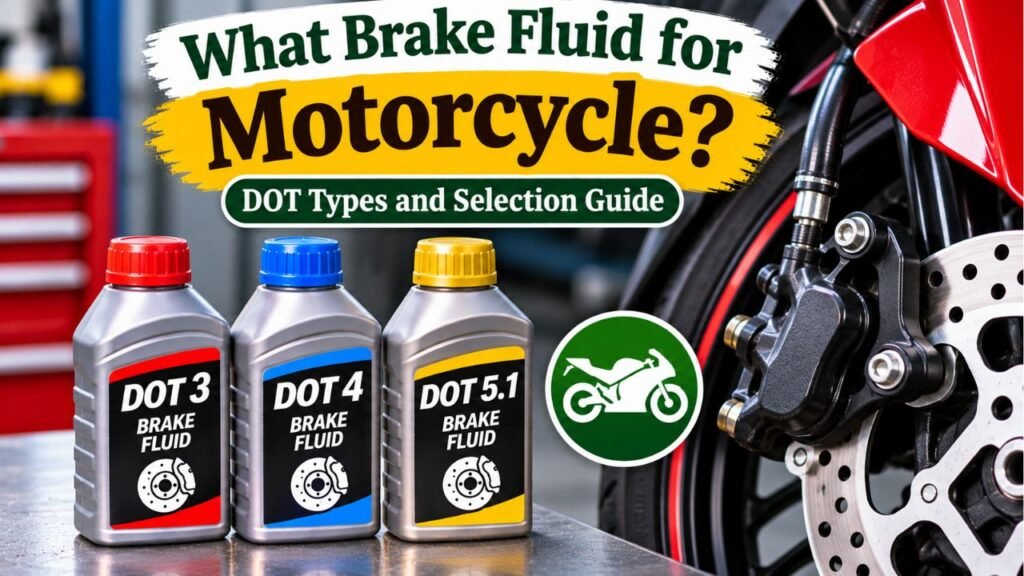
What Brake Fluid for Motorcycle? DOT Types and Selection Guide
Use the brake fluid specified in your motorcycle’s owner’s manual or on its brake master-cylinder reservoir cap. DOT 4 is common on modern motorcycles, but some require DOT 3, DOT 5.1, or silicone-based DOT 5. Never select a fluid solely because it has a higher DOT number or is advertised for racing.
Motorcycle hydraulic brakes depend on the correct fluid to transfer pressure from the lever or pedal to the caliper. The wrong chemistry can damage seals, interfere with ABS operation, or compromise braking. DOT 3, DOT 4, and DOT 5.1 are glycol-based, while DOT 5 is silicone-based and must not be mixed with them. Fluid used in a hydraulic clutch may have different requirements from the brakes.
Heat resistance also matters. Old glycol-based brake fluid absorbs moisture, lowering its boiling point and increasing the risk of vapor-related brake fade. Fresh fluid meeting the manufacturer’s specification offers the intended protection.
In this article, I explain what brake fluid to use for a motorcycle, compare DOT ratings and boiling points, and cover ABS, brand-specific exceptions, topping up, replacement intervals, and safe handling.
What Brake Fluid for Motorcycle? Quick Selection Guide
DOT 4 is a common specification for modern motorcycles, but the correct fluid always depends on the individual motorcycle’s brake system.
Some older motorcycles specify DOT 3. Certain motorcycles require DOT 5.1, while some Harley-Davidson models use silicone-based DOT 5.
These fluids are not universally interchangeable.
Motorcycle Brake Fluid Comparison Chart
| Brake Fluid | Main Composition | Typical Application | Important Consideration |
| DOT 3 | Glycol-based | Certain older and specified motorcycle systems | Use only when permitted by the manufacturer |
| DOT 4 | Glycol-based | Many modern motorcycles | Common choice, including many ABS-equipped models |
| DOT 4 LV | Low-viscosity glycol-based | Certain modern electronic braking systems | Use the required viscosity specification |
| DOT 5 | Silicone-based | Certain specified motorcycle systems | Never mix with DOT 3, DOT 4, or DOT 5.1 |
| DOT 5.1 | Glycol-based | Certain motorcycles and high-performance systems | Not the same as silicone DOT 5 |
| Mineral oil | Mineral-based hydraulic fluid | Certain specialized hydraulic systems, often clutches | Never substitute for DOT fluid without explicit approval |
The TVS Motor guide to brake fluid in two-wheelers explains the main DOT fluid types, their chemical differences, and why selecting the correct fluid is essential for motorcycle braking.
What Is the Best Brake Fluid for Most Motorcycles?
For a motorcycle whose manufacturer specifies DOT 4, choose a reputable DOT 4 product that meets the required standards.
If the motorcycle specifies another fluid, follow that requirement.
An expensive racing fluid isn’t automatically better for daily riding.
Can You Use Any DOT 4 Brake Fluid in a Motorcycle?
If your motorcycle specifies standard DOT 4, a suitable automotive or motorcycle brake fluid meeting the required DOT 4 specification may be acceptable.
However, check whether the manufacturer calls for additional requirements, such as a specific low-viscosity classification.
Don’t assume every DOT 4 product meets every specialized braking-system requirement.
What if You Don’t Know Which Fluid Is Already Inside?
Do not guess.
Check the owner’s manual and master-cylinder reservoir marking.
If the system’s service history is uncertain, have a qualified technician identify the correct specification and determine whether the hydraulic system needs inspection or servicing.
Key Takeaway: Choose brake fluid by the motorcycle manufacturer’s required specification, not by brand popularity, fluid color, or the highest DOT number available.
Understanding Motorcycle Brake Fluid Types
Motorcycle brake fluids are classified according to standardized performance characteristics.
These include boiling-point resistance, viscosity, and other physical and chemical properties.
The classifications don’t form a simple ranking where a higher number is always a better replacement.
DOT 3 Brake Fluid
DOT 3 is a glycol-based hydraulic brake fluid.
It has been used in automotive and certain motorcycle braking systems.
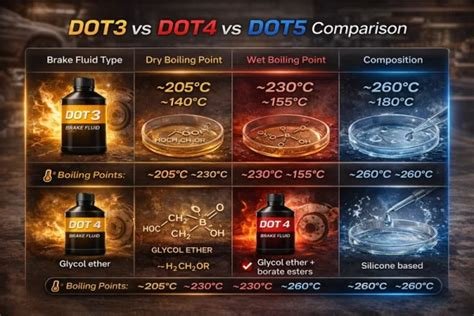
Its minimum dry boiling point is 401°F (205°C), and its minimum wet boiling point is 284°F (140°C).
DOT 3 may be appropriate for a motorcycle that specifically requires it.
However, many newer motorcycles specify DOT 4 or another classification.
Should You Use DOT 3?
Use it only if your motorcycle’s specifications permit it.
Do not substitute DOT 3 into a system requiring DOT 4 or DOT 5.1 without manufacturer approval.
DOT 4 Brake Fluid
DOT 4 is widely used in motorcycle hydraulic braking systems.
It is glycol-based and provides higher minimum boiling-point requirements than DOT 3.
Its minimum dry boiling point is 446°F (230°C).
Its minimum wet boiling point is 311°F (155°C).
DOT 4 is commonly specified for street motorcycles, touring bikes, scooters, and various performance models.
Why Is DOT 4 Popular?
Motorcycle brakes generate substantial heat during operation.
DOT 4 provides a useful combination of:
- Heat resistance
- Hydraulic pressure transmission
- Corrosion protection
- Compatibility with systems designed for it
- Availability from reputable manufacturers
However, DOT 4 absorbs moisture over time and requires scheduled replacement.
DOT 5 Brake Fluid
DOT 5 is a silicone-based hydraulic brake fluid.
It is chemically different from DOT 3, DOT 4, and DOT 5.1.
DOT 5 is specified for certain motorcycle braking systems, including some older Harley-Davidson models.
Is DOT 5 Better Than DOT 4?
Not universally.
DOT 5 has different moisture behavior and chemical characteristics.
It is not automatically suitable for systems designed around glycol-based fluid.
A motorcycle requiring DOT 4 should not be filled with DOT 5 simply because its numerical designation is higher.
Is DOT 5 Compatible With ABS?
DOT 5 generally isn’t suitable for ABS systems designed for glycol-based brake fluid.
However, the decisive requirement is the motorcycle manufacturer’s specification.
Never assume that an ABS-equipped motorcycle can use DOT 5 unless the system was explicitly designed for it.
DOT 5.1 Brake Fluid
DOT 5.1 is glycol-based.
Despite the similar name, it is not the same as silicone-based DOT 5.
DOT 5.1 has higher minimum boiling-point requirements than standard DOT 4.
Its minimum dry boiling point is 500°F (260°C).
Its minimum wet boiling point is 356°F (180°C).
Some motorcycles and performance applications use DOT 5.1.
Does DOT 5.1 Work in Every DOT 4 Motorcycle?
Not automatically.
DOT 4 and DOT 5.1 share a broadly compatible glycol-based chemistry, but that doesn’t establish approval for every motorcycle.
Viscosity requirements, brake-system design, and manufacturer instructions still matter.
Use DOT 5.1 as a replacement only when permitted by the motorcycle manufacturer.
DOT 3 vs. DOT 4 vs. DOT 5 vs. DOT 5.1 for Motorcycles
The biggest differences involve chemical composition, boiling-point performance, and system compatibility.
Motorcycle Brake Fluid Boiling Point Chart
| Fluid Type | Minimum Dry Boiling Point | Minimum Wet Boiling Point | Chemical Base |
| DOT 3 | 401°F / 205°C | 284°F / 140°C | Glycol |
| DOT 4 | 446°F / 230°C | 311°F / 155°C | Glycol |
| DOT 5 | 500°F / 260°C | 356°F / 180°C | Silicone |
| DOT 5.1 | 500°F / 260°C | 356°F / 180°C | Glycol |
These are minimum classification requirements. Individual products may exceed them.
What Is Dry Boiling Point?
Dry boiling point describes the temperature at which fresh brake fluid boils under standardized test conditions.
It is important because hydraulic braking systems can become very hot.
What Is Wet Boiling Point?
Wet boiling point describes performance after a standardized moisture-conditioning procedure.
It helps indicate how the fluid may perform after absorbing moisture during service.
The wet boiling point is usually lower than the dry boiling point for glycol-based fluids.
Why Does Boiling Point Matter on a Motorcycle?
Motorcycles can generate substantial braking heat, particularly during:
- Repeated hard braking
- Mountain descents
- Heavy traffic
- Riding with luggage or a passenger
- Track riding
- Aggressive sport riding
If contaminated fluid boils, vapor bubbles can form.
These bubbles compress when braking pressure is applied.
The result may be a soft lever or reduced braking effectiveness.
Is the Fluid With the Highest Boiling Point Always Best?
No.
A high boiling point is useful, but correct compatibility matters more.
A fluid with excellent laboratory performance can still be unsuitable if it doesn’t meet the braking system’s required chemistry or viscosity.
Key Takeaway: DOT 4 is common, DOT 5.1 is not silicone, and DOT 5 must not be substituted into an incompatible system.
How to Find the Correct Brake Fluid for Your Motorcycle
The safest approach is to identify the exact fluid specification before purchasing or adding anything.
Step 1: Check the Owner’s Manual
The owner’s manual should identify the required brake fluid classification.
Look under sections such as:
- Brakes
- Brake Fluid
- Periodic Maintenance
- Specifications
- Hydraulic Brake System
Record the complete specification.
Step 2: Inspect the Master-Cylinder Reservoir Cap
Many motorcycles have a brake fluid specification printed or molded on the reservoir cap.
For example, the cap may state:
USE ONLY DOT 4 BRAKE FLUID
That is an important identification point.
However, if the cap appears to have been replaced or modified, verify the specification through the owner’s manual.
Step 3: Identify the Front Brake Reservoir
On many motorcycles, the front brake master cylinder is mounted near the right handlebar.
It may have:
- An integrated reservoir
- A rectangular reservoir
- A separate remote reservoir
The exact layout varies.
Step 4: Find the Rear Brake Reservoir
Motorcycles with hydraulic rear brakes typically have a rear master cylinder and reservoir.
The reservoir may be near:
- The right footpeg
- The rear brake pedal
- The frame
- A side panel
Some scooters and motorcycles use different arrangements.
Step 5: Confirm the Model Year
Fluid requirements can change between generations.
Two motorcycles with the same model family name may use different components or maintenance procedures.
Check the exact model and year.
Step 6: Check for ABS Requirements
If the motorcycle has ABS, confirm whether the manufacturer requires a particular brake fluid classification or viscosity.
Some systems have additional service requirements.
Step 7: Choose Fresh Fluid From a Sealed Container
Once the correct specification is confirmed, choose an appropriate product.
Avoid using brake fluid from an unknown or improperly stored container.
What Brake Fluid Does a Honda Motorcycle Use?
Many Honda motorcycles specify DOT 4 brake fluid.
However, the specification must be confirmed for the exact model.
Honda Sport Motorcycles
Many Honda sport bikes use hydraulic disc brakes with DOT 4 fluid.
However, different generations and configurations may have different requirements.
Check the owner’s manual.
Honda Cruisers
Certain Honda cruiser models also specify DOT 4.
However, the motorcycle’s model and production year matter.
Honda Dual-Sport and Off-Road Motorcycles
Many Honda off-road and dual-sport models with hydraulic disc brakes use DOT 4 fluid.
However, some models have different braking arrangements.
A mechanically operated drum brake doesn’t use hydraulic brake fluid.
Can You Use Automotive DOT 4 in a Honda Motorcycle?
If the product meets the exact specification approved by Honda, it may be suitable.
However, don’t use an incompatible fluid or assume that every Honda motorcycle has identical requirements.
What About Honda’s Hydraulic Clutch?
A motorcycle’s hydraulic clutch is a separate system.
Check its own fluid specification.
Do not assume that the brake and clutch require the same fluid without verification.
What Brake Fluid Does a Yamaha Motorcycle Use?
DOT 4 is specified for many Yamaha motorcycles, but requirements vary by model.
Yamaha Sport Bikes
Many Yamaha sport motorcycles use DOT 4 hydraulic brake fluid.
The front and rear brake systems may have separate reservoirs.
Always verify the actual specification.
Yamaha Cruisers
Brake system designs vary across Yamaha cruiser models.
Some older motorcycles may have different components or fluid requirements.
Yamaha Scooters
Many Yamaha scooters use hydraulic disc brakes.
Some also have mechanical drum brakes.
Only the hydraulic circuits require brake fluid.
Should You Use DOT 5.1 in a Yamaha That Specifies DOT 4?
Not without confirming manufacturer approval.
The higher boiling-point classification doesn’t automatically make it an approved substitute.
What Brake Fluid Does a Kawasaki Motorcycle Use?
Many Kawasaki street motorcycles specify DOT 4.
However, there is no single specification that should be assumed for every Kawasaki model.
Kawasaki Ninja Series
Many Ninja models use DOT 4 hydraulic brake fluid.
Check the exact owner’s manual because different model years may use different components.
Kawasaki Z Series
Many Z-series motorcycles also specify DOT 4.
However, the fluid classification and service procedures must be confirmed for the particular bike.
Kawasaki Dirt Bikes
Some off-road motorcycles use hydraulic discs, while others have different braking systems.
Use the specification associated with the actual model.
Does Kawasaki ABS Require Special Fluid?
An ABS-equipped Kawasaki must use the brake fluid approved for that model.
Don’t assume that DOT 5.1 or low-viscosity DOT 4 is required solely because ABS is present.
What Brake Fluid Does a Suzuki Motorcycle Use?
DOT 4 is common in many Suzuki hydraulic brake systems.
However, the correct type depends on the specific motorcycle.
Suzuki GSX-R Motorcycles
Many GSX-R models specify DOT 4 brake fluid.
Performance riding creates significant braking heat, making fluid condition and maintenance important.
Suzuki GSX-S Motorcycles
Many GSX-S models also use DOT 4.
However, confirm the exact fluid requirement before servicing.
Suzuki V-Strom Motorcycles
Many V-Strom models use DOT 4 hydraulic brake fluid.
Touring and adventure use can expose the brakes to demanding conditions, especially when carrying luggage.
Use the specified fluid and follow the service interval.
What Brake Fluid Does a Harley-Davidson Motorcycle Use?
Harley-Davidson is an important example of why brake fluid should never be selected by motorcycle brand alone.
Some Harley-Davidson motorcycles require DOT 4, while certain others specify silicone-based DOT 5.
Using the wrong fluid can create serious compatibility problems.
DOT 4 Harley-Davidson Systems
Various Harley-Davidson models use glycol-based DOT 4.
These systems must not be filled with silicone-based DOT 5.
DOT 5 Harley-Davidson Systems
Some Harley-Davidson motorcycles were designed for DOT 5 silicone brake fluid.
They should not be filled with DOT 4 merely because DOT 4 is common on newer motorcycles.
How Do You Know Which One Your Harley Needs?
Check the:
- Owner’s manual
- Service manual
- Master-cylinder reservoir cap
- Exact model and year
Harley-Davidson’s official brake-line service instructions specifically explain that different models use DOT 4 or DOT 5 and direct owners to the motorcycle’s manual and reservoir cap for the required fluid.
Can You Convert From DOT 5 to DOT 4?
This is not a simple fluid replacement.
The brake system’s seals, components, and design must be considered.
Do not attempt a conversion without a manufacturer-approved procedure and qualified professional assistance.
Key Takeaway: On Harley-Davidson motorcycles, never assume that the fluid used in one model is correct for another.
What Brake Fluid for a Motorcycle With ABS?
Many ABS-equipped motorcycles use DOT 4, while some specify DOT 5.1 or a particular low-viscosity formulation.
The correct choice depends on the motorcycle manufacturer’s requirements.
Does ABS Need Special Brake Fluid?
ABS systems regulate hydraulic brake pressure through valves and other components.
The fluid must meet the system’s chemical, viscosity, and performance requirements.
However, not every ABS motorcycle needs a special fluid beyond its specified DOT classification.
Is DOT 5.1 Better for ABS?
DOT 5.1 has favorable standardized boiling-point and viscosity properties.
It may be appropriate for certain ABS systems.
However, it is not a universal upgrade for every DOT 4 motorcycle.
What Is DOT 4 Low-Viscosity Brake Fluid?
Low-viscosity DOT 4 is formulated to meet specific fluid-flow requirements, particularly at low temperatures.
Some modern electronically controlled braking systems benefit from these properties.
However, use it when the manufacturer’s specification requires or permits it.
Can You Use Silicone DOT 5 With ABS?
Do not use DOT 5 in an ABS system unless the manufacturer explicitly specifies it.
It is incompatible with the glycol-based fluids used in many motorcycle ABS systems.
Does ABS Change the Brake Fluid Replacement Process?
It can.
Certain systems require specific bleeding procedures or diagnostic equipment.
Improper bleeding may leave air trapped in the hydraulic unit.
If you’re unfamiliar with the procedure, professional servicing is preferable.
What Brake Fluid for a Sport Bike or Racing Motorcycle?
Sport motorcycles and track bikes may experience higher brake temperatures than motorcycles used for gentle everyday riding.
However, that doesn’t mean every sport bike requires a racing fluid.
Street Riding
For ordinary street riding, the manufacturer’s specified DOT fluid is generally appropriate.
Using a high-quality fluid that meets the required specification is more important than paying for the highest advertised boiling point.
Track Riding
Track use can involve repeated high-energy braking.
A fluid with higher boiling-point performance may be beneficial when approved for the motorcycle.
However, some specialized racing fluids require more frequent maintenance and may not be intended for extended everyday service intervals.
Should You Use Racing DOT 4?
Only when the product meets the motorcycle’s requirements.
Some racing DOT 4 fluids have higher dry boiling points than ordinary DOT 4 products.
However, compatibility, wet boiling performance, and service life still matter.
Is DOT 5.1 the Best Racing Fluid?
Not necessarily.
Some racing DOT 4 products exceed the boiling-point performance of certain standard DOT 5.1 fluids.
The DOT classification is only part of the comparison.
Choose based on manufacturer approval and the actual product specifications.
Can You Use Car Brake Fluid in a Motorcycle?
Yes, in many cases.
Motorcycle and automotive braking systems can use fluid meeting the same DOT specification.
The important factor is the fluid’s chemistry and required performance classification, not whether the bottle displays a car or motorcycle.
Example
Suppose your motorcycle specifies DOT 4 brake fluid.
A reputable product labeled for automotive use may also be suitable if it meets the required DOT 4 standard and any additional manufacturer requirements.
Is Motorcycle-Specific Brake Fluid Better?
Not automatically.
A motorcycle-branded product doesn’t necessarily provide better performance than another properly specified fluid.
However, specialty motorcycle products may offer features appropriate for particular applications.
What Should You Check on the Bottle?
Look for:
- DOT classification
- Applicable standards
- Product application guidance
- Viscosity information where relevant
- Manufacturer instructions
- Container condition
Do not choose a fluid based on packaging alone.
What About Power Steering Fluid or Transmission Fluid?
These are not substitutes for motorcycle brake fluid.
Using an incompatible petroleum-based fluid can damage brake hydraulic components.
Never put power steering fluid, motor oil, or transmission fluid into a braking system designed for DOT brake fluid.
Can You Mix DOT 3, DOT 4, and DOT 5.1?
DOT 3, DOT 4, and DOT 5.1 are broadly glycol-based fluids.
However, chemical compatibility does not mean every mixture is approved for every motorcycle.
Mixing DOT 3 and DOT 4
These fluids are generally chemically miscible, but their performance requirements differ.
Mixing may reduce the effective performance of the higher-rated fluid.
Some motorcycle manufacturers specifically instruct owners not to mix fluid grades.
Follow the motorcycle’s stated requirements.
Mixing DOT 4 and DOT 5.1
DOT 4 and DOT 5.1 are both glycol-based.
However, a manufacturer may require particular fluid properties.
Don’t substitute or mix them unless permitted.
Mixing DOT 3 and DOT 5.1
These fluids share a glycol-based chemical family.
Nevertheless, mixing them without approval isn’t a recommended maintenance strategy.
Mixing DOT 5 With Other Brake Fluids
Never mix silicone-based DOT 5 with glycol-based DOT 3, DOT 4, or DOT 5.1.
The fluid chemistries are incompatible.
Mixing them can compromise braking-system operation.
Brake Fluid Compatibility Chart
| Combination | General Chemical Relationship | Recommended Action |
| DOT 3 + DOT 4 | Both glycol-based | Only if manufacturer permits |
| DOT 3 + DOT 5.1 | Both glycol-based | Only if manufacturer permits |
| DOT 4 + DOT 5.1 | Both glycol-based | Only if manufacturer permits |
| DOT 4 + DOT 5 | Glycol and silicone | Do not mix |
| DOT 3 + DOT 5 | Glycol and silicone | Do not mix |
| DOT 5.1 + DOT 5 | Glycol and silicone | Do not mix |
| DOT fluid + mineral oil | Incompatible fluid families | Do not mix |
What if You Accidentally Added the Wrong Fluid?
Do not ride the motorcycle.
Have the hydraulic system professionally assessed.
Depending on the fluid and extent of contamination, repairs may involve more than simply flushing the system.
Certain contaminants can damage seals and other components.
Is Motorcycle Brake Fluid the Same as Clutch Fluid?
Not always.
Some motorcycles have hydraulic clutches.
The clutch may use brake-fluid-type hydraulic fluid, mineral oil, or another specified product.
Hydraulic Clutches Using DOT Fluid
Certain motorcycles specify DOT 4 or another glycol-based hydraulic fluid for their clutches.
Use the clutch system’s required specification.
Hydraulic Clutches Using Mineral Oil
Some motorcycle hydraulic clutch systems use mineral oil.
That fluid is not interchangeable with DOT brake fluid.
Does the Brake Fluid Specification Apply to the Clutch?
Not automatically.
Even when the brake and clutch reservoirs look similar, their fluid requirements can differ.
Check both systems separately.
What Happens if You Put Brake Fluid in a Mineral-Oil Clutch?
The wrong fluid may damage seals or affect hydraulic operation.
If this happens, stop using the system and seek professional advice.
Do not assume that simply draining the reservoir will resolve the problem.
Key Takeaway: Check the brake and clutch specifications independently. Similar-looking hydraulic reservoirs don’t always use the same fluid.
How Much Brake Fluid Does a Motorcycle Need?
The required quantity depends on the brake system design.
A motorcycle with a single front disc and rear drum brake may need less hydraulic fluid than a motorcycle with dual front discs, a hydraulic rear brake, and ABS.
Factors Affecting Fluid Quantity
These include:
- Number of hydraulic brake circuits
- Number of calipers
- Brake line length
- Master-cylinder capacity
- ABS hydraulic unit
- Whether the service is a top-up or complete exchange
How Much Fluid Is Needed for Topping Up?
Only enough to restore the correct level after the reason for the low fluid has been evaluated.
Don’t automatically fill the reservoir to the maximum line.
The fluid level can decrease as brake pads wear.
Overfilling may create problems when the caliper pistons are later pushed back during servicing.
How Much for a Complete Brake Fluid Change?
Many motorcycles can be serviced using a modest quantity of brake fluid, but the required amount varies.
Brake fluid is commonly sold in 250 mL, 500 mL, and larger containers.
The bottle size doesn’t tell you the exact amount needed for your bike.
Consult the service manual or qualified technician.
Should You Buy Extra Fluid?
A small amount of appropriately sealed fluid may be useful during a complete exchange.
However, don’t purchase a large container that will remain open for a long period.
Glycol-based brake fluid can absorb moisture after opening.
How Often Should You Change Motorcycle Brake Fluid?
Many motorcycle service schedules recommend brake fluid replacement approximately every one to two years.
However, intervals vary by manufacturer and operating conditions.
The specific owner’s manual takes priority.
Why Does Motorcycle Brake Fluid Need Changing?
Glycol-based fluid gradually absorbs moisture.
Over time, this can reduce boiling resistance and contribute to corrosion.
High brake temperatures can make deteriorated fluid more vulnerable to vapor formation.
General Motorcycle Brake Fluid Maintenance Guide
| Riding Situation | Maintenance Approach |
| Normal street riding | Follow manufacturer schedule, often around 1–2 years |
| Daily commuting | Follow time-based service interval |
| Occasional weekend riding | Still follow time-based maintenance |
| Sport riding | Monitor fluid condition and follow appropriate service requirements |
| Track riding | May require more frequent replacement |
| Motorcycle with unknown service history | Have fluid and hydraulic system inspected |
| Low fluid level | Check pad wear and possible leaks |
| Spongy brake lever or pedal | Do not ride until diagnosed |
| Incorrect fluid added | Stop use and arrange professional inspection |
Brembo’s motorcycle brake fluid guide recommends replacing brake fluid approximately every one to two years for normal road use, with potentially more frequent changes for track riding.
Does Low Mileage Mean the Fluid Lasts Longer?
Not necessarily.
Moisture absorption is influenced by time and environmental conditions, not just the number of miles ridden.
A motorcycle stored for much of the year can still require brake fluid replacement.
Should You Change It Every Year?
Only when appropriate for the bike’s schedule, fluid condition, or riding use.
Some models require annual service, while others specify different intervals.
Can Brake Fluid Last Three Years?
Some motorcycle manufacturers may specify intervals that differ from one or two years.
Follow the actual maintenance schedule.
Don’t assume that every fluid is safe indefinitely because the brakes feel normal.
How to Check Motorcycle Brake Fluid Level
Checking the brake fluid level is a routine maintenance task.
However, it must be performed according to the motorcycle’s owner’s manual.
Step 1: Park the Motorcycle Safely
Place the bike on a stable, level surface.
Use the correct stand or upright position specified by the manufacturer.
Step 2: Locate the Reservoir
Find the front or rear brake fluid reservoir.
Some motorcycles have separate reservoirs for each hydraulic circuit.
Step 3: Position the Reservoir Correctly
Some handlebar-mounted reservoirs must be held level for an accurate reading.
Follow the owner’s manual.
Step 4: Read the Level Markings
Check the fluid level against the appropriate markings.
Look for labels such as:
- MIN
- MAX
- LOWER
- UPPER
Step 5: Consider Brake Pad Wear
The fluid level can gradually fall as brake pads wear and the caliper pistons move outward.
A lower reading doesn’t automatically indicate a leak.
However, a sudden or significant decrease requires inspection.
Step 6: Check for Leaks
Look for signs of fluid around:
- Master cylinder
- Brake hoses
- Hydraulic fittings
- Calipers
- Banjo connections
Do not ride if a hydraulic leak is suspected.
Step 7: Avoid Unnecessary Reservoir Opening
Brake fluid can absorb moisture and become contaminated when exposed.
Don’t open the reservoir unless necessary for approved maintenance.
What if the Brake Fluid Is Below MIN?
The motorcycle needs inspection.
Possible causes include worn pads or hydraulic fluid loss.
Don’t simply top it up and continue riding without determining the cause.
Can You Just Add More Brake Fluid to a Motorcycle?
Sometimes, but topping up must be done correctly and only when appropriate.
A low level isn’t automatically a request for more fluid.
When Topping Up May Be Appropriate
A technician may add the specified fluid after confirming the brake system’s condition.
For example, the correct level may need to be restored following certain maintenance procedures.
When Topping Up Is Not Enough
Adding fluid won’t fix:
- Leaking brake lines
- Worn hydraulic seals
- Trapped air
- Contaminated fluid
- Corroded components
- A failing master cylinder
Can You Add a Different Brand of the Same DOT Fluid?
Products meeting the same required standard are generally intended to provide the required performance.
However, follow the motorcycle manufacturer’s specification and avoid unnecessary mixing of unknown fluid formulations.
What if the Reservoir Is Empty?
Do not ride.
An empty reservoir may indicate a serious leak or that air has entered the hydraulic system.
The cause must be repaired and the brakes properly serviced before use.
How to Replace Motorcycle Brake Fluid Safely
Brake fluid replacement is a safety-critical maintenance procedure.
The exact bleeding method varies between motorcycles.
Some ABS-equipped bikes require specialized equipment.
Step 1: Confirm the Correct Specification
Use the owner’s manual and reservoir markings to select the approved fluid.
Never guess.
Step 2: Inspect the Hydraulic System
Check for leaks, damaged hoses, worn components, and other problems.
A fluid change cannot repair a failed hydraulic part.
Step 3: Protect Painted Surfaces
Glycol-based brake fluid can damage paint and certain finishes.
Cover sensitive areas before opening the system.
Step 4: Use Fresh Fluid
Use suitable fluid from a sealed container.
Do not reuse drained brake fluid.
Step 5: Follow the Correct Bleeding Procedure
The old fluid must be replaced without allowing air to remain in the hydraulic circuits.
The bleeding order and procedure are motorcycle-specific.
Step 6: Service ABS Systems Correctly
Some ABS units require special procedures or diagnostic equipment.
A generic bleeding method may not be sufficient.
Step 7: Verify Brake Operation
Before riding, the brake lever and pedal must have normal response.
There should be no leaks or abnormal hydraulic behavior.
Step 8: Dispose of Old Fluid Properly
Used brake fluid should be taken to an appropriate waste collection or recycling facility that accepts the material.
Do not pour it onto the ground or into drains.
Should You Change Motorcycle Brake Fluid Yourself?
Only if you have the correct tools, service information, and experience.
Incorrect bleeding can leave air trapped in the system and compromise braking.
If you’re unfamiliar with motorcycle hydraulic brakes, professional servicing is the safer choice.
Important: Never ride with a spongy brake lever, sinking pedal, suspected hydraulic leak, or abnormal braking response.
What Happens if You Use the Wrong Motorcycle Brake Fluid?
Using an incompatible fluid can affect the hydraulic system.
The consequences depend on the fluid chemistry and the motorcycle’s design.
Damaged Seals
Brake system seals are designed for specific fluid types.
An incompatible fluid may damage or degrade the sealing materials.
Hydraulic Leaks
Damaged seals may allow fluid to escape.
This can reduce braking performance.
ABS Problems
An incompatible fluid may affect the hydraulic operation of an ABS system.
Certain ABS units also have specific viscosity requirements.
Reduced Heat Resistance
Using fluid below the required specification may reduce the system’s boiling-point safety margin.
Contamination
Mixing incompatible fluid chemistries may create contamination that requires professional repair.
Can You Fix the Problem by Flushing the Fluid?
Not always.
If the wrong fluid has damaged seals or other components, a flush alone may be insufficient.
A qualified technician must assess the system and determine which components require repair or replacement.
Common Mistakes When Choosing Motorcycle Brake Fluid
Avoiding these mistakes helps protect the braking system.
Assuming Every Motorcycle Uses DOT 4
DOT 4 is common, but not universal.
Check the exact model.
Assuming DOT 5.1 Is Silicone-Based
DOT 5.1 is glycol-based.
DOT 5 is silicone-based.
They are not the same fluid.
Mixing DOT 5 With DOT 4
These fluids are chemically incompatible.
Never mix them.
Choosing Racing Fluid Based Only on Boiling Point
A high dry boiling point isn’t the only requirement.
Check compatibility, wet boiling performance, and intended service use.
Using Mineral Oil in a DOT Brake System
Mineral oil is not a substitute for DOT brake fluid.
Only use it in systems specifically designed for that fluid.
Confusing Brake and Clutch Requirements
A motorcycle’s hydraulic clutch may have a different specification.
Check both systems separately.
Topping Up Without Checking for Leaks
Low brake fluid may indicate pad wear or a hydraulic fault.
Investigate the cause.
Using Brake Fluid From an Old Open Bottle
Glycol-based fluid can absorb moisture from the atmosphere.
Use properly stored, suitable fresh fluid.
Ignoring ABS Requirements
Some systems need specific fluid characteristics or bleeding procedures.
Assuming Clear Brake Fluid Is Always Healthy
Brake fluid can absorb moisture without becoming visibly dark.
Use the service schedule and appropriate testing.
Overfilling the Reservoir
Fluid level changes with pad wear.
Follow the specified fill markings and inspection procedure.
Riding With a Soft Brake Lever
An abnormal lever or pedal may indicate air, vapor, leaks, or hydraulic failure.
Do not ride until the cause is corrected.
How to Choose a Quality Motorcycle Brake Fluid
Once you have identified the required specification, consider the product’s quality and suitability.
Check the DOT Rating
The bottle must meet the classification required by your motorcycle.
Check Additional Standards
Some products display specifications such as:
- FMVSS 116
- SAE J1703
- SAE J1704
- ISO 4925
The required standards and classifications depend on the motorcycle.
Check the Boiling-Point Ratings
Compare dry and wet boiling-point specifications when relevant.
However, do not use these numbers to override the manufacturer’s fluid requirement.
Consider Viscosity Requirements
Some ABS systems require a particular low-temperature viscosity.
Use an approved formulation.
Check the Product’s Intended Application
A street-use motorcycle may have different maintenance needs from a dedicated racing machine.
Choose a product suitable for the actual application.
Buy From a Reliable Supplier
Avoid counterfeit products, damaged packaging, and fluids with unknown storage history.
Choose an Appropriate Bottle Size
Smaller sealed bottles can reduce waste when only a modest amount of fluid is required.
However, make sure sufficient fluid is available for a complete service.
Selection Checklist
| Check | Why It Matters |
| Correct DOT classification | Ensures specified fluid type |
| Manufacturer approval | Confirms motorcycle compatibility |
| Suitable viscosity | Important for some ABS systems |
| Boiling-point performance | Supports heat resistance |
| Sealed packaging | Helps protect against contamination |
| Reliable supplier | Reduces risk of unsuitable products |
| Proper bottle quantity | Allows complete service |
| Correct maintenance procedure | Prevents trapped air and hydraulic faults |
Does Motorcycle Brake Fluid Affect Braking Performance?
Yes.
Brake fluid transmits hydraulic pressure.
Its condition matters for reliable braking, especially when temperatures rise.
Can Fresh Brake Fluid Make Brakes Feel Better?
Sometimes.
If the previous fluid was deteriorated or the system contained air that was correctly removed, pedal or lever response may improve.
However, a routine fluid change may not produce a noticeable difference if the old fluid was still performing normally.
Can Old Fluid Cause Spongy Brakes?
Yes, particularly if moisture lowers the boiling point enough for vapor bubbles to form under heat.
However, sponginess may also indicate trapped air or a hydraulic leak.
Does Higher DOT Fluid Shorten Stopping Distance?
Not automatically.
Maximum braking performance depends on tires, road conditions, brake components, and hydraulic-system integrity.
Fresh fluid helps preserve reliable pressure transmission.
Can the Wrong Fluid Cause Brake Failure?
Yes.
An incompatible fluid can damage components or compromise hydraulic operation.
This is why the correct specification is essential.
Conclusion
The correct brake fluid for a motorcycle is the type specified in its owner’s manual or on the brake master-cylinder reservoir cap.
DOT 4 is common on many modern motorcycles, but some models specify DOT 3, DOT 5.1, or silicone-based DOT 5.
The DOT number alone isn’t enough to determine compatibility.
DOT 3, DOT 4, and DOT 5.1 are glycol-based fluids, while DOT 5 is silicone-based and must not be mixed with them.
A higher boiling-point rating may be useful in demanding riding conditions, but it doesn’t make an incompatible fluid safe.
For ABS-equipped motorcycles, use the exact classification and viscosity approved by the manufacturer.
Check the brake and clutch systems separately because their hydraulic fluid requirements can differ.
Replace brake fluid according to the manufacturer’s maintenance schedule, use suitable fresh fluid from a sealed container, and inspect low fluid levels rather than automatically topping up.
The safest choice is straightforward: match the manufacturer’s specification, use a reputable fluid, and maintain the hydraulic braking system correctly.
FAQs About What Brake Fluid for Motorcycle
What Brake Fluid Should I Use for My Motorcycle?
Use the brake fluid specified in your motorcycle’s owner’s manual or master-cylinder reservoir cap.
DOT 4 is common, but some motorcycles require DOT 3, DOT 5, or DOT 5.1.
Do not guess.
Do Most Motorcycles Use DOT 4 Brake Fluid?
Many modern motorcycles use DOT 4, particularly models with hydraulic disc brakes.
However, the specification is not universal.
Always confirm the individual motorcycle’s requirements.
Can I Use DOT 4 Brake Fluid in Any Motorcycle?
No.
Some motorcycles use another DOT classification or a different hydraulic-fluid chemistry.
DOT 4 should be used only when it meets the manufacturer’s required specification.
Can I Use Car Brake Fluid in a Motorcycle?
Yes, when the automotive fluid meets the exact specification approved for the motorcycle.
A correctly specified fluid isn’t unsuitable merely because its packaging mentions cars.
Is DOT 5.1 Better Than DOT 4 for Motorcycles?
DOT 5.1 has higher minimum boiling-point requirements.
However, that doesn’t automatically make it the better choice for every motorcycle.
Use it only when the manufacturer permits it.
Can I Mix DOT 3 and DOT 4 in a Motorcycle?
Both are glycol-based, but some motorcycle manufacturers prohibit mixing grades.
Mixing may also reduce the performance of the higher-rated fluid.
Follow the motorcycle manufacturer’s instructions.
Can I Mix DOT 4 and DOT 5.1?
They share a glycol-based chemistry, but that doesn’t guarantee approval for every hydraulic system.
Use the manufacturer’s specified fluid rather than mixing grades without confirmation.
Can I Mix DOT 4 and DOT 5?
No.
DOT 4 is glycol-based, while DOT 5 is silicone-based.
They must not be mixed.
Is DOT 5 the Same as DOT 5.1?
No.
DOT 5 is silicone-based.
DOT 5.1 is glycol-based.
Their similar names do not mean they are interchangeable.
What Brake Fluid Should I Use for a Motorcycle With ABS?
Use the exact fluid specified for the ABS-equipped model.
Many ABS motorcycles use DOT 4, while others may require DOT 5.1 or a particular low-viscosity formulation.
Do not substitute silicone DOT 5 unless explicitly approved.
What Brake Fluid Does a Honda Motorcycle Use?
Many Honda motorcycle models specify DOT 4.
However, the correct specification depends on the exact model and year.
Check the owner’s manual.
What Brake Fluid Does a Harley-Davidson Motorcycle Use?
Some Harley-Davidson motorcycles specify DOT 4, while certain others use silicone-based DOT 5.
Check the reservoir cap and model-specific manual before adding any fluid.
Can I Use DOT 5.1 in a DOT 4 Motorcycle?
Only when the motorcycle manufacturer permits it.
Although both fluids are glycol-based, additional viscosity and system requirements may apply.
How Often Should Motorcycle Brake Fluid Be Changed?
Many motorcycles require fluid replacement approximately every one to two years.
However, the correct interval depends on the manufacturer’s schedule and riding conditions.
How Much Brake Fluid Does a Motorcycle Need?
The required amount depends on the number of hydraulic circuits, calipers, line lengths, and ABS design.
Check the service manual or ask a qualified technician.
Can I Just Top Up Motorcycle Brake Fluid?
Only after identifying why the level is low.
A falling level may result from pad wear or a leak.
Adding fluid does not repair hydraulic problems or replace contaminated fluid.
Should I Use Racing Brake Fluid on My Street Motorcycle?
Not automatically.
Racing fluids may provide higher boiling-point performance but can have different maintenance requirements.
Use a street-suitable product that meets the manufacturer’s specification.
Does Motorcycle Brake Fluid Expire?
Brake fluid can deteriorate through moisture absorption and contamination.
Opened glycol-based fluid is particularly vulnerable.
Follow product storage guidance and the motorcycle’s maintenance schedule.
What Happens if I Use the Wrong Motorcycle Brake Fluid?
Incompatible fluid may damage seals, affect hydraulic operation, or compromise braking.
Stop riding and have the system professionally inspected.
A simple flush may not be sufficient if damage has occurred.
Can I Use Mineral Oil Instead of DOT Brake Fluid?
No.
Mineral oil and DOT brake fluid are different hydraulic-fluid families.
Use mineral oil only in systems specifically designed for it, such as certain hydraulic clutches.
Is Motorcycle Brake Fluid Different From Clutch Fluid?
Not necessarily.
Some hydraulic clutches use DOT brake fluid, while others require mineral oil or another specified fluid.
Check the clutch system separately.
Can Old Motorcycle Brake Fluid Cause a Soft Brake Lever?
Yes.
Moisture-contaminated fluid may produce compressible vapor under high temperatures.
However, a soft lever can also indicate trapped air, leakage, or another hydraulic fault.
Do not ride until the cause is diagnosed.
Does Changing Motorcycle Brake Fluid Improve Braking?
It can restore boiling resistance and support consistent hydraulic performance.
However, a routine fluid change may not noticeably alter braking when the previous fluid was still healthy.
What Is the Safest Motorcycle Brake Fluid?
The safest fluid is the one that meets the manufacturer’s specified chemistry, DOT classification, viscosity, and other requirements.
No single DOT type is the safest choice for every motorcycle.