What Is Semi Loaded Brake Caliper? Meaning, Parts, and Uses
If you are shopping for replacement brake parts, you may see calipers described as loaded, semi-loaded, unloaded, bare, or complete. These terms can be confusing because they do not describe how the caliper operates. Instead, they usually describe which additional parts are included with the replacement caliper.
So, what is semi loaded brake caliper? A semi-loaded brake caliper is generally a replacement caliper that comes with some installation hardware already included, but usually does not include the brake pads. Depending on the manufacturer or retailer, it may include a caliper bracket, slide pins, boots, clips, or other hardware needed for installation.
The important detail is that “semi-loaded” is not perfectly standardized across every brake-parts brand. One manufacturer may include the mounting bracket and hardware, while another may supply a slightly different package. That means you should always check the exact contents listed for the specific caliper before ordering.
For many DIY brake repairs, a semi-loaded caliper can be a convenient middle ground. It gives you more components than a bare caliper while still allowing you to choose your own brake pads.
What Is Semi Loaded Brake Caliper?
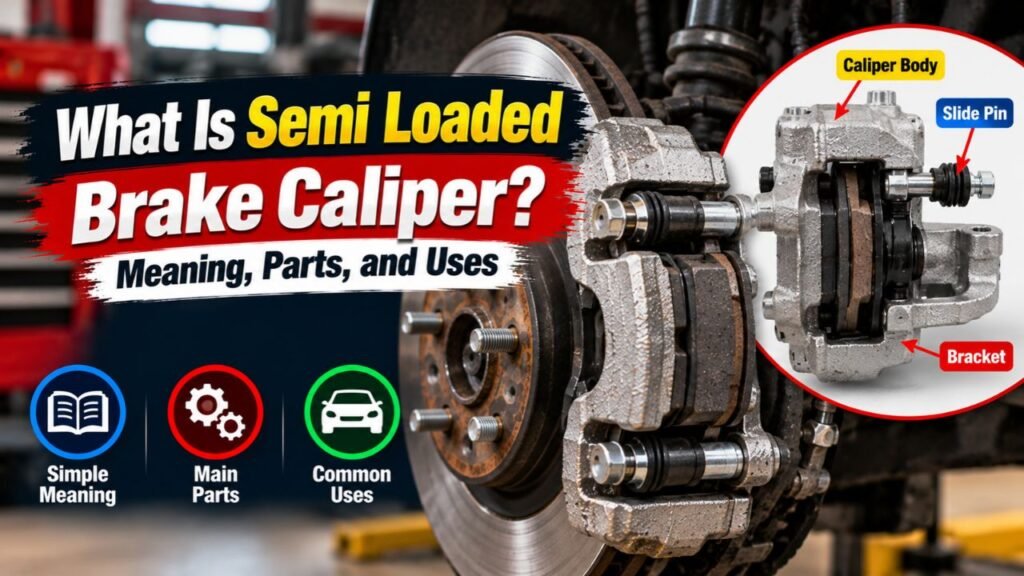
A semi-loaded brake caliper is a replacement brake caliper supplied with some related hardware or mounting components but typically without brake pads.
In many applications, a semi-loaded caliper may include:
- The caliper housing
- Caliper piston or pistons
- Piston seals
- Dust boots
- Caliper mounting bracket
- Slide pins or guide pins
- Slide-pin boots
- Some installation hardware
The exact parts vary by brand and vehicle application.
The easiest way to think about a semi-loaded caliper is:
Bare caliper = mainly the caliper itself
Semi-loaded caliper = caliper plus some hardware, usually without pads
Loaded caliper = caliper plus hardware and typically brake pads
Because terminology varies, always confirm the product description before buying.
What Does “Loaded” Mean on a Brake Caliper?
The word loaded refers to how complete the replacement caliper assembly is when you purchase it.
It does not refer to:
- Brake pressure
- Vehicle weight
- Caliper piston count
- Fixed versus floating design
- Braking power
A loaded caliper is generally supplied with more of the parts needed to complete a brake repair.
A semi-loaded caliper falls between a fully loaded caliper and a bare or unloaded caliper.
What Usually Comes With a Semi-Loaded Brake Caliper?
There is no universal package used by every manufacturer, but several parts are commonly included.
Caliper Housing
The main caliper body is included.
The housing contains the hydraulic piston or pistons that apply pressure to the brake pads when you press the brake pedal.
Caliper Piston
A replacement caliper normally comes assembled with its piston or pistons already installed.
The piston moves outward when hydraulic brake pressure enters the caliper.
Piston Seal and Dust Boot
The internal seal helps contain brake fluid and allows the piston to move correctly.
The external dust boot helps protect the piston area from water, dirt, and road debris.
Caliper Bracket
Many semi-loaded calipers include the caliper mounting bracket, especially on floating-caliper systems.
The bracket attaches to the steering knuckle or other suspension component and supports the caliper and brake pads.
However, some semi-loaded packages may not include the bracket, so verify the listing.
Slide Pins
Floating calipers need slide pins or guide pins so the caliper can move laterally when the brakes are applied.
Semi-loaded units often include new or remanufactured slide pins.
Rubber Slide-Pin Boots
Protective boots help keep moisture and debris away from the slide-pin surfaces.
If these boots become torn, corrosion can develop and cause the caliper to stick.
Brake Hardware
Some semi-loaded calipers include clips, bushings, bolts, or other installation hardware.
Again, the contents depend on the specific product.
Do Semi-Loaded Calipers Come With Brake Pads?
Usually, no.
The absence of brake pads is one of the main differences between a semi-loaded and fully loaded caliper.
This allows you to select the brake-pad type and brand you prefer.
For example, you may want:
- Ceramic brake pads
- Semi-metallic brake pads
- Low-dust pads
- Performance pads
- Original-equipment-style replacement pads
However, because product terminology varies, always check the parts list instead of assuming that every semi-loaded caliper excludes pads.
Semi-Loaded vs. Loaded Brake Calipers
The main difference is usually whether brake pads are included.
| Feature | Semi-Loaded Caliper | Loaded Caliper |
| Caliper body | Usually included | Included |
| Pistons and seals | Included | Included |
| Mounting bracket | Often included | Usually included |
| Slide pins | Often included | Usually included |
| Hardware | May be included | Usually included |
| Brake pads | Usually not included | Typically included |
| Installation convenience | High | Very high |
| Ability to choose your own pads | Yes | Usually limited to included pads |
A loaded caliper can save time because most of the components are already matched and supplied together.
A semi-loaded caliper is attractive when you want a convenient replacement assembly but prefer to purchase brake pads separately.
Semi-Loaded vs. Unloaded Brake Calipers
An unloaded brake caliper, sometimes called a bare caliper, normally comes with fewer external components.
Depending on the manufacturer, an unloaded caliper may require you to reuse or separately purchase items such as:
- Caliper bracket
- Slide pins
- Pad clips
- Mounting hardware
The caliper’s hydraulic components are generally assembled, but the surrounding hardware package may be limited.
A semi-loaded unit usually reduces the number of old components you have to reuse.
Why Would You Buy a Semi-Loaded Brake Caliper?
Semi-loaded calipers offer a useful balance between cost, convenience, and component choice.
You Can Choose Your Own Brake Pads
One of the biggest advantages is the ability to select brake pads separately.
This can be useful if you prefer a specific:
- Pad material
- Manufacturer
- Noise level
- Dust level
- Performance characteristic
More Hardware May Be Included
If the original caliper bracket or slide pins are rusty, worn, or seized, buying a caliper that includes those components can save time.
It can also reduce the need to clean and rebuild old hardware.
Installation Can Be Easier
A semi-loaded assembly may arrive with several important components already fitted together.
That can make replacement easier than transferring every part from the old caliper.
Good for Rusty Brake Systems
Vehicles operated in areas where road salt is common can develop corrosion around:
- Caliper brackets
- Slide pins
- Pad contact points
- Mounting hardware
Replacing more of the assembly can make sense when corrosion is significant.
Why Would You Choose a Loaded Caliper Instead?
A loaded caliper may be preferable if convenience is your highest priority.
Because brake pads and hardware are typically included, you may not need to purchase as many separate parts.
Loaded calipers can be helpful when:
- You want a complete matched assembly.
- The existing brake components are badly worn.
- You want to minimize parts selection.
- You are replacing multiple worn brake components at the same time.
The tradeoff is that you normally have less choice over the brake pads supplied with the assembly.
Why Would You Choose an Unloaded Caliper?
A bare or unloaded caliper can make sense when the existing bracket and hardware are still in excellent condition.
It may also cost less.
An unloaded caliper can be suitable when:
- The bracket is reusable.
- Slide pins are in good condition.
- You already purchased new hardware.
- You want to reuse certain original components.
However, reusing rusty or damaged hardware can lead to problems even when the replacement caliper itself is new.
Are Semi-Loaded Calipers New or Remanufactured?
They can be either.
A semi-loaded caliper may be sold as:
- Brand-new
- Remanufactured
- Rebuilt
A remanufactured brake caliper is an existing caliper that has been disassembled, cleaned, inspected, and rebuilt with replacement components as required.
A new caliper is manufactured from new components.
Do not assume that “semi-loaded” means new or remanufactured. The term only describes the approximate level of included components.
Check the product listing for the caliper’s actual condition.
What Is a Remanufactured Semi-Loaded Caliper?
A remanufactured semi-loaded caliper combines two separate descriptions.
Remanufactured describes the caliper’s condition and production process.
Semi-loaded describes which related components are included.
A remanufactured semi-loaded caliper may therefore be a professionally rebuilt caliper supplied with a bracket and hardware but without brake pads.
Many automotive replacement calipers are sold this way.
How Does a Semi-Loaded Caliper Work?
A semi-loaded caliper works exactly like the corresponding original brake caliper once installed.
The term semi-loaded does not change its braking operation.
When you press the brake pedal:
- The master cylinder creates hydraulic pressure.
- Brake fluid carries that pressure to the caliper.
- Hydraulic pressure moves the caliper piston.
- The piston pushes the brake pad against the rotor.
- The opposite pad also contacts the rotor.
- Friction slows the rotating wheel.
Whether the caliper is fixed or floating depends on the vehicle’s braking-system design, not whether the replacement is described as semi-loaded.
Can a Semi-Loaded Caliper Be Fixed or Floating?
Yes.
“Fixed,” “floating,” and “semi-loaded” describe different things.
Fixed or floating describes the design and operation of the caliper.
Semi-loaded describes the parts supplied with the replacement unit.
For example, you could purchase a semi-loaded floating caliper for a typical passenger car.
Depending on the manufacturer, semi-loaded replacement assemblies may also be offered for other caliper designs.
Is a Semi-Loaded Caliper Ready to Install?
It may be nearly ready to install, but additional parts and procedures are usually required.
You may still need:
- New brake pads
- Brake hardware
- Brake fluid
- Replacement brake hose washers where applicable
- Correct lubricant for slide components
- Brake-cleaning products
The hydraulic brake system will normally need to be bled if the brake hose is disconnected from the caliper.
Bleeding removes air from the hydraulic system.
Air in brake lines can create a soft brake pedal and reduce braking performance.
Do You Need New Brake Pads With a Semi-Loaded Caliper?
In most cases, you should plan to install appropriate brake pads because semi-loaded calipers generally do not include them.
If one caliper failed and caused abnormal pad wear, replacing or reusing only the worn pads on that side is usually not appropriate.
Brake pads are normally replaced as an axle set, meaning both left and right wheels on the same axle receive matching pads.
This helps maintain balanced braking.
Should You Replace the Rotor When Replacing a Caliper?
Not automatically.
The brake rotor should be inspected for:
- Excessive wear
- Deep scoring
- Cracks
- Heat damage
- Severe rust
- Thickness below specification
- Excessive runout where applicable
A seized caliper can overheat and damage a rotor.
If the rotor has been severely overheated or worn beyond specification, it should be replaced.
Always follow vehicle manufacturer specifications when determining whether a rotor remains serviceable.
What Happens If the Old Caliper Bracket Is Rusty?
A badly rusted caliper bracket can cause problems even if the hydraulic caliper is replaced.
Brake pads must be able to move correctly within the bracket.
Heavy corrosion around the pad contact points can cause:
- Pad binding
- Uneven brake wear
- Excessive heat
- Dragging brakes
- Reduced pad movement
Buying a semi-loaded caliper that includes a replacement bracket can be useful in areas where corrosion is common.
How Can You Tell What Comes With a Semi-Loaded Caliper?
Do not rely entirely on the words “semi-loaded.”
Check:
- Product photographs
- Manufacturer description
- Included-parts list
- Vehicle application notes
- Hardware specifications
Look specifically for whether the package contains:
- Caliper bracket
- Slide pins
- Bolts
- Anti-rattle clips
- Brake pads
Two products both described as semi-loaded may include slightly different components.
Does a Semi-Loaded Caliper Include a Brake Hose?
Usually, the brake hose is a separate component.
The flexible brake hose connects the vehicle’s hydraulic brake line to the moving brake-caliper assembly.
A replacement hose may be necessary if the existing one is:
- Cracked
- Swollen
- Leaking
- Twisted
- Internally restricted
- Otherwise damaged
Do not assume a new caliper fixes a brake-hose problem.
Does a Semi-Loaded Caliper Include the Caliper Bracket?
Often, but not always.
The mounting bracket is one of the components commonly associated with semi-loaded caliper packages.
However, industry terminology varies enough that you should confirm the exact listing.
If the bracket is important to your repair, make sure it appears in the product description or images before purchasing.
What Is the Difference Between a Bracketed and Semi-Loaded Caliper?
These terms can overlap.
A bracketed caliper specifically indicates that the caliper is supplied with the mounting bracket.
A semi-loaded caliper may include the bracket along with slide pins or other hardware.
Because manufacturers use product terminology differently, checking the package contents is more reliable than comparing names alone.
Signs You May Need a Replacement Brake Caliper
A bad caliper can cause several braking problems.
Possible symptoms include:
- Vehicle pulling to one side
- One wheel becoming unusually hot
- Uneven brake-pad wear
- Brake fluid leaking around the caliper
- Burning odor near a wheel
- Brake drag
- Reduced braking performance
- Sticking caliper piston
- Seized slide pins
- Excessive brake dust from one wheel
These symptoms can have other causes as well, so proper diagnosis is important before replacing parts.
Should Brake Calipers Be Replaced in Pairs?
Brake calipers are not automatically required to be replaced in pairs in every repair.
If only one caliper has failed, the other side may still be serviceable.
However, the opposite caliper should be inspected for:
- Corrosion
- Fluid leaks
- Sticking pistons
- Slide-pin problems
- Similar age and wear
Brake pads should generally be serviced as an axle set.
If both calipers are heavily corroded or similarly worn, replacing both may make practical sense.
Important Safety Considerations
Brake calipers are part of the vehicle’s primary braking system, so proper installation is critical.
During caliper replacement:
- Support the vehicle securely with appropriate jack stands.
- Never work under a vehicle supported only by a jack.
- Avoid contaminating brake pads or rotors with grease or brake fluid.
- Use the correct replacement parts.
- Follow manufacturer torque specifications.
- Replace required sealing washers.
- Bleed the hydraulic system correctly.
- Check the brake-fluid level.
- Verify a firm brake pedal before driving.
- Follow special procedures for electronic parking-brake systems.
If you are unfamiliar with hydraulic brake repair, professional installation may be the safer option.
Semi-Loaded Brake Caliper Buying Checklist
Before ordering a semi-loaded caliper, verify:
- Correct year, make, and model
- Engine or trim where relevant
- Front or rear position
- Left or right side
- Rotor size where multiple brake packages exist
- Piston configuration
- Whether the mounting bracket is included
- Whether slide pins are included
- Whether hardware is included
- Whether brake pads are included or must be purchased separately
- New versus remanufactured condition
- Core-charge requirements
A vehicle may have more than one brake package available for the same model year, so vehicle fitment matters.
FAQs About What Is Semi Loaded Brake Caliper
What does semi-loaded mean on a brake caliper?
Semi-loaded usually means the replacement caliper includes some supporting components, such as the bracket or slide hardware, but generally does not include brake pads.
Exact package contents vary by manufacturer.
Does a semi-loaded brake caliper come with pads?
Usually, no.
Brake pads are typically purchased separately, although you should always verify the specific product description.
Does a semi-loaded caliper come with a bracket?
Many do, but not all.
Check the product listing because “semi-loaded” is not used identically by every brake-parts manufacturer.
What is the difference between loaded and semi-loaded brake calipers?
A loaded caliper normally includes brake pads and most required installation hardware.
A semi-loaded caliper generally includes the caliper and some hardware but excludes the pads.
Is a semi-loaded caliper better than an unloaded caliper?
Neither is automatically better.
A semi-loaded caliper can be more convenient because it may include a bracket, slide pins, and hardware that would otherwise need to be reused or purchased separately.
Can I reuse my old brake pads with a semi-loaded caliper?
Reusing old pads may be possible only if they are still serviceable and appropriate for the repair, but caliper failure often causes uneven pad wear or overheating.
Brake pads are normally replaced in matching axle sets when replacement is needed.
Do I have to bleed the brakes after installing a semi-loaded caliper?
Yes, if the hydraulic brake line or hose is disconnected and air enters the system, the brakes must be properly bled.
Follow the vehicle manufacturer’s bleeding procedure.
Is a semi-loaded caliper the same as a floating caliper?
No.
Semi-loaded describes which parts come with the replacement caliper.
Floating describes how the caliper operates.
A floating caliper can be sold as unloaded, semi-loaded, or loaded.
Conclusion
The simplest answer to what is semi loaded brake caliper is that it is a replacement brake caliper supplied with some of the related mounting or sliding hardware but usually without brake pads.
A semi-loaded caliper may include the caliper body, piston, mounting bracket, slide pins, boots, and other hardware, although the exact package varies by manufacturer. Compared with an unloaded caliper, it generally provides more components. Compared with a fully loaded caliper, it usually leaves the brake-pad choice to you.
Before purchasing one, check exactly what is included rather than relying on the “semi-loaded” label alone. Confirm vehicle fitment, inspect the remaining brake components, and follow proper hydraulic brake-service procedures during installation.