Brake Caliper Bolt Size: Common Sizes, Threads, and Fit
Finding the correct brake caliper bolt size can be confusing because there is no universal bolt used on every vehicle. The size depends on the vehicle make, model, year, axle, brake package, and whether you are working with a caliper slide-pin bolt or the larger caliper bracket bolt.
On many modern cars and light trucks, brake hardware uses metric fasteners. You may encounter socket sizes such as 10 mm, 12 mm, 13 mm, 14 mm, 17 mm, 18 mm, 19 mm, or 21 mm. Larger trucks may use even larger fasteners.
However, the socket size that fits the bolt head is not the same thing as the bolt’s actual thread diameter. For example, a bolt that takes a 14 mm socket may have an M10 thread.
That difference matters when you are replacing a missing, stripped, rusted, or damaged caliper bolt. Matching only the wrench size is not enough. You also need the correct thread diameter, thread pitch, bolt length, strength grade, and shoulder design.
This guide explains common brake caliper bolt sizes, the difference between slide-pin and bracket bolts, how to measure a caliper bolt correctly, and vehicle-specific examples, including Ford F-150 brake caliper bolt size, Ford F-250 brake caliper bolt size, and Honda Civic brake caliper bolt size.
What Is the Most Common Brake Caliper Bolt Size?
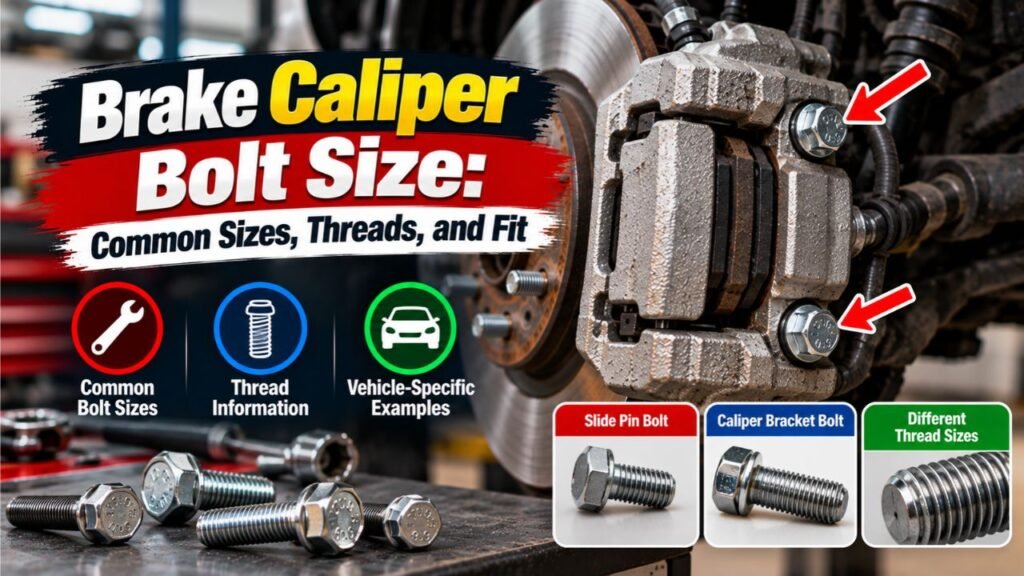
There is no single brake caliper bolt size that fits every vehicle. Caliper slide-pin bolts commonly use smaller metric fasteners, while caliper bracket bolts are usually larger and stronger.
Typical sizes encountered on passenger vehicles and light trucks include:
| Brake Fastener | Common Socket Sizes | Common Thread Range |
| Caliper slide-pin bolt | 10–14 mm, sometimes larger | Often M8–M10 |
| Caliper mounting bolt | 12–18 mm | Often M8–M12 |
| Caliper bracket bolt | 17–21 mm or larger | Often M12–M14 or larger |
| Older SAE applications | Varies | Inch-based threads possible |
These are only general examples. A specific vehicle may use completely different hardware.
The safest approach is to identify the exact bolt by vehicle application or carefully measure the original fastener.
Caliper Bolt Size vs. Socket Size
One of the biggest sources of confusion is the meaning of “bolt size.”
People often use the term to describe the socket they need, but a bolt actually has several different measurements.
A brake caliper bolt may have:
- Head size
- Thread diameter
- Thread pitch
- Bolt length
- Shoulder diameter
- Strength grade
For example, a caliper bolt might require a 14 mm socket but have an M10 thread diameter.
If you are only removing the bolt, the socket or wrench size is usually what matters.
If you are replacing the bolt, all of the measurements matter.
What Size Socket Do You Need for Brake Caliper Bolts?
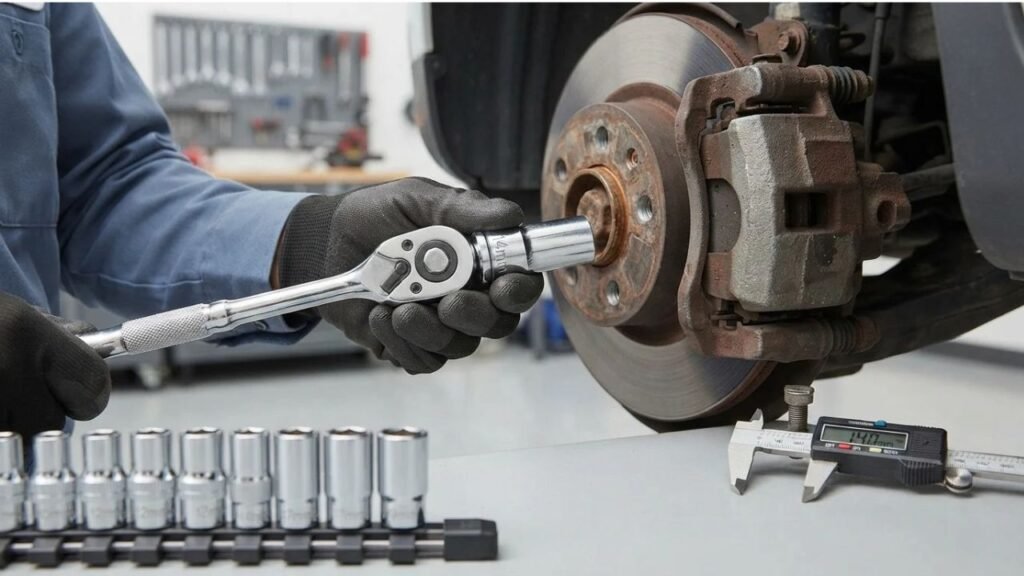
Many brake caliper fasteners can be removed with metric sockets ranging from about 10 mm to 21 mm, depending on their location and vehicle.
Common socket sizes include:
- 10 mm
- 12 mm
- 13 mm
- 14 mm
- 15 mm
- 17 mm
- 18 mm
- 19 mm
- 21 mm
Heavy-duty trucks and certain brake packages may use larger sizes.
Smaller sockets are more commonly encountered on slide-pin bolts, while larger sockets are generally used on the caliper mounting bracket.
Some European vehicles may use internal hex, Torx, or other specialty fastener designs instead of a conventional external hex-head bolt.
Older American vehicles may also use SAE fasteners.
Do not force a slightly incorrect socket onto the bolt. Brake fasteners are often tight, and using the wrong size can round the bolt head.
Caliper Slide-Pin Bolt Size
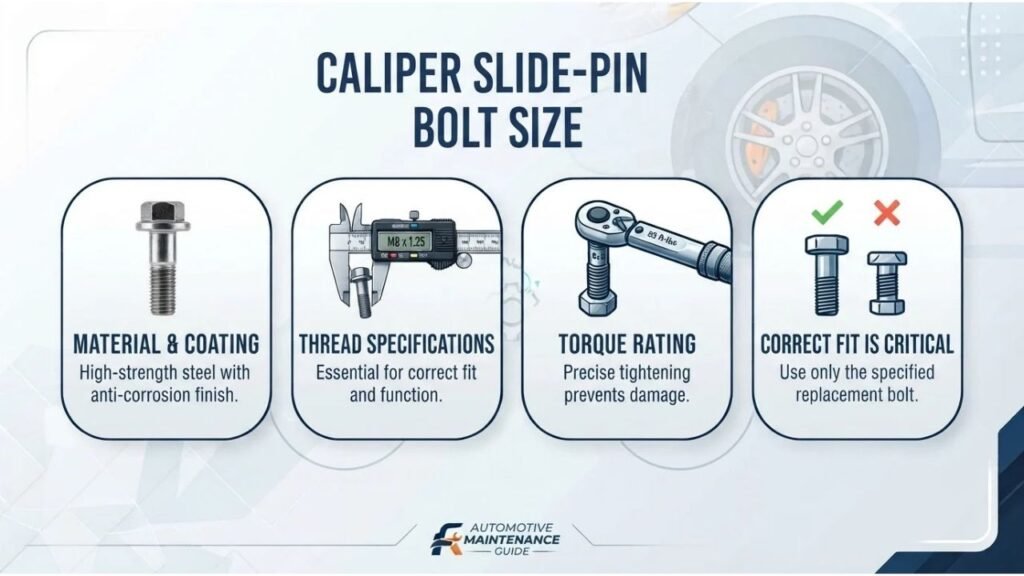
A floating brake caliper normally moves on one or more guide pins, also called slide pins.
The bolts that secure the caliper to these pins are typically smaller than the bolts holding the bracket to the steering knuckle.
Common slide-pin hardware may use:
- M8 threads
- M10 threads
- Approximately 10–14 mm bolt heads in many passenger-car applications
Larger trucks may use larger bolt heads even when the underlying thread diameter remains relatively modest.
These are common examples rather than universal specifications.
Some guide-pin bolts pass through a smooth section before engaging threads. Others screw directly into the guide pin.
That design must be duplicated when replacing the bolt.
Brake Caliper Bracket Bolt Size
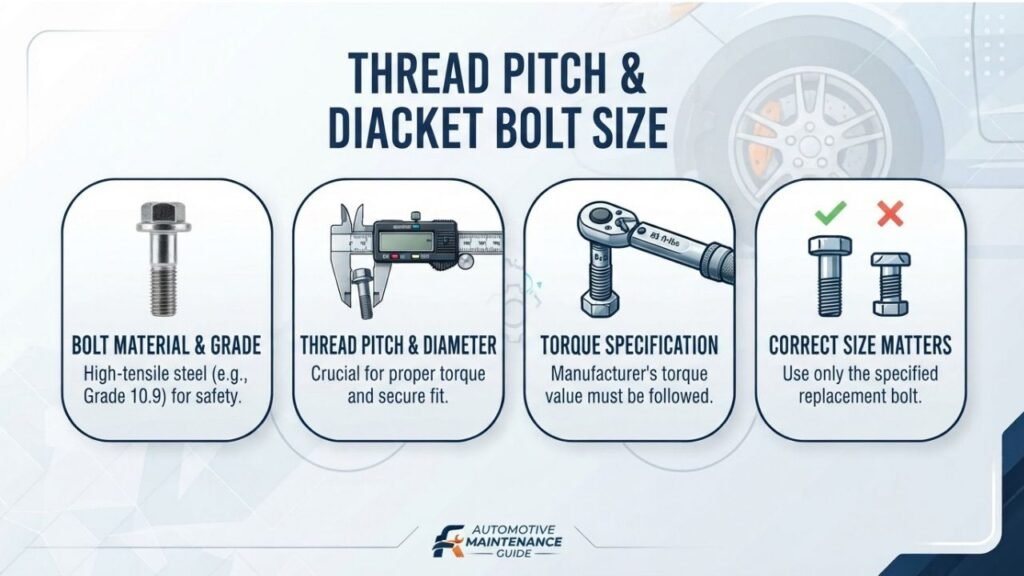
The caliper bracket, sometimes called the caliper carrier, supports the caliper and brake pads.
Bracket bolts connect this assembly to the steering knuckle or axle hardware and generally experience substantial braking forces.
They are usually:
- Larger than slide-pin bolts
- Higher-strength fasteners
- Tightened to a much higher torque
- Sometimes installed with thread-locking compound
Common bracket bolt socket sizes may include:
- 17 mm
- 18 mm
- 19 mm
- 21 mm
- 24 mm on some larger applications
Thread sizes around M12 or M14 are common on many vehicles, although larger or smaller hardware is possible.
Never replace a caliper bracket bolt with a generic hardware-store bolt based only on diameter.
The replacement needs the correct strength rating, thread pitch, length, shoulder design, and dimensions for the brake system.
Ford F-150 Brake Caliper Bolt Size
The Ford F-150 brake caliper bolt size depends heavily on the model year, axle, and brake package. There is not one socket or thread size that applies to every F-150.
For example, service information for a 2015 F-150 shows an 18 mm socket for the front caliper slide-pin bolts and a 21 mm socket for the front caliper bracket bolts.
Newer F-150 models can use different hardware. On the 2021 F-150, published fastener data shows 13 mm-head caliper/slide-pin hardware on several applications, while 21 mm bracket hardware is also used on certain front and rear brake configurations. Some brake packages may use still larger bracket fasteners.
A general reference is:
| Ford F-150 Application | Commonly Encountered Tool Size |
| 2015 front caliper/slide bolt | 18 mm |
| 2015 front caliper bracket bolt | 21 mm |
| 2021-era slide-pin/caliper hardware | Around 13 mm on many applications |
| 2021-era bracket hardware | 21 mm or larger depending on brake package |
These numbers should not be treated as universal specifications for every F-150.
An F-150 may have different brake hardware depending on:
- Model year
- 2WD or 4WD
- Front or rear axle
- Rotor and brake package
- Trim and payload configuration
- Production date
If you are replacing rather than simply removing the bolt, identify the thread diameter, pitch, length, grade, and Ford part specification using the VIN whenever possible.
What Size Socket Is Needed for Ford F-150 Caliper Bolts?
For many F-150 brake jobs, expect sockets somewhere around 13–18 mm for caliper or slide-pin hardware and around 21 mm or larger for bracket bolts.
For example, the 2015 F-150 commonly uses 18 mm and 21 mm tools in the front brake assembly, while newer configurations may use smaller 13 mm slide-pin bolt heads.
Check the exact year before beginning the repair rather than buying one socket based only on the F-150 name.
Ford F-250 Brake Caliper Bolt Size
The Ford F-250 brake caliper bolt size also varies by model year and configuration, especially because F-250 Super Duty trucks may have different front axles, single or dual rear wheels, and different brake assemblies.
For a 2020 Ford F-250 Super Duty, published service-spec data lists 13 mm heads on the front caliper slide-pin bolts, with an M10 × 1.5 thread on those guide-pin fasteners.
Larger bracket hardware can use 18 mm or 21 mm tool sizes, depending on the exact bolt and brake configuration. The same 2020 data includes M14 bracket hardware, while parts listings for the 2011 F-250 Super Duty show replacement caliper bracket bolts with 21 mm heads.
A useful general reference is:
| Ford F-250 Super Duty Application | Commonly Encountered Size |
| Front caliper slide-pin bolt on some newer models | 13 mm |
| Typical slide-pin thread on some 2020 applications | M10 × 1.5 |
| Caliper bracket hardware | 18–21 mm commonly encountered |
| Bracket thread on some newer applications | M14, with pitch varying by location |
Do not assume that every F-250 uses these exact specifications.
F-250 brake hardware can vary according to:
- Model year
- F-250 vs. other Super Duty variants
- 2WD or 4WD
- Front or rear brakes
- Single rear wheel or dual rear wheel
- Axle and brake package
- Production date
Heavy-duty brake bracket bolts may also have very high torque specifications, making correct socket fit especially important.
Use a six-point socket whenever possible and verify the bolt specification before applying a long breaker bar.
Is the Ford F-250 Caliper Bolt the Same as the F-150?
Not necessarily.
Even if an F-150 and F-250 use a bolt head that accepts the same socket, the actual fasteners may have different:
- Thread diameters
- Thread pitches
- Lengths
- Shoulders
- Strength grades
- Torque specifications
Never interchange F-150 and F-250 brake hardware simply because the bolt appears to fit.
Honda Civic Brake Caliper Bolt Size
The Honda Civic brake caliper bolt size is generally smaller than the hardware used on full-size Ford trucks, but the exact size still depends on the Civic generation and whether you are working on the front or rear brakes.
A very common Honda Civic combination is approximately:
- 12–13 mm for caliper slide-pin bolts
- 17 mm for caliper bracket bolts
For example, published specifications for the 2012 Civic list a 12 mm driver on an M8 × 1.25 guide-pin bolt and a 17 mm driver for the front caliper bracket hardware.
On the 2021 Honda Civic, front caliper pin hardware is listed with a 13 mm driver and M8 × 1.25 thread, while the front caliper bracket uses a 17 mm driver and M12-class hardware.
Older Civic repair guides also commonly reference 12 mm caliper hardware and 17 mm bracket bolts.
A general Civic reference is:
| Honda Civic Brake Fastener | Common Size |
| Caliper slide-pin bolt | 12–13 mm |
| Common guide-pin thread | M8 × 1.25 on many models |
| Caliper bracket bolt | 17 mm on many generations |
| Brake-line/bracket hardware | Often smaller and application-specific |
Do not assume the rear brakes use exactly the same hardware as the front brakes.
Depending on the generation, the Civic may have different rear caliper, parking-brake, or electronic parking-brake hardware.
What Size Socket Removes a Honda Civic Brake Caliper?
For many Honda Civics, having 12 mm, 13 mm, and 17 mm sockets or wrenches available will cover the main caliper and bracket fasteners.
However, this should be treated as a starting point rather than a universal rule.
Always check the exact Civic year, trim, front/rear position, and brake configuration before buying replacement bolts.
Ford F-150 vs. F-250 vs. Honda Civic Caliper Bolt Sizes
These examples show why searching only for “brake caliper bolt size” without identifying the vehicle can produce conflicting answers.
| Vehicle | Caliper/Slide-Pin Tool Size Often Seen | Bracket Tool Size Often Seen |
| Ford F-150 | About 13–18 mm depending on year | About 21 mm or larger |
| Ford F-250 Super Duty | About 13 mm on many newer slide pins | About 18–21 mm depending on configuration |
| Honda Civic | About 12–13 mm | About 17 mm |
These are common socket or wrench sizes, not guaranteed replacement-bolt specifications.
Before purchasing a new bolt, verify the actual thread diameter, pitch, length, shoulder, and strength grade.
Front vs. Rear Brake Caliper Bolt Sizes
The front and rear brakes on the same vehicle may use completely different bolt sizes.
Front brakes normally handle a larger share of the braking force, so front calipers and brackets may be larger.
Rear brake assemblies may use:
- Smaller calipers
- Different guide pins
- Integrated parking-brake mechanisms
- Electronic parking-brake motors
- Different mounting bolts
Do not assume a front caliper bolt will fit the rear or vice versa.
Even the left and right sides may use different guide-pin designs in some brake systems, although the main mounting hardware is commonly symmetrical.
Metric vs. SAE Brake Caliper Bolts
Most newer vehicles use metric brake fasteners, especially for caliper and bracket hardware.
Metric bolts are identified by measurements such as:
- M8
- M10
- M12
- M14
The “M” indicates a metric thread, and the number indicates the approximate nominal thread diameter in millimeters.
For example:
M10 × 1.5
means:
- 10 mm nominal thread diameter
- 1.5 mm distance between thread peaks
Older vehicles, particularly some American designs, may use SAE or inch-based fasteners.
Examples include thread sizes such as 3/8 inch or 7/16 inch with a specified number of threads per inch.
Never substitute metric and SAE fasteners just because they appear close in diameter.
How to Measure a Brake Caliper Bolt
If you still have the original bolt, measuring it is one of the most reliable ways to identify a replacement.
You need to determine several specifications.
Measure the Thread Diameter
Use a caliper to measure across the outside of the threads.
Typical metric diameters may measure close to:
- 8 mm for M8
- 10 mm for M10
- 12 mm for M12
- 14 mm for M14
Wear and manufacturing tolerances can make the measured diameter slightly smaller than the nominal size.
Determine the Thread Pitch
Thread pitch is the distance from one thread peak to the next on a metric bolt.
A thread-pitch gauge is the easiest tool to use.
Common metric pitches include:
- 1.0 mm
- 1.25 mm
- 1.5 mm
- 1.75 mm
- 2.0 mm
Do not assume two M12 bolts have the same pitch.
An M12 × 1.25 bolt will not correctly fit a hole designed for M12 × 1.75.
Measure Bolt Length
Bolt length is normally measured from underneath the bolt head to the end of the threaded portion.
Some caliper bolts have:
- Long smooth shoulders
- Partially threaded shafts
- Flanged heads
- Specialized tips
All of these features can affect proper fit.
Identify the Bolt Head
Measure the hex head with a socket or caliper.
Remember that the bolt-head measurement alone does not identify the thread.
Two bolts with the same thread diameter may use different head sizes.
Why Thread Pitch Is So Important
Using the wrong thread pitch can damage the caliper bracket or steering knuckle.
A bolt may appear to begin threading normally but then become increasingly difficult to turn.
Do not force it.
Cross-threading or installing the wrong pitch can damage expensive brake components.
A correct bolt should begin threading smoothly by hand for several turns before you apply significant torque.
If it binds immediately, stop and verify the thread specification.
Why Brake Caliper Bolt Grade Matters
Brake caliper bolts are structural safety fasteners.
They experience repeated loads every time the vehicle brakes.
Metric high-strength bolts may carry markings such as:
- 8.8
- 10.9
- 12.9
SAE bolts use different grade markings.
The correct grade depends on the vehicle’s original specification.
Installing a low-strength generic bolt can create a serious failure risk even when the diameter and thread pitch appear correct.
Use OEM hardware or a replacement specifically listed for your vehicle whenever possible.
Can You Buy Brake Caliper Bolts Separately?
Yes.
Replacement caliper hardware may be available as:
- Individual caliper bolts
- Guide-pin bolt kits
- Caliper slide-pin kits
- Caliper bracket bolt kits
- Complete caliper hardware kits
When ordering parts, provide:
- Vehicle year
- Make
- Model
- Engine when relevant
- Front or rear axle
- Brake package if applicable
For trucks such as the F-150 and F-250, drivetrain, axle, payload, and brake package information can also be important.
Some vehicle models were produced with multiple brake systems during the same model year.
Using the VIN or measuring the brake rotor can sometimes be necessary to identify the correct brake package.
Can You Reuse Brake Caliper Bolts?
Often yes, but not always.
Many conventional caliper bolts can be reused if they are:
- Undamaged
- Not stretched
- Not heavily corroded
- Not stripped
- Still within manufacturer specifications
However, some vehicles use torque-to-yield, pre-coated, or otherwise single-use fasteners.
The manufacturer may require replacement whenever those bolts are removed.
Always check the service information for the specific vehicle.
Should You Use Thread Locker on Caliper Bolts?
It depends on the vehicle.
Some manufacturers specify thread-locking compound on caliper bracket bolts or supply replacement bolts with locking compound already applied.
Other applications specify clean, dry threads.
Using thread locker when it is not required can affect torque readings and make future removal more difficult.
Likewise, omitting thread locker when the manufacturer requires it can allow fasteners to loosen.
Follow the vehicle-specific service procedure rather than applying thread locker automatically.
Brake Caliper Bolt Torque Matters as Much as Size
Correct bolt size is only part of the job.
Caliper bolts must also be tightened to the manufacturer’s specified torque.
Torque specifications vary dramatically between:
- Slide-pin bolts
- Caliper mounting bolts
- Bracket bolts
- Front brakes
- Rear brakes
- Different vehicles
- Different brake packages
A small slide-pin bolt may require much less torque than a large bracket bolt.
Do not use a generic torque number from another vehicle.
Overtightening can:
- Strip threads
- Stretch the bolt
- Damage guide pins
- Break hardware
Undertightening can allow the brake assembly to loosen.
Use a properly calibrated torque wrench and the specification for your exact vehicle.
How to Identify the Correct Bolt Without the Original
If the original bolt is missing, do not simply test random bolts until one fits.
Better options include:
- Check the vehicle service manual.
- Look up the OEM fastener by VIN.
- Ask a dealership parts department.
- Use a vehicle-specific aftermarket parts catalog.
- Compare with the same bolt from the opposite side only if the brake design is identical.
- Have a qualified repair shop identify the hardware.
Brake mounting hardware is not a good place for trial-and-error fitting.
What If the Caliper Bolt Is Stripped?
A stripped bolt can refer to either:
- A rounded bolt head
- Damaged bolt threads
- Damaged threads in the mounting hole
A rounded head may require an extractor socket.
Damaged threads can be more serious.
If the threaded hole in the caliper bracket or steering knuckle is damaged, simply installing a larger bolt is not an acceptable repair.
The component may need:
- Proper thread repair
- Replacement
- Inspection by a qualified technician
Because brake mounting hardware is safety-critical, repaired threads must be capable of handling the specified clamping force.
What If the Caliper Bolt Is Stuck?
Brake bolts are exposed to road salt, water, heat cycles, and corrosion.
A stuck bolt may require:
- Penetrating oil
- Correct six-point socket
- Breaker bar
- Controlled heat where appropriate
- Rust removal
Be cautious around rubber brake hoses, ABS wiring, dust boots, brake fluid, and other heat-sensitive components.
If the bolt begins rounding, stop before the damage becomes worse.
Caliper Bolt vs. Banjo Bolt
A banjo bolt is different from a caliper mounting bolt.
The banjo bolt connects the flexible brake hose to the caliper and allows brake fluid to flow through its hollow center.
It normally uses sealing washers on both sides of the hose fitting.
Do not confuse:
- Caliper slide-pin bolt
- Caliper bracket bolt
- Brake-hose banjo bolt
They have different purposes, dimensions, and torque specifications.
A banjo bolt must also have the correct internal fluid passage and thread.
Caliper Bolt vs. Bleeder Screw
The bleeder screw is another threaded component on the caliper, but it is not a mounting bolt.
Its purpose is to let air and brake fluid escape during brake bleeding.
Bleeder screws are much smaller than most mounting bolts and have a tapered sealing surface.
Never substitute an ordinary bolt for a bleeder screw.
Common Mistakes When Choosing Brake Caliper Bolts
Matching Only the Socket Size
A 17 mm bolt head does not tell you the thread diameter or pitch.
Measure or look up the actual fastener specification.
Ignoring Thread Pitch
Bolts with the same diameter can have different thread pitches.
Forcing the wrong pitch can destroy the threads.
Using a Low-Grade Hardware-Store Bolt
Brake mounting hardware needs the correct strength rating.
Use vehicle-specific or equivalent high-quality replacement hardware.
Guessing the Bolt Length
A bolt that is too short may not provide enough thread engagement.
A bolt that is too long may bottom out or interfere with moving components.
Guessing the Torque
Brake fastener torque is vehicle-specific.
Always obtain the correct specification.
When Professional Help Is Appropriate
Replacing a missing caliper bolt may sound simple, but the braking system is safety-critical.
Professional inspection is a good idea if:
- The mounting threads are stripped.
- The bolt broke inside the bracket or knuckle.
- You cannot identify the correct fastener.
- The caliper or bracket is damaged.
- A replacement bolt repeatedly loosens.
- You do not have the correct torque specification.
- The vehicle pulls or makes noise after brake work.
Do not drive the vehicle if a caliper mounting bolt is missing, broken, or loose.
FAQs About Brake Caliper Bolt Size
What size are most brake caliper bolts?
There is no universal size. Many passenger-vehicle slide-pin bolts use roughly M8–M10 threads, while bracket bolts commonly fall around M12–M14.
Actual sizes vary by vehicle, so always verify the specification.
What size socket removes a brake caliper?
Common caliper socket sizes include approximately 10–14 mm for smaller slide bolts and 17–21 mm for larger bracket bolts.
Larger trucks may use 18 mm, 21 mm, 24 mm, or other sizes depending on the brake system.
What is the Ford F-150 brake caliper bolt size?
It depends on the year and brake package. As one example, a 2015 Ford F-150 commonly uses an 18 mm socket for front caliper slide-pin bolts and a 21 mm socket for front bracket bolts. Newer F-150 configurations may use approximately 13 mm slide-pin hardware and 21 mm or larger bracket hardware.
Always verify your exact model year before replacing a bolt.
What is the Ford F-250 brake caliper bolt size?
On some newer F-250 Super Duty applications, including published 2020 specifications, the front caliper slide-pin bolts use a 13 mm driver with M10 × 1.5 threads. Bracket hardware commonly requires approximately 18–21 mm sockets, depending on the position and configuration.
F-250 hardware varies substantially between model years, axles, and SRW/DRW configurations.
What is the Honda Civic brake caliper bolt size?
Many Honda Civic generations use approximately 12–13 mm slide-pin bolts and 17 mm caliper bracket bolts.
For example, the 2012 Civic uses a 12 mm driver on an M8 × 1.25 guide-pin fastener, while the 2021 Civic uses 13 mm front caliper-pin hardware and a 17 mm front bracket bolt.
Check the model year and whether you are working on the front or rear brakes.
Are brake caliper bolts metric?
Most modern vehicles use metric caliper hardware.
Older vehicles may use SAE fasteners, so check before selecting a socket or replacement bolt.
Are caliper bracket bolts bigger than slide-pin bolts?
Usually, yes.
Caliper bracket bolts carry substantial braking loads and are generally larger and tightened more tightly than slide-pin bolts.
Can I replace a caliper bolt with a regular bolt?
Not unless the replacement exactly meets the required dimensions, thread specification, strength grade, and design.
Using OEM or vehicle-specific brake hardware is the safer choice.
Do caliper bolts need thread locker?
Some do and some do not.
Follow the manufacturer’s service information because thread-locking requirements vary between vehicles and bolt locations.
How do I know the thread pitch of a caliper bolt?
Use a thread-pitch gauge, compare it with a known bolt, or look up the OEM specification.
Do not force an unknown bolt into the mounting hole.
Can I drive with a missing brake caliper bolt?
No.
A missing or loose caliper mounting bolt can allow the caliper to move abnormally and potentially compromise braking.
Repair the brake assembly correctly before driving.
Conclusion
The correct brake caliper bolt size depends on the exact vehicle and on whether you are dealing with a slide-pin bolt, bracket bolt, banjo bolt, or another brake-system fastener.
Many vehicles use smaller M8–M10 hardware for guide pins and larger M12–M14 hardware for brackets, but those ranges should never replace vehicle-specific specifications.
Vehicle examples also show how much the hardware can vary. A Ford F-150 brake caliper bolt size may involve 13–18 mm slide-pin hardware and approximately 21 mm or larger bracket hardware depending on the year. A Ford F-250 brake caliper bolt size may include 13 mm slide-pin bolts and larger 18–21 mm bracket fasteners. A Honda Civic brake caliper bolt size commonly involves 12–13 mm slide-pin hardware and 17 mm bracket bolts on many generations.
If you are replacing a caliper bolt, match the thread diameter, pitch, length, shoulder design, strength grade, and head style—not just the socket size. Then tighten the fastener to the manufacturer’s specified torque.
Because caliper bolts secure a critical part of the braking system, guessing or substituting an incorrect bolt is not worth the risk. Use OEM specifications or a confirmed vehicle-specific replacement whenever possible.