Do Parking Brakes Lock All Wheels? Rear Brakes and Exceptions
No. Most passenger-car parking brakes act on the two rear wheels, not all four. This is true of many traditional handbrakes, foot-operated parking brakes, and electronic parking brakes. The regular brake pedal, by comparison, normally applies braking force at all four wheels.
The answer can be confusing because a parked car often seems completely locked in place. An automatic transmission in Park, a manual transmission left in gear, and an engaged parking brake can all resist movement, but they work through different parts of the vehicle. All-wheel drive does not automatically turn a rear-wheel parking brake into a four-wheel brake.
There are also important exceptions. Certain older or specialized designs act on front wheels or a driveline component. Some electronic parking brakes can command all four regular brakes if activated while the vehicle is moving, even though they hold only the rear wheels after stopping.
Understanding these differences helps you park safely, avoid dangerous moving-vehicle tests, and recognize when a parking brake is not holding as it should.
Do Parking Brakes Lock All Wheels? The Usual Rear-Wheel Setup
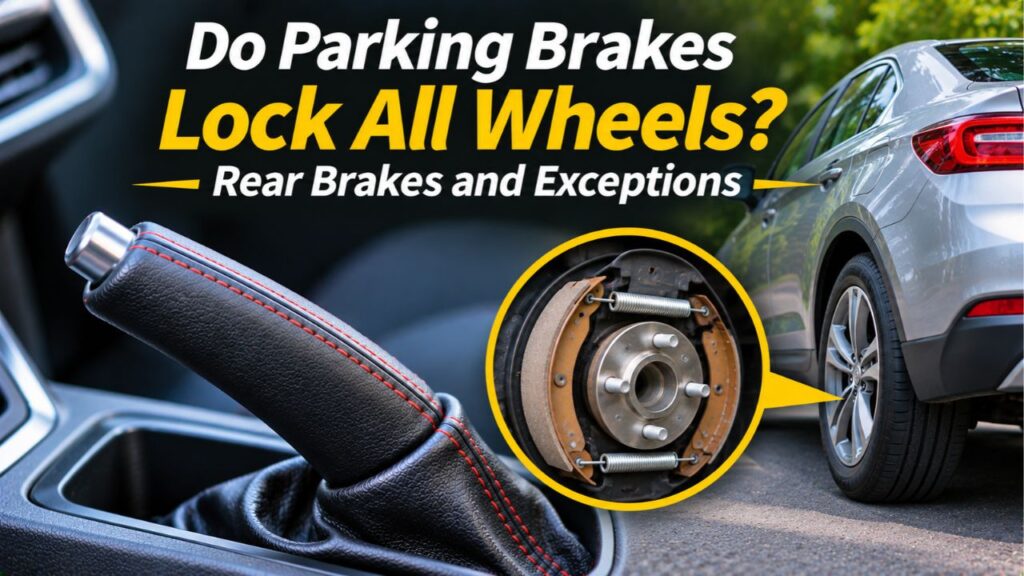
In most ordinary cars, applying the parking brake holds the left and right rear brakes. The front wheels are not separately clamped by that parking-brake mechanism. This does not mean the front wheels can freely pull the parked vehicle away: the rear tires resist movement, and the transmission may provide additional restraint.
A vehicle’s wheels do not need separate parking-brake actuators at every corner to remain stationary on a normal slope. The rear brakes provide holding force through friction between the brake pads or shoes and the rotating parts attached to the wheels.
Locking the rear wheels while parked is different from locking the rear tires during a skid. When stationary, the goal is to stop wheel rotation. When moving, sudden rear-wheel lockup is dangerous because it can reduce directional control.
How Mechanical Parking Brakes Hold the Rear Wheels
Hand Levers and Foot Pedals Pull Cables
A conventional parking brake uses a lever or pedal connected to one or more cables. Pulling the lever tensions the cables, and a splitter or equalizer distributes force to the rear brakes. The brake may expand small shoes against a drum or move a mechanism within a rear disc-brake caliper.
Ford Australia’s explanation of how a handbrake cable works describes the cable and equalizer arrangement that divides force between the two rear brakes. The handbrake can therefore operate independently of the normal hydraulic service-brake circuit.
Some rear disc setups have a small parking-brake drum inside the center of the rotor, often called a drum-in-hat design. Others use the rear caliper itself. Either way, the front service brakes typically do not receive force from the parking-brake cable.
Electric Motors Replace the Handbrake Cable on Many Cars
An electronic parking brake (EPB) replaces the hand lever with a switch and motorized actuation. On a common design, an electric motor at each rear caliper turns a mechanism that clamps the pads. Some systems use one central motor that tensions cables instead.
The switch may feel different, but the stationary holding function is often the same: the rear brakes keep the vehicle from rolling. Once applied, most EPBs maintain their clamping force mechanically rather than running a motor continuously.
Why Most Parking Brakes Work on the Rear Wheels
Using only one axle makes the parking system simpler than duplicating the regular four-wheel brake controls. A mechanical rear-wheel design can include its own cable, lever, and holding mechanism without requiring the normal hydraulic circuit to remain pressurized while the car is parked.
Rear brakes also offer a practical location for parking-brake hardware. Conventional designs can share rear friction components or house separate shoes inside rear disc rotors. The system needs enough holding force for the vehicle’s intended parking conditions, not the same stopping performance as the foot brake.
There is a tradeoff: a parking brake intended to secure a stopped vehicle should not be treated as a normal way to stop a moving car. If rear wheels lock abruptly while the vehicle is moving, the car may skid or rotate. The regular brakes are designed to distribute braking force among the wheels and work with ABS where fitted.
Does an AWD or 4WD Vehicle Lock All Four Wheels When Parked?
Not necessarily. All-wheel drive describes how driving torque reaches the wheels, not which brake mechanisms the parking brake applies. A front-wheel-drive sedan, rear-wheel-drive pickup, and AWD crossover may all have parking brakes that act on only the rear wheels.
An engaged transmission Park mechanism or a coupled four-wheel-drive driveline can sometimes resist rotation through additional axles. That indirect effect is not the same as a parking-brake caliper or shoe clamping every wheel individually.
Differentials and transfer cases also complicate what happens when a wheel is lifted or loses traction. Do not infer the parking-brake layout by trying to turn a raised tire, and never rely on the brake alone to hold a vehicle on a jack or lift. Use manufacturer-approved support points, suitable stands, and wheel chocks.
If a car seems firmly held in Park with its parking brake disengaged, that demonstrates the transmission’s holding mechanism, not the parking brake’s wheel coverage.
Can an Electronic Parking Brake Apply All Four Wheels?
Yes, on some vehicles during an emergency braking command while the vehicle is moving. That is an important exception to the usual two-rear-wheel answer, but it does not mean all four parking-brake actuators lock the wheels while the car is parked.
For example, Volvo’s XC90 parking brake instructions state that the parking brake uses the rear wheels when stationary. When the driver applies it while moving, that model uses the regular brakes on all four wheels, then transitions back to rear-wheel operation at very low speed.
The vehicle’s electronic stability and brake controls can manage that moving-vehicle function rather than allowing an uncontrolled rear-wheel lockup. However, different makes and model years behave differently. Some use separate logic or may not offer the same emergency braking feature.
Never pull an EPB switch while driving just to find out which wheels brake. Follow the owner’s manual and reserve any moving-vehicle emergency function for an actual brake failure.
Can a Parking Brake Hold Front Wheels or the Driveshaft?
Yes, although these are exceptions rather than the standard modern passenger-car layout.
Front-Wheel Parking Brakes
Some older vehicles used parking-brake mechanisms at the front wheels. That means the common statement that a parking brake always operates the rear wheels is too absolute. The correct answer depends on the exact car and brake design.
For most current passenger vehicles, though, rear-wheel parking brakes remain the normal arrangement. If your vehicle has unusual calipers or an older mechanical design, consult its service manual before assuming the rear wheels are the ones held.
Transmission- or Driveshaft-Mounted Parking Brakes
Certain trucks, older utility vehicles, and specialized equipment have a parking brake mounted to a transmission output or driveshaft. Instead of applying a pad or shoe directly at each wheel, the system restrains part of the driveline.
This can keep a vehicle parked, but the relationship between the driveline and individual wheels depends on its axles and differentials. It is particularly unsafe to assume such a brake will secure a vehicle when a driven wheel is lifted off the ground.
Heavy Trucks With Multiple Parking Brake Chambers
Large trucks with air brakes can use spring-operated parking brake chambers on multiple drive-axle wheels. Trailers may have their own spring parking brakes. Such systems can hold more than two wheels, depending on their axle configuration and brake design.
However, this does not automatically mean every wheel is held. Front steering axles are not necessarily equipped with parking brake chambers. Commercial vehicle parking brake configurations must be identified using their specific service and inspection requirements.
Parking Brake vs. Foot Brake vs. Transmission Park
These three controls can all keep a vehicle from moving, but they do not lock the same components.
| System | What It Acts On | Main Purpose |
| Regular foot brake | Usually all four wheel brakes | Slowing and stopping while driving |
| Conventional parking brake | Usually both rear brakes | Holding the stationary vehicle |
| Electronic parking brake | Usually rear brakes when parked; some use four-wheel service braking in emergencies | Parking, with model-dependent emergency capability |
| Automatic transmission Park | Parking pawl or designated driveline lock | Preventing drivetrain output rotation |
| Manual transmission left in gear | Drivetrain resistance through engine and transmission | Additional parking restraint |
The transmission’s Park mechanism does not press pads against four brake rotors. It locks part of the drivetrain. A car may therefore resist rolling with Park selected even when its parking brake is weak or completely disengaged.
Similarly, Auto Hold is not automatically the same as a parking brake. On some vehicles, it temporarily keeps service-brake pressure applied at a traffic light and may later transfer holding responsibility to the EPB. Check the exact vehicle’s behavior.
How to Find Out Which Wheels Your Parking Brake Holds
Step 01: Check the Owner’s Manual for the Brake Design
Look for the parking brake or rear brake section, especially descriptions of cable operation, rear caliper motors, and drum-in-hat parking shoes. Manufacturers may specify which axle is affected and whether a moving-vehicle emergency function is available.
Step 02: Identify the Control Without Disassembling the Brakes
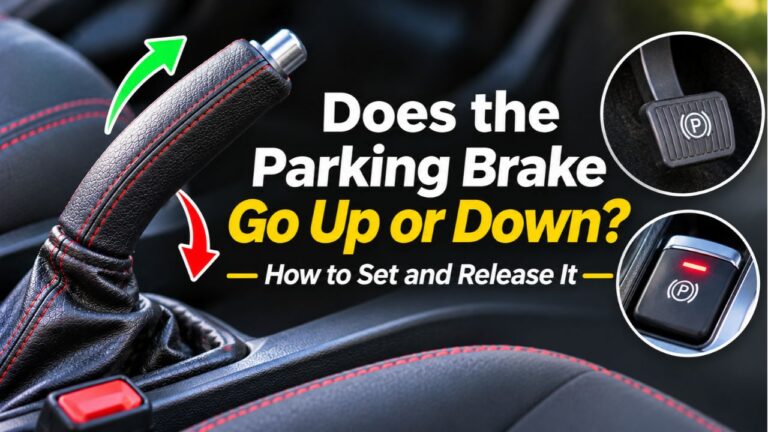
A hand lever or foot pedal suggests a mechanical cable system; an EPB switch suggests electric actuation. Neither control, by itself, proves which wheels are affected. The rear brake mechanism or a service diagram provides stronger evidence.
Step 03: Do Not Test by Locking Wheels in Motion
Avoid pulling the handbrake at speed or attempting to slide the vehicle to see which tires stop rotating. Likewise, don’t jack up one wheel and spin it to infer how the parking brake works. Drivetrain differentials and unsafe support can make that experiment misleading and hazardous.
If the brake does not hold, have a shop inspect it using vehicle-approved procedures and, where appropriate, a brake tester.
How to Park Safely When Only Two Wheels Are Held
A rear-wheel parking brake is designed to keep the whole vehicle stationary, but it should not be the only precaution on a hill. Hold the service brake until the vehicle is secured. Apply the parking brake, then use Park on an automatic or the manufacturer’s recommended gear on a manual transmission.
Turn the front wheels toward the curb when parked downhill. When parked uphill beside a curb, turn the front wheels away from the curb. Without a curb, angle the wheels toward the road shoulder as appropriate for your parking position. On steep or unusual surfaces, wheel chocks can add security.
The Pennsylvania Driver’s Manual parking guidance advises using the parking brake along with Park or an appropriate manual gear and positioning the wheels on slopes. This is sensible precisely because no single holding mechanism should be treated as infallible.
What if Only One Rear Wheel Seems to Hold?
A parking brake designed to act on two rear wheels may apply unevenly if one cable seizes, a caliper mechanism sticks, or shoes are worn or out of adjustment. The dashboard indicator can show that the control has been applied without proving equal holding force at both wheels.
Clues include poor holding ability, unusually long lever travel, dragging after release, or a persistent EPB warning. Do not test by accelerating against the brake or attempting a skid. Arrange inspection, and avoid relying on a questionable brake to secure the car on a hill.
FAQs About Do Parking Brakes Lock All Wheels
Does the Handbrake Lock the Front or Rear Wheels?
On most passenger cars, a mechanical handbrake operates the two rear brakes. Some older or specialized vehicles differ, so the owner’s manual is the best way to confirm your particular setup.
Does an Electronic Parking Brake Lock All Four Tires?
Usually not while parked. Most electronic systems mechanically hold the rear wheels. Certain vehicles can command the regular brakes at all four wheels during emergency operation while moving.
Do AWD Cars Have Four-Wheel Parking Brakes?
Not automatically. AWD describes the drivetrain, not the parking-brake layout. Many AWD vehicles use the same rear-wheel parking-brake arrangement as two-wheel-drive vehicles.
Does Putting an Automatic Car in Park Lock Every Wheel?
No. Park locks a transmission or driveline component rather than engaging a separate brake at every tire. It can prevent vehicle movement, but it is distinct from the parking brake.
Can a Parking Brake Lock the Rear Wheels While Driving?
A mechanical parking brake can make rear wheels skid if applied too suddenly while moving. That is dangerous and should never be used as a routine stopping technique. Some electronic systems manage emergency braking differently.
Why Rear-Wheel Parking Brakes Are Normally Enough
So, do parking brakes lock all wheels? In most passenger cars they do not. The parking brake normally holds the two rear wheels, while the regular foot brake operates all four. AWD does not change that automatically, and electronic systems may have separate emergency braking behavior while the car is moving.
The practical takeaway is to use the parking brake whenever you park, even though it does not clamp every wheel. Combine it with Park or the recommended manual gear and position the front wheels correctly on slopes.
If the vehicle creeps with the brake applied or the mechanism does not release properly, have it inspected rather than trying a risky wheel-lock test. A healthy rear-wheel parking brake is designed to secure the entire parked vehicle.