Does Parking Brake Help Transmission? Reduce Stress When Parked
Yes, using the parking brake helps protect an automatic transmission by reducing the load placed on its parking pawl when the vehicle is parked. It also provides a separate way to keep the car from rolling. The benefit is greatest on a slope, but applying the parking brake on level ground is a worthwhile habit too.
When an automatic car is shifted into Park, a mechanical locking device inside the transmission or driveline stops the output from rotating. If the driver releases the foot brake without setting the parking brake, the car may move slightly until that locking device takes the load. On a hill, the resulting pressure can sometimes make the shifter difficult to move out of Park.
This doesn’t mean the transmission is instantly damaged whenever the parking brake is skipped. Parking mechanisms are built to hold vehicles. The question is how to avoid unnecessary loading and secure the car more reliably. This article explains the parking pawl, the correct parking sequence, what changes for manual transmissions and electric parking brakes, and the symptoms that deserve attention.
Does Parking Brake Help Transmission by Reducing Parking Pawl Stress?
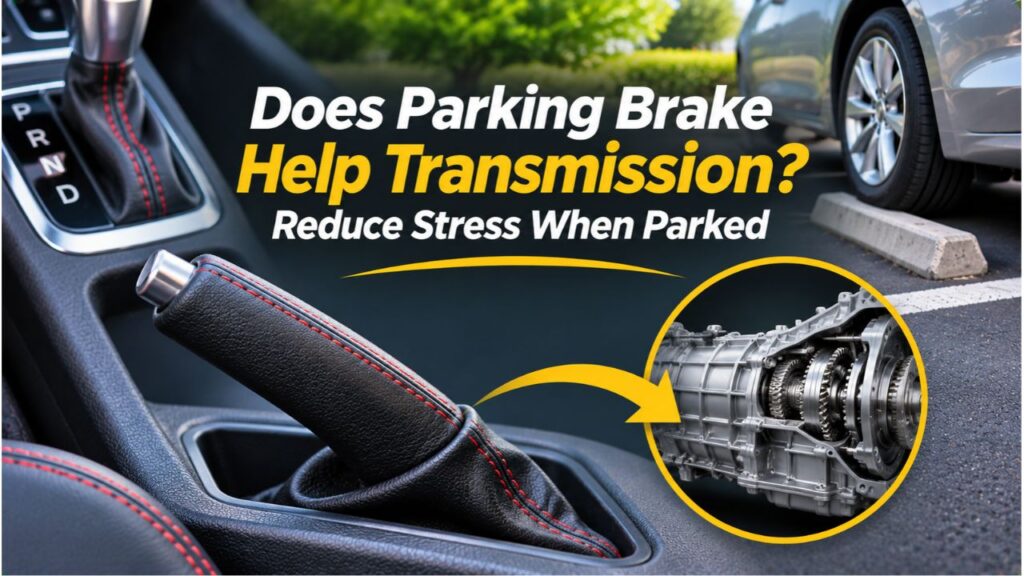
Yes. The parking brake holds the vehicle through its brake mechanism, so the transmission’s parking lock does not have to carry as much of the force trying to roll the car downhill. It reduces parking pawl load, not the friction or heat created during normal gear changes.
A parking pawl is a metal locking piece that engages a toothed parking gear when many automatic transmissions are placed in Park. It prevents the transmission output from rotating and keeps the driven wheels from turning through the normal driveline. It is a holding mechanism, not a service brake for slowing a moving car.
If the vehicle settles after the foot brake is released, movement through the tires and driveline may load the pawl against its gear. The steeper the slope, the greater the downhill force that has to be restrained. Setting the parking brake while the vehicle is still held by the service brake gives that force another path: through the wheel brakes to the road.
The 2022 Ram 2500/3500 owner’s manual guidance on Park specifically instructs drivers to apply the parking brake before shifting into Park on a hill, noting that load on the transmission’s locking mechanism can make it difficult to shift out later. The principle applies broadly to conventional automatic parking mechanisms, although each vehicle’s operating instructions take priority.
How the Parking Brake and Transmission Park Position Work Together
The two systems secure the same vehicle in different ways. Understanding the difference prevents a common mistake: treating the parking brake as unnecessary simply because the shifter has a P position.
The Transmission’s Parking Pawl Locks the Driveline
Selecting Park engages a lock inside a conventional automatic transmission or an associated drive unit. Once the parking gear is restrained, wheel movement is resisted through the connected driveline. There can still be slight movement as components take up their normal clearances.
The pawl is designed for this job. Ordinary parking does not automatically destroy it. However, repeatedly letting a car settle heavily onto the lock, particularly on hills, creates avoidable load and may contribute to difficult shifting or stress on related parts.
The Parking Brake Holds the Wheels Separately
Most passenger-vehicle parking brakes apply a mechanism at the rear wheels. A cable, separate brake shoes, or an electric caliper actuator holds friction surfaces in place after the driver releases the control. The parking brake usually does not change the transmission’s internal gears or lubricate them.
It helps the transmission indirectly: instead of depending primarily on the drivetrain lock to hold a stationary car, the driver engages a wheel-brake holding system as well. Park remains an important additional safeguard, not something to leave out.
| Feature | Parking Brake | Transmission Park Position |
| Main job | Holds the stopped vehicle at its brakes | Locks an output or parking gear in the driveline |
| Typical control | Hand lever, foot pedal, or EPB switch | P on the gear selector |
| Main load location | Brake mechanism and tires | Parking pawl and connected driveline |
| Normal use | Apply whenever parking | Select on an automatic when fully stopped |
| Works independently of the other? | Usually, subject to design | Usually, subject to design |
How to Use the Parking Brake to Protect an Automatic Transmission
The goal is to apply the holding brake before allowing the parked vehicle to rest against its transmission lock. The following sequence works for many conventional automatic cars. Follow the manufacturer’s instructions if your car automatically coordinates Park and an electric parking brake.
Step 01: Stop Completely With the Service Brake
Bring the car to a full stop using the regular brake pedal. Keep your right foot pressing it firmly, especially on a hill. Don’t select Park while the car is still rolling. A parking pawl is not intended to bring a moving vehicle to a stop, and attempting to use it that way can cause damage.
Step 02: Keep the Vehicle Held While You Set the Parking Brake
With the foot brake still applied, engage the parking brake fully. Pull the hand lever, operate the separate foot pedal, or use the electric switch according to the owner’s manual. Watch for the appropriate indicator and make sure the control has completed its action.
If the parking brake is known to be weak or malfunctioning, do not assume it will hold the car. Have it repaired and use approved parking precautions rather than experimenting on a steep slope.
Step 03: Shift the Automatic Transmission Into Park
While maintaining foot-brake pressure, select P. Ensure the selector and dashboard display show Park as required. With the parking brake already applied, the vehicle is less likely to settle heavily against the pawl when you let go of the regular brake.
Step 04: Release the Foot Brake Carefully and Confirm the Vehicle Stays Put
Ease your foot off the regular brake, staying seated and ready to reapply it. The car should remain stationary. A slight change in suspension position is possible, but obvious rolling means you must stop and investigate whether the parking brake has engaged.
Turn the vehicle off and complete the manufacturer’s parking procedure. When facing uphill or downhill, follow local requirements for wheel direction and use wheel chocks where conditions demand them. Neither Park nor the parking brake makes it safe to leave a vehicle on an unstable surface.
Step 05: Release the Parking Brake Properly When Driving Away
To depart, press and hold the service brake first. Start or ready the vehicle as required, select the driving gear, and release the parking brake when the vehicle is ready to move. Then ease off the foot brake and accelerate smoothly. Some electronic systems release automatically under specified conditions.
If the selector resists leaving Park, do not yank it or accelerate to force movement. Hold the foot brake, check the manufacturer’s instructions, and seek diagnosis if the problem persists.
Why the Parking Brake Matters More When Parking on a Hill
Gravity pulls the vehicle downhill, and the steeper the road, the greater the force trying to move it. If only Park is holding a conventional automatic, that force is transferred through the driven wheels and drivetrain to the parking lock. Once the pawl is loaded, moving the selector out of Park may take more effort.
AAA Club Alliance’s parking brake guidance recommends using the parking brake even on level surfaces and describes how allowing a vehicle to settle against the parking pawl can place unnecessary strain on transmission components. On a slope, the benefit is more noticeable because the holding load is greater.
Use Park and the parking brake together rather than trusting either one alone. Where curb parking rules apply, point the wheels in the required direction. For steep grades or work on a vehicle, appropriate chocks add another safeguard.
Does the Parking Brake Help a Manual Transmission Too?
Yes, but for a different reason. Most conventional manual transmissions do not have the same P setting or parking pawl found in automatics. Drivers commonly leave the transmission in first or reverse gear when parked, according to the owner’s manual. Engine compression and drivetrain resistance provide a backup against rolling, but the selected gear isn’t an equivalent mechanical parking lock.
The parking brake should do the main holding work. Set it while pressing the service brake, then choose the recommended gear before leaving the vehicle. A manual car left in neutral with an ineffective parking brake can roll, while relying only on engine resistance can also be unsafe.
Its main contribution is keeping the parked car secure without depending solely on the engine and drivetrain for resistance.
Do Electric Parking Brakes Protect the Transmission?
Yes. An electric parking brake (EPB) can provide the same separate holding function as a cable-operated parking brake, often by using motors at the rear calipers. The mechanism is different, but the benefit of securing the wheels independently of Park is similar.
Some vehicles automatically set the EPB when shifted into P and release it when conditions are met for driving. Other models require manual operation. Toyota’s official electric parking brake instructions describe an automatic mode that applies the parking brake when shifting into Park and releases it when shifting out, under the documented conditions. That behavior should not be assumed on every Toyota or every other brand.
If your vehicle has automatic EPB engagement, verify that the parking-brake indicator actually confirms application. Don’t repeatedly toggle the switch or override warning messages to imitate a manual parking sequence. A fault in the electronic system needs model-specific diagnosis.
What Happens if You Always Park Without Using the Parking Brake?
Many cars can remain in Park without immediately suffering damage. The parking pawl is engineered to hold a stationary vehicle. The downside is that, particularly on slopes, the pawl and connected components may carry more load than necessary.
You might notice the car shift slightly after you release the service brake, a distinct clunk as the driveline settles, or resistance when shifting out of Park. Those symptoms do not automatically mean the transmission is failing; they can be a result of load on an otherwise functioning parking mechanism. Severe banging, repeated inability to select a gear, or unexpected rolling warrants inspection.
Skipping the parking brake also removes a separate restraint. If the transmission’s parking mechanism malfunctions, a correctly functioning parking brake may help keep the car stationary. Using both does not guarantee that every rollaway is impossible, especially on very slippery surfaces or if components are defective.
Can the Parking Brake Damage the Transmission?
Normal parking-brake use does not damage the transmission. It acts mainly on the wheel brakes, not on the transmission’s gear engagement. Applying it while the vehicle is stopped should not create drivetrain strain in a healthy system.
Problems arise from using it incorrectly. Driving with the parking brake partly applied can overheat pads, shoes, calipers, or rotors and create extra resistance. That can affect vehicle performance, but it is not the same as the parking brake directly wearing the transmission’s parking pawl.
A seized parking brake may prevent the car from moving even when the transmission is in Drive. Do not push through the resistance with more throttle. Stop and have the brake inspected to avoid further damage.
What if the Gear Selector Is Stuck in Park on a Hill?
A heavily loaded pawl can make shifting out of Park difficult, especially after the car has rolled slightly downhill onto the parking lock. However, a stuck shifter can also result from a brake-light switch, shift-lock interlock, low battery voltage, selector fault, or transmission problem.
Keep the service brake applied and follow the owner’s manual. Do not force the lever, tow the vehicle with locked wheels, or use excessive engine power. If the manufacturer provides a shift-lock release procedure, it is for specific circumstances and does not fix the underlying cause.
Once the car has been inspected and any faults corrected, using the parking brake before allowing the vehicle to settle can help prevent the same avoidable loading from recurring.
FAQs About Does Parking Brake Help Transmission
Does Using the Parking Brake Extend Transmission Life?
It can reduce repeated parking-lock stress, especially on hills, but there is no universal amount of extra transmission life it guarantees. Proper gear selection and routine transmission maintenance still matter.
Should You Set the Parking Brake Before or After Shifting Into Park?
For many conventional automatics, apply the parking brake while holding the service brake, then select P. Follow the owner’s manual if the car has a coordinated electronic parking sequence.
Does Leaving a Car in Park Without the Handbrake Damage It?
Not necessarily. The parking pawl is designed to hold a parked vehicle, but relying on it alone can add avoidable load on slopes and remove an additional holding mechanism.
Is the Parking Brake Necessary on Flat Ground?
Using it is still a sensible habit. It provides separate holding force and makes the parking routine consistent, even where downhill load is minimal.
Does an Electric Parking Brake Work the Same Way for Transmission Protection?
Its controls differ, but the holding benefit is similar. Confirm whether your model engages the EPB automatically and follow its indicator and manual.
Can a Bad Parking Brake Make the Transmission Feel Stuck?
A dragging parking brake can make the vehicle resist moving even after a gear is selected. A shifter that physically refuses to leave P can have a different cause, including a loaded pawl or shift interlock fault.
Why Using the Parking Brake Is a Smart Transmission Habit
For drivers asking “does parking brake help transmission”, the practical answer is yes. It reduces the holding load that a conventional automatic transmission’s parking pawl may otherwise carry, particularly when the vehicle is on an incline. It also provides a separate safeguard against rolling.
The practical routine is to stop fully, keep your foot on the service brake, set the parking brake, and select Park according to your owner’s manual. With a manual transmission, use the parking brake along with the recommended gear; with an EPB, confirm that its automatic or manual command has engaged.
The parking brake won’t cure a worn transmission or prevent every mechanical failure, but using it correctly is a simple way to reduce unnecessary strain and park more securely every day.