When Should You Test Your Parking Brakes? Timing and Safety Tips
Test your parking brakes regularly, about once a month as a practical routine for many passenger vehicles, and immediately if the brake slips, feels different, or displays a warning. Check operation after relevant brake repairs, before relying on the vehicle on a steep incline, and during scheduled maintenance. Commercial drivers may also have specific pre-trip inspection requirements.
The parking brake is designed to keep a stopped vehicle from rolling. Because it often works independently of the transmission’s Park mechanism, a weak cable, worn brake shoe, or faulty electronic actuator can go unnoticed until the car is parked on a hill. Simply seeing the dashboard symbol light up does not prove the brake has enough holding force.
Testing does not mean pulling the handbrake at highway speed or accelerating against an engaged brake. A useful check starts with the control’s operation, followed by a careful stationary holding check where conditions are safe. This guide explains when to test, how to check manual and electronic parking brakes, what a failed test means, and when professional service is the safer choice.
When Should You Test Your Parking Brakes? Key Times to Check
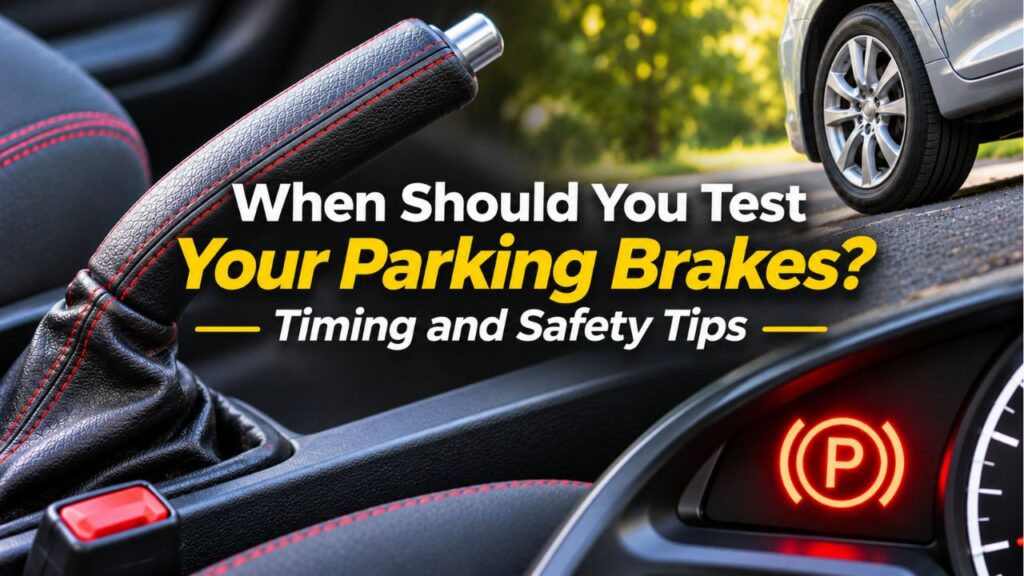
There is no single universal test interval covering every passenger car. The owner’s manual and the brake design determine what is required. However, several situations justify a deliberate check rather than simply assuming the system works.
About Once a Month During Routine Car Care
A monthly function check is a sensible routine for a personal vehicle, particularly if you usually park on flat ground and seldom notice how firmly the brake holds. You can check that the lever, pedal, or electronic switch operates normally and releases completely, then assess holding ability under controlled conditions.
For example, Ford’s owner-manual maintenance checklist includes parking-brake operation among its monthly checks. That is a manufacturer example, not a legal monthly requirement for every make and model. Follow a different interval when your vehicle’s manual specifies one.
Whenever the Brake Feels Loose, Weak, or Unusual
Do not wait for the next scheduled check if the lever suddenly pulls much higher, a foot pedal will not latch, the vehicle creeps after parking, or the parking brake remains partly engaged. Grinding, binding, an unexpected release, or an electronic parking brake warning also calls for prompt inspection.
After Brake Repairs or Parking Brake Adjustment
Check the parking brake after rear pad or shoe replacement, caliper work, cable replacement, adjustment, or electronic parking brake service. Some rear brake systems require adjustment or a manufacturer-specific electronic service procedure to restore normal parking-brake operation.
The repairer should verify that the brake both holds securely and releases fully. A lever that moves normally is not enough; an incorrectly adjusted system may drag when released or fail to hold when applied.
Before Relying on It During Unusual Parking Conditions
If you are about to leave a car on an unfamiliar incline, make sure its parking brake has been working properly. Do not use that steep or crowded location as the first place to investigate a suspect brake. Use Park or the recommended manual-transmission gear, position the wheels appropriately, and add chocks when needed.
Also check after long storage or periods of infrequent use. Corrosion, stuck cables, and seized mechanical parts may develop even when the vehicle has not covered many miles.
Before a Required Inspection or Driving Test
A functional parking brake may be checked during vehicle safety inspections, driving tests, or commercial pre-trip inspections, depending on the jurisdiction and vehicle class. Confirm the actual rules where the vehicle is registered rather than assuming all U.S. states use the same inspection schedule.
If you drive a commercial vehicle, follow its prescribed pre-trip inspection and brake-testing procedures. Those procedures can differ substantially from a passenger-car parking brake check.
Should You Check the Parking Brake Every Time You Park?
Use the parking brake every time you park, but distinguish normal operation from a full holding test. Daily use allows you to notice changes in lever travel, switch response, sounds, and warning indicators. A separate periodic check verifies whether it can hold under controlled load.
A conventional automatic transmission’s Park position locks the drivetrain through a parking mechanism; it does not demonstrate that the parking brake itself works. Similarly, selecting a gear in a manual transmission adds protection but can mask a weak parking brake. A real holding test must account for that difference, without putting the vehicle at risk of rolling.
How to Test Your Parking Brakes Safely While Stationary
A basic owner check requires no special equipment, but it cannot measure brake force or certify roadworthiness. If a problem is already suspected, have a qualified technician test it instead. Follow model-specific instructions, especially on electronic parking brake systems.
Step 01: Choose a Safe, Clear Testing Area
Begin on firm, level ground away from traffic, pedestrians, garage doors, and obstacles. Leave ample room around the vehicle, sit in the driver’s seat, fasten your seat belt, and keep the service brake available. Never position another person in front of or behind the car during a holding check.
For a controlled holding test, a very gentle incline can make weakness easier to detect than perfectly level pavement. Use one only when there is a clear, unobstructed area, you can immediately hold the car with the foot brake, and the owner’s manual permits the method. Do not experiment on a steep driveway.
Step 02: Identify the Parking Brake Control and Instructions
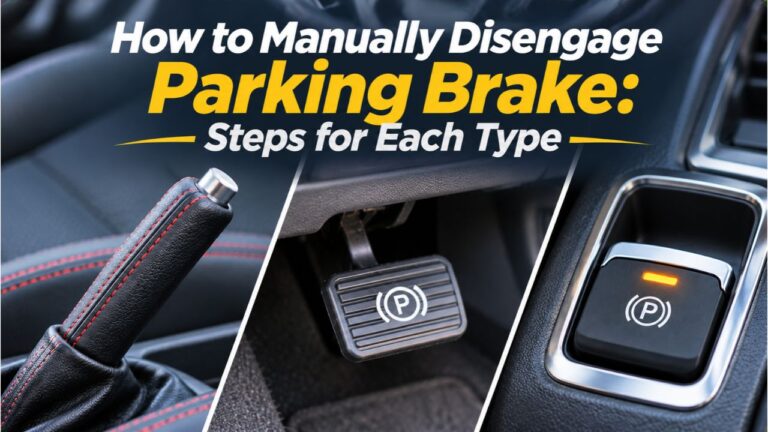
Find the hand lever, foot-operated pedal, or electronic switch. Review its normal apply and release conditions. An electronic parking brake may require the ignition on, the service brake depressed, or the driver’s door closed. Some systems apply automatically or release when drive-away conditions are satisfied.
Do not confuse Auto Hold with the parking brake. Auto Hold typically controls short stops, while the parking brake is intended to secure the parked vehicle. The dashboard indicators may be different.
Step 03: Inspect the Control Before Testing Holding Power
With the car securely stopped, apply and release the parking brake once in its normal manner while maintaining the foot brake. A mechanical lever should latch reliably without a sudden unexplained increase in travel. A foot pedal should engage and release according to its design.
An electronic system should complete its normal actuation without persistent fault messages or repeated grinding. A brief motor sound may be normal. Do not use a generic number of lever clicks as the acceptance standard; allowable travel varies among vehicles.
Step 04: Apply the Brake and Check Whether It Holds
With your foot still firmly on the service brake, apply the parking brake fully. Where the owner’s manual allows a stationary holding test, select Neutral while remaining seated and in full control. Do not press the accelerator. On a gentle incline, ease foot-brake pressure cautiously just enough to see whether the parking brake maintains a standstill.
If the car moves, immediately reapply the service brake. Do not let it roll to find out how much movement is possible. Some electronic or shift-by-wire systems will not permit the same Neutral procedure; use their prescribed method or have a shop perform a brake-force test. Testing while the transmission remains in Park alone cannot isolate parking-brake holding power.
Step 05: Release the Brake and Check for Dragging
After the holding check, press the service brake firmly, return the transmission to a secure position, and release the parking brake using its normal control. Confirm the parking brake indicator changes as expected. A switch indicator turning off does not by itself prove that all mechanical parts released, but it is one useful observation.
A brake that stays stuck, drags, or makes unusual scraping noises needs inspection. Do not continue driving to wear it free. Excessive friction can overheat rear brake components and cause damage.
Step 06: Record Any Problem and Arrange a Proper Inspection
If holding ability is uncertain, stop testing. A repair shop can inspect the hardware and measure brake force with equipment suitable for the vehicle. Do not attempt to prove a weak brake by pulling harder, testing at speed, or accelerating against it.
What Do Parking Brake Test Results Mean?
The results are most useful when you separate failure to apply, failure to hold, and failure to release. Each suggests a different starting point for diagnosis.
| Test Result | Possible Cause | Recommended Action |
| Lever travels unusually far | Cable adjustment, worn hardware, or stretched cable | Inspect against vehicle specifications |
| Brake applies but car creeps | Insufficient holding force or incorrect adjustment | Stop relying on it; arrange service |
| Lever or foot pedal will not latch | Damaged ratchet, release, or linkage | Repair the control mechanism |
| Electronic brake shows a fault | Low voltage, actuator, wiring, or control issue | Diagnose with model-specific tools |
| Brake does not release fully | Seized cable, caliper, mechanism, or actuator | Avoid driving until corrected |
| Brake holds on level ground only | Holding capacity has not been established | Use an approved controlled test or shop equipment |
A functioning parking brake should engage predictably, keep the stationary vehicle secured under the conditions specified for it, and release without leaving the brakes dragging. No single dashboard light or lever-click count establishes all three.
Testing Manual Versus Electronic Parking Brakes
Hand Lever and Foot Pedal Parking Brakes
Traditional mechanical systems use cables or linkages to operate rear brake hardware. Check for a change in control travel, failure of the ratchet to stay latched, slow release, or a sudden increase in effort. Rusted cables or worn brake shoes may prevent proper holding even if the control still moves.
Do not adjust a cable simply to eliminate long lever travel before checking the rear brake mechanism. Tightening an otherwise faulty system can cause brake drag without restoring correct holding force.
Electronic Parking Brakes
Electronic parking brakes use actuators and a control module. A switch can appear to work even when the motor cannot complete its movement or the system reports a fault. Check the indicated applied and released states, listen for abnormal repeated operation, and use only the vehicle’s approved testing method.
An EPB may be unable to release if the 12-volt electrical supply is inadequate. It may also engage automatically under certain conditions. Avoid improvised manual release methods, especially if the vehicle is on an incline. Rear brake servicing may require an electronic maintenance mode before parts are moved.
When Should a Mechanic Inspect the Parking Brake?
A monthly owner check is not a replacement for routine brake-system service. Ask for a parking-brake inspection during scheduled maintenance and whenever you notice abnormal holding, noise, travel, or warning lights. A technician can examine cables, levers, caliper mechanisms, drum shoes, actuators, and associated components that cannot be evaluated from the driver’s seat.
AAA Club Alliance’s parking brake guidance recommends checking parking brake components during routine maintenance and occasionally verifying holding ability on a gentle incline. It also supports using the parking brake regularly, not reserving it only for steep hills.
Why Parking Brake Checks Matter Before Road Tests
A vehicle examination may require more than simply locating the control. The California DMV’s pre-drive safety checklist requires an applicant to demonstrate how to set and release the parking brake and states that a nonworking parking brake can prevent the driving test from proceeding. That is a California example; other states and commercial vehicle programs may use different criteria.
Parking Brake Testing Practices to Avoid
Never test a parking brake by pulling it sharply at driving speed. Some manual brakes can lock the rear wheels and cause a skid, while electronic systems may interpret a moving-vehicle command as emergency braking. Those functions are not appropriate for routine testing.
Do not test on a steep slope, under a raised vehicle, or with someone standing in its path. Do not hold the accelerator against an engaged brake to judge strength; this can overheat parts or cause unexpected vehicle movement. And never assume that selecting Park makes a slipping parking brake acceptable. The parking brake is an important independent way to secure a vehicle.
FAQs About When Should You Test Your Parking Brakes
Should You Test Your Parking Brake Every Day?
For most personal vehicles, normal daily application and observation, plus periodic deliberate checks, is a practical approach. Commercial vehicles may require pre-trip parking brake checks under applicable rules. Follow your vehicle’s manual and any fleet policy.
How Often Should You Check Parking Brake Holding Power?
A monthly routine is reasonable when the manufacturer provides no different schedule. Check sooner if the brake slips, behaves differently, or has been repaired. Professional testing is appropriate if you cannot assess holding force safely.
Can You Test a Parking Brake While the Car Is in Park?
You can check whether the control engages, but Park may hold the vehicle independently and hide a weak parking brake. A valid holding check must isolate that effect using an approved method, preferably under controlled conditions.
Should You Test the Parking Brake After Rear Brake Replacement?
Yes. Rear brake work can affect parking brake adjustment, actuation, and release. Proper verification after repairs includes both holding ability and freedom from dragging once released.
Is It Safe to Test an Electric Parking Brake While Driving?
No. Routine EPB checks should be stationary or performed with approved workshop equipment. Some vehicles have an emergency braking function activated by the EPB switch, but that is not a casual test procedure.
Keep Parking Brake Checks on Your Regular Safety Schedule
When should you test your parking brakes? Check their operation routinely, roughly monthly where appropriate, and check again after repairs or any change in holding or release behavior. Everyday use can reveal warning signs, but a deliberate, controlled holding check provides more useful evidence that the brake can secure the vehicle.
The best test is one that does not create a rolling hazard. Follow the vehicle’s instructions, avoid steep slopes and moving-vehicle experiments, and have a professional inspect any brake that slips, binds, or triggers a warning. A reliable parking brake should apply confidently, hold securely, and release completely before the next drive.