Can Parking Brake Stop Car? Emergency Stopping and Safety Risks
Yes, a parking brake can slow or stop a moving car, but it is designed mainly to hold a vehicle still after parking—not to replace the regular brakes. In an emergency, a mechanical handbrake may provide some stopping force if the service brakes fail. Certain electronic parking brakes can also command emergency braking when the driver holds their switch. The amount of control and stopping power depends on the vehicle and the condition of its braking system.
The danger is assuming the parking brake will stop as smoothly or quickly as the foot brake. A conventional cable-operated system often acts only on the rear wheels. Applying it suddenly while moving can lock those wheels and cause a skid, especially on a curve or slippery road. An electronic system may behave very differently, so the same instructions do not fit every car.
Understanding these limits matters before an emergency occurs. This guide explains how parking brakes work while a vehicle is moving, how manual and electronic systems differ, what steps to take if normal brakes fail, and what to check after an emergency stop.
Can Parking Brake Stop Car While It Is Moving?
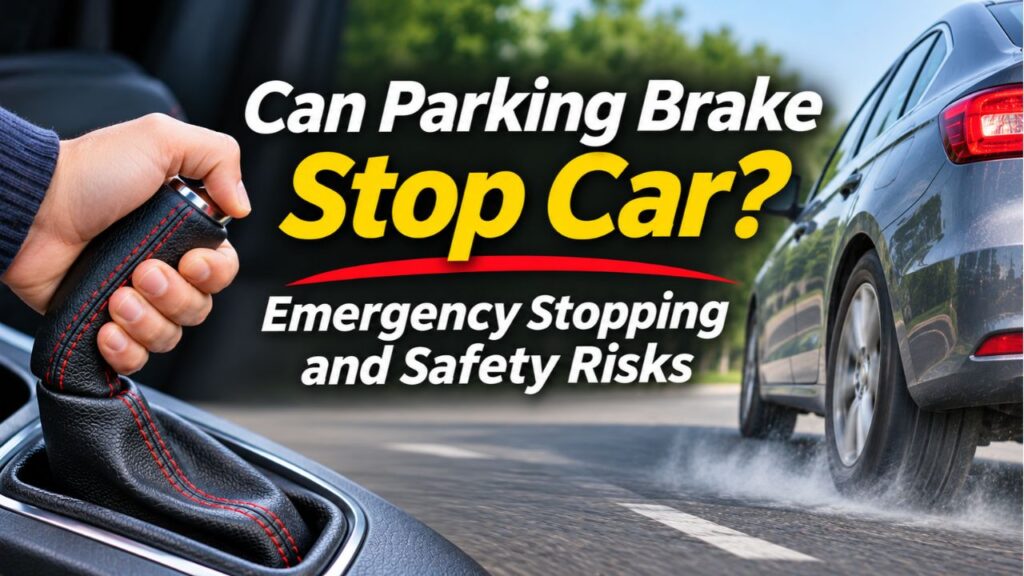
Yes, but its emergency stopping ability is limited and varies by design. A traditional parking brake creates friction at designated wheels, usually the rear wheels on passenger cars. That friction can reduce speed and, given enough time and traction, bring a moving vehicle to a halt. It does not necessarily provide balanced braking at all four wheels.
The parking brake’s primary role is to keep a stationary vehicle from rolling. In a National Highway Traffic Safety Administration interpretation of parking-brake requirements, the agency describes that stationary purpose and explains why it did not require a moving-vehicle stopping test under the cited federal light-vehicle standard. The agency specifically discusses the risk of rear-wheel lockup when drivers cannot easily moderate parking-brake force.
Dry pavement generally offers more grip than rain-soaked asphalt, but there is no universal safe speed for applying a parking brake while moving. Brake condition, road slope, and vehicle load affect the result. Never experiment on public roads.
How Different Parking Brakes Stop a Moving Car
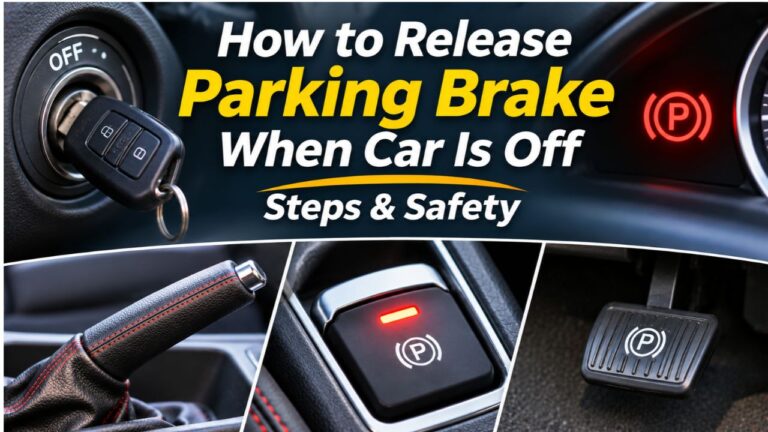
The type of control matters because it determines how the driver applies and releases braking force.
Mechanical Handbrake Lever
A traditional handbrake lever pulls a cable or linkage that operates parking-brake shoes or a mechanism in the rear calipers. The longer the lever is pulled, the more force the system may apply, within the limits of its design and adjustment.
A major concern is that the rear wheels can lock before the driver has regained control. A locked rear tire cannot supply the same predictable cornering grip as a rolling tire. Some lever designs permit the driver to moderate the application by holding the release button, but the correct technique and control layout vary by vehicle.
A mechanical lever may bypass anti-lock braking controls, so do not assume ABS will prevent a rear-wheel skid.
Foot-Operated Parking Brake
A separate pedal near the driver’s left foot also commonly pulls a cable. It is designed to engage and stay engaged after being pressed, which can make its braking force harder to adjust quickly while the car is moving.
Some pedals release with another push; others require a handle. Learn the correct procedure from the owner’s manual while parked.
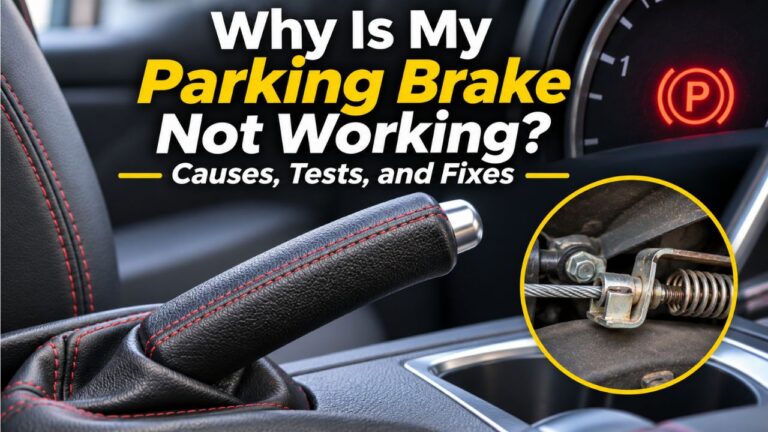
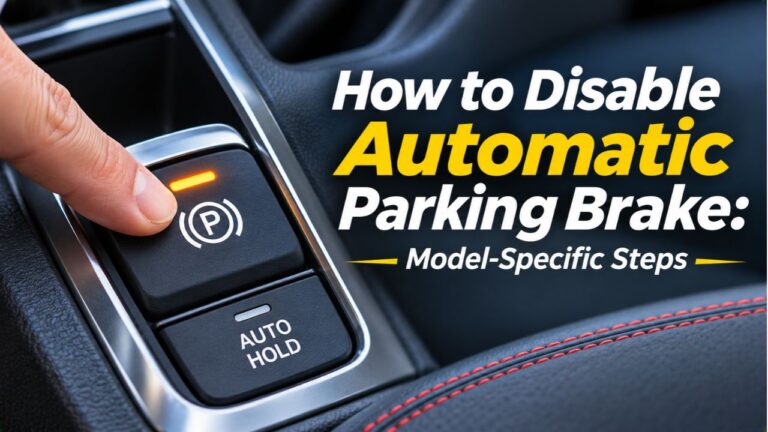
Electronic Parking Brake (EPB)
An EPB uses a switch and electric actuators. Many systems apply the rear parking brakes when stationary, but some can use electronically controlled braking functions while the vehicle is moving. The response may involve the service-brake hydraulic system or other vehicle controls rather than simply clamping the rear wheels at once.
For example, Ford’s 2026 Mustang Mach-E emergency parking-brake instructions say to pull and hold the EPB switch to slow or stop the vehicle in an emergency; releasing the switch ends the commanded emergency braking. That describes the cited Ford model, not every electric parking brake.
| Parking Brake Type | Can It Slow a Moving Car? | Main Limitation |
| Hand-operated cable lever | Often, if mechanically functional | Rear-wheel lockup and limited balance |
| Foot-operated cable pedal | May provide braking force | Harder to apply and release progressively |
| Electronic parking brake | Some offer an emergency stopping function | Behavior and electrical requirements vary by model |
What to Do if Your Regular Brakes Fail While Driving
If the brake pedal stops producing the expected braking response, your first goal is to maintain steering control and reduce speed safely. Use the parking brake only as a last-resort braking method and follow your vehicle’s emergency instructions. The sequence below is general guidance, not a substitute for the owner’s manual.
Step 01: Take Your Foot Off the Accelerator and Stay in Control
Release the accelerator and keep your eyes on a clear path ahead. Hold the steering wheel steadily, avoid sharp movements, and look for a shoulder, open area, or safe uphill route where the car can slow without entering other traffic. Do not panic and grab the parking brake immediately.
If you can do so without distracting yourself from steering, turn on the hazard lights or sound the horn to alert nearby drivers. Give yourself as much room as possible. Traffic, pedestrians, intersections, and roadside obstacles determine which stopping path is safest.
Step 02: Check Whether the Service Brake Still Responds
Press the regular brake pedal deliberately. A very hard pedal can mean lost power assistance rather than a complete loss of hydraulic braking; substantially greater pressure may still slow the car. A pedal that falls toward the floor suggests a different fault, such as lost hydraulic pressure.
On vehicles with functioning four-wheel ABS, firm, continuous pedal pressure is generally appropriate during an emergency stop. Older non-ABS systems may require a different response, including controlled pumping in certain failures. Follow the manufacturer guidance for your particular vehicle, and do not waste valuable time repeatedly testing an ineffective pedal.
Step 03: Reduce Speed With Appropriate Engine Braking
When conditions permit, downshift progressively so the drivetrain helps slow the car. Avoid abrupt changes that could upset traction. Automatic, manual, hybrid, and electric vehicles respond differently.
Do not select Park or Reverse while moving. Do not switch off the ignition to slow down; doing so may remove power assistance or, on some vehicles, affect steering. Maintain the ability to steer until the car stops.
Step 04: Identify the Parking Brake Control You Can Operate
If normal braking and engine braking are insufficient, use the parking-brake emergency method described for your vehicle. With a conventional hand lever, that may mean a controlled, progressive application rather than a sudden hard pull. If the rear wheels begin to skid, reduce parking-brake force to regain control.
For a foot-operated parking brake, check the owner’s manual because a locking pedal may be difficult to modulate. For an EPB, only use the manufacturer’s specified emergency switch action; many systems require the switch to be held, not tapped once. Do not assume every model uses the same direction or control logic.
Step 05: Slow Gradually and Watch for a Skid
Continue steering toward a safe stopping area as the vehicle slows. Keep the car as straight as practical and avoid sudden steering input. If the rear end begins sliding during mechanical parking-brake use, ease off the parking brake as needed to restore traction instead of pulling harder.
The California DMV’s guidance on brake failure advises using the parking brake while being ready to release it if the vehicle starts to skid. The same guidance emphasizes downshifting, maintaining steering, and warning others. These are emergency responses, not a reason to practice parking-brake stops in traffic.
Step 06: Secure the Vehicle and Arrange Help After Stopping
Once the car is stationary in a safe place, keep it from rolling using the appropriate transmission and parking controls. Activate hazard lights if needed and position yourself away from moving traffic. If the parking brake was used heavily, avoid touching wheels, rotors, or calipers; they may be hot.
Do not drive away after a service-brake failure, even if the car eventually stopped. The hydraulic brakes, parking-brake mechanism, tires, and relevant electronic systems need inspection. Arrange towing rather than treating one successful emergency stop as proof that braking is safe.
Why a Parking Brake Can Make a Moving Car Skid
Rear-Wheel Lockup Reduces Stability
A mechanical parking brake on many cars acts at the rear axle. When its friction force exceeds the grip available at a rear tire, that tire may stop rotating while the vehicle is still moving. A sliding tire generally offers less directional control than a rolling tire, making the rear of the car more likely to swing sideways.
Turning increases the risk because tires must share grip between cornering and braking. A sharp rear-brake application on a bend can be far less predictable than progressive braking in a straight line.
Road Surface and Speed Change the Outcome
Wet roads, ice, loose gravel, and uneven pavement make loss of traction more likely. A downhill grade adds speed and distance while the driver is trying to stop. Added cargo or a trailer changes how the vehicle responds and can make a rear-wheel skid harder to control.
Higher speeds require more energy to be absorbed, so a parking brake may take much longer to stop a vehicle. There is no reliable universal stopping-distance figure.
Heat Can Damage the Parking-Brake Mechanism
Prolonged or repeated moving stops can overheat parking-brake shoes, pads, rotors, and related hardware. A dragging parking brake can cause similar damage.
After a real emergency stop, unusual odors, smoke, scraping, or continued wheel resistance deserve professional attention. Do not touch overheated parts or continue driving to see whether the symptoms disappear.
Is the Parking Brake as Strong as the Foot Brake?
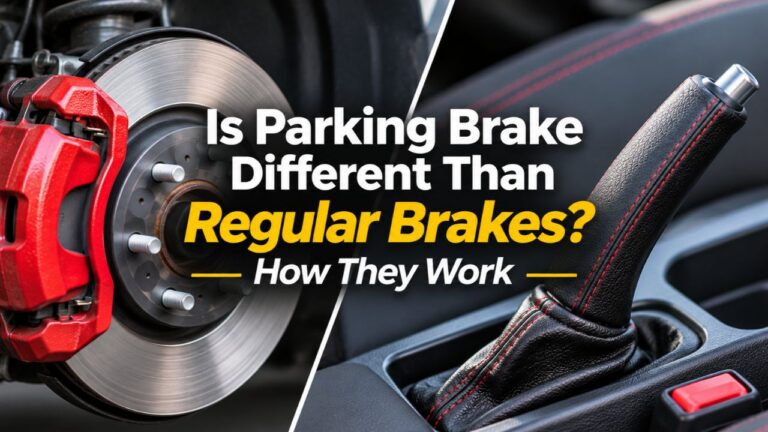
Generally, no. Service brakes are designed for repeated moving stops; parking brakes are mainly designed to hold a parked vehicle without continuous pedal pressure.
Normal service brakes distribute stopping force across the wheels, while functioning ABS can help manage wheel lockup. A cable-operated parking brake may not provide either advantage.
An EPB emergency function may use electronically controlled braking, but the regular brake pedal remains the intended control for driving.
Can a Parking Brake Stop a Car Without Brake Fluid or Engine Power?
A traditional mechanical cable parking brake can often apply its designated brakes independently of hydraulic fluid pressure. That is one reason it may remain useful after certain service-brake hydraulic failures. But a broken cable, seized mechanism, worn shoes, or damaged rear caliper can prevent it from working.
An electronic parking brake has different dependencies. Its motor or emergency-braking function may require usable electrical power and functioning control systems. Some integrated brake systems also use hydraulic components during emergency EPB operation. A dead battery or total electronic failure can therefore change what remains available.
Engine shutdown may reduce brake assistance even if the hydraulic brakes still work with greater pedal effort. The response depends on the failure. Keep the ignition in its operating state until stopped unless the manual instructs otherwise.
When Should You Avoid Using the Parking Brake to Stop?
Never use the parking brake for routine slowing, drifting, or emergency-stop practice. It cannot compensate for known defective service brakes.
Use it to secure the parked vehicle, along with the correct transmission position. If it drags, slips, or will not release, arrange repair.
Find the control and read the operating instructions while parked, not while moving.
FAQs About Can Parking Brake Stop Car
Can a Handbrake Stop a Car in an Emergency?
Yes, a working mechanical handbrake can sometimes slow or stop a moving car when the service brakes fail. It commonly acts on the rear wheels, so abrupt application can cause a skid. Follow the vehicle’s emergency procedure and moderate the force if the car begins losing traction.
Can an Electronic Parking Brake Stop a Moving Car?
Some electronic systems have a dedicated emergency-braking function that operates while a switch is held. Others differ in operation and limitations. Check the exact model’s manual rather than assuming every EPB behaves like the cited Ford system.
Will Pulling the Parking Brake Lock the Rear Wheels?
It can, particularly with a cable-operated rear parking brake on a slippery surface or when force is applied suddenly. Whether the tires lock depends on grip, brake adjustment, speed, and how the system is applied.
Can You Use the Parking Brake if the Brake Pedal Goes to the Floor?
It may provide emergency stopping force, but the situation indicates a potentially serious hydraulic failure. Use appropriate engine braking and the manufacturer-approved emergency method, then have the vehicle towed and repaired once stopped.
Can a Parking Brake Stop a Car on a Hill?
Its normal purpose is to prevent a stopped car from rolling on a slope. Trying to stop an already moving car downhill is harder because gravity continues pulling it forward. Do not depend on the parking brake as a substitute for working service brakes.
Will Using the Parking Brake While Driving Damage It?
It can. Prolonged or repeated use while moving may overheat or wear parking-brake friction parts. An actual emergency may justify using it, but the system should be inspected afterward, especially if there was heavy braking, noise, or a burning smell.
Know What Your Parking Brake Can—and Cannot—Do
So, can parking brake stop car if the normal brakes fail? In some situations, yes. A mechanical parking brake may slow the car through the rear wheels, and certain electronic systems offer an emergency stop function. Neither should be assumed to perform like a healthy, properly operating service-brake system.
The biggest concern is control. A sudden mechanical application can lock rear wheels, while the response of an electronic switch depends on the vehicle. If braking fails, focus on steering, reducing speed, following the owner’s manual, and using parking-brake assistance only as an emergency measure.
Learn the correct control procedure before you need it, but never test it by stopping a moving car on public roads. After any genuine brake failure, arrange towing and professional inspection before returning the vehicle to service.