Do All Cars Have a Brake Booster? Types and Exceptions Explained
No, not all cars have a brake booster. Some older vehicles, lightweight performance cars, and purpose-built race cars use manual brakes without power assistance. Most modern passenger vehicles use some form of assisted braking, but that assistance does not always come from a traditional round vacuum booster.
A brake booster reduces the force a driver needs to apply to the brake pedal. Without one, a properly designed manual system can still stop a car, although the pedal generally requires more effort. Hybrid and electric vehicles may use electrically powered or integrated braking units instead of the vacuum devices found on many gasoline cars.
This difference matters when identifying parts, comparing older vehicles with newer models, or investigating a hard brake pedal. A vehicle that was built without a booster is not necessarily defective. A vehicle that normally has brake assistance but suddenly loses it, however, may be unsafe to drive.
This guide explains which cars have boosters, how the main systems work, and how to recognize the difference between normal manual braking and a fault.
Do All Cars Have a Brake Booster? The Short Answer
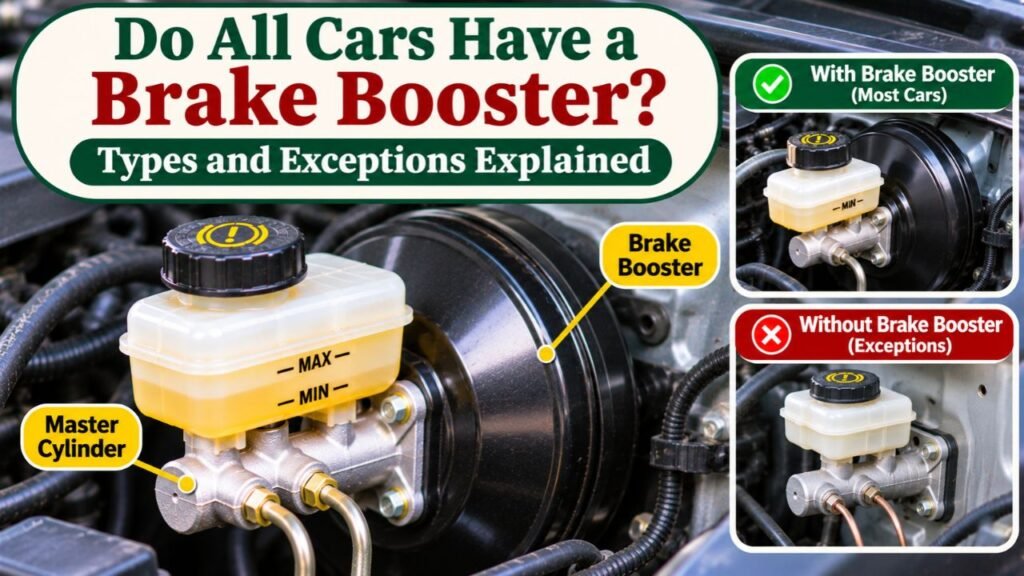
Cars do not universally require a separate brake booster. A booster is a form of power assistance, not the component that creates every car’s braking force. In a traditional hydraulic brake system, the driver presses the pedal, the master cylinder builds pressure, and friction brakes slow the wheels. A booster makes that pressure easier to generate with less leg effort.
Manual-brake vehicles rely on pedal leverage and hydraulic component sizing rather than an external source of assistance. Many modern vehicles instead use vacuum, hydraulic pressure, electric motors, or integrated electronically controlled brake units. The exact arrangement depends on the model and year.
A helpful distinction is between having no power assistance and having no conventional vacuum booster. These are not the same condition. A modern car may lack the familiar round booster behind the master cylinder while still providing substantial brake assist through another device.
Which Cars Do Not Have a Brake Booster?
Older Cars Originally Equipped With Manual Brakes
Power-assisted brakes were once optional equipment on many cars. Some classic vehicles left the factory with a direct mechanical linkage between the brake pedal and master cylinder, with no vacuum booster in between. Their pedal assembly, master cylinder, and brakes were selected to work together without assist.
That original design should not be confused with a missing part. An older car may be safe to operate when its complete manual-brake system is correctly maintained and meets applicable requirements. But a restored vehicle with mixed or incorrectly matched parts can require excessive pedal force.
Race Cars and Specialized Performance Builds
Some track-focused vehicles deliberately use manual brakes to reduce complexity or provide consistent pedal feedback. Those brakes must be engineered around the driver’s available pedal force, brake balance, friction materials, and master cylinder sizes.
In Wilwood’s guide to power-assisted and manual brakes, the manufacturer explains how pedal leverage and hydraulic ratios help manual systems operate without a booster. This does not mean removing the booster from an ordinary road car creates an equivalent racing brake system.
Modified Cars With Purpose-Built Manual Systems
Simply taking the booster off a power-brake car may leave the original pedal ratio and master cylinder poorly matched. The result can be much greater stopping effort and inadequate braking performance. Legal requirements and inspection rules can also apply to modifications.
What Does a Brake Booster Actually Do?
A brake booster amplifies the driver’s pedal force before that force operates the hydraulic braking system. It is commonly positioned between the brake pedal linkage and the master cylinder. Assistance reduces how hard the pedal must be pressed during routine stops and emergency braking.
For a conventional system, the driver still controls braking by moving the pedal. The booster adds force but does not replace the master cylinder, calipers, wheel cylinders, or friction materials.
Boosters also affect pedal feel. A power-assisted pedal often feels easier to press than a manual one, although pedal travel and firmness depend on many other parts. More assistance is not automatically better; the vehicle’s brakes must provide a controlled, predictable response.
How Do Cars Stop Without a Brake Booster?
Brake Pedal Leverage Supplies Mechanical Advantage
The brake pedal is a lever. Its geometry determines how force from the driver’s foot acts on the master cylinder pushrod. Manual-brake systems typically use a pedal arrangement that provides more leverage than comparable power-assisted systems.
That extra leverage allows the driver to create useful hydraulic pressure without a vacuum or electric booster. However, increasing leverage also changes pedal movement, so engineers must balance effort, travel, and available stopping force.
The Master Cylinder Produces Hydraulic Pressure
Pressing the pedal pushes a piston in the master cylinder. Brake fluid transmits the resulting pressure through lines to wheel-end components, where pads or shoes produce friction.
Master cylinder bore size, wheel-cylinder or caliper piston area, and pedal geometry must work together. A poorly matched combination may produce a very hard pedal, excessive travel, or inadequate brake response. Manual brakes are therefore a complete design choice, not merely a booster-free version of a power-brake setup.
Main Types of Brake Assistance Found in Cars
| Brake System | Assistance Source | Where It Is Commonly Found |
| Manual brakes | Driver effort and pedal leverage | Some classic and specialized cars |
| Vacuum booster | Vacuum-to-atmospheric pressure difference | Many conventional gasoline vehicles |
| Hydraulic booster | Pressurized hydraulic fluid | Certain trucks and selected cars |
| Electromechanical booster | Electric motor | Some modern hybrids, EVs, and other cars |
| Integrated brake control | Electrically controlled hydraulic pressure | Some modern hybrid and electronic braking systems |
Vacuum Brake Boosters
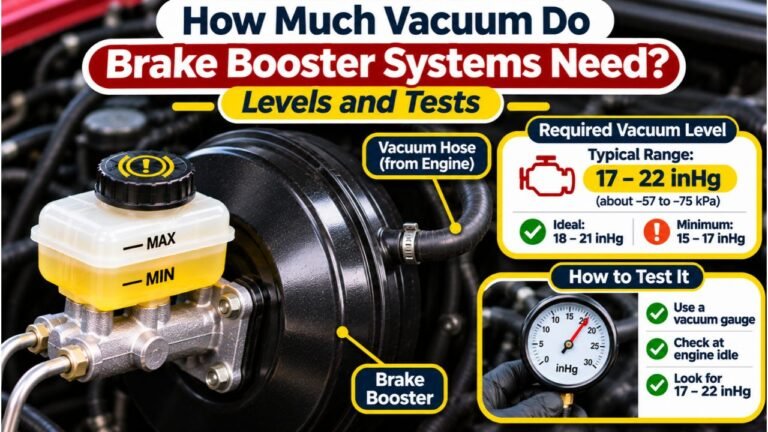
A vacuum booster uses a pressure difference across a diaphragm to add force when the driver presses the brake pedal. Many gasoline engines provide a suitable vacuum source, although some vehicles use a separate pump.
A one-way check valve helps preserve a limited reserve of assistance after the engine stops. Once that reserve is used, the pedal typically becomes harder to press. A hard pedal after several presses with the engine off is therefore not, by itself, evidence that the booster has failed.
Hydraulic Brake Boosters
A hydraulic booster, sometimes called hydro-boost, uses pressurized hydraulic fluid rather than engine vacuum. Some systems share a pressure source with hydraulic power steering, while others have a different dedicated arrangement.
This approach can suit vehicles that require high braking assistance or cannot supply consistent engine vacuum. It is still power-assisted braking. A car with hydraulic boost does have a booster even though no traditional vacuum canister may be present.
Electric and Integrated Brake Assist
Electric brake assistance can use a motor and control electronics to generate the required support. Other vehicles combine brake-force generation, ABS functions, and electronic control into an integrated hydraulic unit.
Bosch’s explanation of its iBooster describes an electromechanical booster that operates independently of engine vacuum and can work with hybrid and electric drivetrains. It is one example, not the only modern braking architecture.
Do Electric and Hybrid Cars Have Brake Boosters?
Many electrified vehicles have brake assistance, but it may not be provided by an engine-driven vacuum booster. Electric cars lack a conventional gasoline engine as a steady vacuum source, so electrically powered assistance and integrated hydraulic systems are practical alternatives.
Hybrids create another challenge because their gasoline engine may turn off while the vehicle is moving. The braking system still needs to supply consistent stopping performance when that happens. The solution varies by manufacturer and generation.
Regenerative braking is not the same as brake boosting. Regeneration uses the electric drive motor to help slow the vehicle and recover energy. The friction brakes remain part of the vehicle’s stopping system, and electronic controls may blend the two braking methods.
A technician identifying parts on an EV should consult the model-specific service information. The absence of a large round booster does not prove that the car has unassisted manual brakes.
Where Is the Brake Booster Located?
On many conventional vehicles, the vacuum brake booster sits on the firewall inside the engine compartment, directly behind the master cylinder. It often resembles a large, round metal housing. The master cylinder and its brake-fluid reservoir are mounted in front of it.
The brake pedal linkage enters the booster from the passenger-compartment side of the firewall. A vacuum hose and check valve usually connect to the booster housing.
Hydraulic and electric units may look different. Some electronic systems combine components into a compact assembly, so identifying the system by shape alone is unreliable. Use the owner’s manual or factory parts diagram for the exact vehicle.
How Can You Tell if Your Car Has a Brake Booster?
Begin by identifying the year, make, model, trim, and braking system. The vehicle’s parts catalog or service information is a more dependable source than its age or the appearance of the pedal.
On a conventional car, look for a round housing behind the master cylinder and an attached vacuum supply hose. If those parts are present, the vehicle likely has a vacuum brake booster. An electric or integrated system may not have an obvious vacuum hose or a separate booster-shaped component.
Brake Booster vs. Master Cylinder: Are They the Same?
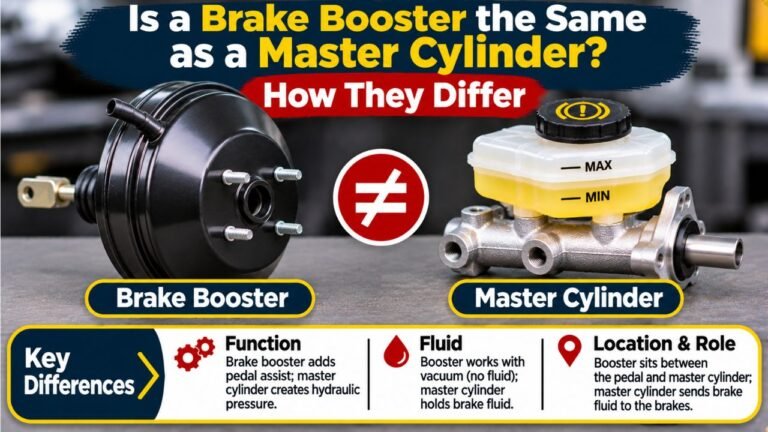
No. The brake booster assists the driver’s force, while the master cylinder converts mechanical input into hydraulic pressure. In a conventional power-brake system they are attached to each other, but they are separate components with different failure symptoms.
A booster problem often causes unusually high pedal effort. A master cylinder with internal seal leakage may instead allow the pedal to sink under sustained pressure. Other hydraulic faults can produce similar symptoms, so pedal feel alone does not identify a defective part.
Brake pads, rotors, ABS modules, and calipers also perform different jobs. Replacing the booster cannot repair worn friction materials, trapped air, or a hydraulic leak elsewhere in the vehicle.
What Happens When a Brake Booster Fails?
If power assistance is lost, the brake pedal may become unusually hard and the driver may need considerably more force to slow the vehicle. Depending on system design and conditions, the mechanical or hydraulic braking path may still function, but stopping performance can be seriously compromised.
A vacuum leak can also create a hissing sound near the pedal, although not every hiss means a failed booster. A damaged vacuum hose, faulty check valve, or inadequate vacuum source may cause symptoms similar to a defective booster.
Do not assume a car is safe because its brakes still respond when pressed very hard. If pedal effort changes suddenly, stopping distance increases, or a brake warning appears, pull over safely and arrange professional service. An abnormal sinking pedal or fluid loss may indicate another serious brake-system problem.
A Basic Brake Booster Check and What It Means
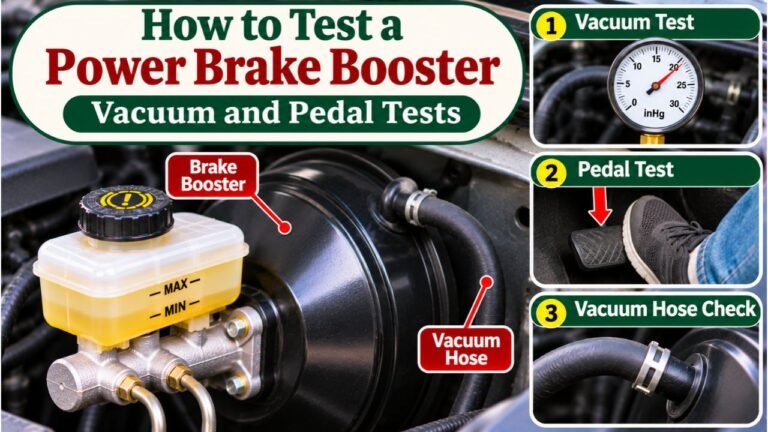
For some conventional vacuum-assisted vehicles, an initial stationary check involves exhausting the stored vacuum with the engine off, holding moderate pressure on the brake pedal, and starting the engine. A small downward change in pedal position can indicate that vacuum assistance has returned.
The CARDONE technical guide to diagnosing a vacuum brake booster describes this type of check and identifies the vacuum supply and one-way check valve as additional diagnostic points. Follow the vehicle manufacturer’s own test procedure, since electronically controlled brakes and some other designs operate differently.
This check is not a complete diagnosis. A pedal that does not move may point to a vacuum supply problem rather than a failed booster. Testing hoses, valves, electrical controls, and hydraulic components may require professional equipment.
Never test questionable brakes by driving at speed to see how much harder you must press. If assistance appears lost, arrange inspection before using the vehicle again.
Can You Drive a Car Without a Brake Booster?
A vehicle designed and maintained as a manual-brake car can be driven with its intended braking system. Its pedal may require more effort, but that characteristic is part of the original engineering rather than a breakdown.
Driving a power-brake car after its assistance fails is a different matter. The driver may not be able to produce the required braking force quickly or consistently in an emergency. Even if some braking remains available, the vehicle should not be treated as suitable for normal travel.
Do not disconnect a functioning booster to imitate manual brakes. Safe conversion requires properly matched components, engineering checks, and compliance with applicable road-use rules.
FAQs About Do All Cars Have a Brake Booster
Do Older Cars Usually Have Manual Brakes?
Many older cars were offered with manual brakes, but not every classic vehicle lacks a booster. Power-assisted brakes were available on numerous models, sometimes as optional equipment. Check the original specifications and any later modifications.
Do All Cars With Disc Brakes Need a Booster?
No. Disc brakes can be used in properly designed manual systems as well as power-assisted ones. The brake pedal ratio, master cylinder bore, and wheel-end components must be matched to provide the necessary performance.
Does a Hard Brake Pedal Mean the Car Has No Booster?
Not necessarily. A car with a functioning vacuum booster may have a hard pedal after the engine has been off and its stored assistance has been depleted. A suddenly hard pedal while driving can indicate a fault that needs immediate attention.
Can a Car Have ABS Without a Traditional Brake Booster?
Yes. ABS and brake assistance serve different functions: ABS manages wheel lockup during braking, while a booster reduces pedal effort. The two features can exist in different system configurations, including integrated electronic designs.
Is a Brake Booster the Same as a Brake Vacuum Pump?
No. A vacuum pump supplies vacuum to certain booster systems, while the booster uses that vacuum to add braking force. Some vehicles do not need a separate pump, and electric brake-assist systems can operate without vacuum altogether.
Why Brake Assist Matters More Than the Booster’s Shape
So, do all cars have a brake booster? No. Some vehicles were designed with unassisted manual brakes, while most modern passenger cars use a form of power assistance. A traditional vacuum booster is only one way to provide that help; hydraulic, electromechanical, and integrated systems can serve similar purposes.
The practical takeaway is to judge a vehicle by its intended braking design, not by whether a round booster appears under the hood. Proper manual brakes can work as engineered, but sudden loss of assistance in a power-brake vehicle is a safety problem.
Verify the system using model-specific information and have unusual pedal effort or braking performance inspected before driving.