Is a Brake Booster the Same as a Master Cylinder? How They Differ
No, a brake booster is not the same as a master cylinder. The booster reduces the effort needed to press the brakes, while the master cylinder creates hydraulic pressure that operates the brakes at the wheels. They often bolt together, which makes them easy to confuse, but they perform different jobs and can fail independently.
Understanding the difference matters when your brake pedal becomes unusually hard, feels soft, slowly sinks, or the brake fluid level drops. Replacing a booster will not repair leaking master-cylinder seals, and replacing a master cylinder will not fix a failed vacuum supply. The wrong diagnosis wastes money and can leave a serious braking fault unresolved.
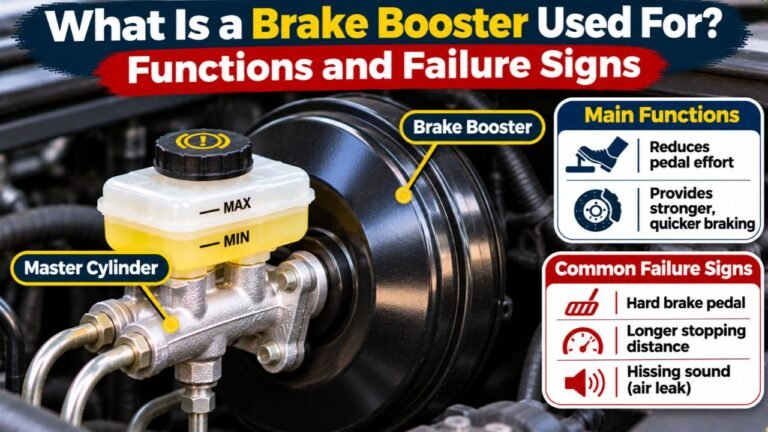
On many vehicles, the booster is the large round housing against the firewall and the master cylinder is the smaller metal component mounted in front, often with a plastic fluid reservoir above it. Newer designs may look different. This article explains how both parts work, how to identify them, what their symptoms mean, and when replacement or professional inspection is appropriate.
Is a Brake Booster the Same as a Master Cylinder? The Core Difference
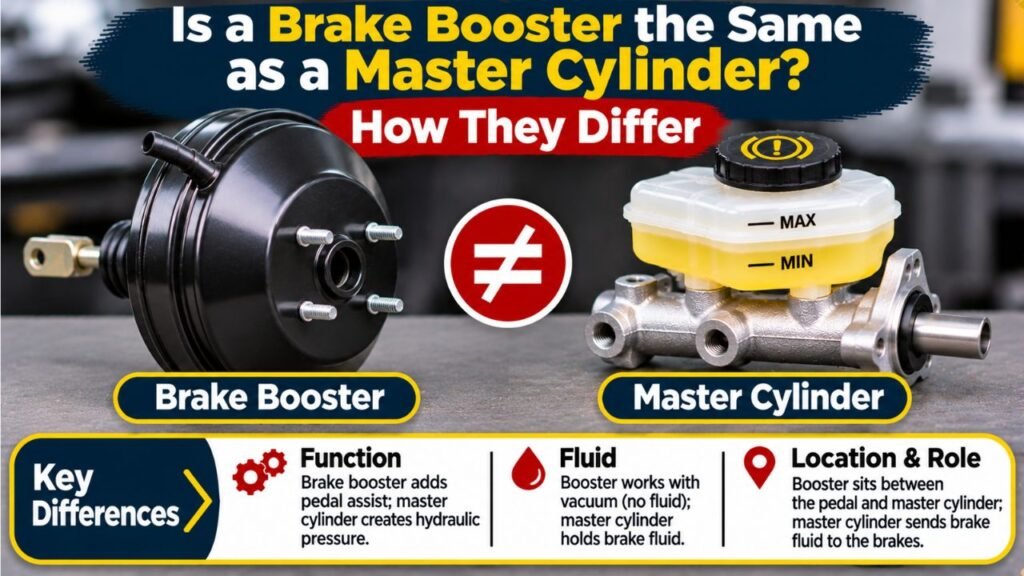
A brake booster adds assistance to the force from your foot. A master cylinder turns mechanical force into hydraulic pressure. These two actions occur one after the other in many conventional power-brake systems.
Imagine pressing the brake pedal at a stoplight. The booster helps push against the master cylinder’s piston so that you do not have to generate all the force with your leg. The master cylinder then pressurizes brake fluid, transmitting force through lines and hoses to the brake calipers or wheel cylinders. Those wheel-end parts apply friction against the rotors or drums.
The distinction is not simply about which component is larger. The booster primarily belongs to the brake-assist mechanism, while the master cylinder belongs to the hydraulic pressure-generating mechanism. A conventional vehicle can have a working master cylinder but a failed booster, or a working booster with a damaged master cylinder.
| Feature | Brake Booster | Brake Master Cylinder |
| Primary job | Increases pedal force with assistance | Generates hydraulic brake pressure |
| Typical location | Between pedal linkage and master cylinder | Ahead of booster, connected to brake lines |
| Main operating medium | Vacuum, hydraulic assist, or an electric mechanism | Brake fluid |
| Common failure clue | Hard pedal requiring greater effort | Sinking or soft pedal, fluid leakage |
| Attached lines | Often a vacuum hose or assist connections | Brake-fluid reservoir and hydraulic lines |
| Replacement considerations | Assist supply and pushrod adjustment | Fluid sealing, correct fitment, and bleeding |
These are common patterns, not universal diagnostic rules. Electronic brake-by-wire systems may combine functions in one assembly, and pedal symptoms can overlap with faults elsewhere.
What Does a Brake Booster Do?
The booster’s purpose is to make normal and emergency braking easier to control by providing additional input force. Without that assistance on a vehicle designed around it, the driver may need substantially more pedal pressure to achieve the expected braking response.
How a Vacuum Brake Booster Produces Assistance
Traditional vacuum boosters have chambers separated by a flexible diaphragm. A control valve changes the pressure difference across the diaphragm as the driver presses the pedal. The resulting movement helps drive an output rod toward the master cylinder piston.
Bosch Mobility’s explanation of the vacuum brake booster describes this diaphragm-and-pressure-difference principle. The booster does not pump brake fluid through the lines; it supplies mechanical assistance before hydraulic pressure is produced.
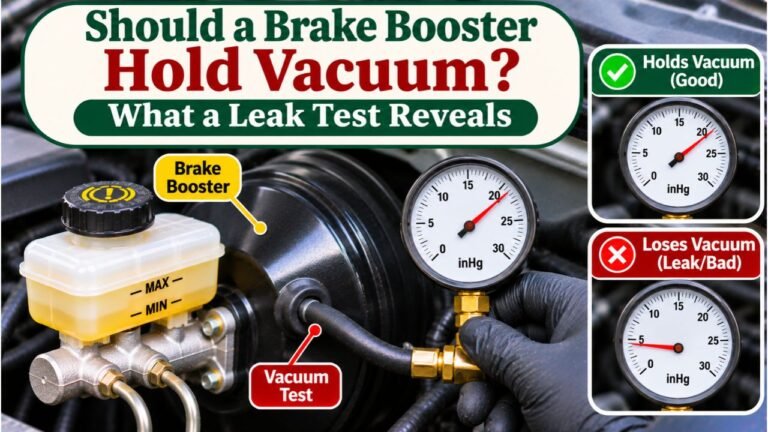
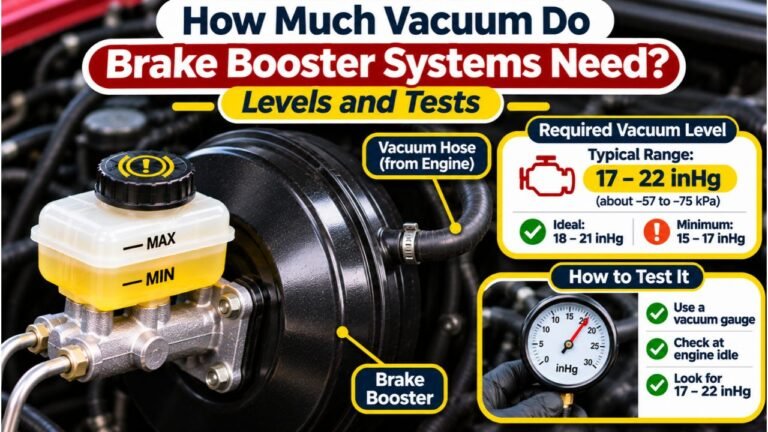
Vacuum may come from the intake manifold or a dedicated pump. A check valve helps retain a limited reserve of vacuum when the supply changes or the engine stops. After that reserve is used, a conventional system can require much greater pedal effort. A faulty vacuum hose or check valve can therefore imitate a failed booster.
Hydraulic and Electric Brake-Assist Systems
Not every power-assisted vehicle has a round vacuum canister. Some trucks use hydraulic assist, often called hydro-boost, which obtains operating pressure from a compatible hydraulic pump. Certain hybrids and electric vehicles use electromechanical assistance because they cannot always rely on engine intake vacuum.
What Does a Brake Master Cylinder Do?
The master cylinder is the hydraulic component that creates pressure when its internal piston or pistons move. It connects to the brake-fluid reservoir and the hydraulic circuits that serve the wheels. Its internal seals must hold pressure and permit the appropriate return of fluid when the pedal is released.
How Master Cylinder Pistons Create Brake Pressure
As the brake pedal and, where fitted, booster push the piston assembly, the master cylinder develops pressure in its working chambers. Pressurized brake fluid transfers force through the system to caliper pistons or drum-brake wheel cylinders. Releasing the pedal lets the components return and allows pressure to drop as designed.
Bosch Mobility’s tandem master cylinder overview identifies its role in converting driver input, including boosted force where fitted, into hydraulic pressure. Modern conventional vehicles generally use a tandem arrangement with two hydraulic circuits for redundancy, although the exact circuit layout differs by model.
The master cylinder’s bore size, piston travel, and seal condition matter to pedal feel. Larger bores move more fluid per unit of travel but require more input force for a given pressure. Smaller bores can increase pressure for the same pushrod force, while moving less fluid per stroke. These choices are engineered alongside the pedal ratio and wheel brakes.
Why the Brake Fluid Reservoir Is Attached to the Master Cylinder
The reservoir supplies the hydraulic circuits and accommodates normal fluid-volume changes. It is commonly made of translucent plastic so the level can be checked against MIN and MAX markings. Some vehicles use a different reservoir arrangement.
Brake boosters do not normally store brake fluid. If liquid appears between a master cylinder and a vacuum booster, it may have leaked past the master cylinder’s rear seal, potentially entering the booster housing. That does not turn the booster into a fluid-operated hydraulic cylinder; it indicates a problem that may affect both parts.
How the Brake Booster and Master Cylinder Work Together
On a conventional power-assisted car, braking follows a straightforward mechanical-to-hydraulic sequence. Your foot moves the brake pedal. The pedal operates the booster’s input mechanism, while the booster adds force through its output pushrod. That combined force acts on the master cylinder, which develops hydraulic pressure for the wheel brakes.
Neither component works as a substitute for the other. A booster without a functioning master cylinder cannot supply the normal hydraulic pressure needed at the wheels. A functioning master cylinder without its expected power assistance may still create pressure, but a vehicle designed for assisted braking can require dangerously high pedal force if the assist fails.
This is why mounting the two parts together does not mean they are interchangeable. A failed booster can sometimes be replaced without replacing a healthy master cylinder. Conversely, a defective master cylinder may be replaced while retaining a good booster, provided contamination, alignment, and other service concerns are addressed.
Why the Pushrod and Pedal Geometry Matter
A pushrod transfers force between the booster and the master cylinder. Its effective length and clearance are part of the brake-system design. If a replacement booster or master cylinder has an incorrect pushrod relationship, the piston may not fully return or may require excess movement before pressure rises.
Insufficient clearance can contribute to dragging brakes or trapped hydraulic pressure. Too much clearance can produce unwanted pedal travel. Measurements and adjustments vary by vehicle; do not guess the pushrod setting or use another model’s specification.
Where Are the Brake Booster and Master Cylinder Located?
Open the hood of many conventional left-hand-drive cars and look toward the firewall on the driver’s side. The brake booster is typically the larger round metal housing mounted behind the master cylinder. The master cylinder is the smaller housing attached to its front, with a plastic reservoir above and steel brake lines connected to its outlets.
The booster may have a large vacuum hose and one-way check valve. The master cylinder usually has brake-fluid lines and may carry an electrical reservoir-level sensor. Those connections help distinguish the parts when you are looking at a crowded engine bay.
Not every vehicle follows this layout. Some have remote reservoirs, hydraulic boosters, compact electronic modules, or an integrated brake actuator. A right-hand-drive vehicle may also place the assembly differently. The owner’s manual and model-specific parts diagram are more reliable than appearance alone.
Important: A brake-fluid reservoir cap belongs to the hydraulic system. Never pour brake fluid into a vacuum hose or booster opening, and never introduce engine oil or power-steering fluid into the brake reservoir.
Brake Booster vs. Master Cylinder Symptoms: How to Tell Them Apart
Pedal feel often provides the first clue, but a symptom cannot identify the failed part with certainty. A leaking brake hose, trapped air, worn linkage, ABS hydraulic fault, or another problem can produce similar behavior.
Hard Brake Pedal: Often a Brake-Assist Problem
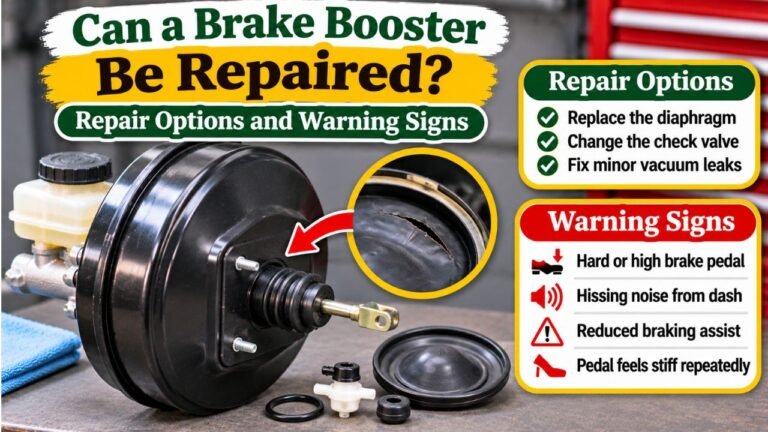
If the pedal suddenly becomes much harder than normal, suspect lost assistance. Possible causes include a torn booster diaphragm, leaking vacuum line, failed check valve, inadequate vacuum supply, or a hydraulic or electronic assist fault on a differently equipped vehicle.
A vacuum leak may also produce a hissing sound near the firewall. On some gasoline engines, it can affect idle quality when the brakes are applied. The absence of hissing does not rule out a defective booster, and a hard pedal can also come from hydraulic restrictions or mechanical problems.
Soft or Sinking Pedal: Often a Hydraulic Problem
A soft, spongy pedal can indicate air in the brake lines, a hydraulic leak, or an issue elsewhere in the circuit. A pedal that slowly sinks under steady pressure can be associated with internal master-cylinder seal bypass or an external fluid leak.
Wetness around the reservoir, fittings, or rear of the master cylinder deserves attention. Internal bypass may occur without any visible loss of fluid, so a dry engine bay does not prove that the cylinder is healthy.
AutoZone’s guide to bad master cylinder symptoms covers low fluid, leaking seals, and changes in pedal feel. These are signs to investigate, not proof that replacing the cylinder will solve the problem.
A hard pedal and a sinking pedal call for different investigations, but both can make a vehicle unsafe. Do not use public-road driving to test braking performance.
Can One Failed Part Damage the Other?
Yes, certain failures can affect the neighboring component, even though they have separate jobs. One example is a master cylinder that leaks brake fluid past its rear seal. Fluid can travel into a vacuum booster and harm internal materials, depending on the design and extent of contamination.
A technician may need to separate the assembly and inspect the booster interior before deciding what to replace. Fitting a new master cylinder without addressing a contaminated booster can leave an unresolved problem.
Do You Replace the Brake Booster and Master Cylinder Together?
Not routinely. If diagnosis confirms that one part has failed and the other is sound, replacing the defective component alone may be appropriate. The correct repair depends on fitment, damage, contamination, and the manufacturer’s service procedure.
For a defective vacuum booster, related checks may include the supply hose, check valve, pump, mounting hardware, and pushrod connection. For a defective master cylinder, inspection focuses on leaks, fluid condition, line fittings, internal pressure retention, and the condition of the reservoir and seals.
Replacing a master cylinder generally opens the hydraulic system, so the prescribed bleeding procedure becomes part of the repair. Certain ABS arrangements require special equipment or electronic service steps. A booster replacement does not always require opening brake lines, but that depends on whether the master cylinder can be moved safely without disconnecting them.
When Is a Brake Problem Too Serious to Drive With?
An unusually hard pedal, a pedal that sinks toward the floor, an active fluid leak, or a major change in stopping response requires prompt attention. An illuminated brake warning light also needs diagnosis according to the vehicle’s instructions.
If the problem appears while driving, slow down carefully and stop in a safe location. Once parked, do not continue normal driving or attempt repeated high-speed tests. Arrange towing and professional inspection when braking performance is uncertain.
FAQs About Is a Brake Booster the Same as a Master Cylinder
Is the Brake Booster Attached to the Master Cylinder?
Yes, in many conventional power-brake systems, the master cylinder bolts to the front of the booster. They remain separate components with different functions, even when installed as one visible assembly.
Can a Brake Master Cylinder Work Without a Booster?
Yes. A properly designed manual-brake system uses pedal leverage and hydraulic sizing to operate without power assistance. Removing a booster from a vehicle originally designed for it is not an equivalent conversion and can create unsafe pedal effort.
Does a Brake Booster Contain Brake Fluid?
A conventional vacuum booster does not use brake fluid as its normal operating medium. If fluid accumulates inside one, a leaking rear master-cylinder seal may be responsible. Some hydraulic-assist systems use other hydraulic fluid in their assist circuits.
Can a Bad Brake Booster Cause a Sinking Brake Pedal?
Lost vacuum assistance typically produces a harder pedal rather than a sinking one. A sinking pedal suggests a hydraulic or related mechanical problem, although more than one fault can exist at once.
Which Part Should Be Replaced for a Brake Fluid Leak?
It depends on the source. A master-cylinder seal, reservoir connection, brake line, hose, caliper, or wheel cylinder may be leaking. Identify the point of failure before selecting replacement parts.
Is the Brake Booster the Same as the ABS Module?
No. The booster provides braking assistance, while an ABS hydraulic and electronic control system regulates wheel-brake pressure to help manage wheel lockup. Some modern integrated brake assemblies combine multiple functions, so a model-specific description is essential.
Why Knowing the Difference Prevents the Wrong Brake Repair
So, is a brake booster the same as a master cylinder? No. The booster supplies additional force to make the pedal easier to press, while the master cylinder produces the hydraulic pressure that applies the wheel brakes. Their close mounting position explains the confusion, but their jobs, failure patterns, and repair requirements are different.
A hard pedal tends to direct attention toward the assist system; a sinking pedal or fluid leak points more strongly toward hydraulic faults. Neither symptom alone proves which part has failed, and a hidden master-cylinder leak can sometimes affect the booster as well.
Before buying either component, have the actual fault and vehicle-specific configuration checked. Repairing the correct part, verifying pushrod alignment, and completing any required hydraulic service provides a safer result than replacing the entire assembly by guesswork.