Can You Mix DOT 3 and DOT 4 Brake Fluid? Risks and Safety Guide
Yes, DOT 3 and DOT 4 brake fluids are generally chemically compatible and can physically be mixed because both are glycol-based hydraulic fluids. However, mixing them is not always recommended because the resulting fluid may no longer meet your vehicle’s required braking performance specifications. The safest approach is to use the exact brake fluid recommended by the vehicle manufacturer.
DOT 4 typically has higher minimum dry and wet boiling-point requirements than DOT 3. Adding DOT 3 to a system requiring DOT 4 can reduce the fluid mixture’s heat resistance. Conversely, adding DOT 4 to a DOT 3 system may be acceptable in some vehicles, but compatibility with the specific braking system must be confirmed.
Modern vehicles may also require low-viscosity DOT 4 fluid for electronic braking systems, making the distinction more important than the DOT number alone.
If you’ve already mixed the two fluids, there is no reason to assume an immediate chemical reaction has occurred. However, you should verify the required specification before continuing to use the vehicle.
In this article, I explain whether you can mix DOT 3 and DOT 4 brake fluid, how their properties differ, what happens after mixing, and when a brake fluid flush is necessary. I also cover ABS compatibility, incorrect fluid top-offs, and the safest way to select replacement brake fluid.
Can You Mix DOT 3 and DOT 4 Brake Fluid?
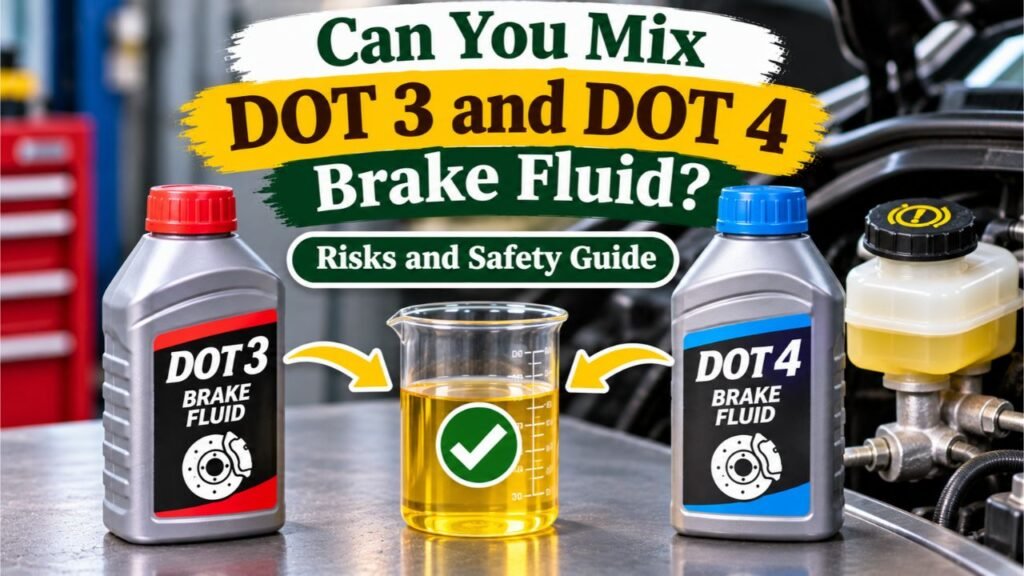
DOT 3 and DOT 4 brake fluids can generally be mixed from a chemical compatibility standpoint, but that doesn’t automatically make the mixture suitable for your vehicle.
Both fluids are glycol-based and belong to the conventional non-silicone brake fluid family.
They are designed to transmit hydraulic pressure through automotive braking systems.
However, they have different performance specifications, including minimum boiling-point requirements and viscosity limits.
According to Orthene’s technical brake fluid FAQs, DOT 3, DOT 4, and DOT 5.1 fluids can generally be mixed, but mixing may reduce performance to that of the lower specification.
The manufacturer also emphasizes using the brake fluid specified by the vehicle manufacturer.
When Is Mixing Potentially Acceptable?
Mixing may be technically possible when:
- Both fluids are genuine glycol-based products.
- The vehicle manufacturer permits the relevant specifications.
- The fluid is clean and uncontaminated.
- The mixture maintains the required braking-system performance.
- No specialized low-viscosity specification is being compromised.
However, there is no universal mixing ratio that guarantees compliance.
When Should You Avoid Mixing?
Avoid mixing when:
- The vehicle specifically requires DOT 4 and you’re considering adding DOT 3.
- A DOT 4 LV or other specialized specification is required.
- You don’t know which fluid is already in the system.
- The brake fluid is contaminated.
- The fluid came from an old or improperly stored container.
- The manufacturer prohibits the substitution.
Key Takeaway: DOT 3 and DOT 4 are usually chemically compatible, but the correct brake fluid is the one that meets your vehicle’s complete specifications.
DOT 3 vs. DOT 4 Brake Fluid: Main Differences
DOT 3 and DOT 4 fluids serve the same fundamental purpose: transferring hydraulic pressure from the brake pedal to the braking components.
However, the minimum performance requirements differ.
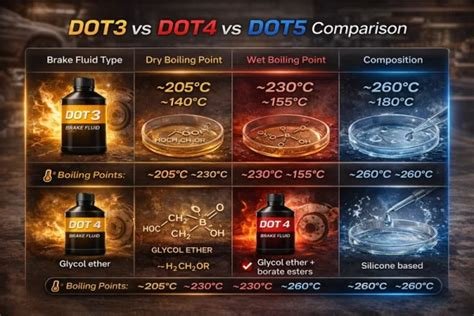
DOT 3 vs. DOT 4 Comparison Chart
| Feature | DOT 3 | DOT 4 |
| Chemical base | Glycol-based | Glycol-based |
| Minimum dry boiling point | 401°F (205°C) | 446°F (230°C) |
| Minimum wet boiling point | 284°F (140°C) | 311°F (155°C) |
| Hygroscopic | Yes | Yes |
| Common applications | Vehicles specifying DOT 3 | Vehicles specifying DOT 4 |
| ABS compatibility | Depends on vehicle requirements | Depends on formulation and vehicle requirements |
| Chemical compatibility with each other | Generally compatible | Generally compatible |
| Can always replace the other? | No | No |
| Manufacturer approval required | Yes | Yes |
These temperatures are minimum performance requirements, not the guaranteed actual boiling points of every product.
Some DOT 3 fluids exceed the minimum DOT 3 values, and some DOT 4 fluids exceed the minimum DOT 4 values.
What Does the DOT Rating Mean?
DOT stands for the U.S. Department of Transportation.
Brake fluid classifications are governed by Federal Motor Vehicle Safety Standard No. 116, commonly called FMVSS 116.
The standard establishes requirements related to boiling points, viscosity, chemical stability, corrosion protection, and other properties.
Why Does DOT 4 Have a Higher Boiling Point?
DOT 4 formulations commonly use different additives and chemical components to achieve higher boiling-point performance.
This can provide additional resistance to vapor formation during high-temperature braking.
However, a higher boiling point doesn’t automatically establish that a fluid is suitable for every braking system.
Is DOT 4 Always Better Than DOT 3?
Not necessarily.
DOT 4 has higher minimum boiling-point requirements, but the vehicle’s hydraulic components and electronic braking systems are designed around specific fluid characteristics.
The correct specification matters more than choosing the highest number on the bottle.
What Happens When You Mix DOT 3 and DOT 4?
Mixing standard DOT 3 and DOT 4 does not normally create the kind of immediate incompatibility associated with mixing glycol brake fluid and silicone DOT 5.
However, the combined fluid’s properties may change.
1. Boiling-Point Performance May Change
DOT 4 has higher minimum boiling-point requirements than DOT 3.
Adding DOT 3 to DOT 4 may reduce the thermal performance of the resulting mixture.
This is important because brake fluid can experience substantial heat during demanding braking.
2. The Mixture May Not Meet DOT 4 Requirements
Even if most of the fluid is DOT 4, the mixture isn’t automatically certified to meet DOT 4 specifications.
The actual resulting boiling point depends on the products and proportions.
You cannot reliably determine compliance just by looking at the percentage of each fluid.
3. Viscosity May Change
Brake fluid viscosity affects how fluid moves through the braking system.
This can be particularly important for electronically controlled braking components.
A mixture with unsuitable low-temperature flow characteristics may not meet the vehicle’s requirements.
4. Additive Performance May Differ
Brake fluid formulations contain additives intended to control corrosion and support component compatibility.
Different manufacturers may use different additive packages.
Chemical miscibility does not guarantee identical long-term performance.
5. There Is Usually No Immediate Chemical Reaction
Standard glycol-based DOT 3 and DOT 4 fluids generally mix without forming an obvious separate layer or immediate solid deposit.
However, this doesn’t establish that the mixture is safe for every vehicle.
Will Mixing DOT 3 and DOT 4 Cause Brake Failure?
Not automatically.
Mixing the two does not necessarily result in immediate loss of braking.
However, using fluid that does not meet the required specification can reduce safety margins, particularly under high-temperature or specialized hydraulic operating conditions.
If braking performance changes, the brake pedal becomes unusually soft, or a warning light appears, stop driving and arrange an inspection.
Key Takeaway: The principal concern is loss of required fluid performance, not an immediate reaction between ordinary DOT 3 and DOT 4.
Can You Add DOT 4 Brake Fluid to a DOT 3 System?
In some vehicles, DOT 4 can be used in a system originally specifying DOT 3, but you must confirm that the manufacturer permits it.
DOT 4 generally provides higher minimum boiling-point performance.
However, vehicle approval depends on more than boiling point.
Why Drivers Consider This Substitution
Some drivers consider using DOT 4 because it offers:
- Higher minimum dry boiling point.
- Higher minimum wet boiling point.
- Additional high-temperature performance potential.
- Availability in certain replacement-fluid brands.
However, these benefits don’t mean every DOT 4 product is an approved replacement.
Can You Top Off DOT 3 With DOT 4?
Potentially, but only after confirming that DOT 4 is allowed for your vehicle.
If the owner’s manual permits either DOT 3 or DOT 4, using a compatible fresh product according to the manufacturer’s instructions may be acceptable.
If the manual specifies DOT 3 only, verify the substitution before adding DOT 4.
Will DOT 4 Improve Braking Power?
Not necessarily.
Normal braking force depends on hydraulic operation, brake components, tires, and overall vehicle condition.
A higher boiling-point fluid can provide greater resistance to vapor formation during demanding braking.
It won’t automatically shorten stopping distances during normal driving.
Can You Completely Switch From DOT 3 to DOT 4?
Possibly, if the vehicle manufacturer approves the replacement.
A complete fluid exchange is preferable to arbitrary mixing when changing fluid specifications.
However, the replacement fluid must still meet all vehicle requirements.
Should You Upgrade DOT 3 to DOT 4 for Better Performance?
Not automatically.
For ordinary street driving, the manufacturer-specified fluid is generally the safest choice.
If you drive under demanding conditions, such as frequent mountain descents or performance use, consult the manufacturer or a qualified brake specialist before changing specifications.
Can You Add DOT 3 Brake Fluid to a DOT 4 System?
Adding DOT 3 to a vehicle that requires DOT 4 is generally not recommended because it may reduce the mixture below the required DOT 4 performance specifications.
This is an important difference between the two mixing scenarios.
Why Is This a Problem?
DOT 4 must meet higher minimum boiling-point requirements.
DOT 3 is permitted to have lower boiling points.
Mixing DOT 3 into a DOT 4 system can reduce the margin against boiling during heavy braking.
Is a Small Amount of DOT 3 Dangerous?
A small amount doesn’t automatically cause immediate brake failure.
However, the resulting mixture’s performance cannot be confirmed from the amount alone.
The correct response depends on:
- How much DOT 3 was added.
- Whether the vehicle requires ordinary DOT 4 or a specialized formulation.
- Whether the fluid has circulated through the braking system.
- The condition of the existing fluid.
- The manufacturer’s requirements.
If the vehicle requires DOT 4 and DOT 3 was added accidentally, contact a qualified mechanic to determine whether a complete fluid exchange is needed before continued operation.
Can You Add DOT 3 to DOT 4 in an Emergency?
Chemical compatibility doesn’t establish that this is a safe emergency substitute.
If the system has unexpectedly low fluid, the underlying cause may be a leak or brake pad wear.
If a leak or braking malfunction is suspected, do not drive the vehicle.
Arrange professional assistance rather than relying on an unapproved fluid substitution.
DOT 3 and DOT 4 Boiling Points Explained
Boiling point is one of the most important differences between DOT 3 and DOT 4.
Brake fluid must remain effective even when the braking system becomes hot.
Minimum Boiling-Point Requirements
| Specification | Dry boiling point | Wet boiling point |
| DOT 3 | 401°F (205°C) | 284°F (140°C) |
| DOT 4 | 446°F (230°C) | 311°F (155°C) |
These values are specified under the applicable DOT performance standard.
The HELLA technical guide to brake fluid explains these minimum values and the importance of boiling point, viscosity, and moisture resistance.
What Is Dry Boiling Point?
Dry boiling point refers to the boiling temperature of new brake fluid tested under specified conditions.
This is the fluid’s performance before the standardized moisture-aging test.
A higher dry boiling point provides greater potential resistance to vapor formation under high temperatures.
What Is Wet Boiling Point?
Wet boiling point measures the fluid’s boiling temperature after standardized moisture conditioning.
Glycol-based brake fluids absorb water over time.
As moisture increases, their boiling points generally decrease.
What Happens if Brake Fluid Boils?
When brake fluid boils, vapor bubbles can form in the hydraulic system.
Unlike liquid brake fluid, vapor is compressible.
This can produce:
- A soft brake pedal.
- Longer pedal travel.
- Reduced hydraulic pressure transmission.
- Reduced braking effectiveness.
- Potentially dangerous loss of braking.
This is why proper brake fluid condition and specification matter.
Does Mixing DOT 3 and DOT 4 Give an Average Boiling Point?
Not necessarily.
You cannot simply average the two published minimum boiling points and assume that the resulting mixture has that temperature.
For example, mixing equal amounts of DOT 3 and DOT 4 doesn’t guarantee a boiling point halfway between their specification limits.
The actual outcome depends on the fluid formulations, moisture content, and mixture properties.
Key Takeaway: DOT 4 must meet higher boiling-point requirements, and adding DOT 3 can undermine that performance. Mixing percentages do not establish a certified boiling point.
Can You Mix DOT 3 and DOT 4 in a Car With ABS?
Chemical compatibility is only one part of the answer.
Modern anti-lock braking systems may have additional fluid requirements.
What Does ABS Do?
ABS stands for Anti-lock Braking System.
It helps regulate brake pressure to reduce wheel lockup under certain braking conditions.
ABS hydraulic components may rapidly open and close valves to control pressure.
Does ABS Require DOT 4?
Not universally.
Some vehicles with ABS specify DOT 3.
Others specify ordinary DOT 4, DOT 4 LV, or another approved formulation.
The correct fluid depends on the braking system’s design.
What Is DOT 4 LV Brake Fluid?
DOT 4 LV means low-viscosity DOT 4.
It is designed for applications requiring particular fluid-flow characteristics, especially at low temperatures.
Certain modern ABS and electronic stability systems require these characteristics.
Can You Mix Ordinary DOT 4 With DOT 4 LV?
Do not assume they are interchangeable.
Both may carry a DOT 4 designation, but their low-temperature viscosity specifications can differ.
If your vehicle requires DOT 4 LV or an ISO 4925 Class 6 fluid, use a product meeting that requirement.
Can DOT 3 Replace DOT 4 LV?
Generally, no, unless explicitly permitted by the vehicle manufacturer.
DOT 3 does not automatically satisfy the boiling-point and low-temperature viscosity requirements of a specialized DOT 4 LV system.
Why Does Viscosity Matter?
Viscosity describes resistance to flow.
In electronically controlled braking systems, fluid must move predictably through valves and passages.
An unsuitable formulation can interfere with expected hydraulic response, particularly under low-temperature conditions.
Key Takeaway: For ABS-equipped vehicles, check the complete fluid specification, including any low-viscosity requirement, rather than relying on the DOT number alone.
DOT 3 vs. DOT 4 vs. DOT 5 vs. DOT 5.1: Which Can Be Mixed?
The numbering system can cause confusion.
DOT 5 and DOT 5.1 are fundamentally different types of fluid.
Brake Fluid Compatibility Chart
| Fluid | General chemical type | Mixing guidance |
| DOT 3 | Glycol-based | Generally chemically compatible with standard DOT 4 and DOT 5.1 |
| DOT 4 | Glycol-based | Generally chemically compatible with DOT 3 and DOT 5.1 |
| DOT 4 LV | Glycol-based, low-viscosity formulation | Use only as permitted by the vehicle specification |
| DOT 5 | Silicone-based | Do not mix with glycol-based DOT 3, DOT 4, or DOT 5.1 |
| DOT 5.1 | Glycol-based | Generally chemically compatible with DOT 3 and DOT 4 |
| Mineral-oil hydraulic fluid | Mineral-oil-based | Do not substitute for conventional glycol brake fluid |
Chemical compatibility does not automatically establish vehicle suitability.
Can You Mix DOT 3 and DOT 5?
No.
DOT 5 is silicone-based and should not be mixed with glycol-based DOT 3.
The same restriction applies to DOT 4 and DOT 5.1.
Can You Mix DOT 4 and DOT 5.1?
They are generally glycol-based and chemically compatible.
However, using them together may change performance characteristics.
Follow the vehicle manufacturer’s specifications.
Is DOT 5.1 the Same as DOT 5?
No.
Despite the similar numbering:
- DOT 5 is silicone-based.
- DOT 5.1 is glycol-based.
They are not interchangeable.
Can You Use Power Steering Fluid Instead of Brake Fluid?
No.
Power steering fluid, transmission fluid, and ordinary hydraulic oils must not be substituted for conventional automotive glycol brake fluid.
Petroleum-based contamination can damage brake system seals and other components.
If an incompatible fluid has entered the hydraulic brake system, do not operate the vehicle. Arrange professional inspection and appropriate repair.
What Should You Do if You Accidentally Mixed DOT 3 and DOT 4?
The correct response depends on which fluid your vehicle requires.
Do not assume the braking system is permanently damaged, but don’t ignore the specification difference.
Step 1: Identify the Required Brake Fluid
Check:
- The owner’s manual.
- The brake fluid reservoir cap.
- Manufacturer service information.
Look for the complete requirement.
For example, DOT 4 LV is more specific than a generic DOT 4 label.
Step 2: Identify What Was Added
Determine:
- Whether the added fluid was DOT 3 or DOT 4.
- The product brand and formulation.
- Whether the bottle was new and sealed.
- The approximate amount added.
- Whether the vehicle has been driven since.
This information can help a technician determine the appropriate service.
Step 3: Check for Any Brake Warning Signs
Do not drive if you notice:
- A brake pedal that sinks or feels unusually soft.
- Reduced braking effectiveness.
- A suspected hydraulic leak.
- A brake warning light indicating a hydraulic problem.
- Abnormally low brake fluid.
- Unusual pedal travel or pressure loss.
Have the vehicle inspected or towed when braking safety is uncertain.
Step 4: Ask Whether a Fluid Exchange Is Required
If the wrong specification was added, a mechanic may recommend restoring the system to the correct fluid.
The required response depends on the vehicle and what was added.
Step 5: Avoid Adding More Fluid to Correct the Mixture
Adding extra DOT 4 to a system contaminated with DOT 3 doesn’t prove that the resulting fluid meets DOT 4 specifications.
Do not try to correct an unknown mixture through guesswork.
Step 6: Have the Brake System Serviced Appropriately
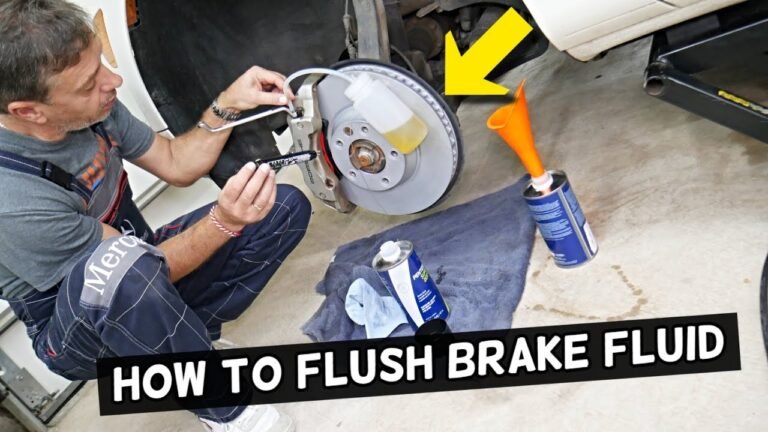
Where required, a qualified technician can perform a complete hydraulic brake fluid exchange.
Certain vehicles require specialized procedures to service ABS hydraulic components.
The process should follow the manufacturer’s instructions.
Do You Need to Flush the Brakes After Mixing DOT 3 and DOT 4?
Not every chemically compatible mixture automatically requires an emergency flush.
However, a fluid exchange may be appropriate when the mixture doesn’t meet the vehicle’s specified requirements.
When a Flush May Not Be Necessary
If the vehicle manufacturer explicitly permits both fluids and the system contains clean, suitable fluid, mixing may not require immediate replacement.
However, this should be based on the manufacturer’s instructions, not on assumptions.
When a Flush Is Recommended
A professional fluid exchange is worth considering when:
- DOT 3 was added to a system requiring DOT 4.
- The vehicle requires DOT 4 LV and an unsuitable fluid was introduced.
- The fluid specification is uncertain.
- The existing fluid is old or contaminated.
- The manufacturer requires a single approved formulation.
- The brake system has been opened for repair.
Can You Remove the Wrong Fluid From the Reservoir Only?
If the fluid hasn’t circulated, the reservoir contents may be easier to address than fluid already distributed through the system.
However, removing only the reservoir fluid does not guarantee that the complete hydraulic system contains the required fluid.
A qualified technician should determine the appropriate procedure.
Can a Brake Flush Restore the Correct Fluid?
A properly performed exchange can replace the existing fluid with the manufacturer-specified product.
However, the procedure must address the relevant hydraulic circuits and any specialized ABS requirements.
If the system was contaminated with petroleum products or silicone fluid, additional component inspection or replacement may be needed.
Can You Keep Driving After Mixing the Fluids?
There isn’t a universal answer.
Standard DOT 3 and DOT 4 mixing doesn’t automatically cause immediate brake failure, but a mixture that fails to meet the required specification should not be assumed safe for continued driving.
If the fluid was added accidentally, verify the specification and obtain professional advice promptly.
If braking performance is abnormal, do not drive.
Is It Safe to Top Off Brake Fluid With a Different DOT Rating?
First, determine why the fluid is low.
A brake fluid level that decreases slightly over time may be related to brake pad wear.
A rapid or unusually large decrease may indicate a hydraulic leak.
Why Brake Fluid Levels Drop
Possible reasons include:
- Normal brake pad wear.
- Leaking calipers.
- Damaged brake hoses.
- Corroded brake lines.
- Master cylinder problems.
- Recent maintenance.
- Other hydraulic system faults.
A low reservoir level should not automatically be treated as a simple maintenance issue.
Should You Top Off Brake Fluid Immediately?
Not always.
If the fluid is low because the pads are heavily worn, filling the reservoir to the maximum mark may create an overfill condition when the pistons are later retracted.
If the level is falling because of a leak, adding fluid won’t solve the problem.
Inspect the braking system and follow manufacturer guidance.
Can You Add DOT 4 if the Reservoir Says DOT 3?
Only if the vehicle manufacturer permits that fluid.
The label on the reservoir is important, but the owner’s manual or current manufacturer service information may provide additional specifications.
Can You Add DOT 3 if the Reservoir Says DOT 4?
Generally, avoid doing so.
DOT 3 may not maintain the required DOT 4 boiling-point performance.
Use the specified fluid.
What if You Have No Correct Brake Fluid Available?
If the reservoir level is dangerously low or a leak is suspected, do not attempt to solve the problem by adding an unapproved substitute.
Arrange professional assistance.
Key Takeaway: Never use a different brake fluid specification merely to compensate for unexplained fluid loss. Identify the cause and use the approved product.
Does Mixing DOT 3 and DOT 4 Affect Brake Performance?
It can affect the performance margin of the fluid, but the effect may not be immediately noticeable during ordinary braking.
Normal Braking Conditions
Under ordinary conditions, a chemically compatible DOT 3/DOT 4 mixture may transmit hydraulic pressure without an obvious pedal change.
However, normal pedal feel is not proof that the mixture meets the vehicle’s specifications.
Heavy Braking Conditions
During demanding braking, higher temperatures increase the importance of the fluid’s boiling point.
If the mixture has a lower boiling point than required, the risk of vapor formation can increase.
Mountain Driving
Long downhill roads can involve repeated braking.
The brake system may remain hot for extended periods.
Maintaining the correct fluid’s thermal performance is especially important in these conditions.
Towing
Towing can increase braking demands, depending on the vehicle, trailer, and braking system.
The manufacturer-specified brake fluid should be maintained.
Performance Driving
Track use and other high-temperature applications may require specialized approved fluids and more frequent maintenance.
Do not rely on an untested DOT 3/DOT 4 mixture for demanding performance use.
Does Mixing Cause a Spongy Brake Pedal?
Mixing standard DOT 3 and DOT 4 does not inherently introduce air into the hydraulic system.
A spongy pedal may result from:
- Trapped air.
- Brake fluid boiling.
- Hydraulic leaks.
- Incorrect bleeding.
- Other brake component problems.
If the pedal becomes spongy after service, the system needs diagnosis.
Does DOT 4 Absorb More Water Than DOT 3?
Both DOT 3 and DOT 4 are hygroscopic, meaning they absorb moisture.
However, the rate of moisture absorption depends on the fluid formulation and operating conditions.
It’s not accurate to claim that every DOT 4 product absorbs moisture faster than every DOT 3 product.
How Does Moisture Enter Brake Fluid?
Moisture may enter gradually through:
- Brake hoses.
- Reservoir components.
- Seals.
- Service openings.
- Improperly stored fluid.
Over time, moisture can reduce boiling-point performance.
Does Mixing Make Brake Fluid Absorb More Water?
Not necessarily.
Mixing changes the overall formulation, but there is no universal rule that adding DOT 3 to DOT 4 increases moisture absorption by a predictable amount.
The more important issue is whether the resulting fluid meets the vehicle’s requirements.
How Often Should You Change Brake Fluid?
Many vehicles specify replacement approximately every two to three years, although some use different intervals or condition-based schedules.
Follow the manufacturer’s maintenance requirements.
Can You Use an Opened Bottle of Brake Fluid?
Fresh fluid from a sealed container is preferable.
Opened brake fluid can absorb moisture during storage, particularly if it has been exposed to humid air or wasn’t tightly sealed.
If the bottle’s condition is uncertain, don’t use it in a safety-critical braking system.
How to Choose the Correct DOT 3 or DOT 4 Brake Fluid
Choosing brake fluid involves more than matching the DOT number.
1. Check the Owner’s Manual
Look for the exact required specification.
This may include:
- DOT 3.
- DOT 4.
- DOT 4 LV.
- DOT 5.1.
- A manufacturer-specific approval.
- An ISO or SAE performance standard.
Follow the complete requirement.
2. Check the Reservoir Cap
The reservoir cap may identify the recommended fluid.
However, verify any additional manufacturer requirements.
3. Read the Fluid Bottle Carefully
Check whether the product meets the stated specification.
Do not choose fluid solely because its label says high performance or racing.
4. Confirm ABS or Electronic Stability Requirements
Certain vehicles require a particular low-temperature viscosity.
Ordinary DOT 4 isn’t automatically equivalent to DOT 4 LV.
5. Use a Fresh, Sealed Container
Glycol-based brake fluid absorbs moisture.
Use clean, properly stored fluid.
Keep contaminants out of the bottle and reservoir.
6. Avoid Unapproved Additives
Do not add lubricants, brake-system additives, or other liquids unless specifically required by the vehicle manufacturer.
7. Have the Fluid Changed When Due
If the service interval has arrived, replace the fluid using the approved specification.
Routine maintenance is preferable to mixing fluids of uncertain condition.
The Brembo brake fluid technical guide emphasizes that although DOT 3 and DOT 4 are both glycol-based, their formulations differ and the safest approach is to follow the vehicle manufacturer’s recommended fluid.
Common Mistakes When Mixing DOT 3 and DOT 4 Brake Fluid
Assuming Chemical Compatibility Means Full Interchangeability
DOT 3 and DOT 4 may mix physically, but the resulting performance may not satisfy the required specification.
Adding DOT 3 to a DOT 4 System Without Checking
This can reduce the mixture’s thermal performance.
Follow the manufacturer’s required fluid specification.
Assuming DOT 4 Is Automatically Better for Every Vehicle
A higher minimum boiling point doesn’t establish compatibility with every hydraulic braking system.
Ignoring DOT 4 LV Requirements
Specialized low-viscosity fluids may be necessary for certain electronic braking systems.
Ordinary DOT 3 or DOT 4 shouldn’t automatically be substituted.
Confusing DOT 5 and DOT 5.1
DOT 5 is silicone-based.
DOT 5.1 is glycol-based.
The two are not interchangeable.
Mixing Brake Fluid With Mineral Oil
Petroleum-based hydraulic fluids can damage components designed for glycol brake fluid.
Never substitute them.
Using Brake Fluid From an Old Open Bottle
Moisture contamination can reduce fluid performance.
Use clean, suitable fluid from a properly stored container.
Trying to Improve DOT 3 by Adding a Small Amount of DOT 4
A small addition doesn’t establish the boiling point or overall performance of the mixture.
Use the correct approved fluid.
Topping Off Without Checking for Leaks
A low reservoir may indicate brake pad wear or a hydraulic fault.
Adding fluid is not a substitute for inspection.
Ignoring Brake Warning Signs
A sinking pedal, reduced braking effectiveness, or suspected hydraulic leak requires immediate attention.
Don’t drive a vehicle with potentially unsafe brakes.
Quick Brake Fluid Mixing Decision Guide
| Situation | Recommended action |
| Vehicle specifies DOT 3; you have DOT 3 | Use fresh approved DOT 3 |
| Vehicle specifies DOT 3; you have DOT 4 | Confirm manufacturer permission before substitution |
| Vehicle specifies DOT 4; you have DOT 4 | Use fresh DOT 4 meeting the full required specification |
| Vehicle specifies DOT 4; you have DOT 3 | Do not substitute without explicit manufacturer approval |
| Vehicle specifies DOT 4 LV | Use the required low-viscosity specification |
| DOT 3 and DOT 4 were accidentally mixed | Verify requirements and obtain professional advice on fluid exchange |
| DOT 5 was accidentally added to glycol-based fluid | Do not drive; obtain professional inspection and service |
| Brake fluid level is unexpectedly low | Inspect for brake wear or hydraulic leaks |
| Brake pedal feels soft or sinks | Do not drive; arrange inspection |
| Fluid type is unknown | Identify the correct specification before adding anything |
Conclusion
DOT 3 and DOT 4 brake fluids are generally chemically compatible, but mixing them isn’t always appropriate for your vehicle.
DOT 4 has higher minimum dry and wet boiling-point requirements than DOT 3. Adding DOT 3 to a system requiring DOT 4 can reduce the fluid’s thermal performance, while adding DOT 4 to a DOT 3 system may be acceptable only when the vehicle manufacturer permits it.
Specialized fluids such as DOT 4 LV require particular attention because low-temperature viscosity is also important.
If you’ve already mixed the fluids, don’t assume immediate damage, but don’t assume the mixture meets the correct specification either.
I recommend checking the owner’s manual, identifying the products involved, and consulting a qualified brake technician if an unapproved fluid was added. A proper fluid exchange may be needed to restore the manufacturer’s specified braking performance.
The safest rule is simple: use the brake fluid specified for your vehicle rather than mixing DOT ratings based on chemical compatibility alone.
FAQs About Mixing DOT 3 and DOT 4 Brake Fluid
Can You Mix DOT 3 and DOT 4 Brake Fluid Without Problems?
DOT 3 and DOT 4 are generally chemically compatible because both are glycol-based.
However, mixing them may change boiling-point performance and other properties.
Use only the fluid specifications approved by your vehicle manufacturer.
Will Mixing DOT 3 and DOT 4 Damage My Brakes?
Not necessarily.
Standard DOT 3 and DOT 4 don’t usually cause immediate chemical incompatibility.
However, the mixture may not satisfy your vehicle’s required specifications.
An unsuitable fluid can compromise braking performance under certain operating conditions.
Can I Put DOT 4 in a Car That Takes DOT 3?
Sometimes.
Certain vehicles permit DOT 4 in place of DOT 3.
However, check the manufacturer’s instructions before making the substitution.
A higher DOT number does not guarantee compatibility.
Can I Put DOT 3 in a Car That Takes DOT 4?
Generally, it isn’t recommended.
DOT 3 has lower minimum boiling-point requirements.
Adding it may reduce the fluid mixture below the vehicle’s required DOT 4 performance.
What Happens if You Accidentally Put DOT 3 in DOT 4?
The fluids generally mix without an immediate chemical reaction.
However, the resulting mixture may not meet DOT 4 requirements.
Contact a qualified mechanic to determine whether a complete fluid exchange is necessary.
Can You Mix DOT 3 and DOT 4 in an ABS System?
Chemical compatibility is possible, but ABS systems may have specific boiling-point and viscosity requirements.
If your vehicle specifies DOT 4 LV or another specialized fluid, don’t substitute ordinary DOT 3 or DOT 4 without manufacturer approval.
Is DOT 4 Brake Fluid Better Than DOT 3?
DOT 4 must meet higher minimum dry and wet boiling-point requirements.
However, it isn’t automatically better for every vehicle.
Use the manufacturer’s specified fluid.
Can You Mix DOT 3 and DOT 4 in a 50/50 Ratio?
The fluids can generally mix, but a 50/50 blend isn’t a recognized universal brake fluid recommendation.
The mixture’s boiling point and other properties cannot be guaranteed without testing.
Use an approved fluid rather than creating a custom blend.
Does Mixing DOT 3 and DOT 4 Lower the Boiling Point?
Adding DOT 3 to DOT 4 may reduce the mixture’s boiling-point performance.
However, the exact resulting temperature depends on the formulations and proportions.
It cannot be calculated reliably by simply averaging published minimum values.
Can You Mix DOT 3, DOT 4, and DOT 5.1?
These three fluids are generally glycol-based and chemically compatible.
However, that doesn’t mean a three-fluid mixture meets the vehicle’s required specifications.
Use the manufacturer-approved fluid.
Can You Mix DOT 5 With DOT 3 or DOT 4?
No.
DOT 5 is silicone-based and should not be mixed with glycol-based DOT 3 or DOT 4.
If incompatible fluid has been added, do not operate the vehicle until the braking system has been professionally evaluated.
Do You Have to Flush Your Brakes After Mixing DOT 3 and DOT 4?
Not in every situation.
If the manufacturer permits the fluids and the mixture meets the required specifications, an immediate flush may not be necessary.
If the wrong specification was added, a qualified technician may recommend a complete exchange.
Can You Top Off DOT 3 With DOT 4?
Only when DOT 4 is permitted by the vehicle manufacturer.
Also check why the fluid level is low.
Brake pad wear or a hydraulic leak may be responsible.
Can You Top Off DOT 4 With DOT 3?
Generally, avoid doing so.
DOT 3 may reduce the mixture’s thermal performance below the DOT 4 requirements.
Use the specified fluid.
Can Mixing DOT 3 and DOT 4 Cause a Spongy Brake Pedal?
Mixing standard glycol-based DOT 3 and DOT 4 does not inherently introduce air.
However, a spongy pedal can indicate trapped air, vapor formation, hydraulic leaks, or another braking-system problem.
Have it inspected immediately.
Should You Use DOT 3 or DOT 4 Brake Fluid?
Use whichever fluid meets your vehicle manufacturer’s complete specification.
Check the owner’s manual and reservoir labeling.
If the required fluid is uncertain, verify the specification before adding anything to the hydraulic system.