Can You Add Brake Fluid When Engine Is Hot? Safety and Steps
Yes, you can physically add brake fluid when the engine is hot, but it is not recommended. The safer approach is to turn off the engine, allow the engine compartment to cool, and then check or refill the brake fluid reservoir if necessary. The brake fluid reservoir is different from the pressurized engine cooling system, so adding brake fluid does not normally release hot steam or coolant. However, working around a hot engine creates other safety risks.
After driving, engine components, exhaust parts, and nearby surfaces may remain extremely hot. Accidentally touching these components can cause burns, while brake fluid spilled onto sufficiently hot surfaces may create a fire hazard. Brake fluid can also damage automotive paint and should be handled carefully.
Another important concern is why the brake fluid level is low. A falling level can indicate worn brake pads or a hydraulic leak, and simply adding fluid may hide a problem that needs inspection.
In this article, I explain whether you can add brake fluid when the engine is hot, why waiting is safer, and how long to let the engine cool. I also cover the correct refilling procedure, DOT fluid compatibility, reservoir levels, spill precautions, and warning signs that indicate your braking system needs professional attention.
Can You Add Brake Fluid When Engine Is Hot?
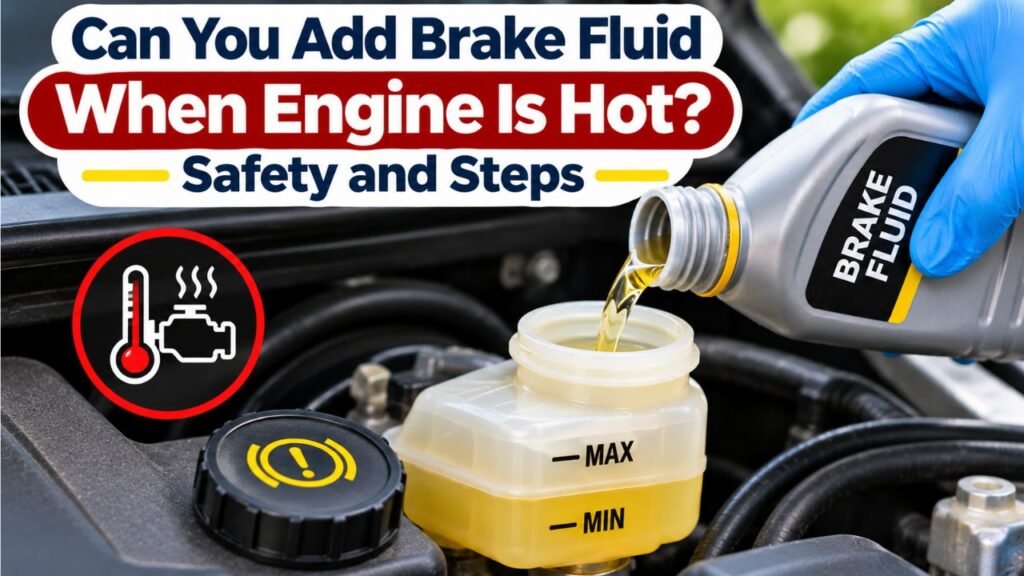
Adding brake fluid to a warm vehicle is physically possible, but waiting until the engine is off and the engine compartment has cooled is the safest general recommendation.
The braking system does not require the engine to be hot before brake fluid can be added. In fact, you should normally perform a reservoir inspection with the engine switched off.
The main risks involve hot components, fluid spills, and accidental contact with moving parts.
What Happens If You Add Brake Fluid to a Hot Engine?
If the correct brake fluid is carefully poured into the proper reservoir without spilling, the engine’s temperature alone does not necessarily cause an immediate problem.
However, an accidental spill can be dangerous.
Brake fluid may contact:
- Hot engine surfaces.
- Exhaust components.
- Nearby wiring or hoses.
- Painted body panels.
- Other components inside the engine compartment.
Some of these surfaces may remain hot long after the engine stops running.
Is It Safe If the Engine Is Only Warm?
A mildly warm engine compartment is generally less hazardous than one containing extremely hot components.
However, it is difficult to determine the temperature of individual components by appearance.
For routine maintenance, there is little benefit to opening the reservoir while the engine compartment is still hot.
Allow the vehicle to cool before working near the master cylinder.
Does the Engine Need to Be Running?
No.
You normally do not need to start or idle the engine to add brake fluid.
For example, AutoZone’s guide to checking brake fluid recommends checking the brake fluid with the engine off and cold.
The engine should remain off while performing a standard reservoir inspection or permitted refill.
Quick Safety Comparison
| Engine Condition | Can Brake Fluid Be Added? | Recommended Action |
| Engine completely cold | Yes, if refilling is appropriate | Preferred condition |
| Engine slightly warm | Physically possible | Allow further cooling when practical |
| Engine very hot after driving | Technically possible, but hazardous | Wait until the engine bay cools |
| Engine overheating | Not recommended | Address overheating safely; don’t approach hot components |
| Engine running | Normally unnecessary | Switch the engine off |
| Brake fluid below MIN | Requires investigation | Check for leaks and brake wear before driving |
| Brake fluid between MIN and MAX | Usually no refill needed | Leave the cap closed unless servicing is required |
Key Takeaway: The fact that brake fluid can be added while the engine is hot does not make it advisable. For normal maintenance, turn off the engine, wait for safe access, and investigate the reason for any low fluid level.
Why Should You Avoid Adding Brake Fluid to a Hot Engine?
Several risks make a cooled engine compartment preferable.
1. Hot Engine Components Can Cause Burns
After a vehicle has been driven, the engine and nearby metal components may remain hot.
The exhaust manifold and related components can become especially hot during operation.
Accidentally touching them while reaching for the brake fluid reservoir may cause serious burns.
Even if the brake reservoir itself feels relatively cool, surrounding components may not be safe to touch.
2. Spilled Brake Fluid Can Create a Fire Hazard
Brake fluid should never be deliberately spilled onto hot engine or exhaust components.
In the official 2011 Mazda CX-7 owner’s manual, Brake Fluid section, page 8-25, Mazda specifically warns that brake fluid spilled on a sufficiently hot engine could cause a fire.
This does not mean every drop of brake fluid automatically ignites upon touching a warm surface.
However, it establishes that a fire hazard is possible under sufficiently hot conditions.
Waiting for the engine compartment to cool reduces unnecessary exposure to this risk.
3. Brake Fluid Can Damage Automotive Paint
Many conventional brake fluids can damage painted automotive surfaces.
An accidental splash may affect the paint or protective finish.
The risk exists whether the engine is hot or cold.
However, working in a hot engine compartment can make precise pouring more difficult.
Use suitable precautions and prevent fluid from contacting painted panels.
4. Cooling Fans May Start Unexpectedly
Some vehicles have electrically operated radiator fans that can run or start even after the engine has been switched off.
A hot engine may trigger additional cooling activity.
Keep hands, clothing, tools, and loose materials away from fans, belts, and other moving components.
Never assume that every component becomes inactive immediately when the ignition is switched off.
5. Rushing Increases the Risk of Contamination
Brake fluid must remain clean.
Opening the reservoir in a hurry can allow dirt, moisture, or foreign materials to enter the hydraulic system.
A contaminated braking system may require additional service.
Waiting until the vehicle is safe to work on allows you to clean the reservoir properly before removing its cap.
Important: Brake fluid should not be treated like engine coolant. The two systems are separate, and their reservoirs require different handling procedures.
How Long Should You Wait Before Adding Brake Fluid?
There is no universal cooling time that applies to every vehicle.
The required time depends on the engine’s operating temperature, vehicle design, ambient conditions, and how recently the car was driven.
After a Short Drive
If the engine has been running only briefly, some parts may cool relatively quickly.
However, the exhaust system may still be hot.
Wait until you can access the brake fluid reservoir without contacting hot components.
After a Long Highway Drive
Long driving periods can leave the engine compartment and exhaust components at elevated temperatures.
Allow sufficient time for the vehicle to cool.
Do not assume that a short waiting period makes every part safe to touch.
After Heavy Traffic
Stop-and-go traffic can increase underhood temperatures.
Cooling fans may operate frequently, and some components may remain hot after parking.
Wait for safe access before beginning maintenance.
After Driving Down a Steep Hill
Extended or repeated braking can generate substantial heat in the braking system.
If the brakes have been used heavily, allow the vehicle to cool before inspecting or servicing brake components.
Is Waiting 15–30 Minutes Enough?
It may be enough in some situations, but it is not a guaranteed safe cooling period.
The engine and exhaust can remain hot longer.
Avoid using a fixed number of minutes as proof that the vehicle is safe.
Best practice: Turn off the engine, park on level ground, and allow the engine compartment to cool sufficiently before touching or opening components.
Can You Check Brake Fluid When the Engine Is Hot?
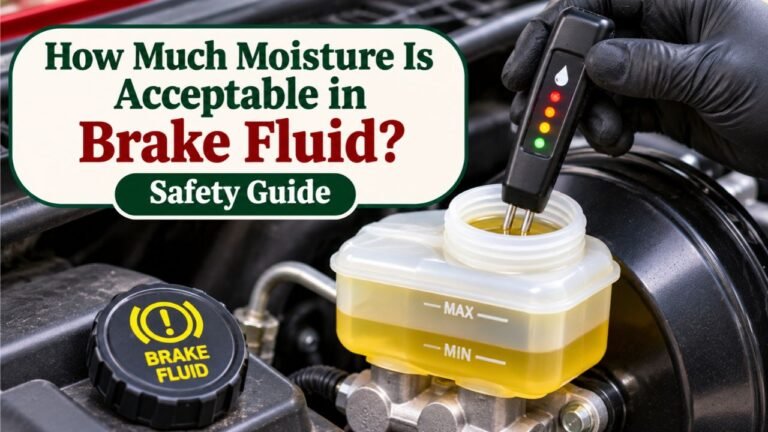
In many vehicles, you can visually inspect the brake fluid level without opening the reservoir.
Most modern brake fluid reservoirs are made from translucent plastic.
The side of the reservoir normally has minimum and maximum level markings.
How to Check the Level
- Park the vehicle on level ground.
- Turn off the engine.
- Allow the engine compartment to cool before reaching inside.
- Open the hood safely.
- Locate the brake fluid reservoir.
- Identify the MIN and MAX markings.
- Observe the fluid level through the reservoir wall.
- Compare the level with the markings and the owner’s manual.
If the fluid is within the specified range, no additional brake fluid may be necessary.
Where Is the Brake Fluid Reservoir?
The reservoir is commonly located near the rear of the engine compartment on the driver’s side.
It is usually mounted on or near the brake master cylinder.
A typical reservoir has a cap marked with the required brake fluid specification or a brake-system symbol.
The exact location varies by vehicle.
Should You Remove the Cap Just to Check the Level?
Usually not.
If the reservoir is translucent and the level markings are visible, inspect it without opening the cap.
This reduces the chance of introducing dirt or moisture.
What if You Cannot See the Fluid Level?
Clean the outside of the reservoir carefully.
Try viewing the level under better lighting.
If the reservoir remains difficult to read, consult the owner’s manual for the appropriate inspection procedure.
Avoid opening the hydraulic system unnecessarily.
How to Add Brake Fluid Safely After the Engine Cools
If the vehicle manufacturer permits a top-up and the cause of the low level has been evaluated, use the following general procedure.
These steps apply to conventional automotive brake-fluid reservoirs. Some vehicles have special hydraulic or electronic braking systems that require different service procedures.
Step 1: Park on a Level Surface
Park the vehicle on stable, level ground.
Place the transmission in Park or the appropriate gear, and secure the vehicle according to its owner’s manual.
A sloped parking surface may make it harder to judge the fluid level accurately.
Step 2: Switch Off the Engine
Turn off the engine and remove the key where applicable.
For vehicles with push-button ignition, make sure the vehicle is fully switched off.
Follow any additional shutdown requirements in the owner’s manual.
Step 3: Allow the Engine Compartment to Cool
Wait until you can work without contacting hot components.
Keep clear of the cooling fan and other moving parts.
If the engine was recently overheating, do not begin maintenance until the immediate hazard has been addressed.
Step 4: Locate the Reservoir
Find the brake master cylinder reservoir.
Consult the owner’s manual if you are uncertain.
Do not confuse the brake fluid reservoir with:
- Engine coolant reservoir.
- Windshield washer fluid tank.
- Power steering fluid reservoir.
- Engine oil filler.
Adding the wrong fluid to any of these systems can cause serious damage.
Step 5: Check the Fluid Level
Look at the MIN and MAX marks.
If the level is within the specified range, topping off usually isn’t necessary.
If the level is below MIN or falling unexpectedly, have the braking system evaluated before relying on the vehicle.
Step 6: Confirm the Required Brake Fluid
Check the owner’s manual and reservoir cap.
Different vehicles may specify:
- DOT 3.
- DOT 4.
- DOT 4 LV.
- DOT 5.
- DOT 5.1.
- Another manufacturer-specific hydraulic fluid.
Use the exact specification approved for your vehicle.
Do not assume that every DOT brake fluid is interchangeable.
Step 7: Prepare Fresh Brake Fluid
Use fluid from a new, sealed container whenever possible.
Brake fluid can absorb moisture from the surrounding air.
Avoid using old fluid from an uncertain or improperly stored bottle.
Keep the bottle closed until you are ready to pour.
Step 8: Clean Around the Reservoir Cap
Use a clean, lint-free cloth to remove dirt and debris from around the cap.
The objective is to prevent contaminants from entering the hydraulic system.
Don’t allow cleaning chemicals, water, or dirty cloth fibers to fall into the reservoir.
Step 9: Remove the Cap Carefully
Follow the cap-removal procedure specified by the manufacturer.
Some caps twist off.
Others use clips or different retaining arrangements.
Avoid pulling on attached sensor wiring.
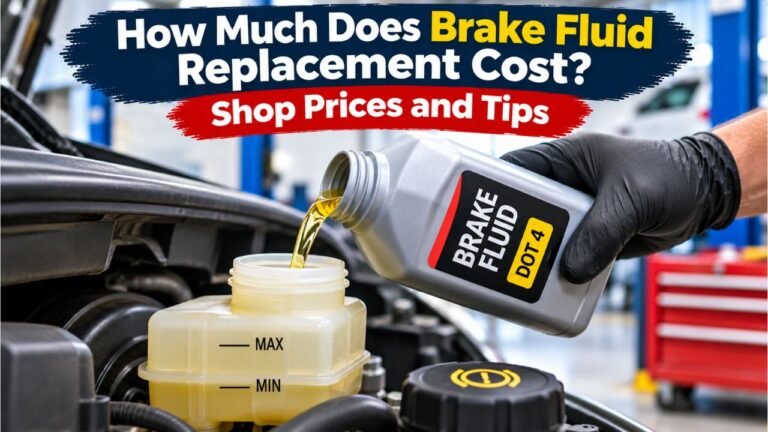
Step 10: Add Brake Fluid Slowly
If a refill is appropriate, pour the correct brake fluid carefully into the reservoir.
Stop frequently to check the level.
Never fill beyond the manufacturer’s maximum mark.
The Ford guide to adding brake fluid recommends using the specified fluid from a clean, unopened container, protecting painted surfaces, cleaning around the reservoir, and avoiding overfilling.
Step 11: Reinstall the Reservoir Cap
Secure the cap according to the manufacturer’s design.
Make sure it is properly seated.
Keep the cap opening free from debris.
Step 12: Check for Problems Before Driving
Verify that no fluid has spilled.
Confirm that the reservoir cap is securely installed.
Check for obvious leaks and warning indicators.
If the brake pedal feels unusually soft, sinks toward the floor, or the brake warning light remains on, do not drive until the problem has been diagnosed.
Important: These steps describe how a permitted refill is performed. They do not mean that adding fluid is the correct remedy for every low-reservoir condition.
Should You Add Brake Fluid If the Reservoir Is Low?
Not automatically.
Brake fluid level can decrease because brake pads wear or because fluid is leaking from the hydraulic system.
Those situations require different responses.
Normal Brake Pad Wear
As disc brake pads become thinner, the caliper pistons extend farther to maintain contact with the rotors.
This movement requires additional brake fluid inside the calipers.
As a result, the reservoir level may gradually decrease.
That does not necessarily mean the fluid is leaking.
Why Topping Off Can Be a Problem
Suppose the brake pads are significantly worn and the reservoir is filled to MAX.
When the old pads are replaced, the caliper pistons are pushed back into their normal positions.
Fluid moves back toward the reservoir.
If the reservoir was previously topped off unnecessarily, the level may become excessive and fluid may overflow.
This is one reason some manufacturers specifically advise against routinely topping off brake fluid to compensate for pad wear.
Brake Fluid Leaks
A leak can occur at:
- Brake lines.
- Flexible brake hoses.
- Calipers.
- Wheel cylinders.
- Master cylinder components.
- Certain hydraulic connections.
An unexplained or rapidly falling reservoir level requires inspection.
When Is Adding Brake Fluid Appropriate?
Adding fluid may be part of an approved service procedure after:
- Repairing the hydraulic system.
- Replacing certain brake components.
- Bleeding the brakes.
- Performing a brake fluid replacement.
- Completing another manufacturer-approved maintenance operation.
If the fluid is simply low without an identified reason, investigate before topping off.
When Should You Avoid Driving?
Do not drive if:
- The brake pedal is soft or sinks.
- Braking performance has changed.
- The reservoir is empty.
- A leak is suspected.
- The brake warning light indicates a hydraulic problem.
- The level falls rapidly after refilling.
Arrange professional inspection or towing as appropriate.
Key Takeaway: Low brake fluid is a symptom, not a diagnosis. Determine whether brake pad wear or a leak is responsible before adding more.
What Type of Brake Fluid Should You Add?
The correct brake fluid depends on the vehicle.
Common passenger-car specifications include DOT 3, DOT 4, DOT 5, and DOT 5.1.
However, not every type is compatible with every system.
Brake Fluid Types Compared
| Fluid Type | Main Chemistry | Typical Characteristics |
| DOT 3 | Glycol-based | Common conventional automotive brake fluid |
| DOT 4 | Glycol-based | Generally higher minimum boiling-point requirements than DOT 3 |
| DOT 4 LV | Glycol-based | Low-viscosity formulations for compatible systems |
| DOT 5 | Silicone-based | Different chemistry; not interchangeable with conventional glycol fluid |
| DOT 5.1 | Glycol-based | Higher minimum boiling-point requirements than DOT 3 and DOT 4 |
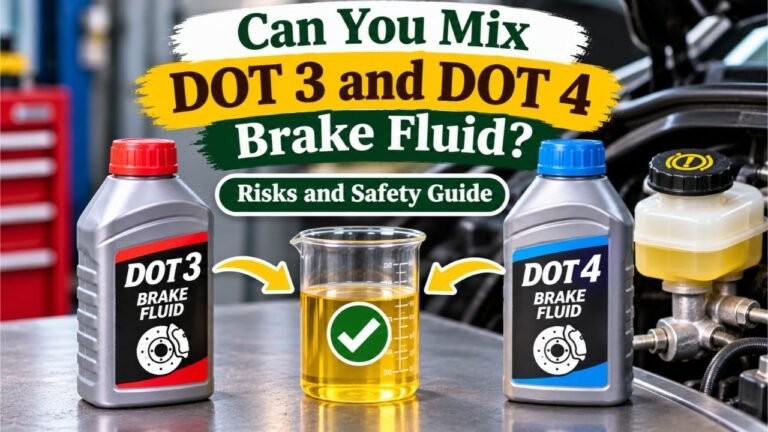
Can You Mix DOT 3 and DOT 4?
DOT 3 and conventional DOT 4 are generally chemically compatible as glycol-based fluids.
However, that doesn’t mean you should automatically substitute one for the other.
Follow the vehicle manufacturer’s required fluid specification.
Some braking systems require particular viscosity or performance characteristics.
Can You Mix DOT 4 and DOT 5.1?
Both are generally glycol-based, but compatibility and suitability for a particular vehicle must still be confirmed.
Use the specified type.
Can You Add DOT 5 to DOT 3 or DOT 4?
No.
Silicone-based DOT 5 must not be mixed with ordinary glycol-based brake fluids.
Using an incompatible fluid can damage braking-system components and impair operation.
Does DOT 5.1 Mean the Same Thing as DOT 5?
No.
Despite the similar names, DOT 5.1 is glycol-based, while conventional DOT 5 is silicone-based.
Always verify the full specification.
Does Brake Fluid Need to Be Cold Before Adding It?
The brake fluid itself does not normally need to be refrigerated or cooled to a special temperature before a permitted refill.
The more important concerns are its specification, cleanliness, and safe handling.
Can You Pour Room-Temperature Brake Fluid Into a Warm Reservoir?
There is no ordinary requirement to warm brake fluid before use.
A modest difference between room-temperature fluid and a warm reservoir is not generally the primary hazard.
However, pouring into a reservoir while the engine compartment is dangerously hot introduces unnecessary spill and burn risks.
Will Cold Brake Fluid Damage a Hot Brake System?
The main concerns during routine maintenance are contamination, fluid compatibility, overfilling, and safe access.
The manufacturer’s specified service procedures should be followed.
Do not use temperature differences as a reason to ignore hot-engine safety precautions.
Should You Heat Brake Fluid Before Adding It?
No.
Do not heat brake fluid as a preparation step.
Use new fluid from a properly stored container at normal ambient temperature, following the product instructions.
Is the Brake Fluid Reservoir Pressurized When the Engine Is Hot?
In many conventional vehicles, the brake fluid reservoir is vented or pressure-compensated so fluid can move as the hydraulic system operates.
It is not the same as a pressurized engine coolant expansion tank.
Brake Fluid Reservoir vs Coolant Reservoir
| Feature | Brake Fluid Reservoir | Engine Coolant Reservoir |
| System | Hydraulic braking | Engine cooling |
| Common fluid | DOT-specified brake fluid | Vehicle-approved coolant |
| Main purpose | Supplies hydraulic brake system | Supports engine cooling |
| Typical inspection | Fluid level between specified marks | Vehicle-specific hot/cold level markings |
| Hot-engine concern | Hot parts, spills, contamination | Hot parts and potentially pressurized coolant |
| Safe refill approach | Engine off and cooled; only when appropriate | Follow cooling-system instructions; never open a hot pressurized cap |
Can Brake Fluid Spray Out Like Hot Coolant?
A conventional brake fluid reservoir does not normally behave like a pressurized radiator cap.
Removing its cap during ordinary maintenance should not produce a jet of hot steam or boiling coolant.
However, some modern integrated brake-control and electrohydraulic systems have special service requirements.
Do not assume that the reservoir can be opened during every operating mode.
Follow the vehicle-specific instructions.
Why Should You Still Wait for Cooling?
Because the surrounding engine compartment may contain hot components.
The absence of radiator-style pressure doesn’t eliminate the risks of burns, spills, fire, and contamination.
What Happens if Brake Fluid Spills on a Hot Engine?
An accidental spill should be treated seriously.
The severity depends on where the fluid lands, the temperature of the surface, and the amount spilled.
Potential Fire Hazard
Brake fluid spilled onto sufficiently hot engine or exhaust components can create a fire hazard.
Do not continue pouring if fluid spills onto hot machinery.
Stop the work and avoid approaching the affected surface until it can be handled safely.
If a fire develops, move away from the vehicle and contact emergency services.
Paint Damage
Conventional brake fluid can damage painted surfaces.
If fluid contacts painted bodywork, follow the vehicle manufacturer’s spill instructions and clean it promptly when safe.
Avoid rubbing contaminated fluid across a larger area.
Damage to Other Components
Brake fluid can affect certain plastics, coatings, and other materials.
Keep it away from components not designed for contact with hydraulic fluid.
What Should You Do Immediately?
If you spill brake fluid:
- Stop pouring.
- Close the fluid bottle securely.
- Avoid touching hot components.
- Keep ignition sources away.
- Allow hot surfaces to cool before attempting cleanup.
- Follow the vehicle and fluid manufacturer’s spill-cleaning instructions.
- Inspect the affected area before operating the vehicle.
If a spill is extensive or enters difficult-to-access areas, professional inspection may be appropriate.
What if Brake Fluid Gets on Your Skin?
Follow the product safety instructions.
Remove contaminated clothing and wash the exposed skin thoroughly with water.
If brake fluid enters your eyes, rinse immediately with water and seek medical attention.
How Much Brake Fluid Should You Add?
The correct amount depends on the reservoir level, manufacturer instructions, and the work being performed.
There is no universal refill volume for every vehicle.
Minimum and Maximum Marks
Most modern reservoirs have MIN and MAX indicators.
If a refill is authorized and appropriate, the level should remain within the manufacturer’s specified range.
Do not exceed MAX.
Can You Fill the Reservoir to the Top?
No.
The reservoir is not intended to be filled to the neck unless a specific service procedure says otherwise.
Overfilling can create problems when brake components are serviced or fluid returns to the reservoir.
Is It Normal for the Fluid to Be Below MAX?
Yes, in many vehicles.
The fluid level can decrease as brake pads wear.
A level between MIN and MAX is not necessarily evidence of a hydraulic problem.
What if the Level Is Below MIN?
Investigate promptly.
Low fluid may indicate a leak or significant brake wear.
Follow the vehicle manufacturer’s instructions and avoid driving when a hydraulic fault is suspected.
Should You Add a Full Bottle?
No.
Never add an arbitrary bottle quantity without checking the reservoir.
Use only the amount required by the approved procedure.
A full brake fluid flush is a separate operation with different fluid quantity and service requirements.
Can You Add Brake Fluid While the Engine Is Running?
For ordinary reservoir maintenance, no.
The engine should be switched off.
There is no general benefit to idling the engine while adding fluid.
Why Keep the Engine Off?
An operating engine introduces additional hazards:
- Moving belts and pulleys.
- Cooling fans.
- Vibrating components.
- Increased temperature around the engine.
- Greater difficulty working safely.
Some vehicles also have electric fans that may operate with the engine off, so additional caution remains necessary.
Does the Brake Booster Need the Engine Running?
No.
The brake booster is separate from the process of checking the brake fluid reservoir.
You don’t need to run the engine simply to refill fluid as part of an approved maintenance procedure.
What About Vehicles With ABS?
Most ABS-equipped vehicles can have their reservoir level inspected according to the ordinary owner-manual procedure.
However, certain hydraulic service operations may require specialized diagnostic equipment or manufacturer-specific steps.
Don’t confuse a simple level inspection with complete ABS system bleeding.
Can You Add Brake Fluid Right After Driving?
It is better to wait.
Right after driving, the engine, exhaust system, and nearby components may still be hot.
What if You Just Drove Five Minutes?
The engine may not be fully warmed up, but the exhaust can heat rapidly.
Allow the vehicle to cool sufficiently before reaching into the engine compartment.
What if You Just Completed a Long Trip?
The engine compartment may be significantly hotter.
Wait until safe access is possible.
If the brakes experienced heavy use, the braking system itself may also be hot.
What if You Notice a Brake Warning Light While Driving?
Safely stop as soon as practical.
Do not assume the warning is caused by low fluid alone.
Check the owner’s manual and assess whether the braking system is operating normally.
If there is a soft pedal, reduced braking effectiveness, or evidence of a hydraulic leak, do not continue driving.
Arrange professional assistance.
Should You Add Fluid Immediately to Turn Off the Warning Light?
Not without identifying the cause.
A warning light can indicate different problems depending on the vehicle.
Topping off brake fluid may not resolve the underlying fault.
Can Heat Damage Brake Fluid?
Brake fluid is designed to withstand substantial operating temperatures.
However, excessive heat combined with contamination can reduce braking performance.
Brake Fluid Boiling Point
Brake fluid specifications include minimum boiling-point requirements.
Typical FMVSS 116 minimum values include:
| Brake Fluid | Minimum Dry Boiling Point | Minimum Wet Boiling Point |
| DOT 3 | 401°F (205°C) | 284°F (140°C) |
| DOT 4 | 446°F (230°C) | 311°F (155°C) |
| DOT 5 | 500°F (260°C) | 356°F (180°C) |
| DOT 5.1 | 500°F (260°C) | 356°F (180°C) |
These are minimum specification values, not the exact boiling points of every commercial product.
Many high-performance brake fluids exceed the minimum requirements.
What Is Dry Boiling Point?
Dry boiling point describes the performance of fluid under the specified dry test conditions.
What Is Wet Boiling Point?
Wet boiling point is measured under defined moisture-conditioned test conditions.
It represents how moisture affects the fluid’s boiling performance.
Why Does This Matter?
When brake fluid becomes excessively hot, it can generate vapor inside the hydraulic system.
Vapor is more compressible than liquid brake fluid.
This can cause a soft pedal or reduced braking performance.
However, these boiling-point characteristics do not mean that opening the reservoir on a hot engine is safe.
The fire and burn risks involve the surrounding components and possible fluid spills.
Does Adding Fresh Brake Fluid Fix Old or Contaminated Fluid?
No.
Adding a small amount of new brake fluid does not fully replace fluid already circulating through the system.
What Happens When You Top Off?
Fresh fluid mixes with the fluid already present in the reservoir.
However, much of the old fluid remains in brake lines, calipers, wheel cylinders, and ABS components.
Can New Fluid Remove Moisture?
No.
Fresh brake fluid does not automatically remove moisture from the existing fluid.
A proper brake fluid replacement is needed when the fluid has reached its service interval or fails appropriate testing.
When Should Brake Fluid Be Changed?
Follow the vehicle manufacturer’s service schedule.
Many vehicles require replacement approximately every two years, while others specify different intervals.
Some recommend inspection or condition testing.
Does Brake Fluid Color Show Its Condition?
Not reliably.
Brake fluid can darken during service, but color alone does not establish moisture content or boiling point.
A clear appearance does not guarantee suitable condition.
Common Mistakes When Adding Brake Fluid
Adding Brake Fluid While the Engine Is Very Hot
This increases exposure to burns and hot-surface spill hazards.
Allow the engine compartment to cool.
Opening the Wrong Reservoir
Brake fluid must not be added to the coolant, power steering, washer-fluid, or engine-oil system.
Confirm the reservoir before opening it.
Using the Wrong DOT Specification
Different brake fluid types have different properties.
Follow the vehicle manufacturer’s requirements.
Filling Above the MAX Mark
Overfilling can cause fluid to overflow during subsequent brake service.
Do not exceed the specified level.
Ignoring Worn Brake Pads
Brake pad wear can cause a normal reduction in reservoir level.
Unnecessary topping off may create excess fluid when the pads are replaced.
Ignoring a Hydraulic Leak
Adding fluid does not repair a leaking brake line, hose, caliper, or master cylinder.
Investigate unexplained fluid loss.
Using Old Brake Fluid
Glycol-based brake fluids absorb moisture.
Use fresh, properly specified fluid from a sealed container whenever possible.
Leaving the Reservoir Cap Open
An open reservoir can admit moisture and contaminants.
Keep the hydraulic system closed except when an approved service procedure requires access.
Pouring Too Quickly
Rapid pouring increases the risk of spills and overfilling.
Add fluid carefully.
Using Dirty Equipment
Contaminated funnels or containers can introduce dirt, water, or incompatible liquids.
Use clean equipment appropriate for brake-fluid service.
Assuming the Brake Pedal Will Improve Immediately
A soft pedal may indicate air, a leak, or another mechanical fault.
Adding fluid alone may not correct it.
Driving With an Unresolved Brake Warning
Braking-system warning indicators should be investigated promptly.
Do not treat a successful top-up as proof that the system is safe.
When Should You Have a Mechanic Inspect the Brakes?
Professional inspection is recommended whenever the reason for a low brake fluid level is unclear.
It is particularly important when braking performance has changed.
Warning Signs That Require Attention
| Warning Sign | Possible Concern | Recommended Action |
| Brake fluid below MIN | Leak or significant brake wear | Have system inspected |
| Fluid level dropping repeatedly | Possible hydraulic leak | Avoid driving until evaluated |
| Soft or spongy brake pedal | Air, leak, or hydraulic problem | Do not drive |
| Pedal sinking toward floor | Serious hydraulic fault | Do not drive; arrange towing |
| Brake warning light stays on | Braking-system fault or low fluid | Follow manual; inspect promptly |
| Wet areas near brake lines or wheels | Possible fluid leakage | Professional inspection |
| Reduced braking effectiveness | Potentially serious brake malfunction | Stop safely and seek assistance |
| Abnormal brake noises | Pad, rotor, or other brake concerns | Inspect and service |
If the vehicle cannot brake reliably, don’t attempt to drive it to a repair shop.
Arrange towing or appropriate roadside assistance.
Best Practices for Checking and Adding Brake Fluid
A careful maintenance routine reduces the risk of contamination, spills, and unnecessary repairs.
For routine inspections, I recommend the following approach:
- Park on level ground.
- Switch off the engine.
- Let the engine compartment cool.
- Check the reservoir through its translucent wall.
- Confirm whether the level is within the specified range.
- Investigate unexpected fluid loss.
- Use only the manufacturer-approved fluid when refilling is appropriate.
- Keep the reservoir and fluid container clean.
- Avoid overfilling.
- Have the braking system inspected if any warning signs remain.
The most important point is to check why the fluid is low before deciding to add more.
A properly functioning hydraulic braking system should not require frequent unexplained additions.
Conclusion
So, can you add brake fluid when the engine is hot? Yes, it is physically possible, but waiting for the engine compartment to cool is the safer choice.
Unlike an engine coolant reservoir, a conventional brake fluid reservoir is not normally a pressurized cooling-system component. However, hot engine and exhaust parts create burn and potential fire hazards if brake fluid is accidentally spilled.
I recommend switching off the engine, allowing sufficient cooling, checking the reservoir level without opening the cap when possible, and confirming the correct fluid specification before any authorized refill.
If the fluid is between MIN and MAX, adding more may be unnecessary. If it is unusually low, investigate brake pad wear and possible hydraulic leaks rather than automatically topping it off.
Brake fluid should always be handled carefully, stored properly, and kept away from hot surfaces and painted panels.
The safest practice is to inspect and service brake fluid with the engine off and cooled, using the exact fluid specified by the vehicle manufacturer.
FAQs About Can You Add Brake Fluid When Engine Is Hot
Is It Safe to Add Brake Fluid to a Hot Engine?
It is not recommended.
Although it may be physically possible, nearby engine components can cause burns, and spilled brake fluid can create a fire hazard on sufficiently hot surfaces.
Wait for the engine compartment to cool.
Do You Have to Let the Engine Cool Before Adding Brake Fluid?
For routine maintenance, allowing the engine compartment to cool is the safest practice.
You don’t need the engine to be hot to check or add brake fluid.
Always follow your vehicle’s instructions.
How Long Should You Wait to Add Brake Fluid After Driving?
There is no universal waiting period.
Cooling time depends on the engine, driving conditions, and ambient temperature.
Wait until the reservoir can be accessed safely without contacting hot components.
Can You Add Brake Fluid With the Engine Running?
For ordinary reservoir maintenance, no.
The engine should be off.
Running the engine introduces unnecessary hazards from moving parts and increased temperature.
Can Brake Fluid Catch Fire on a Hot Engine?
Yes, under sufficiently hot conditions.
Vehicle manufacturers, including Mazda, warn that brake fluid spilled onto a hot engine can create a fire hazard.
Avoid spills and allow the engine compartment to cool before servicing.
Can You Check Brake Fluid While the Engine Is Warm?
In many vehicles, the level can be viewed through the translucent reservoir without opening it.
However, avoid reaching around hot components.
For a detailed inspection or refill, wait until the engine compartment has cooled.
Is the Brake Fluid Reservoir Pressurized When Hot?
A conventional brake fluid reservoir is not pressurized like an engine coolant system.
However, some modern brake systems have special hydraulic service procedures.
Follow the owner’s manual.
Should Brake Fluid Be Checked Hot or Cold?
Cold is generally preferable for a routine inspection.
Park the vehicle on level ground, switch off the engine, and read the level according to the manufacturer’s instructions.
Can I Just Add Brake Fluid if It Is Low?
Not always.
A low level may be caused by brake pad wear or a hydraulic leak.
Investigate the reason before adding fluid.
Some manufacturers specifically advise against routinely topping off the reservoir.
Can You Fill the Brake Fluid Reservoir to MAX?
When a refill is appropriate, follow the manufacturer’s specified level.
Do not exceed MAX.
Be aware that the fluid level may rise when worn brake pads are replaced.
Can I Use DOT 4 if My Car Requires DOT 3?
DOT 3 and conventional DOT 4 are generally glycol-based, but compatibility with a specific braking system must be confirmed.
Use the fluid specified or approved by the vehicle manufacturer.
Is DOT 5 the Same as DOT 5.1?
No.
Conventional DOT 5 is silicone-based.
DOT 5.1 is glycol-based.
They must not be treated as interchangeable.
Can I Add Cold Brake Fluid to a Warm Car?
The fluid normally does not require heating before use.
However, the safest approach is to allow the engine compartment to cool before performing maintenance.
Use fresh fluid at an appropriate storage temperature.
What Should I Do if Brake Fluid Spills on My Engine?
Stop pouring and avoid touching hot parts.
Keep ignition sources away and allow the affected area to cool before cleanup.
Follow the manufacturer’s spill-handling instructions.
If a fire develops, move away and contact emergency services.
Can Brake Fluid Damage Car Paint?
Yes.
Many conventional brake fluids can damage automotive paint and coatings.
Avoid spills and clean affected surfaces promptly according to the manufacturer’s instructions when safe.
Why Is My Brake Fluid Low After Driving?
Brake pad wear can gradually lower the reservoir level.
A hydraulic leak can also cause fluid loss.
If the level is unusually low or drops suddenly, have the brake system inspected.
Can Adding Brake Fluid Fix a Spongy Brake Pedal?
Not necessarily.
A spongy pedal may indicate air in the hydraulic system, a leak, or another braking-system problem.
Do not drive until the cause has been identified and corrected.
Can I Drive After Adding Brake Fluid?
Only if the braking system is operating properly, the manufacturer permits the refill, and there is no unresolved safety problem.
If the fluid was low because of an unexplained leak, the pedal feels abnormal, or a brake warning remains active, do not drive.
Have the vehicle inspected.
Does Adding Brake Fluid Replace a Brake Fluid Flush?
No.
Topping off adds a small amount of fluid to the reservoir.
A brake fluid flush or replacement removes old fluid from the hydraulic system according to a specific service procedure.
Is It Better to Add Brake Fluid in the Morning?
The time of day is not important.
What matters is a safely cooled engine compartment, correct fluid specification, clean handling, and an appropriate reason for the refill.
A cold vehicle parked on level ground is generally convenient for inspection.