Can You Change Brakes With Parking Brake On? Front vs. Rear Pads
Yes, you can usually change front brakes with the parking brake on, but you should release the parking brake before replacing rear brake pads, rotors, drums, or shoes that are part of the parking brake system. Most passenger vehicles use the rear brakes for parking, so engaging the parking brake generally doesn’t interfere with front brake replacement. Rear brake service is different because the engaged parking brake may prevent component removal or damage the mechanism if parts are forced apart.
The correct approach also depends on whether your vehicle has a traditional cable-operated parking brake or an electronic parking brake (EPB). Some modern vehicles require a special maintenance mode before rear brake calipers can be serviced.
Releasing the parking brake creates another concern: the vehicle must remain securely supported while the wheels are removed. Wheel chocks, the correct transmission position, and properly rated jack stands are essential.
This guide explains when the parking brake can remain engaged, why rear brake replacement requires different precautions, how to prepare the vehicle safely, and what to check before driving after the repair.
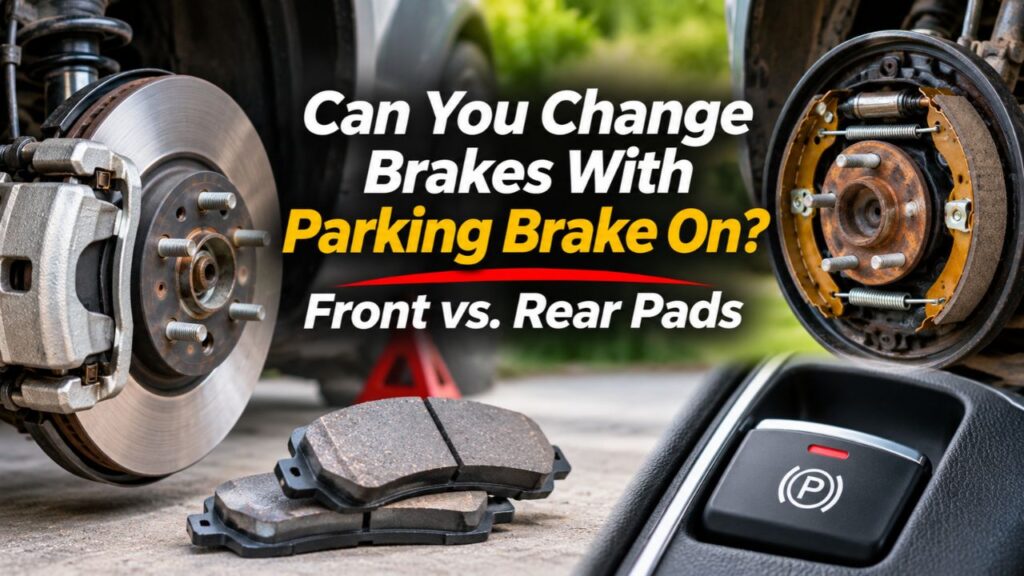
Can You Change Brakes With Parking Brake On? Front vs. Rear
Whether the parking brake can remain engaged depends primarily on which wheels the parking brake controls and which brake components you intend to replace.
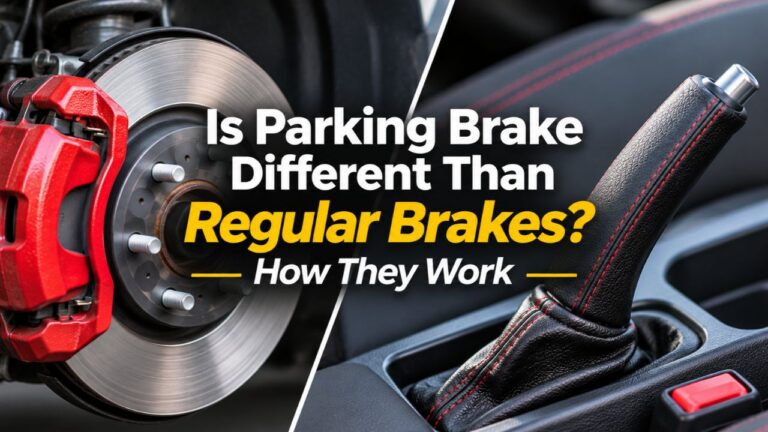
Most conventional passenger vehicles use the parking brake to hold the rear wheels.
| Brake Replacement Job | Parking Brake Position | Reason |
| Front brake pads | Usually engaged | Parking brake normally operates rear brakes |
| Front brake rotors | Usually engaged | Front rotors are generally unaffected |
| Rear disc brake pads | Released | Parking brake may hold the rear caliper engaged |
| Rear brake rotors | Released | Parking brake shoes or calipers may prevent removal |
| Rear drum brake shoes | Released | Engaged shoes press against the drum |
| Electronic rear brake pads | Released and service mode as required | Electric actuators must be placed in the correct position |
Important: This table applies to common rear-wheel parking brake designs. A few vehicles use different arrangements, including parking brakes acting on the front wheels or driveline. Always identify the actual system before starting.
Even when an engaged parking brake doesn’t interfere with the repair, it cannot replace wheel chocks and secure jack-stand support.
Why the Parking Brake Must Be Released for Rear Brake Replacement
A conventional parking brake mechanically applies braking force to keep a stationary vehicle from moving.
On vehicles with rear drum brakes, pulling the parking brake lever typically moves the rear brake shoes outward against the inside of the drum.
If you try to remove the drum while the parking brake is engaged, the shoes can hold it tightly in place.
For rear disc brakes, there are two common arrangements.
Rear Calipers With Integrated Parking Brakes
Some rear calipers incorporate the parking brake mechanism into the caliper assembly.
Applying the parking brake moves a mechanical or electrically controlled mechanism that clamps the pads against the rotor.
If the parking brake remains engaged, removing the caliper or retracting its piston may be difficult or unsafe.
Forcing the piston backward can damage the internal adjustment mechanism or electric actuator.
Rear Disc Brakes With Separate Parking Brake Shoes
Other vehicles use a small drum-style parking brake inside the rear rotor’s center section.
This arrangement is often called a drum-in-hat parking brake.
The main rear disc pads provide normal service braking, while separate parking brake shoes grip the inner drum surface of the rotor.
An engaged parking brake may not prevent the service caliper from being removed, but it can hold the rotor in place.
The parking brake should therefore be released before attempting rotor removal.
How to Prepare Your Car for Brake Replacement Step by Step
The safest approach is to identify the brake design first, secure the vehicle, release the parking brake when necessary, and use the manufacturer’s approved repair procedure.
Step 01: Park on a Flat, Stable Surface
Choose a level concrete garage floor or another solid, stable working surface.
Avoid sloped driveways, loose gravel, soft ground, and uneven pavement.
Turn off the engine and remove the key when appropriate.
For vehicles with electronic brake controls, follow any required shutdown procedure before maintenance.
A sloped surface becomes particularly dangerous when the parking brake must be released for rear brake work.
Do not attempt the repair in an unsuitable location simply because the vehicle appears stationary.
Step 02: Identify Which Brakes You Are Replacing
Determine whether the job involves the front or rear brakes.
Next, identify whether the vehicle has disc or drum brakes and whether its parking brake uses a cable, rear caliper actuator, or separate parking brake shoes.
For a typical front brake job, the parking brake may remain engaged because the rear wheels stay on the ground.
For rear brake replacement, plan to release it once the vehicle has been secured against rolling.
If the vehicle has an electronic parking brake, determine whether a maintenance or service mode is required.
Step 03: Secure the Vehicle With Wheel Chocks
Place properly sized wheel chocks against the tires that will remain on the ground.
For rear brake work, chock the front wheels securely in both rolling directions.
For front brake work, chock the rear wheels even when the parking brake remains engaged.
An automatic transmission should generally be in Park. A manual transmission should be in the gear or position specified by its service instructions.
Transmission engagement alone is not sufficient protection against movement when a vehicle is lifted.
AutoZone’s guide to safely jacking up a car recommends using wheel chocks, designated lifting points, and jack stands rather than relying on a jack alone.
Step 04: Release the Parking Brake When Working on Rear Brakes
After securing the vehicle against movement, release the parking brake according to the manufacturer’s procedure.
For a conventional handbrake, lower the lever fully.
For a foot-operated parking brake, use the designated release control.
For an electronic parking brake, follow the required release and service-mode procedure.
Check that the parking brake indicator shows the expected status.
Do not assume that the brake has released simply because the control moved.
If the rear wheels remain locked, identify the cause rather than forcing the drum or rotor off.
Step 05: Activate Electronic Parking Brake Service Mode if Required
Many vehicles with motor-operated rear calipers require the electronic parking brake to enter a maintenance position before pad replacement.
This may involve a compatible diagnostic scan tool or a vehicle-specific sequence using the ignition and parking brake switch.
Normal parking brake release is not always the same as electronic parking brake service mode.
The service procedure may command the electric actuator to retract its internal mechanism.
Use only the procedure specified for the exact vehicle.
Do not guess at switch combinations or disconnect actuator wiring to bypass the system.
Step 06: Loosen the Wheel Fasteners and Raise the Vehicle
With the vehicle still on the ground, loosen the wheel nuts slightly using the correct tool.
Do not remove them completely.
Position a properly rated floor jack under the manufacturer’s approved lifting point.
Raise the vehicle carefully until the required wheel clears the ground.
Place suitable jack stands at approved support locations.
Lower the vehicle onto the stands and confirm that it is stable before removing the wheels.
Never work on brakes while the vehicle is supported only by a hydraulic jack.
Avoid putting any part of your body beneath an unsupported vehicle.
Step 07: Remove and Replace the Brake Components
Once the vehicle is secured and the parking brake is in the correct position, follow the specific brake replacement procedure.
For disc brakes, this generally involves removing the caliper, replacing worn pads or rotors as needed, inspecting hardware, and retracting the piston using the approved method.
Support the caliper so its weight does not hang from the flexible brake hose.
Some rear caliper pistons require rotation during retraction, while others require straight compression after their electric actuator has been placed in service mode.
Never force a piston backward without confirming the correct design.
For drum brakes, release the parking brake, remove the drum, and follow the specified shoe and spring replacement procedure.
Brake dust can contain harmful materials. Avoid blowing it into the air with compressed air.
Step 08: Reassemble and Check the Brake System
Reinstall all brake components according to the service instructions.
Use the correct fastener torque specifications and replace hardware where required.
On vehicles with electronic parking brakes, complete the required service-mode exit and initialization procedure.
Reinstall the wheels and tighten the fasteners in the specified sequence and to the correct torque.
After lowering the vehicle, press the service brake pedal carefully until it develops normal firmness.
Check the brake-fluid level and inspect for leaks or abnormal warnings.
Verify parking brake application and release before driving.
If the brake pedal remains soft, the parking brake fails to operate, or a warning persists, do not drive until the fault has been corrected.
Can You Change Front Brakes With the Parking Brake Engaged?
Yes, on most vehicles with rear-wheel parking brakes, front brake pads and rotors can be replaced while the parking brake remains engaged.
This can provide an additional means of holding the rear wheels while the front of the vehicle is raised.
However, the parking brake does not secure the vehicle against every possible movement.
Wheel chocks and properly positioned jack stands are still necessary.
The main reason front brake replacement is usually unaffected is that the parking brake mechanism operates separately from the front disc brakes.
You can typically remove the front caliper, brake pads, and rotor without releasing the rear parking brake.
There are exceptions. Some uncommon parking brake designs act on the front wheels, so confirm the system before proceeding.
You may also need the parking brake released for particular diagnostic procedures involving wheel rotation or driveline movement.
Follow the manufacturer’s instructions whenever they differ from general practice.
Can You Replace Rear Drum Brakes With the Parking Brake On?
No. Rear drum brakes generally require the parking brake to be completely released before the drum can be removed.
When engaged, the parking brake cable or actuator pushes the brake shoes against the drum’s inner surface.
This creates friction that prevents the drum from turning and may prevent it from sliding off the hub.
AutoZone’s drum brake replacement instructions specifically state that the parking brake must be disengaged before removing the drum.
If the drum remains stuck after release, other factors may be responsible.
A corrosion buildup around the hub or a wear ridge inside the drum can make removal difficult.
Some designs provide an adjustment access point that allows the shoes to retract.
Use the manufacturer’s adjustment and removal procedure rather than hammering aggressively against a drum that may still be held by the shoes.
Forcing removal can damage springs, adjusters, friction material, or backing-plate components.
What About Changing Rear Disc Brakes With an Electronic Parking Brake?
Electronic parking brakes require additional attention because their actuators can operate independently of a traditional mechanical lever.
On some vehicles, an electric motor mounted to the rear caliper controls a threaded mechanism that moves the piston.
Before replacing the pads, the actuator must be moved to its designated maintenance position.
HELLA’s technical guide to electric parking brakes explains that certain systems require diagnostic equipment to retract the actuator mechanism before rear brake pads can be replaced.
Why EPB Service Mode Matters
Without the correct service mode, the internal actuator may remain positioned for normal parking brake operation.
Attempting to compress the piston can overload the mechanism or damage the motor-driven assembly.
Service mode provides the specified condition for brake maintenance.
However, it does not mean every caliper piston can be pushed directly inward without further preparation.
Follow the correct piston-retraction method for the vehicle.
Can the Electronic Parking Brake Activate During Repairs?
Some EPB systems can apply automatically when the ignition state changes, the transmission is shifted, or certain vehicle conditions occur.
This behavior depends on the manufacturer.
An unexpected actuator movement during maintenance can interfere with the repair or damage components.
Keep the vehicle in its prescribed maintenance condition and avoid operating the parking brake switch while the caliper is disassembled.
If the system displays an EPB malfunction or refuses to enter service mode, stop the repair until the fault is diagnosed.
What Happens if You Change Rear Brakes Without Releasing the Parking Brake?
Leaving the parking brake engaged can create several problems.
- Brake drums may remain locked: Applied shoes can prevent drum removal.
- Rear calipers may resist removal: The integrated parking brake mechanism can maintain clamping force.
- Rotors may become stuck: Separate parking brake shoes can grip the rotor’s internal drum surface.
- Caliper actuators may be damaged: Forcing a piston against an engaged electronic mechanism can damage internal parts.
- Brake hardware may be overstressed: Pulling or prying against applied parking brake components can bend or break hardware.
If the rotor or caliper will not move normally, stop and inspect the parking brake condition.
Do not use greater force simply because the component appears stuck.
A seized caliper, corrosion, or incorrectly adjusted brake shoes may also be responsible.
The correct diagnosis depends on the design.
Should You Keep the Parking Brake On While Jacking Up the Car?
For front brake replacement, leaving the rear parking brake engaged is often appropriate.
For rear brake service, however, the parking brake must usually be released, which means another method must prevent vehicle movement.
Use properly placed wheel chocks before lifting.
Do not treat the transmission’s Park position as a substitute for chocks, particularly when lifting driven wheels.
Never work under a vehicle supported only by a jack, regardless of whether the parking brake is engaged.
If the vehicle needs to be raised at all four wheels, follow an approved lifting and support procedure that does not depend on the parking brake.
A professional lift may be the safer choice for extensive brake work.
Do You Need to Bleed the Brakes After Releasing the Parking Brake?
No. Simply releasing the parking brake does not introduce air into the hydraulic brake system.
The parking brake mechanism generally operates independently of the hydraulic service brake circuit, although it may act on the same rear caliper or friction components.
Replacing brake pads or rotors also does not normally require bleeding if no hydraulic connection is opened and no air enters the system.
However, bleeding may be necessary when replacing a caliper, disconnecting a brake hose, or opening a hydraulic fitting.
Some electronically controlled braking systems have additional service requirements.
Follow the vehicle’s bleeding sequence and equipment requirements when hydraulic work is performed.
FAQs About Can You Change Brakes With Parking Brake On
Can You Remove a Rear Rotor With the Parking Brake Engaged?
Usually not safely. An engaged rear parking brake may hold the rotor through integrated caliper pads or separate drum-style shoes. Release it and follow the correct removal procedure.
Can You Change Front Brake Pads Without Releasing the Handbrake?
Yes, on most vehicles where the handbrake operates the rear wheels. Keep the vehicle securely chocked and supported on jack stands, and check for unusual parking brake designs.
Will Leaving the Parking Brake On Damage New Brake Pads?
Leaving it engaged during front brake replacement generally will not damage the new front pads. During rear brake service, however, forcing components against an applied parking brake can damage the caliper or related hardware.
Do All Electronic Parking Brakes Require a Scan Tool?
No. Some systems have a manufacturer-approved manual service-mode sequence. Others require compatible diagnostic equipment. The procedure depends on the exact vehicle and EPB design.
Can You Release the Parking Brake While the Car Is on Jack Stands?
Only when the vehicle is securely supported and restrained according to the service procedure. For rear brake jobs, it is generally preferable to establish the required parking brake and service-mode condition before lifting whenever the manufacturer directs.
Should You Apply the Parking Brake Immediately After Changing Rear Pads?
First complete the manufacturer’s reassembly, pedal-firming, and electronic service-mode exit procedures. Then operate the parking brake as directed and verify that it applies and releases correctly.
Keep the Vehicle Secure While Changing Brake Components
If you’re wondering can you change brakes with parking brake on, the answer depends on which axle you’re servicing. Front brake replacement can usually be completed with the parking brake engaged because it normally acts on the rear wheels. Rear brake replacement generally requires releasing it, and electronic rear calipers may also require a specific maintenance mode.
The most important preparation is securing the vehicle independently of the parking brake. Use wheel chocks, approved lifting points, and properly rated jack stands. Never force a stuck rear rotor, caliper, or piston before confirming the parking brake is fully released and the correct service procedure has been followed.
Once the repair is complete, restore normal brake operation, confirm a firm pedal, and verify that the parking brake works correctly. If the system cannot be serviced or checked safely, have a qualified brake technician complete the repair before the vehicle returns to the road.