Stuck Brake Caliper Pin: Symptoms, Causes, and How to Fix It
A stuck brake caliper pin can cause uneven brake pad wear, brake drag, excessive heat, pulling while braking, and premature damage to the rotor and pads. Although caliper slide pins are relatively small components, they are essential to the operation of most floating disc brake calipers.
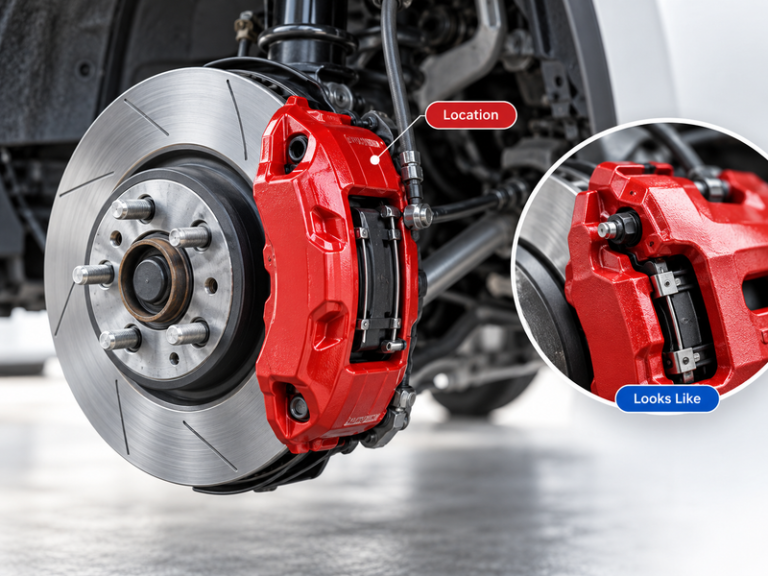
On a floating caliper, the piston pushes the inner brake pad against the rotor while the caliper body slides along its guide pins to bring the outer pad into contact. The caliper needs to move smoothly every time you apply and release the brakes. If one or both slide pins become dry, corroded, bent, or seized, that movement becomes restricted.
A mildly sticking pin may initially cause nothing more than unusual brake pad wear. As the condition gets worse, the affected brake may remain partially applied after you release the pedal. The wheel can then become extremely hot, fuel economy may decline, and the vehicle may pull to one side.
Sometimes a stuck pin can be cleaned and lubricated. In other cases, corrosion or physical damage means the pin, boot, bracket, or complete caliper assembly needs replacement. Because similar symptoms can also result from a seized caliper piston or restricted brake hose, proper diagnosis matters.
This guide explains what a stuck caliper pin does, how to recognize the symptoms, what causes it, how to inspect it, and how the problem is normally repaired.
What Is a Stuck Brake Caliper Pin?
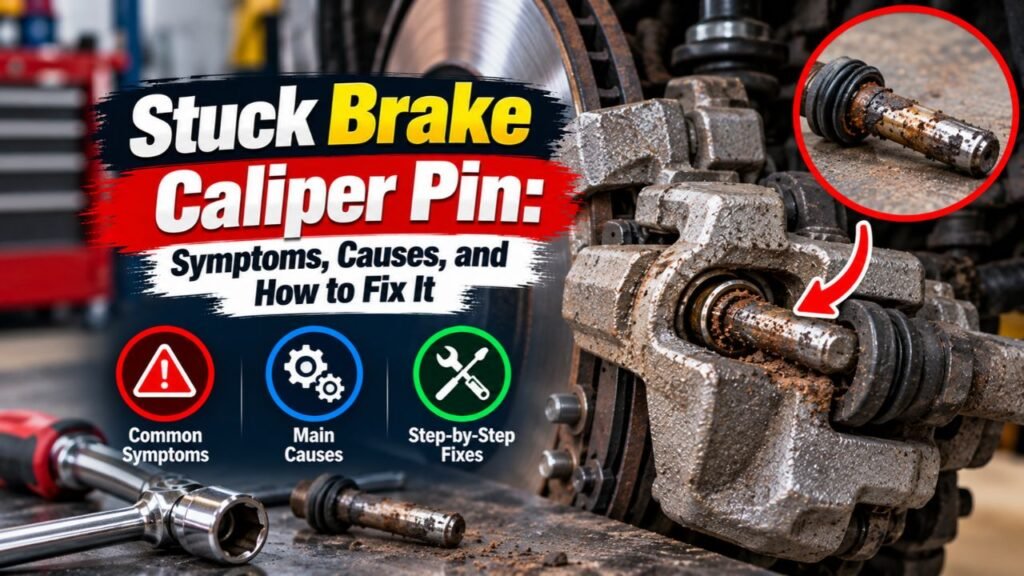
A stuck brake caliper pin is a caliper guide or slide pin that can no longer move freely inside its bore or bushing.
These pins allow a floating brake caliper to slide from side to side as hydraulic pressure applies the brake.
When everything works properly:
- You press the brake pedal.
- Hydraulic pressure moves the caliper piston outward.
- The piston pushes the inner pad against the rotor.
- The caliper slides on its guide pins.
- The outer pad is pulled against the opposite side of the rotor.
- Both pads squeeze the rotor and slow the vehicle.
- When you release the pedal, the brake stops applying significant pressure.
If a slide pin cannot move freely, the caliper may apply unevenly or fail to release correctly.
Common Symptoms of a Stuck Brake Caliper Pin
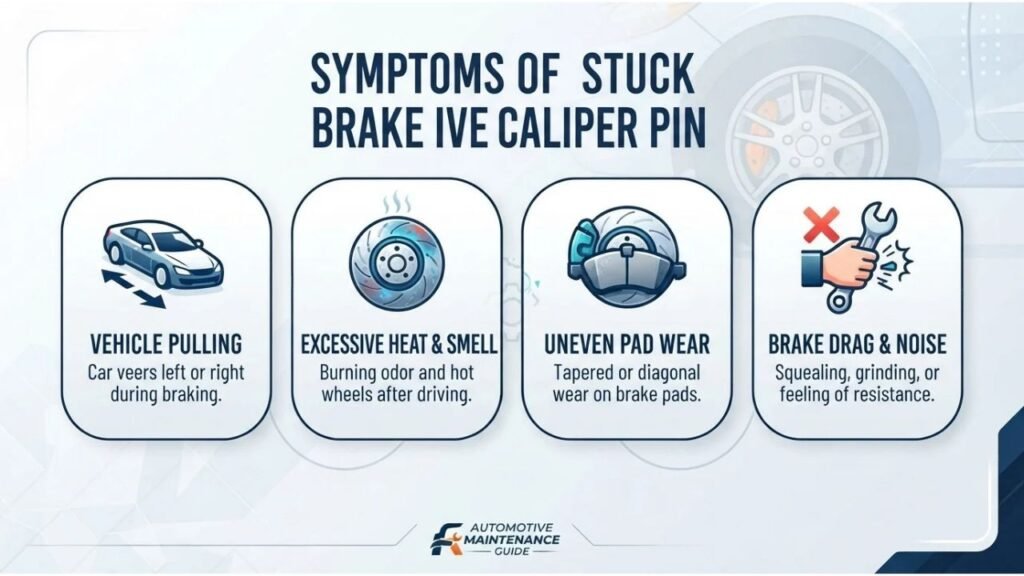
A completely seized pin can create obvious problems, but a partially sticking pin may produce subtle symptoms for a long time.
Common signs include:
- Uneven brake pad wear
- One brake pad much thinner than the other
- Tapered brake pad wear
- Brake drag
- One wheel becoming unusually hot
- Vehicle pulling while braking
- Vehicle pulling while driving
- Burning smell near one wheel
- Excessive brake dust
- Squealing or scraping noises
- Reduced fuel economy
- Rotor discoloration
- Premature brake pad replacement
One symptom alone does not confirm the diagnosis, but several appearing together make caliper movement problems more likely.
Uneven Brake Pad Wear
Uneven pad wear is one of the strongest clues that a floating caliper is not sliding correctly.
The inner and outer pads do not always wear at exactly the same rate, but a large difference deserves investigation.
For example, you might remove the caliper and find that:
- The inner pad is almost worn to the backing plate.
- The outer pad still has considerable friction material.
Or the opposite may occur depending on how the caliper is binding.
A single stuck pin can also cause the caliper to move at an angle, producing tapered pad wear, where one end of a brake pad is noticeably thinner than the other.
Brake Drag After Releasing the Pedal
A sticking slide pin can prevent the caliper from returning smoothly after braking.
The brake pad may continue rubbing against the rotor even though your foot is no longer on the pedal.
This condition is known as brake drag.
Possible signs include:
- The vehicle feels harder to accelerate.
- The car does not coast as freely as usual.
- One wheel creates significantly more heat.
- The engine seems to work harder.
- Fuel economy gets worse.
Severe brake drag should be repaired promptly because constant friction produces a large amount of heat.
One Wheel Becomes Extremely Hot
A dragging brake converts motion into heat continuously.
After driving, the affected wheel may therefore become much hotter than the other wheels.
You may notice:
- Heat radiating from the wheel
- Strong hot-brake smell
- Smoke in severe cases
- Rotor discoloration
- Very hot wheel hardware
Do not touch the brake rotor, caliper, or wheel immediately if you suspect overheating. Brake components can become hot enough to cause serious burns.
A wheel that becomes dramatically hotter than the corresponding wheel on the opposite side is a strong reason to inspect the brakes.
Vehicle Pulls When Braking
A stuck pin can cause the caliper to apply less effectively or remain partially applied.
Either condition can create different braking forces between the left and right sides of the vehicle.
You may feel the steering wheel pull to one side when pressing the brake pedal.
However, pulling can also result from:
- Seized caliper piston
- Contaminated brake pads
- Restricted brake hose
- Uneven tire pressure
- Suspension problems
- Alignment issues
- Different tire traction
The brake system should be inspected rather than assuming the slide pin is automatically responsible.
Vehicle Pulls Even When You Are Not Braking
If the affected brake remains partially applied, the vehicle may pull slightly even when the pedal is released.
The dragging wheel creates resistance on one side.
You might also notice that the vehicle:
- Accelerates less freely
- Requires more throttle
- Coasts poorly
- Produces a burning smell after driving
A dragging brake should not be ignored because heat can damage several nearby components.
Burning Smell From the Wheel
Continuous friction can overheat the brake pad and rotor.
The resulting smell may resemble:
- Burned friction material
- Hot metal
- Chemicals
- Hot rubber
If a strong burning odor appears from one wheel during normal driving, stop safely and inspect the vehicle once everything has cooled.
Smoke from the brake area indicates a more serious overheating condition.
Excessive Brake Dust
Brake pads naturally create dust, but a dragging pad can wear much faster than normal.
The affected wheel may become noticeably darker than the others because of accumulated brake dust.
Excessive dust is more meaningful when combined with:
- High wheel temperature
- Uneven pad wear
- Brake drag
- Burning smell
Different brake pad compounds produce different amounts of dust, so dust by itself is not enough to diagnose a stuck pin.
Squealing, Scraping, or Grinding
A caliper that does not move correctly can cause uneven pad contact.
You may hear:
- Squealing
- Scraping
- Rubbing
- Grinding
If one pad wears completely through its friction material, the metal backing plate can contact the rotor and produce a harsh grinding sound.
That can damage the rotor very quickly.
Clunking or Rattling From the Caliper
Slide pin problems are not limited to pins that seize.
Pins, bushings, or mounting hardware can become worn or loose.
Excessive movement may produce:
- Clunking
- Clicking
- Knocking
- Rattling
The noise may occur when applying or releasing the brakes, changing direction, or driving across rough pavement.
Loose brake hardware should be inspected immediately.
What Causes a Brake Caliper Pin to Stick?
Several conditions can prevent the pin from sliding correctly.
Dried-Out Lubricant
Caliper guide pins require appropriate lubrication.
Over time, the grease can:
- Dry out
- Wash away
- Become contaminated
- Harden
- Lose its lubricating properties
A dry pin develops more friction and becomes vulnerable to corrosion.
Rust and Corrosion
Moisture entering the pin bore can create rust.
Corrosion is particularly common in vehicles exposed to:
- Road salt
- Snow
- Coastal air
- Water
- Mud
- Long periods of outdoor storage
A lightly corroded pin may become rough and difficult to move.
Severe corrosion can seize the pin completely.
Torn Caliper Pin Boot
A rubber boot helps keep moisture and contaminants away from the pin.
If the boot:
- Tears
- Cracks
- Becomes loose
- Is installed incorrectly
water and dirt can enter the guide bore.
Once contamination reaches the pin, corrosion can develop relatively quickly.
Wrong Type of Grease
Using an unsuitable lubricant can create new problems instead of solving the old one.
Some petroleum-based greases can cause certain rubber boots and bushings to swell or deteriorate.
Use a brake-caliper lubricant that is specifically compatible with the slide pin system and rubber components.
Bent Slide Pin
A bent pin may bind even if it is clean and lubricated.
Pins can be damaged by improper installation, impact, or severe mechanical stress.
A bent pin should normally be replaced.
Corrosion Inside the Caliper Bracket
Sometimes the visible pin looks acceptable while the bore inside the bracket is heavily corroded.
Cleaning only the outside of the pin will not correct the problem.
The bore must also allow free movement.
How to Check for a Stuck Brake Caliper Pin
Inspecting caliper pins normally requires removing the wheel and partially removing the brake caliper.
If you are not comfortable performing brake work, have a qualified mechanic inspect it.
Secure the Vehicle
Park on a stable, level surface.
Use the correct lifting points and properly rated jack stands.
Never work beneath or around a raised vehicle supported only by a hydraulic jack.
Remove the Caliper
Follow the service procedure for your specific vehicle.
Caliper designs vary, so bolt locations and pin arrangements may differ.
Do not allow the caliper to hang from the flexible brake hose.
Support it securely.
Test Each Slide Pin
A healthy slide pin should generally move smoothly through its intended range without excessive force.
Check for:
- Stiff movement
- Complete seizure
- Rust
- Pitting
- Bent surfaces
- Dry grease
- Contamination
- Damaged boots
- Excessive looseness
If one pin moves easily while the other barely moves, you have found an important diagnostic clue.
Stuck Pin vs. Seized Caliper Piston
These two problems are often confused because they can produce nearly identical symptoms.
Stuck Slide Pin
A stuck pin prevents the caliper body from sliding properly.
Possible effects include:
- Uneven inner/outer pad wear
- Tapered pad wear
- Reduced caliper movement
- Brake drag
Seized Caliper Piston
A seized piston cannot extend or retract normally inside the caliper bore.
Possible effects include:
- Persistent brake drag
- One wheel overheating
- Poor brake release
- Uneven pad wear
- Reduced braking force
A physical inspection is usually necessary to identify which part is actually stuck.
Sometimes an older caliper has both problems.
Stuck Caliper Pin vs. Collapsed Brake Hose
A restricted brake hose can also cause the brake to remain applied.
Internally damaged hoses may sometimes allow hydraulic pressure to reach the caliper but restrict fluid return afterward.
That can imitate a seized caliper or slide pin.
If cleaning and verifying the slide pins does not solve brake drag, the piston and hydraulic system should also be checked.
How to Free a Stuck Brake Caliper Pin
The correct method depends on how badly the pin is stuck.
If the pin can still be removed and is only dry or lightly corroded, it may be serviceable.
A general repair involves:
- Remove the caliper safely.
- Remove the slide pin.
- Clean old grease and contamination from the pin.
- Inspect the pin for rust, pitting, or bending.
- Clean the guide bore as appropriate.
- Replace damaged rubber boots.
- Apply compatible caliper pin lubricant.
- Reinstall the pin.
- Confirm that it moves smoothly.
- Reassemble the brakes to manufacturer specifications.
Do not force a badly seized pin to remain in service simply because you managed to make it move.
How to Remove a Severely Seized Caliper Pin
A badly rusted pin may be difficult to remove.
Penetrating oil can sometimes help with corrosion outside the rubber components, but brake parts need to be kept free from contamination on friction surfaces.
Depending on the caliper design, severely seized pins may require:
- Controlled twisting
- Heat applied by an experienced technician
- Specialized extraction tools
- Replacement of the caliper bracket
- Replacement of the complete caliper
Do not use uncontrolled heat around rubber hoses, brake fluid, seals, or combustible materials.
If substantial force is needed, replacement of the damaged bracket or caliper may be safer and more reliable.
Can You Clean and Reuse the Slide Pin?
Sometimes.
A slide pin may be reusable if it is:
- Straight
- Smooth
- Free from deep corrosion
- Free from heavy pitting
- Correctly sized
- Able to move smoothly after cleaning
A pin should generally be replaced if it is:
- Deeply pitted
- Heavily rusted
- Bent
- Cracked
- Excessively worn
Trying to polish away severe damage can change the pin dimensions and create excessive clearance.
What Grease Should You Use?
Use grease specifically intended for brake caliper slide pins and compatible with the boots and bushings in your brake system.
Suitable products are generally designed to tolerate:
- Brake temperatures
- Moisture
- Rubber components
- Repeated sliding movement
Do not automatically substitute:
- Wheel bearing grease
- Chassis grease
- Motor oil
- Anti-seize compound
- General petroleum grease
The correct lubricant depends on the caliper design.
Can You Use Anti-Seize on Caliper Pins?
Anti-seize is generally not the preferred lubricant for caliper slide pins unless the vehicle or brake component manufacturer specifically calls for it.
Anti-seize compounds are primarily designed to prevent threaded fasteners from seizing.
A dedicated brake-caliper lubricant is usually more appropriate for sliding guide pins and rubber components.
How Much Grease Should You Apply?
Apply enough lubricant to create a smooth coating over the sliding surface.
Do not pack the boot or guide bore excessively unless the service procedure specifically requires it.
Too much grease can:
- Prevent the pin from seating correctly
- Interfere with boot installation
- Trap contamination
- Create hydraulic resistance in some closed pin bores
Moderate, even coverage is generally preferable to filling the entire cavity.
What If the Caliper Pin Boot Is Torn?
Replace it.
A torn boot will allow moisture and debris to contaminate the repaired pin again.
Installing a clean pin while reusing a damaged boot can lead to another seizure.
Boots may be available separately or as part of a caliper hardware kit.
Can a Stuck Caliper Pin Damage Brake Pads?
Yes.
A pin that prevents normal caliper movement can cause one pad to remain against the rotor.
The affected pad may wear much faster than expected.
If pad wear has become significantly uneven, brake pads are normally replaced in axle pairs rather than replacing only the damaged pad.
Both brakes on the axle should also be inspected for similar problems.
Can a Stuck Caliper Pin Ruin the Rotor?
Yes.
Continuous brake drag can generate enough heat to damage the rotor.
Possible rotor problems include:
- Heavy scoring
- Grooves
- Heat discoloration
- Surface cracking
- Excessive wear
- Thickness variation
- Hot spots
A badly damaged rotor may need replacement.
Simply repairing the pin will not restore a rotor that has already exceeded its service limits.
Can a Stuck Pin Cause Brake Overheating?
Absolutely.
Overheating is one of the more serious consequences of a sticking caliper.
A dragging pad creates continuous friction against the rotor.
Heat can eventually affect:
- Brake pads
- Rotor
- Caliper seals
- Brake fluid
- Wheel bearing
- Nearby rubber components
If the brake is producing smoke or an intense burning smell, stop driving the vehicle.
Can You Drive With a Stuck Brake Caliper Pin?
You should not continue driving normally with a confirmed stuck caliper pin.
A mildly sticking pin might allow the vehicle to move normally for a while, but the condition can worsen without warning.
Continued driving may lead to:
- Rapid pad wear
- Rotor damage
- Brake overheating
- Pulling
- Reduced braking performance
- Higher repair costs
If the vehicle pulls strongly, the wheel becomes extremely hot, or smoke appears, have the vehicle transported rather than continuing to drive it.
How Much Does It Cost to Fix a Stuck Caliper Pin?
The cost varies significantly depending on what needs replacement.
A simple cleaning and lubrication service may require only inexpensive lubricant, boots, or hardware if you perform the work yourself.
Professional repair becomes more expensive if the vehicle also needs:
- New slide pins
- Caliper bracket
- Brake pads
- Brake rotor
- Complete caliper
- Brake hose
Labor rates also vary by region and vehicle.
A stuck pin caught early is usually less expensive to repair than one that has already destroyed the pads and rotor.
Should You Replace Both Calipers?
Not necessarily.
A stuck slide pin does not automatically mean both calipers on the axle require replacement.
However, brake pads are normally replaced as an axle set, and both sides should be inspected.
Replacing both calipers may make sense when:
- Both are heavily corroded
- Both have high mileage
- Both have seized components
- The vehicle has repeated caliper problems
The correct decision depends on the overall condition of the brake system.
How to Prevent Caliper Pins From Sticking
Good brake maintenance can significantly reduce the chance of seized pins.
During brake service:
- Inspect the slide pins.
- Clean old or contaminated grease.
- Use the correct lubricant.
- Replace torn boots.
- Confirm the pins move smoothly.
- Inspect the bracket for corrosion.
- Make sure the pads move correctly in their hardware.
Vehicles exposed to road salt and moisture may require closer attention.
Common Mistakes When Repairing a Stuck Caliper Pin
Installing New Pads Without Fixing the Pin
New brake pads will simply begin wearing unevenly again if the caliper still cannot slide.
Always correct the underlying problem.
Reusing a Deeply Rusted Pin
A heavily pitted pin may never move smoothly even after cleaning.
Replacement is usually the better option.
Lubricating Without Cleaning
Putting fresh grease over corrosion and contaminated old lubricant will not restore proper movement.
Clean and inspect the parts first.
Using the Wrong Grease
Incorrect lubricant can damage rubber components or become ineffective at brake temperatures.
Getting Grease on the Rotor or Pads
Brake friction surfaces must remain clean.
Lubricant on the pads or rotor can reduce braking performance.
Ignoring the Opposite Side
If one caliper has severe corrosion, inspect the brake on the opposite side as well.
Both sides have experienced similar mileage and environmental conditions.
FAQs About Stuck Brake Caliper Pin
Can a stuck brake caliper pin cause one brake pad to wear faster?
Yes. Restricted caliper movement can cause one pad to remain in contact with the rotor longer than the other.
A significant difference between inner and outer pad thickness is a common clue.
How do you know if a caliper pin is seized?
Remove and inspect the caliper according to the vehicle’s service procedure.
A seized pin will be difficult or impossible to move through its normal range by hand.
Rust, dried grease, and damaged boots often accompany the problem.
Can I spray WD-40 on a stuck caliper pin?
General-purpose penetrating sprays are not substitutes for proper brake slide-pin lubricant.
They may sometimes assist in disassembly, but the pin must ultimately be cleaned and lubricated with a product appropriate for the brake system.
Keep sprays away from brake pads and rotor friction surfaces.
Can bad caliper pins make the steering wheel pull?
Yes. Unequal braking force or brake drag on one side can make the vehicle pull.
However, several other brake, tire, alignment, and suspension problems can cause similar symptoms.
Why does one caliper pin keep getting stuck?
Repeated sticking often indicates an unresolved problem such as:
- Torn boot
- Corroded bore
- Incorrect lubricant
- Bent pin
- Water contamination
- Damaged bracket
Replacing or lubricating the pin without correcting the underlying cause may only provide temporary improvement.
Should caliper pins move easily by hand?
Generally, yes. Properly serviced floating-caliper slide pins should move smoothly through their designed range.
They should not require excessive force, although exact resistance varies by caliper design.
Can a stuck caliper pin cause a burning smell?
Yes. If the pin causes a brake pad to drag continuously, the resulting heat can produce a strong burning odor.
A smoking or severely overheated brake requires immediate attention.
Can a stuck pin cause poor gas mileage?
Yes. A dragging brake adds rolling resistance, meaning the engine must use additional energy to move the vehicle.
A severe brake drag problem can noticeably reduce fuel economy.
Conclusion
A stuck brake caliper pin prevents a floating brake caliper from moving as intended and can lead to uneven brake pad wear, dragging brakes, excessive heat, pulling, abnormal noise, and premature rotor damage.
Sometimes the repair is as simple as cleaning an undamaged pin, replacing a torn boot, and applying the correct brake lubricant. A heavily corroded, bent, or pitted pin should normally be replaced, and severe bracket damage may require a new bracket or complete caliper.
Because a seized piston, restricted brake hose, and other brake problems can produce similar symptoms, inspect the complete braking system rather than assuming the pin is always responsible. If the wheel becomes extremely hot, the vehicle pulls strongly, or smoke appears from the brake area, stop driving and have the brake repaired before the vehicle returns to normal use.