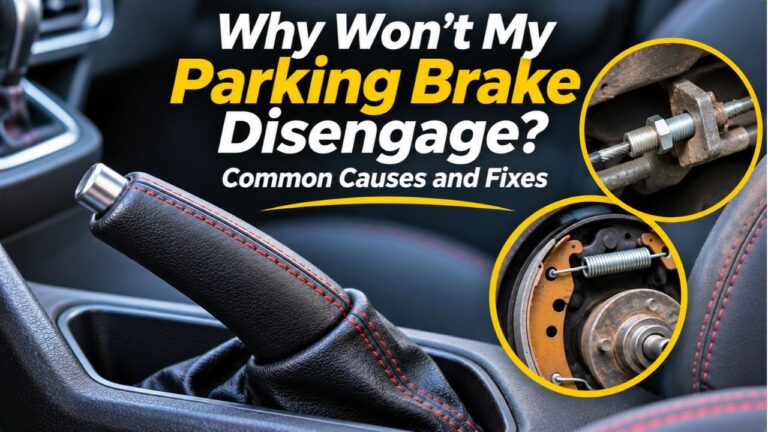
Why Won’t My Parking Brake Go Down? Common Causes and Repairs
If your parking brake won’t go down, the most likely causes are a jammed release button, a stuck ratchet mechanism, excessive cable tension, or corrosion inside the parking brake assembly. A conventional handbrake should lower when you pull it upward slightly, press and hold the release button, and move the lever down. If it remains stuck, something may be preventing the locking mechanism from disengaging.
This problem can happen suddenly, especially after pulling the parking brake too tightly or leaving the vehicle parked for an extended period. Cold weather, moisture, and worn components may also contribute.
A parking brake that will not release properly can keep the rear brakes engaged, making the vehicle difficult or unsafe to drive. Forcing the lever downward may damage its internal components without fixing the cause.
This guide explains why your parking brake gets stuck in the raised position, how to identify the faulty part, and which troubleshooting steps are safe to try. It also covers stuck foot-operated parking brakes, electronic systems, and situations requiring professional repair.
Why Won’t My Parking Brake Go Down? The Main Causes
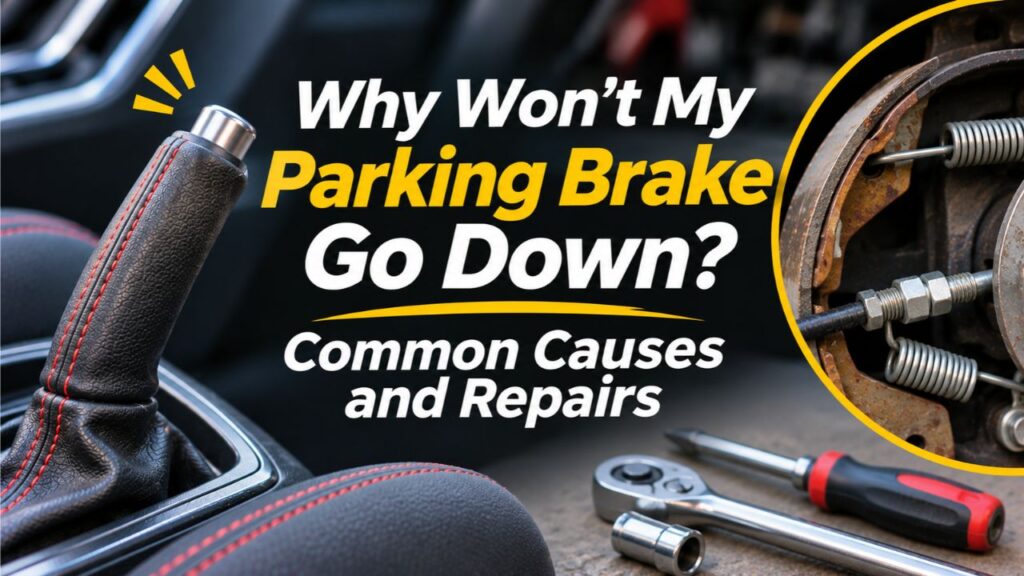
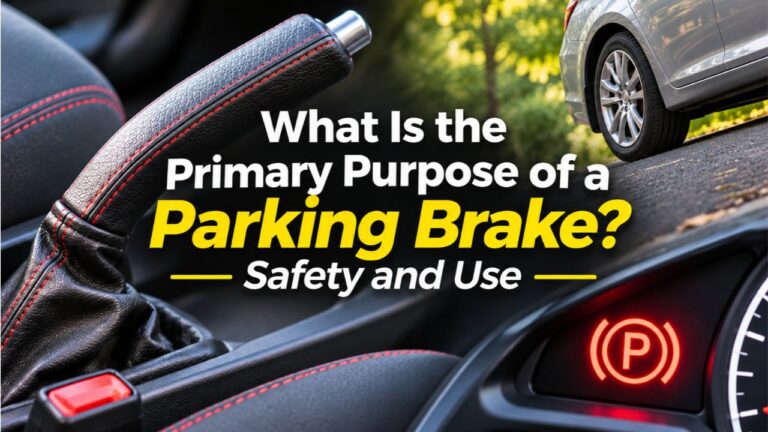
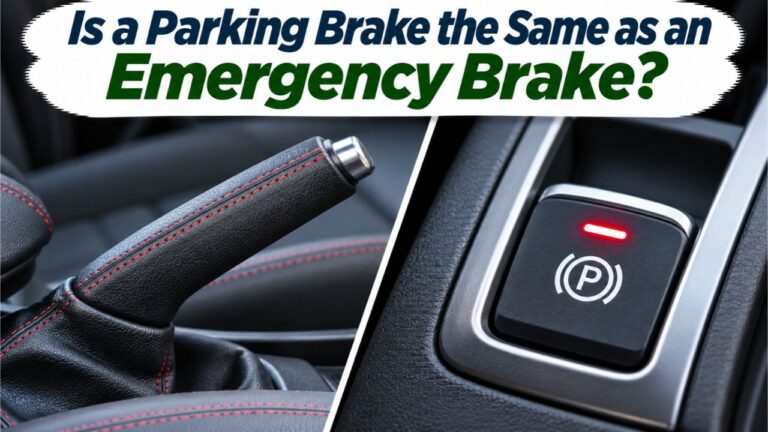
A traditional parking brake lever uses a mechanical locking system to hold the brakes applied after the driver pulls it upward.
Inside the lever assembly, a ratchet and pawl mechanism prevents the handle from moving downward until the release button is pressed.
The lever also connects to cables that transfer force to the rear parking brake components.
When everything operates normally, pressing the release button disengages the locking mechanism and allows the lever to return to its resting position.
If the lever refuses to move, the problem may involve either the locking mechanism or the connected cables and brake hardware.
The following table explains the most common possibilities.
| Possible Cause | Common Symptom |
| Jammed release button | Button will not press normally |
| Stuck ratchet or pawl | Lever remains locked upright |
| Excessive lever tension | Button is unusually difficult to press |
| Corroded parking brake cable | Lever feels stiff or releases poorly |
| Frozen parking brake mechanism | Problem appears during cold weather |
| Damaged lever assembly | Lever feels loose, crooked, or mechanically jammed |
| Seized rear brake hardware | Lever may lower, but the brakes remain applied |
The important distinction is whether the lever itself cannot move or whether the rear brakes remain engaged after the lever has lowered.
These symptoms can have different causes and require different repairs.
Common Mechanical Reasons a Parking Brake Lever Gets Stuck
Parking Brake Release Button Is Jammed
The release button controls the internal locking mechanism.
When you press it, the mechanism should disengage from the ratchet teeth, allowing the lever to move downward.
A damaged button, broken internal spring, dirt accumulation, or worn linkage can interfere with this movement.
Sometimes, the button feels completely solid because the ratchet is under excessive tension rather than because the button itself has failed.
Try lifting the lever slightly before pressing the button. This can remove pressure from the locking mechanism.
If the button still refuses to move, do not strike it or force it with tools.
Ratchet and Pawl Mechanism Is Stuck
The ratchet contains teeth that hold the parking brake lever at different raised positions.
A pawl engages these teeth and prevents the lever from dropping unexpectedly.
Over time, the teeth or pawl can become worn, damaged, or contaminated with debris.
The mechanism may also jam if the parking brake was pulled upward with excessive force.
A jammed pawl can prevent the lever from lowering even when the release button appears to operate normally.
This often requires inspecting the lever assembly and repairing or replacing damaged components.
Parking Brake Cable Is Rusted or Seized
Mechanical parking brakes typically use steel cables running from the lever or pedal toward the rear brakes.
The cables move inside protective housings.
Moisture, dirt, and road salt can eventually cause corrosion, making the cables difficult to move.
According to NAPA’s guide to parking brake operation, corrosion can develop inside the cable housing and prevent the cable from moving smoothly.
A seized cable can increase resistance at the lever and prevent the brakes from releasing correctly.
Sometimes the lever moves down while the cable remains stuck, leaving the rear brakes applied.
A severely corroded cable generally requires replacement rather than a temporary lubrication attempt.
Parking Brake Was Pulled Too Hard
Pulling the handbrake much harder than necessary can place excessive tension on the locking mechanism and cables.
When the ratchet is heavily loaded, the release button may become difficult to press.
This is particularly noticeable when the lever was pulled to its highest position.
The correct initial response is to pull the lever upward slightly while pressing the release button.
Do not use both hands to force it downward or attempt to bend the lever.
Excessive force may damage the ratchet teeth, button mechanism, or mounting hardware.
Rear Parking Brake Components Are Seized
The problem may originate at the rear wheels rather than inside the handbrake lever.
Depending on the vehicle, the parking brake may use dedicated drum brake shoes or a mechanism incorporated into the rear brake calipers.
Corroded linkages, seized caliper mechanisms, damaged springs, or stuck brake shoes can prevent normal release.
In these cases, the lever may lower normally while the rear wheels remain difficult to rotate.
A lever that moves freely does not guarantee that the parking brake has fully released.
The rear brake assembly requires inspection when the vehicle still resists movement.
How to Release a Parking Brake Lever That Won’t Go Down
The following steps focus on safe checks for a traditional mechanical handbrake. They are not instructions for forcing a damaged mechanism to release.
Step 01: Park Safely and Secure the Vehicle
Before attempting to release the parking brake, make sure the vehicle cannot roll unexpectedly.
Keep the vehicle on level ground whenever possible.
For an automatic transmission, select Park. For a manual transmission, select the appropriate gear according to the owner’s manual.
Keep your foot firmly on the regular brake pedal.
Use suitable wheel chocks when necessary, particularly if the vehicle is on a slope.
Do not crawl beneath the vehicle or disconnect any parking brake cables while the vehicle is unsupported.
A parking brake can release suddenly when a jammed mechanism disengages.
Step 02: Pull the Parking Brake Lever Slightly Upward
Grip the handbrake lever firmly.
Instead of immediately pushing it downward, pull it upward a small amount.
This movement can reduce the force pressing the pawl against the ratchet teeth.
If the lever was pulled tightly into its highest position, relieving that pressure may make the release button easier to operate.
Avoid pulling it higher than necessary.
Do not use excessive force if the lever will not move.
If the lever shifts slightly and the button becomes easier to press, continue with the normal release procedure.
Step 03: Press and Hold the Release Button
While maintaining the slight upward pressure, press the button at the end of the handbrake lever.
Hold it firmly without striking or prying it.
The Honda parking brake operating instructions describe the proper sequence as lifting the lever slightly, pressing and holding the release button, and lowering the lever completely before releasing the button.
This approach prevents unnecessary force against the ratchet mechanism.
If the button presses normally but the lever remains locked, the internal linkage or pawl may be damaged.
If the button cannot be pressed at all, stop rather than forcing it.
Step 04: Lower the Lever Slowly
While holding the release button, guide the lever downward toward the center console.
The lever should move smoothly as the ratchet disengages.
Continue lowering it until it reaches its normal resting position.
Release the button only after the lever is fully lowered.
Watch for unusual resistance, clicking, grinding, or binding.
If the lever moves only partway down, do not force it through the obstruction.
Repeatedly forcing the lever can damage the locking components.
A partially lowered lever may also leave the parking brake engaged.
Step 05: Check for Visible Obstructions
If the lever remains stuck, inspect the accessible area around its base.
Look for objects trapped between the lever and center console, damaged trim, or foreign material interfering with movement.
Small objects can occasionally fall into the parking brake opening and obstruct the mechanism.
Remove only loose objects that are safely accessible.
Avoid inserting screwdrivers or sharp tools into the ratchet assembly.
Do not disassemble the center console unless you understand the vehicle-specific procedure and can keep the car securely restrained.
If the mechanism appears damaged, professional inspection is preferable.
Step 06: Consider Cold Weather or Long-Term Storage
If the problem appeared after freezing temperatures, the parking brake cable or rear brake components may be frozen.
Moisture can collect around parking brake hardware and freeze while the vehicle is parked.
Toyota’s official winter driving guidance warns that parking brakes can freeze in cold conditions and recommends additional precautions, including wheel chocks, for affected situations.
A frozen parking brake may become functional after the vehicle is moved to a suitably warm environment and the ice has thawed.
Do not pour boiling water onto brake components, apply an open flame, or accelerate against stuck brakes.
If the vehicle cannot be moved safely, arrange roadside assistance.
Step 07: Verify That the Parking Brake Has Released
After lowering the lever, confirm that it reaches its normal resting position.
With the ignition ON, check whether the parking brake warning indicator turns off.
Keep the regular brake pedal pressed until the vehicle is ready to move.
When conditions are safe, confirm that the brakes release normally without unusual resistance.
A burning smell, grinding noise, or abnormal rolling resistance suggests the rear brakes may remain applied.
Stop immediately if the vehicle does not move normally.
Do not continue driving simply because the handbrake lever is down.
What if the Parking Brake Goes Down but the Brakes Stay Locked?
This situation differs from a lever that is mechanically stuck in the raised position.
If the lever moves down but the rear brakes remain engaged, the release mechanism inside the vehicle may be working while another component is seized.
Possible causes include:
- A parking brake cable stuck inside its housing
- Corroded rear caliper parking brake mechanisms
- Brake shoes stuck against the drum
- Damaged parking brake return springs
- Incorrect parking brake cable adjustment
A technician may need to inspect the rear brake hardware and check whether the cable moves freely.
The faulty component should be repaired or replaced before the vehicle is driven.
Driving against stuck parking brakes can overheat the brakes and damage nearby parts.
Why Won’t a Foot-Operated Parking Brake Release?
Foot-operated parking brakes do not use the same release arrangement as traditional handbrake levers.
In many vehicles, pressing the parking brake pedal downward engages the brake.
Releasing it may require pressing the pedal again or pulling a separate handle beneath the dashboard.
If the pedal stays down and will not return upward, the problem may involve its ratchet, return spring, release handle, or connected cable.
First, identify the manufacturer’s intended release method.
A push-to-release pedal cannot always be disengaged by pulling on it, while a pedal with a separate release handle may not release when pressed again.
If the correct procedure does not work, have the mechanism inspected.
Do not force the pedal upward with your foot.
What if an Electronic Parking Brake Won’t Release?
An electronic parking brake works differently because it uses electric actuators rather than a conventional hand lever.
Most electronic parking brake switches do not physically remain in an elevated position. They return to a normal resting position after being operated.
If the electronic parking brake will not disengage, possible causes include:
- A weak or dead 12-volt battery
- A faulty electronic parking brake switch
- Damaged wiring or electrical connectors
- A malfunctioning parking brake actuator
- Rear brake mechanical binding
- An electronic control system fault
Many vehicles require the ignition to be ON and the service brake pedal pressed before accepting a release command.
Follow the owner’s manual for the correct procedure.
If the vehicle displays a Service Parking Brake message or refuses to release, avoid repeatedly operating the switch.
Electronic parking brake problems may require a compatible diagnostic scan tool and professional repair.
Can You Drive With a Parking Brake That Won’t Go Down?
No. Do not drive if the parking brake lever is stuck in the engaged position or the brakes have not fully released.
Driving with the parking brake applied can generate excessive friction and heat.
Possible consequences include damaged brake pads or shoes, overheated rotors or drums, and reduced braking performance.
If the lever becomes stuck before leaving a parking space, keep the vehicle secured and arrange repair.
If you discover the problem while driving, stop in a safe location.
Do not attempt to force the lever down while operating the vehicle.
When the brakes have overheated, allow them to cool naturally and arrange an inspection before continuing.
How Much Does It Cost to Fix a Stuck Parking Brake?
Repair cost depends on the faulty component, vehicle design, labor requirements, and parts availability.
A release button or minor linkage issue may require less work than replacing corroded parking brake cables or rear brake hardware.
If the lever assembly is damaged, replacement may be necessary.
A seized cable can require additional labor because it may run through brackets, protective shields, or difficult-to-access areas underneath the vehicle.
Electronic parking brake actuator replacement can involve diagnostic work and calibration.
An accurate estimate requires identifying the actual fault.
Replacing the lever, cable, or rear caliper without diagnosis may not solve the problem.
How to Prevent Your Parking Brake From Getting Stuck
Proper maintenance helps reduce parking brake problems.
Use the parking brake regularly under normal driving conditions so mechanical components do not remain unused for extended periods.
Avoid pulling a handbrake lever harder than necessary.
Have cables, linkages, and rear brake mechanisms inspected during routine brake maintenance.
Address stiffness, unusual noises, or inconsistent release behavior before the mechanism becomes completely jammed.
For long-term vehicle storage or extreme freezing conditions, follow the manufacturer’s parking recommendations.
Some vehicles may require wheel chocks or other precautions when using the parking brake could cause freezing.
A properly maintained parking brake should engage securely and release smoothly without requiring excessive force.
FAQs About Why Won’t My Parking Brake Go Down
Why Is My Handbrake Button Stuck?
The release button may be under excessive ratchet tension, contaminated with debris, or affected by a damaged internal spring or linkage. Pulling the lever upward slightly may relieve normal locking pressure. If the button still will not move, the mechanism requires inspection.
Can I Force My Parking Brake Down?
No. Forcing a stuck parking brake lever can damage the ratchet, release button, or cable connection. Use the proper release procedure and arrange repair if the lever remains jammed.
Can a Parking Brake Cable Stop the Lever From Going Down?
Yes. A corroded or seized cable can create abnormal resistance and interfere with parking brake operation. However, a faulty ratchet or release button is also possible when the lever itself cannot move.
Why Won’t My Parking Brake Release in Cold Weather?
Moisture may freeze inside the cable housing or around rear brake components. Allow the mechanism to thaw safely and have it inspected if the problem continues. Never drive against a frozen parking brake.
Can a Parking Brake Get Stuck From Being Pulled Too Hard?
Yes. Excessive force can place heavy tension on the ratchet and cable system, making the release button difficult to operate. Damaged components may require repair or replacement.
Will a Stuck Parking Brake Fix Itself?
Not reliably. Some temporary sticking caused by ice or moisture may disappear after thawing, but corrosion, damaged hardware, and worn mechanisms generally require repair. Repeated sticking should not be ignored.
Get Your Stuck Parking Brake Moving Safely Again
If you’re wondering why won’t my parking brake go down, begin by checking the release button and ratchet mechanism. A traditional handbrake can sometimes become difficult to release because the locking mechanism is under tension. Pulling the lever upward slightly while pressing the release button may solve that problem without unnecessary force.
If the lever remains stuck, possible causes include damaged ratchet components, corroded cables, frozen brake hardware, or an internal mechanical failure. A lever that lowers while the brakes remain engaged requires a different diagnosis, usually involving the cables or rear brake assembly.
Never force the handbrake downward or drive with the brakes partially applied. If the normal release procedure fails, secure the vehicle and have the parking brake system inspected. Correcting the actual fault is the safest way to restore smooth, dependable parking brake operation.