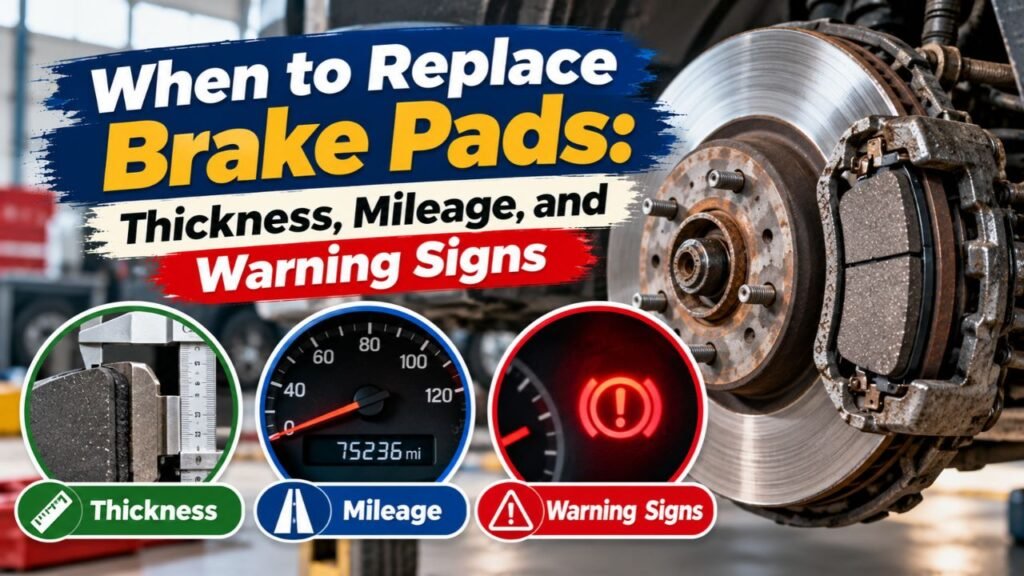
When to Replace Brake Pads: Thickness, Mileage, and Warning Signs
Brake pads should be replaced before the friction material wears down to its minimum limit. For many passenger vehicles, around 3 mm of remaining material is a sensible replacement point, while grinding, a pad-wear warning, severely uneven wear, damaged friction material, or reduced braking performance can mean replacement is needed sooner.
There is no universal mileage at which every set of brake pads wears out. City traffic, hills, towing, vehicle weight, driving style, pad material, caliper condition, and regenerative braking can all change pad life.
For when to replace brake pads, remaining friction-material thickness is more dependable than odometer mileage. Brembo currently advises replacement once pads fall below about 3 mm in its wear guidance, while its installation instructions state that pads with less than 2 mm of friction material or an activated wear indicator should be replaced as an axle set. Vehicle-specific service specifications take priority over generic numbers.
Brake-system condition also has real safety consequences. A NHTSA analysis of national crash databases identified 32,477 police-reported crashes in its GES data—about 0.58% of the analyzed crashes—as at least partially attributable to braking issues. That statistic covers braking-system issues broadly rather than worn pads alone, but it shows why brake symptoms should not be ignored.
Mileage can still give you a rough inspection window. Firestone reports that brake-pad life can vary widely, with manufacturer ranges commonly around 25,000 to 65,000 miles. Pads can wear sooner or last longer, so mileage should trigger inspection rather than automatic replacement.
The safest approach is to inspect pad thickness and condition, compare inner and outer pads, check the rotors, and pay attention to noise, warning indicators, pedal feel, and stopping behavior.
When to Replace Brake Pads Based on Thickness
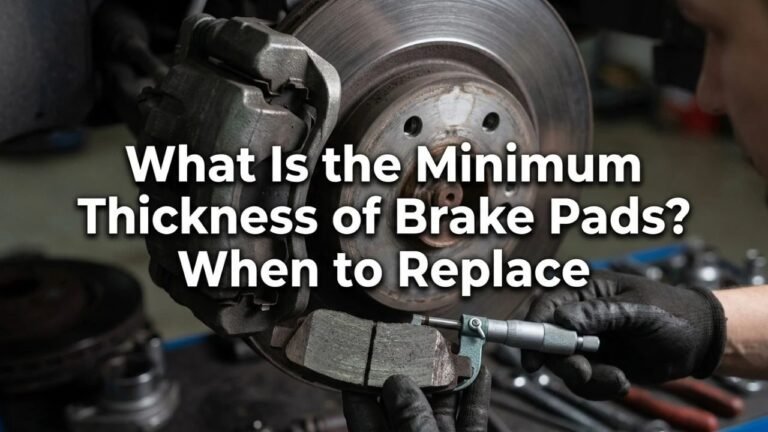
Pad thickness is one of the clearest ways to judge remaining life.
New Brake Pad Thickness
Many new passenger-car brake pads have roughly 10–12 mm of friction material, though the exact starting thickness varies by vehicle and pad design. Brembo currently cites about 10–12 mm as a typical new-pad range.
Do not include the steel backing plate when measuring friction material.
What matters is the remaining material between the rotor and backing plate.
Around 6 mm: Usually Plenty of Material Remains
A pad with roughly 6 mm of usable friction material generally has significant life left if:
- Wear is even
- The friction material is intact
- The rotor is healthy
- The caliper operates correctly
You normally would not replace a healthy 6 mm pad solely because of thickness.
Vehicle-specific instructions can vary. One BMW service bulletin, for example, uses 6 mm as a point for additional inspection on a specific front-brake application rather than as an automatic replacement limit.
Around 4 mm: Start Watching More Closely
At approximately 4 mm, replacement may not be immediately required, but the pads are well into their service life.
This is a good point to consider:
- How many miles you drive monthly
- Upcoming long trips
- Mountain driving
- Towing
- Heavy city use
Checking again at the next service is sensible unless the vehicle manufacturer gives a different instruction.
Around 3 mm: Plan to Replace
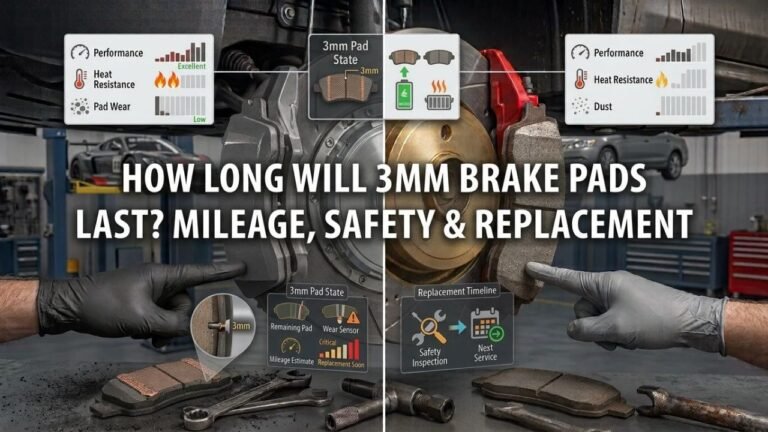
Around 3 mm is a common practical replacement point.
Brembo states that pads below 3 mm should be replaced in its current wear guidance.
Waiting until nearly all friction material is gone provides little benefit and raises the chance that the backing plate or wear indicator will reach the rotor.
Around 2 mm: Replace Promptly
Brembo’s current installation instructions state that pads with less than 2 mm of friction material should be replaced, along with all pads on that axle.
Other manufacturers may specify a different minimum. A GM service bulletin hosted by NHTSA, for example, uses 2.0 mm as the replacement specification for the vehicle covered by that procedure.
Use the vehicle manufacturer’s service limit whenever it is available.
Do Not Measure Only the Outer Pad
The outer pad may look healthy while the inner pad is nearly worn out.
Always compare:
- Inner left
- Outer left
- Inner right
- Outer right
Large differences can indicate sticking slide pins, caliper problems, or another mechanical issue.
A Bendix service procedure specifically directs technicians to compare inboard and outboard pad thickness and investigate guide components when wear differs excessively.
Key Takeaway: Around 3 mm is a sensible replacement zone for many passenger-car pads, but vehicle-specific specifications rule; inspect both inner and outer pads because uneven wear can hide a nearly worn-out pad.
Warning Signs That Brake Pads Need Replacement
You may notice symptoms before measuring the pads.
Squealing or Screeching
Many brake pads use a mechanical wear indicator.
As the friction material becomes thin, the metal tab contacts the rotor and produces a high-pitched squeal.
The sound may:
- Occur while braking
- Come and go
- Be more noticeable at low speeds
Not every squeal means the pads are worn. Moisture, rust, pad compound, dust, or glazed surfaces can also create noise.
A persistent wear-indicator squeal deserves inspection.
Grinding Noise
Grinding is much more serious.
It can mean the friction material has worn away enough that metal components are contacting the rotor.
At that point, continuing to drive may damage:
- Rotors
- Calipers
- Pad hardware
Do not continue normal driving with a harsh metal-on-metal grinding noise.
Electronic Pad-Wear Warning
Some vehicles have an electrical sensor embedded near the friction material.
When the pad reaches its designed wear point, the sensor triggers a warning message or indicator.
Brembo states that electronic wear sensors monitor pad thickness and warn the driver when the pads have reached minimal thickness.
Treat that warning as a request for brake inspection rather than something to reset and ignore.
Reduced Braking Performance
If the vehicle takes noticeably more effort or distance to stop, inspect the entire brake system.
The cause could involve:
- Worn pads
- Overheated brakes
- Contaminated pads
- Rotor problems
- Brake-fluid issues
- Hydraulic faults
Do not assume worn pads are the only explanation.
Vibration During Braking
A vibrating pedal or steering wheel can point to rotor or brake-system problems.
New pads alone may not correct it.
Inspect:
- Rotor thickness
- Rotor condition
- Runout
- Caliper operation
- Suspension and wheel components when appropriate
Vehicle Pulls During Braking
Pulling left or right can indicate unequal braking force.
Possible causes include:
- Uneven pad wear
- Sticking caliper
- Contaminated pad
- Hydraulic restriction
- Tire or suspension issue
Replacing pads without correcting the cause may lead to the same wear pattern again.
Key Takeaway: Wear-indicator squealing calls for inspection, while grinding, noticeably reduced braking, severe pulling, or abnormal pedal behavior should be treated as more urgent brake-system problems.
When to Replace Brake Pads Based on Mileage
Mileage is useful for planning inspections, but not as the final decision.
Typical Mileage Range
Brake-pad life is often quoted around 25,000–65,000 miles, with some pads wearing outside that range.
Another Firestone brake reference gives a broad 20,000–70,000-mile range and recommends judging pads by actual thickness rather than mileage alone.
A driver could need pads at 25,000 miles while another vehicle still has usable material beyond 60,000 miles.
Why City Driving Wears Pads Faster
Stop-and-go driving requires frequent braking.
A car driven 20 miles through city traffic may use its brakes far more than a car traveling 20 highway miles.
Frequent braking means more:
- Friction
- Heat
- Pad wear
Highway Driving Can Extend Pad Life
Drivers who spend most of their time on open highways may travel long distances with very little brake use.
Smooth deceleration also reduces pad wear.
Hills and Mountain Roads Increase Wear
Long descents turn vehicle energy into brake heat.
Repeated or prolonged braking can raise brake temperatures significantly and speed pad wear.
Use appropriate transmission or regenerative braking strategies where the vehicle manufacturer recommends them.
Towing and Heavy Loads Increase Brake Work
A heavier vehicle requires the brakes to absorb more energy during deceleration.
Regular towing, hauling, or carrying heavy loads can shorten pad life.
Performance Driving Wears Pads Faster
Repeated hard braking from high speed raises friction temperatures and consumes pad material quickly.
Performance pads may tolerate the heat better, but they are not immune to wear.
Key Takeaway: Mileage can tell you when inspection is worth doing, but actual thickness and condition determine replacement; stop-and-go traffic, hills, towing, and hard braking can shorten pad life considerably.
Front vs. Rear Brake Pads: Which Wear Out First?
Front pads often wear faster on conventional vehicles, but that is not a universal rule.
Front Brakes Usually Handle Heavy Deceleration Loads
When a vehicle slows, weight transfers toward the front axle.
The front brakes commonly handle a large portion of braking work.
This can make front pads wear more quickly.
Rear Pads Can Wear Faster on Some Vehicles
Modern braking systems use:
- Electronic stability control
- Traction control
- Electronic brake-force distribution
- Automatic emergency braking
- Regenerative-braking coordination
These systems can change front-to-rear brake use.
Some vehicles are known to wear rear pads surprisingly quickly.
Hybrids and EVs Can Be Different
Regenerative braking uses the electric drive system to slow the vehicle and recover energy.
That can reduce friction-brake use during many normal stops.
Friction pads may last longer, but less frequent use can also contribute to corrosion or uneven brake-surface conditions in certain operating environments.
A BMW service bulletin for the i8 illustrates that regenerative-braking behavior can even create application-specific differences between inner and outer pad wear.
Key Takeaway: Front pads often wear first, but modern brake controls and regenerative systems can change the pattern; inspect all four wheels rather than assuming the front axle is the only one due for service.
Replace Brake Pads Immediately in These Situations
Thickness is not the only reason to replace a pad.
Friction Material Is Cracked or Breaking Apart
Pads should be replaced if the friction material has serious:
- Cracks
- Missing sections
- Separation from the backing plate
A Bendix inspection procedure permits minor edge damage in its specific application but calls for replacement when major pad-surface damage is present.
Pad Is Contaminated
Oil, grease, brake fluid, or another contaminant can alter friction.
Contaminated pads may not brake consistently even if they still have plenty of material.
Find and repair the source of contamination as part of the job.
Metal-to-Metal Grinding Has Started
Once the friction material has been consumed, the steel backing plate can contact the rotor.
The vehicle may then need more than pads.
Rotor replacement may also be necessary.
Wear Sensor Has Triggered
If the vehicle has a dedicated brake-pad wear warning, inspect and service the pads.
Brembo advises replacing its electronic wear sensor during brake-pad replacement where applicable.
Pads Are Severely Uneven
One pad nearly worn to the backing plate while its partner remains thick points to a brake-system fault.
Check:
- Slide pins
- Caliper piston
- Pad hardware
- Bracket corrosion
- Flexible brake hose
Do not simply install new pads and leave the cause unresolved.
Key Takeaway: Replace pads based on condition as well as thickness; contamination, major damage, grinding, triggered wear sensors, and severe uneven wear can all justify immediate service.
Do You Replace All Four Brake Pads at Once?
Not necessarily all four wheels, but both sides of the same axle should normally be serviced together.
Replace Pads as an Axle Set
If the front pads are worn out, replace the pads at both front wheels.
If the rear pads need replacement, replace both rear sides.
Brembo’s instructions call for all pads on the axle to be replaced once the wear limit is reached.
Front and Rear Do Not Have to Be Replaced Together
If the fronts measure 3 mm and the rears still have 7 mm, you normally do not need to replace the rear pads just because the fronts are due.
Inspect both axles and service based on condition.
Uneven Left-to-Right Wear Needs Diagnosis
If one front wheel has 2 mm and the other has 6 mm, the difference should be investigated.
A sticking brake may destroy the new set quickly if it is ignored.
Key Takeaway: Replace brake pads across the complete axle, but front and rear pads do not need simultaneous replacement unless both axles are actually due.
Should Rotors Be Replaced With Brake Pads?
Not automatically.
The rotors need to pass their own inspection.
Measure Rotor Thickness
Brake rotors have a minimum allowable thickness.
BMW service information, for example, states that new pads may only be installed when the rotor satisfies the model’s applicable minimum-thickness requirement.
The exact minimum is vehicle- and rotor-specific.
Look for:
- Stamped minimum thickness
- Service-manual specification
Inspect Rotor Surface
Replacement may be needed if the rotor has:
- Deep grooves
- Severe rust
- Heat cracks
- Major surface damage
- Thickness below specification
Check for Pulsation Problems
If the car shakes while braking, inspect rotor runout and thickness variation before installing new pads.
Putting fresh pads against a problem rotor may leave the braking complaint unchanged.
Do Not Automatically Machine Every Rotor
Some rotors can be refinished if enough material remains and the manufacturer allows it.
Others are best replaced.
Use the rotor specifications for the exact vehicle.
Key Takeaway: New pads do not automatically require new rotors, but each rotor should be measured and inspected before the new pads are installed.
How Often Should You Check Brake Pads?
Inspect them regularly rather than waiting for noise.
Check During Tire Rotation or Routine Service
Wheel removal gives good access for inspecting:
- Pad thickness
- Rotor condition
- Calipers
- Brake hoses
This makes tire service a convenient time for a brake check.
Inspect More Often During Severe Use
Shorten the inspection interval if you regularly:
- Tow trailers
- Drive in mountains
- Commute in dense traffic
- Carry heavy loads
- Drive aggressively
Check Before a Long Trip
If the pads already look thin and you are planning a long road trip, replacing them before departure can make more sense than trying to use every final millimeter.
Do Not Depend Entirely on Wear Sensors
A sensor may monitor only one pad or one position.
Uneven caliper wear can allow another pad to become thinner first.
Physical inspection remains useful even on vehicles with electronic pad-life monitoring.
Key Takeaway: Routine wheel-off service is a good time to measure brake pads, and vehicles exposed to towing, hills, heavy traffic, or uneven brake wear deserve more frequent inspection.
How to Check Brake Pad Thickness
You may be able to perform a preliminary inspection through the wheel, but a proper measurement is better.
Look Through the Wheel
On open wheel designs, you may be able to see:
- Rotor
- Caliper
- Outer pad
Look for the friction material between the rotor and steel backing plate.
This method may not reveal the inner pad.
Remove the Wheel for a Better Inspection
With the vehicle safely raised and supported at its specified lift points, removing the wheel provides much better access.
Never rely on a hydraulic jack alone while working near the brakes.
Measure the Friction Material
Use a brake-pad gauge or suitable measuring tool.
Measure the friction material only, not the backing plate.
Check the thinnest area.
Compare Inner and Outer Pads
Do not stop after measuring the most visible pad.
A sticking caliper can create a major difference between the two.
Inspect Both Sides of the Axle
Compare the opposite wheel as well.
Uneven left-to-right wear is useful diagnostic information.
Key Takeaway: Measure the friction material at its thinnest point and inspect inner, outer, left, and right pads rather than relying on a quick look at one visible pad.
Why Brake Pads Wear Out Early
Sticking Caliper Slide Pins
Floating calipers depend on slide pins to move freely.
If they seize, one pad may remain in stronger contact with the rotor.
Sticking Caliper Piston
A piston that does not retract properly can keep pressure on a pad.
Signs may include:
- One wheel running hot
- Burning smell
- Rapid pad wear
- Vehicle pulling
Aggressive Braking
Late, hard braking creates more heat and pad wear than smoother deceleration.
Heavy Vehicle Loads
More mass means the brakes must absorb more energy.
Mountain Driving
Repeated downhill braking raises brake temperature and increases wear.
Poor-Quality or Wrong Pads
A friction compound that does not match the vehicle’s intended use may wear faster or behave poorly.
Use pads cataloged for the exact brake system.
Key Takeaway: Early wear may result from driving conditions, but a large difference between individual pads often points to a mechanical problem that should be corrected before new pads are installed.
Conclusion
When to replace brake pads is best decided by remaining friction-material thickness and pad condition rather than mileage alone. Around 3 mm is a sensible replacement point for many passenger-car applications, while the vehicle manufacturer’s stated service limit should always take priority.
Do not wait for grinding. Squealing wear indicators, electronic pad warnings, severe uneven wear, damaged pads, or reduced braking performance are all reasons to inspect the system sooner.
Mileage ranges such as 25,000–65,000 miles are only rough references. A city-driven vehicle can wear pads much sooner than a highway-driven car, while hybrids and EVs may use their friction brakes less frequently because of regenerative braking.
When replacement is due, service the full axle, inspect the rotors, and correct any caliper or hardware issue causing uneven wear. That prevents a new set of pads from being ruined by the same underlying problem.
FAQs About When to Replace Brake Pads
At What Thickness Should Brake Pads Be Replaced?
Around 3 mm is a common replacement point for many passenger vehicles.
Brembo’s current wear guidance recommends replacement below 3 mm, while its installation instructions state that pads below 2 mm or with an activated wear indicator must be replaced. Vehicle-specific specifications take priority.
Should I Replace Brake Pads at 4 mm?
Not always immediately.
Four millimeters generally means the pads are getting closer to the end of their life, so monitor them more closely. Replacement may make sense sooner if you tow, drive long distances, travel in mountains, or will not be able to inspect them again soon.
How Many Miles Do Brake Pads Usually Last?
A broad range is roughly 25,000–65,000 miles, but pad life varies substantially with driving habits, vehicle weight, brake design, terrain, and pad material.
Actual thickness is a better indicator than mileage.
How Do I Know if My Brake Pads Are Worn Out?
Common signs include thin friction material, a wear-indicator squeal, a brake-pad warning message, grinding, uneven wear, and changes in braking behavior.
Grinding or significantly reduced braking requires prompt inspection.
Can I Drive With 2 mm Brake Pads?
Two millimeters is at or near the replacement limit used in several brake-service specifications.
Brembo’s generic installation guidance says pads below 2 mm should be replaced. Do not plan extended driving on pads that are already at the minimum.
Do I Need New Rotors Every Time I Replace Brake Pads?
No.
Rotors can sometimes remain in service if they are above minimum thickness and free from unacceptable damage or wear. Measure and inspect them during every brake-pad replacement.
Should I Replace Front and Rear Brake Pads at the Same Time?
Only if both axles need them.
Pads should normally be replaced in complete axle sets, meaning both front wheels together or both rear wheels together. Front and rear sets do not have to be changed simultaneously.
Is Grinding a Sign That Brake Pads Need Immediate Replacement?
Yes, grinding can mean the friction material has worn away and metal is contacting the rotor.
Stop treating the problem as routine pad maintenance and have the brakes inspected promptly because rotor or caliper damage may already be present.