Average Cost to Replace Brake Pads: Parts, Labor, and Pricing
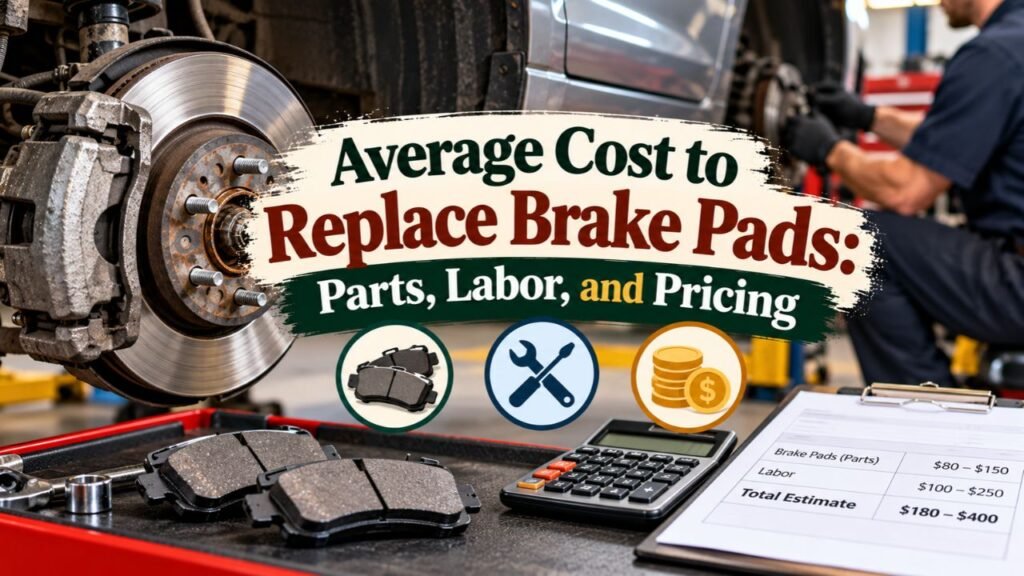
Brake pad replacement for a typical U.S. vehicle often costs about $250 to $400 per axle at a repair shop. The total can be lower on simple economy cars and much higher on luxury, performance, heavy-duty, or specialty vehicles. Replacing pads on both front and rear axles can roughly double the bill.
Current U.S. pricing supports that range. RepairPal’s estimate, updated September 3, 2026, places brake pad replacement at about $335 to $394, with roughly 122–179 attributed to labor and 213–215 to parts in its national estimate. Taxes, fees, location, and added repairs are excluded.
For the average cost to replace brake pads, a practical planning figure is about 300–400 for one axle on many everyday cars. Kelley Blue Book also cites roughly $300 per axle for many dealership brake-pad services, while vehicle-specific pricing varies.
Your invoice can change sharply if the rotors are worn, the caliper is sticking, electronic parking-brake service is required, or premium friction material is specified. A quote for “brakes” may therefore cover far more than pads alone.
Front and rear pads are normally replaced as axle pairs. If one front pad is worn out, a shop generally replaces the pads on both front wheels rather than changing only one wheel. NAPA likewise notes that professional brake work is performed on both wheels of the same axle.
The sections below break down parts, labor, front versus rear pricing, dealer costs, rotor charges, DIY expenses, and signs that a quote is higher because additional brake parts are needed.
Average Cost to Replace Brake Pads by Service Type
Brake-pad pricing makes more sense when you separate one axle from the entire vehicle.
| Brake Service | Typical U.S. Cost Range |
| Brake pads, one axle | 250–400 |
| Budget/economy vehicle, one axle | 200–350 |
| Truck or SUV, one axle | 275–500+ |
| Luxury/performance vehicle, one axle | 350–800+ |
| Front and rear pads | 500–800+ |
| DIY pads, one axle | About 30–150+ in parts |
| Pads plus rotors, one axle | Often 400–800+ |
| Specialty/performance brake systems | Can exceed normal ranges by a wide margin |
These are planning ranges rather than quotes.
NAPA currently states that brake-pad replacement can range from about $200 to more than $800 based on year, make, and model. RepairPal’s national estimate is narrower at 335–394 for brake-pad replacement.
Why the Range Is So Wide
The cost changes with:
- Vehicle make and model
- Front or rear axle
- Brake-pad material
- Labor rate
- Pad size
- Electronic parking-brake system
- Rotor condition
- Caliper condition
- Hardware included with the pads
- Dealer versus independent shop
- Regional shop pricing
A compact sedan using common brake parts may sit near the lower end.
A heavy SUV, European luxury model, or high-performance vehicle can cost much more because the pads are larger, more specialized, or harder to access.
Vehicle-Specific Examples
RepairPal’s September 2026 estimates show how much ordinary vehicles can differ:
- Honda Civic: about 271–328
- Honda Accord: about 291–349
- Honda CR-V: about 264–321
- Honda Ridgeline: about 342–399
- Dodge Charger: about 318–375
Those estimates exclude taxes, fees, location adjustments, and related repairs.
Key Takeaway: Around 250–400 per axle is a useful planning range for many vehicles, but make, model, brake design, and added repairs can move the price far outside it.
How Much Do Brake Pads Cost Without Labor?
A set of brake pads can range from inexpensive aftermarket parts to high-priced OEM or performance components.
Economy Brake Pads
Budget pad sets may cost roughly 30–60 per axle.
They can work for ordinary transportation when the product meets the vehicle’s requirements and comes from a reputable manufacturer.
Price alone should not decide a brake purchase.
Friction behavior, fit, noise control, heat resistance, hardware, and vehicle compatibility all matter.
Midrange Brake Pads
Many ceramic and semi-metallic replacement sets fall roughly in the 50–120 range.
This is a common category for passenger cars, crossovers, and light trucks.
Better kits may include:
- Shims
- Clips
- Wear indicators
- Abutment hardware
Some vehicles require hardware to be purchased separately.
Premium and OEM Pads
OEM, performance, European, heavy-duty, or specialty pads can cost 100–300 or more per axle.
Large performance calipers may use unusually sized friction material.
RepairPal’s current national estimate attributes about 213–215 of its 335–394 brake-pad replacement figure to parts, showing that installed shop parts can cost much more than a low-priced retail pad set.
Key Takeaway: Retail pad sets may start below $50, but installed shop parts can cost considerably more once pad quality, vehicle fitment, hardware, sourcing, and shop markup are included.
How Much Is Labor for Brake Pad Replacement?
Labor commonly accounts for a large part of the bill.
RepairPal’s current national estimate lists labor at approximately $122 to $179 for brake-pad replacement.
Why Labor Prices Differ
Shop labor rates vary by region and business type.
A rural independent garage may charge much less per hour than a dealership in a high-cost metro area.
Labor time may also increase when:
- Caliper bolts are seized
- Brake hardware is heavily corroded
- Electronic parking-brake service mode is required
- Wheels are difficult to remove
- Brake components need cleaning
- Caliper slide pins need service
A straightforward front pad replacement on a common vehicle is usually simpler than rear brake work on a car with an electronic parking brake.
Dealer vs Independent-Shop Labor
Dealerships often have higher hourly labor rates.
In return, they may use OEM parts, factory procedures, brand-specific diagnostic tools, and technicians familiar with that manufacturer’s brake systems.
Independent shops can offer lower installed pricing while using quality aftermarket components.
The quote matters more than assuming one shop type is always cheaper.
Key Takeaway: Labor for a normal pad job often lands around 120–180 in national estimates, but regional rates and brake-system design can push it higher.
Front Brake Pad Replacement Cost vs Rear Brake Pad Cost
Front and rear brake-pad costs are often similar, but they are not guaranteed to match.
Front Brake Pads
Front brakes commonly handle a larger share of braking force because vehicle weight transfers forward during deceleration.
Front pads may therefore wear faster on many vehicles.
A typical front pad service often costs around 250–400 for one axle.
Larger trucks, luxury vehicles, and performance cars can cost more.
Rear Brake Pads
Rear brake pads may last longer on some cars, but modern stability control, brake-force distribution, and electronic parking brakes can change wear patterns.
Rear service can also cost more when the vehicle has:
- Electronic parking brake motors
- Special caliper-reset procedures
- Integrated parking-brake mechanisms
A scan tool may be needed on certain cars to place the parking brake into service mode before the caliper piston is retracted.
Should Front and Rear Pads Be Replaced Together?
Not automatically.
Replace pads based on measured wear and manufacturer service limits.
If the front pads are worn while the rear set still has plenty of usable material, there is usually no need to replace both axles solely because one axle needs service.
Pads on the same axle should be replaced as a set.
Key Takeaway: Front and rear service commonly falls into similar price ranges, though electronic parking-brake systems can make some rear brake jobs more expensive.
How Much Does It Cost to Replace All Four Brake Pads?
Replacing front and rear brake pads can cost roughly $500 to $800 or more on many vehicles if no rotors or calipers are needed.
CARFAX has cited about 300–600 for brake pads across a vehicle, or roughly 150–300 per axle in its published estimate, though current shop pricing can run higher.
A current RepairPal national figure around 335–394 for brake-pad replacement also shows why two-axle service can approach or exceed $700 at typical shop pricing.
Luxury and performance vehicles can exceed $1,000 for pads alone when specialized components and high labor rates are involved.
Ask whether the quote covers:
- Front only
- Rear only
- Both axles
- Hardware
- Brake inspection
- Rotor service
- Shop supplies
- Taxes
Two estimates can look very different simply because they cover different amounts of work.
How Much Does Brake Pad and Rotor Replacement Cost?
Rotors are one of the main reasons a brake bill rises beyond a simple pad replacement.
A brake pad clamps against the rotor every time you stop.
Once the rotor becomes too thin, deeply scored, cracked, heavily rusted, or otherwise outside specification, replacement may be required.
Pads and Rotors on One Axle
A typical pads-and-rotors job may run roughly $400 to $800 per axle on many ordinary vehicles.
Kelley Blue Book has published a lower broad average of around 250–400 per axle for pads and rotors, while NAPA notes that complete brake pad and rotor service can vary drastically by vehicle and can become far more expensive on specialty applications.
Real 2026 pricing varies enough that a vehicle-specific quote is more useful than one national number.
Why Shops May Recommend Rotors With Pads
New brake pads need a suitable rotor surface.
A rotor with deep grooves, severe corrosion, excessive runout, or thickness below specification can create:
- Brake vibration
- Noise
- Uneven pad contact
- Poor bedding
- Rapid new-pad wear
A shop should be able to explain why a rotor needs replacement and provide measurements when relevant.
Can Rotors Be Reused?
Yes, if they remain within specification and their condition supports reuse.
Some shops resurface rotors when thickness permits.
Others replace them because many modern rotors are relatively thin and replacement can be more practical than machining.
Key Takeaway: Adding rotors can raise a one-axle brake job from a few hundred dollars to 400–800 or more, so confirm whether a quote is for pads only or pads plus rotors.
What Makes Brake Pad Replacement More Expensive?
Several items can increase the bill beyond the basic pad service.
Sticking or Damaged Calipers
A seized slide pin or caliper piston can wear one pad much faster than the others.
Replacing the pads without fixing the caliper problem can ruin the new set.
Caliper replacement can add hundreds of dollars to the repair.
Electronic Parking Brake Service
Many newer cars use electric motors to apply the rear parking brake.
Some need diagnostic equipment to retract and reset the system during rear pad replacement.
That can add labor.
Performance Brake Systems
Large multi-piston calipers, specialty friction compounds, and high-performance rotors cost more than standard commuter-car parts.
Kelley Blue Book notes that carbon-ceramic performance systems can reach extremely high replacement costs, far outside the range of ordinary brake service.
Corrosion
Vehicles driven in areas using winter road salt may have:
- Rusted fasteners
- Stuck caliper brackets
- Seized slide pins
- Corroded rotor hubs
Extra disassembly and cleaning adds labor time.
Premium Pads
Ceramic, low-dust, heavy-duty, towing, or OEM pads can increase parts pricing.
Choose material suited to the vehicle rather than buying purely from the cheapest or most expensive option.
Key Takeaway: Calipers, electronic parking brakes, corrosion, specialty brake systems, and premium pads can move the final bill far above a routine pad replacement.
Dealer vs Independent Shop Brake Pad Cost
The dealership is often the higher-priced route, but the difference varies.
Dealership
A dealership may offer:
- OEM pads
- Factory-trained technicians
- Brand-specific diagnostic equipment
- Manufacturer service procedures
- Dealer warranty coverage
Kelley Blue Book places many dealership pad replacements around $300 per axle, though the actual figure depends on vehicle and location.
Independent Repair Shop
An independent shop may offer several pad grades at different prices.
Labor rates can be lower than dealer rates.
Ask which pad brand and product line the quote includes.
A cheap quote using unknown friction material is not directly comparable with an estimate using OEM-quality pads and new hardware.
National Chain
Chains can fall between dealer and independent pricing.
Some offer brake warranties or promotional discounts.
Check what parts and labor are covered before comparing totals.
Can You Save Money by Replacing Brake Pads Yourself?
DIY brake-pad replacement can reduce labor cost substantially.
A pad set for a common vehicle may cost about 30–150 or more, so the parts-only bill can be much lower than a shop invoice.
You may also need:
- Floor jack
- Jack stands
- Wheel chocks
- Socket set
- Torque wrench
- Caliper piston tool
- Brake cleaner
- Suitable lubricant
- Vehicle-specific service information
Rear electronic parking brakes may need a scan tool or a manufacturer-specific service procedure.
RepairPal notes that pad replacement can be performed at home but recommends certified repair service because the braking system is safety-related.
If you are unsure about lifting the vehicle, caliper service, torque specifications, brake-fluid handling, or pedal checks, professional service is the better choice.
How Often Do Brake Pads Need Replacement?
Brake-pad life varies substantially.
Kelley Blue Book says pads commonly last roughly 25,000 to 50,000 miles, while CARFAX gives a wider range of approximately 30,000 to 80,000 miles. Driving style and vehicle use explain much of that variation.
Pads often wear faster with:
- Stop-and-go traffic
- Frequent hard braking
- Heavy towing
- Mountain driving
- Heavy vehicle loads
- Sticking calipers
Highway driving with gradual stops may extend pad life.
Measure pad thickness during inspections rather than replacing pads solely at a fixed mileage.
Signs Your Brake Pads May Need Replacement
Do not rely only on mileage.
Brake wear can show up through several symptoms.
Squealing or Wear-Indicator Noise
Some pads have a metal wear indicator that contacts the rotor as the friction material gets thin.
This can produce a high-pitched squeal.
Brake noise has other causes too, so an inspection is still needed.
Grinding
Grinding may mean the friction material is gone and metal is contacting the rotor.
Stop delaying service if this occurs.
Continuing to drive can damage the rotor and may reduce braking ability.
Brake Warning
Some vehicles use electronic pad-wear sensors.
A dashboard message can indicate that the pads have reached their service threshold.
Uneven Braking or Pulling
Pulling can point to a caliper, hydraulic, tire, suspension, or brake problem rather than normal pad wear alone.
Have the system inspected.
Key Takeaway: Squealing, grinding, a pad-wear warning, or abnormal braking behavior deserves inspection; catching pad wear early can prevent added rotor damage.
How to Avoid Paying Too Much for Brake Pads
Ask for an itemized estimate before approving the work.
The quote should make clear:
- Pad cost
- Labor cost
- Rotor cost
- Caliper cost
- Hardware
- Fees
- Taxes
Ask the shop what pad material and brand it plans to install.
If rotors are recommended, ask what condition or measurement makes replacement necessary.
Get another estimate when a large repair quote is not clearly explained, especially when calipers or all four rotors are being recommended.
Do not delay a confirmed brake problem solely to shop for the lowest price. Brakes are a safety system, and grinding or severe pulling calls for prompt attention.
Conclusion
The average cost to replace brake pads is roughly 250–400 per axle for many vehicles in the United States, with current RepairPal data putting its national estimate at about 335–394.
Parts and labor both contribute to the price. A straightforward economy-car pad job may stay near the lower end, while trucks, luxury cars, electronic parking-brake systems, and performance brakes can cost much more.
If rotors also need replacement, expect the bill to rise sharply. Calipers, corrosion, specialty hardware, or brake-fluid work can push the total higher again.
I would compare quotes by axle and by included parts rather than looking only at the final number. A $300 pads-only estimate and a $600 pads-and-rotors estimate are not the same service.
FAQs About Brake Pad Replacement Cost
What is the average cost to replace brake pads on one axle?
A useful current estimate is around 250–400 for one axle on many U.S. vehicles. RepairPal’s September 2026 national estimate is 335–394 for brake-pad replacement, before taxes, location adjustments, and related repairs.
How much should front brake pads cost to replace?
Front pads commonly cost around 250–400 installed on an ordinary passenger vehicle. Larger trucks, European models, high-performance brakes, or damaged rotors can raise the price.
How much does it cost to replace all four brake pads?
Front and rear pad replacement can often run roughly 500–800 or more. Costs rise when premium pads, specialty brake systems, rotors, or caliper repairs are involved.
Is $500 too much for brake pads?
Not necessarily. $500 can be reasonable for one axle on a larger, luxury, or specialty vehicle, or when the quote includes higher-priced pads, hardware, inspection work, or added labor. Ask for an itemized estimate before deciding.
How much are brake pads without labor?
A retail pad set may cost around 30–150 for many mainstream cars, with OEM and performance sets costing considerably more. Shop-installed parts are often priced higher than online or retail DIY components.
How much does it cost to replace brake pads and rotors?
For many vehicles, pads and rotors on one axle can run roughly 400–800 or more. Vehicle design, rotor price, labor, and local rates have a large effect on the final invoice.
Is it cheaper to replace brake pads yourself?
Yes, if you already have the correct tools and know the brake procedure for your vehicle. DIY removes most labor charges, leaving pad and hardware costs. Brake work needs correct lifting, installation, torque, and post-repair checks.
Do I need to replace rotors every time I replace brake pads?
No. Rotors can sometimes be reused if they remain within the manufacturer’s thickness and condition limits. Deep scoring, severe rust, runout, cracking, or thickness below specification can make replacement necessary.