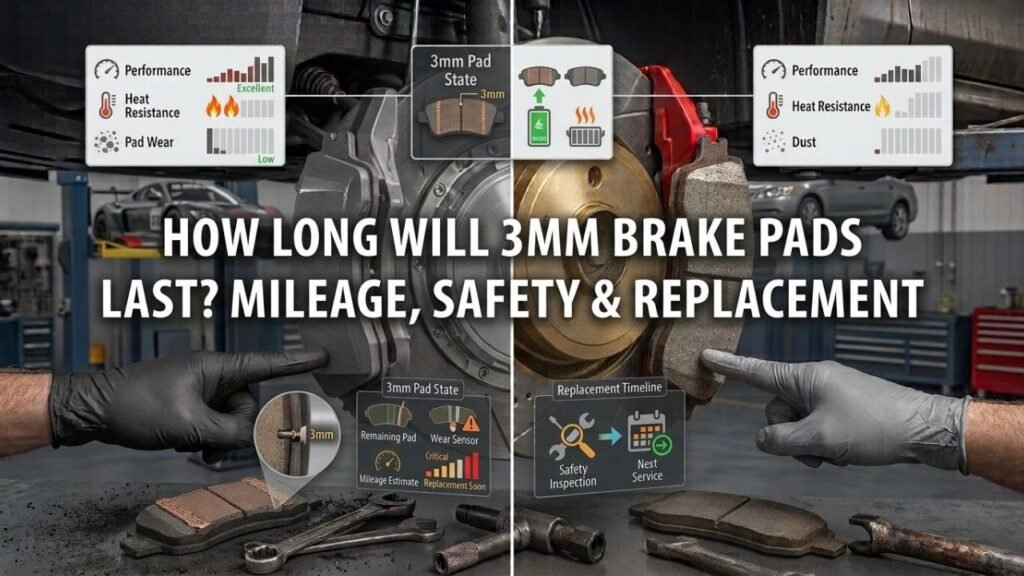
How Long Will 3mm Brake Pads Last? Mileage, Safety & Replacement
Brake pads with 3 mm of friction material remaining are near the end of their usable service life. There is no dependable number of miles they will last because wear changes sharply with traffic, hills, vehicle weight, towing, pad compound, and caliper condition. Treat 3 mm as a replacement point rather than planning to use every remaining millimeter.
Trying to convert 3 mm directly into remaining mileage can give a false sense of security. A car driven mostly on open highways may wear its pads slowly, while the same thickness can disappear much faster during stop-and-go traffic, mountain driving, frequent towing, or repeated hard stops.
Replacing the pads before they become extremely thin reduces the chance of the metal backing plate contacting the rotor. It also gives you time to inspect the rotors, calipers, slide pins, and hardware before worn pads turn into a larger brake repair.
AAA advises that brake pads at roughly 3 mm thick should be replaced, while Firestone describes about 3–4 mm as a common replacement range. Manufacturer specifications still take priority because the minimum thickness can vary by vehicle and brake design.
For anyone asking how long will 3mm brake pads last, I would not use a fixed mileage estimate as the basis for postponing service. A GM service bulletin for certain trucks and SUVs, for example, specifies replacement when friction material reaches 2.0 mm, showing that the exact limit can differ by application.
The useful approach is to confirm the measurement, check the thinnest inner and outer pads, compare them with the vehicle maker’s specification, and schedule replacement if 3 mm is near or at that limit. Driving pattern, pad position, rotor condition, and uneven wear also change how much time remains.
How Long Will 3mm Brake Pads Last in Real Driving?
There is no reliable universal answer in miles. At 3 mm, or about 0.12 inch, many brake-service sources already consider the pads ready for replacement.
Some pads may lose their remaining usable material quickly. Others may wear slowly for a period. That variation is exactly why I would not promise that 3 mm means another 1,000, 3,000, or 5,000 miles.
City and Stop-and-Go Driving
City driving generally uses the friction brakes far more frequently than steady highway driving.
Every stop removes a tiny amount of friction material. Heavy traffic, short blocks, frequent traffic lights, and repeated braking from moderate speeds can consume the last part of a pad faster than a long highway commute.
A driver covering only a modest number of city miles may therefore wear pads faster than someone traveling much farther on an interstate.
At 3 mm, this type of use gives little reason to delay replacement.
Highway Driving
Steady highway travel can produce relatively little brake wear because the brakes may go many miles without being applied.
This can make thin pads appear to last longer in mileage terms.
That does not turn 3 mm into a healthy pad thickness. An emergency stop, highway congestion, an exit on a steep grade, or a long downhill section can place far more heat and friction into the pads than ordinary cruising.
Towing, Hauling, and Mountain Driving
Added vehicle mass means the brakes must manage more energy during deceleration.
Towing a trailer, carrying a heavy load, or descending long grades can raise brake temperatures and increase wear. Frequent use under these conditions is a strong reason to replace 3 mm pads rather than trying to stretch their remaining life.
My preference would be to service thin pads before a towing trip or mountain journey instead of treating the trip as a test of how much material remains.
Aggressive Braking
Late, hard braking generates higher pad pressure and more heat than gentle deceleration.
A driver who regularly brakes hard from speed may consume the final portion of a pad much faster than a driver who leaves more following distance and slows gradually.
Brake wear also does not have to remain perfectly linear as the pad becomes thin.
Key Takeaway: There is no safe fixed-mileage promise for 3 mm pads. City traffic, hills, towing, and hard braking can shorten the remaining interval sharply, so replacement should already be planned.
Is 3mm Brake Pad Thickness Safe?
Three millimeters is generally considered low brake-pad thickness, not a comfortable amount of remaining material.
AAA says pads at roughly 3 mm are ready for replacement. Firestone also identifies approximately 3–4 mm as a common replacement point.
That does not mean every vehicle becomes unsafe the instant a pad reaches exactly 3.0 mm. The manufacturer may publish a different service limit. The point is that very little friction material remains compared with a new pad.
Manufacturer Limits Are Not All the Same
There is no universal 3 mm specification covering every passenger vehicle.
For example, an NHTSA-hosted GM technical bulletin for specified models states that pads should be replaced when the friction surface is worn to within 2.0 mm of the mounting plate. Other applications use different thresholds.
This is why the service manual or manufacturer specification should settle the final decision.
If your car calls for replacement at 3 mm, the pads are due now. If its stated minimum is lower, 3 mm still leaves only a small wear margin.
Thickness Is Not the Only Safety Check
A pad with 3 mm remaining may need replacement sooner if it is:
- Cracked
- Contaminated by brake fluid or grease
- Wearing at an angle
- Separating from its backing plate
- Glazed or heat damaged
- Much thinner than the pad on the opposite side
- Dragging because of a sticking caliper
Thickness is one measurement, not the complete brake inspection.
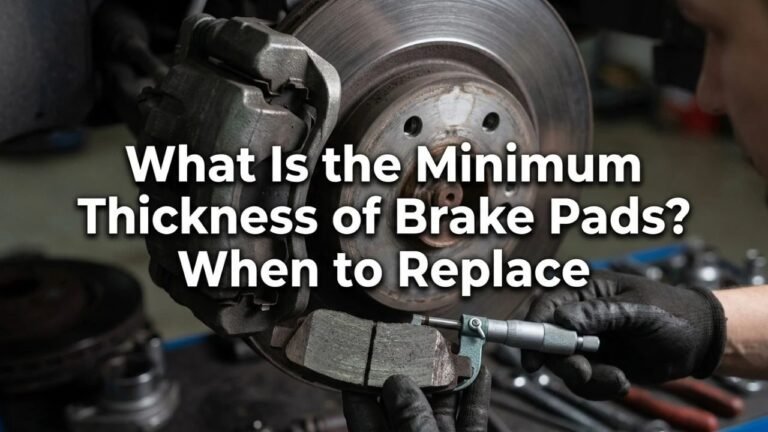
Measure the Friction Material, Not the Backing Plate
A common mistake is measuring the complete brake pad.
The 3 mm figure refers to friction material, not the steel backing plate behind it.
A visual check through a wheel can also hide the inner pad. On some vehicles, the inside pad wears faster than the outside pad, so the visible outer pad may not represent the lowest thickness in the caliper.
Key Takeaway: Three millimeters is a low-pad condition and a common replacement point. Confirm the vehicle-specific limit and inspect the thinnest friction surface rather than judging one visible pad.
Why 3mm Pads Can Wear Out Faster Than Expected
Brake-pad wear is influenced by far more than mileage.
Two cars can cover the same 10,000 miles and remove very different amounts of friction material.
Vehicle Weight
A heavier vehicle carries more kinetic energy at a given speed.
More energy must be converted into heat when the vehicle slows, placing greater demand on the brakes. This is one reason trucks, loaded SUVs, and tow vehicles can consume friction material quickly under demanding use.
Front Versus Rear Pads
Front and rear pads do not necessarily wear at the same rate.
During braking, weight transfers toward the front of a conventional vehicle. Brake-force distribution, ABS programming, stability control, regenerative braking, and vehicle design also affect which axle does more work.
Do not assume a 3 mm rear pad and a 3 mm front pad will continue wearing at identical rates.
Pad Material
Ceramic, semi-metallic, and other friction compounds have different wear characteristics.
A hard-wearing ceramic street pad may lose material differently from a semi-metallic compound used in a heavier or more demanding application.
The rotor material and surface condition also influence wear.
Sticking Calipers or Slide Pins
Abnormally fast wear is sometimes a brake fault rather than normal pad consumption.
A sticking caliper piston can keep the pad pressed against the rotor after the pedal is released. Seized guide pins or binding pad hardware can create a similar problem.
The affected pad may lose the final few millimeters surprisingly fast.
Rotor Condition
Deep grooves, heavy corrosion, severe heat damage, or an unsuitable rotor surface may affect pad contact and wear.
The rotors should therefore be inspected at the same time as 3 mm pads.
Key Takeaway: Thin pads do not wear according to mileage alone. Vehicle weight, pad compound, axle position, caliper movement, and rotor condition can all change the remaining interval.
Can You Estimate Remaining Brake Pad Life From Previous Wear?
Past wear history can give a rough idea of how quickly the pads have been losing thickness, but it should not be used to justify driving below the manufacturer’s service limit.
If you know:
- Original friction-material thickness
- Current thickness
- Mileage since installation
- Vehicle-specific replacement thickness
you can calculate an average historical wear rate.
For example, the basic calculation is:
Material worn ÷ miles driven = average wear per mile
That number can show if the pads have been wearing unusually quickly.
It cannot predict future life with certainty. Driving conditions may change, pad wear may not stay perfectly linear, and one pad can begin wearing faster because of a caliper fault.
I find this calculation more useful for detecting a wear pattern than for deciding how far a 3 mm pad can be pushed.
What Does 3mm Look Like Compared With New Brake Pads?
New brake-pad thickness varies by vehicle and pad design, so there is no single starting measurement.
Many passenger-vehicle pads have far more than 3 mm of friction material when new. By the time only 3 mm remains, most of the original usable friction layer has already been consumed.
A simple thickness reference looks like this:
| Friction Material | General Interpretation | Action |
| 8 mm or more | Substantial material on many applications | Continue normal inspections |
| 5–6 mm | Noticeable wear | Monitor |
| About 4 mm | Getting low | Plan service |
| About 3 mm | Common replacement range | Schedule replacement |
| Near vehicle minimum | Very little margin remains | Replace according to specification |
These ranges are only general references. The manufacturer’s specification overrides the table.
Brembo also advises replacement at less than roughly 3–4 mm in its current service guidance for some passenger-vehicle applications.
Should You Replace 3mm Brake Pads Now or Wait?
For most normal passenger vehicles, I would plan replacement now rather than trying to calculate how many extra miles can be extracted from 3 mm pads.
That approach is less about panic and more about avoiding an unnecessary gamble with a wear component that is already near a common service threshold.
Replace Soon If Braking Feels Normal
If the vehicle brakes normally, the pads are wearing evenly, and 3 mm is still above the exact manufacturer minimum, the car may not require an emergency tow simply because of that measurement.
It still makes sense to schedule the brake job rather than postpone it for another long service interval.
Replace Promptly Before a Long Trip
A road trip can involve traffic, mountain grades, emergency stops, heavy cargo, or weather conditions that place more demand on the brakes than ordinary commuting.
If pads are already at 3 mm, replacing them before a long trip removes that uncertainty.
Do Not Wait if You Hear Grinding
Grinding can indicate that friction material has become extremely thin or that metal components are contacting the rotor.
Continuing to drive can damage the rotor and may affect braking behavior.
Grinding can also have other mechanical causes, so the vehicle needs inspection rather than an assumption that only the pads are involved.
Pay Attention to a Wear Warning
Some cars have an electronic pad-wear sensor. Other pads use a metal wear tab that creates a high-pitched squeal as the material becomes thin.
If a warning appears while the pads measure around 3 mm, the message is straightforward: brake service should not be pushed far into the future.
Key Takeaway: If pads measure 3 mm, schedule replacement rather than trying to reach the absolute minimum. Long trips, warning indicators, uneven wear, or abnormal noises make earlier service more sensible.
Signs 3mm Pads May Need Immediate Attention
Thickness alone cannot tell you the condition of the complete brake system.
Grinding or Harsh Metal Noise
A harsh grinding sound deserves prompt inspection.
If the pad material is exhausted, the backing plate can contact the rotor and score it deeply.
One Pad Is Much Thinner Than Another
Uneven wear may indicate:
- Sticking caliper piston
- Binding guide pin
- Rust under the hardware
- Pad binding in the bracket
- Brake-hose restriction
A GM bulletin covering uneven wear specifically lists caliper piston binding, binding pads or guide pins, and brake-hose restriction among faults technicians may need to check.
Vehicle Pulls During Braking
A vehicle that suddenly pulls left or right during braking may have uneven braking force.
Pads are one possible cause, but calipers, hydraulic components, tires, suspension parts, and contamination can also be involved.
Brake Pedal Changes
A soft pedal, sinking pedal, or large change in pedal travel should not be blamed on 3 mm pads without diagnosis.
Hydraulic faults such as fluid loss or air in the system require a different repair.
Brake Warning Light
A brake or ABS warning light may relate to fluid level, an electronic fault, parking-brake operation, a wear sensor, or another system problem.
Read the owner’s manual and have the fault checked rather than assuming thin pads are the only cause.
Safety Tip: A major loss of braking force, fluid leak, pedal that sinks toward the floor, or severe grinding calls for immediate inspection. Do not keep driving simply because the visible pad still appears to have some material.
Key Takeaway: Abnormal noise, uneven wear, pulling, pedal changes, or warning lights mean the issue may extend beyond ordinary pad wear and should be inspected promptly.
Do Rotors Need Replacement With 3mm Brake Pads?
Not automatically.
The rotors should be inspected and measured when the pads are replaced.
A rotor may remain usable if it:
- Meets minimum thickness specification
- Has a suitable friction surface
- Has no serious cracks
- Has no severe heat damage
- Has no excessive scoring
- Does not have an unacceptable wear pattern
Some rotors can be resurfaced if the manufacturer permits it and enough thickness remains. Others need replacement.
I would not replace a rotor solely because the pad reached 3 mm, and I would not reuse a rotor solely because it looks smooth through the wheel. Measurements and condition should decide.
Should Front and Rear 3mm Pads Be Replaced Together?
Pads should normally be replaced as a complete axle set.
That means both front sides are serviced together or both rear sides are serviced together.
If the front pads are at 3 mm and the rear pads still have plenty of friction material, the rear pads usually do not need replacement solely because the fronts are due.
If one front wheel measures 3 mm while the opposite front wheel has far more material, investigate the uneven wear before installing the new set.
Can 3mm Brake Pads Damage the Rotors?
Three-millimeter pads do not automatically damage the rotors.
The risk rises if the pads are allowed to wear down until the friction material is exhausted. Once the steel backing plate begins contacting the rotor, deep scoring and added heat can occur.
Thin pads may also expose a pre-existing problem. A sticking caliper can overheat both the pad and rotor even before the pad reaches zero material.
Replacing pads at the recommended service point gives the rotor a better chance of remaining usable.
How to Make the Remaining Time Safer Before Replacement
If an inspection confirms the vehicle is still within its manufacturer specification and replacement is already scheduled, avoid placing unnecessary demand on the brakes.
Leave extra following distance, slow gradually, and avoid carrying unnecessary heavy loads.
Do not use gentle driving as an excuse to postpone service for months. The goal is simply to reduce avoidable brake stress until the scheduled repair.
Long downhill grades, towing, aggressive driving, and repeated hard stops are poor conditions for trying to stretch thin pads.
Conclusion
There is no dependable mileage answer to how long will 3mm brake pads last. Three millimeters is already within the replacement range commonly cited by U.S. brake-service sources, and the exact remaining distance changes with traffic, hills, vehicle weight, towing, brake condition, and driving habits.
Check the manufacturer’s minimum specification, measure the thinnest inner and outer pads, and inspect the rotors and calipers at the same time. Uneven wear deserves extra attention because it may indicate a sticking caliper or hardware problem rather than normal pad consumption.
If the pads are at 3 mm, I would schedule replacement now instead of trying to predict the last possible mile. That is especially true before towing, mountain driving, a long road trip, or any trip where brake demand may be higher than normal.
The goal is not to discard usable material too early. It is to service a wear component while there is still enough margin to avoid metal-to-metal contact and added rotor damage.
FAQs About 3mm Brake Pad Life
Is 3mm Too Low for Brake Pads?
Three millimeters is considered low and is a common replacement point. AAA advises replacement at roughly 3 mm, while other service guidance often uses a range around 3–4 mm.
Your vehicle’s published minimum thickness remains the final reference because brake designs and specifications differ.
Can I Drive 1,000 Miles With 3mm Brake Pads?
There is no guarantee that 3 mm pads will safely cover another 1,000 miles.
A mostly highway-driven car may wear slowly, while city traffic, towing, hills, a sticking caliper, or hard braking can consume material much faster. If the pads are at 3 mm, arrange replacement instead of relying on a mileage target.
How Much Brake Pad Is Left at 3mm?
Three millimeters equals about 0.12 inch, slightly less than 1/8 inch.
That is the friction-material measurement, not the thickness of the steel backing plate. On many applications, 3 mm means most of the original usable friction material has already worn away.
Are 3mm Brake Pads an Emergency?
Not always. If braking is normal and 3 mm remains above the manufacturer’s specified minimum, the vehicle may not require emergency recovery.
Still, 3 mm is commonly treated as replacement territory. Grinding, fluid loss, a major pedal change, severe pulling, or sharply uneven wear calls for faster attention.
Will 3mm Front Brake Pads Wear Faster Than Rear Pads?
They may. Front brakes often handle a large share of braking load, but wear distribution varies by vehicle.
Brake-force programming, regenerative braking, driving conditions, pad compound, caliper design, and vehicle weight all affect front-versus-rear wear.
Should I Replace Pads at 3mm or Wait Until 2mm?
Use the vehicle maker’s service specification rather than choosing a universal number.
Many repair sources recommend replacement around 3 mm, while some vehicle-specific procedures permit a lower minimum. Waiting solely to consume another millimeter gives you less wear margin and may not provide much practical benefit.
Does 3mm Include the Brake Pad Backing Plate?
No. The measurement used to judge pad wear refers to the friction material remaining above the metal backing plate.
Including the backing plate in the measurement can make a badly worn pad appear much thicker than it really is. Measure the friction layer itself and check both inner and outer pads.