What Size Master Cylinder for Manual Disc Brakes? Bore Guide
A 7/8-inch or 15/16-inch bore master cylinder is a common starting point for many manual disc-brake systems, especially with a brake pedal ratio near 6:1 to 7:1.
However, the right bore may be 1 inch or another size depending on the calipers, vehicle, and hydraulic layout. There is no single master cylinder that fits every manual disc-brake conversion.
Without a vacuum booster or hydraulic assist, your foot supplies the force that creates brake-line pressure. A master cylinder that is too large can make the pedal exhausting to press, while one that is too small may require excessive pedal movement before the brakes fully engage. Changing the bore without checking the pedal geometry can make either problem worse.
This guide explains how master cylinder diameter changes pressure and travel, how to account for pedal ratio and caliper piston area, and what to consider for front-disc/rear-drum and four-wheel-disc systems. It also covers master-cylinder compatibility, common conversion errors, and the checks needed before driving a vehicle with modified brakes.
What Size Master Cylinder for Manual Disc Brakes Works Best?
The best size is the smallest compatible bore that supplies enough fluid volume and usable stroke while allowing the driver to create adequate pressure without excessive effort. Smaller is not always better.
Wilwood’s guide to power-assisted versus manual brakes explains that manual-brake sizing depends on both hydraulic and pedal leverage, with bores under 1 inch often suitable for these applications. Verify the installed components.
| Master Cylinder Bore | General Effect | When It May Be Considered |
| 7/8 inch | Higher pressure for a given foot force; more pedal travel | Many manual disc/drum systems and some four-wheel-disc arrangements |
| 15/16 inch | Compromise between pressure and fluid movement | Manual disc systems needing slightly more fluid per stroke |
| 1 inch | Less pressure but more fluid per stroke | Certain factory configurations or larger-volume caliper setups |
| 1-1/8 inch | Shorter hydraulic stroke but substantially greater pedal effort | Selected applications specifically engineered for this bore |
These are not guaranteed fitments; pedal geometry and caliper designs vary.
How Master Cylinder Bore Size Changes Pressure and Pedal Travel
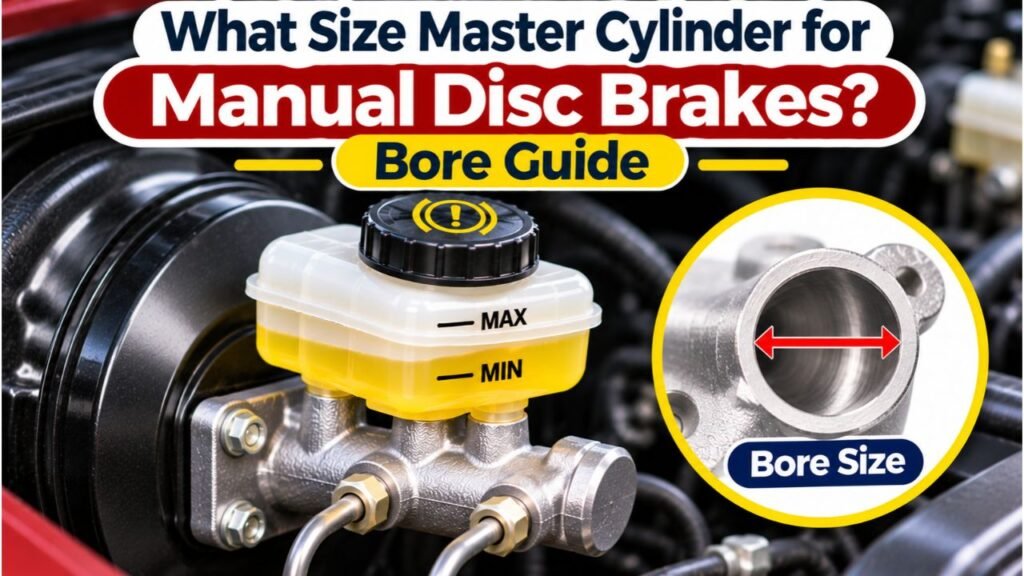
The master cylinder bore is the inside diameter of the cylinder in which the hydraulic piston moves. That diameter determines piston area. The pushrod applies force to that piston.
A smaller piston concentrates a given force over less area, so pressure rises. However, it must move farther to displace the same amount of fluid. A larger piston moves more fluid per inch but requires more input force to create the same pressure.
Brake Pressure Comparison for Common Bore Sizes
The basic relationship is line pressure = pushrod force ÷ master cylinder piston area. As a simplified example, consider a 100-pound foot force applied through a 6:1 brake pedal. Ignoring mechanical losses, the master cylinder receives 600 pounds of force.
| Bore Diameter | Approximate Piston Area | Calculated Line Pressure |
| 7/8 inch | 0.60 sq. in. | 998 psi |
| 15/16 inch | 0.69 sq. in. | 869 psi |
| 1 inch | 0.79 sq. in. | 764 psi |
| 1-1/8 inch | 0.99 sq. in. | 604 psi |
These calculations are not braking-pressure targets. Calipers, pads, rotors, pedal travel, and vehicle load affect stopping performance.
Why a Smaller Bore Can Make the Pedal Feel Longer
Suppose both cylinders must move the same volume of fluid to take up pad clearance. The smaller piston needs a longer stroke to do it. This increased stroke translates into more movement at the foot pedal.
A slightly longer, progressive pedal is not automatically a defect. A pedal that approaches the floor before achieving sufficient braking is a serious problem, however. Bore size must be selected for both pressure and available stroke, not pedal softness alone.
Why Pedal Ratio Matters With Manual Disc Brakes
The pedal ratio is the mechanical advantage created by the brake pedal. It is determined by the distance between the pedal pivot and the footpad compared with the distance between the pivot and the master-cylinder pushrod attachment.
A manual system commonly uses a ratio around 6:1 or 7:1, whereas a power-assisted pedal may use substantially less leverage. Wilwood’s explanation of brake pedal ratios describes how pedal geometry affects both pushrod force and travel.
How to Measure Your Brake Pedal Ratio
- Locate the brake pedal’s pivot point beneath the dashboard or on its mounting assembly.
- Measure from the pivot center to the center of the surface where your foot presses.
- Measure from the same pivot to the center of the pushrod connection.
- Divide the first measurement by the second.
For example, a 12-inch pivot-to-footpad distance divided by a 2-inch pivot-to-pushrod distance gives a 6:1 ratio. Bell-crank linkages require a separate assessment.
A higher ratio multiplies force but also increases pedal travel. If you change the pushrod attachment location, verify that the rod remains aligned through its motion, remains securely retained, and allows full master-cylinder operation. Never drill a new pedal hole based only on an approximate ratio.
Why Removing a Brake Booster Changes the Calculation
Removing a booster does not automatically convert a power-brake pedal into a suitable manual-brake pedal. The original pedal may have too little leverage, creating a hard pedal even with a smaller master cylinder.
A matched manual conversion may require a different pushrod attachment point, an appropriate pedal assembly, and a different master-cylinder bore. Use vehicle-specific conversion hardware.
Match the Master Cylinder to Front and Rear Brake Hardware
The words “manual disc brakes” do not identify the full brake configuration. Front discs with rear drums, four-wheel discs, and aftermarket multi-piston calipers can place different demands on the master cylinder.
Front Disc and Rear Drum Brakes
A 7/8-inch bore is a common choice in some manual front-disc/rear-drum conversions. Other factory arrangements use a 1-inch bore or another specified size, so the vehicle’s original engineering or a complete brake-kit recommendation should take priority over a generic chart.
Drums and discs have different hydraulic requirements. Use pressure-control components matched to the actual hardware.
Four-Wheel Disc Brakes
Four-wheel-disc systems may require additional fluid displacement, depending on caliper piston sizes, pad clearance, and the components selected. Some work well with a 7/8-inch cylinder; others require 15/16 inch, 1 inch, or a system-specific choice.
The ManualBrakes.com master-cylinder application FAQ illustrates how recommendations vary even among closely related vehicles and caliper combinations. For example, it lists different bores for selected GM manual conversions according to the rear calipers used. Treat its examples as kit-specific guidance rather than universal sizing rules.
Caliper Piston Area and Fluid Demand
The caliper piston area helps determine how brake-line pressure produces pad clamping force. Piston diameter also contributes to the fluid volume needed to move the pads into contact with the rotors.
For a simple piston, area equals 3.1416 × diameter squared ÷ 4. In a multi-piston caliper, the effective area calculation depends on whether the design is fixed or sliding; use the caliper manufacturer’s stated effective piston area when available.
Do not choose master-cylinder bore solely by counting pistons. A four-piston caliper with small pistons can behave differently from one with larger pistons. Front-to-rear brake balance also matters.
Check Master Cylinder Stroke and Fluid Capacity
Pressure is only half the sizing problem. The master cylinder must deliver enough fluid before reaching the end of its usable stroke. Calipers must take up their operating clearance, and the pedal must retain an adequate margin before hitting a mechanical stop or the floor.
The fluid displaced during a piston stroke is approximately piston area × stroke length. A 7/8-inch bore moves about 0.60 cubic inch of fluid for each inch of piston travel. A 1-inch bore moves about 0.79 cubic inch over the same distance. Actual system requirements vary.
A longer master-cylinder stroke can compensate for some of the smaller bore’s lower output per inch, but only when the pedal assembly has enough safe movement. Hoses that expand excessively, abnormal pad clearance, and caliper piston knock-back can consume extra fluid and pedal travel.
Tandem Master Cylinders and Reservoir Requirements
Most street vehicles use a tandem master cylinder with two hydraulic circuits. A circuit failure may leave limited braking, but the vehicle is unsafe to drive.
Match circuit configuration, outlets, stroke, and reservoir capacity. Disc brakes need sufficient reservoir volume as pads wear. Equal bore sizes do not guarantee interchangeability.
Master Cylinder Compatibility During a Manual Brake Conversion
Bore size alone does not establish compatibility. The cylinder must match the mounting flange, pushrod interface, available installation space, fluid requirements, and hydraulic circuit arrangement.
Pushrod retention is especially important. Some master cylinders and linkage designs intended for boosted systems do not provide the same mechanical retention as a manual-brake installation. The rod must not be able to slip out when the pedal returns or the chassis moves.
The master-cylinder piston must also fully return to uncover its compensation ports. Incorrect pushrod length or missing free play can hold pressure in the system and cause dragging brakes. Excessive clearance has the opposite effect, adding unwanted dead travel.
Disc-Brake Residual and Proportioning Valves
A residual-pressure valve is not automatically required just because a car has manual disc brakes. Certain low-mounted master cylinders may need a low-pressure disc-brake valve to reduce drain-back, but the need depends on the specific hydraulic design. Incorrect valves can keep pads dragging.
A proportioning valve addresses front-to-rear pressure balance; it cannot correct an improperly sized master cylinder or an unsuitable caliper combination by itself. Use components specified for the vehicle and the actual disc/drum or disc/disc setup.
Check fluid compatibility, port orientation, heat clearance, and brake-rated fittings with correct flares.
How to Choose the Right Master Cylinder Size
Use a system-based process rather than ordering the most popular bore size.
- Identify the brake layout. Record whether the car has front discs/rear drums or discs at all four corners.
- Identify every caliper. Find the make, model, piston sizes, and any recommended master-cylinder specifications.
- Measure the pedal ratio. Confirm the effective leverage and whether the pedal was originally designed for manual or assisted brakes.
- Check the existing master cylinder. Record the bore, usable stroke, reservoir arrangement, and pushrod connection rather than relying on outside appearance.
- Compare likely bores. Consider 7/8 or 15/16 inch when appropriate, but use 1 inch or another size if the system supplier requires it.
- Verify safe travel. Ensure the master cylinder displaces enough fluid without bottoming, and the pedal has usable reserve travel.
- Confirm hydraulic compatibility. Review circuit routing, brake-bias hardware, residual valves, brake fluid, and line fittings.
- Validate before road use. Have the finished system inspected and tested according to the vehicle and component manufacturers’ procedures.
If the parts come from multiple manufacturers, request a sizing recommendation using the complete hardware list. Physical fit alone is insufficient.
What Hard or Long Brake Pedal Travel Tells You
A hard pedal requiring unusually high force can indicate an oversized master-cylinder bore, insufficient pedal leverage, seized caliper components, or pads that are inappropriate for the operating conditions. Do not assume the bore is the only cause.
A long pedal may point to a bore that is too small for the required fluid displacement, but it can also mean air is trapped in the lines, calipers are installed with bleeders in the wrong orientation, hoses are expanding, or the pads are being pushed away from the rotors.
A pedal that slowly sinks under sustained pressure requires immediate diagnosis of leaks or internal hydraulic bypass. Bore changes cannot repair leaks.
If brakes drag after release, check pushrod adjustment and residual-pressure hardware before replacing the master cylinder again. A blocked compensation port or inappropriate valve can hold pressure even when your foot is off the pedal.
Safety Note: Do not drive a vehicle with a pedal that bottoms out, inconsistent braking, visible fluid leaks, or wheels that do not release properly. Brake faults can worsen without warning.
Safety Checks Before Driving With a New Master Cylinder
A new master cylinder normally needs the manufacturer’s specified bleeding procedure, often including bench bleeding before installation. The entire hydraulic system must then be bled correctly using fresh, approved brake fluid. Check every fitting and hose for leaks under applied pedal pressure.
Confirm that the pedal returns freely, the pushrod stays positively retained, both hydraulic circuits operate as intended, and the brakes release without dragging. Follow any required bedding procedure for new pads and rotors.
Initial testing should take place in a controlled, traffic-free environment after a qualified brake technician has verified the installation. Do not use public-road driving to discover whether an uncertain master-cylinder and caliper combination can produce enough stopping force.
Conclusion
Choosing what size master cylinder for manual disc brakes requires balancing pedal force, hydraulic pressure, fluid movement, and available travel. A 7/8-inch or 15/16-inch bore is often worth evaluating first for an appropriately designed manual system, while 1 inch and larger sizes may suit specific caliper and vehicle combinations.
Choose a bore supported by the complete system specifications. Verify pedal geometry, pushrod retention, circuit compatibility, and braking performance.
FAQs About What Size Master Cylinder for Manual Disc Brakes
Is a 1-Inch Master Cylinder Too Big for Manual Disc Brakes?
Not necessarily. Some factory and aftermarket setups use a 1-inch bore successfully. However, it generates less line pressure than smaller bores at the same pedal force, so the pedal ratio and caliper requirements must support that choice.
Can I Use a 7/8-Inch Master Cylinder With Four-Wheel Disc Brakes?
Yes, in some compatible systems. It may provide useful pressure but requires enough piston stroke to move the fluid demanded by all four calipers. Check the brake manufacturer’s recommendation and available pedal travel.
Is 15/16 Inch Better Than 7/8 Inch for Manual Brakes?
Neither is universally better. The 15/16-inch cylinder moves somewhat more fluid per inch while producing somewhat less pressure for the same force. Choose according to caliper volume and pedal leverage.
Do Manual Disc Brakes Need a Different Pedal Ratio?
They often need more mechanical leverage than power-assisted brakes. A ratio near 6:1 to 7:1 is common, but the correct geometry depends on the linkage and master cylinder. A booster delete may require pedal modifications using properly engineered parts.
Can I Keep My Power-Brake Master Cylinder After Removing the Booster?
Only if its bore, pushrod interface, mounting, stroke, and hydraulic arrangement are verified for manual operation. Removing the booster alone does not establish compatibility, and an incorrectly retained pushrod presents a serious safety hazard.
Does a Bigger Master Cylinder Make Disc Brakes Stop Faster?
No. A larger bore moves more fluid per stroke but creates less line pressure for the same input force. Stopping performance also depends on calipers, pads, rotors, tires, vehicle weight, and brake balance.