What Is the Purpose of the Brake Master Cylinder? How It Works
The purpose of the brake master cylinder is to turn the force of your foot on the brake pedal into hydraulic pressure that operates the wheel brakes. It pushes on brake fluid inside sealed circuits, allowing calipers or wheel cylinders to apply the brake pads or shoes. Without a functioning master cylinder, a conventional hydraulic braking system cannot reliably transmit the pressure needed to slow or stop the vehicle.
Most modern passenger cars use a tandem master cylinder with two separate hydraulic circuits. This provides a measure of backup braking if one circuit fails, although pedal travel and stopping distance can increase substantially. The master cylinder also works with the fluid reservoir, brake booster, and, where fitted, an anti-lock braking system.
A failing master cylinder may cause a pedal that slowly sinks, an external brake fluid leak, or weak braking. Yet these symptoms can also have other causes, so proper diagnosis matters.
In this article, I explain what the brake master cylinder does, how its pistons create pressure, and why the dual-circuit design matters. I also cover its parts, location, warning signs, testing, replacement, and maintenance.
What Is the Purpose of the Brake Master Cylinder in a Car?
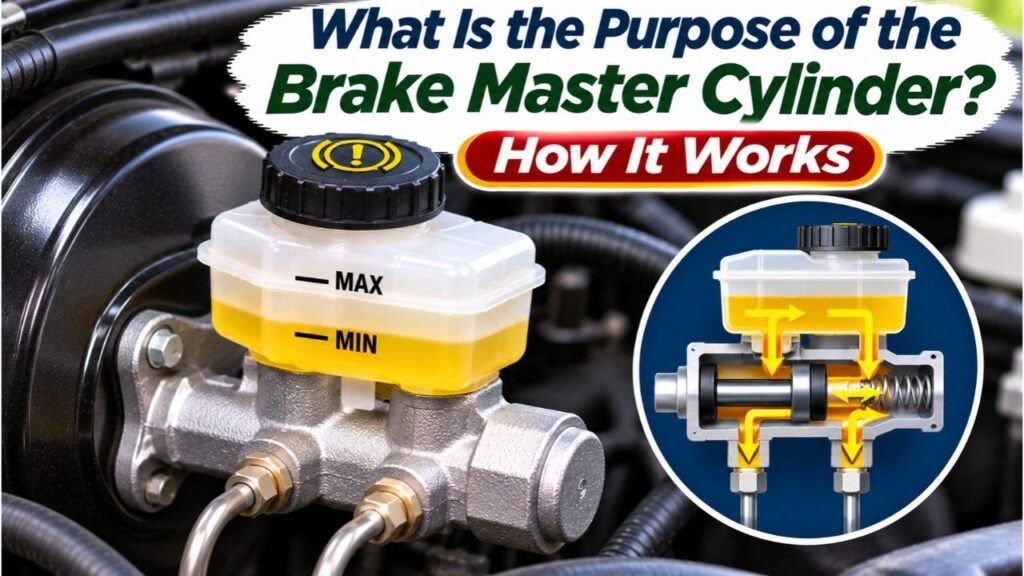
The brake master cylinder is the main hydraulic pressure-generating component in a conventional automotive braking system.
Its primary job is to convert mechanical input from the brake pedal into hydraulic pressure and distribute that pressure through the brake circuits.
When the driver presses the pedal, a pushrod moves one or more pistons inside the master cylinder. Those pistons pressurize brake fluid, transmitting force through the hydraulic lines to the wheel brakes.
According to Bosch Mobility’s explanation of the tandem master cylinder, the master cylinder converts pedal force, often amplified by a brake booster, into hydraulic pressure supplied to the braking circuits.
Main Functions of the Brake Master Cylinder
| Function | Why It Matters |
| Generate hydraulic pressure | Converts brake pedal force into pressure that operates the wheel brakes |
| Transmit driver input | Allows the braking system to respond to pedal application |
| Supply separate hydraulic circuits | Provides partial braking capability if one circuit fails |
| Control pressure application | Increases hydraulic pressure as the pedal is applied |
| Release hydraulic pressure | Allows the brakes to disengage when the pedal is released |
| Work with the brake fluid reservoir | Maintains the fluid supply needed for proper operation |
| Support hydraulic brake control | Provides pressure to conventional braking systems, including those with ABS |
Why Does a Car Need a Master Cylinder?
A brake pedal cannot directly operate all four wheel brakes efficiently through a simple mechanical connection in a typical modern passenger car.
Instead, the hydraulic system transmits braking pressure through fluid-filled lines.
The master cylinder makes this possible.
It connects the driver’s pedal input to the hydraulic components that physically apply the brakes.
Does the Master Cylinder Actually Stop the Wheels?
Not directly.
The master cylinder generates hydraulic pressure.
That pressure operates the wheel brake mechanisms.
In a disc brake system, the caliper pistons push brake pads against a rotating rotor.
In a drum brake system, wheel cylinders push brake shoes against the inner surface of a drum.
The resulting friction slows the wheels.
Does the Master Cylinder Make Brakes Stronger?
The hydraulic system allows pedal force to be converted and transmitted to the wheel brakes.
Its piston sizes and other system dimensions influence the relationship between pedal travel, hydraulic pressure, and braking force.
However, the master cylinder doesn’t independently determine maximum stopping performance.
Tire grip, brake friction components, vehicle weight, and other factors also matter.
Key Takeaway: The brake master cylinder is the hydraulic link between the brake pedal and the wheel brakes. Its main purpose is to generate and control the pressure required for braking.
How Does a Brake Master Cylinder Work?
The brake master cylinder operates through hydraulic pressure.
When the brake pedal is pressed, a pushrod moves the pistons inside the cylinder.
The pistons pressurize the fluid contained in the brake circuits.
This pressure is transmitted through the brake lines to the wheel brakes.
Step 1: The Driver Presses the Brake Pedal
The braking process begins when the driver applies force to the pedal.
The pedal mechanism transfers that input toward the master cylinder.
In many vehicles, a brake booster helps reduce the physical effort required.
Step 2: The Pushrod Moves the Master Cylinder Piston
The pushrod acts on the primary piston inside the master cylinder.
The piston begins moving forward.
During the initial movement, the master cylinder’s fluid passages close or become isolated as designed.
This allows pressure to build inside the hydraulic chamber.
Step 3: Hydraulic Pressure Increases
Once the relevant reservoir passage is closed, continued piston movement raises hydraulic pressure.
Brake fluid transmits the pressure through the connected hydraulic lines.
The fluid is relatively incompressible under normal conditions.
This makes hydraulic pressure transmission possible.
Step 4: Pressure Reaches the Wheel Brakes
In a conventional hydraulic system, pressure travels through the brake lines and any applicable control components.
These can include the ABS hydraulic unit or brake proportioning components.
At each wheel, hydraulic pressure acts on the caliper piston or wheel-cylinder piston.
Step 5: The Brake Pads or Shoes Apply Friction
In disc brakes, hydraulic pressure moves the caliper pistons.
The caliper mechanism presses the brake pads against the rotor.
In drum brakes, hydraulic pressure pushes the wheel-cylinder pistons outward.
This moves the brake shoes against the drum.
Friction reduces wheel rotation.
Step 6: The Driver Releases the Pedal
When the driver releases the brake pedal, the master cylinder’s return springs help move its pistons back toward their resting positions.
The relevant compensation or return passages reopen.
Hydraulic pressure decreases.
The wheel brakes release according to their mechanical design.
Brake Master Cylinder Operating Sequence
| Stage | Master Cylinder Action | Result |
| Pedal released | Pistons remain in rest position | No service-brake application pressure |
| Pedal pressed | Pushrod moves primary piston | Hydraulic pressure begins building |
| Pressure increases | Pistons pressurize brake circuits | Wheel brake mechanisms activate |
| Pedal held | Seals and hydraulic system maintain pressure | Braking force is maintained |
| Pedal released | Pistons return and passages reopen | Hydraulic application pressure decreases |
| Brakes released | Wheel brake components return or relax | Normal wheel movement resumes |
How Does Hydraulic Pressure Transfer Force?
Hydraulic systems operate according to Pascal’s principle.
Pressure applied to a confined fluid is transmitted through the fluid.
The basic pressure formula is:
Pressure = Force ÷ Area
Or:
[
P=\frac{F}{A}
]
Where:
- P = pressure
- F = applied force
- A = piston area
For example, if 200 newtons of force act on a piston with an area of 2 square centimeters:
[
P=\frac{200}{0.0002}=1{,}000{,}000\text{ Pa}
]
That equals approximately 1,000 kPa, or 145 psi.
This simplified example illustrates the relationship between force, piston area, and pressure.
Actual automotive braking pressure depends on pedal leverage, brake assist, component dimensions, and other conditions.
What Are the Main Parts of a Brake Master Cylinder?
A master cylinder contains several components that work together to generate and control hydraulic pressure.
Most modern conventional passenger vehicles use a tandem master cylinder.
This design contains two pressure-generating piston assemblies.
1. Master Cylinder Housing
The housing contains the hydraulic piston bores and internal passages.
It is commonly manufactured from aluminum or cast iron.
Its internal surfaces must allow the pistons and seals to operate correctly.
2. Primary Piston
The primary piston is normally closest to the pushrod.
When the driver presses the brake pedal, the pushrod moves this piston.
Its movement helps develop pressure in the primary hydraulic circuit.
3. Secondary Piston
The secondary piston operates the second hydraulic circuit.
It is positioned in tandem with the primary piston.
The specific way the pistons interact depends on the master cylinder design.
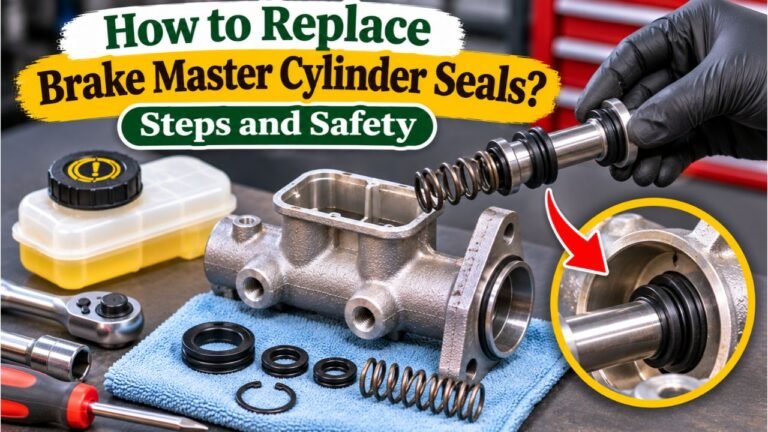
4. Piston Seals
Hydraulic seals help maintain pressure within the chambers.
They prevent fluid from bypassing the pistons under normal operation.
Worn or damaged seals can allow internal pressure leakage.
This may cause a brake pedal to sink.
5. Return Springs
Return springs move the pistons back toward their resting positions when the pedal is released.
They help restore the master cylinder’s normal operating condition.
6. Compensation or Return Ports
These passages connect the hydraulic chambers with the fluid reservoir when the pistons are in the appropriate position.
They allow fluid replenishment and pressure compensation.
The passage arrangement varies by design.
7. Brake Fluid Reservoir
The reservoir stores brake fluid for the hydraulic system.
It is commonly mounted directly above the master cylinder.
Some vehicles use a remote reservoir connected by hoses.
8. Hydraulic Outlet Ports
These ports connect the master cylinder to the brake lines.
A tandem master cylinder generally has separate outlets serving the two hydraulic circuits.
Master Cylinder Parts and Functions
| Component | Main Function |
| Housing | Contains the hydraulic working components |
| Primary piston | Generates pressure in one hydraulic circuit |
| Secondary piston | Generates pressure in the second circuit |
| Piston seals | Help retain hydraulic pressure |
| Return springs | Return pistons after pedal release |
| Compensation passages | Allow appropriate fluid movement and pressure compensation |
| Fluid reservoir | Maintains a supply of brake fluid |
| Outlet ports | Connect the master cylinder to hydraulic brake circuits |
| Pushrod interface | Receives input from the pedal or brake-assist mechanism |
Key Takeaway: The pistons and seals generate and maintain hydraulic pressure, while the reservoir and internal passages support fluid replenishment and release.
Why Does a Brake Master Cylinder Have Two Pistons?
Most modern passenger vehicles use a tandem master cylinder because it supports two independent hydraulic circuits.
This arrangement is an important safety feature.
What Is a Tandem Master Cylinder?
A tandem master cylinder contains two pistons arranged in a single housing.
Each piston assembly operates a separate hydraulic pressure chamber.
The chambers supply two braking circuits.
Why Are Two Brake Circuits Important?
If one hydraulic circuit develops a serious leak, the other circuit may retain enough braking capability to slow and stop the vehicle.
However, braking performance can be severely reduced.
The driver may experience much longer pedal travel and substantially increased stopping distance.
In the Saab Workshop Information System’s master cylinder technical description, the tandem design uses two separate pressure chambers. The documented system allows the remaining circuit to develop pressure when one circuit fails, although greater pedal travel is required.
What Are the Two Main Brake Circuit Layouts?
The two common arrangements are front-to-rear and diagonal circuit division.
Front-to-Rear Split
One hydraulic circuit serves the front brakes.
The other serves the rear brakes.
This arrangement appears on some vehicle designs.
Diagonal Split
One circuit may serve:
- Left front and right rear brakes
The other may serve:
- Right front and left rear brakes
This arrangement helps retain braking capability across both ends of the vehicle if one circuit fails.
Dual-Circuit Comparison
| System | Circuit 1 | Circuit 2 |
| Front/rear split | Front wheels | Rear wheels |
| Diagonal split | Left front and right rear | Right front and left rear |
The actual arrangement depends on the vehicle.
Will the Brakes Still Work if One Circuit Fails?
The remaining circuit may provide partial braking capability.
However, this is an emergency backup feature, not permission to continue driving.
A vehicle with one failed hydraulic circuit is unsafe for normal road use.
What Happens if Both Circuits Fail?
If neither circuit can build the required pressure, the service braking system may lose most or all of its intended hydraulic braking capability.
This is a serious emergency.
Single vs. Tandem Brake Master Cylinder
Brake master cylinders can be classified by the number of hydraulic pressure circuits they operate.
Single-Circuit Master Cylinder
A single-circuit master cylinder has one main hydraulic pressure circuit.
It was used on many older vehicles.
A major hydraulic leak can disable the single circuit, creating a serious braking hazard.
Tandem Master Cylinder
A tandem master cylinder contains two hydraulic pressure chambers.
It provides separate circuits for greater redundancy.
Most modern conventional passenger cars use this arrangement.
Comparison Chart
| Feature | Single-Circuit | Tandem |
| Main pressure circuits | One | Two |
| Typical application | Many older vehicles | Most modern conventional passenger cars |
| Number of main piston assemblies | One | Two |
| Hydraulic redundancy | Limited | Two-circuit design |
| One circuit fails | May lose service braking entirely | Other circuit may retain partial braking |
| Repair considerations | Design-specific | Both circuits must be properly serviced |
Which Type Is Better for Safety?
The tandem design provides a major advantage by dividing the braking system into separate circuits.
However, it does not guarantee full braking performance after a failure.
Any suspected hydraulic failure requires immediate professional attention.
Where Is the Brake Master Cylinder Located?
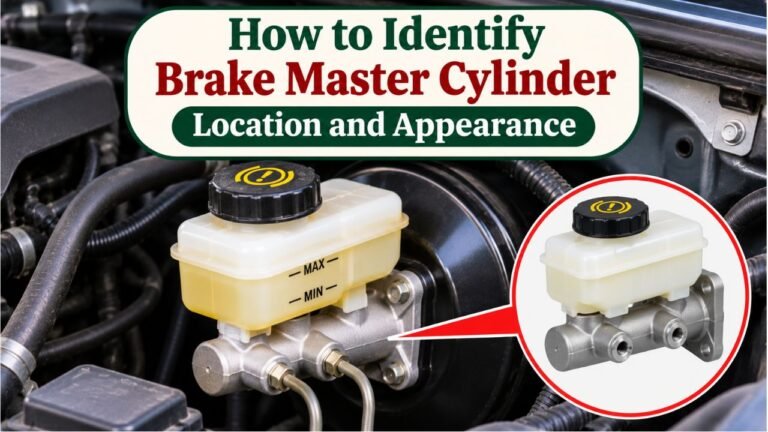
On many conventional cars, the brake master cylinder is located in the engine compartment, attached to the brake booster on the firewall.
In a left-hand-drive vehicle, this is commonly toward the driver’s side.
However, location varies by vehicle design.
How to Identify the Master Cylinder
Look for a component with:
- A brake fluid reservoir
- One or more brake line connections
- A cylindrical metal housing
- A mounting position near the brake booster
The reservoir is often translucent with fluid-level markings.
Where Is the Brake Booster?
On many vehicles, the booster is mounted at the firewall behind the master cylinder.
A vacuum booster often has a large, round housing.
Other vehicles use hydraulic or electric brake-assist systems.
Does Every Vehicle Have the Same Layout?
No.
Some vehicles have:
- Remote fluid reservoirs
- Compact integrated braking assemblies
- Electric brake boosters
- Electronic brake-by-wire systems
- Different firewall or underhood arrangements
Always refer to the correct service information for the vehicle.
Can You See the Master Cylinder Without Removing Parts?
Often, yes.
However, some modern engine compartments have covers or other components that limit visibility.
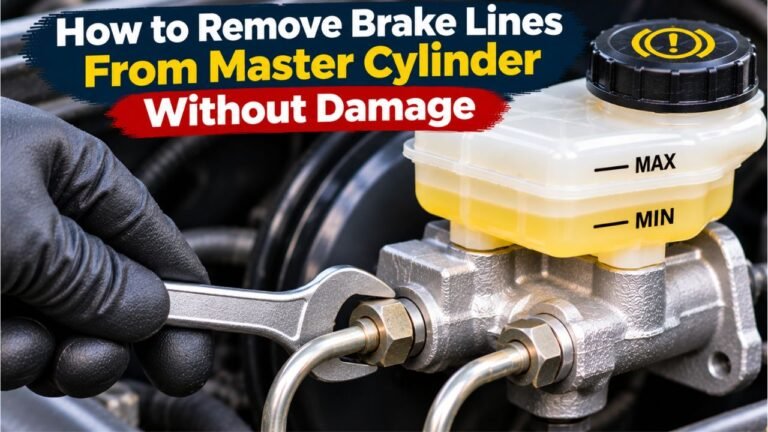
Do not disconnect brake lines merely to identify the part.
What Is the Difference Between the Master Cylinder and Brake Booster?
The master cylinder and brake booster work together, but their purposes are different.
The master cylinder produces hydraulic pressure, while the booster helps reduce the pedal force required to produce that pressure.
Brake Master Cylinder
Its main functions include:
- Generating hydraulic pressure
- Supporting separate brake circuits
- Transmitting pressure to wheel brakes
- Releasing hydraulic application pressure
Brake Booster
A booster assists the driver by increasing the effective input force applied to the master cylinder.
Traditional vacuum boosters use a pressure difference to provide assistance.
Other systems use hydraulic or electric assistance.
Master Cylinder vs. Brake Booster
| Feature | Master Cylinder | Brake Booster |
| Main purpose | Generate hydraulic brake pressure | Assist pedal force |
| Primary mechanism | Hydraulic pistons and brake fluid | Vacuum, hydraulic, or electric assistance |
| Connected to | Brake circuits and fluid reservoir | Pedal mechanism and master cylinder |
| Common failure symptom | Sinking or unusually soft pedal | Hard pedal requiring greater effort |
| Can produce hydraulic pressure? | Yes | Not by itself in a conventional arrangement |
| Contains brake fluid? | Yes | Depends on booster design |
Can a Bad Booster Feel Like a Bad Master Cylinder?
Some symptoms overlap.
However, a failed booster often creates a hard brake pedal requiring more force.
A master-cylinder hydraulic failure may cause a pedal that sinks or excessive travel.
These patterns are useful clues, but they are not definitive diagnoses.
Can the Master Cylinder Work Without the Booster?
In many conventional systems, the master cylinder can still generate hydraulic pressure without normal booster assistance.
However, substantially greater pedal force may be required.
The vehicle must not be driven with an unresolved braking-system fault.
Brake Master Cylinder vs. Brake Caliper
The master cylinder and caliper serve different functions.
Master Cylinder
Creates hydraulic pressure when the brake pedal is pressed.
Brake Caliper
Converts hydraulic pressure into mechanical force that applies the brake pads against the rotor.
How They Work Together
The sequence is:
Brake pedal → Master cylinder → Hydraulic lines → Caliper → Brake pads → Rotor
On ABS-equipped vehicles, an ABS hydraulic unit is also involved in controlling pressure.
Does the Master Cylinder Control Every Caliper?
In a conventional hydraulic braking system, the master cylinder provides pressure to the hydraulic circuits that operate the wheel brakes.
However, ABS and other components may control or modify the pressure delivered to individual wheels.
The master cylinder doesn’t independently regulate every wheel’s braking force.
How Does the Brake Master Cylinder Work With ABS?
A master cylinder remains an important part of many ABS-equipped hydraulic braking systems.
However, the master cylinder and ABS have different functions.
Master Cylinder Function
The master cylinder generates hydraulic pressure from the driver’s braking input.
ABS Function
The anti-lock braking system monitors wheel behavior and adjusts hydraulic pressure to reduce wheel lock during braking.
It uses electronic control and hydraulic components.
Does ABS Replace the Master Cylinder?
Not necessarily.
Many ABS-equipped vehicles use a conventional master cylinder with an ABS hydraulic control unit.
However, some advanced electronically controlled systems integrate pressure generation and control differently.
Can a Bad Master Cylinder Affect ABS?
Yes.
A master-cylinder problem can compromise hydraulic braking performance.
However, an ABS warning light is not automatically proof of master-cylinder failure.
Wheel-speed sensors, wiring, pumps, valves, and electronic faults can also trigger ABS problems.
Does Replacing the Master Cylinder Require ABS Bleeding?
Sometimes.
The service procedure depends on the system and whether air entered the ABS hydraulic unit.
Certain vehicles require a compatible diagnostic tool.
Follow the manufacturer-specific procedure.
What Are the Symptoms of a Bad Brake Master Cylinder?
A failing master cylinder can cause abnormal brake pedal response or hydraulic fluid leakage.
However, these symptoms may also result from faults elsewhere in the braking system.
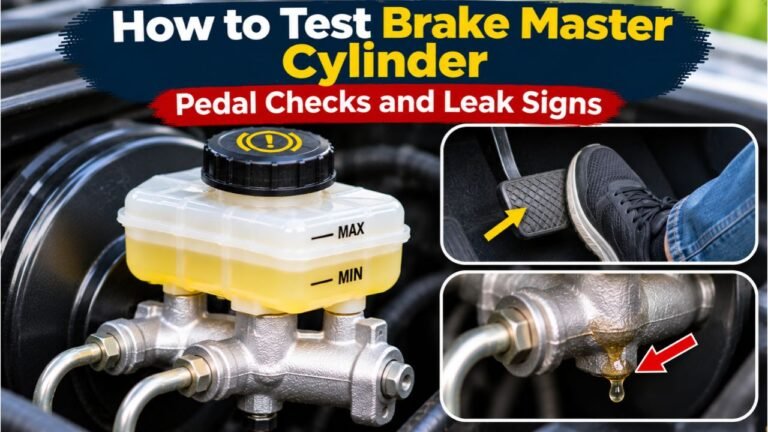
1. Brake Pedal Slowly Sinks
A pedal that gradually moves downward under steady pressure may indicate internal hydraulic leakage.
Worn master-cylinder seals can allow fluid to bypass the piston.
This prevents the master cylinder from maintaining the expected pressure.
However, a leak elsewhere in the hydraulic system may produce similar symptoms.
2. Spongy Brake Pedal
A soft or spongy pedal can occur with hydraulic problems.
However, trapped air in the brake lines is another common cause.
A spongy pedal alone doesn’t confirm master-cylinder failure.
3. Brake Fluid Leak
An external master-cylinder seal may leak.
Fluid might appear around the cylinder body or where it connects to the booster.
Some leaks can be concealed between the master cylinder and booster.
4. Low Brake Fluid Level
Fluid loss may occur because of an external leak.
However, a decreasing reservoir level can also reflect brake pad wear or leakage elsewhere.
A low level is not enough to identify the master cylinder as the failed part.
5. Poor Braking Performance
A defective master cylinder may prevent proper hydraulic pressure from developing or being maintained.
This can increase stopping distance.
Other brake problems can produce the same result.
6. Brake Warning Light
Some vehicles illuminate a brake warning light when fluid levels are low or hydraulic-system faults are detected.
However, a warning light may have several explanations.
7. Inconsistent Pedal Response
The pedal may feel normal at first but behave differently during repeated braking.
This can be associated with internal hydraulic problems.
A qualified technician should investigate.
Bad Master Cylinder Symptoms Chart
| Symptom | Possible Explanation | Is Master Cylinder Failure Certain? |
| Pedal sinks under steady pressure | Internal pressure bypass or external leak | No |
| Pedal feels spongy | Air, vapor, or hydraulic fault | No |
| Fluid near master cylinder | Possible external seal leak | Not without inspection |
| Fluid level drops | Pad wear or hydraulic leak | No |
| Brake warning light | Low fluid or system fault | No |
| Brakes feel weak | Hydraulic or mechanical issue | No |
| Pedal unusually hard | Often brake-assist problem | No |
| Pedal fails to return normally | Mechanical or hydraulic fault | No |
According to NAPA’s guide to testing a brake master cylinder, a sinking pedal can indicate internal hydraulic leakage, while a spongy pedal may also be caused by trapped air or another mechanical problem.
Important: A sinking pedal, visible hydraulic leak, or reduced braking power is a serious warning. Do not continue driving until the braking system has been inspected and repaired.
Why Does a Brake Master Cylinder Fail?
Master cylinders can fail because of internal wear, seal damage, corrosion, contamination, or external leakage.
The exact cause varies by vehicle.
Worn Internal Seals
The pistons rely on seals to maintain hydraulic pressure.
When these seals deteriorate, brake fluid may bypass them.
This can create pressure loss even without a visible external leak.
Internal Corrosion
Moisture-contaminated brake fluid can contribute to corrosion inside the hydraulic system.
Corrosion may damage sealing surfaces and affect piston operation.
External Seal Failure
The master cylinder can leak externally through worn seals or connections.
This can reduce the fluid level and compromise hydraulic performance.
Contaminated Brake Fluid
Dirt, moisture, or incompatible fluid can damage hydraulic components.
Using an unapproved brake fluid may also create seal compatibility problems.
Normal Wear and Aging
Repeated operation over many years can contribute to component deterioration.
However, master-cylinder lifespan depends on design, service history, and operating conditions.
Improper Servicing
Incorrect bleeding, contaminated tools, or inappropriate repair procedures can cause additional hydraulic problems.
For example, some worn conventional master cylinders may be damaged if a service procedure forces their pistons beyond the normal operating range.
How to Tell if the Master Cylinder Is Bad
A proper diagnosis should distinguish master-cylinder problems from faults elsewhere in the braking system.
A sinking or soft pedal does not automatically mean the master cylinder needs replacement.
Check the Brake Fluid Level
Inspect the reservoir according to the vehicle manufacturer’s instructions.
A low level can indicate pad wear or fluid loss.
However, it doesn’t reveal the exact cause.
Look for External Leaks
A technician may inspect:
- Master-cylinder housing
- Reservoir connections
- Brake lines
- Calipers
- Wheel cylinders
- Hydraulic fittings
- Booster mounting area
Some external leaks may not be immediately visible.
Assess Pedal Behavior
With the vehicle safely stationary, a technician may evaluate pedal travel and hydraulic pressure.
A pedal that steadily sinks can suggest an internal or external fluid leak.
However, the assessment must account for brake-assist and electronic-control behavior.
Rule Out Trapped Air
Air in the lines can create a soft pedal.
If recent repairs involved opening the hydraulic system, correct bleeding may be necessary.
Check the Brake Booster
An unusually hard pedal may indicate a brake-assist problem rather than a defective master cylinder.
Perform Manufacturer-Specified Testing
Professional diagnosis may include hydraulic pressure checks or other model-specific tests.
Do not loosen brake lines or attempt unsafe hydraulic pressure testing without proper training and equipment.
Why Proper Diagnosis Matters
Replacing the master cylinder won’t fix a leaking caliper, damaged brake hose, or faulty brake booster.
The underlying cause must be confirmed before replacing parts.
What Happens if the Brake Master Cylinder Fails While Driving?
A master-cylinder failure may prevent the braking system from generating or maintaining sufficient hydraulic pressure.
The severity depends on the type of failure and the braking-system design.
Partial Hydraulic Failure
In a conventional tandem system, one circuit may continue operating after the other fails.
However, the driver may notice:
- Increased pedal travel
- Reduced braking response
- Longer stopping distance
- A brake warning light
The remaining circuit is an emergency safeguard, not a substitute for full braking performance.
Major Hydraulic Failure
If both circuits are unable to maintain pressure, the vehicle may lose most or all normal hydraulic service braking capability.
This is a serious emergency.
What Should You Do?
If braking performance deteriorates while driving:
- Remain focused on controlling the vehicle.
- Release the accelerator.
- Use appropriate engine braking or regenerative braking when available.
- Avoid abrupt steering inputs.
- Follow the owner’s manual for emergency braking procedures.
- Move toward a safe stopping location if control allows.
- Once stopped, do not resume driving.
- Arrange roadside assistance or towing.
Do not rely on repeatedly pumping the pedal as a permanent solution.
Key Takeaway: A tandem master cylinder may provide partial braking after one circuit fails, but any suspected master-cylinder failure makes the vehicle unsafe for normal driving.
Can You Drive With a Bad Master Cylinder?
No.
A defective master cylinder can compromise the ability to slow or stop the vehicle reliably.
Even if the pedal sometimes feels normal, the problem may worsen.
Is a Small External Leak Dangerous?
Yes.
A small leak can develop into more significant fluid loss.
Hydraulic pressure may become unreliable.
What if Only One Brake Circuit Works?
The vehicle should not be driven normally.
The remaining circuit may provide limited emergency braking, but braking performance is reduced.
What if the Pedal Sinks Only Occasionally?
Intermittent symptoms still require inspection.
A master cylinder may develop internal pressure bypass under certain conditions.
However, other hydraulic faults can create similar behavior.
Can You Just Add More Brake Fluid?
No.
Adding fluid does not repair an internal seal problem or hydraulic leak.
The defective component must be diagnosed and corrected.
Does the Master Cylinder Control Front and Rear Brakes?
The master cylinder generates hydraulic pressure for the vehicle’s service brake circuits.
How those circuits connect to the wheels depends on the system design.
Front and Rear Circuit Layout
Some vehicles use one circuit for the front brakes and another for the rear brakes.
Diagonal Circuit Layout
Other vehicles use diagonally divided circuits.
Each circuit serves one front wheel and the opposite rear wheel.
Does the Master Cylinder Determine Brake Bias?
Not necessarily.
Brake-force distribution is influenced by the overall hydraulic and mechanical design.
Some vehicles use proportioning valves or other pressure-control devices.
Modern vehicles may use electronic brake-force distribution through the ABS system.
The master cylinder primarily supplies hydraulic pressure rather than independently controlling the ideal pressure at every wheel.
Why Do Front Brakes Often Do More Work?
During deceleration, vehicle weight transfers toward the front axle.
This commonly allows the front tires and brakes to handle a greater share of braking force.
However, the exact distribution depends on vehicle design and operating conditions.
How Does the Brake Fluid Reservoir Support the Master Cylinder?
The brake fluid reservoir provides the fluid supply needed for hydraulic operation.
It is an important part of the system, but it does not independently generate braking pressure.
Maintains Fluid Supply
The reservoir allows fluid to enter the master cylinder as required.
Compensates for Brake Pad Wear
As disc brake pads wear, caliper pistons extend farther outward.
This changes the amount of fluid held in the wheel brake assemblies.
The reservoir supplies the additional volume.
Supports Pressure Compensation
The master cylinder’s internal passages help accommodate fluid movement when the pistons return to their resting positions.
Provides Fluid-Level Monitoring
Many vehicles have a brake fluid level sensor.
When the reservoir level becomes too low, a brake warning light may illuminate.
Does Low Fluid Always Mean a Bad Master Cylinder?
No.
A gradual reduction may reflect normal brake pad wear.
A sudden or significant drop may indicate a hydraulic leak.
The cause must be inspected.
Should You Always Fill the Reservoir to MAX?
Not automatically.
The correct level depends on the vehicle’s service instructions and brake component condition.
Overfilling may create problems when worn brake pads are replaced and the caliper pistons are pushed back.
What Is the Difference Between a Brake Master Cylinder and a Clutch Master Cylinder?
Both can use hydraulic pressure, but they operate different systems.
Brake Master Cylinder
Generates hydraulic pressure for the wheel brakes.
In modern conventional passenger vehicles, it commonly contains two independent circuits.
Clutch Master Cylinder
In a manual-transmission vehicle with a hydraulic clutch, the clutch master cylinder generates pressure to operate the clutch release mechanism.
It normally serves the clutch hydraulic circuit rather than the service brakes.
Comparison Chart
| Feature | Brake Master Cylinder | Clutch Master Cylinder |
| Main purpose | Operate hydraulic brakes | Operate hydraulic clutch |
| Driver control | Brake pedal | Clutch pedal or motorcycle clutch lever |
| Hydraulic destination | Brake calipers or wheel cylinders | Clutch slave cylinder or release actuator |
| Number of circuits | Often two in modern cars | Usually one |
| Fluid source | Brake fluid reservoir | Separate or shared reservoir |
| Safety role | Essential for service braking | Essential for clutch actuation |
Can They Share Brake Fluid?
Some manual-transmission cars use a common brake fluid reservoir for the brake and clutch hydraulic systems.
Other vehicles have separate reservoirs.
The required fluid depends on the vehicle’s specifications.
Do not assume every hydraulic clutch uses the same fluid as the brakes.
Does a Motorcycle Have a Brake Master Cylinder?
Yes.
Motorcycles with hydraulic disc brakes use master cylinders to generate pressure.
However, their master-cylinder arrangements often differ from passenger cars.
Front Brake Master Cylinder
The front master cylinder is commonly mounted near the right handlebar.
It operates when the rider squeezes the front brake lever.
Rear Brake Master Cylinder
The rear master cylinder is commonly located near the rear brake pedal on motorcycles with a hydraulic rear brake.
Are Motorcycle Master Cylinders Tandem?
Many conventional motorcycles use separate front and rear hydraulic systems.
They do not necessarily use the same tandem master-cylinder design found in modern passenger cars.
Some motorcycles have linked braking systems or ABS configurations that change the arrangement.
Does the Master Cylinder Affect Brake Lever Feel?
Yes.
Master-cylinder piston size, lever geometry, seal condition, and hydraulic-system characteristics influence lever travel and feel.
However, a soft lever can also result from trapped air or another hydraulic problem.
How Long Does a Brake Master Cylinder Last?
There is no universal replacement interval for every brake master cylinder.
Many last for years without requiring replacement.
Lifespan depends on:
- Component quality
- Vehicle design
- Brake fluid condition
- Moisture and corrosion
- Operating conditions
- Maintenance practices
- Internal seal wear
Does a Master Cylinder Need Routine Replacement?
Not normally on a fixed schedule.
Unlike brake fluid, the master cylinder is generally replaced when defective or otherwise required by service information.
Can Old Brake Fluid Shorten Its Life?
Moisture-contaminated brake fluid can contribute to corrosion and deterioration of hydraulic components.
Regular fluid maintenance may help reduce that risk.
What About High-Mileage Vehicles?
High mileage can increase the likelihood of wear, but mileage alone doesn’t determine master-cylinder condition.
Some high-mileage vehicles retain their original master cylinders.
Others require replacement earlier.
Can a Master Cylinder Fail Suddenly?
Yes.
Some failures develop gradually, while others may become noticeable abruptly.
A sudden change in pedal response is a serious warning sign.
How Much Does Brake Master Cylinder Replacement Cost?
The cost depends on the vehicle, replacement part, labor rate, and required bleeding procedures.
A simple conventional master-cylinder replacement may cost less than replacing an integrated electronically controlled brake assembly.
What Affects the Price?
Important factors include:
- Vehicle make and model
- OEM versus aftermarket parts
- Master-cylinder design
- Labor accessibility
- Brake fluid specification
- ABS requirements
- Need for additional repairs
- Local labor rates
Is Labor Usually Required?
Yes.
Replacing a master cylinder involves safety-critical hydraulic work.
The proper installation and bleeding procedure must be followed.
Does the New Master Cylinder Need Bleeding?
Usually, yes.
Many conventional master cylinders require a specified bench-bleeding or pre-bleeding procedure before or during installation.
The hydraulic circuits must also be serviced as required.
Some modern electronically controlled systems use different procedures.
Can a Master Cylinder Be Rebuilt?
Some older master cylinders may be rebuildable under appropriate conditions.
However, modern assemblies are commonly replaced rather than rebuilt.
The correct choice depends on manufacturer guidance, parts availability, and component condition.
Is It Safe to Replace It Yourself?
Only with the necessary service information, equipment, and experience.
Incorrect installation or bleeding can create dangerous brake failure.
Professional replacement is appropriate when the procedure is uncertain.
How to Maintain a Brake Master Cylinder
Master cylinders generally don’t require a separate routine maintenance procedure beyond correct brake-system maintenance.
However, several practices help protect the hydraulic components.
Replace Brake Fluid on Schedule
Follow the vehicle manufacturer’s fluid replacement interval.
Many passenger cars specify time-based replacement, often approximately every two to three years, but requirements vary.
Use the Correct Brake Fluid
Use the exact DOT classification and additional specification approved for the vehicle.
Avoid mixing incompatible fluids.
Keep the Hydraulic System Clean
Dirt and moisture can damage hydraulic components.
Avoid opening the brake fluid reservoir unnecessarily.
Inspect for Fluid Leaks
Have hydraulic connections and components inspected during brake service.
Any unexplained fluid loss requires attention.
Monitor Brake Pedal Feel
Changes in pedal travel or firmness should be investigated.
Don’t wait until braking performance becomes severely reduced.
Follow Correct Bleeding Procedures
If the hydraulic system is opened for repairs, use the manufacturer-approved bleeding procedure.
Some ABS and electronically controlled systems require diagnostic equipment.
Keep Service Records
Record:
- Brake fluid changes
- Hydraulic repairs
- Master-cylinder replacement
- Bleeding procedures
- Brake warning light diagnosis
A maintenance record helps identify recurring problems.
Common Misunderstandings About Brake Master Cylinders
The Master Cylinder Stores All Brake Fluid
No.
The reservoir stores a supply of fluid, while hydraulic lines and wheel brake components contain additional fluid.
The Master Cylinder Creates Brake Friction
No.
It generates hydraulic pressure.
The pads, shoes, rotors, and drums provide braking friction.
The Brake Booster and Master Cylinder Are the Same Part
No.
The booster assists pedal force.
The master cylinder generates hydraulic pressure.
Every Master Cylinder Has Only One Piston
No.
Most modern conventional passenger cars use tandem master cylinders with two pistons.
A Bad Master Cylinder Always Leaks Externally
No.
Internal seal bypass can cause pressure loss without a visible fluid leak.
A Spongy Pedal Always Means the Master Cylinder Is Bad
No.
Trapped air, vapor, leaks, and other faults can cause sponginess.
The Master Cylinder Controls ABS Electronics
No.
The master cylinder supplies hydraulic pressure in many ABS-equipped systems.
The ABS control unit and hydraulic components perform anti-lock pressure regulation.
Replacing Brake Fluid Fixes a Bad Master Cylinder
No.
Fresh fluid cannot repair damaged seals, worn piston bores, or other mechanical failure.
A Car With Two Brake Circuits Is Safe With One Failed
No.
The second circuit provides limited redundancy.
Stopping capability can be significantly reduced.
All Master Cylinders Are Interchangeable
No.
Piston diameter, mounting dimensions, hydraulic connections, system compatibility, and other specifications vary.
Use the correct component for the vehicle.
Brake Master Cylinder Problems: Quick Troubleshooting Guide
| Problem | Possible Cause | Recommended Action |
| Pedal slowly sinks | Internal bypass or hydraulic leak | Professional brake diagnosis |
| Pedal is soft or spongy | Trapped air, fluid vapor, or hydraulic fault | Inspect hydraulic system |
| Pedal is unusually hard | Brake booster or assist problem | Inspect brake assist |
| Fluid around master cylinder | Possible external seal leak | Stop driving and repair |
| Reservoir fluid level drops | Brake pad wear or hydraulic leak | Determine cause |
| Brake warning light stays on | Fluid-level or brake-system fault | Diagnose warning |
| Vehicle pulls during braking | Uneven braking, tires, suspension, or hydraulic problem | Full brake and vehicle inspection |
| Brakes remain applied | Hydraulic pressure not releasing or mechanical fault | Professional inspection |
| Brakes are weak | Multiple possible hydraulic or friction problems | Do not drive until repaired |
Can a Bad Master Cylinder Cause Brakes to Drag?
In certain failure conditions, hydraulic pressure may fail to release correctly.
A blocked compensation passage or related fault can contribute to brake drag.
However, sticking calipers, damaged hoses, and other issues can produce similar symptoms.
Can a Bad Master Cylinder Cause Uneven Braking?
It can affect hydraulic pressure within a circuit.
However, uneven braking is frequently associated with wheel brake components, tires, suspension, or other hydraulic faults.
Diagnosis is necessary.
Can a Bad Master Cylinder Cause ABS Problems?
A hydraulic master-cylinder fault can affect a system equipped with ABS.
However, an ABS warning light can have many unrelated causes.
Can a Master Cylinder Cause Grinding Brakes?
Not typically.
Grinding is more commonly associated with worn friction components or other mechanical brake problems.
However, grinding requires inspection regardless of the suspected cause.
Conclusion
The main purpose of the brake master cylinder is to convert brake pedal force into hydraulic pressure that activates the wheel brakes.
When the driver presses the brake pedal, the master cylinder’s pistons move and pressurize brake fluid.
This pressure travels through the hydraulic circuits to the calipers or wheel cylinders, allowing the brake pads or shoes to apply friction and slow the vehicle.
Most modern conventional cars use a tandem master cylinder with two independent hydraulic circuits.
This arrangement provides a measure of backup braking if one circuit fails, although stopping performance can be significantly reduced.
The master cylinder also works with the brake booster, fluid reservoir, hydraulic brake lines, and ABS where fitted.
Its condition is essential for dependable braking.
Worn internal seals, external leaks, contaminated fluid, or other hydraulic problems can cause a sinking pedal, excessive travel, or reduced braking effectiveness.
However, these symptoms don’t always mean the master cylinder itself has failed.
Proper diagnosis is necessary before replacement.
To help protect the system, use the correct brake fluid, follow the manufacturer’s replacement schedule, and address abnormal pedal behavior immediately.
If the brake pedal sinks, braking power decreases, or hydraulic fluid is leaking, do not drive the vehicle until the braking system has been professionally inspected and repaired.
FAQs About the Purpose of the Brake Master Cylinder
What Is the Main Purpose of the Brake Master Cylinder?
The main purpose of the brake master cylinder is to convert mechanical force from the brake pedal into hydraulic pressure.
That pressure operates the brake calipers or wheel cylinders to slow and stop the vehicle.
What Does a Brake Master Cylinder Do?
It uses pistons to pressurize brake fluid when the pedal is pressed.
Hydraulic pressure is transmitted through the brake lines to activate the wheel brakes.
Why Is the Brake Master Cylinder Important?
It is essential for generating and controlling hydraulic braking pressure.
Without a properly functioning master cylinder, a conventional hydraulic brake system cannot operate reliably.
How Does the Brake Master Cylinder Work?
Pressing the brake pedal moves a pushrod and piston inside the cylinder.
The piston movement generates hydraulic pressure, which is transmitted through the brake fluid to the wheel brakes.
When the pedal is released, pressure decreases.
What Are the Two Main Functions of a Tandem Master Cylinder?
It generates hydraulic pressure in two separate braking circuits and provides limited braking redundancy if one circuit fails.
However, a vehicle with one failed circuit is unsafe for normal driving.
Why Does a Master Cylinder Have Two Pistons?
Two pistons allow a tandem master cylinder to operate two independent hydraulic brake circuits.
This helps preserve some stopping capability if one circuit loses pressure.
Where Is the Brake Master Cylinder Located?
On many conventional cars, it is attached to the brake booster on the firewall, commonly toward the driver’s side of the engine compartment.
The exact location varies by vehicle.
Is the Master Cylinder Connected to the Brake Pedal?
Yes.
In many conventional systems, the pedal transfers force through a pushrod and brake booster to the master cylinder.
The cylinder then generates hydraulic pressure.
What Happens When a Brake Master Cylinder Goes Bad?
The system may fail to generate or maintain proper hydraulic pressure.
Possible symptoms include a sinking pedal, fluid leakage, excessive pedal travel, and reduced braking performance.
Can a Bad Master Cylinder Cause a Spongy Brake Pedal?
Yes, but a spongy pedal can also result from air in the lines, fluid vapor, leaks, or other problems.
Proper diagnosis is required.
Can a Bad Brake Master Cylinder Cause the Pedal to Go to the Floor?
Yes.
Internal seal bypass or external hydraulic leakage can cause excessive pedal movement.
A pedal that sinks toward the floor is a serious safety concern.
Does the Master Cylinder Control All Four Brakes?
In a conventional hydraulic braking system, it provides pressure to the hydraulic circuits operating the wheel brakes.
ABS and other components may regulate pressure at individual wheels.
What Is the Difference Between a Brake Master Cylinder and a Brake Booster?
The master cylinder generates hydraulic pressure.
The brake booster helps reduce the effort needed to press the pedal and operate the master cylinder.
Does the Master Cylinder Work With ABS?
Yes, in many conventional ABS-equipped hydraulic systems.
The master cylinder supplies hydraulic pressure, while the ABS unit regulates pressure to help prevent wheel lock.
Some advanced electronic braking systems use different arrangements.
Can You Drive With a Bad Brake Master Cylinder?
No.
A defective master cylinder may cause partial or severe loss of braking performance.
Do not drive until the fault has been repaired.
Does a Master Cylinder Need Brake Fluid?
Yes.
A hydraulic master cylinder relies on the correct brake fluid to generate and transmit pressure.
Low fluid, contamination, or incompatible fluid can compromise operation.
Can Old Brake Fluid Damage the Master Cylinder?
Yes.
Moisture and contamination can contribute to internal corrosion and seal deterioration over time.
Follow the manufacturer’s fluid maintenance schedule.
How Long Does a Brake Master Cylinder Last?
There is no universal lifespan.
Many master cylinders operate reliably for years, but service life depends on component quality, fluid maintenance, wear, and operating conditions.
Does a New Master Cylinder Need to Be Bled?
Usually, yes.
Many conventional replacement master cylinders require a specified pre-bleeding or bench-bleeding procedure, followed by appropriate system bleeding.
Follow the vehicle-specific service instructions.
Can a Bad Master Cylinder Cause the Brakes to Lock Up?
Certain hydraulic faults involving pressure release can contribute to brake drag or brakes remaining applied.
However, caliper problems, brake hoses, and other faults are also possible causes.
Can a Master Cylinder Leak Internally Without Losing Fluid?
Yes.
Worn internal seals may allow fluid to bypass a piston without leaving the hydraulic system.
This can cause a pedal to sink under steady pressure.
Is a Master Cylinder the Same as a Wheel Cylinder?
No.
The master cylinder generates hydraulic pressure.
A wheel cylinder uses that pressure to operate brake shoes in a drum brake system.
Do Motorcycles Have Brake Master Cylinders?
Yes.
Motorcycles with hydraulic brakes have master cylinders that convert lever or pedal force into hydraulic pressure.
Front and rear systems may use separate master cylinders.
Is Replacing a Brake Master Cylinder Difficult?
It requires correct component identification, hydraulic connections, bleeding procedures, and safety checks.
Some modern braking systems also require diagnostic equipment.
Professional replacement is recommended when the required procedure or equipment is unavailable.