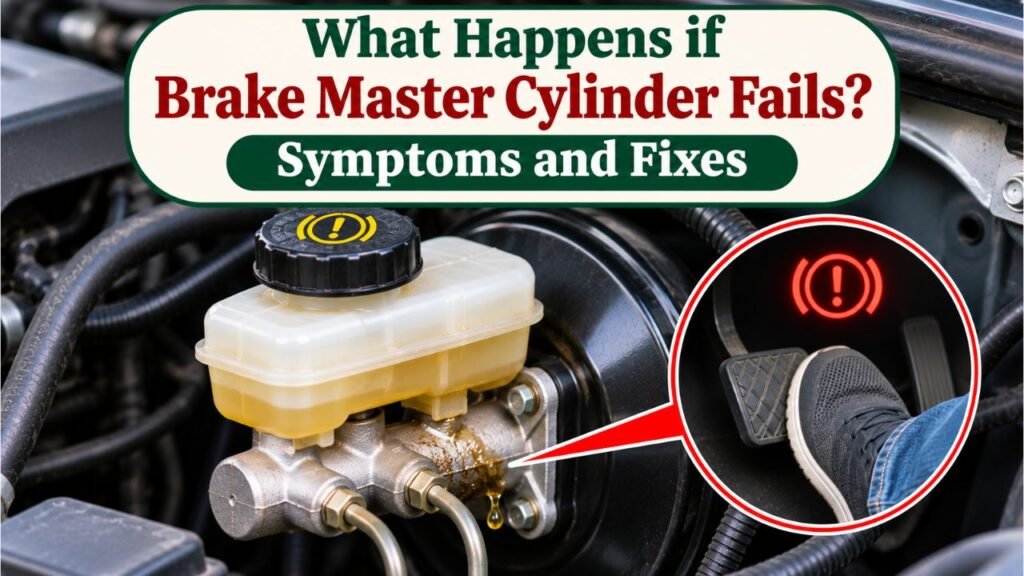
What Happens if Brake Master Cylinder Fails? Symptoms and Fixes
When a brake master cylinder fails, the brakes may lose hydraulic pressure, making the pedal sink toward the floor and increasing stopping distance. Severe failures can cause partial or complete loss of braking. Some master-cylinder faults instead trap pressure, leaving the brakes dragging after the pedal is released. Either situation is unsafe and requires inspection.
The master cylinder converts pedal force into pressure that operates the calipers or wheel cylinders. Worn internal seals can let fluid bypass the pistons without an obvious external leak, while a damaged rear seal may leak into the brake booster. Many vehicles use two hydraulic circuits, so one may provide limited braking if the other fails, but this does not guarantee a safe stop.
Warning signs include a sinking pedal, longer pedal travel, low brake fluid, or a brake-system warning light. Similar symptoms can come from leaking hoses, air in the lines, or other components.
In this article, I explain the types of master-cylinder failure, their effects on braking, how to recognize warning signs, and how technicians distinguish them from other faults. I also cover emergency driving steps, repair options, costs, and ways to prevent damage.
What Happens if Brake Master Cylinder Fails? Main Effects
The most serious consequence of master-cylinder failure is reduced or lost hydraulic braking pressure.
However, the exact result depends on which component fails and whether the vehicle retains pressure in another hydraulic circuit.
Brake Master Cylinder Failure Symptoms Chart
| Type of failure | What happens | Possible result |
| Internal seal failure | Fluid bypasses the piston | Pedal sinks under steady pressure |
| External seal failure | Brake fluid escapes | Low fluid level and reduced pressure |
| Rear seal leakage | Fluid leaks toward the brake booster | Hidden fluid loss and possible booster damage |
| Piston binding | Piston cannot move or return correctly | Inconsistent braking or brake drag |
| Blocked compensating port | Pressure cannot return to reservoir | Brakes remain applied |
| Severe corrosion | Internal surfaces and seals deteriorate | Pressure loss or piston malfunction |
| Hydraulic contamination | Rubber seals or internal components become damaged | Unpredictable braking performance |
| One circuit loses pressure | Part of the hydraulic system becomes ineffective | Longer pedal travel and reduced braking |
| Both circuits lose pressure | Normal hydraulic braking may be unavailable | Potential complete service-brake failure |
A master cylinder can fail in different ways. Not every failure produces identical symptoms.
Can the Brakes Stop Working Completely?
Yes.
A severe master-cylinder failure can prevent sufficient hydraulic pressure from reaching the brakes.
This may cause a near-total or complete loss of normal service braking.
However, modern vehicles typically have a dual-circuit hydraulic system designed to reduce the chance of losing every brake at once.
If one circuit fails, the remaining circuit may provide limited braking.
That does not mean the vehicle remains safe to drive.
What Happens to Stopping Distance?
When the master cylinder cannot create or maintain adequate pressure, the vehicle may require more pedal travel or pedal force to slow down.
Stopping distance can increase substantially.
There is no reliable universal percentage for how much longer the vehicle will take to stop.
The outcome depends on the severity of the failure, vehicle speed, hydraulic-system design, tire traction, and road conditions.
Will the Brake Pedal Go to the Floor?
It can.
A failing master cylinder may allow the brake pedal to move unusually far or sink slowly toward the floor.
This is especially common with internal hydraulic leakage.
However, the same symptom can occur with external fluid loss or other brake-system faults.
Key Takeaway: Master-cylinder failure can affect both braking pressure and brake release. Any significant change in brake-pedal behavior requires immediate attention.
What Does a Brake Master Cylinder Do?
The master cylinder is one of the central components of a vehicle’s hydraulic braking system.
Its purpose is to convert brake-pedal movement into hydraulic pressure.
How the Braking System Normally Works
When you press the brake pedal:
- The brake pedal transfers force through a pushrod.
- The pushrod moves the master-cylinder piston.
- The piston pressurizes brake fluid.
- Hydraulic pressure travels through brake lines and hoses.
- Brake calipers or wheel cylinders apply the brakes.
- Friction between braking components slows the vehicle.
When you release the pedal, pressure normally decreases so the brakes can disengage.
Main Components of a Master Cylinder
A typical master cylinder contains:
- Cylinder housing or bore
- Primary piston
- Secondary piston in tandem designs
- Internal rubber seals
- Return springs
- Hydraulic fluid ports
- Brake-fluid reservoir connections
These components must work together to create, maintain, and release hydraulic pressure.
What Is a Tandem Master Cylinder?
Most modern passenger vehicles use a tandem master cylinder.
It contains two pistons that operate separate hydraulic circuits.
Depending on vehicle design, the circuits may be arranged:
- Front and rear
- Diagonally, connecting opposite front and rear wheels
This design provides a degree of redundancy.
However, it cannot guarantee adequate braking if a serious failure occurs.
Why Are Internal Seals Important?
The master-cylinder seals help prevent pressurized fluid from bypassing the pistons.
If the seals wear or become damaged, hydraulic pressure may escape internally.
The pedal can continue moving even though the driver is maintaining steady pressure.
That is one of the classic signs of master-cylinder failure.
What Are the Symptoms of a Bad Brake Master Cylinder?
A failing master cylinder may cause several noticeable problems.
Some appear gradually, while others occur suddenly.
1. Brake Pedal Slowly Sinks to the Floor
A brake pedal that steadily sinks while being held under constant pressure is an important warning sign of possible internal master-cylinder leakage.
Normally, the pedal should provide predictable resistance.
If an internal seal cannot maintain hydraulic pressure, fluid may bypass the piston.
The pedal can continue moving even though the driver is not pressing harder.
According to Firestone Complete Auto Care’s master-cylinder guide, worn internal seals can allow pressure to escape, resulting in a brake pedal that gradually sinks during steady application.
However, an external hydraulic leak can also cause a sinking pedal.
Do not assume the master cylinder is defective without inspecting the entire system.
2. Soft or Spongy Brake Pedal
A spongy pedal feels unusually soft or springy when pressed.
This often indicates compressible air or vapor within the hydraulic system.
A master-cylinder leak may contribute to air entering the system, but sponginess can also result from:
- Improper brake bleeding
- External leaks
- Deteriorated flexible hoses
- Other hydraulic-system faults
A soft pedal is not proof of a bad master cylinder.
3. Longer Brake Pedal Travel
The brake pedal may move farther than normal before the brakes respond.
This can happen when one hydraulic circuit is no longer functioning correctly.
The driver may need more pedal movement to generate the remaining braking pressure.
Other conditions, such as air in the lines or certain drum-brake problems, can produce similar symptoms.
4. Low Brake Fluid Level
An external master-cylinder leak can reduce the brake-fluid level.
Possible leak locations include:
- Hydraulic line connections
- Master-cylinder body
- Reservoir seals
- Rear master-cylinder seal
A low fluid level can also result from brake-pad wear or leaks elsewhere in the hydraulic system.
The cause must be identified before the vehicle is driven.
5. Brake Warning Light
Some vehicles illuminate a brake-system warning light when low brake-fluid level or hydraulic pressure imbalance is detected.
However, the warning light can also indicate:
- Parking brake engagement
- Low reservoir fluid
- Other braking-system faults
A master cylinder can fail without immediately activating a dashboard warning.
Therefore, an unlit warning lamp does not prove the braking system is safe.
6. Inconsistent Braking
Braking response may change from one pedal application to another.
For example, the pedal may feel acceptable during one stop but sink excessively during another.
This can occur when hydraulic pressure is lost intermittently.
Inconsistent braking should always be investigated.
7. Brake Fluid Leaking Near the Booster
The rear master-cylinder seal may leak into the brake booster.
This is important because the leakage may not be immediately visible on the ground.
Some fluid can accumulate inside the booster housing.
A technician may need to inspect the area between the master cylinder and booster to confirm the source.
8. Brakes Remain Applied
Some master-cylinder problems prevent hydraulic pressure from releasing.
This can cause:
- Brake dragging
- Overheated rotors
- Unusual resistance when driving
- Increased brake-pad wear
- Burning brake odor
However, sticking calipers, collapsed flexible hoses, and parking brake problems are also common causes.
Master Cylinder Warning Signs at a Glance
| Symptom | Possible master-cylinder connection | Urgency |
| Pedal sinks toward floor | Internal bypass or hydraulic leakage | Stop driving |
| Pedal suddenly has excessive travel | Hydraulic pressure loss | Stop driving |
| Brake fluid leaks | Failed seal or connection | Stop driving |
| Brake warning light with abnormal pedal | Hydraulic fault | Stop and inspect |
| Brakes barely slow vehicle | Severe pressure loss | Emergency |
| Multiple brakes remain applied | Pressure-release problem | Stop driving |
| Dark brake fluid | Possible contamination or age | Arrange inspection |
| Pedal feels slightly different | Several possible causes | Diagnose promptly |
What Causes a Brake Master Cylinder to Fail?
Several conditions can damage a master cylinder or prevent it from operating correctly.
Worn Internal Seals
Internal rubber seals experience repeated pressure and movement.
Over time, they can wear or lose their ability to seal properly.
When fluid bypasses a seal, the cylinder may fail to maintain pressure.
This can produce a sinking pedal without visible external leakage.
Corrosion Inside the Cylinder
Conventional DOT 3, DOT 4, and DOT 5.1 brake fluids absorb moisture over time.
Moisture can contribute to corrosion inside metal hydraulic components.
Corrosion may damage the cylinder bore and accelerate seal wear.
If internal surfaces become pitted, the master cylinder may no longer maintain a reliable hydraulic seal.
Contaminated Brake Fluid
Brake fluid can become contaminated by:
- Dirt
- Water
- Rubber debris
- Corrosion particles
- Incorrect hydraulic fluid
- Petroleum-based products
Some contaminants can damage rubber seals.
For example, petroleum-based power steering fluid should never be introduced into a brake system designed for glycol-based brake fluid.
Age-Related Wear
A master cylinder may develop problems after years of operation.
However, there is no universal mileage at which every master cylinder fails.
Actual service life depends on fluid maintenance, operating conditions, component quality, and other factors.
Improper Installation
Problems may occur after a master-cylinder replacement if:
- The wrong part is installed.
- Pushrod clearance is incorrect.
- The component is not properly bled.
- Hydraulic connections leak.
- The brake system contains trapped air.
Incorrect installation can cause pressure loss or brake dragging.
Brake Booster Pushrod Problems
A booster pushrod that holds the master-cylinder piston forward can prevent hydraulic pressure from returning normally.
This can create sticking brakes rather than a sinking pedal.
The correct pushrod clearance depends on the specific vehicle.
What Happens if the Master Cylinder Leaks Internally?
Internal leakage allows brake fluid to bypass the master-cylinder piston seals instead of maintaining hydraulic pressure.
The fluid may remain inside the master-cylinder assembly.
As a result, the reservoir can appear full even though the cylinder is malfunctioning.
Why Does the Pedal Sink?
When the driver presses the pedal, the piston should create pressure and hold it.
If fluid bypasses an internal seal, the piston can continue moving.
The pedal may gradually descend.
This can occur while stopped at a traffic light or during another sustained braking application.
Will You See Brake Fluid Under the Vehicle?
Not necessarily.
An internal bypass can occur without fluid escaping to the ground.
Therefore, the absence of a visible leak does not rule out master-cylinder failure.
Can the Pedal Feel Normal Sometimes?
Yes.
Some failures may be intermittent or more noticeable under particular pressure or temperature conditions.
A temporarily normal pedal does not confirm that the problem has disappeared.
Is Internal Bypass Dangerous?
Yes.
It can reduce the system’s ability to maintain braking pressure.
The condition may become worse and create unpredictable braking performance.
Do not continue driving with a suspected internal hydraulic leak.
What Happens if the Master Cylinder Leaks Externally?
External leakage allows brake fluid to escape from the hydraulic system.
This reduces the amount of available fluid and may eventually prevent adequate pressure from being generated.
Common External Leak Locations
Possible locations include:
- Master-cylinder body
- Rear seal
- Reservoir connections
- Brake-line fittings
A leak may also occur elsewhere in the braking system.
Can Fluid Leak Into the Brake Booster?
Yes.
A failed rear master-cylinder seal may allow fluid to collect in the brake booster.
This can make the leak less obvious.
A technician may discover the fluid when inspecting or removing the master cylinder.
Can an External Leak Cause Complete Brake Failure?
Yes.
If enough brake fluid escapes, the hydraulic system can lose braking pressure.
Even if one circuit retains some function, the vehicle may have severely reduced stopping capability.
What if the Reservoir Is Empty?
An empty brake-fluid reservoir is a serious warning.
Do not simply refill it and resume driving.
The system may contain air, and the underlying leak may still be present.
A qualified repair is necessary before returning the vehicle to service.
Can a Failed Master Cylinder Cause Complete Brake Failure?
Yes, although dual-circuit hydraulic systems are designed to reduce the likelihood of losing all service braking from a single failure.
The outcome depends on the vehicle’s configuration and the type of fault.
Partial Brake Failure
If one hydraulic circuit fails, the other may retain some braking ability.
However, the driver may experience:
- Longer pedal travel
- Increased pedal force
- Reduced braking force
- Longer stopping distance
- Unusual vehicle response
The remaining system is not a substitute for a properly functioning braking system.
Complete Brake Failure
If both circuits fail to provide adequate hydraulic pressure, normal service braking may become unavailable.
The pedal may move toward the floor with little resistance.
This is an emergency.
Does ABS Prevent Master Cylinder Failure?
No.
Anti-lock braking systems help control wheel lockup when adequate braking pressure is available.
ABS cannot repair a hydraulic leak or restore a failed master-cylinder seal.
A functioning ABS system does not guarantee that the vehicle can stop normally after master-cylinder failure.
Does the Parking Brake Still Work?
On many vehicles, the parking brake operates separately from the normal hydraulic service brakes.
It may provide another way to slow the vehicle in an emergency.
However, parking brake designs vary, including electronically controlled systems.
Follow the vehicle’s emergency operating instructions.
What Should You Do if the Brake Master Cylinder Fails While Driving?
If braking power suddenly decreases or disappears, concentrate on controlling the vehicle, reducing speed, and reaching a safe stopping area.
Do not continue the trip after stopping.
Step 1: Release the Accelerator
Stop accelerating.
Keep control of the steering wheel.
Look ahead for traffic, road conditions, and a safe area where the vehicle can stop.
Step 2: Warn Other Drivers
Activate hazard lights when appropriate.
Use the horn if necessary to warn nearby drivers.
Maintain control of the vehicle while signaling.
Step 3: Use the Remaining Service Braking
If the service brakes still provide pressure, apply them to reduce speed.
If the vehicle has functioning four-wheel ABS, firm pressure is generally recommended during emergency braking rather than pumping the pedal to prevent skidding.
If hydraulic pressure is lost and the pedal drops to the floor, several quick pedal applications may temporarily restore some pressure in certain failures.
However, this is not guaranteed.
The California Department of Motor Vehicles’ emergency brake-failure guidance distinguishes braking procedures for vehicles with four-wheel ABS, rear-wheel ABS, and no ABS.
Step 4: Shift Into a Lower Gear
When appropriate for the transmission and vehicle speed, downshift gradually to increase engine braking.
Avoid abrupt shifts that could cause loss of control.
Use the vehicle manufacturer’s recommended method.
Step 5: Use the Parking Brake Carefully
If normal hydraulic braking is unavailable, the parking brake may help slow the vehicle.
For a mechanical parking brake, apply it progressively rather than abruptly.
Be prepared to reduce the application if the wheels skid.
Electronic parking brakes may have different emergency-operation procedures.
Consult the vehicle’s manual rather than assuming the same method works on every car.
Step 6: Steer Toward a Safe Stopping Area
Look for a suitable shoulder, open area, or other safe escape route.
Avoid sudden steering movements that could cause loss of control.
Step 7: Stop Completely and Call for Help
Once the vehicle has stopped safely:
- Secure the vehicle.
- Activate hazard lights as appropriate.
- Do not resume driving.
- Arrange towing or emergency assistance.
- Have the braking system professionally inspected.
Do not switch the ignition into a steering-lock position while the vehicle is moving.
Important: These are emergency measures, not techniques to make a vehicle with failed brakes safe for continued use.
How to Tell if the Master Cylinder Is Bad
A proper diagnosis considers both the pedal behavior and the entire hydraulic system.
A sinking brake pedal is an important clue, but it does not prove that the master cylinder is defective.
1. Check the Brake Fluid Level
With the vehicle safely parked, inspect the reservoir.
Look for fluid below the specified normal level.
However, fluid level can decrease as brake pads wear.
A full reservoir also does not eliminate the possibility of internal bypass.
2. Look for External Leaks
Inspect visible areas around the master cylinder and hydraulic components.
Potential clues include:
- Wet fittings
- Brake-fluid residue
- Leaking reservoir connections
- Fluid around the booster
- Leakage near a wheel
Do not open hydraulic lines merely to check for leaks.
3. Observe Abnormal Pedal Behavior
Pay attention to whether the pedal:
- Feels unusually soft
- Sinks under steady pressure
- Has excessive travel
- Responds inconsistently
- Does not return correctly
These observations can help a technician diagnose the problem.
Do not attempt a road test when braking performance is questionable.
4. Distinguish Internal Leakage From Other Faults
According to NAPA’s master-cylinder diagnostic guide, a brake pedal that gradually drops under steady pressure may indicate leakage, while internal seal bypass is an important possibility when the system cannot maintain pressure.
However, diagnosis must also consider air in the lines, caliper problems, and other hydraulic faults.
5. Have the System Professionally Tested
A qualified technician may perform:
- Brake-fluid level and condition inspection
- Hydraulic leak inspection
- Pedal response testing
- Circuit pressure testing
- Master-cylinder isolation testing
- Brake booster inspection
- Vehicle-specific electronic diagnostics
Some tests require disconnecting hydraulic components.
Improper procedures can introduce air or make the vehicle unsafe.
Diagnostic Findings and Possible Causes
| Finding | Possible cause |
| Pedal sinks under steady pressure | Internal bypass or external hydraulic leak |
| Reservoir level continues dropping | Fluid leakage or another system issue |
| Pedal feels soft or springy | Air, vapor, or other hydraulic problem |
| Brake pedal is unusually hard | Brake booster or assist problem |
| Several brakes remain applied | Trapped pressure, pushrod, or master-cylinder issue |
| One wheel remains applied | Caliper, hose, or parking brake problem |
| Brake warning light appears | Fluid level, pressure imbalance, or other warning |
| Fluid leaks behind master cylinder | Rear seal failure |
Bad Master Cylinder vs Brake Booster: What’s the Difference?
A faulty brake master cylinder and a faulty brake booster can create different symptoms.
Master Cylinder Failure
The master cylinder generates hydraulic pressure.
Typical failures may cause:
- Sinking pedal
- Excessive pedal travel
- Hydraulic fluid leakage
- Reduced braking force
- Inconsistent braking
Brake Booster Failure
The brake booster assists the driver in applying brake force.
A failed vacuum booster may produce:
- Hard brake pedal
- Increased pedal effort
- Reduced power assistance
- Vacuum-related noises in some cases
The hydraulic brakes may still function mechanically, but substantially greater pedal force can be required.
Can the Booster Damage the Master Cylinder?
An incorrectly adjusted booster pushrod may prevent proper master-cylinder piston return.
This can cause hydraulic pressure to remain trapped.
The result may be brakes that drag or remain applied.
Comparison Chart
| Symptom | Master cylinder | Brake booster |
| Pedal slowly sinks | Common warning sign | Less typical |
| Pedal is very hard | Possible but less typical | Common with lost assist |
| Brake fluid leaks | Possible | Booster is not normally a brake-fluid reservoir |
| Increased pedal effort | Possible | Common |
| Hydraulic pressure loss | Directly related | Not the usual failure mechanism |
| Brakes remain applied | Possible with return problems | Possible with pushrod or linkage issues |
Bad Master Cylinder vs Air in Brake Lines
Air in the hydraulic system can produce symptoms resembling master-cylinder failure.
Air in Brake Lines
Air is compressible.
When air enters the system, some pedal movement compresses air rather than creating the expected hydraulic response.
This can cause:
- Soft pedal feel
- Sponginess
- Excessive pedal travel
- Reduced braking response
Internal Master-Cylinder Failure
An internal hydraulic bypass can allow the pedal to sink under steady pressure.
The fluid may remain inside the master-cylinder assembly, so the reservoir level may not noticeably decrease.
Can Both Problems Happen Together?
Yes.
An external hydraulic leak can cause fluid loss and allow air into the system.
A damaged master cylinder and trapped air may therefore be present at the same time.
Will Bleeding the Brakes Fix the Problem?
Bleeding can remove air from the hydraulic system.
However, it will not repair damaged master-cylinder seals or an active leak.
If the underlying defect remains, the symptoms may return or persist.
Can a Failed Master Cylinder Cause Brakes to Stick?
Yes.
Although a loss of braking pressure is a common master-cylinder failure pattern, some faults prevent pressure from releasing.
How Trapped Pressure Develops
A master-cylinder compensating port normally allows hydraulic pressure to equalize when the pedal is released.
If the port remains blocked or the piston cannot return fully, pressure may stay trapped.
The brakes can remain applied.
Symptoms of Brake Drag
Possible symptoms include:
- Vehicle feels difficult to accelerate
- Wheels become unusually hot
- Burning brake smell
- Brake pads wear rapidly
- Vehicle pulls while driving
- Brakes worsen as the vehicle heats up
Can a Booster Pushrod Cause This?
Yes.
An incorrectly adjusted booster pushrod may hold the master-cylinder piston slightly forward.
This can prevent normal hydraulic pressure release.
Is Every Sticking Brake Caused by the Master Cylinder?
No.
A single sticking wheel more commonly suggests a localized issue such as:
- Seized caliper
- Restricted flexible hose
- Binding brake pads
- Parking brake malfunction
The braking system must be diagnosed before replacing the master cylinder.
Will Replacing the Master Cylinder Fix the Brakes?
Replacing the master cylinder can restore normal braking when the cylinder itself is defective and no other faults remain.
However, replacement should follow diagnosis rather than guesswork.
When Replacement Is Necessary
A new or properly approved remanufactured master cylinder may be needed when the original has:
- Failed internal seals
- Significant corrosion
- Damaged pistons
- External seal leakage
- An internal pressure-release defect
What Happens During Replacement?
A typical professional replacement involves:
- Verifying the master cylinder is defective.
- Identifying the correct replacement part.
- Inspecting related hydraulic components.
- Removing the defective assembly.
- Preparing the replacement according to its instructions.
- Installing and connecting the replacement.
- Filling the system with specified brake fluid.
- Bleeding the hydraulic system correctly.
- Checking for leaks and proper pressure retention.
- Confirming safe brake operation.
Why Is Bench Bleeding Important?
A new master cylinder may contain air.
Bench bleeding is commonly performed to remove air from the master-cylinder bore before final installation.
However, the exact procedure depends on the part and vehicle.
Does ABS Make Replacement More Complicated?
It can.
Some ABS-equipped vehicles require specialized bleeding procedures or scan-tool operation when air enters certain hydraulic components.
The repair must follow the vehicle-specific service instructions.
Can You Replace Only the Master Cylinder?
Sometimes.
However, additional work may be necessary when the failure has affected other components.
For example, a rear seal leak may require inspection of the brake booster.
If petroleum contamination damaged rubber components, replacing only the master cylinder may not correct the entire problem.
How Much Does It Cost to Fix a Failed Master Cylinder?
Master-cylinder replacement costs vary by vehicle, labor rates, part quality, and the amount of additional brake service needed.
General Replacement Cost
For some U.S. passenger vehicles, a professional master-cylinder replacement may cost several hundred dollars.
Firestone reports examples around 600–900 or more, depending on the vehicle and repair conditions.
This is a general estimate, not a universal quoted price.
What Affects the Cost?
Important factors include:
- Vehicle make and model
- Master-cylinder part price
- Original equipment vs aftermarket part
- Labor time
- Brake-fluid requirements
- Bleeding procedure
- ABS system complexity
- Related component damage
- Local labor rates
Possible Additional Repairs
A master-cylinder replacement may be accompanied by other repairs when necessary.
Examples include:
- Brake booster replacement
- Brake hose replacement
- Hydraulic line repair
- Brake fluid contamination service
- Caliper repair
- Additional ABS diagnostics
The final cost can be significantly higher if the system has multiple faults.
Should You Buy a Used Master Cylinder?
A used master cylinder has an unknown wear and maintenance history.
Because it is a safety-critical hydraulic component, a new or properly remanufactured unit meeting the vehicle’s specifications is generally preferable.
Can You Rebuild a Master Cylinder?
Certain serviceable designs may have approved rebuild procedures.
However, many modern master cylinders are replaced as complete assemblies.
Rebuilding a damaged or corroded unit without the proper specifications and equipment can create serious safety risks.
Can You Drive With a Bad Brake Master Cylinder?
No. If the master cylinder is suspected of causing abnormal braking, do not continue driving until the system has been professionally assessed.
A vehicle may still appear to stop during light braking even when hydraulic pressure retention is unreliable.
That does not guarantee it will stop safely during an emergency.
What if the Pedal Only Sinks a Little?
An unusual sinking pedal should not be ignored.
A relatively small change may indicate a developing hydraulic problem.
The condition may worsen without warning.
What if the Brakes Still Work?
A failing master cylinder may provide some braking response before a more serious failure occurs.
Continuing to drive creates unnecessary risk.
Have the vehicle towed when braking performance is abnormal.
Can You Drive Slowly to a Repair Shop?
Driving slowly does not eliminate the danger of brake failure.
If the brake pedal is sinking, the vehicle has lost braking pressure, or fluid leakage is suspected, towing is the safer choice.
Does a Full Brake Reservoir Mean It Is Safe?
No.
Internal master-cylinder seal failure may occur without an external leak.
The reservoir may remain full while hydraulic pressure is lost.
Fluid level is only one part of brake-system diagnosis.
How to Prevent Brake Master Cylinder Failure
Not every master-cylinder failure can be prevented.
However, proper brake maintenance can reduce some causes of premature deterioration.
Use the Correct Brake Fluid
Follow the vehicle manufacturer’s required brake-fluid specification.
Common classifications include:
- DOT 3
- DOT 4
- DOT 5
- DOT 5.1
These fluids are not all interchangeable.
In particular, silicone DOT 5 must not be mixed with conventional glycol-based DOT 3, DOT 4, or DOT 5.1.
Replace Brake Fluid as Recommended
Brake fluid can become contaminated with moisture and other materials.
For glycol-based fluids, moisture accumulation may contribute to internal corrosion.
Follow the manufacturer’s maintenance schedule.
There is no universal replacement interval suitable for every vehicle.
Inspect Fluid Levels
Check the brake-fluid reservoir as recommended.
A gradual change may accompany brake-pad wear.
However, a sudden or unexplained decrease can indicate leakage.
Investigate the cause instead of repeatedly topping off the reservoir.
Repair Leaks Promptly
Small hydraulic leaks should not be ignored.
They can lead to fluid loss, air entry, and reduced braking performance.
Avoid Contamination
Keep dirt, water, petroleum-based products, and unsuitable chemicals out of the brake-fluid reservoir.
Use clean equipment and fresh, correctly specified fluid during servicing.
Follow Correct Installation Procedures
After replacing the master cylinder or brake booster, verify proper pushrod clearance, pedal return, and hydraulic bleeding.
Incorrect installation can create pressure-loss or brake-drag problems.
Pay Attention to Pedal Changes
A brake pedal should behave consistently.
If it becomes unusually soft, travels farther, or begins sinking, arrange an inspection immediately.
Common Mistakes When Dealing With Master Cylinder Failure
| Mistake | Why it is dangerous | Better approach |
| Assuming a full reservoir means the cylinder is good | Internal bypass may occur without fluid loss | Evaluate hydraulic pressure |
| Ignoring a sinking pedal | Braking pressure may be failing | Stop driving and inspect |
| Replacing the master cylinder without diagnosing leaks | The real problem may remain | Inspect the entire brake system |
| Assuming a hard pedal always means master-cylinder failure | Brake booster faults are also possible | Check power assistance |
| Repeatedly topping off a leaking system | Does not correct the leak | Repair the source |
| Using incorrect brake fluid | May damage hydraulic seals | Follow manufacturer specifications |
| Bleeding brakes without repairing failed seals | Pressure loss may continue | Repair the underlying fault |
| Driving after brakes temporarily improve | Fault may return suddenly | Arrange professional repair |
| Ignoring ABS bleeding requirements | Air may remain in hydraulic components | Follow vehicle-specific procedure |
| Failing to inspect the booster after rear seal leakage | Fluid may have entered the booster | Check related components |
| Adjusting the booster pushrod by guesswork | Can cause brake drag or other faults | Use manufacturer specifications |
| Assuming dual circuits guarantee safe stopping | Remaining braking may be severely reduced | Treat the failure as unsafe |
Conclusion
When a brake master cylinder fails, the vehicle may lose hydraulic braking pressure, causing a sinking pedal, reduced stopping power, or even complete service-brake failure.
Internal seal damage can allow fluid to bypass the pistons, while external leaks can reduce the amount of fluid available in the hydraulic system.
Some failures also prevent pressure from releasing, causing the brakes to stick or drag.
Although modern dual-circuit systems provide some protection against complete hydraulic failure, they do not guarantee safe braking when a master cylinder malfunctions.
I recommend treating any sinking brake pedal, unusual pedal travel, unexplained fluid loss, or inconsistent braking as an urgent problem.
Do not rely on a full reservoir or the absence of warning lights to determine whether the braking system is safe.
A qualified technician should inspect the master cylinder, brake lines, hoses, booster, calipers, and related hydraulic components before recommending repairs.
If the master cylinder is defective, replacement and proper bleeding can restore its function, provided any other faults are also corrected.
For a vehicle with noticeably reduced braking performance, stop driving and arrange towing rather than risk a sudden loss of control.
FAQs About Brake Master Cylinder Failure
What Happens When the Brake Master Cylinder Goes Bad?
A bad master cylinder may lose the ability to create or maintain hydraulic pressure.
This can cause a soft or sinking brake pedal, excessive pedal travel, reduced braking performance, and potentially complete brake failure.
Some faults instead cause the brakes to remain applied.
Can a Bad Master Cylinder Cause Total Brake Failure?
Yes.
Severe master-cylinder failure can result in complete loss of normal hydraulic braking.
Although many vehicles have two separate hydraulic circuits, this design does not guarantee sufficient braking after a serious failure.
Will the Brake Pedal Go to the Floor if the Master Cylinder Fails?
It can.
Worn internal seals may allow fluid to bypass the pistons.
The pedal may sink under steady pressure or move excessively when the brakes are applied.
However, other hydraulic leaks can produce similar symptoms.
Can a Master Cylinder Fail Without Leaking Brake Fluid?
Yes.
Internal seal bypass can allow pressure to escape inside the master cylinder without fluid leaving the assembly.
The reservoir may remain full even when the master cylinder is defective.
Can a Bad Master Cylinder Cause Spongy Brakes?
Yes, but spongy brakes can also result from air in the hydraulic system, an external leak, or another component fault.
A sinking pedal under steady pressure is an important clue of possible internal pressure loss.
Can a Master Cylinder Cause Brakes Not to Work?
Yes.
If the cylinder cannot generate adequate hydraulic pressure, the brakes may become weak or unresponsive.
This is a serious safety condition requiring immediate attention.
Can a Bad Master Cylinder Cause Brakes to Lock Up?
Yes.
A blocked compensating port, sticking piston, or incorrect pushrod adjustment can trap hydraulic pressure.
This may keep the brakes applied after releasing the pedal.
However, caliper and hose problems can produce similar symptoms.
Does the Brake Warning Light Come On When a Master Cylinder Fails?
Sometimes.
The light may activate because of low brake fluid or a hydraulic pressure imbalance.
However, some master-cylinder failures occur without an immediate warning light.
Normal dashboard indications do not guarantee the braking system is functioning correctly.
How Long Can You Drive With a Bad Master Cylinder?
You should not continue driving with a suspected master-cylinder fault that affects braking.
The failure may worsen unexpectedly.
Arrange professional inspection and towing when necessary.
Will Adding Brake Fluid Fix a Bad Master Cylinder?
No.
Adding fluid cannot repair worn internal seals, a damaged piston, or a corroded cylinder bore.
If fluid is low because of a leak, the source must be repaired and the system properly serviced.
Can a Master Cylinder Fail Suddenly?
Yes.
Some failures develop gradually as internal components wear, while others may become noticeable suddenly.
A sudden loss of hydraulic pressure is a serious emergency.
How Do You Test a Bad Master Cylinder?
Technicians evaluate pedal behavior, fluid levels, external leaks, and the ability of the hydraulic system to maintain pressure.
Specialized isolation or bench testing may be required.
Because brake-system testing can compromise hydraulic integrity, advanced procedures should be performed by qualified professionals.
Is a Hard Brake Pedal a Sign of Master Cylinder Failure?
Not usually the most characteristic sign.
A hard pedal commonly suggests reduced power assistance from the brake booster or a related system.
However, some master-cylinder return or pressure-release problems can also produce unusual pedal feel.
Can a Bad Brake Booster Feel Like a Bad Master Cylinder?
Yes, some symptoms can overlap.
A failing booster more commonly causes a hard pedal requiring greater effort.
A failing master cylinder often causes excessive travel, sinking, or hydraulic pressure loss.
The complete system should be evaluated.
Do You Have to Bleed the Brakes After Replacing a Master Cylinder?
Yes.
Master-cylinder replacement involves opening the hydraulic system, and air must be removed through the appropriate bleeding procedure.
Some ABS-equipped vehicles require specialized steps.
The brake system must be checked for proper operation before driving.
How Much Does It Cost to Replace a Brake Master Cylinder?
The cost varies by vehicle, parts, labor, and related repairs.
Some U.S. professional replacement estimates range from approximately $600 to more than $900.
Complex systems or additional hydraulic repairs can cost more.
Can an Old Brake Master Cylinder Be Repaired?
Certain designs may be rebuilt using approved procedures and suitable replacement components.
However, many modern master cylinders are replaced as complete units.
A damaged or severely corroded cylinder may not be safely repairable.
Is It Safe to Drive if the Brakes Work After Pumping the Pedal?
No.
If the brakes only respond after repeated pumping, the hydraulic system may have air, pressure loss, or another serious fault.
Temporary improvement does not establish that the vehicle is safe to drive.
Stop using the vehicle and arrange a qualified inspection.