What Size Master Cylinder for 4 Wheel Disc Brakes? Bore Guide
For most traditional four-wheel disc brake conversions, a 7/8-inch to 1-inch bore master cylinder is a common starting range for manual brakes, while a 1-inch to 1-1/8-inch bore is commonly used for power-assisted brakes. However, the correct master cylinder size depends on the caliper piston dimensions, brake pedal ratio, booster assistance, and required hydraulic fluid displacement.
A 1-inch bore master cylinder works well in many properly matched four-wheel disc systems, but it is not a universal solution. Smaller bores generate more hydraulic pressure for the same pushrod force, while larger bores move more fluid with less piston travel.
Choosing the wrong size can cause a brake pedal that feels excessively hard, travels too far, or cannot develop the braking force needed for safe stopping. Installing larger calipers or converting rear drum brakes to discs can also change the system’s hydraulic requirements.
In this article, I explain what size master cylinder for 4 wheel disc brakes is typically recommended, including the differences between manual and power-assisted systems. I also cover common bore sizes, caliper piston requirements, pedal ratios, hydraulic pressure calculations, proportioning valves, and how to identify problems with an incorrectly sized master cylinder.
What Size Master Cylinder Do You Need for 4 Wheel Disc Brakes?
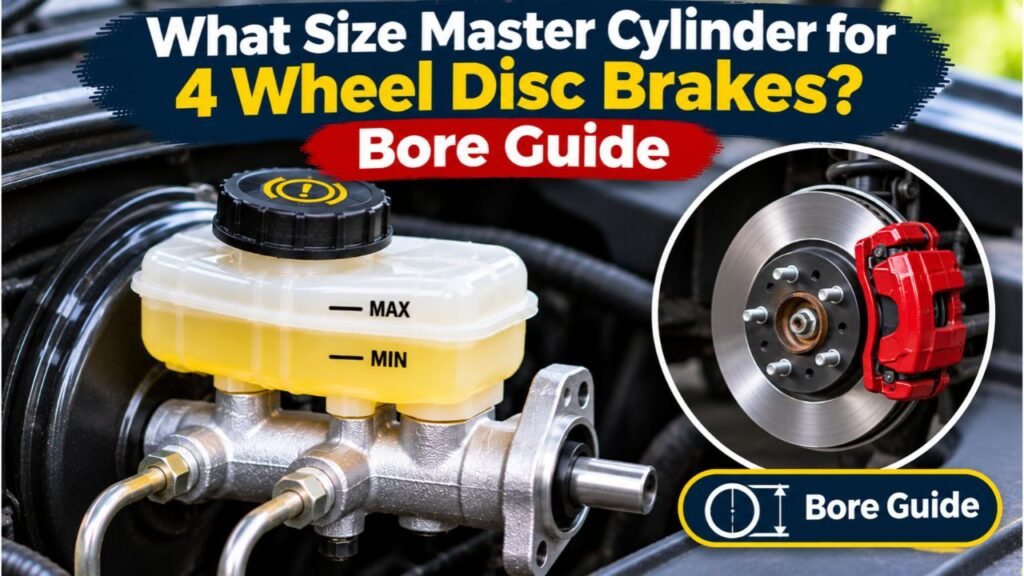
The typical starting range is 7/8–1 inch for manual brakes and 1–1/8 inches for many power-assisted systems, although some boosted applications use a 1-inch bore.
These are general sizing ranges for traditional hydraulic brake systems, especially older vehicles undergoing four-wheel disc conversions.
They are not replacement specifications for every modern passenger car or truck.
Master Cylinder Bore Size Chart
| Brake system | Common starting bore size | Important consideration |
| Manual four-wheel disc brakes | 7/8–1 inch | Pedal ratio and required pressure |
| Manual four-wheel disc with moderate caliper displacement | 15/16–1 inch | Balance between pressure and pedal travel |
| Power-assisted four-wheel disc brakes | 1–1/8 inches common; 1 inch also used | Booster assistance and fluid displacement |
| High-volume multi-piston calipers | Application-specific | Total piston movement and available master cylinder stroke |
| Factory four-wheel disc system | OEM-specified size | Complete vehicle compatibility |
| Custom race braking system | Engineering-specific | Pedal box, balance bar, caliper requirements, and target pressure |
The MOTOR magazine technical guide to master cylinder selection explains that four-wheel disc brake conversions require consideration of vehicle weight, caliper sizes, pedal ratio, brake rotor design, and driving application.
It also emphasizes that a disc/disc master cylinder must provide the required fluid volume and piston stroke.
Is a 1-Inch Master Cylinder Enough for Four-Wheel Disc Brakes?
Often, yes.
A 1-inch master cylinder is a common choice for many traditional disc brake conversions.
It provides a compromise between hydraulic pressure and fluid displacement.
However, a system with large caliper pistons or limited available master cylinder stroke may require a different bore.
A 1-inch bore should therefore be treated as a starting point, not a guaranteed fit.
Is a 1-1/8-Inch Master Cylinder Better?
It can be appropriate for power-assisted braking systems.
A larger bore moves more fluid per inch of piston travel, which can help satisfy the displacement requirements of certain calipers.
However, it generates less hydraulic pressure for the same input force.
Without adequate brake assistance or pedal leverage, a 1-1/8-inch master cylinder may cause excessive pedal effort.
Can You Use a 7/8-Inch Master Cylinder With Four-Wheel Discs?
Yes, when the braking system is designed for it.
A 7/8-inch bore can be useful for manual brakes because it provides greater hydraulic pressure for a given input force.
However, it moves less fluid per inch of travel.
If the calipers require more fluid than the master cylinder can displace within its available stroke, pedal travel may become excessive.
Key Takeaway: There is no universally correct master cylinder bore for four-wheel disc brakes. A suitable size must provide enough pressure and fluid displacement without excessive pedal effort or travel.
Common Master Cylinder Bore Sizes for Four-Wheel Disc Brakes
Several bore sizes are widely used in aftermarket and custom braking systems.
These include:
- 7/8 inch.
- 15/16 inch.
- 1 inch.
- 1-1/16 inch.
- 1-1/8 inch.
Some vehicles use metric bore diameters, such as 24 mm.
Bore Size Conversion Chart
| Bore size | Decimal inches | Approximate millimeters |
| 7/8 inch | 0.875 | 22.23 mm |
| 15/16 inch | 0.9375 | 23.81 mm |
| 24 mm | 0.9449 | 24.00 mm |
| 1 inch | 1.000 | 25.40 mm |
| 1-1/16 inch | 1.0625 | 26.99 mm |
| 1-1/8 inch | 1.125 | 28.58 mm |
The physical differences may appear small, but they can create meaningful changes in hydraulic pressure and fluid displacement.
7/8-Inch Master Cylinder
A 7/8-inch bore has a cross-sectional area of approximately 0.601 square inches.
It produces relatively high hydraulic pressure for a given pushrod force.
This can be useful for manual braking systems.
However, it requires more piston travel to displace the same amount of fluid as a larger master cylinder.
15/16-Inch Master Cylinder
A 15/16-inch bore provides a compromise between 7/8 inch and 1 inch.
It may be useful when a 7/8-inch master cylinder produces excessive travel but a 1-inch master cylinder requires more pedal force than desired.
However, the system must support the bore and stroke requirements.
1-Inch Master Cylinder
A 1-inch bore is a common aftermarket choice.
It offers a practical middle ground between pressure and fluid volume.
Its suitability depends on caliper sizes, pedal ratio, booster assistance, and available stroke.
1-1/16-Inch Master Cylinder
A 1-1/16-inch bore provides additional fluid displacement compared with a 1-inch design.
It may be appropriate for certain brake systems requiring more volume.
However, the increased bore also lowers hydraulic pressure at the same pushrod force.
1-1/8-Inch Master Cylinder
A 1-1/8-inch bore moves considerably more fluid than a 7/8-inch or 1-inch bore.
It is frequently associated with power-assisted disc brake applications.
However, it can create an excessively hard pedal when used in a manual system without sufficient mechanical leverage.
Manual vs Power Brakes: How Master Cylinder Size Changes
One of the most important factors in master cylinder selection is whether the vehicle has power brake assistance.
Manual Four-Wheel Disc Brakes
Manual brakes rely on the driver’s foot force and the mechanical leverage of the brake pedal.
There is no vacuum or hydraulic booster multiplying the input force.
For this reason, smaller master cylinder bores are often used to obtain suitable hydraulic pressure.
Common starting sizes include:
- 7/8 inch.
- 15/16 inch.
- 1 inch.
However, the correct bore depends on the entire system.
Why Smaller Bores Are Common for Manual Brakes
Hydraulic pressure is calculated by dividing the applied force by the piston area.
A smaller master cylinder piston has less area.
For a given force, that produces greater pressure.
This helps reduce the pedal effort required to develop a particular hydraulic pressure.
However, the smaller piston moves less fluid for a given stroke.
The available pedal travel must therefore be sufficient.
Power-Assisted Four-Wheel Disc Brakes
Power-assisted systems use a booster to increase the effective force acting on the master cylinder.
This allows the system to use a larger bore without requiring the driver to supply all the corresponding force directly.
Common power-assisted bore sizes include:
- 1 inch.
- 1-1/8 inch.
Some applications use other diameters.
Does a Brake Booster Determine Master Cylinder Size?
It is one important factor.
However, booster diameter alone is not sufficient to choose a bore.
Booster performance depends on:
- Effective diaphragm area.
- Vacuum supply or hydraulic assistance.
- Booster design.
- Pedal ratio.
- Master cylinder piston area.
- System operating conditions.
A master cylinder must be compatible with both the booster and the hydraulic braking system.
Manual vs Power Brake Comparison
| Feature | Manual brakes | Power-assisted brakes |
| Booster | No | Yes |
| Typical pedal ratio | Often about 5:1–7:1 | Often about 4:1–5:1 |
| Common bore tendency | Smaller | Larger |
| Typical four-disc starting range | 7/8–1 inch | 1–1/8 inches common; 1 inch also used |
| Input force | Driver and pedal leverage | Driver, pedal leverage, and booster |
| Main challenge | Achieving enough pressure without excessive travel | Balancing assistance, pressure, and displacement |
The NAPA guide to measuring brake pedal ratio explains that manual braking systems typically require greater pedal leverage than power-assisted systems.
It also identifies bore size and pedal ratio as important factors affecting pedal effort.
How Master Cylinder Bore Size Affects Brake Pressure
The master cylinder bore has a direct effect on hydraulic pressure.
The basic equation is:
[
P=\frac{F}{A}
]
Where:
- P = Hydraulic pressure in psi.
- F = Force applied to the piston in pounds-force.
- A = Piston area in square inches.
For a circular master cylinder bore:
[
A=\frac{\pi d^2}{4}
]
Where d represents the bore diameter.
Example: Comparing Different Master Cylinder Sizes
Assume a simplified hydraulic system receives 600 pounds-force at the master cylinder piston.
This could represent an idealized manual brake setup with:
- 100 pounds-force applied to the pedal.
- A 6:1 mechanical pedal ratio.
- No booster assistance.
- Friction losses ignored.
The theoretical results are:
| Master cylinder bore | Piston area | Theoretical pressure |
| 7/8 inch | 0.601 sq in | 998 psi |
| 15/16 inch | 0.690 sq in | 869 psi |
| 1 inch | 0.785 sq in | 764 psi |
| 1-1/8 inch | 0.994 sq in | 604 psi |
These are simplified single-piston pressure calculations intended to explain the mathematical relationship.
They are not validated specifications for a particular tandem master cylinder or recommended operating pressures.
Actual braking performance depends on the complete hydraulic system, including the tandem circuit arrangement, booster, pedal geometry, and wheel brakes.
What Happens When Bore Size Increases?
As bore diameter increases, piston area increases.
At the same input force, pressure decreases.
For example, changing from a 7/8-inch bore to a 1-1/8-inch bore significantly increases piston area.
The larger bore can move more fluid but requires more input force to reach the same pressure.
What Happens When Bore Size Decreases?
A smaller bore generates more pressure from the same input force.
However, more piston movement is needed to deliver the same fluid volume.
That is why selecting the smallest possible bore is not always beneficial.
Key Takeaway: A larger master cylinder does not automatically produce stronger braking. It moves more fluid but generates less pressure at the same input force.
How Bore Size Affects Brake Pedal Travel
Master cylinder selection involves two competing requirements:
- Generate sufficient hydraulic pressure.
- Move sufficient brake fluid.
Bore size affects both.
Fluid Displacement Formula
For a simplified cylindrical piston:
[
V=A\times S
]
Where:
- V = Fluid volume displaced.
- A = Piston area.
- S = Piston stroke.
Fluid Volume by Bore Size
The following table assumes one inch of effective piston travel.
| Master cylinder bore | Theoretical volume displaced |
| 7/8 inch | 0.601 cubic inches |
| 15/16 inch | 0.690 cubic inches |
| 1 inch | 0.785 cubic inches |
| 1-1/8 inch | 0.994 cubic inches |
These figures show the mathematical relationship between diameter and displacement.
They do not account for compensation-port closure, actual usable stroke, tandem circuit operation, or the brake system’s hydraulic compliance.
Why a Larger Bore Reduces Pedal Travel
A larger piston moves more fluid during the same stroke.
If the calipers require a given fluid volume, a larger master cylinder may satisfy that requirement with less piston movement.
That can reduce the corresponding pedal travel.
Why a Smaller Bore Increases Pedal Travel
A smaller master cylinder must move farther to displace the same fluid volume.
For example, assume a hydraulic circuit requires 0.50 cubic inches of fluid displacement.
Using the simplified formula:
[
S=\frac{V}{A}
]
The calculated piston travel would be:
| Master cylinder bore | Travel needed for 0.50 cu in |
| 7/8 inch | 0.832 inches |
| 15/16 inch | 0.724 inches |
| 1 inch | 0.637 inches |
| 1-1/8 inch | 0.503 inches |
This hypothetical example shows why pedal travel must be considered alongside pressure.
The values are not specifications for an actual brake circuit.
What if the Master Cylinder Runs Out of Stroke?
If the master cylinder cannot displace enough fluid within its available stroke, the wheel brakes may not develop the intended clamping force.
The pedal may travel excessively or bottom out.
This creates a serious safety risk.
A smaller bore is useful only when the system has enough usable stroke to accommodate the required displacement.
What Brake Pedal Ratio Do You Need for Four-Wheel Disc Brakes?
Brake pedal ratio is another major factor in master cylinder selection.
It describes the mechanical leverage created by the pedal.
Brake Pedal Ratio Formula
[
\text{Pedal Ratio}=\frac{A}{B}
]
Where:
- A = Distance from the pedal pivot to the center of the footpad.
- B = Distance from the pedal pivot to the pushrod attachment point.
Both distances must use the same units and the correct effective lever geometry.
Example: Calculating Pedal Ratio
Suppose:
- Pivot-to-footpad distance: 12 inches.
- Pivot-to-pushrod distance: 2 inches.
Then:
[
\frac{12}{2}=6
]
The pedal ratio is approximately 6:1.
In a simplified ideal arrangement, 100 pounds-force at the pedal produces approximately 600 pounds-force at the pushrod.
Actual results can differ because of changing geometry and mechanical losses.
Typical Manual Brake Pedal Ratios
Manual disc brake systems often use pedal ratios around 5:1–7:1.
A 6:1 ratio is a commonly discussed starting point.
However, a specific setup must be engineered to provide adequate travel and pressure.
Typical Power Brake Pedal Ratios
Power-assisted braking systems commonly use lower mechanical ratios, often around 4:1–5:1.
The booster provides additional input force.
Can You Use a Power Brake Pedal With Manual Brakes?
Not automatically.
Removing the booster without checking the pedal ratio can leave the driver with insufficient mechanical leverage.
The result may be an excessively hard pedal.
Any conversion from power to manual brakes should account for pedal geometry, pushrod retention, available travel, and hydraulic sizing.
Can You Fix a Hard Pedal by Changing the Bore?
Sometimes an incorrectly large bore contributes to excessive pedal effort.
However, hard pedals can also result from:
- Incorrect pedal ratio.
- Faulty booster.
- Insufficient vacuum supply.
- Improper pushrod adjustment.
- Mechanical binding.
- Caliper or friction-material problems.
Changing the master cylinder without diagnosing these factors may not solve the problem.
How Caliper Piston Size Affects Master Cylinder Selection
Caliper piston size influences the fluid volume and force requirements of a four-wheel disc brake system.
However, the number of pistons alone doesn’t determine the correct master cylinder.
Why Caliper Pistons Matter
When hydraulic pressure reaches a brake caliper, it acts on the caliper pistons.
Those pistons apply force to the brake pads.
The piston dimensions influence the force produced at a given pressure.
The required piston movement and total hydraulic volume also affect master cylinder travel.
Single-Piston Floating Calipers
Many conventional disc brake systems use floating calipers with one or more pistons on one side.
Hydraulic pressure moves the piston against the inner brake pad.
The caliper housing reacts by sliding, bringing the outer pad against the rotor.
Multi-Piston Fixed Calipers
A fixed caliper may contain pistons on both sides of the rotor.
These pistons apply pressure to the pads without the same floating action.
The number, size, and arrangement of pistons affect the hydraulic requirements.
Does a Four-Piston Caliper Always Need a Larger Master Cylinder?
No.
A four-piston caliper with relatively small pistons may have different hydraulic requirements from a single-piston caliper with a large piston.
The design also influences how much fluid is needed to take up pad clearances.
Use the actual caliper specifications rather than piston count alone.
How to Estimate Piston Area
For one round piston:
[
A=\frac{\pi d^2}{4}
]
For a caliper with multiple pistons, calculate the relevant piston areas using the manufacturer’s prescribed convention.
Fixed opposing-piston and floating caliper designs must be evaluated correctly.
Don’t assume that simply adding every piston area produces a valid comparison of clamping force or master cylinder requirements across different caliper types.
What Information Do You Need?
For each caliper, identify:
- Manufacturer and model.
- Piston diameters.
- Number and configuration of pistons.
- Hydraulic displacement requirements.
- Expected piston movement.
- Recommended operating pressure.
- Brake pad and rotor compatibility.
These details help determine whether the master cylinder can supply enough fluid and pressure.
The TBM Brakes brake system setup and calculation guide provides dedicated calculations for pedal ratio, master cylinder area, hydraulic pressure, fluid displacement, and pedal travel.
It also cautions that these calculations do not independently verify the suitability of the calipers, rotor size, or brake pad compound.
Does Rotor Size Affect Master Cylinder Bore Size?
Rotor diameter affects braking torque, but it doesn’t directly determine the master cylinder bore.
How Rotor Diameter Affects Braking
A larger effective rotor radius increases the mechanical leverage available at the brake friction surface.
For a given friction force, this can increase braking torque.
Does a Bigger Rotor Require More Brake Fluid?
Not automatically.
The master cylinder primarily needs to supply the displacement and pressure required by the caliper arrangement.
A larger rotor might be installed with calipers that have similar hydraulic requirements to the original calipers.
Alternatively, a brake upgrade may include larger or differently configured calipers that change those requirements.
What Should You Check?
Consider both the rotor and caliper specifications.
Rotor diameter alone is insufficient for master cylinder selection.
What Master Cylinder Do You Need for a Rear Disc Brake Conversion?
Converting a vehicle from front disc/rear drum brakes to four-wheel disc brakes can change hydraulic system requirements.
The original master cylinder may not be suitable for the modified setup.
Why Rear Disc Conversion Matters
Drum brakes use wheel cylinders and self-adjusting shoe mechanisms.
Disc brakes use caliper pistons and different operating clearances.
Replacing the rear drums with discs can change:
- Hydraulic fluid displacement.
- Pressure requirements.
- Front-to-rear brake balance.
- Parking brake arrangement.
- Proportioning valve requirements.
Can You Keep the Original Disc/Drum Master Cylinder?
Sometimes a particular original master cylinder may be compatible with a specific manufacturer-approved conversion, but this must be verified.
For many traditional aftermarket conversions, a dedicated disc/disc master cylinder is recommended because the original disc/drum unit may lack the required stroke, reservoir capacity, or other characteristics.
Does a Four-Wheel Disc Master Cylinder Need Two Reservoirs?
Modern conventional brake systems generally use a tandem or dual-circuit master cylinder.
This provides separate hydraulic circuits and a level of redundancy.
The reservoir may have two internal compartments even when it appears as a single container.
What About Residual Pressure Valves?
Some drum brake systems use residual-pressure valves intended to maintain a small amount of hydraulic pressure.
Using an inappropriate drum-type residual valve on a disc brake circuit can contribute to brake drag.
However, certain disc brake installations with low-mounted master cylinders may require a small residual-pressure valve according to the brake-system manufacturer’s instructions.
Don’t assume all disc brake conversions need a residual valve, or that every original valve must be retained.
Do You Need a Different Proportioning Valve?
Possibly.
A traditional disc/drum proportioning arrangement may not provide the intended rear-brake pressure control after a conversion.
Some aftermarket conversions require a disc/disc combination valve or an adjustable rear proportioning valve.
However, original equipment systems with electronic brake-force distribution or integrated control strategies require manufacturer-specific evaluation.
Changing the master cylinder alone does not guarantee correct front-to-rear braking balance.
Don’t Forget the Parking Brake
Four-wheel disc conversions must retain an effective, compatible parking brake.
The rear caliper design, cable arrangement, and parking brake mechanism must be properly matched.
How to Choose the Correct Master Cylinder for Four-Wheel Disc Brakes
Choosing a suitable master cylinder requires evaluating the complete brake system.
Step 1: Identify the Vehicle and Brake System
Record:
- Vehicle make and model.
- Model year.
- Vehicle weight and intended use.
- Original brake configuration.
- Current brake configuration.
- Type of brake assistance.
If the vehicle has an original factory four-wheel disc braking system, the manufacturer’s specified master cylinder is generally the correct replacement starting point.
Step 2: Determine Whether Brakes Are Manual or Power-Assisted
Identify whether the system uses:
- Manual mechanical pedal input.
- Vacuum booster assistance.
- Hydraulic booster assistance.
- Another approved braking arrangement.
This affects how much force reaches the master cylinder.
Step 3: Measure the Brake Pedal Ratio
Check the relationship between the pedal pivot, footpad, and pushrod mounting point.
Do not assume that the original pedal ratio remains suitable after removing or adding a booster.
Step 4: Identify the Front and Rear Calipers
Collect the manufacturer and part number for each caliper.
Find the piston sizes and hydraulic specifications.
Do not choose a master cylinder solely from wheel size or rotor diameter.
Step 5: Determine Required Hydraulic Pressure
Use the system manufacturer’s guidance to identify the required pressure range.
The appropriate pressure depends on the caliper design, pads, brake torque requirements, and other factors.
Do not assume that a generic pressure value applies to every vehicle.
Step 6: Determine Fluid Displacement and Stroke
Check how much fluid the wheel brakes require and how much the proposed master cylinder can displace within its usable stroke.
A bore that provides adequate pressure but insufficient fluid volume is not suitable.
Step 7: Verify Physical Compatibility
Check:
- Mounting bolt pattern.
- Pushrod depth and retention.
- Pushrod length and clearance.
- Bore diameter.
- Master cylinder stroke.
- Brake line ports.
- Thread specifications.
- Reservoir capacity.
- Hydraulic circuit configuration.
- Booster compatibility.
A master cylinder that bolts into place is not automatically hydraulically compatible.
Step 8: Review Brake Balance Requirements
Confirm the correct proportioning valve and hydraulic routing.
Check whether the conversion kit includes matching components.
Step 9: Follow the Correct Installation and Bleeding Procedure
Brake system modifications should be performed using the manufacturer’s procedures.
The master cylinder may require bench bleeding.
Some ABS systems require specialized bleeding operations.
Step 10: Verify the Complete System Before Road Use
A qualified technician should check:
- Hydraulic pressure where specified.
- Pedal travel and feel.
- Proper pedal return.
- No brake drag.
- No fluid leaks.
- Adequate fluid reserve.
- Correct front-to-rear braking behavior.
- Proper parking brake operation.
Important: Sizing charts provide starting points for designing a braking system. They do not replace component compatibility information or professional validation.
Is a 7/8-Inch or 1-Inch Master Cylinder Better?
Neither is always better.
The choice depends on whether the system needs more hydraulic pressure or more fluid displacement.
Advantages of a 7/8-Inch Bore
For the same pushrod force, it produces more hydraulic pressure.
This can be useful in manual brake applications.
Disadvantages of a 7/8-Inch Bore
It moves less fluid for each inch of piston travel.
A system requiring substantial fluid displacement may experience excessive pedal travel.
Advantages of a 1-Inch Bore
It moves more fluid per inch of piston travel.
It can provide a useful balance between pressure and stroke in many correctly designed systems.
Disadvantages of a 1-Inch Bore
For the same applied piston force, it produces less pressure than a 7/8-inch bore.
A manual system with insufficient pedal ratio may feel too hard.
Comparison Table
| Feature | 7/8-inch bore | 1-inch bore |
| Piston area | 0.601 sq in | 0.785 sq in |
| Pressure at equal force | Higher | Lower |
| Fluid volume per inch of stroke | Lower | Higher |
| Piston travel for equal fluid volume | Longer | Shorter |
| Common suitability | Selected manual brake systems | Selected manual or power systems |
| Main concern | Excessive travel | Excessive effort if leverage is inadequate |
The correct choice requires both pressure and displacement calculations.
Is a 1-Inch or 1-1/8-Inch Master Cylinder Better?
These sizes are common in traditional power-assisted braking applications.
1-Inch Bore
A 1-inch bore can provide a good balance of hydraulic pressure and fluid displacement.
It may suit certain manual or power-assisted setups.
1-1/8-Inch Bore
A 1-1/8-inch bore provides greater fluid displacement for the same piston travel.
However, it requires more input force to produce the same hydraulic pressure.
This makes it more practical where adequate booster assistance is available.
How Much More Fluid Does a 1-1/8-Inch Bore Move?
A 1-inch bore has an area of approximately 0.785 square inches.
A 1-1/8-inch bore has an area of approximately 0.994 square inches.
The difference is:
[
\frac{0.994-0.785}{0.785}\times100\approx26.6%
]
For the same effective stroke, the 1-1/8-inch master cylinder moves approximately 26.6% more fluid.
However, with the same applied force, it generates approximately 21% less hydraulic pressure.
These figures describe the basic piston-area relationship, not a guarantee of better or worse braking performance.
Which One Should You Choose?
Use the bore recommended by the brake component manufacturer or the complete conversion kit.
A larger master cylinder is only an improvement if the system needs the additional displacement and can still generate adequate hydraulic pressure.
How to Tell if Your Master Cylinder Bore Is Too Large
An oversized bore may produce excessive pedal effort.
However, several other problems can create similar symptoms.
Common Symptoms
Possible symptoms include:
- Very firm brake pedal.
- Excessive effort needed to slow the vehicle.
- Short pedal travel but inadequate braking.
- Difficulty modulating braking force.
Why Does This Happen?
A larger piston area requires greater input force to produce a given hydraulic pressure.
If the pedal ratio or booster assistance is insufficient, the driver may need to press unusually hard.
Other Possible Causes
A hard pedal can also result from:
- Brake booster problems.
- Insufficient vacuum.
- Incorrect pedal ratio.
- Incorrect pushrod geometry.
- Seized calipers.
- Unsuitable brake pads.
Do not assume that bore size is the cause without diagnosis.
How to Tell if Your Master Cylinder Bore Is Too Small
An undersized bore may create excessive pedal travel because it displaces less fluid per inch of stroke.
Common Symptoms
Possible symptoms include:
- Long brake pedal travel.
- Pedal approaching the floor.
- Inadequate fluid displacement.
- Inconsistent brake engagement.
Why Does This Happen?
The master cylinder must move enough fluid to operate the calipers.
If the available piston stroke is insufficient, the system may not achieve normal braking behavior.
Other Possible Causes
Excessive pedal travel can also result from:
- Air in the hydraulic system.
- External leaks.
- Internal master cylinder bypass.
- Incorrectly installed calipers.
- Excessive caliper piston retraction.
- Rotor runout or bearing movement.
- Incorrect ABS bleeding.
A soft pedal isn’t proof that the master cylinder bore is too small.
Can a Wrong Bore Damage the Braking System?
An unsuitable master cylinder can create dangerous braking behavior.
For example, insufficient stroke may prevent normal braking pressure from being achieved at the wheels.
Incorrect pushrod or residual-pressure arrangements may also contribute to brake drag.
The system should not be operated until the cause has been identified and corrected.
Does Master Cylinder Reservoir Size Matter for Four-Wheel Discs?
Yes, but the reservoir’s capacity is a separate consideration from the master cylinder bore diameter.
Why Reservoir Capacity Matters
Disc brake caliper pistons gradually extend as brake pads wear.
This changes how much fluid remains in the reservoir.
The reservoir must have adequate capacity to accommodate the system’s expected fluid-volume changes.
Are Disc Brake Reservoirs Larger Than Drum Brake Reservoirs?
Many traditional disc/drum master cylinders have a larger reservoir for the disc brake circuit.
A four-wheel disc master cylinder may require suitable capacity for both disc brake circuits.
However, reservoir configuration varies by manufacturer.
Does a Larger Reservoir Increase Brake Pressure?
No.
Hydraulic pressure is generated by the master cylinder pistons and the applied force.
Reservoir size doesn’t directly increase pressure.
Can You Use a Drum Brake Master Cylinder With Four-Wheel Discs?
Not without verifying that it meets all requirements.
Traditional drum brake master cylinders may have unsuitable fluid displacement, stroke, reservoir capacity, or residual-pressure arrangements.
Use a master cylinder approved for the specific four-wheel disc system.
Common Mistakes When Selecting a Four-Wheel Disc Master Cylinder
Choosing the Largest Bore Available
A larger bore doesn’t automatically produce greater braking force.
It can increase pedal effort.
Assuming One Inch Fits Every Conversion
Although common, a 1-inch master cylinder isn’t universally suitable.
Ignoring Caliper Piston Dimensions
Different calipers have different hydraulic requirements.
Using the Wrong Pedal Ratio
A manual brake conversion with insufficient pedal leverage may produce a very hard pedal.
Ignoring Master Cylinder Stroke
Adequate fluid displacement is as important as hydraulic pressure.
Selecting a Master Cylinder Based Only on Rotor Diameter
Rotor size affects braking torque but doesn’t directly establish hydraulic displacement.
Using a Drum Brake Residual Valve With Discs
An inappropriate residual-pressure valve can contribute to dragging brakes.
Ignoring Front-to-Rear Brake Balance
Rear disc conversions may require changes to the proportioning arrangement.
Using the Wrong Pushrod Configuration
Master cylinders designed for different booster or manual arrangements may have different pushrod requirements.
Improper retention, excessive clearance, or preload can create serious problems.
Skipping Brake Bleeding
Air in the hydraulic system can cause excessive pedal travel and poor braking.
Assuming a Firm Pedal Means the System Is Safe
A firm pedal doesn’t guarantee adequate hydraulic pressure, appropriate brake balance, or correct stopping performance.
Testing an Unverified Brake Conversion on Public Roads
A custom braking system must be properly inspected and validated before normal road use.
Example: Choosing a Manual Four-Wheel Disc Master Cylinder
Consider a hypothetical classic car converted to four-wheel disc brakes.
The vehicle has:
- Manual brake operation.
- Approximately 6:1 pedal ratio.
- Front and rear calipers selected as a matched set.
- No vacuum booster.
A 7/8-inch or 1-inch bore may be considered as a starting point.
Why Not Automatically Use 1-1/8 Inches?
With no booster, the larger bore may require excessive pedal force.
Why Not Automatically Use 7/8 Inch?
The calipers may require more fluid displacement than the smaller bore can supply within the available stroke.
How Is the Final Size Determined?
The brake-system manufacturer or qualified specialist should evaluate:
- Caliper piston dimensions.
- Fluid requirements.
- Required line pressure.
- Pedal travel.
- Pedal leverage.
- Master cylinder stroke.
- Vehicle braking requirements.
The correct bore is the one that satisfies these requirements together.
Example: Choosing a Power Four-Wheel Disc Master Cylinder
Now consider a different hypothetical vehicle.
It has:
- Four-wheel disc brakes.
- Vacuum booster.
- Approximately 4:1 pedal ratio.
- Larger calipers.
- A manufacturer-approved conversion package.
A 1-inch or 1-1/8-inch bore may be considered.
Why a Larger Bore May Be Appropriate
The booster adds force.
That can allow a larger master cylinder to move the required fluid without excessive pedal effort.
Is 1-1/8 Inch Always Necessary?
No.
If a 1-inch bore provides sufficient stroke, fluid displacement, and hydraulic pressure with the selected booster, there may be no benefit to increasing the diameter.
What Determines the Best Choice?
The correct choice depends on the matched brake components and verified system performance.
A properly engineered kit may specify the exact master cylinder size and pushrod arrangement.
Follow that specification rather than substituting a different bore based on a general rule.
Conclusion
For traditional four-wheel disc brake systems, master cylinder bores commonly range from 7/8 inch to 1 inch for manual brakes, while 1 inch to 1-1/8 inches is common for power-assisted applications.
However, bore diameter alone does not determine whether a master cylinder is suitable.
A smaller bore produces greater hydraulic pressure for the same pushrod force but requires more travel to displace a given amount of brake fluid.
A larger bore moves more fluid per inch of stroke but generates less pressure at the same force.
The correct choice must account for caliper piston dimensions, pedal ratio, booster assistance, required pressure, available stroke, hydraulic circuit design, and front-to-rear brake balance.
I recommend using the master cylinder specified by the vehicle manufacturer or a properly engineered four-wheel disc conversion kit. For custom systems, confirm the dimensions and requirements with the brake component manufacturer or a qualified brake specialist.
Do not choose a larger master cylinder simply to achieve a firmer pedal, or a smaller one solely to reduce pedal effort.
The best master cylinder is the one that provides adequate pressure and fluid displacement while maintaining safe pedal travel, braking response, and system compatibility.
FAQs About What Size Master Cylinder for 4 Wheel Disc Brakes
What Size Master Cylinder Is Best for Four-Wheel Disc Brakes?
There is no universal best size.
A 7/8–1-inch bore is a common starting range for manual systems, while 1-inch and 1-1/8-inch bores are commonly used in power-assisted setups.
The correct choice depends on calipers, pedal ratio, booster assistance, and available stroke.
Is a 1-Inch Master Cylinder Good for Four-Wheel Disc Brakes?
Yes, a 1-inch master cylinder works in many properly matched four-wheel disc systems.
However, it may produce excessive effort in some manual applications or insufficient displacement in certain high-volume systems.
Always verify component compatibility.
What Size Master Cylinder Do I Need for Manual Four-Wheel Disc Brakes?
A 7/8-inch, 15/16-inch, or 1-inch bore may be appropriate, depending on the system.
Manual brakes typically need adequate mechanical pedal leverage to generate the required pressure.
Use the caliper manufacturer’s sizing recommendations.
What Size Master Cylinder Do I Need for Power Four-Wheel Disc Brakes?
A 1-inch to 1-1/8-inch bore is a common starting range for traditional power-assisted conversions.
However, the exact size depends on the booster, pedal ratio, caliper requirements, and hydraulic displacement.
Is a Bigger Brake Master Cylinder Better?
Not necessarily.
A larger bore moves more fluid for the same piston travel but produces less hydraulic pressure at the same input force.
An oversized master cylinder can create excessive pedal effort if the system lacks adequate assistance.
Does a Four-Wheel Disc Conversion Need a Different Master Cylinder?
Often, yes.
Converting rear drum brakes to discs may change the required fluid displacement, stroke, reservoir capacity, and hydraulic control arrangement.
A compatible disc/disc master cylinder may be necessary.
Follow the conversion manufacturer’s specifications.
Can the Wrong Master Cylinder Size Cause a Hard or Soft Brake Pedal?
Yes.
An excessively large bore can contribute to a hard pedal, while an undersized bore can contribute to excessive travel.
However, air, leaks, booster problems, incorrect pedal geometry, and caliper issues can produce similar symptoms.
The complete braking system must be inspected to identify the cause.