Difference Between Front and Rear Brake Calipers: Key Differences
Front and rear brake calipers perform the same basic job: they squeeze the brake pads against the brake rotors to slow the vehicle. However, they are not necessarily interchangeable or identical.
Vehicle weight transfer, parking brake design, rotor size, and braking requirements often make the front and rear calipers quite different.
The main difference between front and rear brake calipers is that front calipers are usually larger and handle more braking force, while rear calipers are often smaller and may also incorporate the parking brake mechanism.
Understanding the difference between front and rear brake calipers is useful when replacing brakes, diagnosing uneven pad wear, buying replacement parts, or trying to understand why front and rear brake components often have different sizes and prices.
On most passenger vehicles, the front brakes perform a greater share of the braking work because vehicle weight shifts toward the front during deceleration.
Rear brakes still play an essential role in stability and stopping, but they usually operate under a lighter load. This difference influences caliper size, piston design, pad size, rotor dimensions, and how quickly the components wear.
What Is the Difference Between Front and Rear Brake Calipers?
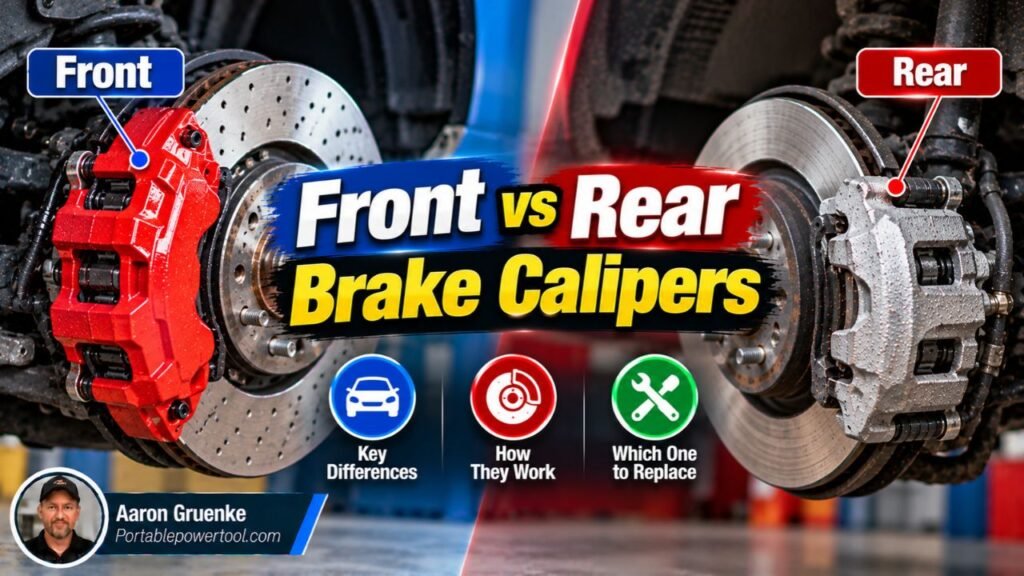
The difference between front and rear brake calipers mainly comes down to braking load and system design.
Front calipers generally:
- Handle more braking force
- Use larger brake pads
- Work with larger rotors
- May use larger or multiple pistons
- Experience more heat
- Usually wear pads faster
Rear calipers generally:
- Handle less braking load
- Are often smaller
- May use smaller pistons
- Frequently incorporate the parking brake
- May require special piston retraction procedures
- Often have smaller pads and rotors
Here is a quick comparison:
| Feature | Front Brake Calipers | Rear Brake Calipers |
| Braking workload | Usually higher | Usually lower |
| Typical size | Larger | Smaller |
| Heat generation | Higher | Usually lower |
| Rotor size | Usually larger | Often smaller |
| Pad size | Usually larger | Often smaller |
| Parking brake function | Usually no | Often yes |
| Piston design | Often larger or multi-piston | Often smaller |
| Pad wear | Often faster | Often slower |
| Replacement complexity | Usually straightforward | Can be more complex |
| Interchangeable front-to-rear | No | No |
These are general patterns. Performance vehicles, trucks, electric vehicles, and specialized brake systems can use different arrangements.
Why Are Front Brake Calipers Usually Larger?
Front brake calipers are usually larger because the front brakes do more work during stopping.
When a vehicle slows down, its weight shifts forward. This is called weight transfer.
As more load moves onto the front tires, those tires can generate more braking force without losing traction. The braking system is designed around this behavior.
That is why the front of many vehicles has:
- Larger brake rotors
- Larger brake pads
- Larger calipers
- Larger pistons
- Greater heat capacity
The extra size helps the front brakes generate and manage the greater braking force.
How Much Braking Do the Front Brakes Handle?
There is no single percentage that applies to every vehicle.
However, the front brakes generally perform a greater share of the total braking effort during normal and hard stops.
The exact front-to-rear brake balance depends on:
- Vehicle weight distribution
- Suspension geometry
- Tire grip
- Brake system design
- Vehicle speed
- Electronic brake controls
- Driving conditions
Modern vehicles also use ABS, electronic brake-force distribution, stability control, and other systems to adjust braking force dynamically.
Because of this, fixed statements such as “front brakes always do exactly 70% of the braking” should be treated only as rough generalizations rather than universal specifications.
What Do Rear Brake Calipers Do?
Rear brake calipers provide braking force at the rear wheels.
Although the rear brakes usually perform less work than the front brakes, they remain essential.
Rear braking helps:
- Shorten stopping distance
- Maintain vehicle stability
- Balance braking force
- Control vehicle attitude
- Support ABS and stability-control functions
Rear brakes also prevent the front brakes from having to handle the entire braking load.
On many vehicles, the rear calipers have another responsibility: operating the parking brake.
Rear Calipers and the Parking Brake
One of the biggest practical differences between front and rear brake calipers is the parking brake mechanism.
Many rear disc-brake systems integrate the parking brake into the rear caliper.
There are two common designs.
Mechanical Parking Brake Calipers
Older and many conventional vehicles use a cable-operated parking brake.
Pulling the handbrake lever or pressing the parking-brake pedal pulls a cable.
That cable operates a lever on the rear caliper, mechanically applying the brake.
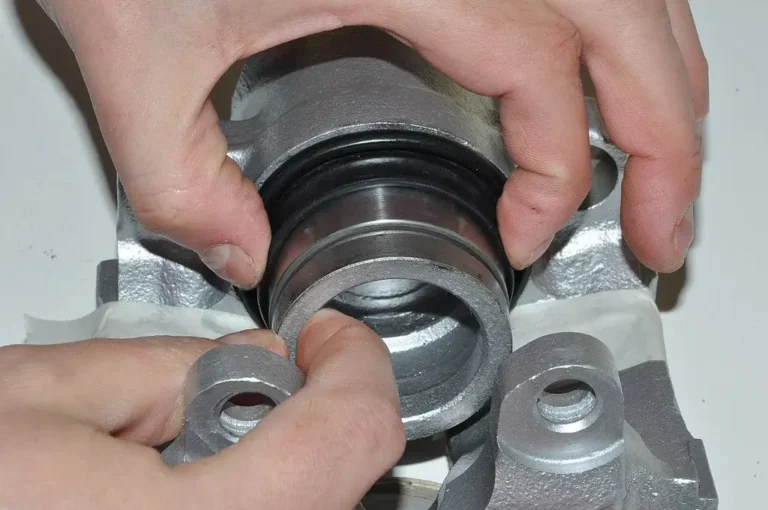
Because of this internal mechanism, the rear caliper piston may need to be rotated while being pushed inward during brake pad replacement.
Simply forcing the piston straight in can damage some caliper designs.
Electronic Parking Brake Calipers
Many newer vehicles use an electronic parking brake, often called EPB.
An electric motor attached to the rear caliper applies and releases the parking brake.
Before replacing rear brake pads, the system may need to be placed into a special:
- Service mode
- Maintenance mode
- Brake pad replacement mode
Depending on the vehicle, this may require:
- A dashboard procedure
- A scan tool
- Diagnostic software
Forcing an electronic parking brake piston backward without following the correct procedure can damage the actuator or caliper.
Front Calipers Usually Do Not Operate the Parking Brake
The front calipers normally focus only on service braking.
They receive hydraulic pressure when you press the brake pedal and release when that pressure is removed.
Because there is usually no parking brake mechanism built into the front caliper, front brake service can sometimes be simpler.
However, front calipers may be physically larger and heavier.
Front vs Rear Caliper Piston Size
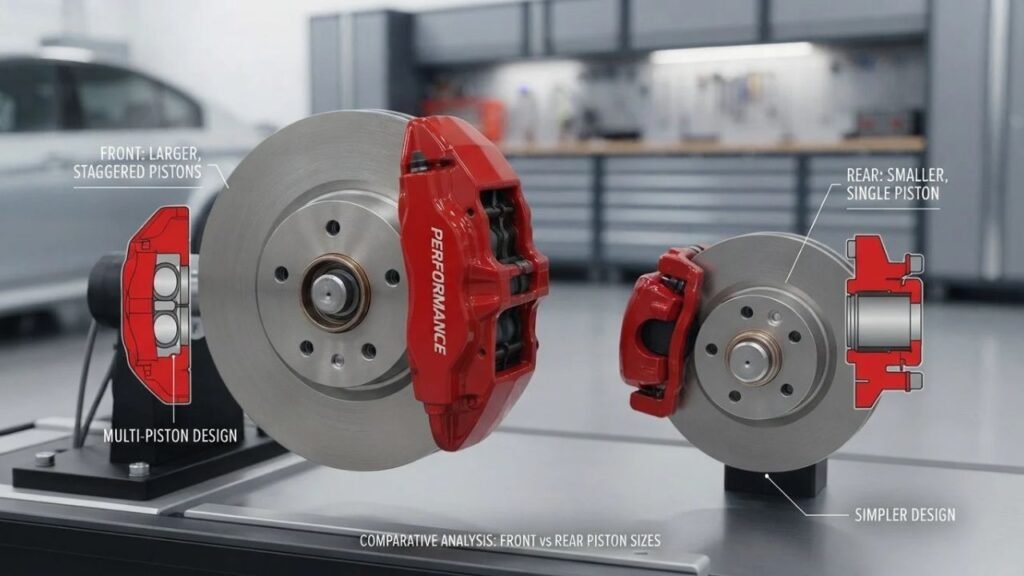
Front calipers often have larger pistons because they need to generate greater clamping force.
A larger piston has more surface area.
When hydraulic pressure acts on that larger area, the caliper can generate more force against the brake pads.
Rear caliper pistons are often smaller because the rear axle requires less braking force.
However, piston size is carefully matched to:
- Master cylinder
- Rotor diameter
- Pad area
- Vehicle weight
- ABS programming
- Brake balance
Installing a caliper with the wrong piston size can seriously affect brake balance.
Number of Pistons
The number of caliper pistons also varies.
Front Calipers
Front brakes may use:
- Single-piston floating calipers
- Dual-piston floating calipers
- Four-piston fixed calipers
- Six-piston fixed calipers
- Larger multi-piston performance designs
Performance cars and heavy vehicles commonly use multiple front pistons.
Rear Calipers
Rear calipers commonly use:
- Single-piston floating calipers
- Smaller multi-piston designs
- Electronic parking-brake calipers
Performance vehicles may also use multi-piston rear calipers, but the rear units are often still smaller than the front ones.
Front vs Rear Brake Rotor Size
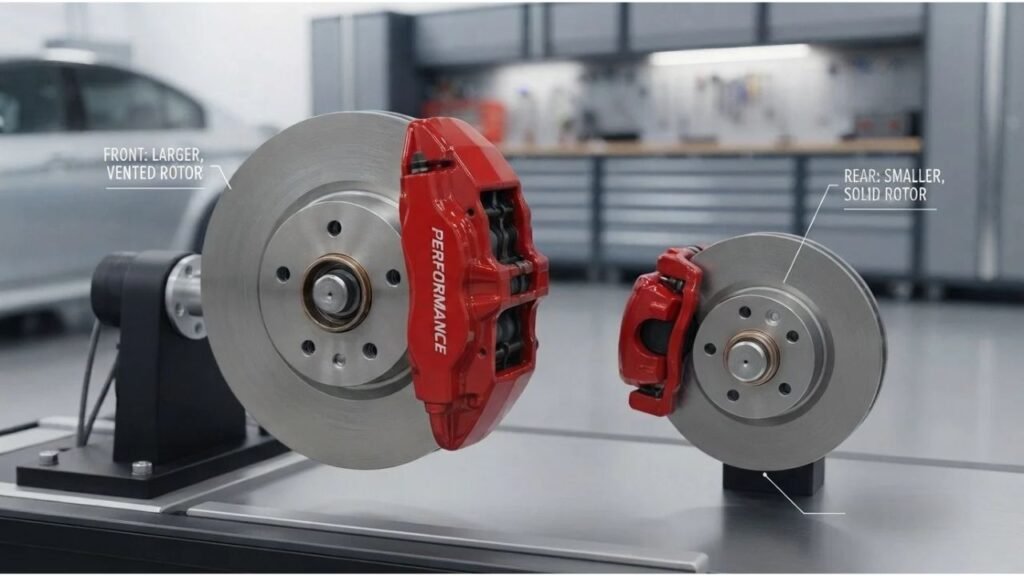
Caliper size is closely related to rotor size.
Front brake rotors are usually larger in both:
- Diameter
- Thickness
Larger rotors provide greater leverage and more material to absorb heat.
Rear rotors are often smaller because the rear brakes generate less heat during most stops.
Some rear rotors also have a drum-shaped center section containing separate parking brake shoes. This design is sometimes called a drum-in-hat parking brake system.
In those vehicles, the rear caliper may not operate the parking brake at all.
Front and Rear Brake Pads Are Usually Different
Front and rear calipers typically use different brake pads.
Front pads are commonly:
- Larger
- Thicker
- Designed for higher temperatures
- Built for greater braking loads
Rear pads may be smaller because the rear brakes handle less energy.
Do not assume that brake pads fit both axles just because they look similar.
Always use pads specified for the exact axle and vehicle.
Do Front Brake Pads Wear Faster Than Rear Pads?
Often, yes.
Because the front brakes usually do more work, front pads commonly wear faster.
However, this is not guaranteed.
Rear pads can sometimes wear surprisingly quickly because of:
- Electronic stability control activity
- Traction control
- Electronic parking brake operation
- Sticking rear calipers
- Seized slide pins
- Vehicle-specific brake bias
Some modern vehicles intentionally use the rear brakes more actively than older vehicles did.
For that reason, brake pad life should be evaluated by inspection rather than assumptions.
Are Front and Rear Calipers Interchangeable?
No.
Front and rear brake calipers should not be swapped.
They differ in:
- Mounting location
- Piston diameter
- Caliper size
- Rotor dimensions
- Pad shape
- Hydraulic design
- Parking brake mechanisms
- Bleeder screw location
Using the wrong caliper can interfere with brake function and brake balance.
Replacement calipers should always be matched to the specific:
- Year
- Make
- Model
- Engine or trim when applicable
- Axle
- Wheel position
Can Left and Right Calipers Be Swapped?
Usually, no.
Even front-left and front-right calipers may be different.
One of the most important reasons is the bleeder screw location.
The bleeder screw normally needs to be near the highest point of the caliper so trapped air can escape during brake bleeding.
If calipers are installed on the wrong sides, the bleeder screw may sit too low.
That can leave air trapped inside the caliper even if brake fluid comes out during bleeding.
The result may be a soft or spongy brake pedal.
Front vs Rear Caliper Heat
Front brakes usually generate more heat because they absorb more of the vehicle’s kinetic energy during stopping.
Excessive heat can affect:
- Brake pads
- Rotors
- Caliper seals
- Brake fluid
- Wheel bearings
Front braking components therefore tend to be designed with greater thermal capacity.
However, an abnormally hot rear wheel may indicate a problem such as:
- Stuck caliper piston
- Seized slide pins
- Parking brake not releasing
- Collapsed brake hose
- Electronic parking brake fault
A rear brake should not become extremely hot simply because it is located at the rear.
Floating Front and Rear Calipers
Many everyday vehicles use floating calipers on both front and rear axles.
A floating caliper usually has pistons on one side.
When hydraulic pressure moves the piston outward, the caliper body slides on guide pins so both brake pads clamp the rotor.
Proper slide-pin movement is essential.
If the slide pins seize, you may see:
- Uneven pad wear
- Brake dragging
- Reduced braking
- Excessive heat
- One pad wearing much faster than the other
Both front and rear floating calipers can develop this problem.
Fixed Front and Rear Calipers
Performance vehicles commonly use fixed calipers.
A fixed caliper does not slide on pins.
Instead, pistons are positioned on both sides of the rotor.
Fixed calipers can provide:
- Even pad pressure
- Greater rigidity
- Large pad capacity
- Improved heat handling
Front fixed calipers are commonly larger and may use more pistons than their rear counterparts.
For example, a performance vehicle might use six-piston front calipers and four-piston rear calipers.
Why Rear Caliper Replacement Can Be More Complicated
Rear caliper replacement may require additional steps because of the parking brake.
Depending on the vehicle, the technician may need to:
- Disconnect a parking brake cable
- Transfer mounting brackets
- Retract a screw-type piston
- Put an electronic parking brake into service mode
- Reset or calibrate an electronic actuator
Front calipers normally do not require these parking-brake procedures.
This does not mean rear calipers are always more expensive, but the repair can involve extra complexity.
Front vs Rear Caliper Replacement Cost
Caliper prices vary widely depending on vehicle and design.
A basic floating caliper for a common vehicle may be relatively inexpensive, while a large performance caliper or electronic parking-brake unit can cost much more.
Front calipers may cost more because they are:
- Larger
- Heavier
- Multi-piston
- Designed for larger rotors
Rear calipers may become expensive when they contain:
- Electronic parking brake motors
- Complex mechanical adjusters
- Integrated parking brake mechanisms
The vehicle-specific part price matters more than simply whether the caliper is front or rear.
Symptoms of a Bad Front Brake Caliper
A failing front caliper may cause:
- Vehicle pulling while braking
- Steering wheel pulling to one side
- One front wheel becoming unusually hot
- Uneven front brake pad wear
- Burning smell
- Grinding
- Brake fluid leak
- Reduced acceleration due to brake drag
Because front brakes provide substantial braking force, a front caliper problem may be especially noticeable while driving.
Symptoms of a Bad Rear Brake Caliper
A bad rear caliper may cause:
- One rear wheel overheating
- Rear brake dragging
- Uneven rear pad wear
- Parking brake problems
- Brake fluid leaks
- Burning smell
- Reduced fuel economy
- Vehicle instability during braking
A faulty rear electronic parking brake can also trigger:
- Dashboard warning lights
- Parking brake warnings
- Failure to release the brake
Can a Bad Front Caliper Affect Steering?
Yes.
A front caliper that applies unevenly can make the vehicle pull left or right during braking.
A seized front caliper may also cause the vehicle to pull while driving because one wheel is being slowed continuously.
However, pulling can also result from:
- Tire pressure problems
- Alignment
- Suspension faults
- Brake hoses
- Tires
A complete inspection is needed before blaming the caliper.
Can a Bad Rear Caliper Cause Pulling?
Yes, although it may feel different from a front caliper problem.
Uneven rear braking can affect vehicle stability and may cause the rear of the vehicle to feel unsettled under braking.
A severely dragging rear brake may also make the vehicle feel sluggish.
Do Front and Rear Calipers Use the Same Brake Fluid?
Yes.
Front and rear calipers normally share the vehicle’s hydraulic brake system and use the same specified brake fluid.
Common brake fluid specifications include:
- DOT 3
- DOT 4
- DOT 5.1
The correct type depends on the vehicle manufacturer.
Do not confuse silicone-based DOT 5 fluid with DOT 5.1. They are not the same.
Always use the brake fluid specification listed for the vehicle.
Do Front and Rear Calipers Need to Be Replaced Together?
No.
A front caliper does not need replacement simply because a rear caliper fails, and vice versa.
Even two calipers on the same axle do not automatically have to be replaced together.
However, both sides should be inspected.
Replacing both calipers on an axle may make sense if:
- Both are heavily corroded
- Both show signs of sticking
- Both are very old
- Matching performance is desirable
The decision should be based on condition rather than a universal replacement rule.
Can Front and Rear Brake Calipers Fail at the Same Time?
It is possible but not especially common.
Multiple caliper problems can occur because of:
- Severe corrosion
- Contaminated brake fluid
- Long-term vehicle storage
- Brake hose problems
- Poor maintenance
- Extremely high mileage
If several calipers are failing, the rest of the hydraulic brake system should also be inspected.
Why Front and Rear Brakes Need Different Braking Force
If the rear brakes applied as much braking force as the front brakes under heavy deceleration, the rear wheels could lock more easily because less vehicle weight remains over them.
Rear wheel lockup can reduce stability.
Modern brake systems manage this through:
- Hydraulic system design
- ABS
- Electronic brake-force distribution
- Stability control
The front and rear calipers are therefore part of a carefully balanced braking system.
Changing caliper sizes or installing mismatched components can upset that balance.
Should You Upgrade Only the Front Calipers?
Performance brake modifications should be approached as a complete system.
Installing larger front calipers without considering:
- Master cylinder
- Rear brakes
- Rotor size
- Brake bias
- Wheel clearance
- ABS operation
can change braking balance.
For street vehicles, use brake kits specifically engineered for the vehicle rather than mixing unrelated components.
How to Identify a Front or Rear Caliper
If you are buying replacement parts, do not identify them only by size.
Look at:
- Part number
- Manufacturer catalog
- Vehicle fitment
- Mounting bracket
- Piston size
- Parking brake connection
- Bleeder screw orientation
Rear calipers may have an obvious parking brake lever or electronic motor.
Front calipers usually lack these features.
Common Mistakes When Replacing Rear Calipers
Forcing the Piston Straight Back
Some rear caliper pistons must be rotated while being retracted.
Forcing them can damage the internal parking brake mechanism.
Ignoring Electronic Parking Brake Service Mode
EPB systems may require a specific procedure before piston retraction.
Installing the Caliper on the Wrong Side
Make sure the bleeder screw is positioned correctly near the top.
Forgetting to Adjust or Test the Parking Brake
After repairs, the parking brake should operate and release correctly.
Common Mistakes When Replacing Front Calipers
Allowing the Caliper to Hang by the Hose
The brake hose should not support the caliper’s weight.
Support the caliper with a hook or suitable support.
Installing Twisted Brake Hoses
A twisted hose can restrict movement and may cause premature failure.
Failing to Bleed the System
If a hydraulic line is disconnected, air must be properly removed from the brake system.
Ignoring Rotor and Pad Damage
A seized caliper can damage pads and rotors.
Inspect the entire brake assembly before installing the replacement caliper.
FAQs About Difference Between Front and Rear Brake Calipers
Are Front Brake Calipers Bigger Than Rear Calipers?
Usually, yes.
Front calipers are often larger because the front brakes handle more braking force and heat during deceleration.
Why Are Rear Brake Calipers Smaller?
Rear brakes usually experience less load because vehicle weight shifts toward the front during braking.
Smaller rear calipers help maintain appropriate front-to-rear brake balance.
Do Rear Brake Calipers Have a Parking Brake?
Many do, but not all.
Some rear calipers contain a mechanical or electronic parking brake mechanism. Other vehicles use separate parking brake shoes inside the rear rotor.
Can I Use a Front Caliper on the Rear?
No.
Front and rear calipers differ in mounting, piston size, brake balance, pad shape, and often parking-brake design.
Always use the correct vehicle-specific caliper.
Why Do Front Brake Pads Wear Faster?
Front brakes generally do more stopping work, so front pads often wear faster.
However, modern stability-control systems and rear brake design can cause rear pads to wear quickly on some vehicles.
Are Rear Calipers Harder to Replace?
They can be.
Rear calipers may contain mechanical or electronic parking brake components that require additional tools or procedures.
Does the Front or Rear Caliper Cost More?
There is no universal answer.
Front calipers may cost more because they are larger or multi-piston, while rear electronic parking brake calipers can also be expensive.
Do I Need to Replace All Four Calipers at Once?
No.
Calipers should normally be replaced based on their condition. A failure at one wheel does not automatically mean all four calipers are bad.
Conclusion
The difference between front and rear brake calipers mainly reflects the different braking demands at each axle. Front calipers are usually larger, generate more clamping force, work with larger rotors, and handle more heat because vehicle weight shifts forward during braking.
Rear calipers are generally smaller because they handle less braking load, but they can be mechanically more complicated because many rear calipers also operate the parking brake.
Front and rear calipers are not interchangeable. Their piston size, mounting design, pad shape, braking force, and parking brake features are selected specifically for each position on the vehicle. When replacing a caliper, always use the correct part for the exact axle and wheel position and make sure the rest of the braking system is inspected for related wear or damage.