Can You Use Engine Enamel on Brake Calipers? What to Know
Painting brake calipers is a popular way to improve the appearance of a vehicle without replacing expensive brake components. Because engine enamel is designed to tolerate heat and automotive conditions, it may seem like an obvious alternative to dedicated caliper paint.
Yes, you can use engine enamel on brake calipers if the specific enamel is rated for sufficient heat and suitable for exterior metal parts, but dedicated brake-caliper paint is usually the better choice.
If you are asking can you use engine enamel on brake calipers, the key issue is not simply whether the paint can withstand heat. Brake calipers are also exposed to brake dust, road salt, moisture, wheel cleaners, brake-cleaning chemicals, and repeated heating and cooling cycles. Some engine enamels tolerate these conditions well, while others may discolor, soften, chip, or lose adhesion sooner than a coating specifically formulated for calipers.
Proper surface preparation matters just as much as paint selection. Even high-quality enamel can peel quickly if it is applied over grease, loose rust, brake dust, or poorly prepared old paint.
This guide explains when engine enamel can work on brake calipers, how it compares with dedicated caliper paint, what temperature rating to look for, and how to apply it without interfering with brake operation.
Can You Use Engine Enamel on Brake Calipers Safely?
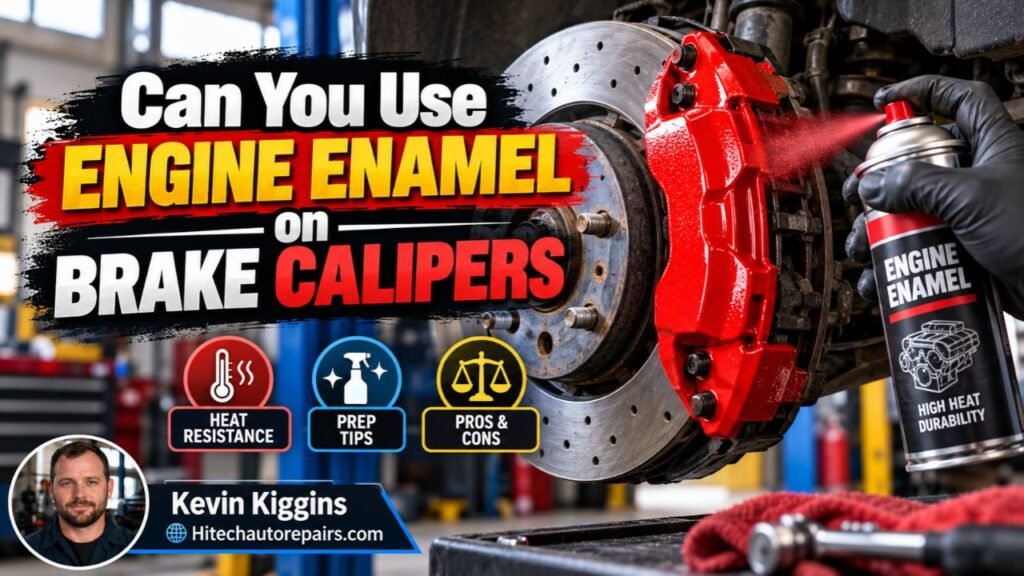
Yes, you can use engine enamel on brake calipers when the paint manufacturer indicates that the product is suitable for the temperatures and conditions the caliper will experience.
Engine enamel is generally formulated for automotive metal surfaces that become hotter than ordinary painted body panels. Depending on the product, it may offer resistance to:
- Heat
- Oil
- Grease
- Automotive fluids
- Moisture
- Corrosion
- Chipping
Those properties can make it suitable for the exterior of a brake caliper.
However, engine enamel is not automatically identical to brake-caliper paint. Caliper-specific coatings are designed around the particular combination of brake heat, brake dust, road contaminants, and cleaning products found around a wheel.
Before using engine enamel, check the product label for:
- Maximum temperature rating
- Compatible surfaces
- Required primer
- Curing instructions
- Chemical resistance
- Recommended automotive applications
Do not assume every can labeled “engine enamel” is suitable for brake components.
Engine Enamel vs. Brake Caliper Paint
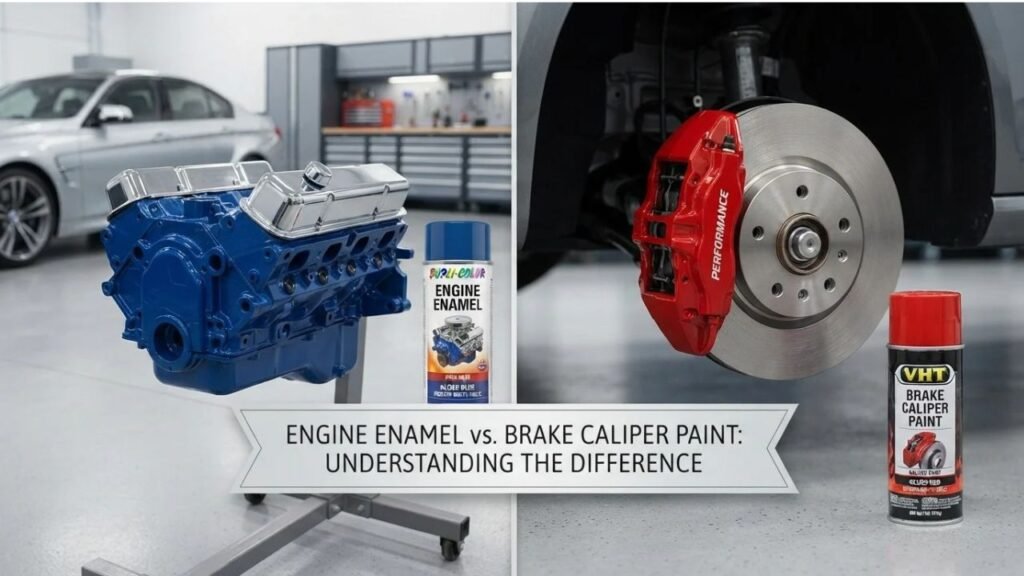
Both coatings can withstand more heat than ordinary household paint, but they are designed for somewhat different environments.
| Feature | Engine Enamel | Brake Caliper Paint |
| Designed for high heat | Yes | Yes |
| Intended specifically for calipers | Usually no | Yes |
| Brake-dust resistance | Varies | Usually designed for it |
| Chemical resistance | Usually good | Typically optimized for brake-area exposure |
| Color choices | Often wide | Usually automotive-focused |
| Application | Spray or brush, depending on product | Spray, brush, or two-part kits |
| Best choice for calipers | Acceptable in some cases | Generally preferred |
Engine enamel can be a reasonable option when you already have a suitable product and its specifications match the application.
If you are buying paint specifically for this job, a dedicated caliper coating is generally easier to recommend.
Why Engine Enamel Can Work on Brake Calipers
Brake calipers become hot, but they normally do not reach the extreme temperatures experienced by certain exhaust components.
Engine enamel is designed to handle repeated heating and cooling on components around an engine.
A suitable engine enamel can therefore provide:
- Heat resistance
- A hard finish
- Corrosion protection
- Good color retention
- Resistance to normal automotive grime
This makes it much more appropriate than ordinary general-purpose spray paint.
The challenge is that calipers operate in a harsh location close to the road.
They are constantly exposed to:
- Water
- Road salt
- Dirt
- Brake dust
- Small stones
- Cleaning chemicals
- Temperature cycles
A coating that survives engine-bay heat may not necessarily be optimized for all of these conditions.
What Temperature Rating Should Engine Enamel Have?
There is no single temperature rating that applies to every vehicle or driving condition.
Brake temperature depends on:
- Vehicle weight
- Rotor size
- Driving speed
- Braking frequency
- Towing
- Mountain driving
- Track use
- Brake-pad compound
- Cooling airflow
For normal street vehicles, many automotive high-temperature enamels can tolerate the temperatures seen at the exterior of a caliper.
However, instead of choosing paint solely by the highest temperature number printed on the can, look for a coating that is specifically approved by its manufacturer for comparable automotive metal applications.
For vehicles used in racing, repeated high-speed braking, heavy towing, or other severe service, dedicated performance brake coatings are a safer choice.
Is High-Temperature Engine Paint the Same as Caliper Paint?
No.
Both may be high-temperature coatings, but the formulas can differ.
Engine enamel may be designed primarily to tolerate:
- Engine heat
- Oil
- Fuel residue
- Grease
- Underhood chemicals
Brake-caliper paint may be formulated specifically to handle:
- Brake dust
- Road salt
- Water
- Repeated brake heat cycles
- Wheel-cleaning products
- Brake-area contamination
That does not mean engine enamel will fail. It simply means a caliper-specific product is designed with the intended application in mind.
Can You Use Regular Engine Enamel Spray Paint?
Possibly, provided the particular product is suitable for the application.
Check the instructions rather than relying only on the product category.
The enamel should be suitable for metal and capable of handling the temperature and exposure expected around the brake system.
Avoid using paint when the manufacturer specifically states that it is unsuitable for braking components or similar high-temperature areas.
Can You Use Engine Enamel on Rusty Calipers?
Yes, but you should remove loose rust first.
Painting directly over flaking corrosion usually produces a poor result because the paint is attached to unstable rust rather than solid metal.
For lightly rusted calipers:
- Let the brakes cool completely.
- Remove the wheel.
- Clean away brake dust and grime.
- Scrub loose rust with a wire brush or abrasive pad.
- Remove remaining dust and grease.
- Let the surface dry.
- Apply the required primer if the enamel calls for one.
- Apply the engine enamel in thin coats.
If the caliper has severe structural corrosion, leaks, damaged boots, or a seized piston, painting should not be the priority.
The brake problem needs to be repaired first.
Do You Need Primer Under Engine Enamel?
That depends on the paint.
Some engine enamels are designed for direct application to properly prepared metal.
Others work best with a compatible high-temperature primer.
Using the wrong primer can actually make the finish less durable.
An ordinary primer that cannot tolerate repeated heat cycles may soften or lose adhesion beneath the enamel.
Use only a primer that the engine-enamel manufacturer recommends for that coating system.
How to Prepare Brake Calipers for Engine Enamel
Preparation is often more important than the brand of paint.
Let the Brakes Cool
Never paint recently driven brake components.
Wait until the rotors and calipers are completely cool.
Remove the Wheel
Raise the vehicle using the correct lifting points and support it securely with appropriate jack stands.
Never rely solely on a hydraulic jack while working around a wheel.
Remove Brake Dust and Dirt
Thoroughly clean the exterior of the caliper.
Brake dust, grease, and road grime can prevent the enamel from bonding.
Remove Loose Rust and Paint
Use a wire brush or suitable abrasive pad to remove:
- Flaking rust
- Peeling coating
- Loose scale
- Dirt stuck to the surface
You generally do not need to grind a sound factory finish down to bare metal unless the coating manufacturer specifies otherwise.
Degrease the Surface
Any remaining grease or oil can cause paint defects and poor adhesion.
The caliper should be completely clean and dry before painting.
What Parts Should You Mask Before Painting?
Engine enamel should be applied only to appropriate exterior metal surfaces.
Do not paint:
- Brake-pad friction material
- Brake rotor friction surfaces
- Caliper piston surfaces
- Piston dust boots
- Slide pins
- Guide-pin boots
- Bleeder openings
- Brake hose connections
- Fastener threads
- Pad sliding surfaces
- Machined mounting surfaces
Good masking is critical if you spray the enamel while the caliper remains installed.
Cover the rotor and pads completely.
Overspray on friction surfaces can interfere with normal braking.
How to Apply Engine Enamel to Brake Calipers
Always follow the instructions on the exact product, but the general process is straightforward.
- Park the vehicle on a flat surface and let the brakes cool.
- Safely raise and support the vehicle.
- Remove the wheel.
- Clean the caliper thoroughly.
- Remove loose rust and old peeling paint.
- Degrease the metal.
- Mask the rotor, pads, boots, hoses, and other areas that should not be painted.
- Apply compatible primer if required.
- Apply a light first coat of engine enamel.
- Allow the recommended flash time.
- Add additional thin coats as instructed.
- Let the coating dry and cure for the specified period.
- Remove masking carefully.
- Reinstall the wheel.
- Tighten the wheel fasteners to the vehicle manufacturer’s specification.
Thin coats generally produce a better result than one heavy coat.
Can You Paint Calipers Without Removing Them?
Yes.
For a cosmetic job, completely removing the brake caliper is often unnecessary.
You can remove the wheel, clean the visible caliper surfaces, mask surrounding components, and apply the coating while the caliper remains mounted.
This also avoids opening the hydraulic brake system.
If you unbolt the caliper to improve access, support it properly.
Never allow the caliper to hang from the brake hose because that can damage the hose.
Is Brush-On Paint Better Than Spray Engine Enamel?
Neither method is automatically better.
Spray enamel can produce a smooth finish, but it requires more masking because overspray can travel onto nearby components.
Brush-on caliper paint offers greater control around:
- Brake hoses
- Rotors
- Pads
- Suspension parts
If your engine enamel is available only as a spray, careful masking is essential.
For an installed caliper, many DIY users find a brush-on dedicated caliper coating easier to control.
How Many Coats of Engine Enamel Should You Use?
Follow the manufacturer’s instructions.
In general, several thin coats are preferable to one thick layer.
Heavy application can cause:
- Runs
- Sags
- Uneven drying
- Soft paint underneath
- Longer curing time
- Reduced durability
Allow the recommended time between coats.
Some enamels have specific recoat windows. Applying another coat too early or too late can cause wrinkling or poor adhesion.
Does Engine Enamel Need to Be Heat-Cured?
Some high-temperature coatings require or benefit from a particular curing process.
Others cure at room temperature before being exposed to heat.
This varies significantly among products.
Do not invent your own heat-curing procedure.
Follow the manufacturer’s instructions regarding:
- Air-drying time
- Recoat intervals
- Full curing
- Heat cycles
- When the vehicle can be driven
The coating may feel dry long before it has fully hardened.
How Long Should You Wait Before Driving?
The correct waiting time depends on the enamel.
A coating may become touch-dry within a short period yet need much longer to reach sufficient hardness.
Driving too soon exposes uncured paint to:
- Brake heat
- Dust
- Moisture
- Stones
- Road debris
That can damage the finish before it has fully cured.
Use the product’s stated cure time rather than relying on a universal number.
Will Engine Enamel Peel Off Brake Calipers?
It can, especially if preparation is poor.
Common reasons for peeling include:
- Painting over brake dust
- Greasy surfaces
- Loose rust
- Incompatible primer
- Excessively thick coats
- Insufficient curing
- Applying paint outside its recommended temperature range
- Chemical exposure the enamel cannot tolerate
A properly prepared surface and compatible coating system can last much longer.
Will Brake Cleaner Damage Engine Enamel?
Possibly.
Brake cleaners can contain strong solvents, and not every engine enamel has the same solvent resistance.
Even fully cured paint may be damaged by certain aggressive cleaners.
If you plan to use brake cleaner around a painted caliper, check the enamel manufacturer’s chemical-resistance information.
Avoid deliberately saturating painted surfaces unless the coating is known to tolerate the cleaner.
Will Engine Enamel Change Brake Performance?
Properly applied exterior paint should not meaningfully change braking performance.
The coating is cosmetic and protective.
However, paint applied to the wrong surfaces can cause problems.
Never coat:
- Brake pads
- Rotors
- Pad guides
- Slide pins
- Sealing surfaces
Paint on these areas could interfere with friction, movement, or proper assembly.
What Colors of Engine Enamel Work on Calipers?
The color does not significantly affect the caliper’s function.
Common choices include:
- Red
- Black
- Silver
- Blue
- Yellow
- Orange
- Gray
Red is particularly popular because of its association with performance brake systems.
Choose a color you like, but prioritize paint compatibility and durability over appearance.
When Should You Use Dedicated Caliper Paint Instead?
Dedicated caliper paint is the better choice when:
- You are buying paint specifically for the project.
- You want a coating formulated for brake dust.
- The car sees aggressive driving.
- The vehicle is exposed to road salt frequently.
- You regularly clean the wheels with strong automotive chemicals.
- You want a product with clear brake-caliper application instructions.
For an ordinary street car, a suitable engine enamel can work, but a caliper-specific coating eliminates much of the uncertainty.
Engine Enamel vs. High-Heat Exhaust Paint
These products should not automatically be treated as interchangeable.
Exhaust paint is designed for much higher temperatures found on exhaust manifolds, headers, and pipes.
Some ultra-high-temperature coatings require heat curing and may have surface-finish characteristics that are not ideal for calipers.
Higher temperature resistance does not automatically mean better caliper paint.
Choose a coating designed for the actual environment rather than simply buying the product with the highest temperature rating.
Common Mistakes When Using Engine Enamel on Brake Calipers
Using Any Engine Paint Without Checking Its Specifications
Engine enamels vary.
Make sure the specific product is suitable for the temperatures and conditions expected.
Painting Over Brake Dust
Brake dust creates a poor surface for paint adhesion.
Clean the caliper thoroughly first.
Painting Rubber Components
Avoid piston boots and slide-pin boots.
Paint and solvents can damage rubber or interfere with movement.
Getting Overspray on the Rotor
The rotor friction surface must remain clean.
Mask it completely when spraying.
Painting Slide Pins
Slide pins must move freely and use the correct lubricant.
Do not coat them with enamel.
Applying Heavy Coats
Thick paint can run and take much longer to cure.
Apply controlled thin coats.
Driving Before the Paint Cures
Fresh paint may look dry but remain soft underneath.
Follow the full curing instructions.
Is Engine Enamel Worth Using on Brake Calipers?
It can be.
If you already have quality engine enamel that is rated for suitable temperatures and automotive exposure, using it on the exterior of brake calipers may provide a durable cosmetic finish.
However, the price difference between engine enamel and dedicated caliper paint is often relatively small compared with the labor involved in preparing and painting four calipers.
If you are starting from scratch, choosing a purpose-made caliper coating may give you greater confidence that the paint is suited to the environment.
FAQs About Can You Use Engine Enamel on Brake Calipers
Is engine enamel heat resistant enough for brake calipers?
Many engine enamels can tolerate the exterior temperatures of brake calipers during normal street driving, but specifications vary.
Check the manufacturer’s temperature rating and intended applications before use.
Is engine enamel better than regular spray paint for calipers?
Generally, yes.
Engine enamel is designed for higher temperatures and automotive environments, making it more appropriate than ordinary decorative spray paint.
Dedicated brake-caliper paint is still usually the preferred option.
Can you use engine enamel on rusty brake calipers?
Yes, after removing loose rust and properly preparing the metal.
Do not paint over severe corrosion or use paint to hide a mechanically failing caliper.
Do I need high-temperature primer with engine enamel?
Only if the enamel manufacturer recommends it.
Use a primer that is compatible with both the paint and expected operating temperature.
Can engine enamel withstand brake cleaner?
Some products may resist it, while others can soften or discolor when exposed to strong solvents.
Check the specific paint’s chemical-resistance information before applying brake cleaner to painted surfaces.
Can I spray engine enamel on calipers without removing them?
Yes.
Remove the wheel and thoroughly mask the brake rotor, pads, rubber components, brake hose, and nearby parts before spraying.
Does engine enamel prevent brake-caliper rust?
It can help protect properly prepared exterior metal from moisture and surface corrosion.
It cannot repair existing severe rust or protect internal brake components.
Should I use engine enamel or caliper paint?
If both are available, dedicated caliper paint is generally the safer choice because it is specifically formulated and tested for the brake-caliper environment.
Suitable engine enamel can still work for many normal street applications.
Conclusion
If you are wondering can you use engine enamel on brake calipers, the answer is yes, provided the specific engine enamel is suitable for the heat, metal surface, and automotive environment involved. It is considerably more appropriate than ordinary paint and can provide an attractive, durable finish when the calipers are cleaned and prepared correctly.
Still, dedicated brake-caliper paint is generally the better option when you are purchasing paint specifically for the job because it is designed to handle brake dust, road contamination, repeated heat cycles, and the conditions around a vehicle’s braking system.
Whichever coating you choose, keep paint away from rotors, pads, slide pins, rubber boots, threads, and sealing surfaces. Careful preparation, thin coats, proper curing, and correct masking matter more than simply choosing the paint with the highest temperature rating.