Can You Put Brake Calipers on the Wrong Side? What Happens
Installing brake calipers looks straightforward, especially when the left and right calipers appear nearly identical. However, many brake calipers are side-specific, and putting them on the wrong side can create a serious problem even if they physically bolt into place.
Yes, you can sometimes physically put brake calipers on the wrong side, but you generally should not. If the left and right calipers are swapped, the bleeder screws may end up below the brake hose connection or piston chamber, making it difficult or impossible to bleed trapped air from the system correctly.
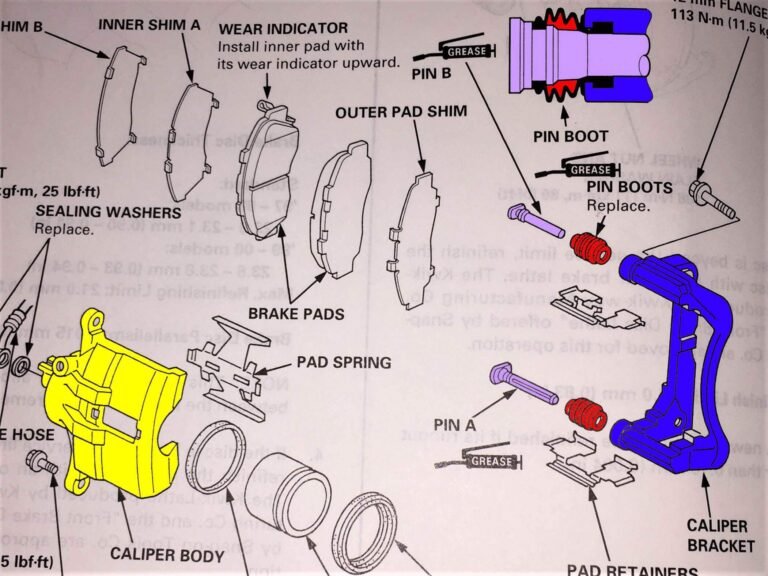
That trapped air can leave the brake pedal soft or spongy and reduce braking performance. Some calipers also have side-specific brake hose routing, brackets, parking-brake mechanisms, pad hardware, or piston designs, so swapping them can create additional installation problems.
The easiest way to identify whether the calipers are installed correctly is usually to check the bleeder screw position. On most hydraulic disc brake calipers, the bleeder screw should be at or near the highest point of the fluid chamber when the caliper is installed.
This guide explains what happens when calipers are installed on the wrong sides, how to tell left from right, why the bleeder screw matters, and what to do if you discover that the calipers have been swapped.
Can You Put Brake Calipers on the Wrong Side?
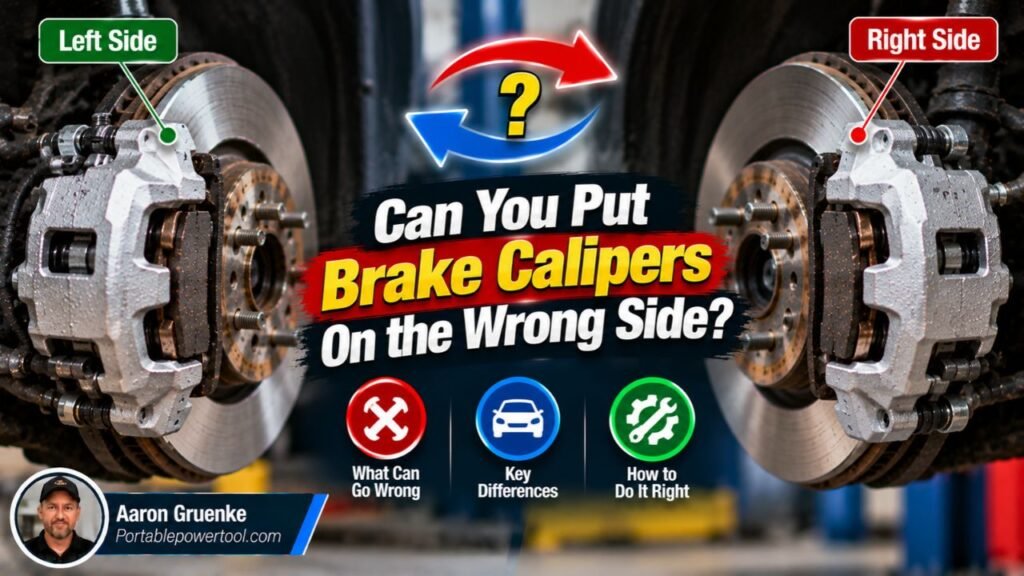
In many vehicles, you can put brake calipers on the wrong side mechanically, but they may not function correctly or safely.
Some left and right calipers use the same mounting dimensions. This means a right-side caliper may bolt onto the left side of the vehicle and vice versa.
The problem is that several important features may end up in the wrong position, including:
- Bleeder screw
- Brake hose fitting
- Parking brake mechanism
- Pad retaining hardware
- Electrical connections
- Caliper brackets
The most common and important issue is the bleeder screw ending up too low.
Air naturally rises in brake fluid. If the bleeder screw is below the highest point inside the caliper, trapped air can remain above it even while you bleed the brakes.
Why the Bleeder Screw Must Be at the Top
The bleeder screw, sometimes called the bleed valve, allows trapped air to escape from the hydraulic brake system.
Brake fluid itself is essentially incompressible under normal braking conditions, while air compresses easily.
If air remains inside a caliper:
- You press the brake pedal.
- Hydraulic pressure begins building.
- Some pedal movement compresses the trapped air.
- Less pressure immediately reaches the brake piston.
- The pedal may feel soft or spongy.
Because air rises, manufacturers generally place the bleeder near the top of the caliper’s fluid chamber.
If you swap the left and right calipers, the bleeder may point downward or sit below part of the piston bore.
You can then bleed fluid out of the screw while still leaving an air pocket trapped above it.
What Happens If Brake Calipers Are Installed on the Wrong Side?
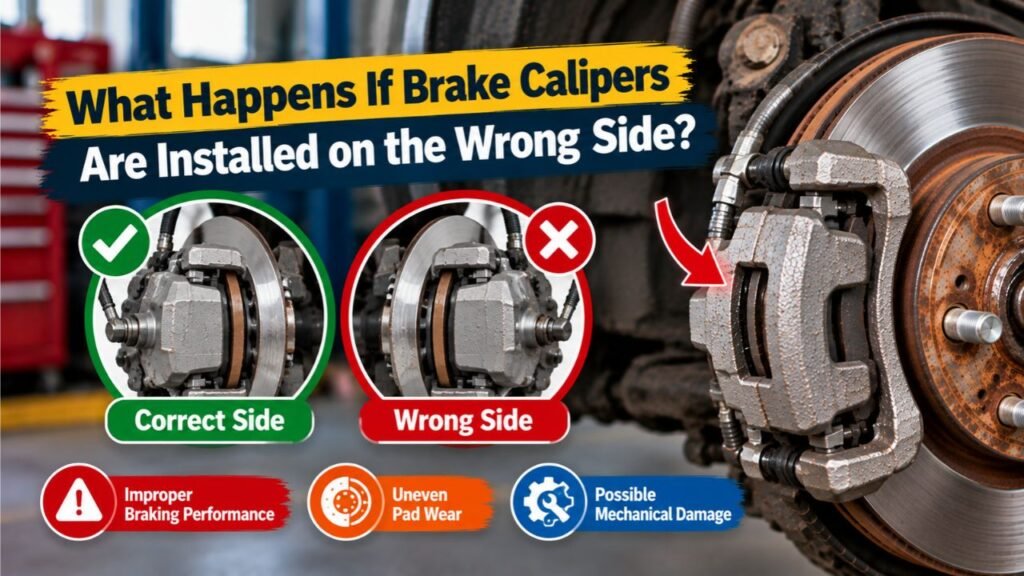
The exact symptoms depend on the caliper design, but several problems are common.
Spongy Brake Pedal
A spongy brake pedal is one of the most common symptoms.
The pedal may:
- Travel farther than normal
- Feel soft
- Improve temporarily after pumping
- Never become firm during bleeding
If you have repeatedly bled a new caliper but the pedal still feels soft, check whether the bleeder screw is positioned at the top.
Air Will Not Bleed Out
You may open the bleeder and see clean brake fluid with no visible bubbles while the pedal still feels wrong.
That can happen because an air pocket remains trapped above the bleeder.
The fluid leaving the screw does not necessarily mean all air has left the caliper.
Reduced Braking Response
Air inside the hydraulic system can reduce braking responsiveness.
The vehicle may require more pedal travel before the brakes engage firmly.
This should not be treated as normal after caliper replacement.
Brake Hose Routing Problems
The brake hose may end up:
- Twisted
- Stretched
- Rubbing against suspension components
- Too close to the wheel
- Bent at an unnatural angle
A flexible brake hose should not be twisted or placed under tension through the full steering and suspension range.
Parking Brake Problems
Rear calipers may incorporate a mechanical or electronic parking brake.
Left and right rear calipers can have different:
- Lever positions
- Cable attachment points
- Electric parking brake motors
- Brackets
- Internal mechanisms
Swapping them may make the parking brake impossible to connect or operate correctly.
How to Tell Left and Right Brake Calipers Apart
The easiest method is often to inspect the bleeder position.
Look at the Bleeder Screw
Once installed, the bleeder should generally sit near the highest point of the caliper’s hydraulic chamber.
If the bleeder is at the bottom while the hose connection is higher, the caliper may be on the wrong side.
Check the Part Number
Many replacement calipers are labeled:
- LH
- RH
- Left
- Right
- Driver side
- Passenger side
In the United States:
- Left side generally means the driver’s side.
- Right side generally means the passenger side.
Always verify the manufacturer’s listing because terminology can vary between markets.
Compare the Old Caliper
If you still have the original caliper, place it next to the replacement.
Compare:
- Bleeder position
- Brake hose inlet
- Mounting ears
- Parking brake hardware
- Bracket position
The new caliper should match the orientation of the original unit.
Check the Service Manual or Parts Catalog
Vehicle-specific service information is the best reference when there is any uncertainty.
Some calipers look almost identical but contain subtle side-specific differences.
Is the Bleeder Screw Always Above the Brake Hose?
Not necessarily in every design.
The critical issue is not simply whether the bleeder is physically above the hose connection.
The bleeder needs to be located so that trapped air can rise toward and escape through it.
On many calipers, that means it appears at or near the highest visible point.
Some unusual caliper designs may position fluid passages differently, so vehicle-specific service information should take priority.
Can You Bleed a Caliper Installed Upside Down?
Usually not effectively if the bleeder is below the trapped air.
You may remove some air, but an air pocket can remain in the upper part of the piston chamber.
If you suspect the caliper is on the correct side but its installed orientation prevents proper bleeding, some service procedures allow the caliper to be temporarily removed and positioned so the bleeder becomes the highest point.
However:
- The brake hose must not be strained.
- The piston must not be allowed to extend excessively.
- The caliper must be supported safely.
- A suitable spacer may need to be placed between the pads or piston.
Follow the manufacturer’s service procedure rather than improvising.
Can You Swap Left and Right Front Calipers?
Only if the caliper design specifically allows it.
Most side-specific front calipers should remain on their designated sides.
Swapping them may place the bleeders incorrectly.
Some aftermarket or racing calipers are designed with multiple bleeders or symmetrical configurations that allow different mounting orientations.
Standard passenger-vehicle replacement calipers should generally be installed according to their left/right designation.
Can You Swap Left and Right Rear Calipers?
Rear calipers are often even more side-specific than front calipers.
This is because they may include:
- Parking brake levers
- Parking brake cables
- Electric parking brake motors
- Spring mechanisms
- Specialized hose fittings
A rear caliper may physically bolt onto the opposite side but leave the parking brake hardware facing the wrong direction.
Always verify side designation before installation.
What If Both Calipers Have Bleeder Screws?
Both left and right calipers normally have their own bleeder screws.
The issue is where each bleeder ends up after installation.
For example, the right caliper may have its bleeder positioned so it sits at the top only when mounted on the right side.
If installed on the left, that same bleeder can end up near the bottom.
This is one reason the calipers may look almost identical on a workbench but still be side-specific.
Why Air in the Brake System Is Dangerous
Hydraulic brakes depend on pressure being transferred efficiently through brake fluid.
Air interferes with that process because it compresses.
Possible symptoms include:
- Soft pedal
- Excess pedal travel
- Delayed brake engagement
- Inconsistent braking
- Reduced confidence in emergency stops
A brake pedal that remains unusually soft after caliper replacement should be investigated before normal driving resumes.
How to Check If Your Calipers Are on the Wrong Side
You can perform a basic visual inspection.
Step 1: Look at the Bleeder Screws
Check both calipers.
Each bleeder should generally be near the highest point of the caliper.
If both bleeders are near the bottom, the calipers may have been swapped.
Step 2: Check the Brake Hoses
The hoses should route naturally without:
- Twisting
- Pulling
- Kinking
- Contacting the tire
- Contacting the wheel
- Rubbing suspension parts
Turn the steering from lock to lock on front calipers and inspect the hose carefully.
Step 3: Check the Caliper Part Numbers
Compare the installed part numbers with the vehicle application.
Confirm which number belongs on each side.
Step 4: Inspect Parking Brake Connections
On rear calipers, verify that the parking brake cable or electronic motor is installed in its correct orientation.
Step 5: Check Pedal Feel
A newly serviced brake system should not have an abnormally spongy pedal after proper bleeding.
If it does, caliper orientation should be one of the things you check.
How to Fix Calipers Installed on the Wrong Side
If you confirm the calipers are swapped, the proper fix is usually to reinstall them on the correct sides.
A typical correction involves:
- Safely raise and support the vehicle.
- Remove the wheels.
- Disconnect each caliper as required.
- Move the left caliper to the left side and the right caliper to the right side.
- Reconnect the brake hoses correctly.
- Confirm hoses are not twisted.
- Torque all fasteners to manufacturer specifications.
- Refill the brake fluid reservoir as needed.
- Bleed the hydraulic system completely.
- Check for leaks.
- Confirm a firm pedal before driving.
Because opening brake lines introduces air, the brakes must be bled again after the calipers are moved.
Should You Reuse the Brake Hose Sealing Washers?
Many banjo-style brake hose connections use copper or other crush washers.
These washers are designed to deform slightly when tightened and create a hydraulic seal.
Vehicle and caliper manufacturers commonly specify new sealing washers whenever the connection is opened.
Reusing damaged or previously crushed washers can increase the chance of brake-fluid leaks.
Follow the hardware instructions supplied with the caliper or the vehicle service information.
What If the Calipers Were Installed Wrong but the Brakes Feel Fine?
Do not assume the installation is acceptable just because the vehicle appears to stop normally.
The calipers should still be verified.
A system may contain only a small amount of trapped air at first, or other orientation issues may not become obvious until:
- Hard braking
- Suspension movement
- Full steering lock
- Parking brake use
- Hose wear
Correct brake assembly is more important than relying on a short test drive.
Can the Wrong Caliper Side Damage the Brake Hose?
Yes.
If the hose fitting ends up on the wrong side or at the wrong angle, the flexible hose can become twisted or stretched.
Repeated suspension and steering movement can then stress the hose.
A damaged brake hose may:
- Leak
- Crack
- Bulge
- Become internally restricted
Any brake hose showing physical damage should be replaced.
Can Wrong-Side Calipers Cause Brake Drag?
Indirectly, yes.
Caliper orientation itself is most commonly associated with bleeding problems, but incorrect installation can also affect:
- Hose routing
- Parking brake mechanisms
- Pad hardware
- Caliper movement
Any of these problems can contribute to brake drag.
However, if the only problem is a low bleeder screw, the primary symptom is usually trapped air rather than constant brake drag.
Could the Caliper Piston Fall Out During Correction?
It can if the brake pedal is pressed while a caliper is removed and there is nothing preventing piston movement.
Never press the brake pedal with the caliper removed from the rotor unless the procedure specifically uses a suitable piston spacer or block.
Excessive piston extension can:
- Damage the seal
- Release brake fluid
- Allow the piston to come out of the bore
Support the caliper properly during service.
Do Fixed Calipers Have Left and Right Sides?
Many fixed multi-piston calipers are also side-specific.
They may use:
- Multiple bleed screws
- Internal crossover passages
- External crossover tubes
- Staggered piston sizes
A performance caliper may require smaller and larger pistons to be positioned in a particular direction relative to rotor rotation.
Installing such a caliper on the wrong side may cause uneven pad wear or incorrect bleeding.
Always follow the caliper manufacturer’s orientation instructions.
Common Mistakes When Replacing Brake Calipers
Assuming Both Calipers Are Identical
Parts can look nearly identical while still having different left and right configurations.
Ignoring Bleeder Screw Position
The bleeder location is one of the quickest ways to identify incorrect orientation.
Twisting the Brake Hose
A twisted hose may eventually fail or interfere with steering.
Reusing Damaged Sealing Washers
A small hydraulic leak can develop around the hose connection.
Failing to Bleed the System Completely
Any time the hydraulic line is opened, air can enter.
The system needs to be properly bled afterward.
Driving With a Soft Pedal
A soft pedal after brake service indicates a problem that should be corrected before normal driving.
FAQs About Can You Put Brake Calipers on the Wrong Side
What happens if brake calipers are installed on the wrong side?
The most common problem is that the bleeder screws end up too low to remove trapped air effectively.
This can leave the brake pedal soft or spongy.
Other issues may include incorrect hose routing and parking brake problems.
How do I know which caliper goes on which side?
Check the part number, left/right markings, brake hose location, parking brake hardware, and especially the bleeder screw position.
The bleeder should generally be near the highest point when the caliper is installed.
Should the caliper bleeder screw face up?
Generally, yes.
The bleeder should be positioned at or near the highest point of the hydraulic chamber so trapped air can escape.
Can wrong-side calipers cause a spongy brake pedal?
Yes.
If the bleeder is below trapped air inside the caliper, the air may remain even after repeated bleeding.
This creates a soft or spongy pedal.
Can you drive with the calipers swapped?
You should correct the installation before normal driving.
A caliper installed on the wrong side may contain trapped air or create brake hose and parking brake problems.
Can I just turn the caliper upside down to bleed it?
In some service procedures, a caliper can be temporarily repositioned while supported and fitted with a suitable spacer so the bleeder becomes the highest point.
However, follow vehicle-specific service instructions and do not strain the hose or allow the piston to extend.
Are front brake calipers left and right specific?
Many are.
Even when their mounting points are similar, bleeder screw and hose fitting locations can make them side-specific.
Are rear brake calipers side specific?
Often, yes.
Rear calipers may also have side-specific parking brake levers, cables, brackets, or electric parking brake motors.
Conclusion
So, can you put brake calipers on the wrong side? In many cases, the calipers may physically bolt onto the opposite sides, but they should not be left that way unless the manufacturer specifically designed them to be interchangeable.
The clearest warning sign is usually the bleeder screw. If the bleeder is not at or near the highest point of the caliper, trapped air may remain in the hydraulic system and cause a soft brake pedal.
Always verify left and right caliper orientation, check brake hose routing, confirm parking brake hardware, and bleed the system correctly after installation. If the pedal remains soft or you are unsure about the installation, have the brake system inspected before driving normally.