What Is Service Parking Brake Mean? Causes and Safe Next Steps
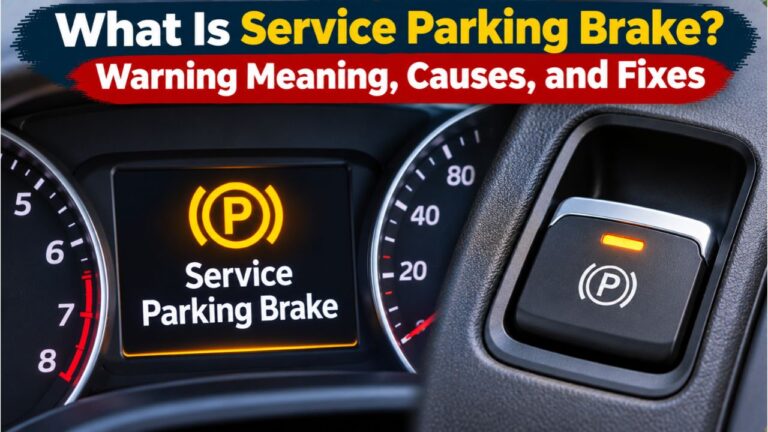
The “Service Parking Brake” message means your vehicle has detected a problem with its parking brake system that requires inspection or repair. On vehicles with an electronic parking brake (EPB), the warning may indicate an electrical fault, malfunctioning actuator, damaged wiring, faulty switch, or a problem with the control system. It does not simply mean you forgot to release the parking brake.
The warning commonly appears on the instrument cluster or Driver Information Center. Depending on the vehicle, it may appear with an amber parking brake warning light, a wrench symbol, or another brake-related indicator.
Some vehicles can still apply and release the parking brake when this message appears. Others may have limited parking brake operation or a mechanism that will not engage or disengage correctly.
Understanding the warning matters because an unreliable parking brake may allow a parked vehicle to roll or create resistance while driving.
This guide explains what the Service Parking Brake message means, its common causes, warning light differences, safe troubleshooting checks, repair options, and when professional diagnosis is necessary.
What Is Service Parking Brake Mean on Your Dashboard?
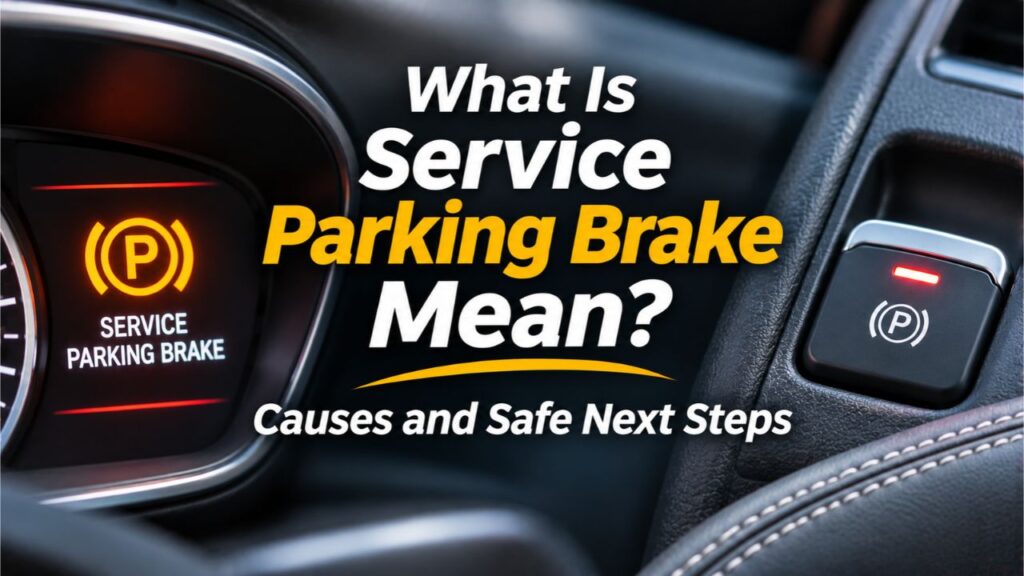
The Service Parking Brake warning indicates that the vehicle has detected a fault involving its parking brake system. The message tells the driver that the system needs attention rather than confirming that the parking brake is applied.
Electronic parking brakes use switches, control modules, electric motors, and mechanical components to hold a stationary vehicle. When the system detects an abnormal condition, it may display a warning.
For example, the 2015 Chevrolet SS owner’s manual identifies the SERVICE PARKING BRAKE message as an indication of a parking brake problem and directs owners to obtain service.
The exact meaning varies by manufacturer and vehicle model. The warning alone does not identify which component has failed.
Important: A Service Parking Brake warning does not automatically mean your regular hydraulic brakes have stopped working. However, because some vehicles share electronic controls between braking systems, additional warning lights or abnormal brake-pedal behavior must be taken seriously.
How the Electronic Parking Brake System Works
An electronic parking brake performs the same basic function as a traditional handbrake, but it uses electrical controls instead of requiring the driver to pull a mechanical lever.
The driver operates a switch, and the control system commands the parking brake mechanism to engage or release.
Two common designs are used.
Caliper-Mounted Electronic Parking Brakes
Many vehicles have electric motors attached to the rear brake calipers.
When the parking brake is activated, the motor operates a mechanism that applies force through the caliper piston.
The brake pads then hold the rotor to prevent the wheel from rotating.
The system monitors operation to determine whether the requested action has been completed.
Cable-Operated Electronic Parking Brakes
Some vehicles use a centrally mounted electric actuator that pulls parking brake cables.
The cables operate the rear parking brake mechanisms, similar to a conventional mechanical parking brake.
The difference is that the driver commands the actuator electrically rather than pulling a hand lever.
Both designs depend on properly functioning electrical and mechanical components. Problems with either side can trigger a service warning.
Common Causes of the Service Parking Brake Warning
Several faults can activate the warning. The correct diagnosis depends on the vehicle’s design and stored diagnostic trouble codes.
Faulty Electronic Parking Brake Actuator
A failed actuator is one possible cause.
The actuator contains an electric motor and mechanical components responsible for applying or releasing the parking brake.
Internal wear, corrosion, damaged gears, or an electrical failure may prevent it from operating correctly.
Possible symptoms include unusual noises near the rear wheels, delayed operation, or a parking brake that fails to respond.
A defective actuator may need replacement, but it should be tested before parts are ordered.
Weak Battery or Electrical Power Problems
Electronic parking brakes depend on adequate electrical power.
Low battery voltage, poor electrical connections, or charging-system problems may interfere with normal operation.
Some vehicles may display parking brake warnings when the supply voltage falls outside the system’s operating range.
A weak battery does not prove that the parking brake actuator is defective.
The battery, charging system, relevant fuses, and electrical connections should be evaluated before replacing expensive components.
Damaged Parking Brake Wiring or Connectors
Wiring carries electrical power and control signals between the parking brake module, switch, and actuators.
Damage can result from corrosion, road debris, moisture intrusion, or physical wear.
A loose connector or broken wire may interrupt communication or electrical current.
Because rear brake components operate close to water, dirt, and road salt, exposed wiring and connectors deserve careful inspection.
The problem may be intermittent if vibration or moisture affects the connection.
Defective Parking Brake Switch
The electronic parking brake switch sends the driver’s request to apply or release the brake.
A damaged switch may fail to send the correct signal.
Symptoms may include inconsistent operation or no response when the switch is used.
However, a switch that does not produce the expected result is not necessarily defective. The control module may refuse the command because another system condition is preventing operation.
Parking Brake Control Module or Software Fault
Electronic parking brake systems depend on software and electronic control modules.
A communication problem, incorrect control signal, or software issue can trigger a service message.
For example, General Motors Service Bulletin 24-NA-122 addresses a Service Parking Brake message accompanied by diagnostic trouble code C0616 on certain 2024 Chevrolet Silverado HD and GMC Sierra HD trucks.
The bulletin identifies a possible software anomaly and specifies updating the electronic brake control module rather than replacing it for that condition.
This is a model-specific example. It does not mean software causes every parking brake warning.
Mechanical Problems With the Rear Brakes
Not every Service Parking Brake message results from an electrical failure.
Mechanical problems can prevent the parking brake from reaching its expected position.
Possible causes include:
- Seized parking brake mechanisms
- Damaged actuator gears
- Corroded or binding cables
- Incorrectly installed brake components
- Problems following rear brake replacement
- Internal caliper or parking brake hardware damage
These problems may require physical inspection after electronic diagnosis.
Symptoms That May Appear With a Service Parking Brake Warning
The dashboard message may appear by itself or alongside noticeable changes in parking brake operation.
Parking Brake Will Not Engage
The driver may activate the parking brake switch without getting the normal confirmation.
Some systems produce an audible motor sound but fail to hold the vehicle.
Others display an error immediately.
A parking brake that cannot engage leaves the vehicle without that intended parking protection.
Parking Brake Will Not Release
A more serious problem occurs when the brake stays applied.
The vehicle may resist movement, refuse to disengage the parking brake, or display another warning message.
Do not accelerate against a parking brake that remains engaged.
Doing so can overheat the rear brakes and damage friction components.
Warning Light Remains Illuminated
A parking brake status light usually indicates whether the brake is engaged.
A separate service indicator may identify a detected system problem.
According to Ford’s official electronic parking brake message guide, messages such as “Park Brake Limited Function Service Required” and “Park Brake Malfunction Service Now” indicate conditions requiring vehicle service.
Ford also distinguishes these warnings from normal applied and released status messages.
Unusual Motor Noises or Intermittent Operation
A brief motor sound during electronic parking brake operation can be normal.
Grinding, repeated clicking, prolonged operation, or inconsistent engagement may indicate a problem.
These symptoms should be evaluated alongside warning lights and diagnostic information rather than used to identify a failed actuator by sound alone.
What to Do When the Service Parking Brake Message Appears
Start with safe, noninvasive checks. Do not disassemble an electronic parking brake or attempt to force its release without the manufacturer’s instructions.
Step 01: Stop the Vehicle in a Safe Location
If the warning appears while driving, remain attentive to brake-pedal feel and vehicle behavior.
Find a safe place to stop, preferably on level ground.
Keep the regular brake pedal applied while bringing the vehicle to a complete stop.
If the service brakes feel abnormal, the vehicle pulls unexpectedly, or a red brake system warning appears, stop as safely as possible and arrange assistance.
Do not continue driving to see whether the warning disappears.
Step 02: Check the Parking Brake Indicators
Read the exact dashboard message.
Determine whether the warning is accompanied by a red parking brake status indicator, amber service warning, ABS indicator, or another brake-related alert.
These indicators may identify different problems.
For example, a red parking brake status light can mean the brake is applied, while an amber service indicator generally points toward a system fault.
Consult the owner’s manual for the exact warning combination.
Step 03: Verify Whether the Parking Brake Responds
With the vehicle stationary and your foot firmly on the regular brake pedal, follow the manufacturer’s procedure for operating the parking brake switch.
On many vehicles, applying the electronic parking brake involves pulling or pressing a switch, while releasing it requires the ignition to be on and the service brake pedal to be pressed.
Watch the instrument cluster for the expected status change.
If the brake does not respond normally, stop operating the switch repeatedly.
Excessive attempts may overheat the actuator or discharge a weak battery.
Never test a questionable parking brake by allowing the vehicle to roll.
Step 04: Check for Obvious Electrical Problems
If the vehicle has recently experienced a weak battery, jump-starting, or charging problems, these details may help the diagnosis.
Look for additional electrical warning messages.
A technician can test battery condition and charging voltage using the correct equipment.
Do not assume that disconnecting the battery will repair the parking brake.
A warning that temporarily disappears after a restart may return because the underlying fault remains.
Step 05: Secure the Vehicle Before Leaving It
Do not assume that the parking brake is applied simply because its switch was operated.
If the system cannot confirm engagement, the vehicle must be secured using a suitable alternative.
For an automatic transmission, select Park and follow the owner’s manual.
Avoid parking on a slope with an unreliable parking brake. Use appropriate wheel chocks when necessary and safe to position.
If the vehicle cannot be secured or the parking brake is stuck engaged, arrange professional assistance.
Step 06: Arrange Proper Diagnostic Testing
If the warning persists, have the vehicle inspected using diagnostic equipment capable of accessing the parking brake or related brake control modules.
A basic engine-code reader may not retrieve the information needed.
A technician can evaluate stored faults, commanded actuator operation, electrical supply, wiring, and mechanical brake condition.
The goal is to identify the failed component rather than replacing parts based only on the dashboard message.
Can You Drive With a Service Parking Brake Warning?
Driving may still be possible with some Service Parking Brake warnings, but it is not automatically safe. The decision depends on the vehicle’s braking behavior, whether the parking brake is fully released, and what other warnings are present.
If the normal service brakes operate correctly and the parking brake is confirmed released, some manufacturers permit continued driving to obtain service.
However, the parking brake may not be reliable when the vehicle is parked.
Do not drive if:
- The parking brake remains partially or fully engaged.
- The vehicle resists movement or the rear brakes drag.
- The regular brake pedal feels abnormal.
- A serious brake system warning appears.
- The vehicle produces a burning smell or signs of overheating.
- The manufacturer instructs the driver to stop.
A parking brake that remains applied can generate substantial heat and damage nearby brake components.
If there is uncertainty about the brake’s release status or overall braking performance, towing is safer than driving.
Service Parking Brake vs. Other Brake Warning Messages
Different brake messages identify different conditions.
| Dashboard Message | General Meaning |
| Service Parking Brake | Parking brake system needs diagnosis |
| Parking Brake On | Parking brake is engaged |
| Release Parking Brake | Brake is applied when it should be released |
| Parking Brake Not Applied | System did not confirm full engagement |
| Parking Brake Not Released | System did not confirm full release |
| Service Brake System | Another braking-system fault requires inspection |
| Service Brake Assist | Brake assistance may have a problem |
| ABS Warning | Antilock braking system has detected a fault |
The wording and operation vary by manufacturer.
A Service Parking Brake warning should not automatically be interpreted as a master cylinder, brake booster, or hydraulic brake fluid problem.
Likewise, a general brake warning deserves separate attention even if the parking brake is operating normally.
How Mechanics Diagnose and Repair a Service Parking Brake Fault
Professional diagnosis generally begins with the vehicle’s fault information and a physical inspection.
Read the Parking Brake Diagnostic Trouble Codes
A compatible diagnostic scan tool can communicate with the modules responsible for parking brake operation.
Stored diagnostic trouble codes help narrow the investigation to electrical, communication, actuator, or control problems.
A code identifies a detected condition, not always the exact part that must be replaced.
Inspect Electrical Connections and Power Supply
The technician may check battery condition, fuses, wiring continuity, connectors, and voltage supply.
Corroded connections or damaged wiring can sometimes be repaired without replacing the electronic parking brake actuator.
Electrical testing must follow the manufacturer’s specifications.
Check Mechanical Parking Brake Components
The rear calipers, cables, actuator mounting, and related hardware may require inspection.
A mechanically seized brake can prevent a functioning actuator from completing its commanded movement.
Replacing the motor without addressing the mechanical fault may not restore proper operation.
Perform Required Repairs and Calibration
Depending on the diagnosis, repairs may involve replacing a switch, repairing wiring, servicing rear brake hardware, updating software, or replacing an actuator.
Some vehicles require a scan tool to place the electronic parking brake in a special maintenance mode during rear brake service.
After repairs, the system may need calibration, relearning, or functional verification.
Fault codes should be cleared only after the underlying problem has been corrected.
Does Service Parking Brake Mean You Need New Brake Pads?
Not necessarily.
The warning does not automatically indicate that the brake pads are worn out.
A parking brake fault may involve electronics, wiring, a switch, or another component unrelated to pad thickness.
However, rear brake wear, incorrect installation, or mechanical damage may contribute to parking brake problems on certain designs.
If the warning appears immediately after a rear brake pad replacement, improper electronic parking brake service procedures deserve attention.
A technician should verify that the correct maintenance mode and installation procedure were followed.
Do not purchase replacement pads solely because the dashboard displays a Service Parking Brake message.
How to Prevent Electronic Parking Brake Problems
Not every electronic parking brake failure can be prevented, but proper maintenance can reduce avoidable problems.
Keep the vehicle’s battery and charging system in good condition.
Follow the manufacturer’s rear brake service procedures, especially where electronic parking brake maintenance mode is required.
Inspect exposed wiring and connectors when brake work reveals corrosion or physical damage.
Do not repeatedly apply and release the electronic parking brake without a reason, particularly when the battery is weak.
Address unusual noises, dragging brakes, and intermittent warnings promptly.
Regular inspection helps identify problems before the parking brake becomes unreliable or refuses to release.
FAQs About What Is Service Parking Brake Mean
Does Service Parking Brake Mean My Brakes Are Bad?
Not always. The message usually identifies a problem with the parking brake system rather than proving that the regular hydraulic brakes have failed. However, any additional brake warnings or abnormal braking behavior require immediate attention.
Can a Weak Battery Cause the Service Parking Brake Message?
Yes. Low electrical voltage can interfere with some electronic parking brake systems. Battery or charging-system problems should be checked when the warning appears alongside other electrical symptoms.
Will the Service Parking Brake Message Go Away on Its Own?
It may disappear temporarily after restarting the vehicle, particularly if the triggering condition was intermittent. However, the fault may still be stored and can return. Persistent or recurring warnings require diagnosis.
Can I Reset the Service Parking Brake Warning?
Some faults can be cleared after the underlying problem is repaired. Disconnecting the battery or clearing codes without diagnosis is not a reliable fix and may remove useful diagnostic information.
How Much Does It Cost to Fix a Service Parking Brake Warning?
The cost depends on the cause, vehicle model, and labor involved. A wiring repair or switch replacement may be less expensive than replacing an electronic actuator or control module. Proper diagnosis helps avoid unnecessary replacement costs.
Does Service Parking Brake Mean the Brake Is Stuck?
No. The warning means the system has detected a problem, but the brake may still apply and release. If the parking brake is stuck or has not fully released, do not drive until it has been safely repaired.
What the Service Parking Brake Warning Means for Your Next Move
For drivers asking what is service parking brake mean, the message indicates that the vehicle has detected a parking brake system problem requiring attention. It may involve an electrical connection, actuator, switch, control module, software issue, or mechanical brake component. The warning itself does not identify the exact cause.
The first priority is determining whether the parking brake applies and releases correctly and whether the regular brakes operate normally. A persistent warning should be diagnosed with the appropriate equipment rather than cleared repeatedly or ignored.
If the parking brake will not release, the vehicle cannot be secured safely, or normal braking feels abnormal, arrange professional assistance. Identifying and repairing the actual fault is the safest way to restore dependable parking brake operation.