Is the Parking Brake the Same as a Handbrake? Types and Uses
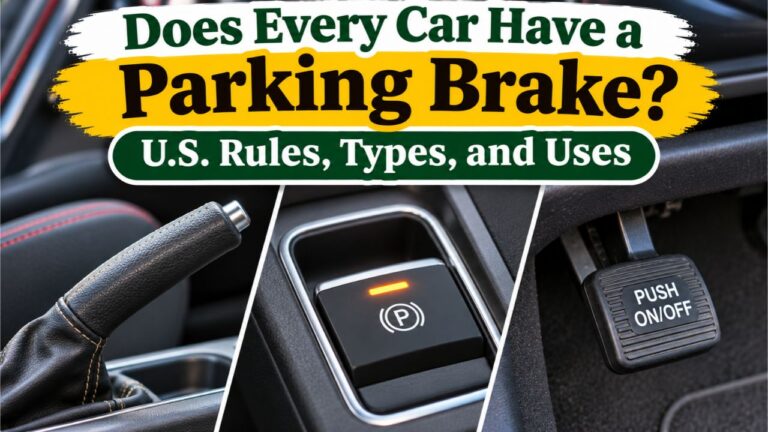
Yes, a handbrake is a type of parking brake. The terms usually refer to the same system when a vehicle has a hand-operated lever, typically beside the driver’s seat. However, not every parking brake is a handbrake: some vehicles use a foot-operated pedal, and many newer models use an electric switch instead of a lever.
The naming difference can be confusing when reading an owner’s manual, shopping for replacement parts, or learning to drive a different car. You might also hear “emergency brake” or “e-brake,” which are common names for the parking brake even though its primary job is to prevent a parked vehicle from rolling.
The important distinction isn’t the label on the control. It’s whether the vehicle has a mechanical hand lever, a foot pedal, or an electronically operated system—and how that system applies and releases the holding force. This article explains the terminology, where different parking brakes are located, how they work, when to use them, and why they are not the same as the regular brake pedal or the transmission’s Park setting.
Is the Parking Brake the Same as a Handbrake? The Main Difference
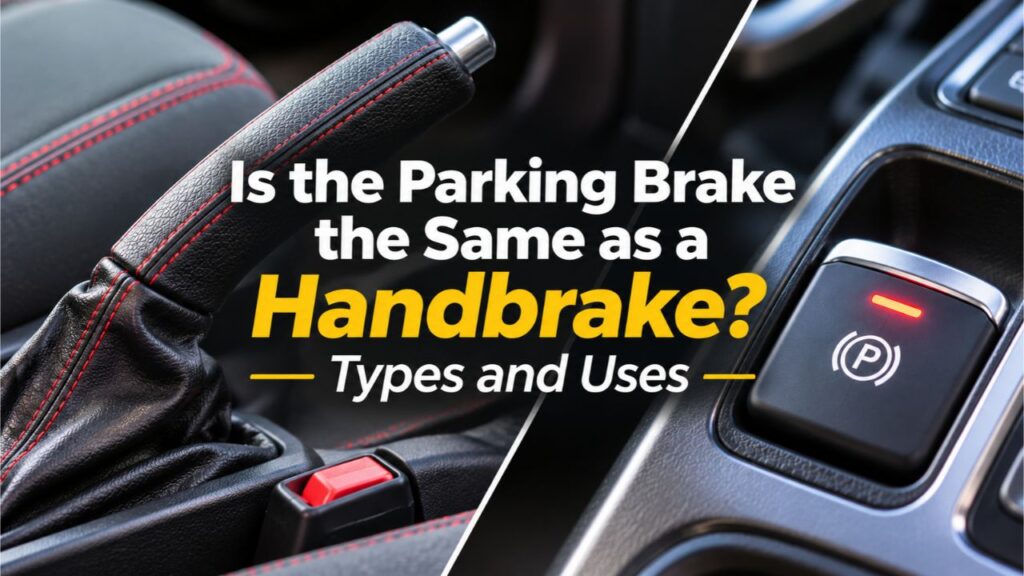
In everyday conversation, parking brake describes the function, while handbrake describes a familiar way of operating it. A traditional handbrake is a lever that you pull with your hand to hold the vehicle in place after stopping. It is one kind of parking brake, not a separate braking system installed alongside one.
As AAA Club Alliance’s guide to emergency and parking brakes explains, drivers also call this equipment a hand brake, emergency brake, or e-brake. The names often overlap, but the operating control differs between vehicles.
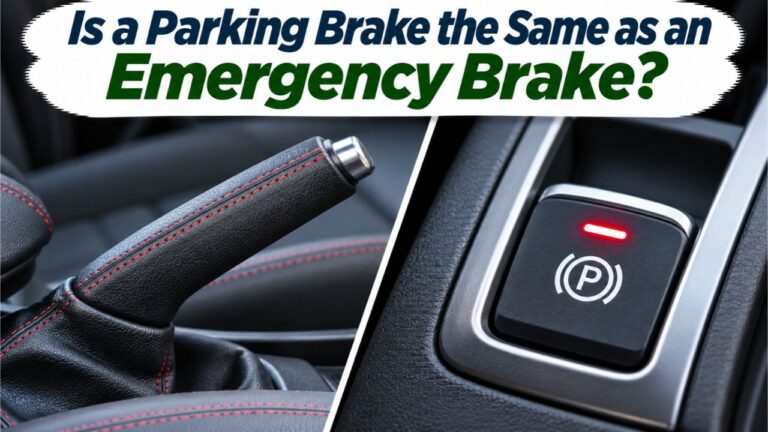
For example, two cars can have parking brakes with the same purpose even though one has a lever between the seats and the other has a small switch on the center console. Calling the first car’s control a handbrake is precise. Calling the second a parking brake is more accurate, although people may still casually use “handbrake.”
The same principle applies to a foot-operated parking brake. It isn’t a handbrake in the literal sense, because you set it with your foot, but it fulfills the same parking function.
Three Common Types of Parking Brake Controls
The control’s appearance is the easiest way to identify what your vehicle uses. The underlying holding mechanism may also differ, so operating instructions should come from the specific owner’s manual.
Traditional Handbrake Lever
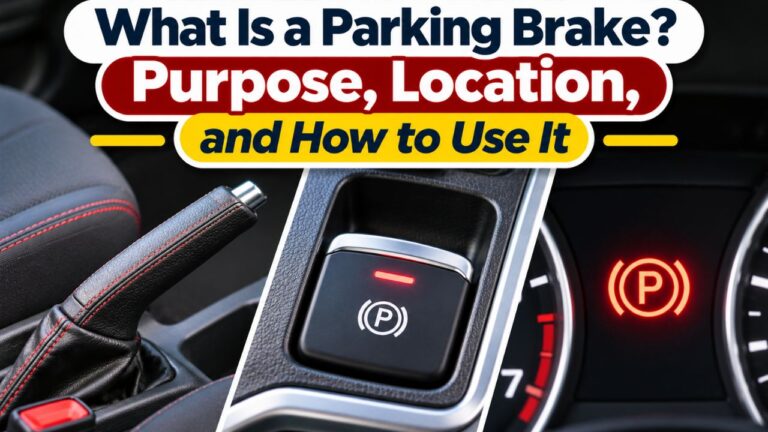
A mechanical handbrake typically sits between the front seats, beside the driver’s seat, or occasionally in another reachable location. Pulling the lever tensions a cable or linkage that applies the designated parking brakes. A ratchet holds the lever in position until the release mechanism is operated.
Many levers have a button at the end. On a common design, you lift the lever slightly, press the button, and lower it completely to release the brake. Other arrangements work differently. The lever should move smoothly and should hold the vehicle without excessive travel or force.
This is the arrangement most people picture when someone says “pull the handbrake.” It is common in older passenger cars and remains familiar on many manual-transmission vehicles.
Foot-Operated Parking Brake Pedal
Some cars, SUVs, and trucks have a separate pedal near the driver’s left footwell. Pressing it engages the parking brake. Depending on the model, you release it with a dashboard handle, a second press of the pedal, or another mechanism.
The small parking brake pedal is different from the main brake pedal, even though both are operated by foot. The regular pedal slows the moving vehicle; the parking brake pedal activates a mechanism intended to hold the vehicle once stopped. Never assume that every foot-operated parking brake releases in the same way.
Electronic Parking Brake Switch
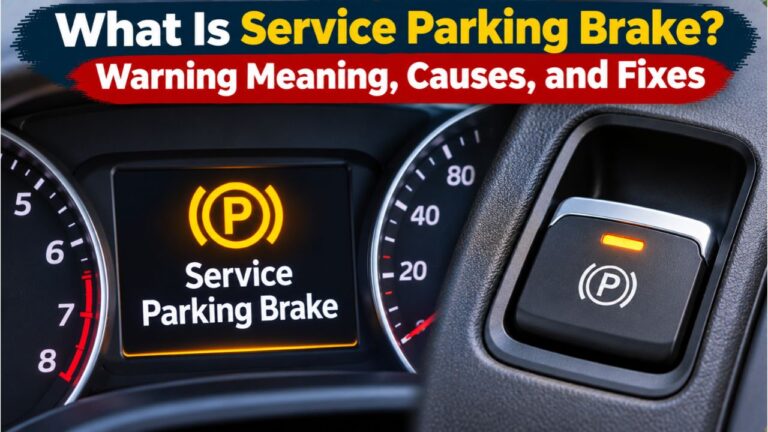
An electronic parking brake (EPB) uses a switch and electric actuators rather than a manually pulled cable lever. The switch may be marked with a circled P, a parking-brake symbol, or another manufacturer’s marking. Some systems can apply or release automatically under specified conditions.
Electric actuators may operate at the rear brake calipers or through a motor-driven cable mechanism. Their holding function is still that of a parking brake, even though an electrical command initiates its operation.
A Toyota digital owner’s manual section on the parking brake describes switch-operated manual and automatic modes for the model covered. It also notes that the driver can pull the switch to engage the brake and press it to release under the stated conditions. Other vehicles may require different actions.
| Control Type | Typical Driver Action | Common Name |
| Hand lever | Pull upward; release using the lever mechanism | Handbrake or parking brake |
| Separate foot pedal | Press to apply; release by model-specific control | Foot parking brake |
| Electrical switch | Pull or press as specified | Electronic parking brake |
How a Handbrake or Parking Brake Holds the Vehicle
A parking brake is designed primarily to keep a stationary vehicle from moving. The holding force comes from friction at designated wheel brakes, but exactly how that friction is applied depends on the vehicle.
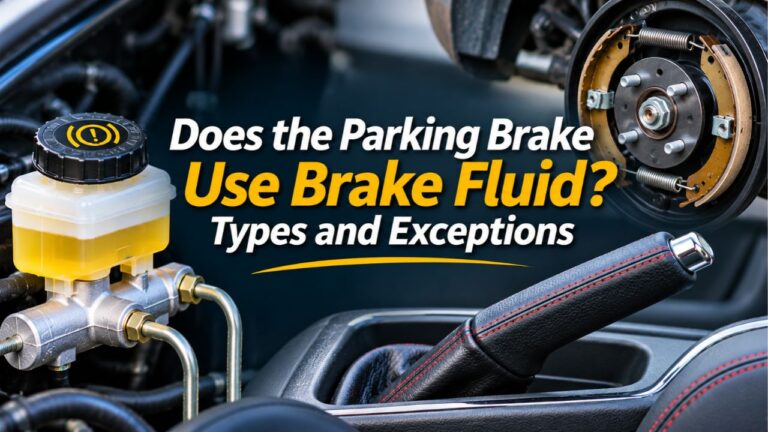
On many cable-operated systems, the hand lever or foot pedal pulls a cable connected to the rear brakes. Some drum-brake vehicles use the regular rear brake shoes. Some vehicles with rear disc brakes use a separate small drum mechanism inside the rotor hat, while others have a mechanical actuator built into the rear caliper.
Electronic systems use electric actuators to apply the parking mechanism and may include automatic adjustment and status monitoring. The switch’s electronic operation does not mean that electricity alone continuously holds a stationary vehicle.
In its interpretation of federal parking-brake requirements, the National Highway Traffic Safety Administration explains that the parking brake is intended to prevent a stationary vehicle from moving and discusses the requirement for mechanical means of retaining engagement under the cited passenger-car standard. Those details concern the applicable U.S. regulation, not every vehicle category worldwide.
Because the parking brake usually acts on fewer wheels than the regular service brakes, it should not be treated as an equally capable substitute for normal braking while driving.
Parking Brake vs. Regular Brake Pedal
The regular brake pedal operates the service brakes, which are designed to slow and stop a moving vehicle repeatedly under normal driving conditions. In conventional hydraulic systems, pressing the pedal sends pressure through the master cylinder and brake lines to the wheel brakes. Electronic or integrated braking arrangements can manage that process differently.
The parking brake serves a different primary purpose: holding the stopped vehicle in place without the driver keeping a foot on the pedal. It can share rear pads, shoes, or calipers with the service brakes, but its application and holding mechanisms are distinct.
A parking brake may remain engaged with the engine switched off and the driver outside the car. The service brake pedal normally requires the driver to keep applying force. Neither system should be confused with a transmission gear selection.
A fully functioning service braking system is essential even when the handbrake works perfectly. Likewise, a good brake pedal does not excuse a parking brake that cannot hold a stationary vehicle.
Is the Handbrake Also the Emergency Brake?
In everyday American English, emergency brake or e-brake usually means the parking brake. The name reflects its potential role as a backup if the normal braking system develops a serious problem. Still, its intended day-to-day use is securing a parked car.
A traditional mechanical lever often acts mainly on the rear brakes. Pulling it abruptly at speed could lock those wheels, reduce vehicle control, or cause a skid, especially on slippery pavement. It does not provide the same predictable stopping performance as healthy service brakes.
Some modern electronic systems have a special emergency-braking function. Rather than simply clamping the rear brakes like a mechanical lever, certain vehicles can use controlled braking while the switch is held. This behavior is model-specific; other cars may respond differently or restrict operation.
Do not experiment with handbrake or EPB emergency stopping on public roads. If your regular brakes fail while moving, follow the owner’s manual emergency instructions, maintain control, and seek a safe place to stop. After a braking failure, have the vehicle towed and inspected.
When Should You Use the Parking Brake?
Use the parking brake whenever the manufacturer instructs you to secure the vehicle after stopping, not just on steep hills. It adds protection against unwanted movement and helps avoid depending entirely on the transmission to hold the vehicle.
Parking an Automatic-Transmission Car
Bring the car to a complete stop using the service brake. While holding the foot brake, apply the parking brake and place the transmission in Park according to the vehicle’s recommended sequence. Confirm the vehicle is secured before releasing the service brake and exiting.
Automatic transmissions typically have a parking pawl, a mechanism that locks part of the transmission when Park is selected. The parking brake provides a separate holding method. Using it can also reduce the load placed on the pawl when parked on a slope.
Some EPB-equipped vehicles engage the parking brake automatically when you select Park. Do not assume yours does: check the indicator and the manual.
Parking a Manual-Transmission Car
After stopping, apply the parking brake and select the parked gear specified by the vehicle manufacturer, often first or reverse. The exact recommendation can depend on whether the vehicle is facing uphill or downhill.
Don’t rely only on leaving a manual transmission in gear. Engine and drivetrain resistance may help prevent movement, but the parking brake is the intended additional restraint. On a slope, turn the wheels as directed in your driver’s manual and follow local parking rules.
Parking on Level Ground or a Hill
A parking brake is useful on flat ground because an unattended vehicle can still move if the transmission, surface, or parking conditions change. On a hill, the consequences of unintended movement are greater. Apply the parking brake fully before taking your foot away from the service pedal.
If a parking brake cannot hold a vehicle securely, do not rely on the transmission alone as a repair workaround. Choose a safe parking location, use appropriate precautions, and have the problem corrected.
Why Park (P) Is Not the Same as the Parking Brake
The letter P on an automatic gear selector stands for Park, but selecting it is not necessarily the same as applying the vehicle’s parking brake. Park generally engages a mechanical lock inside the transmission. The parking brake applies friction at the designated wheel brakes.
Both help keep the vehicle stationary, but they act at different locations and through different mechanisms. A car with an electronic parking brake might coordinate the two automatically; a vehicle with a traditional handbrake generally requires the driver to operate them separately.
This is why a dashboard symbol showing a circled P should be read in context. On a switch it may identify the electronic parking brake, while the gear selector’s P identifies the transmission position. Check the owner’s manual if the markings are unfamiliar.
Signs Your Handbrake or Parking Brake Needs Attention
A reliable parking brake should hold the parked vehicle when correctly applied under the conditions specified by the manufacturer. Arrange inspection if you notice any of these changes:
- Weak holding power: The vehicle creeps or rolls despite correct application.
- Excessive lever or pedal travel: The control moves much farther than it used to before holding.
- Sticking or incomplete release: The car resists moving normally after the parking brake is released.
- New scraping or overheating: A dragging parking brake can heat brake parts and cause unusual smells or wear.
- Warning lights or messages: An EPB fault or a parking-brake warning that does not clear may indicate an electrical or mechanical problem.
On a cable-operated system, corrosion, seized linkages, incorrect adjustment, or worn friction components may be responsible. Electronic systems can suffer from actuator, wiring, switch, or control faults. A generic cable adjustment is not an appropriate fix for every design.
Avoid driving with the parking brake partly engaged. If the wheels remain locked or the vehicle cannot be secured after stopping, arrange professional service rather than forcing the control.
FAQs About Is the Parking Brake the Same as a Handbrake
Is a Handbrake the Same as an E-Brake?
Usually, yes. Both names commonly refer to the parking brake. “Handbrake” most accurately describes a hand-operated lever, while “e-brake” can refer to lever, foot-pedal, or electronic designs.
Do All Cars Have a Handbrake Lever?
No. Some use a separate foot pedal, and many newer vehicles have an electronic switch. These controls perform the parking-brake function without a conventional hand lever.
Is the Parking Brake Connected to the Rear Wheels?
Often, yes, particularly on conventional passenger cars. Some designs use dedicated drum shoes inside rear rotors or mechanisms integrated into rear calipers. The exact arrangement depends on the vehicle.
Should You Use the Handbrake in an Automatic Car?
Yes, when the owner’s manual calls for it. Applying the parking brake adds a separate way to secure the vehicle and can reduce reliance on the transmission’s Park mechanism.
Can an Electronic Parking Brake Be Used While Driving?
Some vehicles provide an emergency function, but operation varies. Never pull or press the switch at speed to test it. Follow the model-specific emergency procedure only when needed.
Why Does My Parking Brake Light Stay On?
The brake may still be applied, or the vehicle may have a brake-system or EPB fault. Some red brake warnings also indicate low fluid or other problems. Check the manual and arrange inspection if the warning remains after proper release.
One Parking Function, Different Controls
So, is the parking brake the same as a handbrake? Yes when you’re talking about a car with a traditional hand-operated parking lever. The handbrake is simply one way to apply the parking brake; a foot pedal or electronic switch can perform the same holding job without being a literal handbrake.
Whatever control your vehicle uses, its purpose is to secure the car after it stops. It is different from the regular brake pedal and from selecting Park on an automatic transmission, even when the systems share some hardware or work together electronically.
Check the owner’s manual for the correct apply-and-release procedure, use the parking brake whenever directed, and have weak holding or incomplete release repaired promptly. Familiarity with the actual control matters more than which name appears on the dashboard.