Can I Use Brake Fluid for My Power Steering? Risks and Fixes
No, you cannot safely use brake fluid for your power steering. Brake fluid and power steering fluid have different chemical compositions, lubrication properties, and seal compatibility requirements. Adding brake fluid to a hydraulic power steering system can damage seals, hoses, the steering pump, and other components. Even a small amount of the wrong fluid should be treated as contamination rather than a harmless substitute.
Most automotive DOT 3, DOT 4, and DOT 5.1 brake fluids are glycol-based, while conventional power steering fluids are commonly formulated from petroleum-derived or specialized synthetic hydraulic oils. They are designed for different operating conditions and should not be mixed.
If you accidentally pour brake fluid into your power steering reservoir, do not start the engine or operate the steering system. The safest next step is to have the contamination evaluated and the fluid removed using the correct repair procedure.
In this article, I explain why brake fluid cannot replace power steering fluid, what damage it can cause, and what to do if you have already added it. I also cover compatible power steering fluids, possible repair requirements, warning signs, and how to avoid confusing the two reservoirs.
Can I Use Brake Fluid for My Power Steering in an Emergency?
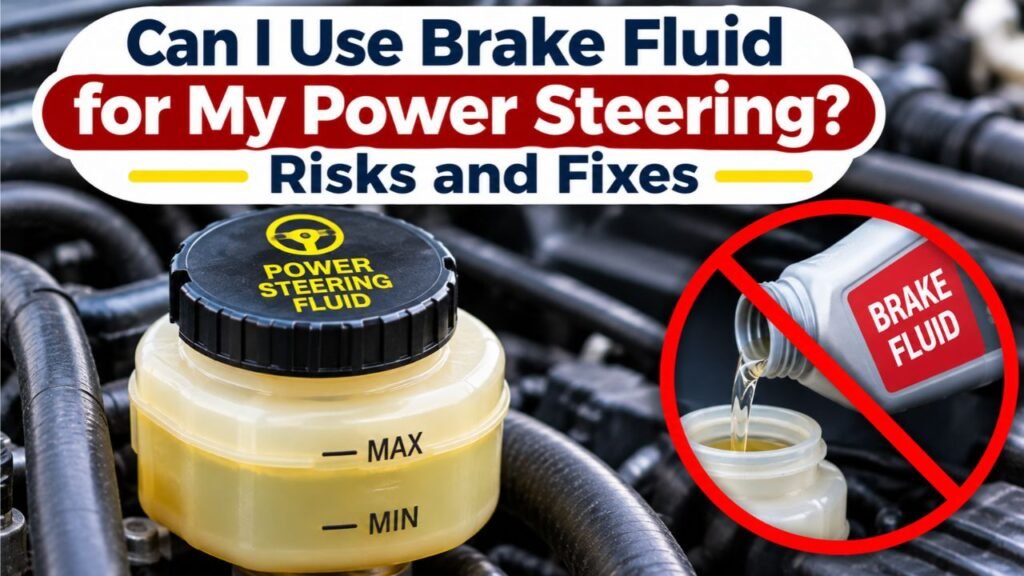
No. Brake fluid is not a safe emergency substitute for power steering fluid, even if the reservoir is almost empty.
Both products are hydraulic fluids, but that doesn’t make them interchangeable.
Power steering systems require fluid with specific lubrication, viscosity, corrosion protection, and material compatibility characteristics.
Brake fluid is formulated primarily for hydraulic brake systems that operate under different conditions.
Using the wrong fluid can damage internal components and compromise steering assistance.
Why Brake Fluid Is Not a Suitable Substitute
A hydraulic power steering system contains components such as:
- A hydraulic pump.
- A power steering reservoir.
- High-pressure and return hoses.
- A steering rack or steering gearbox.
- Hydraulic valves.
- Internal seals and O-rings.
These components are designed to operate with approved hydraulic fluid.
Brake fluid may not provide the lubrication or compatibility required by the steering system.
It can also interact unfavorably with seals and other materials.
According to YOUCANIC’s guide to accidentally adding brake fluid to power steering, using brake fluid in a power steering system can damage the pump and seals, potentially causing premature component failure.
What If You Only Need to Drive a Short Distance?
Using brake fluid for a short distance is still unsafe.
The amount of damage depends on factors such as:
- Quantity of brake fluid added.
- Original steering fluid.
- System design.
- Length of operation.
- Fluid circulation.
- Component materials.
There is no guaranteed safe distance or quantity.
If the correct power steering fluid is unavailable, obtain the specified product or arrange appropriate assistance.
Don’t deliberately contaminate the system to complete a short trip.
Is It Better to Drive With Low Power Steering Fluid?
Neither operating with dangerously low fluid nor adding brake fluid is a good solution.
Low fluid can cause poor lubrication, pump damage, noise, and reduced steering assistance.
A low reservoir may also indicate a leak.
The appropriate response is to identify the specified fluid and correct the low-fluid condition without introducing contamination.
Key Takeaway: Brake fluid should never be used as an emergency substitute for power steering fluid. Use only a product approved for the specific vehicle.
Brake Fluid vs Power Steering Fluid: What’s the Difference?
Brake fluid and power steering fluid perform different functions.
Both use hydraulic pressure, but their chemical formulations are significantly different.
Brake Fluid
Brake fluid transfers hydraulic pressure from the master cylinder to the wheel brakes.
Most commonly used automotive brake fluids are formulated to provide:
- High boiling-point resistance.
- Suitable hydraulic pressure transmission.
- Compatibility with brake-system seals.
- Corrosion protection.
- Performance across specified temperatures.
DOT 3, DOT 4, and DOT 5.1 fluids are generally glycol-based.
DOT 5 is a different silicone-based brake fluid and isn’t interchangeable with glycol-based brake fluids.
Power Steering Fluid
Power steering fluid transfers hydraulic pressure in a steering-assistance system.
It also lubricates internal components.
Its formulation must meet the requirements of the pump, valves, seals, hoses, and steering gear.
Depending on the manufacturer, the approved fluid may be:
- Dedicated power steering fluid.
- A specified automatic transmission fluid.
- A specialized synthetic hydraulic fluid.
The correct formulation varies by vehicle.
Brake Fluid vs Power Steering Fluid Comparison
| Feature | Brake fluid | Power steering fluid |
| Primary function | Operates hydraulic brakes | Provides hydraulic steering assistance |
| Common chemical base | Glycol-based for DOT 3, 4, and 5.1 | Petroleum-derived or specialized synthetic hydraulic oil |
| High boiling-point requirements | Central design requirement | Different thermal and fluid requirements |
| Lubrication | Formulated for brake-system requirements | Formulated to lubricate steering components |
| Seal compatibility | Brake-system materials | Steering-system materials |
| Common reservoir | Brake master cylinder reservoir | Power steering reservoir |
| Typical specification | DOT 3, DOT 4, DOT 5, or DOT 5.1 | Manufacturer-specific PSF, ATF, or hydraulic specification |
| Can replace the other | No | No |
Why Doesn’t Hydraulic Fluid Mean Interchangeable?
The term hydraulic fluid describes a fluid’s use in transmitting power.
It doesn’t establish chemical compatibility.
Hydraulic systems can require very different fluids.
For example, a vehicle’s brakes and power steering may both use hydraulic pressure but rely on different seal materials, lubricants, and operating requirements.
The fact that a fluid transfers pressure doesn’t establish that it is suitable for another system.
What Happens if You Put Brake Fluid in Power Steering?
Adding brake fluid to power steering fluid can create several problems.
The severity depends on the amount added, system design, and whether the contaminated fluid has circulated.
1. Damage to Power Steering Seals
Hydraulic steering systems contain seals intended for the approved hydraulic fluid.
Brake fluid may be chemically incompatible with those materials.
Exposure can contribute to:
- Seal swelling.
- Seal deterioration.
- Loss of sealing performance.
- Internal or external leaks.
The effects may develop gradually.
A steering system can initially appear normal even when contamination has introduced a risk of future seal damage.
2. Power Steering Pump Damage
The pump depends on suitable fluid for hydraulic operation and lubrication.
Brake fluid doesn’t necessarily provide the intended lubrication characteristics.
This can contribute to increased wear or other pump problems.
Possible symptoms include whining noises, reduced performance, or eventual pump failure.
However, pump noise alone doesn’t prove that brake fluid contamination is the cause.
3. Damage to Steering Hoses
Power steering hoses are designed for specific hydraulic fluids.
An incompatible fluid may affect some hose materials or seals at their connections.
This can increase the risk of leakage.
A high-pressure steering leak is a serious concern and requires appropriate repair.
4. Steering Rack or Gearbox Problems
The steering rack or gearbox contains internal hydraulic components and sealing materials.
Contaminated fluid can travel through these parts as the system operates.
Potential consequences include:
- Internal leakage.
- Reduced steering assistance.
- Seal deterioration.
- Abnormal steering behavior.
- Premature component wear.
If damage progresses, repair or replacement of affected components may become necessary.
5. Fluid Foaming or Changes in Performance
Mixing incompatible fluids may alter their intended properties.
Depending on their formulations, the mixture may exhibit undesirable changes in lubrication, viscosity, or other characteristics.
Foaming and inconsistent hydraulic performance can also occur for several other reasons, including air entering through leaks.
The exact chemical behavior cannot be predicted reliably from the fluid names alone.
6. Loss of Power Steering Assistance
Severe pump problems, fluid leakage, or internal hydraulic failure can reduce power steering assistance.
The steering wheel may become much harder to turn, particularly during low-speed maneuvers.
The vehicle’s mechanical steering connection may still function, depending on its design, but steering effort can increase substantially.
Unexpected steering-assist loss creates a safety risk.
Key Takeaway: Contamination may not cause an immediate failure, but it can damage seals and hydraulic components. Lack of symptoms immediately after adding brake fluid doesn’t prove the system is safe.
What to Do if You Accidentally Put Brake Fluid in Power Steering
If you have already added brake fluid, the next steps depend primarily on whether the steering system has operated and circulated the contaminated fluid.
Step 1: Do Not Start the Engine
If the engine is off, leave it off.
In conventional hydraulic power steering systems, the engine drives the pump.
Starting the engine can circulate contaminated fluid into the hoses, pump, and steering gear.
Some electro-hydraulic systems have electrically powered pumps, so avoid switching on or operating the system until its configuration is understood.
Step 2: Do Not Operate the Steering System
Avoid turning the steering wheel or otherwise activating the hydraulic assist system unnecessarily.
The goal is to prevent additional circulation of contaminated fluid.
Step 3: Identify What Was Added
Check the container label.
Record:
- Brake fluid specification.
- Product name.
- Approximate quantity added.
- Whether other fluids were present.
- Whether the engine or steering pump operated afterward.
This information can help a technician determine the appropriate response.
Step 4: Avoid Mixing in Additional Fluids
Do not attempt to solve the problem by simply adding more power steering fluid.
Dilution doesn’t guarantee that incompatible fluid has been removed.
Likewise, don’t add chemical cleaners, solvents, or other fluids that haven’t been approved for the steering system.
Step 5: Have the Reservoir and System Assessed
If the engine has not been started and the fluid has not circulated, the contamination may be more localized.
A qualified technician can determine whether the reservoir can be drained and cleaned without exposing additional components.
However, removing fluid from the reservoir alone may not be sufficient in every system.
Step 6: Arrange Professional Flushing When Necessary
If the steering pump has operated after contamination, a professional system flush may be needed.
The technician may inspect:
- Reservoir.
- Pump.
- Hydraulic hoses.
- Steering rack or gearbox.
- Seals.
- Fluid condition.
The repair must remove incompatible fluid and address any damaged components.
Step 7: Refill With the Correct Fluid
After the system has been appropriately serviced, it should be filled with the manufacturer-specified hydraulic fluid.
The system may also need to be bled to remove trapped air.
Follow the vehicle manufacturer’s procedure.
Step 8: Verify Steering Operation
Before the vehicle returns to service, the technician should verify that:
- The correct fluid has been installed.
- Fluid level is appropriate.
- There are no leaks.
- Steering assistance operates correctly.
- Abnormal pump noises are absent.
- The system has been properly bled.
If steering performance remains abnormal, further diagnosis is necessary.
What If You Already Drove the Car?
If the system has been operated with brake fluid contamination, stop using the vehicle and arrange professional assistance.
Do not assume that a normal-feeling steering wheel means the contamination is harmless.
For an uncertain or potentially compromised system, towing is preferable to driving.
Important: If you accidentally added brake fluid, don’t continue driving to test whether it causes problems. Prompt professional correction offers the best chance of limiting damage.
What If You Only Added a Small Amount of Brake Fluid?
The amount matters, but there is no universally safe quantity.
A few drops create a different contamination situation from filling most of the reservoir with brake fluid.
However, even a small amount should not be intentionally left in the system.
A Few Drops
A very small amount may have limited the initial exposure.
If the pump hasn’t operated, the contamination may still be largely confined to the reservoir.
Nevertheless, the correct response depends on the steering system and fluid chemistry.
A technician should determine whether reservoir cleaning is enough.
A Small Splash
Adding a tablespoon or similarly small quantity is not automatically harmless.
If the pump operates, the contaminant may circulate.
Don’t assume that dilution eliminates the compatibility problem.
A Large Amount
If a significant portion of the reservoir has been filled with brake fluid, the contamination risk is higher.
This situation warrants prompt professional assessment.
Do not run the pump to see whether the steering still works.
Does Adding More Power Steering Fluid Fix It?
No.
Adding more correct fluid may lower the concentration of contamination, but it doesn’t reliably remove the brake fluid.
Some incompatible fluid may remain in contact with seals and internal components.
Proper removal and inspection are more dependable.
Can Brake Fluid Damage Power Steering Seals?
Yes.
Power steering seals are designed to work with particular hydraulic fluids.
Their chemical compatibility is important to system reliability.
Why Seal Materials Matter
Automotive hydraulic systems use different rubber and elastomer formulations.
A material that resists one fluid may not resist another.
For example, many hydraulic brake seals are designed for glycol-based brake fluids.
Conventional steering systems commonly use materials selected for their approved hydraulic oils.
Exposure to incompatible chemicals may cause unwanted changes in seal dimensions or mechanical properties.
Can Seal Damage Be Reversed?
Not necessarily.
If a seal has swollen, deteriorated, or lost its mechanical properties, replacing the contaminated fluid may not restore the seal.
A technician may need to replace affected components.
The repair depends on the extent of damage.
How Long Does Seal Damage Take?
There is no fixed period.
The reaction depends on:
- Seal material.
- Fluid composition.
- Temperature.
- Concentration.
- Exposure duration.
A system may develop leakage after some time rather than immediately.
This is why prompt removal matters even when the vehicle initially operates normally.
Can Brake Fluid Damage the Power Steering Pump?
Yes.
A hydraulic steering pump requires fluid with suitable lubrication and viscosity properties.
Brake fluid is not engineered as a substitute for the specified steering lubricant.
Why Pump Lubrication Matters
The pump contains moving parts operating under hydraulic loads.
The approved fluid helps reduce wear and maintain proper operation.
An unsuitable fluid can affect lubrication and internal performance.
The extent of damage depends on pump design and operating conditions.
Signs of a Potential Pump Problem
Symptoms may include:
- Whining or groaning noises.
- Difficulty turning the steering wheel.
- Inconsistent assist.
- Fluid leakage.
- Abnormal vibration.
- Pump overheating.
These symptoms can also result from ordinary power steering problems, including low fluid or air in the system.
They do not prove brake fluid contamination without further diagnosis.
Will a Flush Fix the Pump?
A flush may remove contaminated fluid.
However, it cannot repair worn internal components or damaged seals.
If the pump has already suffered damage, replacement or another repair may be necessary.
Should You Replace the Pump Immediately?
Not every contamination incident requires automatic pump replacement.
The need depends on the amount of exposure, whether the system was operated, and the inspection findings.
A professional should determine which components are still serviceable.
Which Fluid Should You Use for Power Steering?
The correct power steering fluid depends on your vehicle.
There is no single universal power steering fluid suitable for every make and model.
Some vehicles require dedicated power steering fluid.
Others specify automatic transmission fluid or specialized hydraulic fluid.
Common Power Steering Fluid Types
| Fluid type | Typical use | Important caution |
| Dedicated power steering fluid | Vehicles requiring a specified PSF | Match the manufacturer specification |
| Automatic transmission fluid (ATF) | Certain steering systems designed for ATF | Use only the approved ATF specification |
| Specialized hydraulic fluid | Some European and other hydraulic steering applications | Must meet the exact vehicle requirements |
| DOT 3 brake fluid | Hydraulic braking systems | Not suitable as power steering fluid |
| DOT 4 brake fluid | Hydraulic braking systems | Not suitable as power steering fluid |
| DOT 5 brake fluid | Specific compatible brake applications | Not suitable as power steering fluid |
| DOT 5.1 brake fluid | Hydraulic braking systems requiring compatible fluid | Not suitable as power steering fluid |
What Does the Owner’s Manual Say?
The manufacturer’s specifications are the primary reference.
For example, the Mahindra Bolero owner’s manual lists an approved ATF-type lubricant for the power steering system and a separate DOT 3 brake-fluid specification for the braking system.
This demonstrates why the two fluids cannot be treated as substitutes.
However, these specifications apply to the particular vehicle covered by that manual, not to every car.
Can Automatic Transmission Fluid Replace Power Steering Fluid?
Sometimes.
Certain vehicles are specifically designed to use an approved ATF in the steering system.
Other vehicles require a dedicated steering fluid.
You should never assume ATF is compatible simply because another vehicle uses it.
What About Synthetic Power Steering Fluid?
Synthetic fluid may be appropriate when it meets the manufacturer’s required specifications.
However, a generic label such as synthetic hydraulic fluid doesn’t establish compatibility.
Verify the exact requirement.
Does Fluid Color Matter?
Fluid color is not a reliable compatibility test.
Some power steering fluids are red, green, amber, or nearly clear.
Their appearance doesn’t establish whether the formulation is approved for your vehicle.
Key Takeaway: Match the required specification, not simply the fluid’s color or the label’s general description.
Can You Use DOT 3, DOT 4, or DOT 5 Brake Fluid in Power Steering?
No.
The DOT classification doesn’t make a brake fluid suitable for steering assistance.
DOT 3 Brake Fluid
DOT 3 is commonly used in compatible hydraulic braking systems.
It is generally glycol-based.
It should not be used in a conventional hydraulic power steering system.
DOT 4 Brake Fluid
DOT 4 has higher minimum boiling-point requirements than DOT 3.
However, higher boiling resistance doesn’t make it suitable for power steering.
It remains a brake fluid, with different chemical and material compatibility requirements.
DOT 5 Brake Fluid
DOT 5 is silicone-based.
This distinguishes it from glycol-based DOT 3, DOT 4, and DOT 5.1.
However, being silicone-based doesn’t make DOT 5 an approved power steering lubricant.
It should not be used in a power steering system unless a manufacturer explicitly specifies an appropriate product for that system.
Conventional automotive power steering systems do not use ordinary DOT 5 brake fluid as a substitute.
DOT 5.1 Brake Fluid
DOT 5.1 is glycol-based despite its name.
It is intended for compatible braking applications.
Its higher minimum boiling-point requirements do not make it an alternative to power steering fluid.
Does Higher DOT Number Mean Better Steering Fluid?
No.
DOT brake-fluid classifications aren’t power steering fluid performance ratings.
Do not select steering fluid based on DOT numbers.
Can You Use Brake Fluid in a Hydro-Boost Steering and Brake System?
No.
Some vehicles use a hydraulic brake booster powered by the power steering pump.
This system is commonly called Hydro-Boost.
However, it doesn’t mean the vehicle’s brake fluid and power steering fluid are interchangeable.
How Hydro-Boost Works
A conventional vacuum brake booster uses engine vacuum or another vacuum source to assist braking.
A Hydro-Boost system uses hydraulic pressure to provide brake assistance.
In many designs, this pressure comes from the power steering hydraulic circuit.
Are the Brake and Steering Fluids Shared?
No, not in the sense of mixing their hydraulic fluids.
The hydraulic booster and the brake master cylinder have distinct fluid circuits.
The booster side uses the approved steering hydraulic fluid.
The brake hydraulic system uses its specified brake fluid.
They perform related functions but remain hydraulically separate.
Why Is This Important?
Because the brake booster uses power steering pressure, a driver may mistakenly believe that brake fluid belongs in the steering reservoir.
That is incorrect.
Contamination can affect seals and hydraulic components.
Always identify the correct reservoir and specified fluid before topping off either system.
What If the Hydro-Boost System Is Contaminated?
Avoid operating the system.
Have a qualified technician assess the contamination and perform the appropriate service.
Because steering assistance and brake assistance may depend on the same hydraulic power source, a failure can affect both functions.
This is a particularly serious reason to avoid experimenting with incompatible fluids.
How Can You Tell if Brake Fluid Was Added to Power Steering?
You cannot always confirm contamination by appearance alone.
Brake fluid and power steering fluid can have similar colors.
The mixture may also change appearance depending on formulation and circulation.
Check the Service History
Consider whether the wrong fluid may have been added during:
- Routine maintenance.
- A home fluid top-off.
- A recent repair.
- A quick-service appointment.
- A previous owner’s maintenance.
If you have an actual reason to suspect contamination, investigate promptly.
Inspect the Fluid Container
If the mistake occurred recently, check which bottle was used.
The product label is more useful than judging the fluid by color.
Look for Warning Symptoms
Possible symptoms include:
- Abnormal pump noise.
- Inconsistent steering assistance.
- New hydraulic leaks.
- Excessive steering effort.
- Unexpected fluid changes.
However, these problems can have other causes.
Can a Mechanic Confirm the Fluid Type?
A technician may be able to identify contamination through service history, fluid inspection, or suitable testing.
The appropriate method depends on the system and what contaminants are suspected.
Don’t rely solely on smell or color.
Can You Flush Brake Fluid Out of Power Steering?
A professional flush is often an appropriate response when brake fluid has circulated through the steering system. However, flushing may not repair seals or components that have already been damaged.
The exact procedure varies by vehicle.
Reservoir-Only Fluid Removal
If contamination is discovered before the system operates, a technician may be able to remove fluid from the reservoir and prevent further circulation.
However, a simple reservoir exchange doesn’t necessarily remove fluid from the entire hydraulic system.
Complete Steering System Flush
A more comprehensive flush is intended to replace contaminated fluid throughout the hydraulic circuit.
The technician must use the correct approved fluid and an appropriate service procedure.
The system also requires proper bleeding afterward.
The CarParts.com power steering fluid flush guide, reviewed by an ASE-certified master automotive technician, explains that a reservoir exchange replaces only part of the fluid, while a return-line flush can replace more of the system’s fluid.
It also stresses the importance of using the exact fluid required by the manufacturer.
Should You Use a Chemical Flush?
Don’t use an arbitrary solvent or chemical cleaner.
An unapproved flushing chemical can introduce additional compatibility problems.
Use the procedure and materials approved for the particular steering system.
Can You Flush the System Yourself?
Some experienced technicians and DIY mechanics perform steering-fluid exchanges.
However, an incompatible-fluid contamination incident is different from ordinary maintenance.
Incorrect procedures can introduce air, operate the pump without sufficient fluid, or leave contamination behind.
Because steering is safety-critical, professional servicing is the preferable approach when brake fluid has entered the system.
What If a Flush Doesn’t Fix the Problem?
Additional inspection may reveal damaged seals, hoses, or steering components.
Repair or replacement may be necessary.
A flush cannot restore components that have already suffered significant physical or chemical damage.
How Much Does It Cost to Fix Brake Fluid in Power Steering?
Repair costs depend on how much contamination occurred and whether components were damaged.
A simple reservoir cleanup can be less involved than replacing a pump or steering rack.
However, the correct procedure must still be followed.
Factors That Affect Repair Cost
Costs depend on:
- Vehicle make and model.
- Steering system design.
- Amount of brake fluid added.
- Whether the pump circulated the fluid.
- Labor rates.
- Required flushing procedure.
- Replacement parts.
- Amount and specification of new fluid.
If the Engine Was Never Started
The problem may be less extensive if the contaminated fluid remained in the reservoir.
Prompt professional removal may help prevent additional exposure.
However, the actual required work depends on the system configuration.
If the Vehicle Was Driven
If contaminated fluid circulated throughout the system, repairs may be more extensive.
A technician may need to evaluate the steering pump, rack, hoses, and seals.
Component replacement may be necessary if damage is found.
Is Repair Always Expensive?
Not necessarily.
The final cost can vary significantly.
The important factor is addressing the problem promptly instead of continuing to operate the contaminated system.
For a reliable estimate, request an inspection and written repair quote from a qualified workshop.
What if You Accidentally Put Power Steering Fluid in the Brake Reservoir?
The reverse mistake is also dangerous.
Do not put power steering fluid into a brake fluid reservoir.
Many brake-system seals are designed for glycol-based brake fluids and are incompatible with petroleum-based fluids.
Contamination can cause seals to swell or deteriorate.
This may impair braking and potentially lead to brake failure.
What Should You Do?
If power steering fluid has entered the brake reservoir:
- Do not drive the vehicle.
- Avoid operating the braking system unnecessarily.
- Arrange professional assessment.
- Have the contaminated system serviced according to the manufacturer’s procedure.
- Replace damaged or exposed components where required.
A brake system contaminated with petroleum fluid can require substantial repair.
Simply removing the fluid from the reservoir may not resolve contamination that has reached the hydraulic circuits.
Which Mistake Is More Dangerous?
Both are serious.
However, power steering fluid contamination of the hydraulic braking system can directly compromise the vehicle’s ability to stop.
Brake fluid contamination of a hydraulic steering system can damage components and impair steering assistance.
Neither situation should be ignored.
Does Electric Power Steering Need Brake Fluid or Power Steering Fluid?
Most fully electric power steering systems do not require hydraulic steering fluid at all.
This is important because many modern vehicles use electric power steering instead of conventional hydraulic assistance.
Hydraulic Power Steering
Traditional hydraulic power steering uses:
- A hydraulic pump.
- Fluid reservoir.
- Hydraulic hoses.
- Steering rack or gearbox.
It requires the manufacturer’s specified hydraulic fluid.
Electro-Hydraulic Power Steering
An electro-hydraulic system uses an electric motor to drive a hydraulic pump.
It still uses hydraulic fluid.
The fluid must meet the manufacturer’s specification.
Electric Power Steering
A fully electric power steering system uses an electric motor to provide steering assistance.
It doesn’t rely on a conventional hydraulic steering pump or steering-fluid reservoir.
Therefore, no power steering fluid top-off is required.
How to Identify Your System
Consult the owner’s manual.
A hydraulic or electro-hydraulic vehicle typically has a reservoir and hydraulic lines.
A fully electric system generally doesn’t have a power steering fluid reservoir.
Don’t assume that every car has hydraulic steering.
What Can You Use Instead of Power Steering Fluid?
Only an approved fluid should be used.
There is no safe universal household substitute.
Automatic Transmission Fluid
Some vehicles specify a particular ATF for power steering.
If the owner’s manual explicitly permits it, that exact fluid may be appropriate.
Otherwise, do not use it.
Dedicated Power Steering Fluid
A product meeting the manufacturer’s required power steering specification is suitable.
However, products labeled universal power steering fluid are not automatically compatible with every vehicle.
Check the actual approval or specification.
Specialized Hydraulic Fluid
Some vehicles require specialized hydraulic fluid with a particular specification.
These fluids must not be replaced by ordinary ATF or generic hydraulic oil unless the vehicle manufacturer approves the substitution.
Can You Use Engine Oil?
No, unless a highly specialized system explicitly specifies such a lubricant.
Ordinary automotive power steering systems aren’t designed to use random engine oil.
Can You Use Transmission Fluid?
Only when the manufacturer specifies a compatible ATF.
The general term transmission fluid isn’t enough.
Different transmission fluids have different formulations.
Can You Use Water?
No.
Water doesn’t provide the required lubrication, corrosion protection, and hydraulic-fluid performance.
It can cause serious damage.
Can You Use Brake Fluid?
No.
It is chemically and functionally unsuitable for conventional hydraulic power steering.
Key Takeaway: The correct substitute is not simply another automotive fluid. It must meet the steering system’s exact specification.
How to Check and Add Power Steering Fluid Safely
If the vehicle uses hydraulic power steering and the reservoir is low, use the manufacturer’s procedure.
Step 1: Park Safely
Park on level ground.
Secure the vehicle.
Follow the owner’s manual regarding engine temperature and whether the engine should be running or stopped during the level check.
Never reach near moving belts or pulleys.
Step 2: Locate the Correct Reservoir
Identify the power steering reservoir.
Check the cap and owner’s manual.
Do not confuse it with:
- Brake fluid reservoir.
- Engine coolant reservoir.
- Windshield washer tank.
- Transmission-related components.
Step 3: Verify the Fluid Specification
Before opening the reservoir, identify the exact fluid required.
Use the owner’s manual or manufacturer service information.
Step 4: Inspect the Fluid Level
Some reservoirs use MIN and MAX markings.
Others have HOT and COLD level indicators.
Follow the correct procedure for the vehicle.
Step 5: Add the Correct Fluid if Appropriate
If a simple top-off is appropriate, add the approved fluid in small amounts.
Avoid overfilling.
Do not mix incompatible products.
Step 6: Check for Leaks
Power steering fluid doesn’t normally disappear without a reason.
A persistently low level may indicate leakage.
Inspect visible components for fluid loss without contacting hot or moving parts.
Have the system checked if the level repeatedly drops.
Step 7: Confirm Normal Steering Operation
After proper servicing, steering assistance should operate normally.
Unexpected noises, leaks, or heavy steering require investigation.
Don’t continue driving with unexplained steering problems.
Common Mistakes When Choosing Power Steering Fluid
Assuming All Hydraulic Fluids Are Interchangeable
Different hydraulic systems use fluids with different chemical requirements.
Always follow the specified formulation.
Using Brake Fluid Because It Is Available
Brake fluid is not an acceptable substitute.
Its chemical composition may damage steering-system components.
Assuming DOT 5 Is Safe Because It Is Silicone-Based
DOT 5 is a brake fluid, not a power steering lubricant.
Do not use it in steering systems.
Using Any Automatic Transmission Fluid
Some systems require a specific ATF, but others do not.
Use only the approved formulation.
Matching Fluid by Color
Color does not reliably identify fluid chemistry.
Read the specification.
Mixing Different Steering Fluids Without Confirmation
Two products may both be labeled power steering fluid yet have incompatible formulations.
Verify compatibility before mixing.
Adding More Fluid to Hide a Leak
Topping off may temporarily restore the level, but it doesn’t repair a damaged hose, pump, or seal.
Continuing to Drive After Adding Brake Fluid
Operating the pump can spread contamination.
Stop use and seek professional assessment.
Assuming a Reservoir Exchange Cleans the Entire System
Some fluid remains in hoses and steering components.
A technician must determine the appropriate cleaning or flushing method.
Ignoring Electric Power Steering
Fully electric steering systems don’t use ordinary hydraulic steering fluid.
Don’t search for a reservoir that isn’t part of the vehicle’s design.
How to Prevent Mixing Brake Fluid and Power Steering Fluid
Preventing contamination is much easier than repairing a damaged system.
Keep Fluids in Original Containers
Avoid storing automotive fluids in unmarked bottles.
Keep the product label readable.
Verify the Reservoir Before Opening It
Check the cap markings and owner’s manual.
Brake and power steering reservoirs can both be located in the engine compartment.
Use Separate Filling Equipment
Avoid using the same funnel or transfer tool for different fluids unless it has been properly cleaned according to the appropriate procedures.
Dedicated, labeled tools help reduce cross-contamination.
Read the Specification, Not Just the Product Name
A bottle labeled hydraulic fluid isn’t necessarily suitable for power steering.
Check the manufacturer’s requirements.
Avoid Guessing During Emergencies
If you cannot confirm the correct fluid, don’t add a substitute.
Obtain the right product or arrange assistance.
Inspect Low Fluid Levels
A low reservoir may indicate a leak.
Check the underlying problem instead of repeatedly topping off.
Follow Manufacturer Maintenance Instructions
Use the specified inspection, service, and replacement procedures.
This helps protect the pump, seals, and other steering components.
Conclusion
You should never use brake fluid for your power steering system. Although both products transfer hydraulic pressure, they have different chemical compositions and are formulated for different components.
DOT 3, DOT 4, DOT 5, and DOT 5.1 brake fluids are not suitable substitutes for conventional power steering fluid.
Using brake fluid in a hydraulic steering system can damage seals, hoses, the pump, and the steering rack or gearbox.
If brake fluid has already been added, I recommend leaving the system off and arranging professional inspection before the contaminated fluid can circulate farther.
The required repair depends on the quantity added, how long the system operated, and whether any components were damaged.
For routine power steering maintenance, always use the exact fluid specification listed by the vehicle manufacturer. Some vehicles require dedicated power steering fluid, while others use an approved automatic transmission fluid or specialized hydraulic lubricant.
The safest rule is simple: brake fluid belongs in compatible brake systems, and power steering systems must use their specifically approved hydraulic fluid.
FAQs About Can I Use Brake Fluid for My Power Steering
Can I Put DOT 3 Brake Fluid in Power Steering?
No. DOT 3 is formulated for compatible hydraulic brake systems.
It doesn’t meet ordinary power steering lubrication and material compatibility requirements.
Use the fluid specified by the vehicle manufacturer.
What Happens if I Accidentally Add Brake Fluid to Power Steering?
Brake fluid can contaminate the hydraulic system and potentially damage seals, the steering pump, hoses, and other components.
If the system hasn’t operated, leave it off and arrange prompt professional assessment.
If it has been driven, the system may require a comprehensive flush and inspection.
Can a Small Amount of Brake Fluid Damage Power Steering?
Yes, contamination can create risks even when the quantity is small.
However, the actual outcome depends on the amount, system design, and exposure.
There is no universally safe amount to leave in the reservoir.
Can I Flush Brake Fluid Out of My Power Steering System?
A professional flush can remove contaminated fluid from the hydraulic circuit.
However, flushing doesn’t repair components that have already suffered damage.
A technician should determine the correct service procedure and inspect affected seals, hoses, and the pump.
Can I Use Transmission Fluid Instead of Power Steering Fluid?
Only if the vehicle manufacturer specifically permits the relevant automatic transmission fluid.
Some power steering systems use ATF, while others require dedicated or specialized hydraulic fluid.
Always match the exact specification.
Is Power Steering Fluid the Same as Brake Fluid?
No.
Both are hydraulic fluids, but they are formulated for different applications.
Brake fluid is designed for hydraulic braking systems, while power steering fluid must provide the lubrication and compatibility required by steering components.
They should never be interchanged.
Can I Drive With Brake Fluid in My Power Steering Reservoir?
No. Driving may circulate contaminated fluid through the pump, hoses, and steering gear.
This can increase the risk of damage and loss of steering assistance.
Leave the vehicle off and arrange appropriate service before driving again.