Can I Use Brake Cleaner as Starting Fluid? Risks and Alternatives
No, you should not use brake cleaner as starting fluid. Some non-chlorinated brake cleaners contain flammable solvents that might briefly make an engine fire, but they are formulated to strip grease and oil from brake components—not to provide a controlled, engine-safe starting mixture. Spraying them into an intake creates fire, backfire, inhalation, and potential engine-damage risks. Chlorinated brake cleaner is especially unsuitable because heating its solvents can generate hazardous decomposition fumes.
Starting fluid is a different product, and even purpose-made starting fluid is not appropriate for every engine. Some manufacturers specifically prohibit it, particularly on diesels equipped with glow plugs or intake heaters. A car, lawn mower, or generator that will not start usually needs a proper diagnosis instead of repeated aerosol sprays.
A no-start problem may involve stale fuel, weak battery voltage, an ignition fault, restricted airflow, or failed fuel delivery. Diagnosing those causes is more useful than briefly forcing an engine to fire.
In this article, I explain why brake cleaner is unsafe as starting fluid, the difference between chlorinated and non-chlorinated formulas, and what may happen if it has already been sprayed. I also cover safer alternatives and practical troubleshooting steps for gasoline, diesel, and small engines.
Can I Use Brake Cleaner as Starting Fluid? The Short Answer
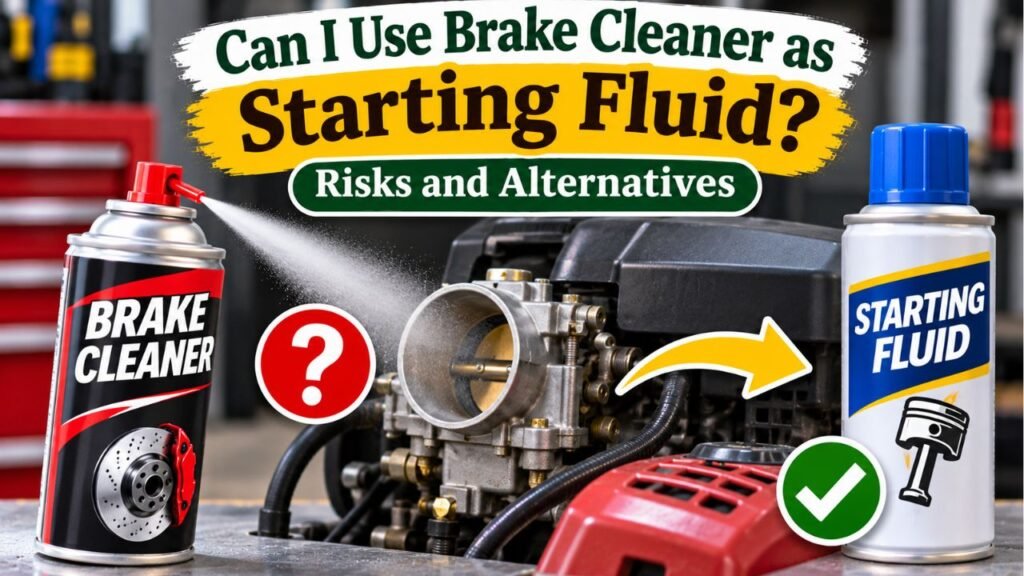
Brake cleaner should not be used as a substitute for starting fluid in gasoline or diesel engines.
The products have different chemical formulations and intended uses.
Brake cleaner is designed to remove oil, grease, brake dust, and other contaminants from brake components. Starting fluid is specifically formulated to assist starting in compatible internal combustion engines.
Some brake cleaners contain combustible solvents. These may ignite inside an engine under certain conditions, which explains why people sometimes claim that brake cleaner works as starting fluid.
However, the ability to ignite does not make a chemical suitable for engine combustion.
According to CRC Industries’ guide to brake cleaner and its common misuses, brake cleaner is not a safe starting-fluid substitute. The manufacturer identifies fire hazards and potential engine damage as important concerns.
Brake Cleaner vs Starting Fluid
| Feature | Brake cleaner | Starting fluid |
| Intended purpose | Cleaning brake components | Helping compatible engines start |
| Typical formulation | Fast-evaporating cleaning solvents | Highly volatile combustible ingredients |
| Designed for engine starting? | No | Yes, where manufacturer-approved |
| Flammability | Depends on formulation | Generally highly flammable |
| Lubricating ingredients | Generally not intended to lubricate | Some formulations include lubricating additives |
| Intake-system compatibility | Not established for starting use | Depends on product and engine |
| Potential fire hazard | Yes | Yes |
| Suitable for diesel engines with glow plugs? | No | Generally prohibited without specific manufacturer approval |
| Recommended alternative for a no-start problem | Do not use | Diagnose the fault; use only if explicitly permitted |
Key Takeaway: A solvent that can burn is not automatically a safe engine-starting product. Brake cleaner should remain a brake-cleaning product.
Why Do Some People Use Brake Cleaner as Starting Fluid?
Some mechanics and DIY vehicle owners have heard that spraying a combustible aerosol into an intake can briefly help an engine start.
This claim exists because certain non-chlorinated brake cleaners contain volatile hydrocarbons or other flammable solvents.
When an engine draws in combustible vapor, the vapor may ignite under suitable conditions.
However, the outcome is unpredictable.
Why an Engine Might Fire Briefly
An engine needs several conditions to start and continue running.
A gasoline engine generally requires:
- An appropriate air-fuel mixture
- Adequate compression
- Correct ignition timing
- A functioning ignition system
- Sufficient cranking speed
A flammable aerosol may temporarily provide combustible vapor.
However, brake cleaner is not formulated to deliver the controlled fuel characteristics required by the engine.
The engine may briefly fire, run roughly, backfire, or fail to start.
Does a Brief Start Mean Brake Cleaner Is Safe?
No.
A short combustion event does not prove that the product is safe for the intake system, engine components, or nearby people.
A substance may ignite while still presenting a serious fire or toxicity hazard.
Repeated exposure can also create additional risks.
Does It Diagnose a Bad Fuel Pump?
Not reliably.
Some people assume that if an engine briefly fires on an aerosol, the fuel pump must be defective.
That conclusion is too narrow.
Potential causes of insufficient fuel delivery include:
- Empty fuel tank
- Faulty fuel pump
- Restricted fuel filter
- Injector problems
- Carburetor faults
- Fuel pressure regulation problems
- Electrical or control-system faults
A temporary combustion event does not identify which component has failed.
Proper diagnostic testing is more useful.
Chlorinated vs Non-Chlorinated Brake Cleaner as Starting Fluid
Brake cleaners are available in different formulations.
The distinction between chlorinated and non-chlorinated products is important because their chemical properties and hazards differ.
Can You Use Non-Chlorinated Brake Cleaner as Starting Fluid?
No. Non-chlorinated brake cleaner is not a safe starting-fluid substitute, even when its ingredients are flammable.
Many non-chlorinated products contain solvents such as:
- Acetone
- Heptane
- Other hydrocarbon solvents
- Alcohols, depending on formulation
These substances help dissolve contaminants and evaporate quickly.
However, their behavior as cleaning solvents does not establish their suitability for combustion inside an engine.
Potential risks include:
- Flash fire
- Intake backfire
- Inhalation exposure
- Damage to plastics or rubber components
- Loss of protective lubrication
- Uncontrolled combustion
Some non-chlorinated formulations are labeled extremely flammable.
That warning should be treated as a hazard, not a recommendation for engine starting.
Can You Use Chlorinated Brake Cleaner as Starting Fluid?
No. Chlorinated brake cleaner is especially inappropriate for engine-starting use.
Some chlorinated formulas are classified as nonflammable under specified testing conditions.
However, nonflammable does not mean harmless.
Chlorinated solvents exposed to sufficiently high temperatures or ignition-related conditions can decompose and release hazardous gases.
This presents a serious inhalation risk.
The chemicals are not intended to enter an engine’s combustion chambers.
Is Nonflammable Brake Cleaner Safer for Starting an Engine?
No.
A nonflammable cleaner may not provide a combustible starting mixture at all.
More importantly, its solvent chemistry may create serious health risks when exposed to heat.
Never assume a product is suitable for engine use because its label says nonflammable.
Chlorinated vs Non-Chlorinated Comparison
| Feature | Chlorinated brake cleaner | Non-chlorinated brake cleaner |
| Primary use | Brake component cleaning | Brake component cleaning |
| Solvent chemistry | Contains chlorinated solvents | Uses non-chlorinated solvents |
| Flammability | Some formulations are nonflammable | Many formulations are highly flammable |
| Main starting-use concern | Hazardous fumes and inappropriate chemistry | Fire, backfire, and engine damage |
| Intended for combustion? | No | No |
| Recommended as starting fluid? | No | No |
The bottom line is the same for both products: neither should be sprayed into an engine as starting fluid.
What Happens If You Use Brake Cleaner as Starting Fluid?
The outcome depends on the product formulation, the amount involved, and the engine’s operating condition.
A single accidental exposure does not guarantee immediate engine failure, but several hazards are possible.
1. Intake Backfire
Combustible vapor can ignite unexpectedly under unfavorable conditions.
An intake backfire can create sudden pressure and flame movement through the intake system.
Potential consequences include damage to:
- Air-intake components
- Air filter housing
- Sensors
- Intake ducting
- Other nearby components
People working near the intake may also be exposed to flames or hot gases.
2. Flash Fire
Some brake cleaners release highly flammable vapor.
The vapor may encounter ignition sources such as electrical sparks, hot components, or engine combustion.
This can create a flash-fire hazard.
Never spray flammable aerosol products toward an operating engine or known ignition source.
3. Loss of Protective Lubrication
Brake cleaner is formulated to dissolve and remove oil and grease.
That is useful when cleaning suitable brake components.
It is not desirable when the solvent contacts engine surfaces that depend on lubrication.
Solvent exposure can remove protective oil films.
Depending on the circumstances, this may increase wear or contribute to component damage.
However, it would be inaccurate to claim that a single small accidental exposure always causes measurable engine wear.
4. Rubber and Plastic Damage
Brake cleaners can be incompatible with certain plastic, rubber, and coated components.
Depending on the product and contact time, exposure may damage:
- Intake seals
- Gaskets
- Plastic housings
- Sensor components
- Protective coatings
Modern intake systems can contain materials that are not compatible with aggressive brake-cleaning solvents.
5. Toxic Vapor Exposure
Brake cleaners can produce vapors that irritate the respiratory system or create other health hazards.
Chlorinated formulations are especially concerning when exposed to high heat because decomposition can produce dangerous gases.
Avoid breathing any aerosol spray or vapor.
6. Additional Engine Problems
Repeated exposure or improper chemical use may contribute to:
- Rough combustion
- Engine hesitation
- Misfiring
- Starting difficulties
- Damage to sensitive intake components
Not every symptom will occur in every engine.
However, none of these risks is justified when safer diagnostic methods are available.
Brake Cleaner vs Starting Fluid: What’s the Chemical Difference?
The main difference is their formulation and intended use.
What Is Brake Cleaner Made For?
Brake cleaner is intended to dissolve and remove unwanted contaminants.
It is typically formulated for rapid evaporation and minimal residue on approved brake components.
It is not designed to serve as engine fuel.
What Is Starting Fluid Made For?
Starting fluid contains volatile ingredients selected to ignite readily under suitable starting conditions.
Some formulations contain ether or other highly volatile combustible ingredients.
Certain products also contain upper-cylinder lubricating additives.
However, starting-fluid formulations vary, and the presence of lubricating additives does not make a product universally safe.
Does Brake Cleaner Contain Ether?
Not every brake cleaner contains the same ingredients.
Some products contain hydrocarbons, ketones, alcohols, or chlorinated solvents.
Do not assume brake cleaner contains ether simply because it evaporates quickly.
Likewise, do not assume every starting-fluid product has exactly the same chemical composition.
Why Does the Difference Matter?
The engine manufacturer designs the starting system around specific fuel, combustion, ignition, and lubrication requirements.
An arbitrary cleaning solvent does not meet those requirements simply because it can burn.
The safest choice is to follow the vehicle manufacturer’s starting instructions.
Can You Use Brake Cleaner to Start a Gasoline Engine?
No. Brake cleaner is not recommended for starting modern or older gasoline engines.
Gasoline engines already have systems designed to deliver an appropriate fuel-air mixture.
A no-start problem is usually best approached by diagnosing those systems.
Modern Fuel-Injected Gasoline Engines
Modern gasoline vehicles commonly use electronic fuel injection, ignition controls, and sensors to manage combustion.
A failure to start may involve:
- Insufficient fuel pressure
- Faulty crankshaft-position sensor
- Weak battery
- Ignition-coil failure
- Injector malfunction
- Electrical wiring or fuse problems
- Immobilizer or security-system faults
Brake cleaner will not identify or correct these problems reliably.
It may also expose sensitive intake components to solvents.
Older Carbureted Gasoline Engines
Older engines use mechanical or electronically assisted carburetors.
Hard starting may involve:
- Stale gasoline
- Blocked fuel passages
- Incorrect choke operation
- Fuel delivery problems
- Ignition faults
- Mechanical compression problems
Some older engines may have manufacturer-approved starting-fluid procedures.
However, brake cleaner is still the wrong product.
Does Brake Cleaner Work Through a Carburetor?
A flammable formulation might cause a brief combustion event under certain conditions.
However, that does not mean it is safe to spray into a carburetor.
Brake cleaner can also affect materials used in carburetor seals and components.
Use appropriate carburetor-cleaning products for the cleaning tasks specified by the manufacturer.
Can You Use Brake Cleaner as Starting Fluid in a Diesel Engine?
No. Brake cleaner should never be used as a starting aid in a diesel engine.
Diesel engines operate using compression ignition rather than spark plugs.
They have specific fuel-injection and combustion requirements.
Introducing an unsuitable volatile solvent can create serious risks.
Why Diesel Engines Require Extra Caution
Some diesel engines use:
- Glow plugs
- Intake air heaters
- Grid heaters
- Specialized cold-start systems
These components can create ignition conditions that make volatile starting products dangerous.
Premature ignition can produce excessive pressure and potentially damage engine components.
What About Ordinary Starting Fluid?
Even purpose-made starting fluid is prohibited on some diesel engines.
According to Perkins’ winter diesel operation and starting guidance, starting fluid should not be used unless the engine has a factory-installed system specifically designed to control its use.
Perkins warns that spraying starting fluid into an air cleaner creates a significant fire or explosion risk.
This caution is even more important when considering brake cleaner, which is not designed as an engine-starting product.
Safer Diesel Starting Checks
If a diesel engine will not start, investigate:
- Battery condition
- Cranking speed
- Fuel quality
- Fuel filter restriction
- Water in the fuel system
- Glow plugs
- Intake heaters
- Cold-weather fuel suitability
- Fuel pressure and injection-system faults
A qualified diesel technician can perform more advanced testing.
Do not use aerosol chemicals to bypass starting-system problems.
Can You Use Brake Cleaner as Starting Fluid for a Lawn Mower?
No. Brake cleaner is not recommended for starting a lawn mower.
Small gasoline engines may appear simpler than modern automotive engines, but they still require the correct fuel and suitable starting conditions.
Why Lawn Mowers Fail to Start
Common causes include:
- Old gasoline
- Empty fuel tank
- Dirty carburetor
- Restricted fuel filter
- Dirty air filter
- Fouled spark plug
- Disconnected ignition wire
- Faulty safety switch
- Incorrect choke operation
- Engine compression problems
The Briggs & Stratton small-engine troubleshooting guide identifies stale fuel, carburetor problems, spark-plug faults, and compression-related issues among common causes of starting problems.
Should You Use Starting Fluid on a Lawn Mower?
Only if the specific engine manufacturer permits it.
Some small-engine manufacturers warn against using pressurized starting fluids because of possible engine damage.
A mower that repeatedly needs starting fluid has an underlying issue that should be diagnosed.
What About Snowblowers and Generators?
The same principle applies.
Brake cleaner should not be used to start snowblowers, portable generators, pressure washers, or similar gasoline-powered equipment.
Use the correct fuel and diagnose the underlying fault.
Can You Use Carb Cleaner Instead of Starting Fluid?
Carburetor cleaner and starting fluid are also different products.
Carb cleaner should not automatically be used as a starting-fluid substitute.
Carburetor cleaner is formulated to remove deposits from approved fuel-system components.
Certain formulations are flammable, but that does not establish safe use as an engine-starting aid.
Brake Cleaner vs Carb Cleaner vs Starting Fluid
| Product | Intended use | Recommended for starting an engine? |
| Brake cleaner | Removing brake contaminants | No |
| Carburetor cleaner | Cleaning compatible carburetor components | Not unless specifically approved |
| Throttle-body cleaner | Cleaning approved throttle-body components | Not unless specifically approved |
| Starting fluid | Assisting engine starting | Only when approved for the engine |
| Fresh recommended fuel | Normal engine operation | Yes, through the vehicle’s designed fuel system |
The correct product should be selected according to its intended application.
Is WD-40 a Safe Alternative?
No.
Multipurpose lubricants and penetrating oils are not automatically suitable as starting fluids.
Some contain flammable components, but that is not proof of safe engine-starting use.
Avoid substituting household aerosols or unrelated automotive chemicals.
Can You Use Gasoline in Place of Starting Fluid?
Gasoline is the normal fuel for gasoline engines, but it must be delivered through the vehicle’s intended fuel system.
Do not pour gasoline into the air intake or use uncontrolled gasoline sprays as a starting aid.
That creates a serious fire hazard.
If the engine is not receiving fuel correctly, diagnose the fuel system.
What Should You Use Instead of Brake Cleaner?
The safest alternative is to address the underlying reason the engine will not start.
There is no single starting product appropriate for every engine.
For a Gasoline Car
Check the normal starting system, including:
- Battery condition
- Starter operation
- Fuel supply
- Relevant fuses
- Ignition-system operation
- Warning lights and fault codes
If the vehicle manufacturer’s instructions permit a particular starting aid, use only the specified product and method.
Modern gasoline vehicles generally should not need starting-fluid sprays during normal operation.
For a Lawn Mower
Start by checking fuel freshness, air filtration, and basic maintenance items.
A dirty carburetor or fouled spark plug may require cleaning or replacement according to the engine manual.
For a Diesel Engine
Check cold-weather fuel suitability, battery capacity, glow-plug operation, and other manufacturer-specified starting components.
Use an approved block heater or battery warming equipment when appropriate.
Do not use improvised aerosol starting aids.
For Any Engine
If the engine has a fuel leak, strong fuel odor, damaged electrical wiring, or evidence of backfire damage, stop troubleshooting until the hazard has been addressed.
A qualified technician may be needed.
How to Diagnose an Engine That Won’t Start Without Brake Cleaner
A systematic approach is more reliable than repeated spraying.
First, determine which type of no-start problem you have.
Step 1: Does the Engine Crank?
Turn the key or operate the starter normally.
Determine whether the engine rotates.
There are two major situations:
- No-crank: The engine does not rotate normally.
- Crank-no-start: The engine rotates but does not begin running.
These conditions often have different causes.
Step 2: Check the Battery
If the starter turns slowly or only clicks, battery voltage or the starting circuit may be involved.
Check:
- Battery charge
- Terminal condition
- Connection tightness
- Relevant electrical warnings
A battery may show a reasonable resting voltage yet fail under load.
A proper battery test may be necessary.
Step 3: Check the Fuel Supply
Confirm that the correct fuel is present.
For gasoline-powered small equipment, consider whether the fuel is stale.
For modern fuel-injected vehicles, fuel pressure may require a proper diagnostic test.
Do not open pressurized fuel-system components without following the manufacturer’s safety procedure.
Step 4: Check the Air Intake
Inspect the air filter according to the service manual.
A severely restricted filter can affect engine operation.
Check for damaged intake hoses or obvious obstructions.
Avoid spraying brake cleaner into the intake during inspection.
Step 5: Check Ignition-System Symptoms
Gasoline engines need a functioning ignition system.
Potential faults include:
- Spark plugs
- Ignition coils
- Ignition wiring
- Crankshaft-position sensors
- Electrical controls
Do not perform unsafe open-spark tests around fuel vapors.
Use approved diagnostic equipment or a qualified mechanic.
Step 6: Check Fault Codes
On vehicles with onboard diagnostics, a compatible scan tool may provide relevant diagnostic trouble codes.
However, a code does not automatically identify the exact failed component.
Interpret codes alongside symptoms and diagnostic measurements.
Step 7: Consider Mechanical Problems
If fuel, ignition, and cranking systems are functioning correctly, mechanical problems may still prevent starting.
Examples include:
- Low compression
- Incorrect valve timing
- Timing-belt or timing-chain problems
- Valve damage
- Other internal engine faults
Professional compression or leak-down testing may be needed.
No-Start Diagnostic Chart
| Symptom | Possible causes | Appropriate next step |
| Starter only clicks | Weak battery, electrical connection, starter fault | Check battery and starting circuit |
| Cranks slowly | Low battery power, starter or mechanical issue | Perform battery and cranking-system checks |
| Cranks normally but won’t fire | Fuel, ignition, control, or compression issue | Follow model-specific diagnostics |
| Starts and immediately stalls | Fuel delivery, idle control, sensor, or air issue | Check codes and related systems |
| Runs poorly after starting | Fuel quality, ignition, airflow, or mechanical issue | Diagnose rather than adding aerosol |
| Small engine won’t start after storage | Stale fuel, carburetor, spark plug | Perform manufacturer-recommended maintenance |
| Diesel struggles in cold weather | Battery, fuel waxing, glow plugs, heater problem | Follow diesel cold-start procedures |
Key Takeaway: An engine that will not start needs a cause-based diagnosis. Brake cleaner can introduce additional problems without identifying the original fault.
What If You Already Used Brake Cleaner as Starting Fluid?
If brake cleaner has already been sprayed into the engine intake, do not continue applying it.
The next steps depend on whether the engine is operating normally and whether any hazardous symptoms are present.
1. Stop Spraying Immediately
Do not add more brake cleaner or another aerosol product in an attempt to make the engine run.
Repeated applications increase exposure and ignition risks.
2. Turn the Engine Off
If the engine is operating abnormally, shut it down when safe.
Do not continue cranking while substantial solvent vapor may remain in the intake or nearby area.
3. Avoid Ignition Sources
Keep flames, smoking materials, sparks, and other ignition sources away from the affected area.
Do not perform electrical tests that may create sparks while flammable vapors are present.
4. Ventilate the Area
Move away from concentrated vapors.
Allow the area to ventilate naturally and follow the product’s safety precautions.
Do not intentionally run the engine to burn off remaining solvent.
5. Watch for Symptoms
Potential warning signs include:
- Backfiring
- Abnormal knocking
- Rough running
- Intake damage
- Strong solvent odor
- Smoke
- Persistent starting difficulties
If any of these occur, arrange an appropriate inspection before further operation.
6. Seek Help if You Inhaled Vapors
If someone experiences dizziness, breathing difficulty, severe coughing, or other concerning symptoms after exposure, move to fresh air and seek appropriate medical advice.
For severe breathing problems or other serious symptoms, seek emergency medical assistance.
Can a Single Spray Destroy an Engine?
Not necessarily.
A brief accidental exposure does not guarantee engine failure.
However, the outcome depends on the chemical formulation, amount, engine condition, and whether abnormal combustion occurred.
Do not interpret the absence of immediate damage as proof that the practice is safe.
Should You Flush the Engine After Using Brake Cleaner?
There is no universal flushing procedure that applies to every engine after solvent exposure.
Do not add additional chemicals in an attempt to neutralize brake cleaner.
If a significant amount entered the intake or combustion system, ask a qualified technician to evaluate the engine.
Is It Safe to Spray Brake Cleaner Into an Engine While Running?
No. Do not spray brake cleaner into a running engine’s air intake.
This creates unnecessary exposure to ignition sources, hot surfaces, moving parts, and potentially sensitive engine components.
Fire and Backfire Hazards
Flammable solvents can ignite unexpectedly.
A running engine already contains hot components and normal ignition activity.
The combination can create conditions for fire or backfire.
Risk to Intake Components
Some brake-cleaner solvents are incompatible with plastics, rubber, sensors, or specialized coatings.
These materials are common in modern engine air-intake systems.
Risk to the Person Performing the Work
Working around a running engine also presents hazards involving:
- Moving belts
- Cooling fans
- Hot exhaust components
- Aerosol vapors
- Unexpected engine acceleration
- Electrical equipment
Do not use brake cleaner as a running-engine diagnostic spray.
Use proper testing methods instead.
Can Starting Fluid Damage an Engine Too?
Yes.
Starting fluid is designed for a specific purpose, but it is not risk-free.
Certain engines can be damaged by inappropriate starting-fluid use.
Premature Ignition
Highly volatile starting fluids can ignite under conditions that produce excessive or poorly timed combustion pressure.
This is particularly concerning in some diesel engines.
Lubrication Concerns
Some starting fluids contain lubricating additives, but their use still depends on engine compatibility.
Starting fluid does not replace the lubrication supplied by engine oil or the fuel system.
Repeated Starting Problems
If an engine requires starting fluid every time, that suggests an underlying problem.
Possible causes include:
- Fuel supply failure
- Carburetor restrictions
- Ignition problems
- Cold-start system faults
- Low compression
- Other mechanical issues
Correcting the cause is more reliable than depending on repeated starting-fluid applications.
When Should You Avoid Starting Fluid Entirely?
Avoid it whenever the engine manufacturer prohibits it.
This is especially important for engines equipped with glow plugs, intake heaters, or certain electronic starting systems.
The owner’s manual takes priority over general product claims.
Common Mistakes When Using Brake Cleaner Around Engines
| Mistake | Why it is risky | Better approach |
| Treating flammable brake cleaner as starting fluid | Fire and engine-damage risk | Use approved starting procedures |
| Assuming non-chlorinated means engine-safe | Solvents may still be unsuitable | Follow the product’s intended use |
| Using chlorinated cleaner in an intake | Risk of hazardous decomposition fumes | Never use it as a starting aid |
| Repeatedly spraying an engine that won’t start | Can increase chemical exposure and ignition risk | Diagnose the no-start condition |
| Assuming a brief start proves a bad fuel pump | Multiple faults can produce similar symptoms | Test fuel delivery properly |
| Using starting fluid on an incompatible diesel | Premature ignition and serious damage possible | Follow manufacturer restrictions |
| Using carb cleaner as a universal substitute | Cleaning formulation differs from fuel | Use only approved products |
| Spraying near hot components | May ignite vapors or create dangerous fumes | Keep cleaning products away from ignition sources |
| Ignoring damaged intake plastics or seals | Chemical incompatibility may cause failures | Inspect and repair damaged parts |
| Continuing to crank after backfiring | May worsen an existing fault | Stop and investigate |
Does Brake Cleaner Evaporate Completely?
Brake cleaners are generally formulated to evaporate quickly.
However, evaporation rates differ between products and environmental conditions.
Do not assume all vapor has disappeared simply because the visible liquid is gone.
Vapors may remain in confined spaces.
Is Brake Cleaner Safe for Cleaning a Throttle Body?
Not automatically.
Some aggressive brake-cleaning solvents can damage throttle-body coatings, seals, or sensors.
Use a cleaner specifically approved for the throttle body and follow the manufacturer’s instructions.
Can Brake Cleaner Be Used to Find Vacuum Leaks?
Using a flammable spray around a running engine creates fire risks and is not the preferred diagnostic approach.
A professional automotive smoke test is generally a safer and more controlled method for locating intake-system leaks.
Conclusion
Brake cleaner should not be used as starting fluid, even if a particular formulation contains flammable solvents.
Brake cleaner is designed to remove grease and contaminants from brake components. It is not formulated to provide a controlled, safe combustion mixture inside an engine.
Non-chlorinated brake cleaner can create fire and backfire hazards, while chlorinated formulations present additional concerns involving hazardous decomposition fumes.
Neither is an appropriate starting aid.
I recommend diagnosing a no-start problem by checking the battery, fuel supply, ignition system, intake, and relevant engine controls.
For lawn mowers and other small gasoline engines, begin with fuel freshness, air filtration, and basic maintenance checks.
For diesel engines, follow the manufacturer’s cold-start procedures and avoid starting fluid entirely when it is prohibited.
Even purpose-made starting fluid should only be used when the engine manufacturer permits it.
If brake cleaner has already been sprayed into an engine, stop further use, avoid ignition sources, and investigate any abnormal symptoms before restarting.
Using the correct diagnostic process is safer and more effective than substituting an aggressive cleaning solvent for engine fuel.
FAQs About Using Brake Cleaner as Starting Fluid
Can Brake Cleaner Start an Engine?
Some flammable brake-cleaner formulations may cause an engine to fire briefly under certain conditions.
However, this does not mean the product is safe or suitable for engine starting.
Manufacturers do not recommend using brake cleaner as starting fluid.
Can You Use Non-Chlorinated Brake Cleaner as Starting Fluid?
No.
Many non-chlorinated formulas contain flammable solvents, but they are designed for cleaning brake parts.
They can create fire, backfire, chemical-exposure, and potential engine-damage risks when introduced into an engine intake.
Can You Use Chlorinated Brake Cleaner as Starting Fluid?
No.
Chlorinated brake cleaner is not designed for engine combustion.
Heating chlorinated solvents can produce hazardous decomposition gases.
Do not spray them into an engine intake.
Is Brake Cleaner the Same as Starting Fluid?
No.
Brake cleaner is a degreasing solvent intended for brake components.
Starting fluid is formulated to help compatible engines start.
The ingredients, intended use, and engine-compatibility requirements differ.
Will Brake Cleaner Damage an Engine?
It can cause damage under certain conditions.
Possible risks include backfire, damage to sensitive intake components, and removal of protective oil films.
However, one accidental exposure does not guarantee immediate damage.
Stop using it and inspect the engine if abnormal symptoms develop.
Can You Use Brake Cleaner to Start a Lawn Mower?
No.
A lawn mower that will not start should be checked for stale fuel, a dirty carburetor, spark-plug problems, restricted airflow, or other starting faults.
Use only starting products and procedures permitted by the engine manufacturer.
Can You Use Brake Cleaner to Start a Diesel Engine?
No.
Diesel engines may use glow plugs or intake heaters that make volatile starting products particularly dangerous.
Some diesel manufacturers prohibit starting fluid unless the engine is equipped with an approved controlled system.
Brake cleaner is not a suitable substitute.
Can You Use Carb Cleaner as Starting Fluid?
Not automatically.
Carburetor cleaner is formulated for cleaning fuel-system components, not necessarily for combustion.
Use an appropriate starting aid only when the engine manufacturer approves it.
What Can You Use Instead of Starting Fluid?
The best alternative is to diagnose and correct the starting problem.
Check the battery, fuel quality, fuel delivery, ignition, and air intake as appropriate.
If the manufacturer permits a specific starting aid, follow the approved product instructions.
Can Brake Cleaner Cause a Backfire?
Yes, combustible solvent vapor introduced under unfavorable conditions may ignite unexpectedly and contribute to an intake backfire.
This can create a risk of injury or component damage.
Do not use brake cleaner as a starting spray.
Can I Spray Brake Cleaner Into a Carburetor?
Not as a starting aid.
Brake cleaner may also affect certain carburetor seals, gaskets, or other materials.
For carburetor cleaning, use a product approved for the specific components and follow the service instructions.
What Should I Do if I Already Sprayed Brake Cleaner Into the Intake?
Stop spraying and shut down the engine when safe.
Keep ignition sources away, ventilate the area, and avoid additional cranking while vapors may remain.
If the engine backfired, runs abnormally, or may have received a significant amount of solvent, arrange a professional inspection.
Is Brake Cleaner More Powerful Than Starting Fluid?
There is no meaningful universal comparison.
The products serve different purposes.
A brake cleaner’s ability to dissolve grease or ignite under certain conditions does not make it a stronger or better engine-starting product.
Does Brake Cleaner Contain Ether?
Some cleaning solvents have properties similar to volatile starting-fluid ingredients, but brake-cleaner formulations vary.
Do not assume that a product contains ether or is compatible with engine starting based on how quickly it evaporates.
Read the specific product label and safety information.