Can Bmw Rotors Be Resurfaced: What to Know and Why It Matters
Yes, BMW rotors can be resurfaced, but only if they still have enough remaining thickness above the manufacturer’s minimum specification. The real question isn’t just whether it’s possible, but whether it’s the smartest choice for your specific situation.
Most modern BMWs use composite brake rotors, which are designed with a two-piece construction—an iron friction ring attached to an aluminum hat. This design saves weight and improves handling, but it also changes how you approach resurfacing. The process itself is straightforward for a qualified machinist, yet the decision to resurface rather than replace depends on a chain of factors: your driving style, the rotor’s current thickness, whether you’re experiencing pedal pulsation or just noise, and the cost difference between machining and buying new parts.
If you’ve ever felt a vibration through the steering wheel or brake pedal, you know how unsettling it can be. That pulsation is often the result of uneven brake pad material transferred onto the rotor surface, creating high and low spots. Resurfacing removes that uneven layer, restoring a smooth, flat surface for the new pads to bed against.
However, if the rotor is already too thin, warped from excessive heat, or cracked, machining it becomes a waste of money and a safety risk.
In this article, I’ll walk you through the specific conditions that determine whether resurfacing is viable for your BMW, how to check if your rotors qualify, the hidden risks of machining composite rotors, and when replacement is the only responsible option. You’ll also learn what to ask your mechanic and how to spot a shop that’s cutting corners. By the end, you’ll know exactly what to check, what to measure, and how to make a confident decision that keeps your braking system reliable and your wallet intact.
Why BMW Rotors Are Different From Other Cars
BMW doesn’t use the same one-piece cast iron rotors you’ll find on many economy cars. Instead, most models produced in the last two decades feature composite or two-piece rotors. The friction surface is still iron, but it’s bolted or pinned to a lightweight aluminum center hat.
This reduces unsprung weight, which improves suspension response and ride comfort.
That design choice has a direct consequence for resurfacing. The aluminum hat and iron ring expand at different rates when they get hot. Over time, this can cause slight distortion at the mounting points, even if the friction surface itself is perfectly flat.
A skilled machinist needs to account for this by using a on-car lathe or a bench lathe with proper adapters that support the rotor correctly. If the rotor is mounted incorrectly, you’ll get a false reading and a cut that’s not parallel to the hub.
Another difference is the minimum thickness specification. BMW rotors are often thinner than aftermarket equivalents from other brands because the engineers designed them to work with the car’s specific caliper and pad setup. There’s less material to remove before you hit the discard limit.
This means you have less margin for error, and a rotor that could be resurfaced on a Toyota might already be at the end of its life on a BMW.
The Core Question: Thickness and Tolerance
Before any machinist touches your rotors, they must measure the thickness at several points around the friction surface using a micrometer. The reading needs to be compared to two numbers: the minimum thickness cast into the rotor (often stamped on the hat or the edge) and the discard thickness listed in BMW’s service data.
Here’s the rule of thumb: if the rotor is already at or below the minimum thickness, resurfacing is off the table. You’d be removing material that’s needed for structural integrity and heat dissipation. If the rotor has at least 0.5 to 1.0 millimeter of material above the minimum, it might be a candidate for resurfacing, depending on the depth of any grooves or scoring.
You also need to check lateral runout, which is the side-to-side wobble of the rotor as it spins. BMW specifies a maximum runout, usually around 0.03 millimeters for most models. If runout exceeds that, resurfacing alone won’t fix the problem because the issue lies in the hub or the rotor’s mounting surface, not the friction face.
When Resurfacing Makes Sense
There are specific scenarios where resurfacing your BMW rotors is a legitimate, cost-effective repair.
You Have New Pads and a Smooth Rotor
If you’re replacing brake pads and the rotors are still thick, have no deep grooves, and show no signs of cracking, a light resurfacing can provide a fresh, even surface for the new pads to bed in. This is especially useful if the old pads left a glaze or uneven transfer layer. Skipping this step with new pads on an old surface can lead to poor braking performance and noise.
Minor Pulsation Without Heat Damage
A slight pedal pulsation that appears only after heavy braking, but disappears when the brakes cool, is often caused by pad material transfer, not true rotor warping. In this case, resurfacing removes the high spots and restores a smooth surface. If the rotor hasn’t been overheated to the point of blue discoloration or cracking, this is a viable fix.
Cost Comparison Favors Machining
OEM BMW rotors can be expensive, especially for M models or those with larger brake packages. If your rotors are still within spec, paying for resurfacing (typically $15 to $25 per rotor at a local machine shop) is far cheaper than buying new ones. This is particularly true if you only need to do one axle.
When Resurfacing Is a Bad Idea
The risks of resurfacing BMW rotors often outweigh the benefits, and it’s important to recognize those red flags before you commit.
Rotors Below Minimum Thickness
This is the most common dealbreaker. BMW rotors are designed to be replaced, not machined multiple times. If your car has over 50,000 miles on the original rotors, there’s a strong chance they’re already at or near the discard limit.
Machining them further would leave them too thin to safely absorb and dissipate heat, increasing the risk of brake fade or even rotor failure.
Deep Grooves or Cracks
A rotor with deep scoring from worn-out pads, or any visible cracks, should never be resurfaced. Machining can’t remove cracks that extend into the metal, and deep grooves may not fully clean up without dropping the rotor below minimum thickness. In these cases, replacement is the only safe option.
Heat Damage and Blue Discoloration
If your rotors have a blue or purple tint, they’ve been overheated. This changes the metallurgy of the iron, making it harder and more prone to cracking. Resurfacing won’t restore the original heat-treatment properties.
The rotor may look fine after machining, but it will be more susceptible to thermal stress and premature failure.
Composite Rotor Separation
On two-piece rotors, the iron ring is attached to the aluminum hat with rivets or bolts. Over time, these can loosen or the interface can corrode. If there’s any play between the two pieces, resurfacing is pointless because the rotor will still wobble when mounted.
You’d need to replace the entire assembly.
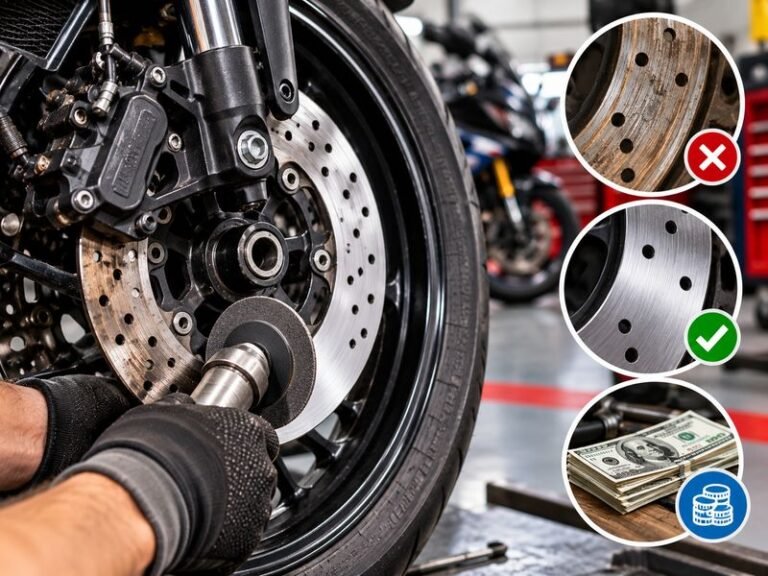
The Resurfacing Process: What to Expect
If you decide to proceed, here’s what a proper resurfacing job looks like.
1. Removal and Inspection: The rotors are removed from the car and inspected for cracks, heat damage, and thickness. 2.
Measurement: A micrometer is used to measure thickness at 8 to 10 points around the rotor. The readings are compared to the minimum spec. 3.
Machining: The rotor is mounted on a lathe, and a cutting tool removes a thin layer (usually 0.002 to 0.005 inches) from each side to create a smooth, parallel surface. 4. Final Check: The machinist measures again to confirm the final thickness is still above minimum and checks the surface finish for a proper non-directional swirl pattern.
It’s worth noting that many dealerships and independent BMW shops no longer resurface rotors at all. They’ve found that the labor cost, combined with the risk of the rotor being out of spec afterward, makes replacement a more reliable and profitable option. If a shop tells you they don’t machine rotors, that’s not necessarily a scam—it’s often a policy based on warranty concerns.
On-Car vs. Bench Resurfacing
There are two methods for resurfacing, and they produce different results.
On-car resurfacing uses a special lathe that mounts directly to the wheel hub, spinning the rotor in place. This method corrects runout relative to the hub, which is ideal if the pulsation was caused by hub or bearing issues. However, it’s messier and requires more skill to set up correctly.
Bench resurfacing removes the rotor and mounts it on a traditional lathe. This is more precise for achieving a perfectly flat surface, but it doesn’t account for any runout in the hub itself. If your hub has a slight imperfection, a bench-resurfaced rotor will still wobble when reinstalled.
For BMWs, on-car resurfacing is often preferred because it addresses the entire rotating assembly. But it’s also more expensive and less common. If you’re only dealing with pad transfer and the hub is in good shape, bench resurfacing is perfectly adequate.
What About the Cost of New Rotors?
It’s helpful to know what you’re comparing against. A set of aftermarket BMW rotors from a reputable brand like Zimmermann, Brembo, or ATE can cost anywhere from $80 to $200 per rotor, depending on the model. OEM rotors from the dealership can be double that.
When you factor in the cost of resurfacing (around $40 to $50 for both front rotors) plus the risk that the rotors might not clean up properly, the savings can be tempting. But you also need to consider the labor cost of removing and reinstalling the rotors. If a shop charges $150 per axle for labor, and you’re already paying that, the difference between machining and replacement is just the part cost.
In many cases, the smartest financial move is to replace the rotors yourself if you have the tools, or to buy new rotors and have a shop install them. The peace of mind of knowing you have fresh metal is worth the extra cost, especially if you plan to keep the car for several more years.
FAQ
How many times can BMW rotors be resurfaced?
Most BMW rotors can only be resurfaced once, if at all. Because they start with less material than aftermarket rotors, a single machining pass often brings them close to or below the minimum thickness. After one resurfacing, they should be replaced the next time they need service.
Can I resurface just the front rotors and leave
Yes, you can resurface only the front rotors if the rear ones are still within spec and not causing problems. However, it’s generally recommended to replace or resurface rotors in pairs on the same axle to ensure even braking performance. Mixing a resurfaced rotor with a heavily worn one on the same axle can cause pulling or uneven pad wear.
Will resurfacing fix brake pedal pulsation?
Resurfacing will fix pulsation only if the cause is uneven pad transfer or minor surface irregularities. If the pulsation is due to a warped hub, excessive runout, or a rotor that’s already too thin, resurfacing won’t help. You need to diagnose the root cause before deciding.
How do I know if my BMW rotors can be
You need to measure the thickness with a micrometer and compare it to the minimum spec stamped on the rotor. If there’s at least 0.5 mm of material above the minimum, and there are no cracks or deep grooves, resurfacing is possible. If you’re not comfortable measuring, a machine shop can do it for a small fee.
Is it cheaper to resurface or replace BMW rotors?
Resurfacing is cheaper upfront, usually costing $15 to $25 per rotor versus $80 to $200 for a new one. However, resurfacing is only worth it if the rotor has enough material left and no structural damage. If you have to pay labor to remove and reinstall the rotors, the cost difference narrows significantly.
Conclusion
The decision to resurface your BMW rotors comes down to a single measurement: remaining thickness. If your rotors have enough material above the minimum spec, no cracks, and no heat damage, resurfacing can save you money and restore smooth braking. But if they’re thin, scored, or overheated, replacement is the only safe choice.
The biggest risk is trying to save a few dollars on rotors that are already at the end of their life. A rotor that’s too thin won’t dissipate heat properly, leading to brake fade or even structural failure under hard braking. That’s not a compromise worth making on a car that can reach high speeds quickly.
Before you book the service, ask your mechanic to measure the rotor thickness and show you the numbers. If they can’t provide a measurement, find someone who can. Then make your decision based on data, not guesswork.
Your brakes are the most critical safety system on the car, and a little due diligence goes a long way toward keeping you and your passengers safe.