
Can You Resurface Motorcycle Rotors? Safety, Cost & Lifespan
Yes, you can resurface some motorcycle rotors, but that does not mean every motorcycle brake disc should be machined.
Motorcycle rotors are generally much thinner than automotive rotors, and many modern bikes use floating brake rotors that are not ideal candidates for conventional resurfacing. Before removing any material, the rotor must have enough thickness remaining, be free from cracks and serious heat damage, and still meet the motorcycle manufacturer’s specifications.
In many cases, replacing a damaged motorcycle rotor is safer and more practical than resurfacing it.
However, a rotor with minor surface glazing, light scoring, or uneven pad deposits may sometimes be restored if it is otherwise in good condition and a qualified motorcycle brake specialist determines that resurfacing is appropriate.
The important part is knowing the difference between a rotor that can still be serviced and one that has reached the end of its usable life.
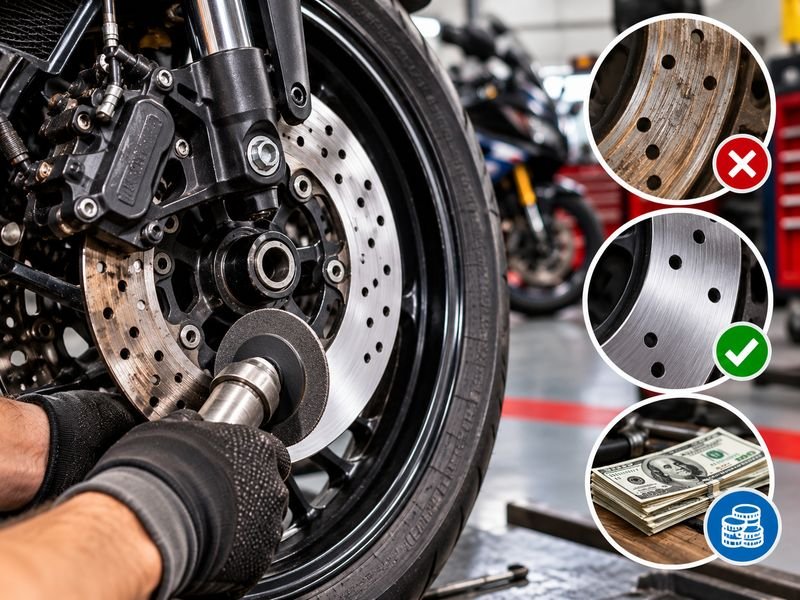
Can You Resurface Motorcycle Rotors?
Motorcycle rotors can sometimes be resurfaced if they have enough remaining thickness and only minor surface damage. The decision should be based on the rotor’s condition and the manufacturer’s service limits rather than appearance alone.
Resurfacing removes a very small amount of material from the braking surface to create a smoother and more uniform surface for the brake pads.
It may be considered when a rotor has:
- Light, even scoring
- Minor glazing
- Uneven brake-pad deposits
- Mild surface irregularities
- Plenty of thickness remaining above the minimum specification
Resurfacing should not be used as a way to save a rotor that is already badly damaged.
A rotor with cracks, severe grooves, excessive runout, serious heat damage, or thickness at or below the service limit generally needs replacement.
Another important consideration is the rotor design.
Fixed vs Floating Motorcycle Rotors
A fixed rotor is made as a relatively solid assembly and may be easier for a specialist to machine accurately.
A floating rotor has a separate friction ring connected to a carrier using buttons, bobbins, or rivets. The design allows limited movement as the rotor heats and cools.
Because of this construction, resurfacing a floating rotor can be more complicated. Some motorcycle brake specialists have equipment designed to service certain floating rotors, but many manufacturers and repair shops will recommend replacement instead.
Never assume a rotor is machinable simply because there appears to be enough metal left.
Why Motorcycle Rotors Are Different From Car Rotors
Car brake rotors are usually much thicker and have considerably more material available for machining.
Motorcycle rotors need to remain light and compact, so their friction surfaces can be only a few millimeters thick.
That difference matters because resurfacing always removes material.
Removing a small amount from a thick automotive rotor may leave plenty of usable metal. Removing that same amount from a motorcycle rotor can significantly reduce its remaining service life or bring it close to its minimum allowable thickness.
A thinner rotor also has less material available to absorb and manage braking heat.
For that reason, motorcycle rotor resurfacing requires more careful measurement than simply looking at the surface and deciding whether the grooves appear minor.
When Does Resurfacing a Motorcycle Rotor Make Sense?
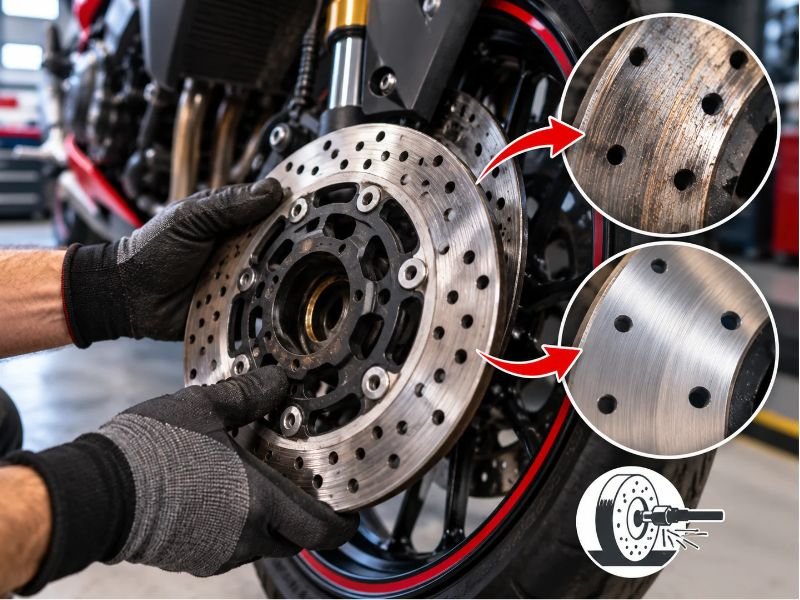
Resurfacing is most reasonable when the problem is primarily limited to the friction surface and the rotor itself remains structurally sound.
For example, brake pads can sometimes leave uneven deposits on a rotor. The rider may experience a pulsing sensation and assume the rotor is permanently warped when the problem is actually an inconsistent friction layer.
A rotor may also develop light glazing after repeated heating or improper pad bedding.
If the disc is still flat, undamaged, and comfortably within its service specifications, a professional may be able to restore the braking surface.
However, machining should never be used to hide structural damage.
Before resurfacing, the technician should check:
Rotor thickness: The disc must remain above the manufacturer’s minimum thickness even after machining.
Lateral runout: Excessive side-to-side movement can indicate a bent rotor, mounting problem, damaged carrier, or another issue that resurfacing may not solve.
Surface condition: Light marks are very different from deep grooves or cracks.
Heat damage: Severe discoloration or localized heat spots deserve careful inspection.
Floating hardware: Bobbins, buttons, and carriers must also be in acceptable condition on floating rotors.
If one of these areas fails inspection, replacement usually makes more sense.
When Should You Replace a Motorcycle Rotor Instead?
There are several situations where resurfacing should not be considered a substitute for replacement.
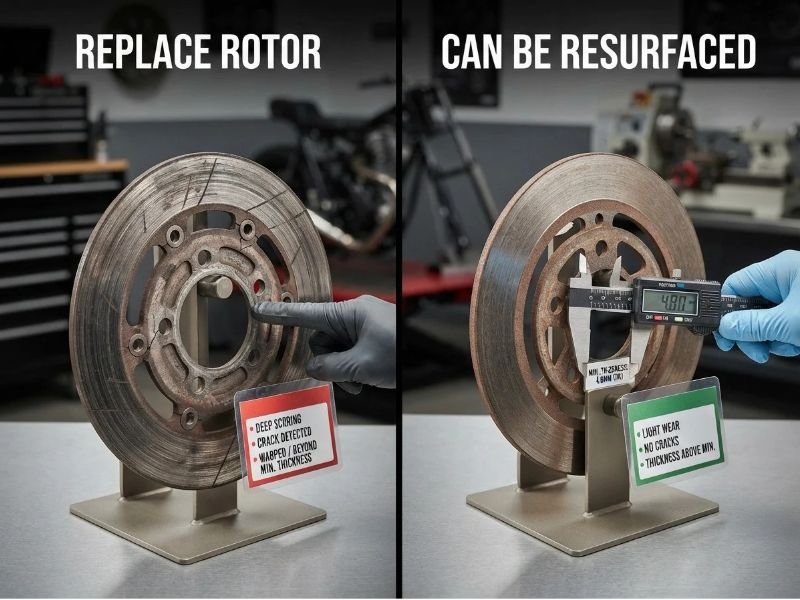
The Rotor Is at or Below Minimum Thickness
Motorcycle brake discs normally have a specified minimum thickness or service limit.
The specification may be stamped on the rotor or listed in the motorcycle’s service information.
If the disc has already reached that limit, removing more metal is not appropriate.
Replace it.
The Rotor Is Cracked
A cracked brake rotor should not be repaired by machining.
Even a small crack can grow because motorcycle rotors experience repeated heating, cooling, and heavy braking forces.
The Rotor Has Deep Grooves
Light scoring may sometimes be serviceable.
Deep grooves are different. Removing enough material to completely eliminate them could leave the rotor too thin.
The Rotor Is Seriously Bent or Warped
If runout exceeds the motorcycle manufacturer’s limit, resurfacing is not automatically a solution.
The problem could involve the rotor itself, the carrier, mounting surfaces, wheel bearings, hub, or installation.
The underlying cause should be identified before replacing or servicing parts.
The Rotor Has Severe Heat Damage
Brake discs can experience extremely high temperatures.
Serious blue or dark heat spots, cracking, distortion, or changes in the braking surface can indicate that the disc has been overheated.
A badly heat-damaged rotor is generally better replaced than machined.
Can I Resurface My Rotors Myself?
You should generally not attempt true motorcycle rotor resurfacing at home unless you have the correct precision equipment and the experience required to measure and machine brake components accurately.
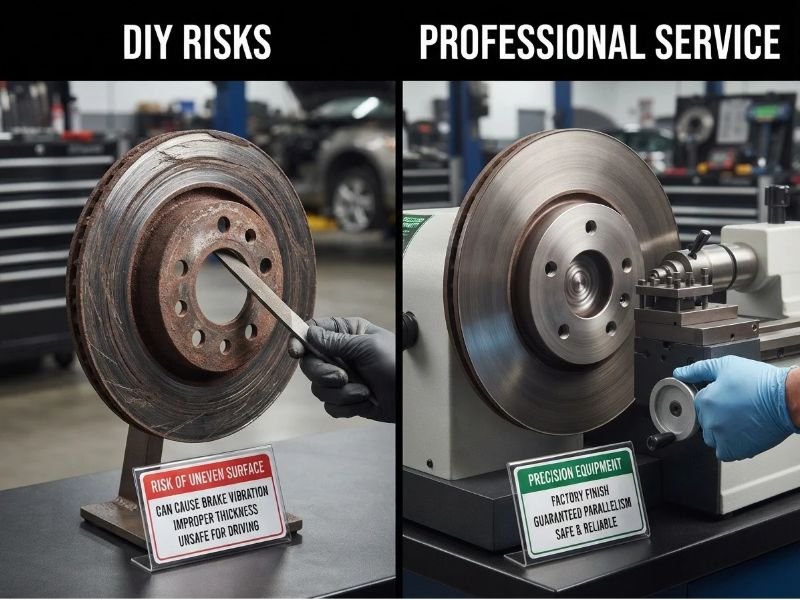
Resurfacing is not the same thing as simply sanding the rotor.
Professional resurfacing requires the disc to remain extremely flat, parallel, and within its thickness and runout specifications.
Using an angle grinder, random-orbit sander, grinding wheel, or similar hand-held power tool can create:
- Uneven rotor thickness
- High and low spots
- Poor brake-pad contact
- Excessive runout
- Brake pulsation
- Reduced braking performance
That makes DIY machining a poor choice for a safety-critical component.
Can You Sand a Motorcycle Rotor?
Lightly cleaning or deglazing a rotor is different from resurfacing it.
A very light abrasive treatment may sometimes be used to remove minor glazing or surface deposits, depending on the rotor and brake manufacturer’s recommendations.
However, sanding cannot safely correct:
- Deep grooves
- A bent rotor
- Excessive runout
- Cracks
- A rotor below minimum thickness
If you are unsure why the rotor is causing vibration or poor braking, measure and diagnose the problem before removing material.
How Is a Motorcycle Rotor Resurfaced?
When resurfacing is appropriate, the goal is to remove only enough material to restore a consistent friction surface.
A specialist will normally begin by thoroughly inspecting the disc.
The rotor thickness is measured at several locations using a micrometer. The technician may also measure lateral runout with a dial indicator.
If the rotor passes inspection, it can then be machined or precision-ground using equipment suitable for its design.
After resurfacing, the technician should verify that:
- Final thickness remains within specification
- Both braking surfaces are uniform
- Runout is acceptable
- The rotor is free from cracks or other damage
- The mounting surfaces are clean
- The braking surface is properly cleaned before installation
New or properly prepared brake pads may also be required depending on the condition of the existing pads.
The pads and rotor then need to establish an even friction layer during the appropriate bedding-in process.
How Much Does It Cost to Resurface Rotors?
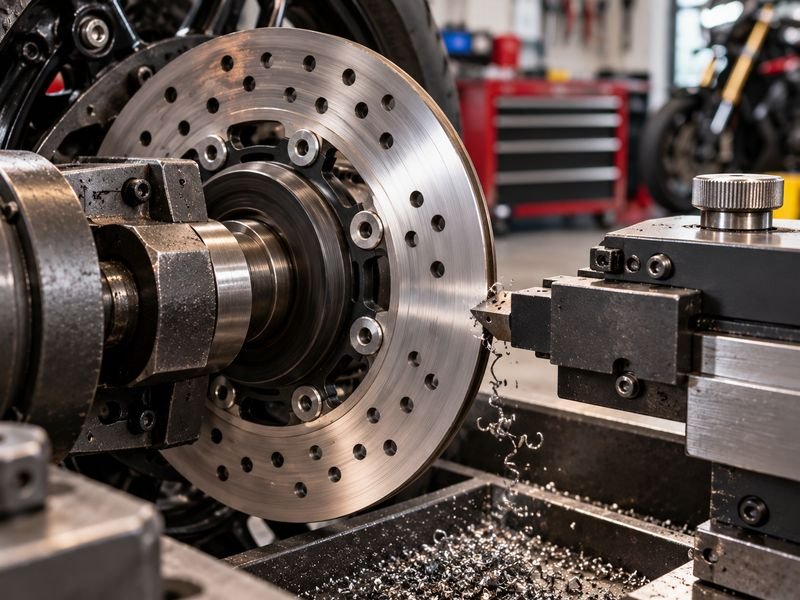
The cost to resurface motorcycle rotors varies considerably because not every automotive machine shop has the equipment needed to work with motorcycle discs.
As a general U.S. estimate, machining a loose rotor may cost roughly $30 to $80 or more per rotor, depending on the shop, rotor design, and required work.
A specialist may charge more for unusual or floating rotors.
If the shop must also remove the motorcycle wheel, remove the rotor, inspect it, reinstall everything, and perform additional brake work, labor can significantly increase the total bill.
This is why cost should be compared with the price of a replacement rotor before approving resurfacing.
For an inexpensive aftermarket rotor, the difference between machining and replacing may be relatively small.
For an expensive OEM or specialty rotor that is still well within specification, professional resurfacing may be more attractive.
The cheapest option is not automatically the best option when dealing with brakes.
Resurfacing vs Replacing Motorcycle Rotors
| Condition | Resurface | Replace |
|---|---|---|
| Minor glazing | Possibly | Usually unnecessary |
| Light scoring | Possibly | If thickness is limited |
| Uneven pad deposits | Possibly | Not always necessary |
| Deep grooves | Usually no | Yes |
| Cracks | No | Yes |
| Below minimum thickness | No | Yes |
| Severe heat damage | Usually no | Yes |
| Excessive runout | Diagnose first | Often |
| Damaged floating carrier/bobbins | No simple resurfacing fix | Often |
| Plenty of thickness and minor surface wear | May be suitable | Optional |
This table is only a general guide. Your motorcycle’s service specifications should always take priority.
How Long Will Resurfaced Rotors Last?
There is no fixed mileage for how long resurfaced motorcycle rotors will last.
A properly resurfaced rotor that still has plenty of usable thickness may continue working for many thousands of miles. Another rotor that is already relatively close to its service limit may need replacement much sooner.
Its remaining lifespan depends on factors such as:
- Thickness after resurfacing
- Riding style
- Brake-pad compound
- Motorcycle weight
- Highway vs city use
- Mountain or performance riding
- Brake temperatures
- Rotor material
- Proper pad bedding
- Caliper condition
Aggressive riding and repeated hard braking generally produce more heat and can accelerate rotor and pad wear.
A sticking caliper can also dramatically shorten rotor life because the brake pad remains in contact with the disc and continuously generates heat.
Therefore, resurfacing should not be viewed as resetting the rotor back to new condition.
It simply restores the braking surface while leaving the rotor with less material than it had before.
What Is the Lifespan of Brake Rotors?
There is no universal mileage interval for motorcycle brake rotor replacement.
Unlike oil or certain scheduled maintenance items, rotors are normally replaced according to condition and measured wear, not just mileage.
Some riders may use the same rotors through several sets of brake pads, while motorcycles subjected to racing, mountain roads, heavy loads, frequent stop-and-go riding, or aggressive braking may wear rotors much faster.
The best way to determine rotor life is to periodically inspect:
Thickness: Measure the braking surface and compare it with the manufacturer’s service limit.
Runout: Check if the rotor moves side to side beyond specification.
Surface condition: Watch for deep scoring, cracks, heavy corrosion, and abnormal wear.
Brake feel: Pulsation, vibration, unusual noises, or inconsistent braking deserve inspection.
Pad wear: Uneven pad wear can sometimes indicate a caliper or rotor problem.
A rotor can therefore be old and still serviceable, while a much newer rotor may require replacement after severe overheating or mechanical damage.
Can I Resurface My Rotors Twice?
A rotor does not have a universal rule saying it can be resurfaced once, twice, or any specific number of times.
What matters is how much material remains.
In theory, a rotor could be resurfaced a second time if:
- It is still safely above minimum thickness
- Enough material will remain after machining
- There are no cracks
- Runout is within specification
- There is no severe heat damage
- The rotor design is suitable for resurfacing
In practice, motorcycle rotors begin with relatively little excess material, so a second resurfacing may not leave enough safety margin.
That means two resurfacing jobs should never be assumed to be acceptable simply because the first one worked.
The rotor needs to be measured again before every machining operation.
If it is already approaching its minimum thickness, replace it.
How Do You Measure a Motorcycle Rotor Before Resurfacing?
Rotor thickness should be measured with a micrometer, not estimated visually.
Measure several positions around the rotor because wear may not be perfectly uniform.
Avoid measuring only an unworn lip near the outside edge, since that area may not represent the thickness of the actual pad contact surface.
Compare the lowest measurement with the specification for your motorcycle.
You should also check lateral runout with a dial indicator if vibration or pulsation is present.
Do not rely on a universal internet specification for runout or minimum thickness. These limits vary between motorcycles and rotor designs.
For example, manufacturer service information can specify very different minimum thicknesses even between front and rear rotors on the same motorcycle.
Use the value stamped on the rotor or the specification in the service manual for your exact model.
Does Resurfacing Fix a Warped Motorcycle Rotor?
Not necessarily.
The term “warped rotor” is often used whenever the rider feels brake pulsation, but pulsation can have several causes.
Possible causes include:
- Excessive lateral runout
- Uneven pad material transfer
- Thickness variation
- Contaminated mounting surfaces
- Bent rotor or carrier
- Wheel-bearing problems
- Improper installation
If the rotor truly has excessive runout or structural distortion, machining the surface may not fix the underlying problem.
The rotor and related components should be measured first.
Do You Need New Brake Pads After Resurfacing Rotors?
Installing fresh pads is often a good idea when resurfacing a rotor, particularly if the old pads have worn unevenly, become glazed, or developed a wear pattern matching the previous rotor surface.
Putting badly worn or contaminated pads against a newly machined surface can interfere with proper bedding.
However, pads that are nearly new, evenly worn, uncontaminated, and within specification may sometimes be reusable after appropriate inspection and preparation.
Follow the brake-pad manufacturer’s recommendations and inspect the entire braking system rather than treating the rotor as an isolated component.
What Can Cause Motorcycle Rotors to Wear Out Early?
Rotor wear does not always happen simply because the motorcycle has accumulated a lot of miles.
Premature wear can result from:
- Worn brake pads
- Aggressive brake-pad compounds
- Sticking caliper pistons
- Seized or dry caliper hardware
- Incorrect pad installation
- Frequent hard braking
- Track riding
- Excessive heat
- Contamination
- Improper wheel or rotor installation
If a rotor wears unusually quickly, replacing it without correcting the underlying cause may result in the new rotor developing the same problem.
Should You Resurface or Replace Motorcycle Rotors?
Start by measuring rather than guessing.
If the rotor has only minor surface problems, plenty of remaining thickness, acceptable runout, and a design suitable for machining, resurfacing may be reasonable.
Replacement is generally the more appropriate choice if the rotor:
- Is near or below its wear limit
- Has cracks
- Has deep grooves
- Has significant heat damage
- Is badly distorted
- Has damaged floating hardware
- Would cost almost as much to resurface as replace
Modern motorcycle braking systems depend on precise tolerances. Saving a relatively small amount of money is not worthwhile if the result reduces braking reliability.
FAQs About Can You Resurface Motorcycle Rotors
Can You Resurface Motorcycle Rotors?
Yes, some motorcycle rotors can be resurfaced if they have sufficient thickness remaining, only minor surface damage, and a design that can be machined correctly. Rotors with cracks, serious damage, or thickness below specification should be replaced.
Can I Resurface My Rotors Myself?
True rotor resurfacing is generally not a good DIY project. It requires accurate measurements and precision machining equipment. Light deglazing may sometimes be possible, but sanding does not repair a bent, deeply scored, cracked, or excessively worn rotor.
How Much Does It Cost to Resurface Rotors?
Motorcycle rotor resurfacing may cost approximately $30 to $80 or more per rotor for machining alone in the U.S., although prices vary considerably. Removal, installation, inspection, and additional brake work can increase the total.
How Long Will Resurfaced Rotors Last?
There is no fixed mileage. Their lifespan depends on remaining thickness, riding conditions, pad choice, heat exposure, and overall brake condition. A rotor with significant thickness remaining can potentially provide substantial additional service, while one already close to its wear limit may not.
What Is the Lifespan of Brake Rotors?
Motorcycle brake rotors do not have one universal lifespan. They should normally be replaced based on measured thickness, runout, cracks, scoring, heat damage, and overall condition rather than mileage alone.
Can I Resurface My Rotors Twice?
Possibly, but only if the rotor remains safely above its minimum thickness after another machining operation and has no other damage. Because motorcycle rotors are relatively thin, replacement is often more practical by the time a second resurfacing is being considered.
Can You Resurface a Floating Motorcycle Rotor?
Some specialists can service certain floating rotors, but they are more complicated than fixed rotors. Always check the manufacturer’s recommendations and have the rotor inspected by a shop familiar with motorcycle braking systems.
Is Sanding a Rotor the Same as Resurfacing It?
No. Sanding can sometimes remove very light glaze or deposits, but professional resurfacing precisely corrects the friction surface using specialized equipment. Sandpaper cannot correct serious runout, cracks, deep grooves, or insufficient thickness.
How Do I Know if My Motorcycle Rotor Is Too Thin?
Look for the minimum thickness specification stamped on the rotor or listed in the service manual. Measure the worn braking surface at several locations with a micrometer. If any measurement is at or below the specified service limit, replace the rotor.
Conclusion: Can You Resurface Motorcycle Rotors?
So, can you resurface motorcycle rotors? Yes, in some situations—but only when the rotor remains structurally sound, has enough thickness left, and is suitable for precision machining.
Light scoring, glazing, and certain surface irregularities may be serviceable. Cracks, deep grooves, severe heat damage, excessive runout, and thickness at or below the manufacturer’s limit are strong reasons to replace the disc instead.
You should also avoid assuming that a rotor can be resurfaced a certain number of times. Remaining thickness and condition matter more than whether it has been machined once or twice before.
Measure the rotor, check the exact specifications for your motorcycle, inspect the complete braking system, and compare the cost of professional resurfacing with a replacement disc.
When the condition is questionable, replacement is usually the safer approach for a component that directly controls how effectively your motorcycle stops.
