How Long Will 4mm Brake Pads Last? Safety and Replacement Tips
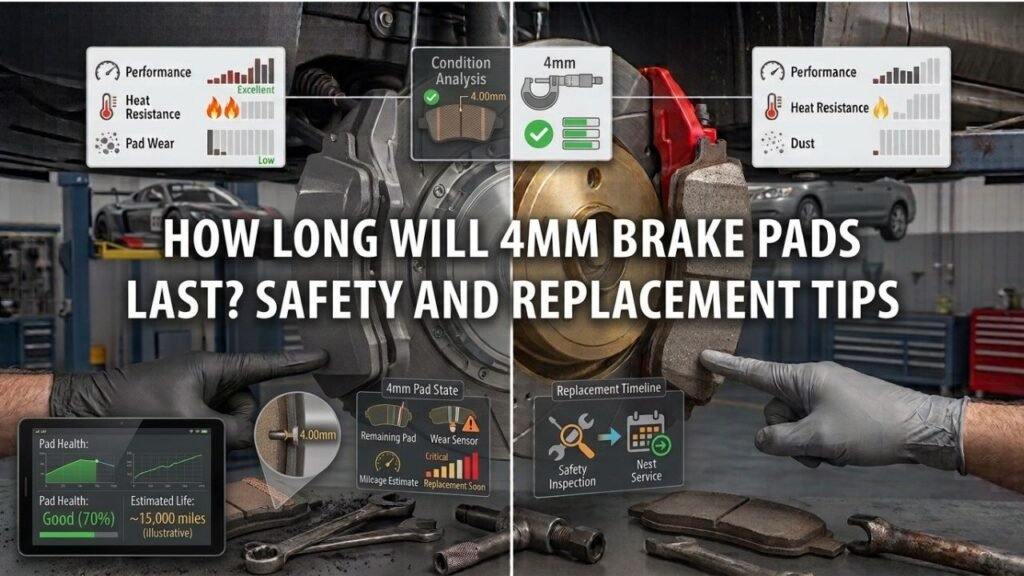
Brake pads measuring 4 mm of friction material are generally still usable on many passenger vehicles, but they are near the point where replacement should be planned. Remaining mileage cannot be predicted from thickness alone; the best estimate comes from the vehicle’s specified wear limit and the rate at which those pads have been wearing.
A 4 mm reading is quite different from a nearly new pad. Brembo states that new pads are commonly around 10–12 mm thick and recommends replacement once friction material drops below about 3 mm. A vehicle manufacturer may specify a different service limit, so its repair information takes priority.
That means the practical benefit of finding 4 mm now is time to plan rather than waiting for grinding, rotor damage, or a last-minute brake job. Checking the pads again after a known number of miles also gives a much better estimate of remaining life than relying on a generic mileage chart.
U.S. vehicles are staying on the road longer. S&P Global Mobility reported that the average age of U.S. light vehicles reached 12.8 years in 2025, with about 289 million light vehicles in operation. Brake inspection becomes increasingly relevant as vehicles accumulate years and mileage.
The direct answer to how long will 4mm brake pads last is that no dependable universal mileage exists. City traffic, hills, towing, vehicle weight, pad compound, regenerative braking, caliper condition, and driving style can make the final millimeter of usable material disappear at very different rates.
My preference is to treat 4 mm as a planning measurement rather than a mileage promise. If the pads are wearing evenly, the brakes work normally, and the manufacturer permits a lower service limit, immediate replacement may not be necessary. A long trip, heavy towing, steep terrain, or fast recent wear changes that judgment.
The sections below explain if 4 mm pads are okay, how to estimate their remaining mileage from actual wear, which conditions shorten their life, when replacement makes sense, and which warning signs mean you should not wait for another thickness check.
How Long Will 4mm Brake Pads Last?
There is no fixed number of miles that every 4 mm brake pad will last.
Thickness tells you how much friction material remains. It does not tell you how quickly that material will disappear.
4mm Is Close to the Common Replacement Range
Brembo advises replacement when pad material falls below 3 mm. Some vehicle-specific service data permit lower limits. For example, published Audi service specifications for certain brake systems list a 2 mm friction-material wear limit, excluding the backing plate.
This difference is why a generic statement such as “all pads must be replaced at 4 mm” is too broad.
At 4 mm, you may have roughly 1 mm before reaching a 3 mm planning point, or more material before reaching a lower manufacturer-specified limit. The correct specification for your vehicle matters more than a universal internet chart.
Remaining Mileage Depends on Your Actual Wear Rate
The most useful estimate comes from two thickness measurements taken at different mileages.
Suppose a pad measured 6 mm during a previous inspection and measures 4 mm after another 8,000 miles. It lost 2 mm over 8,000 miles, or about 4,000 miles per millimeter during that period.
If you plan replacement at 3 mm and the wear rate stays similar, that history suggests roughly another 4,000 miles to the planning point.
That number is only a projection. Braking conditions during the next few thousand miles may differ from the previous period.
Do Not Calculate From Original Thickness Alone
A new pad that started at 10 mm and is now at 4 mm has lost 6 mm, but dividing total vehicle mileage by 6 does not always produce a reliable forecast.
The pads may not have been installed when the vehicle was new. Driving habits may have changed. A caliper could begin dragging. A new commute could add far more stop-and-go braking.
A recent before-and-after measurement is more useful than assuming pad wear stays identical throughout the pad’s entire service life.
Key Takeaway: A 4 mm measurement tells you the pads are getting low, but their previous wear rate and the vehicle’s specified service limit provide a better remaining-mileage estimate.
Are 4mm Brake Pads OK to Drive On?
In many vehicles, 4 mm brake pads are still serviceable, provided the pads are wearing evenly and the brake system has no other fault.
Four millimeters should still be treated as a maintenance-planning point rather than a thickness to ignore until the next distant service.
4mm Is Usually Above the Wear Limit
Manufacturer limits differ by brake design.
Brembo’s general passenger-car guidance says pads should be replaced when they fall below 3 mm. Some Audi specifications list 2 mm as the friction-material wear limit for specific systems. Bendix documentation for certain air-disc brake systems also specifies replacement below 2 mm of friction material.
Those specifications show why 4 mm is not automatically an emergency measurement.
They also show why the exact car matters. Never substitute another vehicle’s minimum thickness for the specification applying to yours.
4mm May Be a Good Time to Schedule Replacement
Waiting until the exact minimum leaves less room for unexpected wear before the next inspection.
If your mechanic measures 4 mm during routine service, planning the brake job soon may make sense if you drive many miles between inspections.
Drivers facing mountain travel, towing, dense city traffic, or a long trip may choose to replace at 4 mm rather than use most of the remaining margin.
Uneven 4mm Readings Need More Attention
A single “4 mm” number does not describe every pad on the axle.
One pad may measure 4 mm while the opposite pad is thinner. Inner pads can also wear differently from outer pads when caliper slides, pistons, or pad contact points are not moving correctly.
Bendix service information instructs technicians to compare pad wear and investigate excessive differences rather than measuring only one location.
Key Takeaway: Four millimeters is commonly still usable, but it is close enough to common replacement thresholds that inspection and service planning should begin.
What Determines How Fast 4mm Brake Pads Wear?
Brake-pad thickness decreases through friction, and the amount of friction work varies greatly from one vehicle and driver to another.
This explains why two cars with identical 4 mm measurements can reach replacement thickness at very different mileages.
Stop-and-Go Driving
Urban driving generally uses the brakes far more often than steady highway travel.
Every traffic light, intersection, parking maneuver, and congestion slowdown removes a small amount of friction material. A vehicle driven mostly in city traffic may therefore consume its remaining pad material faster than one covering the same mileage on open highways.
Hills and Mountain Roads
Descending steep grades converts large amounts of vehicle energy into brake heat.
Repeated braking on long descents increases pad temperature and wear. Using the correct transmission or regenerative-braking strategy where the vehicle manufacturer permits it can reduce reliance on the friction brakes.
A driver with 4 mm pads before a mountain trip has a different situation from a driver commuting on flat highways.
Vehicle Weight and Towing
A heavier vehicle carries more kinetic energy at a given speed, so the brake system has more work to do during deceleration.
Passengers, cargo, towing, and repeated heavy braking can raise brake temperature and pad wear.
This does not mean every truck or SUV consumes pads quickly. Brake systems are sized for the vehicles they serve, and driving conditions still matter.
Driving Style
Braking late and hard usually produces more brake heat than slowing early and smoothly.
Following distance also matters. A driver who repeatedly accelerates toward slowing traffic and then brakes hard uses the pads more often than someone who anticipates traffic flow.
I would consider recent driving style when estimating the last few millimeters rather than relying on the pad’s total age.
Caliper or Rotor Problems
A pad can wear rapidly even when the driver’s habits have not changed.
A sticking caliper piston, seized slide pin, pad binding in the bracket, or damaged rotor can create uneven or accelerated wear. Brembo identifies damaged discs, incorrect assembly, and caliper faults among causes of abnormal pad wear.
If one pad suddenly loses material much faster than its partner, the cause deserves inspection before new pads are fitted.
Hybrid and Electric Vehicle Regenerative Braking
Many hybrids and electric vehicles use the electric motor to recover energy during deceleration, reducing how often the friction brakes perform all of the stopping work.
That can make pads last much longer in some driving patterns.
It can also mean mileage is an even poorer predictor of remaining pad life. A 4 mm pad on a vehicle that uses substantial regenerative braking may wear far more slowly than one on a conventional vehicle driven through heavy traffic.
Key Takeaway: Traffic, terrain, vehicle load, driver behavior, brake condition, and regenerative braking can all change how quickly 4 mm becomes 3 mm.
How to Estimate the Remaining Life of 4mm Brake Pads
The best estimate uses your own vehicle’s measured wear history.
You need the previous pad thickness, current thickness, and miles traveled between those inspections.
Calculate Miles Per Millimeter of Wear
Use this simple method:
Miles driven ÷ millimeters worn = approximate miles per millimeter
For example:
- Previous measurement: 6 mm
- Current measurement: 4 mm
- Distance traveled: 8,000 miles
- Pad material used: 2 mm
- Approximate recent wear rate: 4,000 miles per millimeter
If replacement is planned at 3 mm, the historical rate suggests about 4,000 more miles.
This is an estimate rather than a guarantee.
Use More Than One Pad Measurement
Measure the inner and outer pad on each wheel when the brake design permits accurate inspection.
Do not estimate remaining life from the thickest visible pad.
If the outer pad is 4 mm and the hidden inner pad is 2.5 mm, the thinner pad should drive the service decision.
Recheck Pads Sooner Once They Reach 4mm
A pad at 8 mm provides far more wear margin than one at 4 mm.
Once the measurement reaches 4 mm, a shorter follow-up interval gives better information about the current wear rate.
The correct interval depends on vehicle mileage, brake design, current pad condition, and service schedule. A driver covering many miles each month may need another measurement sooner than a low-mileage driver.
Key Takeaway: Track actual thickness loss over a known mileage and base your forecast on the thinnest pad, not a generic miles-left table.
When Should You Replace 4mm Brake Pads?
Replacement at exactly 4 mm is not mandatory for every vehicle.
There are situations where replacing them at that measurement is reasonable, and others where monitoring them for a little longer may fit the manufacturer’s limits.
Replace Soon if You Drive Heavily
Consider scheduling replacement at or near 4 mm if you regularly:
- Drive in dense stop-and-go traffic
- Tow a trailer
- Carry heavy loads
- Travel through steep terrain
- Cover high monthly mileage
- Have a long trip approaching
These conditions can consume the remaining margin faster than light highway use.
Replace Earlier if Wear Is Uneven
Four millimeters is less reassuring if another pad on the same axle is already thinner.
Uneven wear can point to a sticking caliper, slide-pin problem, pad binding, or rotor issue.
The underlying fault should be corrected rather than installing pads and assuming the wear problem is solved.
Follow the Vehicle’s Wear Sensor
Some vehicles use an electrical brake-pad wear sensor.
Brembo explains that these sensors monitor pad wear and provide a warning when the pads approach minimum thickness.
Do not ignore a brake-pad warning simply because one visible pad appears to measure 4 mm. The sensor may be associated with a different pad or wheel.
Replace Immediately if the Pad Is Damaged
Thickness is only one part of pad condition.
Cracked friction material, major pieces missing from the pad, contamination, severe overheating, or separation from the backing plate can require replacement even if the remaining material measures 4 mm or more.
Bendix service documentation states that pads with major surface damage should be replaced.
Key Takeaway: Replace based on thickness, wear pattern, driving demands, sensor warnings, and physical condition—not on the 4 mm number alone.
Warning Signs That Matter More Than a 4mm Measurement
A thickness reading should never overrule obvious brake symptoms.
If the vehicle develops a new brake problem, have it inspected instead of waiting for the pads to reach a lower number.
Grinding During Braking
Grinding may mean friction material is severely worn or a brake component is contacting the rotor incorrectly.
Do not assume a previous 4 mm measurement is still current. A sticking component can cause one pad to deteriorate faster than expected.
Pulling to One Side
A car that pulls strongly during braking can have uneven braking force.
Possible causes include a caliper problem, pad contamination, uneven friction material, hydraulic trouble, or another wheel-related fault.
Thickness should be checked on both sides along with the rest of the brake system.
New Brake Warning Light
A pad-wear warning means the vehicle has detected the condition its sensor was built to monitor.
The exact trigger point differs by vehicle.
Check the owner’s manual and arrange inspection rather than estimating extra mileage from a previous measurement.
Severe Vibration or Abnormal Pedal Feel
Brake vibration can come from rotor thickness variation, deposits, component looseness, or other brake and suspension faults.
A soft or unusually long pedal can point to a hydraulic problem rather than pad thickness alone.
A brake pedal that suddenly changes deserves prompt diagnosis.
Key Takeaway: Grinding, pulling, warnings, severe vibration, or a sudden pedal change can justify brake inspection even when a recent pad measurement was 4 mm.
Is It Better to Replace at 4mm or Wait Until 3mm?
For many normally driven vehicles with even pad wear, 4 mm provides some planning room before the common 3 mm replacement point cited by Brembo.
Replacing at 4 mm can still make sense if another service is already being performed, upcoming driving will be demanding, or the next scheduled inspection is far away.
Waiting closer to 3 mm may be reasonable when the manufacturer permits it, the pads are wearing evenly, the brake system is in good condition, and another inspection is coming soon.
I would not chase the final millimeter simply to avoid replacing pads. The amount saved by squeezing out a little extra friction material can disappear quickly if the pads reach metal-to-metal contact and damage the rotors.
Can 4mm Brake Pads Damage the Rotors?
A normal, undamaged 4 mm pad should not damage a rotor simply because it measures 4 mm.
Rotor damage becomes more likely when pads are allowed to wear through their friction material, when a foreign object becomes trapped, when the pad is damaged, or when a caliper keeps the brake dragging.
Rotors also have their own minimum-thickness specification. Brembo recommends measuring a rotor at several points and comparing the lowest measurement with the minimum thickness marked for that rotor.
This is why a brake inspection should consider the pad and rotor together rather than treating pad thickness as the only measurement that matters.
Conclusion
How long will 4mm brake pads last cannot be answered with one dependable mileage figure. Four millimeters is generally near the later stage of pad life, but the distance remaining depends on the car’s wear limit, recent wear rate, driving conditions, and condition of the brake system.
For many vehicles, 4 mm brake pads are still okay for continued short-term use if wear is even and no brake fault is present. Brembo’s general guidance places replacement below 3 mm, while some vehicle-specific specifications use other limits. The specification for your exact vehicle should make the final call.
The most useful approach is to record the current 4 mm reading and compare it with an earlier or future measurement. That shows how quickly your vehicle is actually using pad material instead of relying on a broad mileage estimate.
If I had 4 mm pads with unknown wear history, I would start planning replacement and arrange another inspection rather than trying to predict the last millimeter from mileage alone.
FAQs About 4mm Brake Pad Life
Is 4mm Brake Pads OK?
Yes, 4 mm brake pads are generally still usable on many vehicles, but they are getting close to common replacement thresholds. Brembo recommends replacement below about 3 mm. Check the service specification for your exact car because some brake systems use different limits.
Should I Replace Brake Pads at 4mm?
You do not automatically need to replace every pad at exactly 4 mm. Replacement may make sense if you drive heavily, have a long trip ahead, see uneven wear, or will not inspect the brakes again soon. For light use with even wear, some service life may remain.
How Many Miles Can I Drive With 4mm Brake Pads?
There is no dependable universal number. Remaining mileage varies with traffic, hills, towing, vehicle weight, pad material, brake condition, and driving style. A better estimate comes from measuring how many millimeters your pads lost over a known number of recent miles.
Is 4mm Considered Low for Brake Pads?
Yes. Four millimeters is considered worn compared with a typical new pad of roughly 10–12 mm. It is still above the replacement point used for many brake systems, but it is close enough that future service should be planned rather than ignored.
Can I Take a Long Trip With 4mm Brake Pads?
Possibly, but thickness alone cannot confirm that a long trip is a good idea. Check all pads for even wear, inspect the rotors and calipers, and consider the route. Mountain driving, towing, heavy loads, and high mileage can use the remaining pad material faster.
How Fast Do Brake Pads Wear From 4mm to 3mm?
The rate varies from vehicle to vehicle. If your pads previously lost 2 mm over 8,000 miles, that history equals about 4,000 miles per millimeter under those conditions. A future 1 mm loss could occur sooner or later if the type of driving changes.
Is 3mm the Minimum Brake Pad Thickness?
Three millimeters is a common replacement recommendation, but it is not a universal minimum for every vehicle. Brembo advises replacement below 3 mm, while some published vehicle-specific specifications list a 2 mm wear limit. Always use the specification provided for your exact brake system.
Should I Replace All Brake Pads if One Is at 4mm?
Pads are normally serviced in axle sets, but a 4 mm reading alone does not mean every pad must be replaced immediately. Measure the other pads first. If one is much thinner, inspect the caliper, slide pins, bracket contact points, and rotor for a cause of uneven wear before fitting the new set.