How to Tell If Brake Pads Are Worn: Signs, Checks, and Limits
Worn brake pads often show themselves through squealing, grinding, longer stopping distance, a brake warning message, or visibly thin friction material. A direct inspection is more reliable than noise alone. If the friction lining is near its service limit, wearing unevenly, or contacting the rotor with metal, the pads should be replaced promptly.
Brake pads wear every time you slow the vehicle. The friction material becomes thinner until it eventually reaches a point where continued use can damage the rotors and reduce braking performance.
Some pads include metal wear indicators that create a high-pitched squeal before the friction material is completely gone. Other vehicles use electronic pad-wear sensors that trigger a dashboard warning.
For how to tell if brake pads are worn, visual inspection and thickness measurement give the clearest answer. Sounds and pedal changes are useful warning signs, but they can also come from rotors, calipers, wheel bearings, debris, or other brake-system problems.
Brake-pad lifespan varies widely. City driving, heavy vehicles, towing, frequent hills, aggressive braking, rust, caliper problems, and pad compound can all change how quickly a set wears.
Front pads often wear faster than rear pads on many vehicles because the front brakes handle a large portion of the stopping load. That pattern is not universal, especially on vehicles with complex brake-bias, stability-control, regenerative-braking, or rear-brake strategies.
The safest time to inspect pads is before they reach metal-to-metal contact. Waiting for loud grinding can turn a routine pad replacement into a pads-and-rotors repair.
Common Signs of Worn Brake Pads
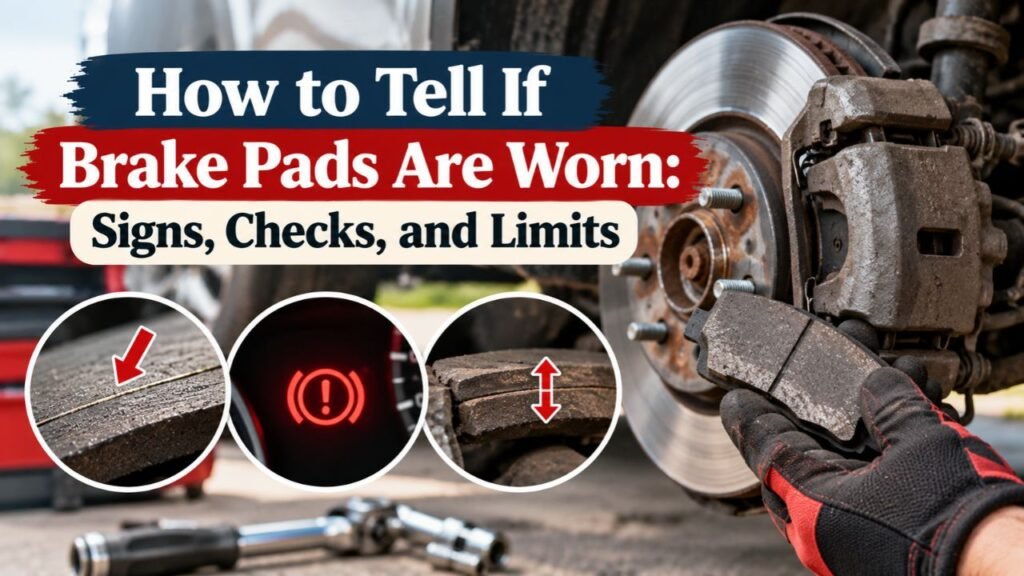
Brake pads can give several warnings before they are completely used up.
High-Pitched Squealing
A recurring high-pitched squeal during braking may come from a mechanical wear indicator.
This small metal tab is designed to contact the rotor once the pad becomes thin enough.
The sound may be:
- High pitched
- Repetitive
- More noticeable at low speed
- Present during light braking
- Intermittent at first
Not every squeal means worn pads.
Brake noise can also come from:
- Moisture
- Surface rust
- Dust
- Pad vibration
- Glazed friction material
- Certain performance pad compounds
If the noise persists, inspect the pads rather than replacing them based on sound alone.
Grinding or Scraping
Grinding is more serious.
Possible causes include:
- Friction material worn away
- Pad backing plate contacting rotor
- Stone or debris caught near the rotor
- Damaged brake hardware
- Severely scored rotor
If the pad has worn down to its metal backing plate, continued driving can damage the rotor quickly.
Do not treat grinding as a normal wear-indicator sound.
Longer Stopping Distance
Brake pads that are badly worn, overheated, contaminated, or damaged may reduce braking performance.
You may notice that the vehicle needs more distance to stop.
Stopping-distance changes can also come from:
- Tires
- Brake fluid
- Rotor condition
- Caliper faults
- Brake booster problems
- ABS faults
- Wet or icy roads
Any noticeable drop in braking performance deserves inspection.
Brake Warning or Pad-Wear Message
Some vehicles use electronic wear sensors.
When the friction material reaches a set point, the sensor circuit changes and the vehicle may display:
- Brake pad warning
- Service brakes message
- Brake warning symbol
A pad-wear warning should not be confused with every red or amber brake warning.
Other brake lights can indicate:
- Parking brake applied
- Low brake fluid
- ABS fault
- Hydraulic problem
- Electronic parking brake fault
Check the owner’s manual for the exact symbol.
Vehicle Pulls During Braking
A vehicle that pulls left or right during braking can have uneven brake operation.
Possible causes include:
- One pad set worn more than the other
- Seized caliper
- Sticking slide pins
- Contaminated pad
- Collapsed brake hose
- Tire or suspension problem
Pulling is not a normal sign to ignore.
Brake Pedal Feels Different
Worn pads do not always cause a dramatic pedal change because the hydraulic system automatically moves the caliper pistons outward as pad material disappears.
Still, you may notice abnormal pedal behavior if another brake problem is present.
Watch for:
- Pedal sinking
- Very soft pedal
- Excessive travel
- Pulsation
- Inconsistent braking
A soft or sinking pedal can indicate a hydraulic problem and needs prompt diagnosis.
Key Takeaway: Squealing, grinding, warning messages, pulling, reduced braking, and pedal changes can point toward worn pads, but direct inspection is the best way to confirm pad condition.
How to Check Brake Pad Thickness
Pad thickness gives you a more dependable wear assessment than noise alone.
Look Through the Wheel
On some alloy wheels, you can see the outer brake pad without removing the wheel.
Look through the wheel spokes toward the caliper.
You may be able to identify:
- Rotor
- Pad backing plate
- Friction material
The friction material is the section pressed against the rotor.
Do not mistake the metal backing plate for usable pad material.
Remove the Wheel for a Better View
A complete inspection is easier with the wheel removed.
Use:
- Level ground
- Wheel chocks
- Correct lifting points
- Properly rated jack stands
Never rely on a hydraulic jack alone while inspecting brakes.
Once the wheel is removed, inspect both the inner and outer pads.
This matters because one pad can wear faster than the other.
Measure the Friction Material
Use a brake-pad gauge, small ruler, or suitable measuring tool to estimate the remaining friction lining.
Do not include the metal backing plate in the measurement.
New passenger-vehicle pads commonly start with roughly 8–12 mm of friction material, though exact dimensions vary.
Many technicians consider around 3 mm a practical replacement range for typical passenger vehicles, but the vehicle or brake manufacturer may specify a different service limit.
At around 2 mm or less, there is usually very little useful material left.
Always use the vehicle-specific wear specification if one is available.
Check All Pads on the Axle
Do not inspect only the easiest pad to see.
Check:
- Left inner pad
- Left outer pad
- Right inner pad
- Right outer pad
The thinnest pad matters most.
If one pad is nearly gone while the others are much thicker, investigate the cause rather than replacing pads and ignoring the uneven wear.
Key Takeaway: Measure the actual friction material, inspect every pad on the axle, and use the thinnest pad as the condition reference.
What Brake Pad Thickness Means
Thickness ranges give you a rough idea of remaining service life.
| Approximate Friction Material | General Condition |
| 8–12 mm | Common new-pad range |
| 6 mm | Plenty of material on many pads |
| 4 mm | Wear is becoming more noticeable |
| 3 mm | Common planning/replacement range |
| 2 mm or less | Very near the end of service |
| Metal contact | Overdue; rotor damage likely |
These numbers are general references rather than universal service limits.
Pad design varies among:
- Passenger cars
- SUVs
- Trucks
- Performance vehicles
- Electric vehicles
- Commercial vehicles
The correct minimum thickness comes from the vehicle or brake-component manufacturer.
How to Tell If Brake Pads Are Wearing Unevenly
Uneven wear can point to a mechanical problem.
Inner Pad Worn More Than Outer Pad
This can happen when the caliper piston continues applying pressure or does not retract properly.
Possible causes include:
- Piston binding
- Corrosion
- Contaminated seals
- Hydraulic restriction
A moderate difference can exist on some designs, but a large difference deserves inspection.
Outer Pad Worn More Than Inner Pad
This often points toward a sliding-caliper problem.
Possible causes include:
- Seized guide pin
- Dry guide pin
- Corroded bracket
- Pad binding in clips
If the caliper cannot slide freely, clamping force may not release evenly.
One Wheel Worn Much Faster Than the Other
Compare the same axle.
If one side has much thinner pads, inspect for:
- Sticking caliper
- Restricted brake hose
- Seized slide pins
- Parking brake problem
- Pad binding
- Installation issue
Pad Worn at an Angle
Tapered wear can come from:
- Caliper alignment issues
- Slide-pin problems
- Pad movement problems
- Hardware damage
Do not assume new pads alone will correct it.
Key Takeaway: Large differences between inner and outer pads or between left and right wheels usually point toward a caliper, slide, hardware, or hydraulic problem that should be corrected with the pad replacement.
What Do Worn Brake Pads Sound Like?
Brake noise changes as wear becomes more severe.
Squeak
A light squeak may come from:
- Dust
- Moisture
- Pad vibration
- Wear indicator
It does not prove the pad is worn out.
Squeal
A sharp, repeated squeal during braking can be a mechanical wear indicator rubbing against the rotor.
Inspect the pad thickness soon.
Scraping
Scraping may indicate:
- Very thin pad
- Debris
- Rust scale
- Hardware touching the rotor
The brakes should be inspected rather than driven until the sound becomes worse.
Grinding
Grinding can mean friction material is gone and metal is contacting metal.
At that stage, the rotor may already be damaged.
A vehicle with severe brake grinding should not be treated as safe simply because it still stops.
Can You Tell Brake Pad Wear From the Dashboard?
Sometimes.
Electronic wear-monitoring systems vary.
Simple Wear Sensor
Some pads have a sensor wire embedded near the wear limit.
Once the pad wears enough, the system triggers a warning.
The sensor may also need replacement when new pads are installed.
Estimated Brake Life
Some vehicles calculate estimated brake life using:
- Mileage
- Brake use
- Sensor data
- Driving conditions
An estimated percentage is useful, but a physical inspection still matters.
No Warning Does Not Mean the Pads Are Fine
Many vehicles do not monitor every pad.
A sensor may be installed on only one or two wheels.
A seized caliper on another wheel could wear a pad rapidly without triggering the expected warning early.
How Long Do Brake Pads Usually Last?
There is no dependable mileage that applies to every vehicle.
Brake pads may last:
- Less than 20,000 miles under severe conditions
- 30,000–50,000 miles in many mixed-use situations
- 60,000 miles or more under light-duty driving
Some sets last much longer.
Driving conditions matter more than a universal mileage figure.
City Driving
Frequent stop-and-go traffic increases brake use.
Pads often wear faster in urban driving than during steady highway travel.
Highway Driving
Highway miles can be easier on brake pads because the brakes are used less often.
Hills and Mountains
Frequent downhill braking increases heat and wear.
Using proper lower gearing where appropriate can reduce brake load.
Towing and Heavy Loads
More vehicle mass means the brakes have more kinetic energy to manage.
Pads can wear faster under frequent towing or heavy hauling.
Aggressive Braking
Hard braking creates more heat and friction.
Repeated aggressive stops shorten pad life.
Hybrid and Electric Vehicles
Regenerative braking can reduce use of the friction brakes during normal deceleration.
That can extend pad life, though corrosion and sticking components can become concerns when mechanical brakes are used less frequently.
Key Takeaway: Mileage alone is a weak brake-pad indicator. Driving environment, vehicle weight, braking style, caliper condition, and regenerative braking all change pad life.
Should You Replace Brake Pads at 3 mm?
Around 3 mm is commonly treated as a practical replacement point for passenger-vehicle pads.
There are several reasons not to wait until the lining reaches zero.
A thin pad:
- Has less service life remaining
- Can overheat more easily
- Leaves little margin if wear accelerates
- May reach the backing plate before the next inspection
- Can damage the rotor if ignored
If your manufacturer specifies a different service limit, follow that number.
A technician may also recommend earlier replacement before:
- Long road trip
- Towing
- Mountain driving
- Winter season
- Track use
The decision should account for both thickness and expected driving.
Do Worn Brake Pads Damage Rotors?
They can.
Once the friction material disappears, the steel backing plate can contact the rotor.
That contact can create:
- Deep grooves
- Heat damage
- Scoring
- Reduced rotor thickness
- Heavy metal debris
At that point, rotor replacement is often necessary.
Even before metal-to-metal contact, damaged pads can contribute to abnormal rotor wear.
Replacing pads before they reach the backing plate usually costs less than waiting for grinding.
Can Brake Pads Be Worn Without Making Noise?
Yes.
Brake pads can become thin with very little warning noise.
Reasons include:
- No mechanical wear tab
- Wear tab not contacting consistently
- Electronic sensor rather than audible indicator
- Missing or damaged indicator
- Uneven wear on another pad
This is why scheduled inspection matters.
A quiet brake system is not proof that pad thickness is acceptable.
Can New Brake Pads Squeal?
Yes.
Noise does not always mean wear.
New brakes may squeal because of:
- Pad compound
- Bedding process
- Rotor finish
- Vibration
- Contamination
- Hardware
- Cold or wet conditions
Persistent new-brake noise should still be investigated if it is loud or accompanied by poor braking, vibration, overheating, or pulling.
When Should You Inspect Brake Pads?
Brake pads should be checked as part of routine vehicle maintenance.
Useful inspection opportunities include:
- Tire rotation
- Wheel removal
- Brake-fluid service
- Suspension repair
- Seasonal tire change
- Before a long trip
- After a brake warning appears
Drivers who operate under severe conditions may need more frequent inspections.
Examples include:
- Heavy traffic
- Towing
- Mountain roads
- Delivery driving
- Frequent short trips
- Performance driving
What Else Should You Inspect With the Pads?
Brake-pad wear is only one part of brake condition.
Rotors
Check for:
- Deep grooves
- Cracks
- Heavy corrosion
- Heat spots
- Excessive wear lip
- Thickness below specification
Caliper Slide Pins
They should move freely on sliding-caliper designs.
Seized pins can create uneven wear.
Caliper Piston
Check for:
- Leaks
- Torn dust boot
- Corrosion
- Binding
Brake Hose
Inspect for:
- Cracks
- Bulges
- Abrasion
- Leakage
Pad Hardware
Look for:
- Rusted clips
- Broken springs
- Binding pad ears
- Missing hardware
Key Takeaway: A pad inspection should include the rotor, caliper, slide pins, hose, and hardware because uneven wear often starts somewhere else in the brake assembly.
When Is It Unsafe to Keep Driving?
Stop treating the problem as routine wear if you notice:
- Loud metal grinding
- Brake warning combined with poor braking
- Pedal sinking toward the floor
- Brake-fluid leak
- Strong pull during braking
- Smoke from a wheel
- Burning smell
- One wheel extremely hot
- Severe vibration
- Very weak braking
These symptoms can indicate more than thin pads.
A vehicle with uncertain braking should be inspected before normal driving continues.
Conclusion
For how to tell if brake pads are worn, the most reliable method is to inspect and measure the friction material rather than relying only on noise or mileage.
A high-pitched wear-indicator squeal, grinding, warning message, reduced braking, or uneven braking can all justify an immediate inspection. Around 3 mm of remaining friction material is a common planning point for replacement on many passenger vehicles, though the exact service limit should come from the vehicle or brake manufacturer.
Inspect inner and outer pads on both sides of the axle. If one pad is much thinner than the others, look for a sticking caliper, seized slide pin, pad binding, or another brake fault.
Replacing worn pads before they reach metal-to-metal contact protects the rotors and gives you more control over when the repair happens.
FAQs About Telling If Brake Pads Are Worn
How Can I Check Brake Pads Without Removing the Wheel?
Look through the wheel spokes toward the caliper.
On some vehicles, the outer pad friction material is visible. This gives you a rough idea, but removing the wheel provides a much better view of both inner and outer pads.
How Thick Should Brake Pads Be?
New pads commonly have about 8–12 mm of friction material, though designs vary.
Around 3 mm is a common replacement planning point, and 2 mm or less usually means very little usable lining remains.
Are Brake Pads Bad at 4 mm?
Four millimeters does not automatically mean the pads are unsafe.
They are clearly worn, though, and should be monitored. Replacement timing depends on manufacturer limits, expected driving, wear rate, and condition of the rest of the brake system.
What Happens When Brake Pads Wear Completely Out?
The metal backing plate can begin contacting the rotor.
That causes grinding and can quickly score or overheat the rotor, increasing repair cost and reducing safe braking performance.
Do Worn Brake Pads Always Squeal?
No.
Some worn pads remain quiet. Others use electronic wear sensors instead of mechanical squealers.
Direct inspection is more reliable than waiting for noise.
Can Worn Brake Pads Cause Vibration?
They can contribute indirectly, but vibration during braking is more commonly associated with rotor thickness variation, runout, uneven friction deposits, suspension issues, or other brake faults.
Inspect the full brake assembly.
Why Is One Brake Pad More Worn Than the Other?
Common causes include a sticking caliper piston, seized slide pins, corroded hardware, pad binding, or hydraulic restriction.
Replacing only the pads without fixing the cause may lead to the same uneven wear again.
Can I Drive With 2 mm Brake Pads?
Two millimeters is very close to the end of service for many passenger-vehicle pads.
Replacement should be arranged promptly rather than waiting for grinding or a warning light.
Do Front Brake Pads Wear Faster Than Rear Pads?
They often do because front brakes handle a large share of braking load.
Some vehicles may wear rears at a similar rate or even faster because of brake-bias, stability-control, parking-brake, or regenerative-braking strategies.
Should I Replace Rotors When I Replace Worn Brake Pads?
Not automatically.
The rotors should be measured and inspected for thickness, scoring, cracks, corrosion, heat damage, and runout. Reuse is possible only if they remain within specification and suitable for service.