Organic vs Sintered Brake Pads: Differences, Pros, and Best Use
Organic brake pads are usually quieter, give strong initial bite when cold, bed in quickly, and cause less rotor wear. Sintered pads are harder, last longer in wet or gritty conditions, tolerate sustained heat better, and suit demanding braking. For light, dry riding, organic often makes more sense; for long descents, mud, rain, heavy bikes, or hard use, sintered is usually the stronger option.
Choosing the wrong compound may lead to more noise, faster pad wear, added rotor wear, or brake fade during repeated hard stops. Compatibility matters too: some bicycle rotors are specifically marked for resin pads and should not be paired with metallic pads.
The best compound gives you predictable brake feel for the riding conditions you actually encounter. A commuter on flat, dry roads has very different requirements from a downhill mountain biker, e-bike rider, touring motorcyclist, or someone regularly riding in rain.
U.S. bicycle brake requirements give useful context for how seriously braking performance is treated. The U.S. Consumer Product Safety Commission states that a bicycle equipped only with hand brakes must be capable of stopping within 15 feet from 15 mph with a 150-pound rider under its prescribed test. Pad compound is only one part of meeting safe brake performance, but it directly affects friction, temperature behavior, and consistency.
For organic vs sintered brake pads, the biggest differences are material, heat tolerance, wet-weather behavior, noise, pad life, rotor wear, and braking feel. SRAM describes organic pads as quieter with good initial bite, while its sintered pads are intended for harder use, sustained descents, and wet or muddy conditions.
What stood out to me during the research is that compound names do not tell the full story. A high-quality organic motorcycle pad can outperform a poor metallic pad in its intended use, and individual manufacturers tune compounds differently. Start with the brake maker’s compatibility requirements, then select the compound around heat, weather, weight, and riding style.
The comparison below covers how both pads are made, braking feel, stopping power, heat resistance, noise, rotor wear, service life, rain performance, compatibility, and which compound suits bicycles, e-bikes, motorcycles, and different riding conditions.
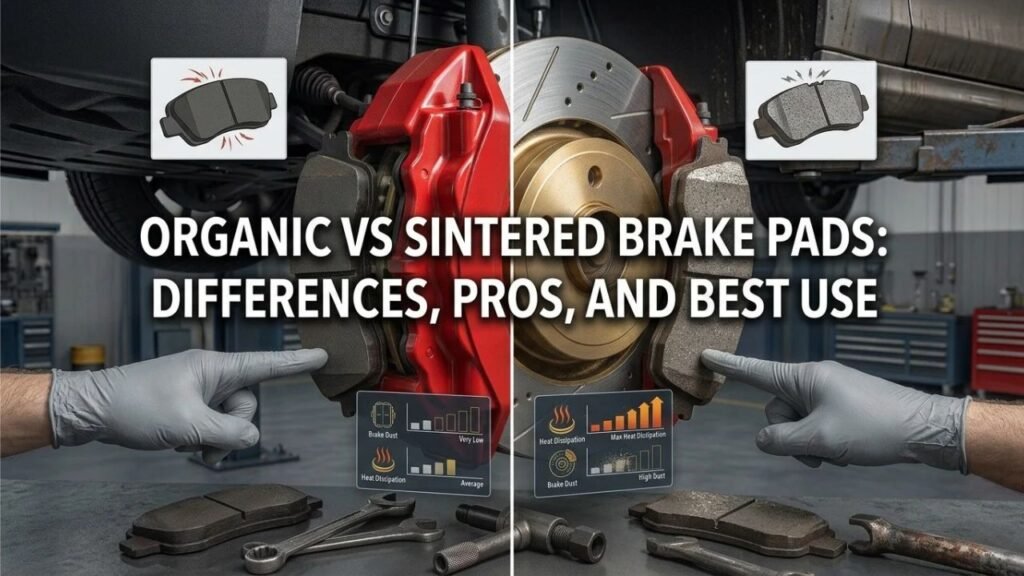
Organic vs Sintered Brake Pads: Quick Comparison
Organic and sintered pads perform the same basic job: they clamp against a brake rotor and turn motion into heat through friction. Their material construction changes how they behave while doing it.
| Feature | Organic Brake Pads | Sintered Brake Pads |
| Main material | Fibers and fillers bonded with resin | Metallic powders fused with heat and pressure |
| Initial bite | Usually strong from cold | May improve as temperature rises |
| Brake feel | Smooth and progressive | Firmer and more direct |
| Noise | Usually quieter | More likely to squeal |
| Pad life | Usually shorter | Usually longer in harsh conditions |
| Wet performance | Can wear quickly in wet grit | Strong in rain and mud |
| Heat tolerance | Lower | Higher |
| Rotor wear | Usually lower | Usually higher |
| Bedding time | Usually shorter | Often longer |
| Best use | Dry, moderate riding | Heat, mud, rain, heavy-duty riding |
These are general compound tendencies rather than guarantees. SRAM, EBC, Brembo, Shimano, and other manufacturers tune individual products for specific brake systems and uses.
Organic Pads Favor Quietness and Control
Organic pads are commonly made from aramid or other fibers, carbon-based materials, fillers, and resin. They are also called resin pads in many bicycle brake systems.
The softer compound commonly produces less noise and a smooth lever feel. Organic pads also tend to develop useful friction without needing much temperature in the brake.
Sintered Pads Favor Heat and Wear Resistance
Sintered pads use metallic powders that are compressed and heated until the particles bond together. Brembo describes its sintered motorcycle pads as metallic powders combined under high pressure and high temperature.
Their harder structure makes them well suited to prolonged braking, wet conditions, mud, and applications that repeatedly generate high rotor temperatures.
Key Takeaway: Organic pads favor quiet operation and cold bite, while sintered pads favor heat resistance, durability, and harsh-condition braking.
What Are Organic Brake Pads?
Organic pads use a non-metallic or low-metallic friction mixture held together by resin. Exact recipes vary, so two organic pads can feel quite different even when both carry the same broad material label.
How Organic Brake Pads Are Made
Typical formulations may contain aramid fibers, carbon, ceramic material, rubber-like fibers, mineral fillers, graphite, and resin.
EBC describes its motorcycle organic pads as man-made fibers such as aramid bonded together with resin. Its FA-Series organic motorcycle pad is designed around low noise, brake feel, and low rotor wear.
The resin binder contributes to the pad’s softer feel compared with a heavily metallic sintered compound.
Advantages of Organic Pads
Organic pads are attractive when noise and brake modulation matter.
Common strengths include:
- Quiet braking
- Strong response from cold
- Smooth, progressive lever feel
- Shorter bedding period on many systems
- Less rotor abrasion
- Good performance for moderate road use
- Lower heat transfer into some bicycle calipers
SRAM specifically describes its organic bicycle pads as providing consistent initial bite, less noise, and shorter bedding time than sintered pads.
Disadvantages of Organic Pads
The softer compound generally wears faster, especially when exposed to abrasive water, mud, and grit.
Organic material may also lose braking consistency sooner during long, hot descents. Sustained braking can raise the pad and rotor temperature enough for friction to fall, producing brake fade.
For riders who spend most of their time in dry, moderate conditions, those disadvantages may never become a major problem.
Key Takeaway: Organic pads suit riders who prioritize low noise, good cold response, modulation, and reduced rotor wear over maximum heat and mud resistance.
What Are Sintered Brake Pads?
Sintered pads, often called metallic brake pads, are made primarily from metallic particles combined under high pressure and heat.
The particles bond without being melted into a conventional liquid metal casting. The resulting friction block is hard, dense, and resistant to wear.
How Sintered Pads Behave Under Heat
Heat tolerance is one of the main reasons sintered pads are used for demanding braking.
SRAM recommends sintered pads for heavy-duty use such as steep sustained descents and says they perform well in wet and muddy conditions. Brembo also markets sintered motorcycle compounds for high-temperature stability and intensive riding.
That makes them attractive for downhill mountain bikes, loaded e-bikes, touring motorcycles, heavy motorcycles, aggressive trail riding, and long mountain descents.
Advantages of Sintered Pads
Common strengths include:
- Strong resistance to heat
- Longer life in wet and gritty conditions
- Consistent behavior during repeated braking
- Good mud resistance
- Good rain performance
- Suitable for heavier machines
- Strong performance during long descents
EBC uses sintered compounds for heavier touring motorcycles and sport applications, while its organic pads target lower noise and gentler rotor interaction.
Disadvantages of Sintered Pads
The harder compound can make more noise and may feel less smooth at light braking loads.
Sintered material may also wear some rotors faster. This matters greatly on bicycles because certain rotors are manufactured specifically for resin pads and are not rated for metallic compounds.
Shimano states that rotors labeled RESIN PAD ONLY should only be used with resin pads because metal pads can rapidly damage those rotors.
Key Takeaway: Sintered pads make the most sense where brakes face high temperatures, water, mud, frequent hard stops, or heavier loads.
Organic vs Sintered Brake Pads for Stopping Power
Sintered does not automatically mean shorter stopping distances in every condition.
Stopping power depends on the complete brake system: pad compound, rotor, caliper, hydraulic or cable setup, tire grip, temperature, surface conditions, vehicle weight, and brake design.
Organic Pads Often Feel Strong From Cold
Organic pads commonly produce useful bite immediately without much heat.
That can make them feel sharp and responsive during short urban rides, road cycling, cross-country cycling, or lighter motorcycle use.
A rider who rarely creates high brake temperatures may prefer that immediate feel.
Sintered Pads Stay More Consistent Under Repeated Braking
Sintered pads become more attractive once heat starts to build.
Long mountain descents, repeated heavy stops, loaded e-bikes, off-road riding, and heavy motorcycles can produce conditions where an organic compound begins losing consistency.
SRAM specifically positions sintered pads for higher-temperature applications such as steep sustained descents.
Tire Grip Still Sets the Final Limit
More pad friction does not automatically produce more usable stopping force once a tire reaches its traction limit.
A pad should give the rider controllable friction across the temperature and weather conditions the brake experiences. Excessively abrupt bite can sometimes make fine control harder on loose terrain.
Key Takeaway: Organic pads can feel stronger immediately from cold, while sintered pads tend to preserve braking consistency better as temperature and braking demand rise.
Organic vs Sintered Pads in Rain, Mud, and Dry Conditions
Weather is one of the clearest reasons to choose one compound over the other.
Dry Conditions
Organic pads work very well in dry conditions when brake temperatures remain moderate.
Road bikes, recreational bicycles, commuter bikes, scooters, and lighter motorcycles may get quieter braking and good modulation from organic material.
If you rarely ride in rain or mud, the extra wear resistance of a sintered pad may provide little practical advantage.
Wet Conditions
Sintered pads generally handle repeated wet braking better.
Organic pads can wear much faster when water combines with road grit or trail debris. SRAM states that its organic pads wear faster in wet conditions, while sintered pads are suited to wet and muddy environments.
For riders who cannot avoid wet weather, pad longevity alone may justify switching to sintered material when the brake system permits it.
Mud and Grit
Mud creates an abrasive mixture between the rotor and pad.
Sintered compounds generally tolerate this environment better because their harder friction material resists abrasive wear.
Galfer likewise recommends sintered bicycle compounds for wet conditions, mountain routes, enduro, downhill riding, and e-bikes where temperature and contamination demands are higher.
Key Takeaway: Organic pads are well suited to dry conditions, while sintered pads generally last longer and remain more consistent in rain, mud, and abrasive trail conditions.
Which Brake Pads Last Longer?
Sintered pads generally outlast organic pads when riding conditions are wet, dirty, hot, or demanding.
No fixed mileage ratio applies across all brake systems.
Pad life changes with:
- Rider and machine weight
- Terrain
- Rotor size
- Brake temperature
- Riding speed
- Frequency of braking
- Mud and water exposure
- Pad formulation
- Caliper condition
- Bedding procedure
A light road cyclist on flat pavement may get excellent life from organic pads. A downhill rider may destroy the same compound rapidly.
The same pattern applies to motorcycles. EBC positions organic pads as a medium-life material with low rotor attack, while its sintered lines target high braking demand and longer life.
I would not buy sintered pads solely because someone claims they last a set number of times longer. Match the pad to the brake’s workload first.
Which Pads Wear Rotors Faster?
Organic pads are generally easier on rotors.
The softer pad compound tends to wear itself rather than aggressively abrading the rotor. That characteristic is one reason organic pads remain attractive for casual riding and systems using lighter rotors.
Sintered material is harder and may increase rotor wear in some brake systems.
The difference is not universal. High-quality sintered compounds can be formulated to control rotor wear, and EBC markets several motorcycle sintered pads as producing low or no abnormal disc damage within their intended applications.
Compatibility matters more than a general rule. A metallic pad running against a rotor specifically marked for resin pads is a different situation from a complete brake system designed around sintered material.
Are Organic or Sintered Brake Pads Quieter?
Organic pads are normally quieter.
Their softer resin-based compound tends to damp vibration better and produces less metallic squeal.
Sintered pads are more likely to make noise, especially during cold operation, light braking, or wet conditions. SRAM lists greater noise as one of the tradeoffs of its sintered compounds.
Noise does not always mean the compound is wrong.
Squealing can also come from:
- Oil or grease contamination
- Poor bedding
- Glazed pads
- Dirty rotors
- Misaligned calipers
- Loose hardware
- Uneven deposits on the rotor
Changing to organic pads will not correct a contaminated or badly adjusted brake.
Can You Switch From Organic to Sintered Brake Pads?
Sometimes, but compatibility must be checked first.
This is especially important with bicycle disc brakes.
Check the Rotor Markings
Look directly at the brake rotor.
If it says Resin Pad Only, do not install sintered or metallic pads. Shimano warns that metal pads will rapidly wear rotors intended only for resin compounds.
A metal-compatible rotor may be needed before changing compounds.
Check the Brake Manufacturer’s Instructions
Do not assume that a pad fitting physically means the compound is approved.
Use the manufacturer compatibility chart for the caliper and rotor.
Motorcycle manufacturers may also specify pad type for ABS calibration, rotor material, braking balance, noise requirements, or intended operating conditions.
Consider the Existing Rotor Transfer Layer
During bedding, some pad material transfers onto the rotor surface.
SRAM recommends replacing the rotor when changing between its pad compounds because old transferred material can contribute to noise and reduced brake performance.
Other manufacturers may provide different procedures, so follow the instructions for the brake system you have.
Key Takeaway: Before switching compounds, confirm caliper fit, rotor compatibility, and the manufacturer’s bedding or rotor-replacement instructions.
Organic vs Sintered Brake Pads for Different Uses
Neither pad type wins every category. The better choice changes with the braking environment.
Road and Recreational Bicycles
Organic pads often suit dry road riding.
They offer quiet operation, good initial bite, and smooth modulation without the extra noise associated with many metallic pads.
If the route includes long mountain descents or frequent wet weather, sintered pads may be worth considering if the rotor is compatible.
Mountain Bikes
For dry cross-country riding, organic pads can work very well.
For downhill, enduro, mud, repeated descents, or aggressive trail riding, sintered pads are usually the stronger match because they resist heat and abrasive wear better.
E-Bikes
E-bikes add weight and often maintain higher average speeds than conventional bicycles.
More mass means the brakes must convert more kinetic energy into heat. For that reason, sintered or other high-temperature compounds are common choices for demanding e-bike use.
Rotor and caliper compatibility still comes first.
Motorcycles and Scooters
Organic motorcycle pads suit many scooters, lighter motorcycles, urban use, and riders who prefer smooth feel and low noise.
Sintered material is common on larger motorcycles, touring bikes, sport motorcycles, and machines that generate more heat.
Brembo offers sintered compounds for road, touring, off-road, and maxi-scooter applications, while EBC offers both organic and sintered compounds for different motorcycle workloads.
Passenger Cars
The organic-versus-sintered terminology is much less common when shopping for normal passenger-car brake pads.
Car pads are more often marketed as NAO/organic, ceramic, low-metallic, or semi-metallic. If you are choosing pads for a car, compare the compounds specified for that vehicle rather than assuming a bicycle or motorcycle sintered-pad recommendation applies.
Key Takeaway: Organic fits quieter, moderate-use braking well; sintered fits demanding heat, weather, weight, and repeated braking better.
Organic vs Sintered vs Semi-Metallic Brake Pads
Semi-metallic or semi-sintered pads sit between the two broad compound families.
They combine an organic-style matrix with added metallic material to balance heat resistance, wear life, noise, and brake feel.
For some riders, that middle ground makes more sense than choosing either extreme.
A semi-metallic pad may provide:
- Better wet resistance than a basic organic pad
- Longer life than organic material
- Less noise than some full sintered compounds
- Good brake feel at moderate temperatures
- Better heat capability for mixed riding
EBC sells semi-sintered motorcycle pads specifically as a bridge between organic pad characteristics and the endurance of a sintered compound.
Do not assume all pads labeled semi-metallic contain the same amount or type of metal. Formulation varies substantially between brands.
Which Should You Choose?
Choose organic brake pads if most of these describe your use:
- Riding is mainly dry
- Braking loads are moderate
- Noise bothers you
- You prefer smooth modulation
- You want reduced rotor wear
- Long, hot descents are uncommon
Choose sintered brake pads if most of these fit:
- You regularly ride in rain or mud
- Your brakes get very hot
- You ride long descents
- You have a heavy bike or motorcycle
- You ride an e-bike under demanding conditions
- Pad life in harsh conditions matters
- Some extra brake noise is acceptable
My preference is to keep the factory compound unless the current pads reveal a clear limitation. If organic pads repeatedly fade or disappear quickly in wet conditions, moving toward sintered material makes sense. If sintered pads are noisy and the brakes never see serious heat, organic material may suit the use better.
Compatibility overrides preference. Never install a compound that the rotor or brake manufacturer does not approve.
Conclusion
The main difference in organic vs sintered brake pads is the balance between feel and durability. Organic pads tend to be quieter, smoother, easier on rotors, and strong from cold. Sintered pads resist heat, mud, water, and abrasive wear better, making them a strong match for demanding braking.
For dry commuting, casual cycling, lighter motorcycles, and moderate brake temperatures, organic material often provides all the braking performance needed with less noise. Long descents, enduro and downhill riding, heavy e-bikes, touring motorcycles, rain, and mud push the comparison toward sintered compounds.
Before changing pad material, check the caliper and rotor requirements. A bicycle rotor marked Resin Pad Only should not be used with a sintered pad, and some manufacturers give specific procedures when changing compounds.
I would choose based on the hardest conditions the brakes regularly face rather than buying the harder compound by default. The correct pad is the one that stays predictable across your normal temperature, weather, load, and braking demands.
FAQs About Organic and Sintered Brake Pads
Are sintered brake pads better than organic?
Sintered pads are better for high heat, mud, rain, long descents, and heavy-duty braking. Organic pads are often better for quiet operation, cold bite, smooth modulation, and low rotor wear. Neither material is automatically superior for every brake system.
Do sintered brake pads stop faster?
Not automatically. Pad compound is only one part of stopping performance. Rotor size, tire grip, caliper force, temperature, brake setup, and surface conditions also affect stopping distance. Sintered pads have a major advantage when repeated braking raises temperatures enough to challenge an organic compound.
Do sintered pads last longer than organic pads?
Usually, especially in wet, muddy, or high-temperature conditions. Organic pads can still have good service life in dry, moderate riding. There is no fixed lifespan difference because pad formulation, terrain, braking frequency, rider weight, and brake temperature all change wear.
Why are organic brake pads quieter?
Organic compounds use resin and fiber-based materials that tend to damp vibration better than hard metallic compounds. That often reduces squeal during light or cold braking. Pad contamination, rotor deposits, alignment, and bedding can still make an organic pad noisy.
Can sintered brake pads damage rotors?
They can increase rotor wear compared with softer organic pads, and they should never be used on a rotor rated only for resin material. Shimano specifically warns that metal pads can rapidly wear rotors marked Resin Pad Only.
Are organic pads good in the rain?
They can still brake in wet conditions, but repeated rain, mud, and grit generally increase organic-pad wear. Sintered pads tend to retain consistency and durability better in harsh wet riding, which is why they are common for mountain biking and demanding all-weather use.
Are sintered pads good for everyday riding?
Yes, if the brake system is compatible. They may produce more noise and may offer less initial bite before warming on some systems, so a rider who mainly travels short distances on dry, flat roads may prefer organic pads.
Can I put sintered pads on a resin-only rotor?
No. Use a compatible metal-rated rotor first. Shimano states that its rotors marked Resin Pad Only are intended only for resin pads because metallic pads can rapidly wear the braking surface.