Are Brake Caliper Clips Necessary? Purpose, Signs & Replacement
Yes, brake caliper clips are necessary when your vehicle’s brake design uses them. These small pieces of brake hardware help keep the brake pads properly positioned, reduce unwanted movement and rattling, and allow the pads to move correctly inside the caliper bracket.
However, not every braking system uses the same type of clip.
Some vehicles use abutment clips, others use external anti-rattle springs, and some fixed calipers hold the pads with retaining pins and springs instead. A few brake pads even have certain spring features built into the pad assembly.
So, if your vehicle was designed with a particular brake clip or retaining spring, it should be installed correctly. You should not intentionally leave it out simply because the brakes appear to work without it.
A missing, damaged, rusted, or incorrectly installed clip can contribute to brake noise, pad movement, binding, and uneven brake pad wear.
Are Brake Caliper Clips Necessary?
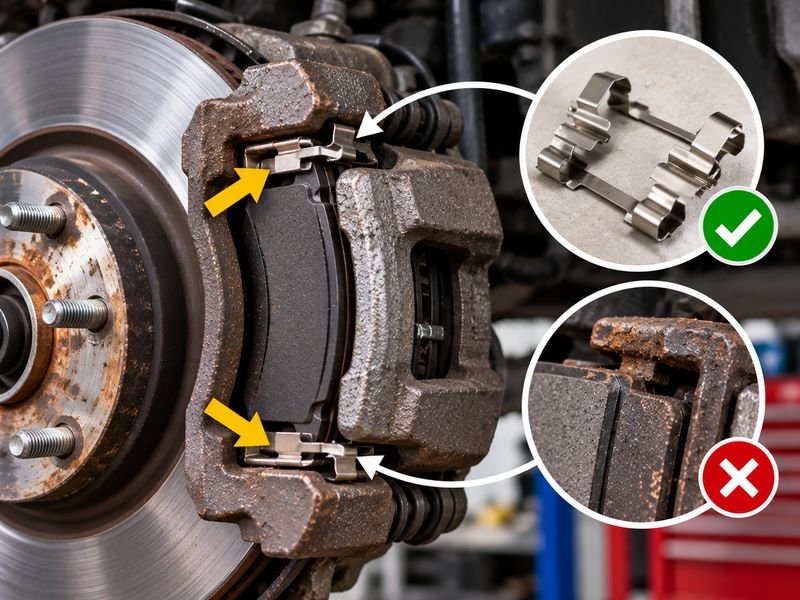
Yes. If the original brake system uses caliper clips or related brake hardware, they serve a purpose and should be present.
These parts may look insignificant compared with a brake rotor, caliper, or pad, but the brake system depends on all of its components fitting and moving correctly.
Depending on the brake design, clips may:
- Hold or guide the brake pads
- Reduce pad movement and rattling
- Provide tension against the pads
- Help the pads slide smoothly in the bracket
- Keep brake hardware correctly positioned
- Reduce certain types of brake noise
Leaving required hardware out of a brake job can change how the pads fit and move.
That does not necessarily mean the vehicle will instantly lose all braking ability, but it can create problems that should not be ignored.
What Are Brake Caliper Clips?
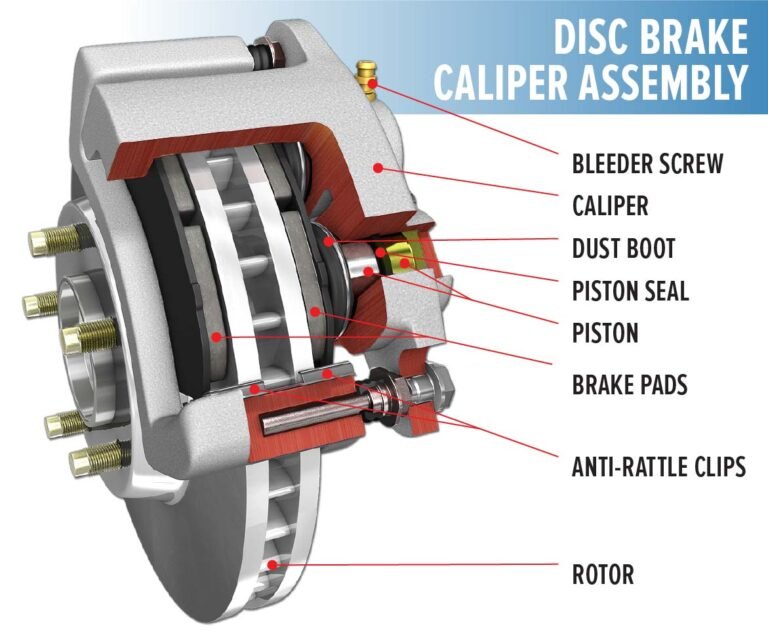
“Brake caliper clip” is a broad term people often use for several different pieces of disc brake hardware.
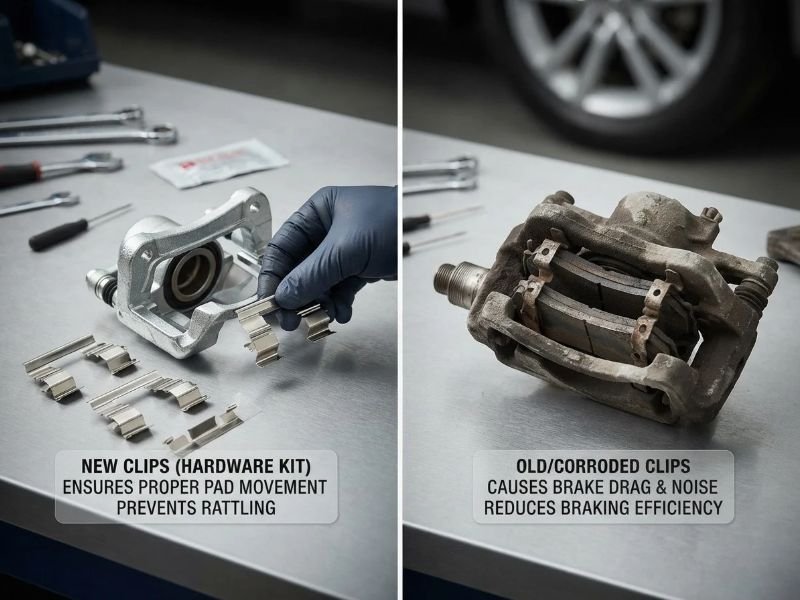
The exact design varies considerably between vehicles.
Brake Pad Abutment Clips
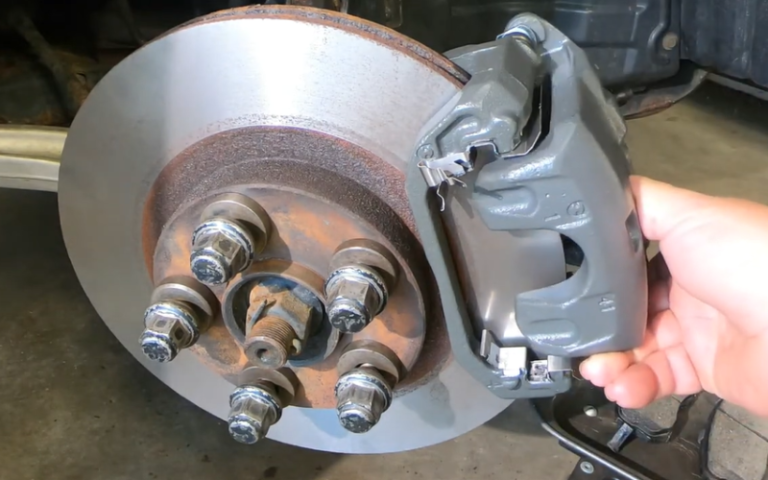
Abutment clips are thin metal pieces installed where the brake pad ears or tabs contact the caliper bracket.
The pads slide against these clips as the brakes apply and release.
They provide a smoother, properly shaped contact surface for pad movement.
Corrosion underneath the clips can push them inward and reduce the available space for the brake pad. When that happens, the pad may bind instead of sliding freely.
Anti-Rattle Clips or Springs
An anti-rattle clip places controlled spring tension on part of the brake assembly.
Its purpose is largely to control unwanted brake-pad movement and vibration.
Without the correct spring tension, pads may move or rattle inside the caliper assembly, especially over bumps or when changing between braking and acceleration.
Brake Pad Retaining Clips and Pins
Some calipers use pins, clips, or springs to retain the brake pads.
This arrangement is especially common on certain fixed or multi-piston calipers.
These components may look very different from the stainless-steel abutment clips used on many floating calipers, but they are still part of the brake’s designed retention system.
What Do Brake Caliper Clips Actually Do?
Their exact job depends on the type of clip, but there are several common functions.
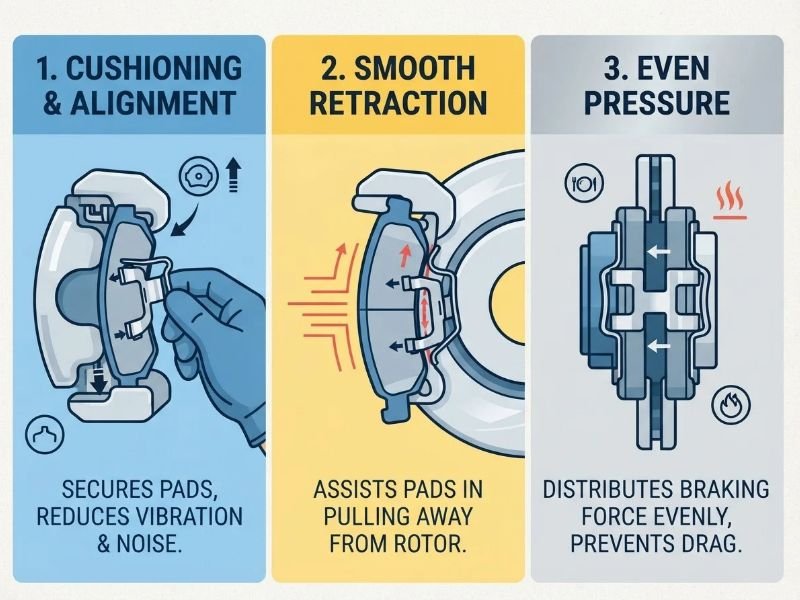
Keep the Brake Pads Properly Positioned
Brake pads need to sit correctly relative to the rotor.
Clips and retaining hardware help control the pad’s position inside the caliper or bracket.
The pads still need enough freedom to move when the brakes are applied and released, but they should not be excessively loose.
Help Prevent Brake Pad Rattle
Brake pads can vibrate or move slightly as a vehicle travels over rough roads.
Properly fitted anti-rattle hardware helps control this movement.
A missing or weak spring may allow a metallic tapping or rattling sound that is particularly noticeable at low speeds or over bumps.
Allow Proper Brake Pad Movement
On many floating-caliper systems, the brake pad tabs slide against abutment clips.
The contact points need to be clean and correctly fitted so the pad can move without binding.
If rust builds underneath a clip, the clip can be pushed toward the brake pad and make the fit too tight.
The result may be a pad that does not release properly after braking.
Help Maintain Correct Brake Hardware Fit
Brake components experience repeated heating and cooling.
Over time, hardware can corrode, become distorted, or lose some of its original spring tension.
Installing the correct hardware helps maintain the fit the braking system was designed to have.
What Happens If Brake Caliper Clips Are Missing?
The result depends on which clip is missing and how the particular brake system is designed.
A missing anti-rattle spring may cause different symptoms from a missing pad-retaining component.
For that reason, it is better to diagnose the exact missing part rather than assume all brake clips serve the same function.
Possible problems include rattling, clicking, squeaking, excessive pad movement, binding, and uneven pad wear.
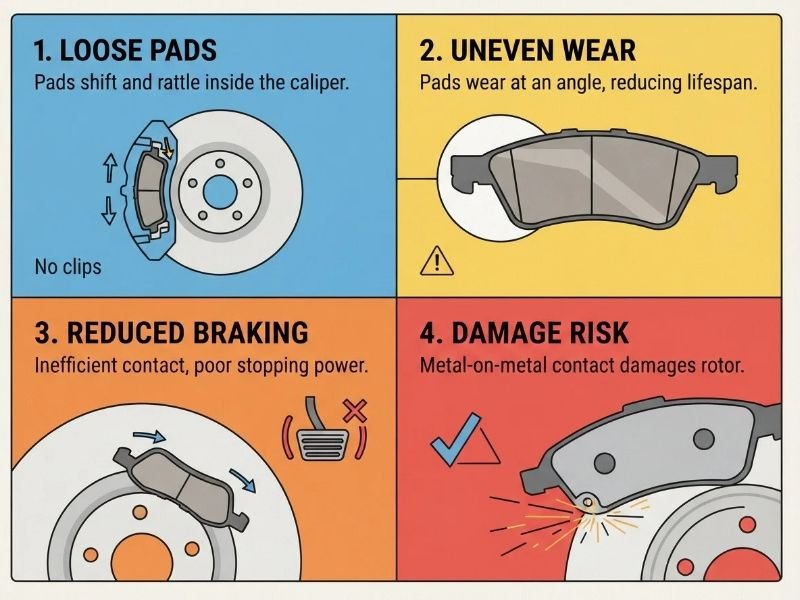
Brake Pads May Rattle
One of the most noticeable symptoms is a metallic rattle.
You may hear it:
- While driving over bumps
- At low speeds
- When changing direction
- When first applying the brakes
- When releasing the brake pedal
Sometimes the noise changes or disappears when the brake pedal is pressed because the caliper clamps the pads against the rotor.
However, several suspension and brake components can cause similar noises, so a rattle alone does not prove that a clip is missing.
The Pads May Not Move Correctly
Brake pads must be able to move within the designed clearances.
Incorrect or missing hardware can change that fit.
A pad that becomes too loose can move excessively. A pad that becomes too tight because of corrosion or incorrect hardware can bind in the caliper bracket.
Neither condition is desirable.
Brake Pads May Wear Unevenly
If a pad cannot move correctly, one portion of the braking system may remain in contact with the rotor longer than intended.
That can contribute to:
- Uneven pad wear
- Premature pad wear
- Excessive heat
- Brake drag
- Rotor discoloration or damage
Uneven wear can also result from other problems, such as seized slide pins or a sticking caliper piston, so the entire brake assembly should be inspected.
Can You Drive Without Brake Caliper Clips?
You should not intentionally continue driving with required brake hardware missing.
Whether a vehicle can physically move without a particular clip is different from whether the brake system is correctly assembled.
Some clips primarily control noise and pad movement, while others are part of the pad-retention system. Without identifying the exact part and brake design, there is no reliable universal distance that is safe to drive.
If you discover a missing clip after a brake repair, the better approach is to verify:
What part is missing?
Does the vehicle’s brake design require it?
Are the pads still correctly positioned?
Is there any grinding, dragging, rattling, or unusual brake feel?
If you are unsure, have the brake assembly inspected before continuing normal driving.
Do All Cars Have Brake Caliper Clips?
No. Not every vehicle uses the same visible brake caliper clips.
A conventional floating-caliper brake system may use stainless-steel abutment clips at the caliper bracket.
Another vehicle may use an external spring clip.
A fixed multi-piston caliper may instead use:
- Pad-retaining pins
- Cross springs
- Integrated pad springs
- Other vehicle-specific retaining hardware
Therefore, comparing your brakes visually with another vehicle is not a reliable way to determine whether something is missing.
The correct brake hardware depends on the exact year, make, model, brake package, and sometimes axle position.
Are Anti-Rattle Clips Necessary?
Yes, when the brake system was designed to use them.
Anti-rattle clips help maintain spring tension and control movement of the brake pads or caliper components.
Leaving an anti-rattle clip out may lead to:
- Rattling
- Clicking
- Brake squeal
- Excessive pad movement
The brakes may still create stopping force, but the assembly is no longer configured the way it was designed.
If a replacement brake pad kit includes anti-rattle hardware intended for your application, install it according to the manufacturer’s instructions.
Are Brake Pad Abutment Clips Necessary?
Yes, on brake systems designed for them.
Abutment clips create the surfaces along which the brake pad tabs move.
However, simply installing new clips is not enough.
The caliper bracket underneath the clips must be clean and free of excessive rust buildup.
Installing a fresh clip over a thick layer of corrosion can reduce the clearance around the pad.
The pad may then become difficult to install or fail to slide properly.
During a brake service, the bracket should be inspected and prepared before the new hardware is fitted.
Can Brake Caliper Clips Cause Brake Noise?
Yes. Worn, missing, loose, or incorrectly installed brake hardware can contribute to noise.
Possible noises include:
Rattling: Often associated with excessive movement in the pad or hardware.
Clicking: May occur when a loose pad shifts as braking force changes direction.
Squealing: Brake vibration can have many causes, and worn hardware is one possible contributor.
Scraping: A severely displaced piece of hardware may contact another rotating component.
Not every brake noise comes from clips.
Worn pads, rotor condition, improper bedding, caliper problems, wheel bearings, backing plates, and suspension components can also create noises that seem to come from the brakes.
How Do You Know If a Brake Caliper Clip Is Bad?
Brake hardware should be inspected whenever the brake pads are serviced.
Look for several common problems.
Heavy Rust or Corrosion
Light surface discoloration is different from severe corrosion.
A heavily corroded clip may no longer fit or flex correctly.
Also inspect underneath abutment clips because rust on the bracket can interfere with brake pad movement.
Bent or Distorted Clips
A clip should match its intended shape.
If it has been bent during removal or installation, it may not position the pad correctly.
Do not try to force badly damaged hardware back into shape simply to reuse it.
Loss of Spring Tension
Anti-rattle hardware relies on spring tension.
Repeated brake heating and years of use can affect old hardware.
If a spring no longer applies the intended tension, replacement is usually inexpensive compared with repeating the brake job later.
Broken or Missing Pieces
Cracked or broken clips should be replaced.
If one side of the vehicle has hardware that the other side does not, investigate whether something is missing before assuming the difference is normal.
Should You Replace Brake Clips When Replacing Brake Pads?
Replacing old brake hardware when installing new pads is generally a good practice when a correct hardware kit is available for the vehicle.
New pads installed with heavily corroded, bent, or fatigued hardware may not move as intended.
Many quality brake pad sets include new abutment clips or other required hardware.
However, do not assume every piece in a universal-looking hardware kit belongs on your vehicle.
Match the new components to the original design and installation instructions.
If the replacement clips are visibly different from the old ones, verify the part number and application before installing them.
Can You Reuse Old Brake Caliper Clips?
Sometimes reusable-looking hardware is found during a brake job, but new brake hardware is generally preferable when replacement clips are supplied for the application.
Old clips have already experienced:
- Heat cycles
- Road salt
- Water
- Brake dust
- Corrosion
- Repeated mechanical loading
A clip can look acceptable while no longer providing the same spring tension it originally had.
Considering the relatively low cost of most brake hardware kits, replacing appropriate clips during pad service can help avoid repeat disassembly.
Do New Brake Pads Come With Clips?
Some do and some do not.
Higher-quality or application-specific brake pad kits often include the necessary abutment clips or brake hardware, but this is not universal.
Some pads are sold separately from the hardware kit.
Before beginning the brake job, check whether the package contains the hardware required for your vehicle.
Do not discard the original hardware until you have confirmed that the replacement pieces are correct.
Should You Lubricate Brake Caliper Clips?
Certain brake pad contact points and abutment clip surfaces may require a small amount of appropriate brake lubricant, depending on the brake and pad manufacturer’s instructions.
Use only a brake-specific, high-temperature lubricant that is suitable for the particular component.
More lubricant is not better.
Most importantly, never put brake lubricant on:
- Brake pad friction material
- Rotor friction surfaces
Those surfaces must remain clean because the braking system depends on friction between the pad and rotor.
Also remember that caliper slide pins may have their own lubricant requirements. Some rubber components can be damaged or swollen by incompatible lubricants.
Follow the service information for the vehicle rather than using a random general-purpose grease.
Can Incorrectly Installed Brake Clips Cause Problems?
Yes.
Having the clip present is not enough—it must also be installed correctly.
A clip that is upside down, not fully seated, bent, or installed in the wrong position may interfere with the brake pad or even contact the rotor.
Possible signs of incorrect installation include:
- Pads that are extremely difficult to fit
- Pads that cannot slide freely
- Metallic scraping
- Clicking or rattling
- Uneven pad wear
- A wheel that becomes unusually hot
- Brake drag after pad replacement
If a problem begins immediately after a brake job, inspect the installation rather than assuming the new pads simply need more time to “break in.”
Why Won’t My Brake Pads Fit With New Clips?
This is a common issue during brake service.
If the pads fit without the clips but become extremely tight when new abutment clips are installed, do not automatically grind down the brake pad backing plate.
First inspect the caliper bracket underneath the clips.
Rust can build up on the bracket and push the new clip inward.
The correct repair may involve removing the clip, cleaning corrosion from the bracket’s hardware seating area, and then reinstalling the proper clip.
Also confirm that:
- The clips are the correct parts
- They are installed in the correct locations
- They are fully seated
- The brake pads are correct for the vehicle
A properly assembled floating-caliper brake should allow the pads to move as designed without being excessively loose.
Can a Missing Brake Clip Cause Uneven Pad Wear?
It can contribute to uneven wear, particularly when the missing or damaged hardware affects how the pad sits or moves.
However, uneven brake pad wear has several other common causes.
These include:
- Sticking caliper slide pins
- A seized caliper piston
- Rusted caliper brackets
- Brake hose problems
- Incorrect pad installation
- Rotor condition
If one pad is significantly more worn than another, inspect the entire brake assembly instead of replacing only the clip.
Can a Brake Caliper Clip Touch the Rotor?
A properly installed clip normally should not rub continuously against the rotor’s friction surface unless a particular design specifically uses a component in that manner.
If you hear metal scraping after brake service, inspect the hardware installation.
A clip may be:
- Bent
- Mispositioned
- Not fully seated
- The wrong part
- Installed backward
Do not assume continuous scraping is normal just because the brakes were recently serviced.
What If My New Brake Pads Do Not Use the Old Clips?
Do not guess.
Replacement pad designs can occasionally differ from the original components, but the complete assembly must still match the brake manufacturer’s intended configuration.
Check the replacement pad installation instructions and correct parts information.
If the old brake system used a retention component and the new kit appears to eliminate it without explanation, verify the application before driving the vehicle.
Brake hardware is not a good place to improvise.
When Should Brake Caliper Clips Be Replaced?
Brake hardware should at least be carefully inspected during every brake pad replacement.
Replace clips or related hardware when they are:
- Missing
- Cracked
- Severely corroded
- Bent
- Distorted
- Loose
- No longer providing proper spring tension
- Included as new replacement hardware with the brake pad set
The caliper bracket, slide pins, boots, pads, and rotor should also be inspected at the same time.
A good brake job addresses the whole system rather than simply sliding in new pads.
FAQs About Are Brake Caliper Clips Necessary?
Are Brake Caliper Clips Necessary?
Yes. If your vehicle’s brake system was designed with clips, springs, or retaining hardware, those components should be correctly installed. They help control pad movement, fit, and noise.
What Happens If You Don’t Use Brake Pad Clips?
The pads may rattle, move excessively, bind, or wear unevenly depending on which hardware is missing and how the brake system is designed.
Can You Drive Without a Brake Caliper Clip?
It is not a good idea to intentionally drive with required brake hardware missing. Different clips perform different jobs, and some are more important to pad retention than others. Have the missing part identified and corrected.
Do You Really Need Anti-Rattle Clips?
If the vehicle was designed to use them, yes. Anti-rattle clips help control unwanted brake pad movement and vibration.
Can Missing Brake Clips Cause Squeaking?
Yes, missing or weak brake hardware can contribute to vibration and brake noise, although squeaking can have several other causes.
Do Brake Caliper Clips Need Grease?
Some brake hardware contact points may use a small amount of brake-specific lubricant, but lubrication requirements vary. Never allow grease onto the pad friction material or rotor surface.
Do You Have to Replace Brake Clips With New Pads?
It is generally good practice to install appropriate new brake hardware when supplied for the vehicle, especially if the old clips are corroded, bent, loose, or fatigued.
Do All Brake Pads Have Clips?
No. Brake hardware designs vary. Some systems use abutment clips, some use anti-rattle springs, and others use retaining pins or integrated pad hardware.
Can Brake Clips Cause Grinding?
An incorrectly installed, bent, or displaced clip can potentially contact another component and create scraping or grinding sounds. The brakes should be inspected if this begins after a repair.
Why Are My New Brake Pads Tight After Installing Clips?
Rust beneath the abutment clips, incorrect clips, improper installation, or incorrect pads can reduce clearance. Inspect and clean the caliper bracket and verify the parts rather than forcing the pads into place.
Can You Reuse Brake Pad Clips?
Some old hardware may appear reusable, but replacing it is generally preferable when a correct new hardware kit is available, especially if the original clips have corrosion or reduced spring tension.
Conclusion: Are Brake Caliper Clips Necessary?
So, are brake caliper clips necessary? Yes—when your vehicle’s braking system was designed to use them.
Brake clips, springs, and retaining hardware may be small, but they help the brake pads stay correctly positioned and move as intended. Missing, damaged, corroded, or incorrectly installed hardware can contribute to rattling, binding, brake noise, and uneven pad wear.
Just remember that not every vehicle uses the same style of clip. A floating caliper with abutment clips can look very different from a fixed caliper that uses retaining pins and springs.
During a brake pad replacement, inspect the complete hardware system, clean corrosion from the caliper bracket, install the correct clips in the correct positions, and use brake-specific lubricant only where appropriate.
If you are unsure whether a clip is missing or incorrectly installed, verify the correct brake configuration for your exact vehicle rather than leaving the part out.