What Is Brake Fluid? How It Works, What It Does, and More
Brake fluid is a hydraulic fluid that transfers force from the brake pedal to the brakes at the wheels, allowing a vehicle to slow down or stop. When you press the brake pedal, the braking system uses brake fluid to carry hydraulic pressure through the brake lines to the calipers or wheel cylinders.
Understanding what is brake fluid becomes especially important because this liquid does far more than simply fill a reservoir. It must transmit pressure reliably, tolerate extremely high temperatures, protect internal brake components from corrosion, lubricate seals and moving parts, and continue working across a wide range of driving conditions.
That also explains what does brake fluid do and how does brake fluid work: it allows a relatively small movement of your foot at the brake pedal to create controlled braking force at multiple wheels through a sealed hydraulic system.
But not every brake fluid is identical. Different fluids use different chemical bases and additive packages, which is why understanding what is brake fluid made of matters when choosing, topping up, flushing, or servicing a braking system.
This guide explains brake fluid from the ground up, including its purpose, composition, hydraulic operation, DOT classifications, boiling points, moisture absorption, warning signs, maintenance, compatibility, and the mistakes that can lead to expensive or unsafe brake problems.
What Is Brake Fluid?
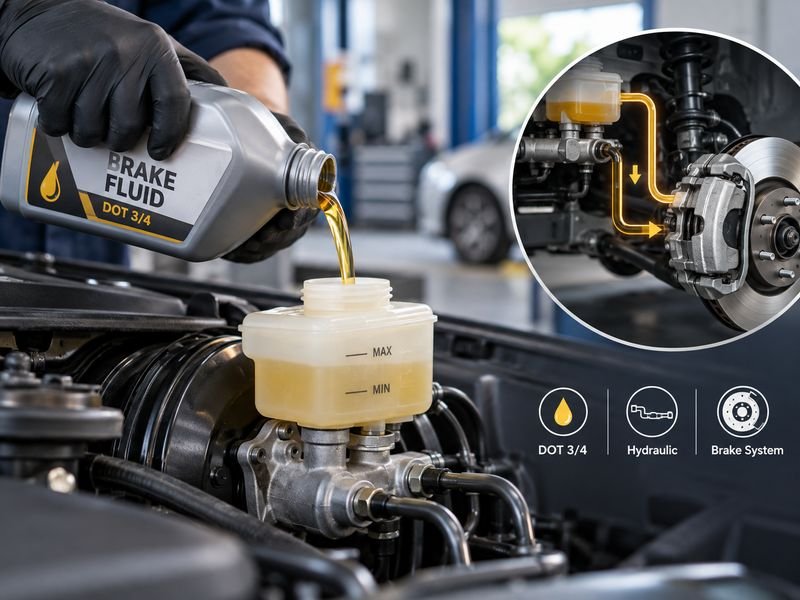
Brake fluid is a specially formulated hydraulic fluid used in a vehicle’s braking system to transfer pressure from the driver’s brake pedal to the braking components at the wheels.
In most passenger vehicles, the fluid is stored in the brake master cylinder reservoir under the hood. When the brake pedal is pressed, the master cylinder pressurizes the fluid and sends that pressure through brake lines and flexible brake hoses.
At the wheels, that hydraulic pressure operates either:
- Brake calipers in a disc brake system
- Wheel cylinders in a drum brake system
The resulting force presses brake pads against rotors or brake shoes against drums, creating friction that slows the vehicle.
Brake fluid is therefore one of the most important working fluids in a car. Without sufficient fluid and proper hydraulic pressure, the braking system cannot operate normally.
Unlike engine oil, brake fluid is not primarily there to lubricate large moving engine components. Its most important role is to transmit hydraulic force consistently and safely.
What Does Brake Fluid Do?
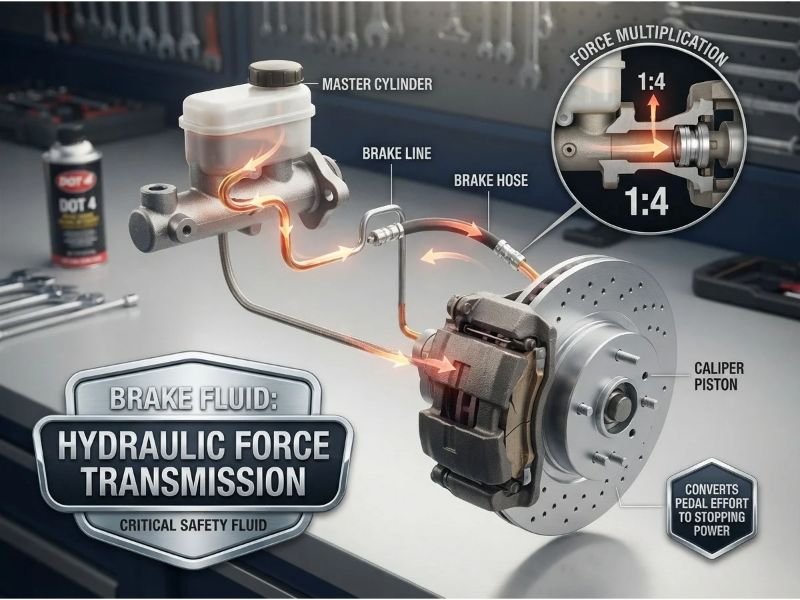
The simplest answer to what does brake fluid do is that it transfers the force you apply to the brake pedal into hydraulic pressure that activates the brakes.
However, brake fluid performs several important functions at the same time.
Transfers Braking Force
The primary job of brake fluid is to transmit force through the hydraulic braking system.
When you press the pedal, the master cylinder pushes against the fluid. Because liquids are extremely difficult to compress under normal braking conditions, that pressure is transmitted through the brake lines.
The calipers or wheel cylinders then convert the hydraulic pressure into mechanical movement.
Without this pressure transfer, pressing the pedal would not effectively operate the brakes at the wheels.
Helps Create Consistent Brake Pedal Feel
A properly filled and bled hydraulic system helps create a firm and predictable pedal.
If air enters the system, the pedal may feel soft or spongy because air compresses much more easily than brake fluid.
That distinction is important.
Brake fluid itself should transmit pressure efficiently, while trapped air can absorb part of the pedal movement.
Handles High Brake Temperatures
Braking generates a large amount of heat.
When brake pads press against rotating brake rotors, friction converts the vehicle’s motion into heat. Some of that heat can transfer into the caliper and eventually the brake fluid.
Brake fluid is therefore designed to maintain useful properties at temperatures much higher than ordinary water-based liquids could tolerate safely.
Its boiling point is especially important.
If the fluid becomes hot enough to boil, vapor bubbles can form. Vapor is compressible, which can lead to reduced hydraulic pressure and a dangerously soft brake pedal.
Protects Brake Components
Brake fluid formulations commonly include additives designed to protect metal components within the hydraulic system.
These components can include:
- Master cylinder
- ABS hydraulic modulator
- Brake lines
- Calipers
- Wheel cylinders
- Proportioning or control valves
Corrosion inside the braking system can damage seals, restrict fluid movement, and create expensive failures.
Lubricates Internal Seals and Components
Brake fluid also provides lubrication for certain internal seals, pistons, and valves.
This is especially important in components such as:
- The master cylinder
- ABS hydraulic control unit
- Caliper pistons
- Wheel cylinders
The fluid must therefore be chemically compatible with the rubber seals and other materials used in the braking system.
How Does Brake Fluid Work?
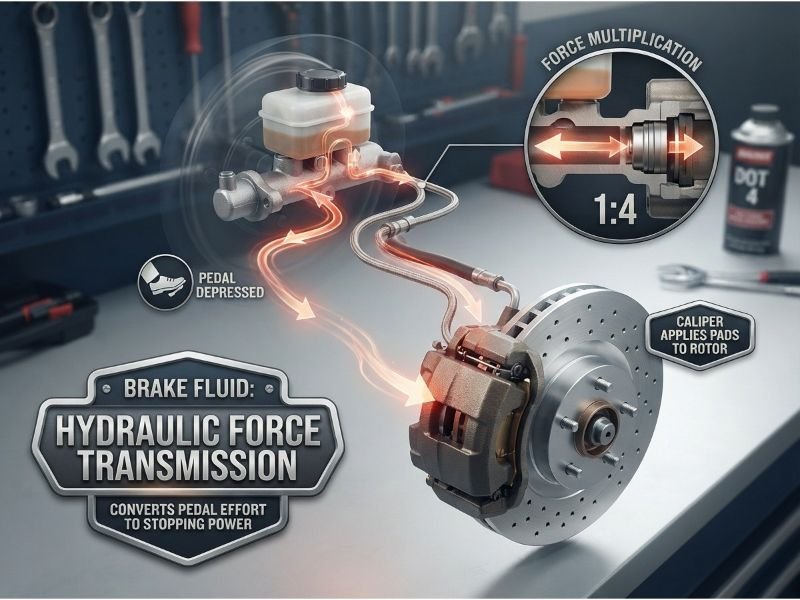
To understand how does brake fluid work, it helps to follow what happens from the moment you press the brake pedal until the vehicle slows.
The system works using hydraulic pressure.
Step 1: You Press the Brake Pedal
Pressing the pedal creates mechanical force.
Depending on the vehicle, a brake booster may multiply that force before it reaches the master cylinder.
Most modern passenger vehicles use some form of brake assistance because applying adequate braking force directly with pedal pressure alone would require much more effort.
Step 2: The Master Cylinder Pressurizes the Brake Fluid
The brake pedal or booster moves a piston inside the master cylinder.
As the piston moves, it pressurizes the brake fluid.
The fluid is contained in a sealed hydraulic circuit.
Because brake fluid is effectively incompressible under normal operating conditions, the pressure travels through the hydraulic system.
Step 3: Pressure Travels Through the Brake Lines
The pressurized fluid moves through rigid metal brake lines and flexible brake hoses.
The flexible sections are necessary near the wheels because the suspension and steering components move.
Hydraulic pressure reaches the brakes at each wheel.
Modern vehicles usually use split hydraulic circuits so that a single failure is less likely to remove all braking capability at once.
The exact layout varies by vehicle.
Step 4: Brake Calipers or Wheel Cylinders Move
On a disc brake system, hydraulic pressure moves one or more caliper pistons.
The pistons push the brake pads against the rotor.
On a drum brake system, pressure operates wheel cylinders that push the brake shoes outward against the inside of the brake drum.
Step 5: Friction Slows the Vehicle
The brake pads or shoes create friction against the rotating braking surface.
That friction converts kinetic energy into heat.
As the wheels slow, the vehicle slows with them.
Step 6: Releasing the Pedal Reduces Pressure
When you take your foot off the brake pedal, pressure in the hydraulic system drops.
The caliper pistons and other brake components move enough to release most of the clamping force, allowing the wheels to rotate freely again.
The fluid remains in the system, ready for the next braking event.
Why Brake Fluid Works So Well in a Hydraulic System
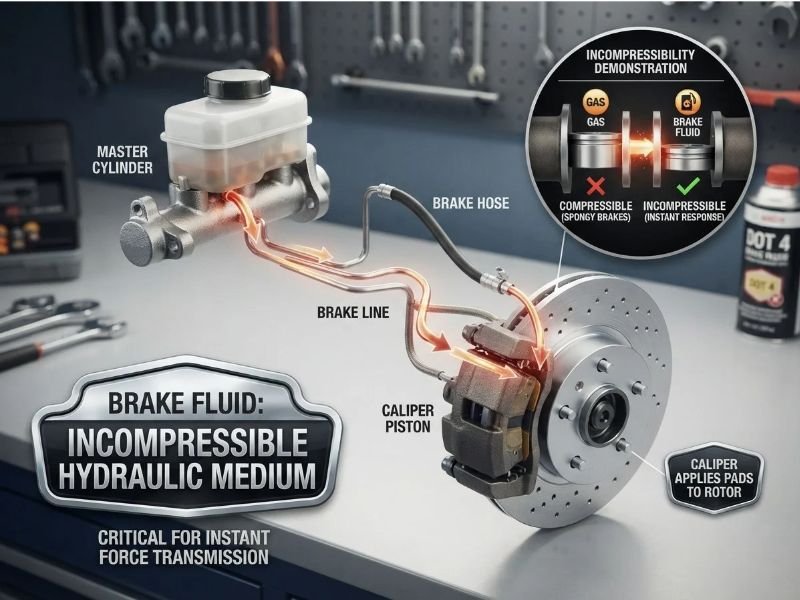
Brake fluid is useful because liquids transmit pressure efficiently.
In a properly functioning braking system, pressing the pedal at the master cylinder generates pressure that can be transmitted through relatively small brake lines to each wheel.
This principle allows the braking system to convert pedal input into substantial clamping force.
The hydraulic system also makes it possible to distribute braking force among multiple wheels.
Modern vehicles may further control that pressure using systems such as:
- ABS
- Traction control
- Electronic stability control
- Electronic brake-force distribution
These systems rely on precise hydraulic pressure control, which makes fluid condition particularly important.
What Is Brake Fluid Made Of?
The answer to what is brake fluid made of depends on the type of brake fluid.
Most automotive brake fluids are based on either:
- Glycol ethers
- Glycol ether and borate ester blends
- Silicone
- Specialized mineral-based fluids in certain applications
The base chemistry determines important characteristics such as moisture absorption, boiling point, seal compatibility, and whether different fluids can be mixed.
Glycol Ether-Based Brake Fluid
Most commonly used brake fluids in passenger vehicles are glycol ether based.
DOT 3 and many DOT 4 brake fluids use glycol ethers as a major part of their formulation.
These fluids generally contain:
- Glycol ethers
- Lubricating components
- Corrosion inhibitors
- Oxidation inhibitors
- Stabilizers
- Other performance additives
Glycol-based brake fluid is hygroscopic, meaning it absorbs moisture from the surrounding environment over time.
That characteristic has both advantages and disadvantages, which we will discuss shortly.
Borate Ester Brake Fluid
Many higher-performance DOT 4 fluids and DOT 5.1 formulations may use borate ester chemistry in combination with glycol ethers.
Borate esters can help provide improved high-temperature performance.
The exact formulation differs among manufacturers, so a fluid should be selected according to its required specification rather than its ingredient list alone.
Silicone-Based Brake Fluid
DOT 5 brake fluid is generally silicone based.
This makes it chemically different from the common glycol-based fluids used in many vehicles.
DOT 5 fluid does not absorb moisture in the same way glycol-based fluids do.
However, that does not mean it can simply be substituted into any braking system.
DOT 5 should not be mixed casually with glycol-based DOT 3, DOT 4, or DOT 5.1 fluids.
Use only the fluid type specified by the vehicle manufacturer.
Mineral-Based Hydraulic Brake Fluids
Some specialized vehicle braking systems use mineral-based hydraulic fluids.
These systems are less common in ordinary passenger vehicles and may require specific fluid formulations.
Using conventional brake fluid in a system designed for mineral hydraulic fluid—or vice versa—can damage seals and other hydraulic components.
Always confirm the required specification before adding fluid.
What Are the Main Ingredients in Brake Fluid?
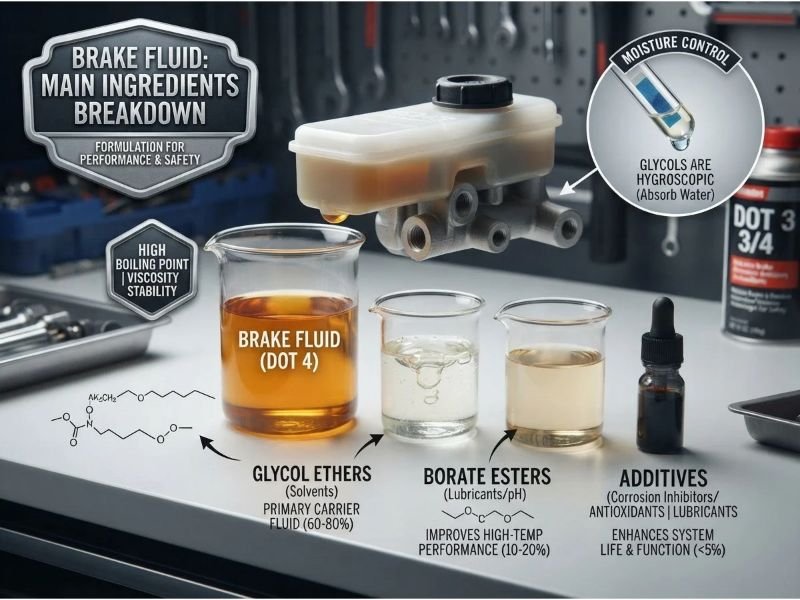
Although formulations vary, a typical brake fluid contains several categories of ingredients.
Base Fluid
The base makes up the main part of the formulation and determines many of its fundamental characteristics.
Depending on the brake fluid specification, the base may include glycol ethers, borate esters, silicone compounds, or another specialized hydraulic fluid.
Corrosion Inhibitors
The braking system contains numerous metal components.
Corrosion inhibitors help reduce internal rust and chemical deterioration.
They are particularly important because absorbed moisture can increase corrosion risk over time.
Lubricating Additives
Internal seals, pistons, valves, and moving hydraulic components require compatible lubrication.
Brake fluid helps provide that lubrication while maintaining hydraulic performance.
Antioxidants and Stabilizers
Brake fluid experiences repeated heating and cooling cycles.
Chemical stabilizers and antioxidants help slow fluid degradation under these conditions.
pH-Control and Protective Additives
Brake fluid formulations may contain additives that help maintain chemical stability and protect hydraulic components.
The exact blend is manufacturer-specific and should not be assumed to be identical across products carrying the same general DOT classification.
Why Brake Fluid Must Have a High Boiling Point
One of the most important characteristics of brake fluid is its ability to resist boiling.
During heavy braking, heat from the rotor or drum can reach nearby hydraulic components.
If brake fluid boils, it can create vapor.
Unlike liquid brake fluid, vapor compresses relatively easily.
That can cause:
- Soft brake pedal
- Increased pedal travel
- Reduced braking response
- Temporary braking loss in severe conditions
This condition is sometimes associated with brake fluid fade or vapor-related brake fade.
For that reason, brake fluid specifications include boiling-point requirements.
Dry vs. Wet Boiling Point
Brake fluid specifications often refer to two different boiling points.
Dry Boiling Point
The dry boiling point refers to relatively fresh brake fluid with very little moisture contamination.
New brake fluid generally has its highest boiling resistance.
Wet Boiling Point
The wet boiling point represents fluid after it has absorbed a defined amount of moisture under standardized testing conditions.
The wet boiling point is lower than the dry boiling point.
This is one reason brake fluid does not remain chemically unchanged forever.
As moisture content increases, high-temperature performance can decline.
Why Does Brake Fluid Absorb Water?
Most glycol-based brake fluids are hygroscopic.
This means they gradually absorb moisture from the environment.
Moisture can enter through:
- The reservoir venting system
- Rubber hoses
- Seals
- Service operations
- Containers that have been opened and stored improperly
The hydraulic braking system may appear sealed, but it is not necessarily completely isolated from atmospheric moisture for the life of the vehicle.
Why Hygroscopic Behavior Exists
Allowing water to dissolve throughout the fluid helps prevent larger free-water pockets from collecting in isolated areas.
However, increasing moisture content lowers the fluid’s boiling point and can contribute to corrosion.
This is why periodic fluid inspection or replacement may be recommended.
DOT 3 vs. DOT 4 vs. DOT 5 vs. DOT 5.1 Brake Fluid
Brake fluids are commonly classified using DOT designations.
These designations represent performance standards rather than simple brand names.
DOT 3 Brake Fluid
DOT 3 is commonly glycol ether based.
It has been widely used in passenger vehicles and light trucks.
It is hygroscopic and absorbs moisture over time.
Some vehicles originally specifying DOT 3 may permit another compatible specification, but this should only be done when allowed by the manufacturer.
DOT 4 Brake Fluid
DOT 4 is also generally glycol based and is widely used in modern vehicles.
Its formulation typically provides higher minimum boiling performance than DOT 3.
There are also specialized DOT 4 formulations designed for demanding or performance-oriented applications.
DOT 5 Brake Fluid
DOT 5 is silicone based.
It is fundamentally different from DOT 3 and DOT 4.
It should not be assumed interchangeable simply because the number is higher.
Never switch a vehicle to DOT 5 unless the braking system is specifically designed or properly converted for it.
DOT 5.1 Brake Fluid
Despite the similar name, DOT 5.1 is generally glycol based rather than silicone based.
This is an important distinction.
DOT 5.1 offers high-temperature performance while retaining characteristics associated with glycol-based brake fluids.
Again, compatibility should always be confirmed using vehicle manufacturer information.
Can Different Types of Brake Fluid Be Mixed?
Some glycol-based fluids may be chemically compatible with one another, but that does not automatically mean mixing them is a good idea for every vehicle.
The braking system was designed around a particular specification.
Mixing fluids can:
- Alter boiling performance
- Change fluid characteristics
- Complicate future service
- Violate manufacturer requirements
DOT 5 silicone fluid should not be casually mixed with glycol-based fluids.
The safest approach is simple:
Use the exact brake fluid specification listed in the owner’s manual, reservoir cap, or manufacturer service information.
Where Is Brake Fluid Stored?
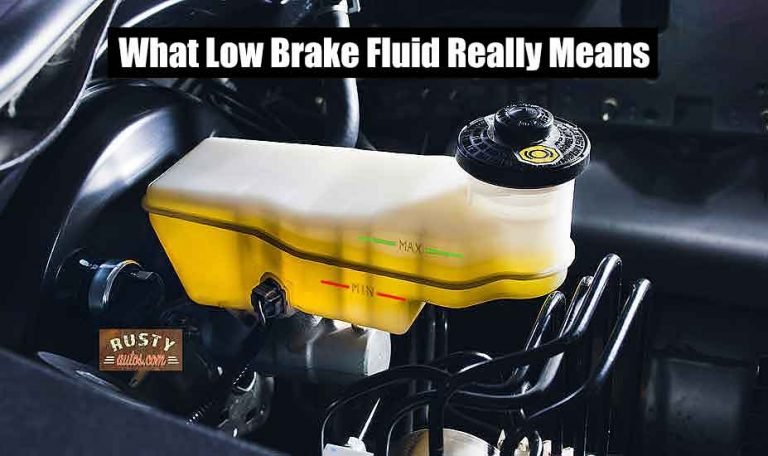
Brake fluid is usually stored in a translucent plastic reservoir mounted on or near the brake master cylinder.
On most passenger vehicles, this reservoir is located in the engine compartment near the firewall on the driver’s side, although location varies by vehicle design.
The reservoir normally has:
- A minimum mark
- A maximum mark
- A cap showing the required fluid specification
Some vehicles may also use sensors to monitor fluid level.
Do not assume a low reservoir automatically means the fluid simply needs topping up.
Brake pad wear and hydraulic leaks can both affect fluid level.
Why Does Brake Fluid Level Drop?
A small gradual change in reservoir level can occur as brake pads wear.
As pads become thinner, caliper pistons remain farther extended. More brake fluid remains in the caliper bores, which can lower the reservoir level slightly.
A significant or sudden drop, however, may indicate a hydraulic leak.
Possible leak points include:
- Brake lines
- Flexible hoses
- Calipers
- Wheel cylinders
- Master cylinder
- ABS hydraulic unit
- Connections and fittings
If brake fluid is disappearing, the cause should be diagnosed rather than repeatedly adding fluid.
What Color Is Brake Fluid?
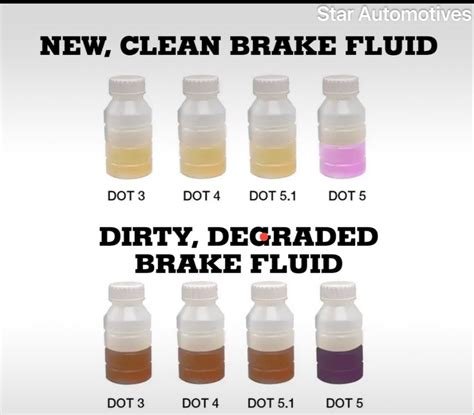
Fresh glycol-based brake fluid is typically clear to pale yellow or amber, although exact appearance varies by product.
As it ages, it may become darker.
Very dark fluid can indicate contamination or deterioration, but color alone does not provide a complete measurement of fluid condition.
Fluid may also become contaminated by:
- Moisture
- Rubber degradation
- Corrosion products
- Dirt introduced during service
Never intentionally add dyed or unknown fluid just to match an expected color.
Does Brake Fluid Wear Out?
Brake fluid does not wear out in the same mechanical way as a brake pad, but its condition can deteriorate.
Over time, glycol-based fluid may:
- Absorb moisture
- Accumulate contaminants
- Lose corrosion protection
- Experience reduced boiling performance
- Become chemically degraded
This is why some manufacturers specify brake fluid replacement intervals.
The correct interval varies by vehicle.
Some manufacturers use a time-based schedule, while others specify inspection procedures or different maintenance requirements.
Always follow the maintenance schedule for the specific vehicle.
How Often Should Brake Fluid Be Changed?
There is no single universal brake fluid replacement interval that applies to every vehicle.
The proper schedule depends on:
- Vehicle manufacturer
- Brake fluid specification
- Driving environment
- Climate
- Service history
- Brake system design
- Fluid condition
Some vehicles have scheduled replacement intervals, while others rely more heavily on inspection and service guidance.
For the most accurate recommendation, check the owner’s manual or manufacturer maintenance information.
Signs Brake Fluid May Need Attention
Brake fluid problems can produce several symptoms, although many of these can also have other causes.
Possible warning signs include:
- Soft or spongy brake pedal
- Increased pedal travel
- Brake warning light
- Fluid below the minimum mark
- Visible hydraulic leaks
- Inconsistent braking
- Poor braking after heavy use
- Dark or contaminated-looking fluid
A brake warning light or pedal problem should not automatically be blamed on old brake fluid.
The system should be inspected for mechanical and hydraulic faults.
What Happens When Brake Fluid Gets Too Low?
Low brake fluid can interfere with hydraulic braking if the level drops enough for air to enter the system.
Possible consequences include:
- Soft pedal
- Reduced hydraulic pressure
- Increased pedal travel
- Brake warning light
- Reduced braking performance
The most important issue is finding out why the fluid is low.
If the level is dropping because of a leak, simply adding more fluid does not repair the problem.
What Happens If Air Gets Into Brake Fluid?
Air in the brake lines causes trouble because air compresses easily.
When you press the pedal, some pedal movement is used to compress trapped air rather than immediately moving the brake components.
This can create a:
- Soft pedal
- Spongy pedal
- Long pedal travel
- Inconsistent pedal response
Removing trapped air typically requires bleeding the brake system according to the proper procedure.
Vehicles with sophisticated ABS systems may require manufacturer-specific procedures or diagnostic equipment in certain service situations.
What Happens If Water Gets Into Brake Fluid?
Moisture contamination can lower the brake fluid’s boiling point and increase corrosion risk.
During hard braking, contaminated fluid can become more susceptible to vapor formation.
Moisture can also contribute to corrosion in:
- Calipers
- Wheel cylinders
- Master cylinder
- Brake lines
- ABS hydraulic components
This is one reason brake fluid containers should be tightly sealed after opening.
Can Brake Fluid Freeze?
Automotive brake fluid is formulated to operate over a broad temperature range.
In normal automotive environments, appropriate brake fluid is designed to remain functional at very low temperatures.
However, contamination or the use of an incorrect fluid can affect low-temperature performance.
Always use a fluid meeting the vehicle’s specified standard rather than choosing fluid based solely on general temperature claims.
Is Brake Fluid Flammable?
Brake fluid should always be treated as a chemical automotive fluid and kept away from ignition sources.
Its exact flammability characteristics depend on the formulation.
More importantly for routine service, brake fluid should be handled carefully because it can damage painted surfaces and should not be allowed to contact skin or eyes unnecessarily.
Follow the product’s safety instructions and dispose of used fluid properly.
Does Brake Fluid Damage Car Paint?
Yes. Many common brake fluids can damage automotive paint.
If brake fluid is spilled on a painted surface, it should be addressed promptly according to appropriate cleaning recommendations without aggressively rubbing it into the finish.
When servicing the reservoir:
- Keep the surrounding area clean
- Protect painted surfaces
- Avoid overfilling
- Wipe up spills carefully
- Keep the cap and fluid container clean
Brake fluid contamination can also occur if dirt falls into an open reservoir.
Can You Use Any Brake Fluid in Any Car?
No.
You should use the brake fluid specification required by the vehicle manufacturer.
Using the wrong fluid can affect:
- Seal compatibility
- Boiling performance
- ABS operation
- Corrosion protection
- Pedal feel
- Long-term hydraulic reliability
The correct specification is often printed on the reservoir cap or listed in the owner’s manual.
Do not choose brake fluid solely because it has a higher DOT number.
A higher number does not automatically make a fluid suitable for a specific braking system.
What Happens If the Wrong Brake Fluid Is Used?
The consequences depend on what type of fluid was added and what system it entered.
Potential problems include:
- Seal damage
- Fluid incompatibility
- Reduced braking performance
- Corrosion
- Hydraulic component failure
- ABS system damage
Contamination with substances such as engine oil, power steering fluid, or petroleum-based products can be particularly serious because many brake-system seals are not designed for those fluids.
If the wrong fluid has been added, avoid driving the vehicle until the proper corrective procedure has been determined.
Brake Fluid and ABS
Modern anti-lock braking systems rely heavily on precise hydraulic control.
An ABS hydraulic control unit may contain:
- Solenoid valves
- Pumps
- Accumulators
- Small fluid passages
During ABS operation, the system rapidly adjusts hydraulic pressure to help prevent wheel lock.
Contaminated fluid, incorrect fluid, or internal corrosion can therefore affect expensive and sensitive hydraulic components.
This is another reason proper brake fluid maintenance matters even when the pedal still feels normal.
Brake Fluid and Electronic Stability Control
Electronic stability control and traction systems may also use the hydraulic braking system to apply braking force to individual wheels.
The system may work together with:
- Wheel-speed sensors
- Steering-angle sensors
- Yaw sensors
- ABS valves
- Hydraulic pumps
Brake fluid therefore supports more than ordinary pedal-operated braking in many modern vehicles.
It plays a role in several electronic safety systems that depend on controlled brake pressure.
Brake Fluid vs. Power Steering Fluid
Brake fluid and power steering fluid are not interchangeable.
They are designed for completely different hydraulic systems and may use very different chemical formulations.
Putting power steering fluid into a brake system can damage seals and lead to severe hydraulic problems.
Likewise, brake fluid should not be added to a power steering reservoir unless the vehicle specifically uses an unusual system calling for that exact fluid.
Always identify the reservoir and fluid specification before adding anything.
Brake Fluid vs. Transmission Fluid
Brake fluid and automatic transmission fluid are also completely different.
Transmission fluid is formulated for transmission lubrication, hydraulic operation, cooling, and friction control.
Brake fluid is formulated specifically for automotive hydraulic braking.
Never substitute one for the other.
Brake Fluid vs. Engine Oil
Engine oil lubricates, cools, cleans, and protects internal engine components.
Brake fluid transfers hydraulic pressure through the braking system.
Their properties and additive packages are entirely different.
Engine oil contamination in a brake system can damage rubber seals and potentially require extensive hydraulic repairs.
Can You Top Up Brake Fluid Yourself?
Checking and topping up brake fluid may be simple on many vehicles, but it should not be treated as routine topping-up in the same way as windshield washer fluid.
Before adding fluid:
- Confirm the correct fluid specification.
- Check why the level is low.
- Inspect for obvious leakage.
- Avoid introducing dirt into the reservoir.
- Do not overfill.
- Avoid spilling fluid on painted surfaces.
If the fluid level has dropped significantly, a brake inspection is more important than simply adding fluid.
How to Check Brake Fluid Safely
Most modern reservoirs are translucent, allowing the level to be checked from outside.
Park on Level Ground
A level surface provides a more reliable fluid-level reading.
Turn the vehicle off and follow any manufacturer-specific instructions.
Locate the Reservoir
Find the brake master cylinder reservoir.
Do not confuse it with coolant, power steering, clutch, or washer-fluid reservoirs.
Check MIN and MAX Marks
The fluid should normally remain within the specified range.
Do not assume the reservoir must always be filled exactly to the maximum line.
Inspect the Area for Leaks
If the fluid is low, look around the master cylinder and visible brake components for signs of leakage.
A full brake inspection may be necessary.
Use Only Fresh, Correct Fluid
If adding fluid is appropriate, use a clean, recently opened container of the specified fluid.
Do not pour old, contaminated, or unknown brake fluid into the system.
Why You Should Keep Brake Fluid Containers Sealed
Because glycol-based brake fluid absorbs moisture, an opened container can gradually take in water from the atmosphere.
Even fluid that has never been poured into a vehicle can deteriorate after prolonged exposure to humid air.
Keep containers:
- Tightly sealed
- Clean
- Clearly labeled
- Away from contamination
- Stored according to manufacturer instructions
Avoid using fluid if its history or contamination status is uncertain.
Common Brake Fluid Mistakes
Using the Wrong DOT Specification
Do not assume that a higher number automatically means a better choice.
Use the specification required for the vehicle.
Mixing DOT 5 With Glycol-Based Fluid
DOT 5 silicone fluid is chemically different from DOT 3, DOT 4, and DOT 5.1 glycol-based fluids.
Mixing incompatible fluids can create serious problems.
Filling a Low Reservoir Without Looking for a Leak
A low reservoir may signal worn pads or a leak.
Repeated topping up can hide a developing hydraulic problem.
Leaving the Reservoir Open
Leaving the reservoir open allows dirt and moisture to enter.
Keep exposure as brief as practical.
Reusing Drained Brake Fluid
Used fluid can contain moisture and contaminants.
Brake fluid removed during bleeding or flushing should not normally be poured back into the system.
Getting Brake Fluid on Paint
Brake fluid can damage painted surfaces.
Protect bodywork during service and clean spills promptly using an appropriate method.
Why Brake Fluid Maintenance Matters
Brake fluid is easy to overlook because it normally operates silently inside a closed system.
Unlike worn brake pads, there may be no obvious sound when brake fluid gradually absorbs moisture or loses some of its protective properties.
Yet fluid condition can affect:
- Brake pedal consistency
- Hydraulic component life
- Boiling resistance
- Internal corrosion
- ABS operation
- Overall braking reliability
Following the manufacturer’s service recommendations helps maintain the hydraulic system as a whole rather than focusing only on pads and rotors.
FAQs About Brake Fluid
What is brake fluid used for?
Brake fluid is used to transfer hydraulic pressure from the brake pedal and master cylinder to the brakes at the wheels. That pressure operates brake calipers or wheel cylinders so the vehicle can slow or stop.
What does brake fluid do when you press the brake pedal?
Brake fluid carries hydraulic pressure through the brake lines to the wheel brakes. The pressure moves caliper pistons or wheel cylinders, forcing friction material against the rotor or drum.
How does brake fluid work in a car?
Brake fluid works by transmitting hydraulic pressure through a sealed braking system. Because the liquid does not compress significantly under normal operation, pedal force can be transferred efficiently to the brakes.
What is brake fluid made of?
Brake fluid is commonly made from glycol ethers, borate esters, silicone, or specialized hydraulic base fluids depending on its specification. It also contains additives for lubrication, corrosion protection, and chemical stability.
Is brake fluid the same as hydraulic fluid?
Brake fluid is a type of hydraulic fluid, but not all hydraulic fluids are suitable for brakes. Automotive brake fluid must meet specific requirements for temperature resistance, seal compatibility, lubrication, and braking-system performance.
Can I mix DOT 3 and DOT 4 brake fluid?
Some DOT 3 and DOT 4 glycol-based fluids are chemically compatible, but you should still follow the vehicle manufacturer’s specified fluid requirement. Mixing can change the final fluid’s performance characteristics.
Is DOT 5.1 the same as DOT 5 brake fluid?
No. DOT 5.1 is generally glycol based, while DOT 5 is silicone based. Their similar names can be misleading, so the exact specification should always be confirmed before adding fluid.
Why does brake fluid get dark?
Brake fluid can become darker as it ages and accumulates moisture, corrosion products, and other contaminants. Color can provide a useful clue, but it is not the only way to judge fluid condition.
What happens if a car runs out of brake fluid?
If brake fluid becomes critically low, air may enter the hydraulic system and braking performance can be severely reduced. Low fluid also commonly indicates a leak that needs immediate diagnosis.
Does brake fluid need to be changed?
Brake fluid may need periodic replacement because glycol-based fluids absorb moisture and can deteriorate over time. The correct replacement interval depends on the vehicle manufacturer’s maintenance schedule and the condition of the fluid.
Conclusion
Understanding what is brake fluid makes the entire braking system much easier to understand. Brake fluid is the hydraulic medium that carries pressure from the master cylinder through the brake lines and ultimately allows the calipers or wheel cylinders to apply the brakes.
If you have wondered what does brake fluid do, its central job is force transmission, but it also helps lubricate hydraulic components, protect the system from corrosion, and withstand the significant temperatures generated during braking.
Understanding how does brake fluid work also explains why air, moisture, contamination, or fluid loss can create serious braking problems. A liquid-filled hydraulic system transfers pressure effectively, while air or vapor can compress and reduce brake response.
Finally, what is brake fluid made of depends on its specification. Most passenger vehicles use glycol-based fluids such as DOT 3, DOT 4, or DOT 5.1, while DOT 5 is silicone based and some specialized systems use other hydraulic formulations.
Use only the specification required for your vehicle, keep the fluid clean, investigate unexplained fluid loss, and follow the manufacturer’s maintenance recommendations. Brake fluid may remain out of sight most of the time, but it is one of the most important fluids in the entire vehicle.