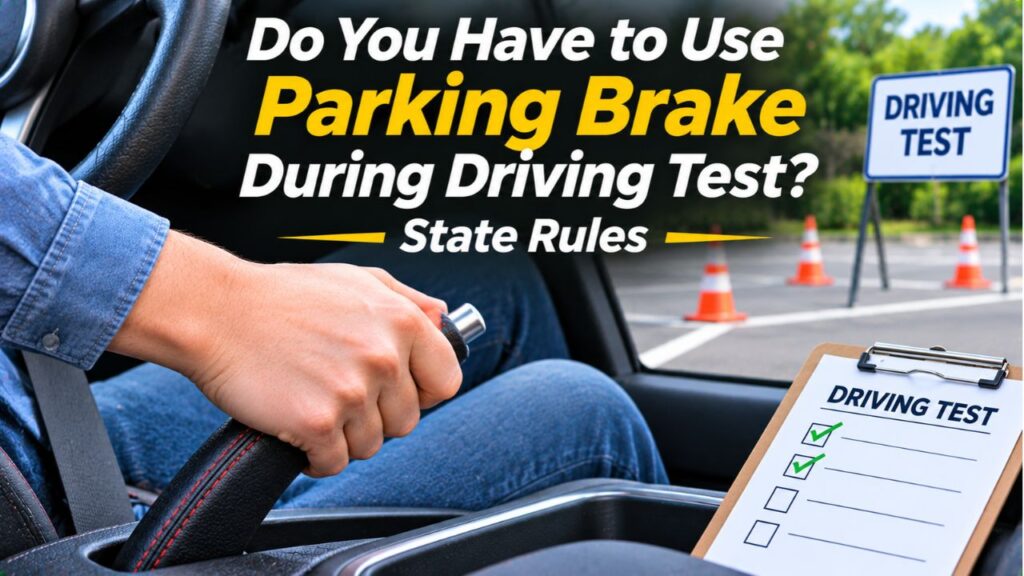
Do You Have to Use Parking Brake During Driving Test? State Rules
You may have to demonstrate or use the parking brake during a driving test, but the exact requirement depends on your state’s testing rules and the maneuver you are performing. Many examiners check that you know how to set and release it before the road portion. When you fully park the car, using the parking brake is generally the safe habit, especially on a hill.
You do not normally engage the parking brake at every red light, stop sign, or brief pause during the test. Those stops are handled with the regular brake pedal. Confusing the two can lead to unnecessary movements, an incomplete release, or a car that feels held back as you drive away.
The rules also differ for traditional hand levers, foot-operated parking brakes, and electronic switches. A working parking brake may be a requirement for the test vehicle even when the examiner never asks you to use it while driving. This guide explains state examples, the moments when the control matters, how to operate it confidently, and what to do if you forget a step.
Do You Have to Use Parking Brake During Driving Test in Every State?
No single parking-brake rule covers every U.S. driving test. States set their own road-test procedures, vehicle eligibility rules, and scoring criteria. An examiner might ask you to demonstrate the control during a pre-drive inspection, assess how you secure the vehicle after a parking maneuver, or simply require a functioning parking brake in the test car.
The key distinction is between three expectations: knowing the control, having equipment that works, and applying it during an actual parking task. Passing one does not automatically satisfy the others. A parking brake can work perfectly while a learner does not know where the release is. Conversely, a learner might operate the switch correctly but arrive in a car whose parking brake cannot hold.
Check the official road-test information for your state and license class before testing. The guidance in another state’s driving handbook can help you practice, but it cannot tell you exactly what your examiner will score.
When Examiners May Expect the Parking Brake to Be Used
Before Driving: Vehicle Controls and Safety Inspection
A common test-day task is locating the parking brake and demonstrating how it engages and releases. In California, the California DMV’s pre-drive safety checklist explicitly requires applicants to demonstrate both actions. It also states that a test will be rescheduled if the parking brake fails to work or set during the check.
That check is about safe control of the test vehicle, not about using the parking brake to slow down during the road test. Before the appointment, practice finding the lever, pedal, or switch without searching around the cabin. Learn what light or message confirms that it is engaged and how to release it while holding the regular brake pedal.
During Parallel Parking and Curbside Parking
Parallel parking usually involves stopping, selecting a suitable gear, checking position, and following the examiner’s directions. Whether you must set the parking brake at the end of that particular maneuver depends on the test rules and whether the examiner is asking you to park and secure the vehicle or briefly stop before continuing.
Do not apply it halfway through a reversing maneuver. Finish positioning the car, hold the regular brake pedal, and follow the test instructions. If you are told to secure or leave the vehicle parked, set the parking brake. If the examiner promptly directs you to move again, make sure the brake is fully released before pulling out.
When Parking on a Hill
Hill parking is where using a parking brake becomes especially important. Once the vehicle has stopped, keep the service brake pressed, apply the parking brake, and select Park or the proper manual-transmission gear according to the vehicle instructions. Turn the front wheels toward or away from the curb as the relevant state rules require.
A hill-parking evaluation may assess curb positioning, wheel direction, and whether the vehicle is secured. Do not allow the car to roll to prove that the parking brake works. Keep control of the vehicle throughout the maneuver.
At the End of the Driving Test
When you return to the test center and are directed to park, stop completely and secure the car. On an automatic, that generally means keeping your foot on the regular brake, engaging the parking brake, selecting Park in the sequence recommended by the manufacturer, and shutting down when instructed. A manual vehicle requires the appropriate gear as well.
Wait for the examiner’s directions before leaving the seat. The goal is a stable, properly parked vehicle, not an extra dramatic demonstration of the brake lever.
During Stop Signs and Traffic Lights
A complete stop at a stop sign or red light is not ordinarily the same as parking. Use the service brake pedal to hold the car while you assess traffic and wait for permission to proceed. Operating a mechanical handbrake at every ordinary intersection is unnecessary and can distract from observations and safe vehicle control.
If your car has Auto Hold, remember that this feature is not identical to the parking brake. Review whether your state’s test rules permit its use rather than assuming electronic assistance is allowed.
How Parking Brake Testing Rules Differ by State
California: Demonstrating Set and Release Is Required
California’s pre-drive inspection expressly includes the emergency or parking brake. You must know how to set it and release it. A malfunction can prevent the road test from proceeding, even if the main foot brakes appear normal.
This does not mean an applicant must pull the handbrake at each traffic stop. Be prepared for the pre-drive demonstration and for correctly securing the vehicle during parking tasks. Instructors sometimes teach a consistent end-of-test routine to reduce forgetfulness, but always follow the examiner’s actual instructions.
Pennsylvania: Examiners May Test the Control
The Pennsylvania driver’s manual section on road testing says an examiner may ask the applicant to operate vehicle controls, including the parking or emergency brake, before the road test. It warns that failing to operate a requested control properly results in failing the road test.
Pennsylvania also teaches drivers to set the parking brake when securing a parked car. Treat the control as something you must know how to operate reliably, not as an optional accessory you can ignore because your car has an automatic transmission.
Massachusetts: The Examiner Must Be Able to Access It
Massachusetts has a distinctive test-vehicle rule. The Massachusetts RMV’s passenger road-test requirements state that the examiner must have unobstructed access to the parking brake and that the vehicle must allow the examiner to make an emergency stop with it. A vehicle that does not meet those requirements cannot be used for the test.
This is a vehicle-eligibility rule, not a requirement that you use the parking brake repeatedly while moving. It also shows why a suitable car in one state may not qualify for an examination in another. If your vehicle has a foot-operated brake or an unusual electronic switch location, check eligibility before booking or arriving.
How to Use the Parking Brake Correctly on Test Day
Even if the test is not specifically about parking-brake operation, a smooth routine helps you avoid driving with the brake partly engaged.
Step 01: Locate the Control Before the Examiner Arrives
Find the hand lever, small foot pedal, or electronic parking-brake switch while the car is stationary. Look for the parking-brake symbol, commonly a circled P, and identify its corresponding instrument-panel indicator. Read the owner’s manual if you are uncertain about the exact motion.
Practice the release as well as the application. A foot-operated mechanism may release with a second press or a separate handle; an electronic switch may require the regular brake pedal to be depressed. Do not learn these differences for the first time during the test.
Step 02: Keep the Car Secured Before Demonstrating
Before operating the parking brake, hold the service-brake pedal and ensure the transmission is in the correct stationary position. If the examiner asks you to demonstrate the brake during the pre-drive check, follow the requested order and keep the vehicle from moving.
Do not start rolling to show that the parking brake works. An ordinary parking-brake demonstration should be completed with the vehicle stationary, using the method described by its manufacturer.
Step 03: Apply the Parking Brake When Told to Secure the Car
After completing a parking maneuver, keep your foot on the regular brake and engage the parking brake fully. Pull a mechanical lever as directed, operate the parking pedal to its normal engaged position, or use the EPB switch according to the vehicle’s instructions.
Check for the expected warning or status light. On an incline, also choose the correct transmission position and wheel direction. The aim is to prevent rolling when you release the foot brake, not to make the parking-brake control move as far as possible.
Step 04: Release It Fully Before Driving Away
Press the normal brake pedal before releasing the parking brake, when required by the vehicle. Lower the hand lever completely, operate the foot-pedal release correctly, or press the electronic switch in its specified direction. Verify that the parking-brake status has cleared.
If a warning remains, the car resists moving, or an EPB fault appears, stop and tell the examiner. Never accelerate against a parking brake that may still be engaged.
Step 05: Use the Regular Brake for Normal Traffic Stops
During ordinary driving, use the brake pedal to slow and stop smoothly. Keep your attention on traffic signals, pedestrians, mirrors, blind spots, and the examiner’s directions. The parking brake is a holding device for a parked car, not a substitute for the regular brakes at intersections.
If you need to stop and park for an extended period, follow the examiner’s direction and use the proper parking procedure. There is no benefit in repeatedly applying and releasing the parking brake for short pauses.
Step 06: Finish the Test With a Secure Parking Routine
At the final parking spot, stop completely, maintain the foot brake, engage the parking brake, and place the transmission in its correct parked condition. Follow the manufacturer’s recommended order and the examiner’s instructions. Confirm the car is stationary before switching off or opening the door.
If the examiner asks you to leave the engine running or wait in the seat, do so without relaxing control of the vehicle. A safe, calm finish is better than rushing through a routine because the route is over.
Can You Fail a Driving Test for Forgetting the Parking Brake?
Possibly, but the consequence depends on what was required and how the examiner scores it. Failing to demonstrate a required control, arriving with a nonworking parking brake, and forgetting to secure a car during a parking task are not identical mistakes.
In some states a defective parking brake prevents the exam from starting. Elsewhere, an incorrect control demonstration may count as a test failure. Forgetting to set the brake at the end could be a scored error when the test criteria require the car to be secured, but one missed action is not automatically a nationwide instant failure.
If you realize the brake is still engaged before moving, keep your foot on the service brake and release it correctly. Do not hide a malfunction, argue with the examiner while the car is in motion, or perform an unsafe maneuver to compensate for a mistake.
Check the Parking Brake Before Your Driving Test
A few days before the appointment, verify that the parking brake applies and releases according to the owner’s manual. Check that the lever, pedal, or switch responds normally and the warning indicator changes as expected. If the vehicle rolls when it should be held or feels dragged after release, arrange repair before the test.
Also make sure the car meets your state’s registration, insurance, lighting, tire, seat-belt, and other vehicle requirements. A working parking brake alone does not make a car eligible. Practice the complete parking sequence on level ground and, where safe and permitted, with an instructor on a suitable slope.
Do not use the test itself to investigate a faulty parking brake. Rescheduling with a safe car is preferable to arriving with uncertain braking equipment.
FAQs About Do You Have to Use Parking Brake During Driving Test
Do I Have to Set the Parking Brake During Parallel Parking?
Not under one universal U.S. rule. It depends on the examiner’s instructions and the state’s scoring criteria. If you are told to fully park and secure the car, apply it; if you are merely pausing before another maneuver, follow the directions.
Do I Use the Parking Brake at Every Stop Sign?
No. Use the regular brake pedal for normal stops at signs and traffic lights. The parking brake is meant primarily to secure a stationary, parked vehicle.
Is a Parking Brake Checked Before the Road Test?
It can be. California expressly requires a set-and-release demonstration, and other states have their own control checks or vehicle equipment requirements. Review the official test checklist for your state.
Can I Take a Driving Test With an Electronic Parking Brake?
Often, yes, if the car meets your state’s rules and you can operate the system correctly. Some jurisdictions have special accessibility requirements, so check eligibility for the exact vehicle before arriving.
Will I Fail if I Forget to Release the Parking Brake?
It may be scored as an error and can create a safety concern. The outcome depends on the circumstances and testing rules. Always check the brake indicator before moving and stop if the vehicle feels held back.
Should I Set the Parking Brake at the End of the Test?
Yes, when you are directed to finish and secure the parked vehicle, unless the examiner gives an instruction that requires a different safe procedure. Hold the foot brake and follow the owner’s manual for the proper parking sequence.
Use the Parking Brake at the Right Moments During Your Road Test
If you’re asking do you have to use parking brake during driving test, the most accurate answer is that you may need to demonstrate it and should apply it when fully securing the vehicle, but requirements vary by state. You do not ordinarily use it at every traffic stop.
Before test day, confirm your state’s rules and make sure the parking brake works. Know how to set and release your particular control, use the service brake for regular stops, and follow the examiner’s directions during parking maneuvers. That routine protects the vehicle and helps you show confident, safe control.